REVIEW 1 major objections 8 minor 80 references
The missing high-energy form of propenethial is scarce because formation itself strongly prefers the low-energy isomer and tunneling erases the rest within a few thousand years.
Reviewed by Pith at T0; open to challenge. T0 means a machine referee read the full paper against a public rubric. the ladder, T0–T4 →
T0 review · grok-4.5
2026-07-31 08:53 UTC pith:2Y64YHCP
load-bearing objection Solid lab + non-detection paper with a useful steric explanation for isomer selectivity; the “even lower” theoretical limit is over-sold but the core claim holds. the 1 major comments →
Laboratory spectroscopy, theoretical characterization, and astronomical search for syn-propenethial (CH2CHCHS)
The pith
A machine-rendered reading of the paper's core claim, the machinery that carries it, and where it could break.
Core claim
Syn-propenethial is not detected in TMC-1 because its dominant gas-phase formation channel is strongly isomer-selective (~94 % anti at cloud temperatures) and because quantum tunneling converts any leftover syn molecules into the anti form on astronomically short timescales of order 10^3 years.
What carries the argument
The reduced potential-energy surface of CH2CHCH2 + S, in which two H-elimination transition states from a gauche adduct differ by ~6 kcal mol^-1 because of steric repulsion; master-equation branching ratios and SCT-CVT tunneling lifetimes are derived from that surface.
Load-bearing premise
The barrierless allyl-plus-sulphur reaction is assumed to dominate formation of propenethial in TMC-1, so that its computed anti-to-syn branching ratio can be scaled directly against the observed anti column density.
What would settle it
A secure detection of syn-propenethial (or a much tighter upper limit) in a source whose chemistry is known to be grain-surface dominated, or laboratory measurement of a competing formation route that yields a substantially higher syn fraction.
If this is right
- Syn-propenethial is expected to remain below current detection thresholds in both cold dark clouds and warmer cores.
- Observed aldehyde/thione abundance ratios need not be corrected upward for an undetected high-energy conformer of propenethial.
- Steric control at the transition state of radical–atom additions can systematically suppress high-energy conformers of other sulphur-bearing organics.
- Tunneling-mediated conformational equilibration on ~10^3 yr timescales must be included when predicting isomer ratios of molecules with comparable barriers.
Where Pith is reading between the lines
- If steric discrimination at H-elimination steps is common, many other undetected high-energy conformers of S- and O-bearing organics may share the same dual suppression (selective formation + tunneling erasure).
- The same LED analysis used here could be applied a priori to rank which conformational isomers of newly detected COMs are worth deep astronomical searches.
- A full gas-grain network that folds in the computed branching ratio and tunneling rates would give a quantitative prediction for the anti column density itself, testable against the already-measured value.
Editorial analysis
A structured set of objections, weighed in public.
Referee Report
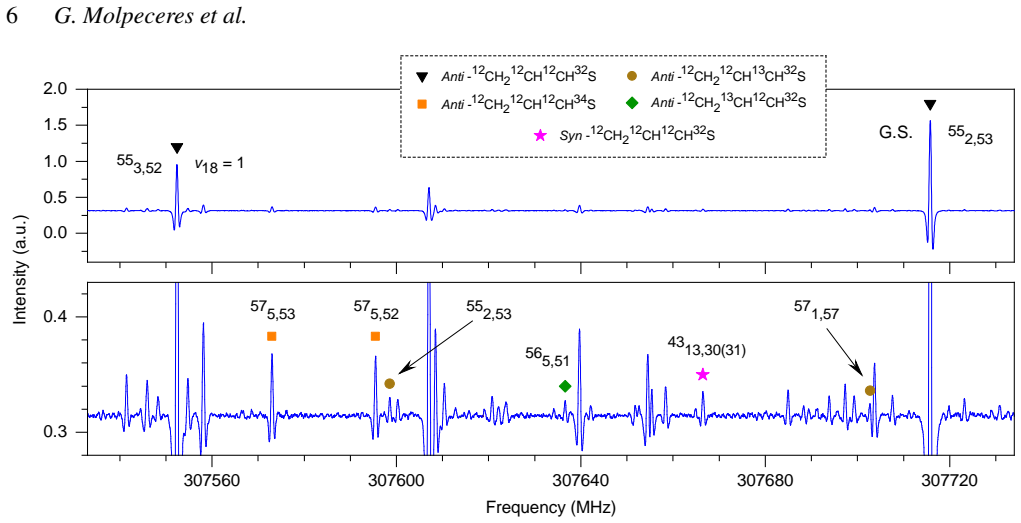
Summary. The manuscript reports the laboratory rotational characterization of syn-propenethial, syn-CH2CHCHS, using FTMW spectroscopy of discharge products and previously recorded millimeter-wave spectra. A global fit to 164 lines gives precise rotational and centrifugal-distortion constants, with the assignment supported by observation of the 34S isotopologue. The authors search the QUIJOTE TMC-1 survey and obtain a 3σ LTE upper limit N(syn-CH2CHCHS) < 1.5×10^10 cm−2, corresponding to syn/anti < 0.34. To interpret the non-detection, they calculate the CH2CHCH2 + S potential-energy surface, RRKM/master-equation branching ratios, and SCT-CVTST unimolecular isomerization rates. They find approximately 94% anti formation at 40 K and syn→anti tunneling on a nominal 10^3–10^4 yr timescale, and use the former to infer a conditional syn column density of 2.8×10^9 cm−2.
Significance. The principal result is a useful and technically strong laboratory catalog for a previously uncharacterized high-energy isomer, immediately enabling astronomical searches. Particular strengths are the complementary FTMW and millimeter-wave datasets, independent confirmation through 34S, a well-constrained global fit, explicit LTE assumptions and a rotational-temperature sensitivity check, and deposition of supporting data in a public repository. The observational upper limit and syn/anti ratio are model-independent of the subsequent chemical interpretation. The branching-ratio and tunneling calculations are first-principles rather than fitted to the non-detection and provide falsifiable chemical predictions. The inferred 2.8×10^9 cm−2 value is less secure because it assumes dominance of one formation channel, but this does not weaken the laboratory result or the observational upper limit.
major comments (1)
- [§3.3, §4, and Abstract] The value 2.8×10^9 cm−2 is repeatedly called a theoretical “upper bound” or “even lower upper limit.” It is obtained by dividing the observed anti column by the branching ratio of only the CH2CHCH2 + S reaction. That is a conditional prediction for that channel, not an upper limit on total syn-CH2CHCHS, especially because §3.3 states that exploratory grain-surface routes lack conformer selectivity and Appendix B's precursor model underpredicts the calibration radical CH2CCH by about two orders of magnitude. The core non-detection is unaffected: the observed syn/anti < 0.34 already limits nonselective channels. Nevertheless, the abstract, §3.3, §4, and conclusions should relabel 2.8×10^9 cm−2 as a channel-specific/conditional estimate, or provide a quantitative demonstration that alternative routes are minor.
minor comments (8)
- [§3.4 and Figure 7] The nominal syn→anti lifetime is exponentially sensitive to the barrier height, barrier width, and interpolated minimum-energy path. Since the text anticipates electronic-structure errors approaching 1 kcal mol−1, please provide a small sensitivity range for k_uni and τ, or state explicitly that the 10^3 yr value is an order-of-magnitude estimate rather than a chemically accurate lifetime.
- [§2.3.2 and §3.3] The MESS calculations should state the pressure or zero-pressure limit, bath-gas/collisional treatment, and whether stabilization of I1 is included. The claim that the assumed C6 coefficient cancels exactly in the syn/anti branching ratio is clearest under common-entrance, nonselective-stabilization conditions; those conditions should be made explicit.
- [§3.1 and Table 1] The text says that seven 34S lines were observed, whereas Table 1 lists N_e = 9 for the FTMW-34S fit. Please reconcile these counts or explain whether two measured frequencies were excluded or otherwise treated specially.
- [§2.3.2, §3.3, and §4] Several chemical formulae appear to be typographical errors: “formation of CH3CHCHS” in §2.3.2, “CH2CHSH + H” for the C3H5 + S product in §2.3.2/§3.3, and “CH2CHCSH” twice in §4. These should be checked systematically because they obscure atom balance and the identity of the product.
- [§3.1] The derivation of the stated 1110–1200 K formation temperature from the measured FTMW anti:syn ≈ 4.5:1 ratio is not explained. A simple Boltzmann estimate using the 1207 K energy separation would not obviously give that range, so please state the partition-function/degeneracy treatment or clarify that the temperature comes from an independent discharge diagnostic.
- [§3.3 and §4] The observational and conditional theoretical columns differ by 1.5×10^10 / 2.8×10^9 ≈ 5.4, or 0.73 dex. Calling this “nearly one order of magnitude” is somewhat inflated; “about a factor of five” would be more accurate. The anti-column uncertainty should also be propagated into the conditional syn estimate.
- [Figure 5] TS4 is shown but not explicitly identified in the surrounding discussion, presumably as H elimination from I2. Please label the reaction coordinate/energy units and describe TS4 in the text so that the 50 kcal mol−1 I2 elimination barrier is unambiguous.
- [General] There are several small wording and typographical issues, including “unaivailability” in §1, inconsistent hyphenation of anti/syn, and the use of “propenyl radical” for CH2CHCH2, which is more commonly called the allyl radical. A final copy-edit would improve readability.
Circularity Check
No significant circularity: observational upper limit, ab initio branching ratios, and tunneling lifetimes are independent inputs, not forced by construction.
full rationale
The paper’s load-bearing chain does not reduce any claimed prediction to its own inputs. (1) The 3σ column-density upper limit (1.5×10^10 cm^-2) is obtained directly from non-detection of predicted Q-band lines in QUIJOTE data under fixed LTE parameters; it does not depend on the formation or tunneling calculations. (2) The ~15.8 anti:syn branching ratio and the 2.8×10^9 cm^-2 ‘theoretical’ bound are computed from a new SCS-MP2/CCSD(T)-F12 PES plus RRKM/master-equation kinetics for CH2CHCH2+S, then multiplied by the independently measured anti column density from Cabezas et al. (2025); the ratio is not fitted to the non-detection. (3) Syn→anti lifetimes (~10^3 yr at 10 K) come from new SCT-CVTST rate constants on the same electronic-structure level; methodology citations (García de la Concepción et al. 2022; prior Molpeceres works) supply the algorithm, not the numerical result. Self-citations identify the candidate formation route and supply the anti abundance, but do not define or force the branching fractions or tunneling rates. The dominance assumption for the single gas-phase channel is a scientific vulnerability, not a circular reduction. No self-definitional loop, fitted-as-prediction step, uniqueness import, or renamed empirical pattern is present.
Axiom & Free-Parameter Ledger
free parameters (2)
- C6 capture coefficient =
100 a.u. (estimated)
- Trot and source size for LTE upper limit =
9 K, 80"
axioms (4)
- domain assumption CCSD(T)-F12/cc-pVTZ-F12//SCS-MP2/aug-cc-pVTZ energies are accurate to ≲1 kcal mol^-1 for the stationary points of interest.
- domain assumption The barrierless CH2CHCH2 + S reaction is the dominant formation route under TMC-1 conditions; grain-surface and ion-molecule channels are secondary.
- domain assumption Unimolecular tunneling is the only process that interconverts the two conformers on astronomical timescales; bimolecular destruction rates are isomer-independent.
- domain assumption LTE at a single rotational temperature adequately describes the excitation of both isomers in TMC-1.
read the original abstract
We report the laboratory characterization of the higher-energy isomer of propenethial, syn-CH2CHCHS. While the lower-energy isomer, anti-CH2CHCHS, was detected in the interstellar medium during the QUIJOTE line survey of TMC-1, we report the non-detection of the syn isomer in the same source, deriving an upper limit to its column density of 1.5 $\times$ 10$^{10}$ cm$^{-2}$. A subsequent theoretical investigation into the origin of this non-detection reveals that the most plausible formation pathway for CH2CHCHS is highly isomer-specific, producing nearly 95\% of the anti isomer. This predicted branching ratio allows us to infer an even lower effective upper limit for the abundance of the syn isomer. In addition, calculations of tunneling-mediated unimolecular isomerization in the gas phase show that syn-CH2CHCHS converts to the lower-energy anti isomer on timescales of the order of 10$^{3}$ years. Overall, we conclude that the detection of syn-CH2CHCHS is highly challenging in both cold and warm interstellar environments. These results underscore the importance of electronic-structure and kinetic effects in determining isomer abundances across diverse interstellar environments.
Figures




Reference graph
Works this paper leans on
-
[1]
ApJ , fjournal=
Fournier, Paul , title=. ApJ , fjournal=
-
[2]
The Astrophysical Journal Supplement Series , author =
a. The Astrophysical Journal Supplement Series , author =. 2012 , note =. doi:10.1088/0067-0049/199/1/21 , number =
-
[3]
The 2024 KIDA network for interstellar chemistry. , keywords =. doi:10.1051/0004-6361/202450606 , archivePrefix =. 2407.15958 , primaryClass =
Pith/arXiv arXiv 2024
-
[4]
Monthly Notices of the Royal Astronomical Society , author =
Gas and grain chemical composition in cold cores as predicted by the. Monthly Notices of the Royal Astronomical Society , author =. 2016 , note =. doi:10.1093/mnras/stw887 , abstract =
-
[5]
P. Kania and L. St r \' tesk\' a and M. S ime c kov\' a and S . Urban. Pressure shifts of acetonitrile ground state parameters. J. Mol. Struct. 2006. doi:https://doi.org/10.1016/j.molstruc.2006.02.025
-
[6]
The Journal of Physical Chemistry A , author =
Ab. The Journal of Physical Chemistry A , author =. 2025 , pages =. doi:10.1021/acs.jpca.4c05478 , language =
-
[7]
The Journal of Chemical Physics , volume =
Cabezas, Carlos and Guillemin, Jean-Claude and Endo, Yasuki , title =. The Journal of Chemical Physics , volume =. 2016 , month =. doi:10.1063/1.4967250 , url =
-
[8]
The Journal of Chemical Physics , volume =
Cabezas, Carlos and Guillemin, Jean-Claude and Endo, Yasuki , title =. The Journal of Chemical Physics , volume =. 2016 , month =. doi:10.1063/1.4972017 , url =
-
[9]
and Werner, Hans-Joachim , title =
Knizia, Gerald and Adler, Thomas B. and Werner, Hans-Joachim , title =. The Journal of Chemical Physics , volume =. 2009 , month =. doi:10.1063/1.3054300 , url =
-
[10]
High-energy interstellar isomers: cis-N-methylformamide in the G+0.693-0.027 molecular cloud. , keywords =. doi:10.1051/0004-6361/202556709 , archivePrefix =. 2509.12097 , primaryClass =
-
[11]
Starburst Energy Feedback Seen through HCO ^ + /HOC ^ + Emission in NGC 253 from ALCHEMI. , keywords =. doi:10.3847/1538-4357/ac26b8 , archivePrefix =. 2109.06476 , primaryClass =
-
[12]
Monthly Notices of the Royal Astronomical Society , author =
The interstellar chemistry of. Monthly Notices of the Royal Astronomical Society , author =. 2017 , pages =. doi:10.1093/mnras/stx1265 , language =
-
[13]
EAS Publications Series , year = 2012, editor =
Laboratory astrophysics and astrochemistry in the Herschel/ALMA era. EAS Publications Series , year = 2012, editor =. doi:10.1051/eas/1258040 , adsurl =
arXiv 2012
-
[14]
Astronomy & Astrophysics , author =. 2020 , pages =. doi:10.1051/0004-6361/201936516 , abstract =
-
[15]
O-bearing complex organic molecules at the cyanopolyyne peak of TMC-1: Detection of C _ 2 H _ 3 CHO, C _ 2 H _ 3 OH, HCOOCH _ 3 , and CH _ 3 OCH _ 3. , keywords =. doi:10.1051/0004-6361/202140978 , archivePrefix =. 2104.11506 , primaryClass =
-
[16]
EPJ Web of Conferences , author =
The. EPJ Web of Conferences , author =. 2022 , pages =. doi:10.1051/epjconf/202226500041 , abstract =
arXiv 2022
-
[17]
Journal of Computational Chemistry , author =
Spectroscopic. Journal of Computational Chemistry , author =. 2026 , pages =. doi:10.1002/jcc.70343 , abstract =
-
[18]
ACS Earth and Space Chemistry , author =
Interstellar. ACS Earth and Space Chemistry , author =. 2026 , pages =. doi:10.1021/acsearthspacechem.6c00001 , language =
-
[19]
Astronomy & Astrophysics , author =
Discovery of two cyano derivatives of acenaphthylene (. Astronomy & Astrophysics , author =. 2024 , pages =. doi:10.1051/0004-6361/202452196 , abstract =
-
[20]
The Astrophysical Journal Letters , author =
On the. The Astrophysical Journal Letters , author =. 2025 , pages =. doi:10.3847/2041-8213/adafa7 , abstract =
-
[21]
Astronomy & Astrophysics , keywords =
TMC-1, the starless core sulfur factory: Discovery of NCS, HCCS, H _ 2 CCS, H _ 2 CCCS, and C _ 4 S and detection of C _ 5 S. Astronomy & Astrophysics , keywords =. doi:10.1051/0004-6361/202140642 , archivePrefix =. 2103.12431 , primaryClass =
-
[22]
ACS Earth and Space Chemistry , author =
Isomer-. ACS Earth and Space Chemistry , author =. 2025 , pages =. doi:10.1021/acsearthspacechem.5c00274 , language =
-
[23]
More sulphur in TMC-1: Discovery of the NC _ 3 S and HC _ 3 S radicals with the QUIJOTE line survey. , keywords =. doi:10.1051/0004-6361/202451256 , archivePrefix =. 2407.15275 , primaryClass =
-
[24]
The Astrophysical Journal Letters , author =
First. The Astrophysical Journal Letters , author =. 2023 , pages =. doi:10.3847/2041-8213/ace977 , abstract =
-
[25]
Discovery of thiofulminic acid with the QUIJOTE line survey: A study of the isomers of HNCS and HNCO in TMC-1. , keywords =. doi:10.1051/0004-6361/202349105 , archivePrefix =. 2401.11785 , primaryClass =
-
[26]
The Astrophysical Journal , author =
First. The Astrophysical Journal , author =. 2024 , pages =. doi:10.3847/1538-4357/ad3af3 , abstract =
-
[27]
Astronomy & Astrophysics , author =
Formic acid isomerism in dark clouds:. Astronomy & Astrophysics , author =. 2025 , pages =. doi:10.1051/0004-6361/202555969 , abstract =
-
[28]
Astronomy & Astrophysics , author =
Discovery of linear propadienone:. Astronomy & Astrophysics , author =. 2026 , pages =. doi:10.1051/0004-6361/202557355 , abstract =
-
[29]
Monthly Notices of the Royal Astronomical Society , author =
The interstellar chemistry of. Monthly Notices of the Royal Astronomical Society , author =. 2016 , pages =. doi:10.1093/mnras/stv2866 , language =
-
[30]
Astronomy & Astrophysics , keywords =
Detection of thioacetaldehyde (CH _ 3 CHS) in TMC-1: Sulfur-oxygen differentiation along the hydrogenation sequence. Astronomy & Astrophysics , keywords =. doi:10.1051/0004-6361/202453459 , archivePrefix =. 2501.05125 , primaryClass =
-
[31]
Astronomy & Astrophysics , keywords =
Space and laboratory discovery of HC _ 3 S ^ +. Astronomy & Astrophysics , keywords =. doi:10.1051/0004-6361/202040013 , archivePrefix =. 2101.05163 , primaryClass =
-
[32]
Astronomy & Astrophysics , author =
The sulphur saga in. Astronomy & Astrophysics , author =. 2021 , pages =. doi:10.1051/0004-6361/202141297 , abstract =
-
[33]
A detection of sulfur-bearing cyclic hydrocarbons in space , issn =. Nature Astronomy , author =. doi:10.1038/s41550-025-02749-7 , abstract =
-
[34]
Astronomy & Astrophysics , author =. 2016 , pages =. doi:10.1051/0004-6361/201629913 , urldate =
-
[35]
Surface Reaction of Methyl Mercaptan (CH _ 3 SH) with Hydrogen Atoms on Amorphous Solid Water. , keywords =. doi:10.3847/1538-4357/acafde , adsurl =
-
[36]
Astronomy & Astrophysics , author =
Hydrogenation of acetaldehyde on interstellar ice analogs results in limited destruction , volume =. Astronomy & Astrophysics , author =. 2025 , pages =. doi:10.1051/0004-6361/202451990 , abstract =
-
[37]
Monthly Notices of the Royal Astronomical Society , author =
On the reservoir of sulphur in dark clouds: chemistry and elemental abundance reconciled , volume =. Monthly Notices of the Royal Astronomical Society , author =. 2017 , pages =. doi:10.1093/mnras/stx828 , language =
-
[38]
The sulphur depletion problem. MOn. Not. R. Astron. Soc. , year = 1999, month = jul, volume =. doi:10.1046/j.1365-8711.1999.02562.x , adsurl =
arXiv 1999
-
[39]
The Astrophysical Journal , author =
The. The Astrophysical Journal , author =. 2025 , pages =. doi:10.3847/1538-4357/adb84c , abstract =
-
[40]
Watson, J. K. G. , title =. Vibrational Spectra and Structure , editor =. 1977 , publisher =
1977
-
[41]
Astronomy & Astrophysics , author =
Discovery of five cyano derivatives of propene with the. Astronomy & Astrophysics , author =. 2022 , pages =. doi:10.1051/0004-6361/202244255 , abstract =
-
[42]
Herbert M. Pickett , abstract =. The fitting and prediction of vibration-rotation spectra with spin interactions , journal =. 1991 , issn =. doi:https://doi.org/10.1016/0022-2852(91)90393-O , url =
-
[43]
and Manby, Frederick R
Werner, Hans-Joachim and Knowles, Peter J. and Manby, Frederick R. and Black, Joshua A. and Doll, Klaus and He. The. The Journal of Chemical Physics , volume =. 2020 , doi =
2020
-
[44]
Endo, Y. and Kohguchi, H. and Ohshima, Y. PDN–FTMW spectroscopy of open-shell complexes. Faraday Discuss. 1994. doi:10.1039/FD9949700341
-
[45]
The Journal of Physical Chemistry A , author =
Mapped. The Journal of Physical Chemistry A , author =. 1999 , pages =. doi:10.1021/jp9842493 , language =
-
[46]
Georgievskii, Yuri and Miller, James A. and Burke, Michael P. and Klippenstein, Stephen J. , month = nov, year =. Reformulation and solution of the master equation for multiple-well chemical reactions , volume =. Journal of Physical Chemistry A , publisher =. doi:10.1021/jp4060704 , abstract =
-
[47]
and Neese,F
Saitow,M. and Neese,F. , title =. J. Chem. Phys. , volume =. 2018 , type =
2018
-
[48]
Bistoni,G. , title =. WIRES Comput. Molec. Sci. , volume =. doi:10.1002/wcms.1442 , year =
-
[49]
Altun,A. and Leach,I.F. and Neese,F. and Bistoni,G. , title =. Angew. Chem. Int. Ed. , volume =. doi:10.1002/anie.202421922 , year =
-
[50]
Surface diffusion of. Physical Review B , author =. 1995 , pages =. doi:10.1103/PhysRevB.51.9985 , language =
-
[51]
Balanced basis sets of split valence, triple zeta valence and quadruple zeta valence quality for
Weigend, Florian and Ahlrichs, Reinhart , year =. Balanced basis sets of split valence, triple zeta valence and quadruple zeta valence quality for. Physical Chemistry Chemical Physics , publisher =. doi:10.1039/b508541a , abstract =
-
[52]
The Journal of Chemical Physics , author =
Property-optimized. The Journal of Chemical Physics , author =. 2010 , pages =. doi:10.1063/1.3484283 , abstract =
-
[53]
The Journal of Chemical Physics , author =. 2016 , pages =. doi:10.1063/1.4952647 , abstract =
-
[54]
Journal of Computational Chemistry , author =. 2020 , pages =. doi:10.1002/jcc.26411 , abstract =
-
[55]
Computer Physics Communications , author =
Pilgrim:. Computer Physics Communications , author =. 2020 , pages =. doi:10.1016/j.cpc.2020.107457 , language =
arXiv 2020
-
[56]
The Journal of Physical Chemistry , author =
A general small-curvature approximation for transition-state-theory transmission coefficients , volume =. The Journal of Physical Chemistry , author =. 1981 , pages =. doi:10.1021/j150621a001 , language =
-
[57]
Bao, Junwei Lucas and Truhlar, Donald G. , year =. Variational transition state theory:. Chemical Society Reviews , publisher =. doi:10.1039/c7cs00602k , abstract =
-
[58]
ACS Earth and Space Chemistry , author =
Atom. ACS Earth and Space Chemistry , author =. 2026 , pages =. doi:10.1021/acsearthspacechem.5c00360 , language =
-
[59]
Discovery of the elusive thioketenylium, HCCS ^ + , in TMC-1. , keywords =. doi:10.1051/0004-6361/202142815 , archivePrefix =. 2112.11855 , primaryClass =
-
[60]
Astronomy & Astrophysics , author =
The trans/cis ratio of formic (. Astronomy & Astrophysics , author =. 2022 , note =. doi:10.1051/0004-6361/202142287 , abstract =
-
[61]
Astronomy and Astrophysics , author =
Discovery of the propargyl radical (. Astronomy and Astrophysics , author =. 2021 , note =. doi:10.1051/0004-6361/202140553 , abstract =
-
[62]
Astronomy & Astrophysics , author =
Conformational isomerism of methyl formate:. Astronomy & Astrophysics , author =. 2025 , pages =. doi:10.1051/0004-6361/202554686 , abstract =
-
[63]
Altun,A. and Saitow,M. and Neese,F. and Bistoni,G. , title =. J. Chem. Theory Comput. , volume =. doi:10.1021/acs.jctc.8b01145 , year =
-
[64]
Riplinger,C. and Neese,F. , title =. J. Chem. Phys. , volume =. doi:10.1063/1.4773581 , year =
-
[65]
Neese,F. and Hansen,A. and Liakos,D.G. , title =. J. Chem. Phys. , volume =. doi:10.1063/1.3173827 , year =
-
[66]
WIREs Computational Molecular Science , author =
Software. WIREs Computational Molecular Science , author =. 2025 , pages =. doi:10.1002/wcms.70019 , abstract =
-
[67]
The Journal of Chemical Physics , author =
Systematically convergent basis sets for explicitly correlated wavefunctions:. The Journal of Chemical Physics , author =. 2008 , pages =. doi:10.1063/1.2831537 , abstract =
-
[68]
The Journal of Chemical Physics , author =
A full coupled‐cluster singles and doubles model:. The Journal of Chemical Physics , author =. 1982 , pages =. doi:10.1063/1.443164 , language =
doi:10.1063/1.443164 1982
-
[69]
The Journal of Chemical Physics , author =
Geminal-spanning orbitals make explicitly correlated reduced-scaling coupled-cluster methods robust, yet simple , volume =. The Journal of Chemical Physics , author =. 2014 , pages =. doi:10.1063/1.4890002 , abstract =
-
[70]
Woon, David E. and Dunning, Thom H. , month = feb, year =. Gaussian basis sets for use in correlated molecular calculations. The Journal of Chemical Physics , publisher =. doi:10.1063/1.466439 , abstract =
-
[71]
WIREs Computational Molecular Science , author =
Spin‐component‐scaled electron correlation methods , volume =. WIREs Computational Molecular Science , author =. 2012 , pages =. doi:10.1002/wcms.1110 , abstract =
-
[72]
Astronomy & Astrophysics , author =
Discovery of propenethial (. Astronomy & Astrophysics , author =. 2025 , pages =. doi:10.1051/0004-6361/202554670 , urldate =
-
[73]
An important paper , journal=
-
[74]
Another Unreal Paper , journal=
-
[75]
A Last Unreal Paper , journal=
-
[76]
Discovery of benzyne, o-C _ 6 H _ 4 , in TMC-1 with the QUIJOTE line survey. , keywords =. doi:10.1051/0004-6361/202141660 , archivePrefix =. 2108.02308 , primaryClass =
-
[77]
Yebes 40 m radio telescope and the broad band Nanocosmos receivers at 7 mm and 3 mm for line surveys. , keywords =. doi:10.1051/0004-6361/202038701 , archivePrefix =. 2010.16224 , primaryClass =
arXiv 2010
-
[78]
Discovery of fulvenallene in TMC-1 with the QUIJOTE line survey. , keywords =. doi:10.1051/0004-6361/202244399 , archivePrefix =. 2207.09369 , primaryClass =
-
[79]
Abundance and excitation of molecular anions in interstellar clouds. , keywords =. doi:10.1051/0004-6361/202347077 , archivePrefix =. 2307.04487 , primaryClass =
-
[80]
The spatial distribution of an aromatic molecule, C _ 6 H _ 5 CN, in the cold dark cloud TMC-1. , keywords =. doi:10.1051/0004-6361/202346722 , archivePrefix =. 2305.15315 , primaryClass =
discussion (0)
Sign in with ORCID, Apple, or X to comment. Anyone can read and Pith papers without signing in.