REVIEW 3 major objections 6 minor 91 references
Four nuclear methods agree that 134Xe two-neutrino double-beta decay could be shorter than 2×10^24 years and within next-generation reach.
Reviewed by Pith at T0; open to challenge. T0 means a machine referee read the full paper against a public rubric. the ladder, T0–T4 →
T0 review · grok-4.5
2026-07-31 07:55 UTC pith:W556FKX3
load-bearing objection Solid multi-method half-life bands for two unobserved Xe 2ν modes; the “within reach” abstract line is real but driven by the least-quenched corners of each band. the 3 major comments →
Two-neutrino double-weak decays of ¹²⁶Xe and ¹³⁴Xe from different many-body methods
The pith
A machine-rendered reading of the paper's core claim, the machinery that carries it, and where it could break.
Core claim
When theoretical uncertainties are assigned consistently inside each method, the four many-body calculations of the two-neutrino half-lives of 126Xe and 134Xe are mutually consistent; every calculation places the lower edge of the 134Xe half-life below ≈2×10^24 y, a window that projected next-generation xenon experiments can probe.
What carries the argument
The two-neutrino nuclear matrix element M^{2ν} (and its quenched effective form M_eff^{2ν}), evaluated with four distinct many-body frameworks whose uncertainty bands are generated from quenching factors, pairing parameters, closure assumptions, or EFT truncation and low-energy constants.
Load-bearing premise
The half-life bands rest on phenomenological quenching factors and pairing or low-energy constants that are fitted to neighboring measured decays or to hypothetical log ft values; if those effective couplings misrepresent the target nuclei the predicted ranges shift by more than an order of magnitude.
What would settle it
A measured half-life (or a firm lower limit tighter than ~10^24 y) for the two-neutrino double-beta decay of 134Xe that falls outside the overlapping theoretical window reported by the four methods.
If this is right
- Next-generation xenon experiments that reach ~1.7×10^24 y sensitivity can test part of every theory band for 134Xe.
- A positive 134Xe detection would supply a new calibration point for the same nuclear methods used to predict neutrinoless double-beta matrix elements.
- 126Xe is predicted roughly ten times slower, so experimental priority naturally falls on 134Xe.
- Consistency across pnQRPA, shell model, IBM-2 and EFT strengthens confidence that the shared nuclear structure input is not method-specific.
Where Pith is reading between the lines
- Because 2ν and 0ν matrix elements are known to correlate inside these frameworks, a measured 134Xe 2ν rate would tighten the nuclear uncertainty that currently limits 136Xe neutrinoless searches.
- Charge-exchange measurements of the Gamow-Teller strength connecting the intermediate 1+ states to the initial and final nuclei would collapse the dominant EFT low-energy-constant uncertainty and shrink that band dramatically.
- If future data favor the short half-life edge, the single-state-dominance closure used by IBM-2 would be preferred over higher-state dominance for this mass region.
Editorial analysis
A structured set of objections, weighed in public.
Referee Report
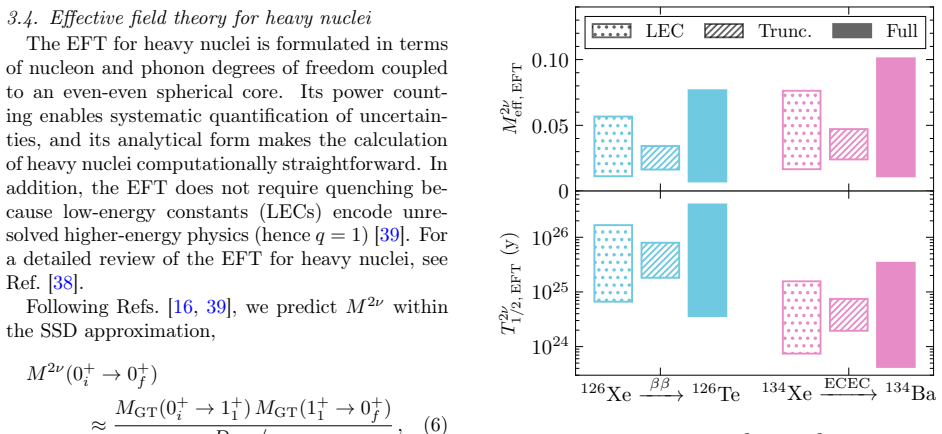
Summary. The paper predicts nuclear matrix elements and half-lives for the two-neutrino double-electron capture of 126Xe and the two-neutrino double-beta decay of 134Xe using four many-body approaches: pnQRPA (with isospin-restoration g_pp fitting to measured 124Xe/136Xe decays), the nuclear shell model (GCN5082 and QX interactions, with a jump=3 truncation for 126Xe), the microscopic IBM-2 (under both SSD and HSD closure assumptions), and an EFT for heavy nuclei (LECs fitted to hypothetical log ft values with an EFT truncation uncertainty). Each method carries an estimated theoretical uncertainty, dominated by quenching (phenomenological methods) or LEC/ratio uncertainties (EFT). The central findings are: (i) all predictions are mutually consistent within uncertainties except the IBM-2 SSD case; (ii) 126Xe half-lives are typically an order of magnitude longer than 134Xe ones; (iii) the lower edges of the 134Xe bands approach or fall below ~2×10^24 y, near the projected 1.7×10^24 y LZ sensitivity.
Significance. If the bands hold, this is a useful, timely benchmark: 134Xe is directly accessible to running and planned xenon experiments (PandaX, LZ, XLZD), and a measurement would discriminate among the four methods in the same way the 124Xe ECEC measurement did. The paper's main strengths are methodological transparency and uncertainty honesty: each method's fitting procedure is documented in dedicated appendices (pnQRPA g_pp fits in App. B/Fig. B.6, NSM truncation systematics in App. C/Table C.4, IBM-2 Hamiltonian parameters in App. D, and the EFT hypothetical-log ft construction in App. E including a LogFT-vs-BetaShape comparison and an independent cross-check against the 136Xe(3He,t) B(GT) datum). The running-sum comparison of pnQRPA and NSM (Figs. 3–4) is a genuinely informative diagnostic of how two methods arrive at similar NMEs through very different strength distributions. The work is explicitly not first-principles — g_pp, quenching factors, and LECs are all anchored to neighboring measured decays or constructed log ft systematics — but the authors state this clearly, and the resulting predictions are falsifiable on a realistic experimental timescale, which is the standard by which
major comments (3)
- [Abstract vs. Table 1 / Table C.5] The abstract states that 'for all calculations the lower range of the predicted 134Xe half-life is shorter than T≈2×10^24 y.' This is contradicted by the paper's own Table 1 and Table C.5: the NSM lower edge is 2.04×10^24 y (GCN5082 with maximal quenching), i.e., marginally *longer* than 2×10^24 y. The body text (§4) handles this correctly, saying the LZ projected sensitivity of 1.7×10^24 y is 'within the range of the pnQRPA, IBM-2 (HSD) and EFT predictions, and very close to the NSM one' — but the abstract does not. Since this is the paper's headline phenomenological claim, the abstract should be brought into agreement with Table 1 (e.g., 'shorter than or comparable to ~2×10^24 y').
- [Abstract / §5, Tables B.3, D.7] Relatedly, the reachability statement in the abstract should be qualified by where the short half-lives come from. Inspecting Tables B.3 and D.7: the pnQRPA lower edge (1.22×10^24 y) corresponds to g_A^eff = 1.27, i.e., zero quenching, while with the quenched g_A^eff = 0.8 the half-life is 3.8×10^24 y; the short IBM-2 HSD edges come from q = 1 and q = 0.788, while the maximally quenched q = A^{-0.18} gives 2.74×10^24 y; and the EFT low edge (0.424×10^24 y) is the extreme of the LEC band, which the authors themselves identify (§3.4, Fig. 2) as dominated by the least-controlled ingredient, the empirical β−/EC log ft ratio r. Since the paper argues elsewhere that quenching is *required* to reproduce neighboring measured decays, the physically preferred points within each band sit systematically above the quoted lower edges. The claim is not false — the bands do extend below threshold and th
- [Appendix C / Table C.4] For 126Xe the NSM uses a jump=3 truncation and states explicitly that no truncation uncertainty is included. Table C.4 shows the NME is still dropping steeply with truncation: for GCN5082, M_eff goes 0.061–0.113 (jump=0) → 0.049–0.091 (jump=2) → 0.024–0.044 (jump=3), roughly a factor-of-two reduction in the last step, with no demonstration that jump=4 is converged or computationally inaccessible. Fig. C.7 shows the change is concentrated in the lowest 1+ state, so this is not a diffuse many-state effect that can be argued away. Given that the cross-method consistency claim for 126Xe (Table 1, Fig. 1 upper panel) relies on the NSM band sitting at 11.2–38.1×10^24 y, an unquantified factor-~2 systematic at the last truncation step is load-bearing. At minimum the authors should estimate the residual truncation error (e.g., from the jump=2→3 trend or the 124Xe experience in Ref. [93]) and eit
minor comments (6)
- [Table B.3] Table B.3 lists single values (not ranges) of M^2ν for 134Xe (0.053 and 0.037) while 126Xe carries ranges from the unknown 124I 1+_1 energy. A brief note on why the 136Xe-anchored g_pp fit for 134Xe yields no analogous range (the 134Cs 1+_1 energy is known, Table A.2) would help the reader.
- [Table 1 / Appendix A] pnQRPA and NSM compute non-closure NMEs with explicit energy denominators but are paired with the HSD (average-energy) PSF; the SSD/HSD PSFs differ by only ~2% (Table A.2), so this is numerically harmless, but one sentence explaining the choice would preempt confusion about double-counting the closure energy.
- [Fig. 1] Fig. 1 would be more informative if the edges of each band were annotated with the quenching factor or g_A^eff value that produces them, since the paper's own discussion shows the band positions are driven primarily by q. This would also make the point of major comment 2 visible at a glance.
- [§3.3, Eq. (5)] In §3.3, the HSD closure energy systematics '1.12 A^{1/2} MeV' appears without a reference; please add the source (or state it is from prior IBM-2 work). Also, Eq. (5) has a stray comma after '⟨E_k⟩, is simply replaced'.
- [§4] The semi-empirical-formula comparison (§4) is a useful sanity check; it would strengthen the paper to note explicitly that the SEF values (4.61×10^25 y and 4.03×10^24 y) lie inside all non-SSD bands, reinforcing the consistency claim.
- [§1, §5, affiliations] Typographical: 'we use four different widely-used many-body methods' (§1, 'different'/'used' repetition); 'half-live values' in §5 should be 'half-life values'; affiliation f lists 'Department of Physics and Astronomy at UNC' which reads oddly ('University of North Carolina at Chapel Hill'?).
Circularity Check
Disclosed phenomenological calibration on neighboring 2ν data, not circular prediction-by-construction for the target nuclei.
specific steps
-
fitted input called prediction
[Sec. 3.1 / App. B (pnQRPA); similarly Sec. 3.2–3.4 for NSM/IBM-2/EFT quenching and LECs]
"the particle-particle parameter g_pp is fitted to the 2ν half-lives of the neighboring double-weak-decaying isotopes 124Xe and 136Xe, following the partial isospin-restoration scheme"
g_pp (and analogously NSM/IBM-2 q and EFT LECs) is fixed so that neighboring measured 2ν half-lives are reproduced for a chosen g_A^eff range; the same parameters then set the NME and half-life bands for 126Xe/134Xe. The short edges of those bands are therefore driven by the unquenched or lightly quenched end of the calibration range rather than by an independent first-principles constraint on the targets. This is mild and disclosed transfer across nearby nuclei, not a by-construction identity for the target half-lives themselves.
full rationale
The paper’s half-life bands for 126Xe and 134Xe are obtained by computing NMEs in four many-body frameworks and folding in quenching/g_pp/LEC ranges taken from neighboring measured 2ν decays (124Xe, 136Xe, 130Te) or isotopic-chain log ft systematics. That is ordinary phenomenological transfer, not a self-definitional loop: the target isotopes are not used in the fits, the NMEs are evaluated from the many-body wave functions (or SSD LECs) of those nuclei, and the paper states the calibration sources explicitly (Sec. 3.1–3.4, Apps. B–E). No uniqueness theorem is imported from the authors to forbid alternatives; self-citations are methodological (prior EFT/IBM-2/NSM setups). The abstract’s ‘lower range shorter than 2e24 y’ claim is a statement about the reported uncertainty bands, not a quantity forced equal to an input by algebra. Mild fitted-input character exists—the width and short edge of each band are largely set by the adopted quenching/LEC ranges—but that does not make the 126/134 results tautological. Score 2 reflects that minor, fully disclosed dependence without elevating ordinary nuclear-physics calibration to circularity.
Axiom & Free-Parameter Ledger
free parameters (7)
- pnQRPA g_pp (isoscalar) and g_A^eff range =
g_A^eff = 0.8 and 1.27; g_pp set per fit
- NSM quenching factor q =
q=0.42–0.57 (GCN5082); q=0.67–0.82 (QX)
- IBM-2 quenching factor q =
q=1, 0.788, or A^{-0.18}
- IBM-2 Hamiltonian parameters (esp. 126Te) =
see Table D.6
- EFT LECs via hypothetical log ft^{EC/β} =
log ft^{EC/β}=5.015(120)/5.64(58) (126I); 5.3565(5275)/4.967(134) (134Cs)
- SSD vs HSD average intermediate energy ⟨E_k⟩ =
SSD: experimental E(1_1^+); HSD: ~1.12 A^{1/2} MeV
- pnQRPA E_exc(124I,1_1^+) range for 126Xe g_pp fit =
50–300 keV
axioms (7)
- domain assumption 2ν half-life factorizes as (T_{1/2}^{2ν})^{-1}=G^{2ν} g_A^4 (M^{2ν})^2 with subleading energy-denominator and higher-order corrections neglected at the few-to-ten-percent level.
- domain assumption Partial isospin restoration (Fermi NME set to zero by adjusting g_pp^{T=1}) is an adequate pnQRPA constraint.
- domain assumption Spherical pnQRPA and the chosen no-core 25-orbital Woods-Saxon+Bonn-A setup capture the relevant GT strength for these nearly spherical nuclei.
- domain assumption NSM valence space (g7/2,d5/2,d3/2,s1/2,h11/2) with GCN5082/QX and jump≤3 truncation for 126Xe is sufficient once quenching is applied.
- domain assumption IBM-2 closure approximation with either single-state or higher-state dominance brackets the intermediate-state sum.
- domain assumption Heavy-nucleus EFT at leading SSD order with phonon breakdown scale gives a controlled truncation error via the Lerch-transcendent formula.
- standard math Lowest intermediate 1^+ energy in the NME denominator can be fixed to experiment (or the stated range) for all methods.
read the original abstract
We calculate the nuclear matrix elements and corresponding half-lives for the two-neutrino double-electron capture of $^{126}$Xe and the two-neutrino double-beta decay of $^{134}$Xe. We use different many-body methods: the proton-neutron quasiparticle random-phase approximation, the nuclear shell model, the microscopic interacting boson model, and an effective field theory for heavy nuclei. For both nuclei, all our half-life predictions are generally consistent with each other when including theoretical uncertainties for each method. Interestingly, for all calculations the lower range of the predicted $^{134}$Xe half-life is shorter than $T^{2\nu}_{1/2} \approx 2\times10^{24}$\,y, which may be within the reach of next-generation experiments. For $^{126}$Xe, our results typically predict one order of magnitude longer half-lives than those for $^{134}$Xe.
Figures


Reference graph
Works this paper leans on
-
[1]
M. Agostini, G. Benato, J. A. Detwiler, J. Menéndez, F. Vissani, Toward the discov- ery of matter creation with neutrinolessββ decay, Rev. Mod. Phys. 95 (2) (2023) 025002. doi:10.1103/RevModPhys.95.025002
-
[2]
M. J. Dolinski, A. W. P. Poon, W. Rodejo- hann, Neutrinoless double-beta decay: Sta- tus and prospects, Annu. Rev. Nucl. Part. Sci. 69 (2019) 219–251.doi:10.1146/ annurev-nucl-101918-023407
2019
-
[3]
J. J. Gómez-Cadenas, J. Martín-Albo, J. Menéndez, M. Mezzetto, F. Monra- bal, M. Sorel, The search for neu- trinoless double-beta decay, Riv. Nuovo Cim. 46 (10) (2023) 619–692. doi:10.1007/s40766-023-00049-2
-
[4]
Saakyan, Two-neutrino double-beta decay, Annu
R. Saakyan, Two-neutrino double-beta decay, Annu. Rev. Nucl. Part. Sci. 63 (2013) 503–529.doi:10.1146/ annurev-nucl-102711-094904
2013
-
[5]
Barabash, Precise half-life values for two-neutrino double-βdecay: 2020 review, Universe 6 (2020) 159.doi:10.3390/ universe6100159
A. Barabash, Precise half-life values for two-neutrino double-βdecay: 2020 review, Universe 6 (2020) 159.doi:10.3390/ universe6100159
2020
-
[6]
J. Engel, J. Menéndez, Status and future of nuclear matrix elements for neutrinoless double-beta decay: a review, Rep. Prog. Phys. 80 (2017) 046301.doi:10.1088/1361-6633/ aa5bc5
-
[7]
Jokiniemi, B
L. Jokiniemi, B. Romeo, P. Soriano, J. Menén- dez, Neutrinolessββ-decay nuclear matrix ele- ments from two-neutrinoββ-decay data, Phys. Rev. C 107 (4) (2023) 044305.doi:10.1103/ PhysRevC.107.044305
2023
-
[8]
M. Horoi, A. Neacsu, S. Stoica, Statistical analysis for the neutrinoless double-β-decay matrix element of48Ca, Phys. Rev. C 106 (5) (2022) 054302.doi:10.1103/PhysRevC.106. 054302
-
[9]
M. Horoi, A. Neacsu, S. Stoica, Predicting the neutrinoless double-β-decay matrix ele- ment of 136Xe using a statistical approach, Phys. Rev. C 107 (4) (2023) 045501.doi: 10.1103/PhysRevC.107.045501
-
[10]
M. Horoi, A. Neacsu, Uncertainty quantifica- tion of the 76Ge neutrinoless double-beta de- cay nuclear matrix element (2026).arXiv: 2605.21657
Pith/arXiv arXiv 2026
-
[11]
X. Lian, C. R. Ding, C. L. Bai, J. M. Yao, Ab initio correlations between neutrinoless and two-neutrino double-beta decays in48Ca (2026).arXiv:2605.19479
Pith/arXiv arXiv 2026
-
[12]
Aprile (XENON collaboration), et al., Observation of two-neutrino double electron capture in 124Xewith XENON1T, Nature 568 (7753) (2019) 532–535.doi:10.1038/ s41586-019-1124-4
E. Aprile (XENON collaboration), et al., Observation of two-neutrino double electron capture in 124Xewith XENON1T, Nature 568 (7753) (2019) 532–535.doi:10.1038/ s41586-019-1124-4
2019
-
[13]
E. Aprile (XENON collaboration), et al., Double-weak decays of 124Xeand 136Xein the XENON1T and XENONnT experiments, Phys. Rev. C 106 (2) (2022) 024328.doi: 10.1103/PhysRevC.106.024328
-
[14]
Aalbers (LUX-ZEPLIN collaboration), et al., Two-neutrino double electron capture of 124Xe in the first LUX-ZEPLIN exposure, J
J. Aalbers (LUX-ZEPLIN collaboration), et al., Two-neutrino double electron capture of 124Xe in the first LUX-ZEPLIN exposure, J. Phys. G 52 (1) (2025) 015103.doi:10.1088/ 1361-6471/ad9039
2025
-
[15]
Z. Bo (PandaX collaboration), et al., Measure- ment of two-neutrino double electron capture half-life of 124Xe with pandax-4t, JHEP 05 (2025) 119.doi:10.1007/JHEP05(2025)119
-
[16]
E. A. Coello Pérez, J. Menéndez, A. Schwenk, Two-neutrino double electron capture on124Xe based on an effective theory and the nuclear shell model, Phys. Lett. B 797 (2019) 134885. doi:10.1016/j.physletb.2019.134885
arXiv 2019
-
[17]
P. Pirinen, J. Suhonen, Systematic approach toβand2νββdecays of massA= 100−136 nuclei, Phys. Rev. C 91 (2015) 054309.doi: 10.1103/PhysRevC.91.054309
-
[18]
Suhonen, Double beta decays of124Xe inves- tigated in the QRPA framework, J
J. Suhonen, Double beta decays of124Xe inves- tigated in the QRPA framework, J. Phys. G 40 (2013) 075102.doi:10.1088/0954-3899/40/ 7/075102. 13
-
[19]
Abe (KamLAND-Zen collaboration), et al., Search for majorana neutrinos with the com- plete KamLAND-Zen dataset, Phys
S. Abe (KamLAND-Zen collaboration), et al., Search for majorana neutrinos with the com- plete KamLAND-Zen dataset, Phys. Rev. Lett. 135 (26) (2025) 262501.doi:10.1103/ jkf6-48j8
2025
-
[20]
L. Luo (PandaX collaboration), et al., Search for double beta decay of 136Xe to the0 + 1 ex- cited state of136Ba with PandaX-4T, JHEP 05 (2025) 089.doi:10.1007/JHEP05(2025)089
-
[21]
Adhikari (nEXO collaboration), et al., nEXO: neutrinoless double beta decay search beyond 1028 year half-life sensitivity, J
G. Adhikari (nEXO collaboration), et al., nEXO: neutrinoless double beta decay search beyond 1028 year half-life sensitivity, J. Phys. G 49 (1) (2022) 015104.doi:10.1088/ 1361-6471/ac3631
2022
-
[22]
Adams (NEXT collaboration), et al., Sensitivity of a tonne-scale next detector for neutrinoless double beta decay searches, JHEP 2021 (08) (2021) 164.doi:10.1007/ JHEP08(2021)164
C. Adams (NEXT collaboration), et al., Sensitivity of a tonne-scale next detector for neutrinoless double beta decay searches, JHEP 2021 (08) (2021) 164.doi:10.1007/ JHEP08(2021)164
2021
-
[23]
J. Aalbers (XLZD collaboration), et al., Neu- trinoless double beta decay sensitivity of the XLZDrareeventobservatory, J.Phys.G52(4) (2025) 045102.doi:10.1088/1361-6471/ adb900
-
[24]
NuDat3.0, nndc.bnl.gov/nudat3/
-
[25]
D. S. Akerib (LUX collaboration), et al., Search for two neutrino double electron cap- ture of 124Xeand 126Xein the full exposure of the LUX detector, J. Phys. G 47 (10) (2020) 105105.doi:10.1088/1361-6471/ab9c2d
-
[26]
K. Abe (XMASS collaboration), et al., Im- proved search for two-neutrino double electron captureon 124Xeand 126Xeusingparticleiden- tification in XMASS-I, Prog. Theo. Exp. Phys. 2018 (5) (2018) 053D03.doi:10.1093/ptep/ pty053
doi:10.1093/ptep/ 2018
-
[27]
S. Al Kharusi (EXO-200 collaboration), et al., Search for double beta decays of 134Xewith EXO-200 Phase II, Phys. Rev. Lett. 136 (23) (2026) 232502.doi:10.1103/vpny-23wq
-
[28]
X. Yan (PandaX collaboration), et al., Search- ing for two-neutrino and neutrinoless double beta decay of 134Xewith the PandaX-4T ex- periment, Phys. Rev. Lett. 132 (2024) 152502. doi:10.1103/PhysRevLett.132.152502
-
[29]
L. Jokiniemi, B. Romeo, C. Brase, J. Kotila, P. Soriano, A. Schwenk, J. Menéndez, Two- neutrinoββdecay of 136Xe to the first ex- cited0 + state in 136Ba, Phys. Lett. B 838 (2023) 137689.doi:10.1016/j.physletb. 2023.137689
arXiv 2023
-
[30]
P. Vogel, M. R. Zirnbauer, Suppression of the two neutrino double beta decay by nuclear structure effects, Phys. Rev. Lett. 57 (1986) 3148–3151.doi:10.1103/PhysRevLett.57. 3148
-
[31]
Engel, P
J. Engel, P. Vogel, M. R. Zirnbauer, Nuclear structure effects in double beta decay, Phys. Rev. C 37 (1988) 731–746.doi:10.1103/ PhysRevC.37.731
1988
-
[32]
Ejiri, J
H. Ejiri, J. Suhonen, K. Zuber, Neu- trino–nuclear responses for astro-neutrinos, single beta decays and double beta decays, Phys. Rept. 797 (2019) 1–102.doi:10.1016/ j.physrep.2018.12.001
2019
-
[33]
Caurier, A
E. Caurier, A. P. Zuker, A. Poves, A full 0ℏωdescription of the2νββdecay of 48Ca, Phys. Lett. B 252 (1990) 13–17.doi:10.1016/ 0370-2693(90)91071-I
1990
-
[34]
E. Caurier, F. Nowacki, A. Poves, Shell model description of theββdecay of 136Xe, Phys. Lett. B 711 (2012) 62.doi:10.1016/j. physletb.2012.03.076
doi:10.1016/j 2012
-
[35]
M. Horoi, B. A. Brown, Shell-model analysis of the 136Xedouble beta decay nuclear matrix elements, Phys. Rev. Lett. 110 (2013) 222502. doi:10.1103/PhysRevLett.110.222502
-
[36]
Coraggio, N
L. Coraggio, N. Itaco, G. De Gregorio, A. Gargano, Z. H. Cheng, Y. Z. Ma, F. R. Xu, M. Viviani, The renormalization of the shell- modelGamow-Telleroperatorstartingfromef- fective field theory for nuclear systems, Phys. Rev. C 109 (1) (2024) 014301.doi:10.1103/ PhysRevC.109.014301
2024
-
[37]
J. Barea, J. Kotila, F. Iachello,0νββand 2νββnuclear matrix elements in the inter- acting boson model with isospin restoration, Phys. Rev. C 91 (3) (2015) 034304.doi: 10.1103/PhysRevC.91.034304
-
[38]
E. A. Coello Pérez, T. Papenbrock, Effec- tive field theories for collective excitations of 14 atomicnuclei, J.Phys.G.52(3)(2025)033001. doi:10.1088/1361-6471/adb50b
-
[40]
D. S. Delion, J. Suhonen, Two-neutrinoββde- cays and low-lying Gamow-Tellerβ− strength functions in the mass range A=70–176, Phys. Rev. C 95 (3) (2017) 034330.doi:10.1103/ PhysRevC.95.034330
2017
-
[41]
A. A. Raduta, C. M. Raduta, A. Escuderos, Descriptionofthetwoneutrinodoublebetade- cay in deformed nuclei with projected spherical single particle basis, Phys. Rev. C 71 (2005) 024307.doi:10.1103/PhysRevC.71.024307
-
[42]
Singh, R
S. Singh, R. Chandra, P. K. Rath, P. K. Raina, J. G. Hirsch, Nuclear deformation and the two neutrino double-beta decay in 124,126Xe, 128,130Te, 130,132Ba and 150Nd isotopes, Eur. Phys. J. A 33 (2007) 375–388.doi:10.1140/ epja/i2007-10481-7
2007
-
[43]
A. Shukla, P. K. Raina, P. K. Rath, Study of two neutrinoβ+β+/β+ EC/ECECdecay of 124,126Xeand 130,132Bafor0 + →0 + transition in PHFB model, J. Phys. G. 34 (3) (2007) 549. doi:10.1088/0954-3899/34/3/013
-
[44]
Gysbers, G
P. Gysbers, G. Hagen, J. D. Holt, G. R. Jansen, T. D. Morris, P. Navrátil, T. Pa- penbrock, S. Quaglioni, A. Schwenk, S. R. Stroberg, K. A. Wendt, Discrepancy be- tween experimental and theoreticalβ-decay rates resolved from first principles, Nature Phys. 15 (5) (2019) 428–431.doi:10.1038/ s41567-019-0450-7
2019
-
[45]
S. R. Stroberg, Beta decay in medium-mass nuclei with the in-medium similarity renormal- ization group, Particles 4 (4) (2021) 521–535. doi:10.3390/particles4040038
-
[46]
Z. Li, T. Miyagi, A. Schwenk, Ab initio calcu- lations ofβ-decay half-lives for N=50 neutron- rich nuclei, Phys. Rev. Lett. 136 (18) (2026) 182501.doi:10.1103/xjv9-t6sn
-
[47]
S. Novario, P. Gysbers, J. Engel, G. Hagen, G. R. Jansen, T. D. Morris, P. Navrátil, T. Pa- penbrock, S. Quaglioni, Coupled-cluster calcu- lations of neutrinoless double-βdecay in48Ca, Phys. Rev. Lett. 126 (2021) 182502.doi: 10.1103/PhysRevLett.126.182502
-
[48]
Z. Li, L. Jokiniemi, A. Schwenk, Ab initio calculations of two-neutrino and neutrinoless double-βdecay of 48Ca and related Gamow- Teller strength distributions (2026).arXiv: 2607.11733
Pith/arXiv arXiv 2026
-
[49]
D. S. Akerib (LUX-ZEPLIN collaboration), et al., Projected sensitivity of the LUX- ZEPLIN experiment to the two-neutrino and neutrinoless doubleβdecays of 134Xe, Phys. Rev. C 104 (2021) 065501.doi:10.1103/ PhysRevC.104.065501
2021
-
[50]
Šimkovic, R
F. Šimkovic, R. Dvornický, D. Stefánik, A. Faessler, Improved description of the2νββ- decay and a possibility to determine the ef- fective axial-vector coupling constant, Phys. Rev. C 97 (3) (2018) 034315.doi:10.1103/ PhysRevC.97.034315
2018
-
[51]
S. e. Morabit, R. Bouabid, V. Cirigliano, J. de Vries, L. Gráf, E. Mereghetti, 2νββspec- trum in chiral effective field theory, JHEP 06 (2025) 082.doi:10.1007/JHEP06(2025)082
-
[52]
D. Castillo, D. Frycz, B. Benavente, J. Menén- dez, Two-neutrinoββdecay to excited states at next-to-leading order, Phys. Lett. B 875 (2026) 140306.doi:10.1016/j.physletb. 2026.140306
arXiv 2026
-
[53]
J. Kotila, F. Iachello, Phase-space factors for double-βdecay, Phys. Rev. C 85 (2012) 034316.doi:10.1103/PhysRevC.85.034316
-
[54]
J. Kotila, F. Iachello, Phase space factors for β+β+ decay and competing modes of double- βdecay, Phys. Rev. C 87 (2013) 024313.doi: 10.1103/PhysRevC.87.024313
-
[55]
A. Faessler, F. Šimkovic, Double beta decay, J. Phys. G 24 (12) (1998) 2139–2178.doi: 10.1088/0954-3899/24/12/001
-
[56]
S. R. Elliott, P. Vogel, Double beta decay, Annu. Rev. Nucl. Part. Sci. 52 (1) (2002) 115–151.doi:10.1146/annurev.nucl.52. 050102.090641. 15
arXiv 2002
-
[57]
Suhonen, From Nucleons to Nucleus: Con- cepts of Microscopic Nuclear Theory, Springer- Verlag, Berlin Heidelberg, 2007
J. Suhonen, From Nucleons to Nucleus: Con- cepts of Microscopic Nuclear Theory, Springer- Verlag, Berlin Heidelberg, 2007
2007
-
[58]
Šimkovic, V
F. Šimkovic, V. Rodin, A. Faessler, P. Vo- gel,0νββand2νββnuclear matrix ele- ments, quasiparticle random-phase approxi- mation, and isospin symmetry restoration, Phys. Rev. C 87 (2013) 045501.doi:10.1103/ PhysRevC.87.045501
2013
-
[60]
L. Jokiniemi, P. Soriano, J. Menéndez, Impact of the leading-order short-range nuclear ma- trix element on the neutrinoless double-beta decay of medium-mass and heavy nuclei, Phys. Lett. B 823 (2021) 136720.doi:10.1016/j. physletb.2021.136720
arXiv 2021
-
[61]
Holinde, Two-nucleon forces and nuclear matter, Phys
K. Holinde, Two-nucleon forces and nuclear matter, Phys. Rep. 68 (1981) 121.doi:10. 1016/0370-1573(81)90188-5
1981
-
[62]
E. Caurier, G. Martinez-Pinedo, F. Nowacki, A. Poves, A. P. Zuker, The shell model as uni- fied view of nuclear structure, Rev. Mod. Phys. 77 (2005) 427.doi:10.1103/RevModPhys.77. 427
-
[63]
B. A. Brown, The nuclear shell model to- wards the drip lines, Prog. Part. Nucl. Phys. 47 (2001) 517.doi:10.1016/S0146-6410(01) 00159-4
-
[64]
T. Otsuka, A. Gade, O. Sorlin, T. Suzuki, Y. Utsuno, Evolution of shell structure in ex- otic nuclei, Rev. Mod. Phys. 92 (2020) 015002. doi:10.1103/RevModPhys.92.015002
-
[65]
B. H. Wildenthal, W. Chung, B. A. Brown, Experimental and theoretical Gamow-Teller beta-decay observables for the sd-shell nuclei, At. Data Nucl. Data Tables 33 (1985) 347–404. doi:10.1016/0092-640X(85)90009-9
-
[66]
W. T. Chou, E. K. Warburton, B. A. Brown, Gamow-Teller beta-decay rates for A≤18 nuclei, Phys. Rev. C 47 (1993) 163.doi: 10.1103/PhysRevC.47.163
-
[68]
L. Coraggio, A. Gargano, N. Itaco, R. Man- cino, F. Nowacki, Calculation of the neutrino- less double-βdecay matrix element within the realistic shell model, Phys. Rev. C 101 (2020) 044315.doi:10.1103/PhysRevC.101.044315
-
[69]
Niţescu, S
O. Niţescu, S. Ghinescu, V.-A. Sevestrean, M. Horoi, F. Šimkovic, S. Stoica, Theoretical analysis and predictions for the two-neutrino double electron capture of 124Xe, J. Phys. G 51 (12) (2024) 125103.doi:10.1088/ 1361-6471/ad8767
2024
-
[70]
E. Caurier, F. Nowacki, A. Poves, K. Sieja, Collectivity in the light xenon isotopes: A shell model study, Phys. Rev. C 82 (2010) 064304. doi:10.1103/PhysRevC.82.064304
-
[71]
C. Qi, Z. X. Xu, Monopole-optimized effective interaction for tin isotopes, Phys. Rev. C 86 (2012) 044323.doi:10.1103/PhysRevC.86. 044323
-
[72]
B. M. Rebeiro, S. Triambak, P. E. Gar- rett, G. C. Ball, B. A. Brown, J. Menéndez, B. Romeo, P. Adsley, B. G. Lenardo, R. Lind- say, V. Bildstein, C. Burbadge, R. Coleman, A. Diaz Varela, R. Dubey, T. Faestermann, R. Hertenberger, M. Kamil, K. G. Leach, C. Natzke, J. C. Nzobadila Ondze, A. Radich, E. Rand, H.-F. Wirth, 138Ba(d,α) study of states in 136Cs:...
2023
-
[73]
M. Horoi, A. Neacsu, Shell model predictions for 124Sndouble-βdecay, Phys. Rev. C 93 (2016) 024308.doi:10.1103/PhysRevC.93. 024308
-
[74]
A.Arima, T.Otsuka, F.Iachello, I.Talmi, Col- lectivenuclearstatesassymmetriccouplingsof proton and neutron excitations, Phys. Lett. B 66 (1977) 205.doi:10.1016/0370-2693(77) 90860-7. 16
-
[75]
Iachello, A
F. Iachello, A. Arima, The Interacting Boson Model, Cambridge University Press, 1987
1987
-
[76]
T. Otsuka, A. Arima, F. Iachello, Nuclear shell model and interacting bosons, Nucl. Phys. A 309 (1978) 1.doi:10.1016/0375-9474(78) 90532-8
-
[77]
J. Barea, F. Iachello, Neutrinoless double- beta decay in the microscopic interacting bo- son model, Phys. Rev. C 79 (2009) 044301. doi:10.1103/PhysRevC.79.044301
-
[78]
A. Gade, I. Wiedenhöver, J. Gableske, A. Gel- berg, H. Meise, N. Pietralla, P. von Brentano, Proton–neutron structure of low lying collec- tive quadrupole excitations in 126Xe, Nucl. Phys. A 665 (3) (2000) 268–284.doi:10. 1016/S0375-9474(99)00387-5
2000
-
[79]
G. Puddu, O. Scholten, T. Otsuka, Collec- tive quadrupole states ofXe,Ba and Cein the interacting boson model, Nucl. Phys. A 348 (1980) 109.doi:10.1016/0375-9474(80) 90548-5
-
[80]
J. Kotila, J. Barea, Occupation probabilities of single particle levels using the microscopic interacting boson model: Application to some nuclei of interest in neutrinoless double-βde- cay, Phys. Rev. C 94 (2016) 034320.doi: 10.1103/PhysRevC.94.034320
-
[81]
J. Abad, A. Morales, R. Nuñez-Lagos, A. F. Pacheco, An estimation of the rates of (two- neutrino) double beta decay and related pro- cesses, Ann. Fis. Ser. A 80 (1984) 9
1984
-
[82]
J. Abad, A. Morales, R. Nuñez-Lagos, A. F. Pacheco, An estimation of the rates of (two- neutrino) double beta decay and related pro- cesses, J Phys. Colloques 45 (1984) C3–147. doi:10.1051/jphyscol:1984328
-
[83]
P. Domin, S. Kovalenko, F. Šimkovic, S. V. Se- menov, Neutrino accompaniedβ ±β±,β +/EC andEC/ECprocesses within single state dom- inance hypothesis, Nucl. Phys. A 753 (2005) 337.doi:10.1016/j.nuclphysa.2005.03. 003
discussion (0)
Sign in with ORCID, Apple, or X to comment. Anyone can read and Pith papers without signing in.