Ab initio correlations between neutrinoless and two-neutrino double-beta decays in ⁴⁸Ca
Pith reviewed 2026-05-20 02:18 UTC · model grok-4.3
The pith
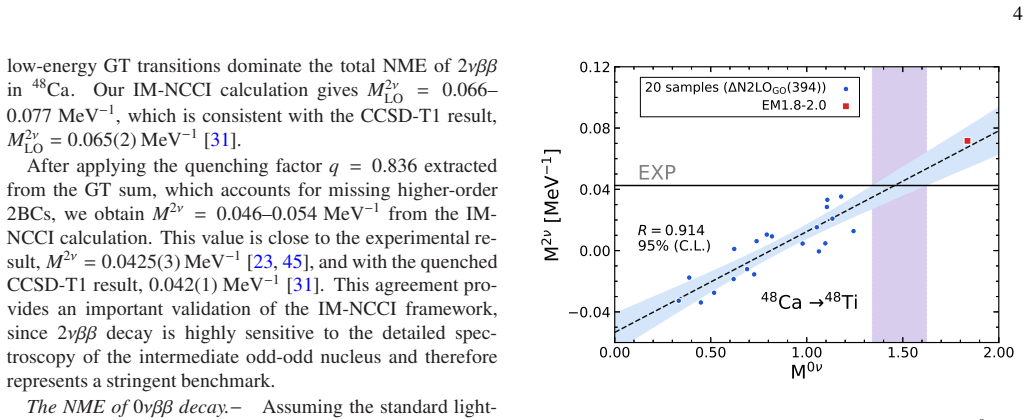
Linear correlations from ab initio models constrain the neutrinoless double-beta decay matrix element in 48Ca to 1.30-1.65
A machine-rendered reading of the paper's core claim, the machinery that carries it, and where it could break.
Core claim
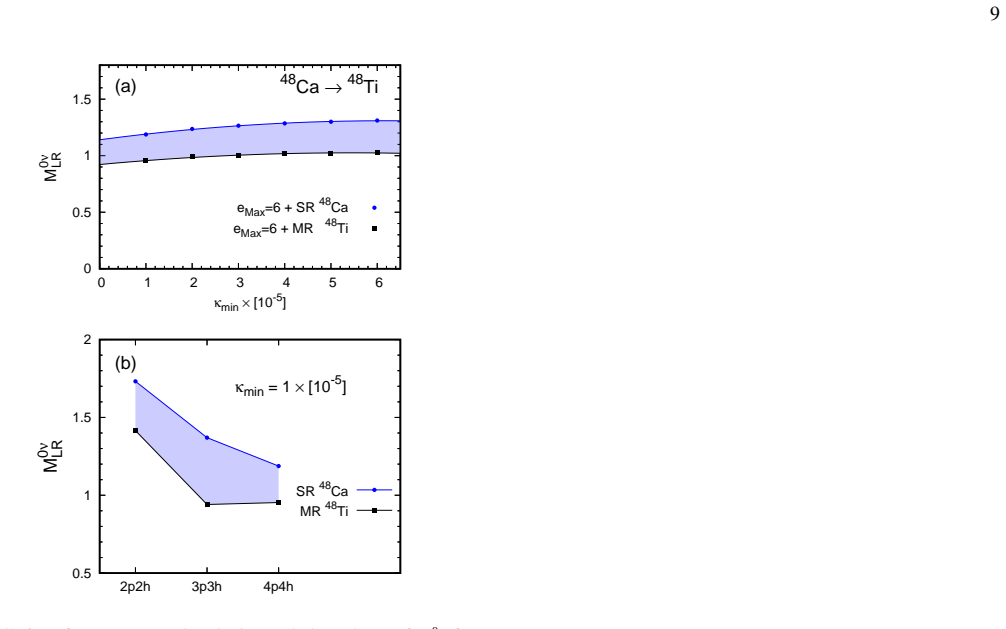
Using the IM-NCCI framework with chiral Hamiltonians, the authors compute both 2νββ and 0νββ nuclear matrix elements for 48Ca, finding that the 0νββ NME correlates linearly with the 2νββ NME and the double GT transition strength across 34 Hamiltonians. After including short-range operators and an effective quenching factor of approximately 0.84 to account for missing two-body weak currents, the total 0νββ NME is 1.00-2.02, and the correlation with experimental 2νββ data constrains it further to 1.30-1.65.
What carries the argument
The linear correlation relations between the 0νββ nuclear matrix element and the nuclear matrix elements for 2νββ decay and double Gamow-Teller transitions, derived from calculations with multiple chiral Hamiltonians in the IM-NCCI framework.
If this is right
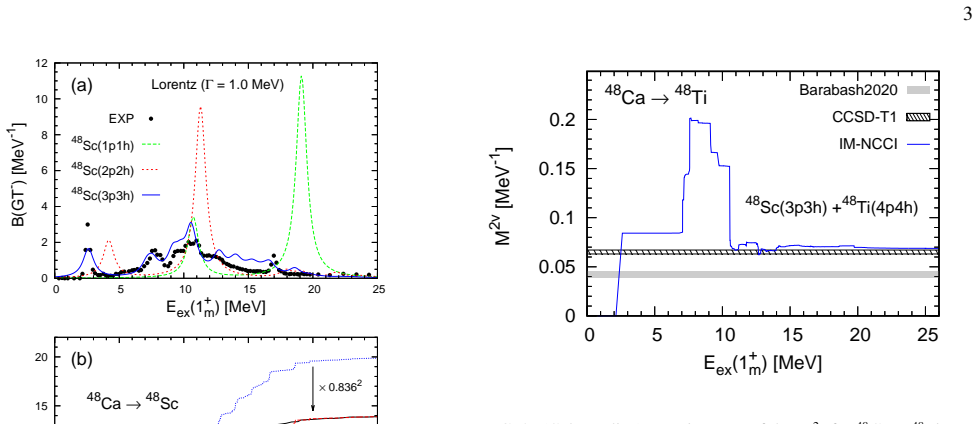
- The IM-NCCI framework reproduces the positions of main resonance peaks in the Gamow-Teller strength for the calcium-48 to scandium-48 transition.
- An effective quenching factor of 0.84 from two-body currents brings the computed 2νββ NME into agreement with experiment.
- Including short-range operators gives a total 0νββ NME between 1.00 and 2.02.
- The established correlations allow the use of experimental 2νββ data to constrain 0νββ predictions within 95% confidence level.
- This method provides a complementary ab initio approach for studying nuclear weak decays and extends to heavier nuclei.
Where Pith is reading between the lines
- If the linear correlations prove general across other nuclei, then measured two-neutrino decay rates could provide tight bounds on neutrinoless decay matrix elements without requiring full ab initio computations for each candidate.
- Discrepancies between the constrained range and future direct measurements of 0νββ in 48Ca would indicate the need to refine the treatment of two-body currents or model spaces in the calculations.
- The approach might be combined with other many-body methods to cross-validate the correlation slopes and improve uncertainty estimates for neutrinoless double-beta decay searches.
Load-bearing premise
The strong linear correlations observed across the 34 chiral Hamiltonians between the neutrinoless and two-neutrino double-beta decay nuclear matrix elements continue to hold when the models are confronted with experimental two-neutrino data.
What would settle it
A direct experimental determination of the neutrinoless double-beta decay half-life in 48Ca yielding a matrix element value outside the interval 1.30-1.65, or new ab initio calculations with Hamiltonians that violate the observed linear correlation, would falsify the constrained prediction.
Figures




read the original abstract
We develop a novel ab initio in-medium no-core configuration-interaction (IM-NCCI) framework for nuclear charge-exchange processes by combining the in-medium similarity renormalization group with chiral nuclear Hamiltonians, and apply it to the $2\nu\beta\beta$ and $0\nu\beta\beta$ decays of $^{48}$Ca. This framework reproduces the locations of several main resonance peaks in the Gamow-Teller (GT) strength distribution for the $^{48}\mathrm{Ca}\to{}^{48}\mathrm{Sc}$ transition. The cumulative GT strength indicates missing contributions from two-body weak currents, corresponding to an effective quenching factor of $q\simeq0.84$. Incorporating this quenching yields a $2\nu\beta\beta$ nuclear matrix element (NME) in excellent agreement with experiment. Applying the same framework to $0\nu\beta\beta$ decay, and including the contribution from short-range operators, we obtain a total NME of $M^{0\nu}=1.00\text{-}2.02$. Using 34 non-implausible chiral Hamiltonians, we establish from first principles strong linear correlations between the $0\nu\beta\beta$ NME and the NMEs governing $2\nu\beta\beta$ decay and double GT transitions. Combining these correlation relations within the 95% confidence level with the experimental $2\nu\beta\beta$-decay data yields a constrained prediction of $M^{0\nu}=1.30\text{-}1.65$. This work establishes IM-NCCI as a complementary ab initio framework for nuclear weak decays and opens a pathway toward constraining $0\nu\beta\beta$ NMEs in heavier candidate nuclei using experimentally accessible $2\nu\beta\beta$-decay data.
Editorial analysis
A structured set of objections, weighed in public.
Referee Report
Summary. The manuscript develops an in-medium no-core configuration-interaction (IM-NCCI) framework by combining the in-medium similarity renormalization group with chiral nuclear Hamiltonians to study both two-neutrino (2νββ) and neutrinoless (0νββ) double-beta decays in 48Ca. It reports reproduction of Gamow-Teller resonance locations, an effective quenching factor q ≈ 0.84 to match experimental 2νββ strength after accounting for missing two-body currents, a 0νββ NME range of 1.00-2.02 including short-range operators, and strong linear correlations between 0νββ and 2νββ/double-GT NMEs across 34 chiral Hamiltonians. These correlations, combined with experimental 2νββ data at 95% CL, yield a constrained M^{0ν} prediction of 1.30-1.65.
Significance. If the linear correlations remain robust under variations in the nuclear Hamiltonian and inclusion of explicit two-body currents, this approach offers a valuable ab initio method to constrain 0νββ nuclear matrix elements using experimentally accessible 2νββ data. The framework's ability to reproduce GT strength distributions and achieve post-quenching agreement with measured 2ν NME demonstrates its utility for nuclear weak processes. The use of multiple (34) non-implausible Hamiltonians to establish correlations from first principles is a notable strength, providing a pathway for heavier nuclei.
major comments (2)
- [Results section on correlations] The linear correlations between M^{0ν} and the NMEs for 2νββ and double GT transitions are central to the constrained prediction of 1.30-1.65, but the manuscript lacks details on the fitting procedure (regression method, goodness-of-fit metrics such as R², error propagation from the 34 Hamiltonians, and sensitivity analysis to Hamiltonian selection). This information is required to verify the 95% CL band and is absent from the results section discussing the correlations.
- [Section on 0νββ NME and quenching] The 0νββ NME calculation includes short-range operators while the 2νββ uses effective quenching q≃0.84 for missing two-body currents in the GT distribution. The potential differential impact of explicit two-body currents on the slope or scatter of the 0ν-2ν correlation is not quantified; this directly affects the validity of intersecting the correlation band with experimental 2ν data and should be addressed in the discussion of the constrained range.
minor comments (2)
- [Abstract and results] Clarify whether the reported 0νββ range 1.00-2.02 represents the full span over the 34 Hamiltonians or a statistical interval (e.g., 1σ or 2σ).
- [Introduction and notation] Define acronyms such as IM-NCCI and GT at first use in the main text and ensure consistent notation for matrix elements (M^{0ν}, M^{2ν}).
Simulated Author's Rebuttal
We thank the referee for the careful reading of our manuscript and the constructive comments. We address the major comments point by point below. Revisions will be made to improve the clarity and completeness of the presentation.
read point-by-point responses
-
Referee: [Results section on correlations] The linear correlations between M^{0ν} and the NMEs for 2νββ and double GT transitions are central to the constrained prediction of 1.30-1.65, but the manuscript lacks details on the fitting procedure (regression method, goodness-of-fit metrics such as R², error propagation from the 34 Hamiltonians, and sensitivity analysis to Hamiltonian selection). This information is required to verify the 95% CL band and is absent from the results section discussing the correlations.
Authors: We agree that additional details on the correlation analysis will strengthen the manuscript. The linear fits were performed using ordinary least-squares regression on the 34 Hamiltonian results. In the revised version we will explicitly describe the regression method, report the R² values (which exceed 0.92 for both the 0ν–2ν and 0ν–double-GT relations), detail the propagation of uncertainties from the Hamiltonian ensemble into the 95% CL band, and include a sensitivity analysis obtained by successively removing individual Hamiltonians or restricting the set to those with χ² per degree of freedom below a chosen threshold. These additions will allow readers to reproduce and verify the constrained M^{0ν} interval. revision: yes
-
Referee: [Section on 0νββ NME and quenching] The 0νββ NME calculation includes short-range operators while the 2νββ uses effective quenching q≃0.84 for missing two-body currents in the GT distribution. The potential differential impact of explicit two-body currents on the slope or scatter of the 0ν-2ν correlation is not quantified; this directly affects the validity of intersecting the correlation band with experimental 2ν data and should be addressed in the discussion of the constrained range.
Authors: We acknowledge that two-body currents may affect the 0νββ and 2νββ matrix elements differently and could therefore modify the slope or scatter of the observed correlations. Our present calculations employ an effective quenching factor calibrated to the 2νββ strength for the latter while retaining the short-range operator contribution for the former, both evaluated consistently within the same IM-NCCI framework. A fully quantified assessment of the differential effect would require a new suite of calculations that incorporate explicit two-body currents in both channels, which lies beyond the scope of the current work. In the revised manuscript we will expand the discussion section to explicitly note this limitation, discuss its possible implications for the extracted 1.30–1.65 range, and identify the inclusion of explicit two-body currents as an important direction for future refinement. revision: partial
Circularity Check
No significant circularity; derivation grounded in Hamiltonian variation and external data
full rationale
The paper varies 34 non-implausible chiral Hamiltonians inside the IM-NCCI framework to identify linear correlations between the calculated 0νββ NME and the NMEs for 2νββ decay and double-GT transitions. These correlations are then combined with independent experimental 2νββ data to produce the constrained interval M^{0ν}=1.30-1.65. The effective quenching q≃0.84 is fixed separately by matching the cumulative GT strength to data and is not adjusted to the target 0νββ result. No equation reduces by construction to a fitted parameter, no load-bearing premise rests solely on self-citation, and the final constraint incorporates external experimental input rather than re-expressing the input set. The derivation is therefore self-contained against external benchmarks.
Axiom & Free-Parameter Ledger
free parameters (1)
- quenching factor q =
0.84
axioms (2)
- domain assumption Chiral nuclear Hamiltonians at the employed order provide a sufficiently accurate description of the strong interaction for low-energy nuclear structure and weak processes.
- domain assumption The in-medium similarity renormalization group combined with no-core configuration interaction accurately captures the relevant nuclear correlations for Gamow-Teller and double-beta operators in 48Ca.
invented entities (1)
-
short-range operators
no independent evidence
Lean theorems connected to this paper
-
IndisputableMonolith/Cost/FunctionalEquation.leanwashburn_uniqueness_aczel unclear?
unclearRelation between the paper passage and the cited Recognition theorem.
Using 34 non-implausible chiral Hamiltonians, we establish from first principles strong linear correlations between the 0νββ NME and the NMEs governing 2νββ decay and double GT transitions.
-
IndisputableMonolith/Foundation/RealityFromDistinction.leanreality_from_one_distinction unclear?
unclearRelation between the paper passage and the cited Recognition theorem.
We develop a novel ab initio in-medium no-core configuration-interaction (IM-NCCI) framework ... combining the in-medium similarity renormalization group with chiral nuclear Hamiltonians
What do these tags mean?
- matches
- The paper's claim is directly supported by a theorem in the formal canon.
- supports
- The theorem supports part of the paper's argument, but the paper may add assumptions or extra steps.
- extends
- The paper goes beyond the formal theorem; the theorem is a base layer rather than the whole result.
- uses
- The paper appears to rely on the theorem as machinery.
- contradicts
- The paper's claim conflicts with a theorem or certificate in the canon.
- unclear
- Pith found a possible connection, but the passage is too broad, indirect, or ambiguous to say the theorem truly supports the claim.
Forward citations
Cited by 1 Pith paper
-
Ab Initio Nuclear Theory for Heavy Nuclei and Its Application to Dark Matter-Nucleus Scattering
Review highlighting ab initio calculations for heavy nuclei and dark matter-nucleus scattering to reduce nuclear uncertainties.
discussion (0)
Sign in with ORCID, Apple, or X to comment. Anyone can read and Pith papers without signing in.