REVIEW 3 major objections 10 minor 73 references
No adjustment to FeH gf-values gives the best match of M-dwarf metallicities to binaries, clusters, and interferometric temperatures.
Reviewed by Pith at T0; open to challenge. T0 means a machine referee read the full paper against a public rubric. the ladder, T0–T4 →
T0 review · grok-4.5
2026-07-31 05:08 UTC pith:A2Z3XUZU
load-bearing objection Solid multi-benchmark DR19 test that favors leaving Hargreaves FeH gf-values alone; diffusion on the G primaries is a real but modest soft spot, not a collapse of the claim. the 3 major comments →
A Test of FeH Line Parameters using DR19 APOGEE spectra of Benchmark M Dwarfs
The pith
A machine-rendered reading of the paper's core claim, the machinery that carries it, and where it could break.
Core claim
The best simultaneous concordance among binary metallicities, open-cluster metallicities, and interferometric effective temperatures is obtained when the FeH gf-values taken from Hargreaves et al. (2010) are left unchanged; a systematic downward shift of those gf-values that forces exact Teff agreement worsens the metallicity comparisons.
What carries the argument
Fe I–FeH equilibrium: stellar parameters for each M dwarf are fixed by requiring that iron abundances derived from atomic Fe I lines and from selected E–A FeH lines are identical, using 1-D LTE MARCS atmospheres and the baseline APOGEE line list.
Load-bearing premise
That one-dimensional LTE atmospheres and a single fixed microturbulence fully capture how Fe I and FeH lines form in M-dwarf H-band spectra, so any remaining abundance tension can be blamed on the gf-values themselves.
What would settle it
A larger set of M dwarfs with both precise interferometric diameters and independent high-resolution optical metallicities that still show a systematic Fe I–FeH offset after the same analysis, or that require a non-zero mean gf correction to restore simultaneous Teff and [Fe/H] agreement.
If this is right
- The unaltered Hargreaves FeH list can be used for large APOGEE M-dwarf abundance catalogs without a global gf zero-point shift.
- M-dwarf metallicities placed on this scale are directly comparable to G-dwarf and open-cluster scales at the ~0.06 dex level.
- Previously reported 0.1–0.2 dex Fe I–FeH offsets are more likely to reflect analysis systematics than laboratory line-strength errors.
- Future line-list updates should preserve the present zero-point unless they demonstrably improve both temperature and metallicity benchmarks at once.
Where Pith is reading between the lines
- If 3-D or non-LTE effects later prove important, they may absorb the residual ~70 K temperature offset without requiring gf changes.
- The same benchmark logic can be applied to other hydride molecules (CrH, MgH) that appear in cooler M and L dwarfs.
- Homogeneous re-reduction of the full APOGEE M-dwarf sample with these fixed gf-values would tighten Galactic chemical-evolution constraints at the lowest masses.
Editorial analysis
A structured set of objections, weighed in public.
Referee Report
Summary. The paper tests the FeH E4Π–A4Π line list of Hargreaves et al. (2010), as implemented in the APOGEE DR19 line list, against three benchmark samples: 18 wide G+M binaries, 4 M dwarfs with interferometric angular diameters, and 6 M dwarfs in the Hyades and Coma Berenices. Using 1-D LTE MARCS/Turbospectrum synthesis via BACCHUS, with M-dwarf Teff and log g set by enforcing Fe I–FeH abundance equality, the authors find: G- and M-dwarf binary metallicities agree at 0.01±0.07 dex; Hyades and Coma Berenices M-dwarf means (+0.08±0.04, +0.02±0.08) match optical literature values; spectroscopic Teff agrees with interferometric Teff at +72±79 K. Line-by-line astrophysical gf corrections from the binaries average ⟨δ log gf⟩ = −0.016±0.055 with no trends in wavelength, χ, or log gf. Forcing the interferometric Teff scale via δ log gf ≈ −0.2 dex degrades the binary and cluster metallicity agreement. The authors conclude the baseline FeH gf-values require no adjustment.
Significance. FeH is one of the few diagnostics available for M-dwarf temperatures and metallicities in the APOGEE H-band, and the claimed 0.1–0.2 dex Fe I–FeH mismatch has propagated into several published analyses. An empirical, externally anchored validation of the Hargreaves et al. (2010) E–A4Π gf-values is therefore directly useful to the M-dwarf and galactic-archaeology communities. Strengths worth naming: three mutually independent external anchors (co-natal binaries, cluster metallicities, interferometric diameters) rather than internal consistency alone; falsifiable line-by-line astrophysical gf corrections (Table 5); machine-readable abundance tables; full use of public DR19 data and standard codes. If the conclusion survives the corrections requested below, the paper usefully rules out large (≳0.2 dex) FeH gf errors and bounds residual offsets at the ≲0.1 dex level.
major comments (3)
- [§5.2.2 / §6] The binary test compares present-day G-primary photospheric [Fe/H] against the M-secondary, but the correct benchmark is the pair's common initial composition. The manuscript itself cites Dotter et al. (2017) depletions of -0.03 to -0.10 dex for G dwarfs, yet does not propagate this. Since lowering FeH log gf raises the fitted M-dwarf abundance, a diffusion correction would shift the binary-preferred adjustment from <delta log gf> = -0.016 +/- 0.055 to roughly -0.05 to -0.12 dex — overlapping the Hyades formal minimum (-0.04), the Coma Berenices result (-0.120 +/- 0.11), and the direction favored by the interferometric Teff comparison. The headline conclusion ('best overall concordance... no adjustments', Abstract and Section 6) is therefore contingent on an assumption the paper itself flags as wrong in sign. Required: quantify the shift in <delta log gf> over the plausible diffusion ran
- [§5.2.1–5.2.3] With the diffusion correction applied, all four external anchors lean mildly negative: binaries (shifted), Hyades formal best at -0.04 (Fig. 6 bottom, §5.2.3), Coma Berenices at -0.120 +/- 0.11 (Table 5), and interferometry at -0.18 (with large uncertainty: propagating the +72 +/- 79 K offset through the stated ~50 K per 0.1 dex sensitivity gives delta log gf ≈ -0.14 +/- 0.16). The paper weights the binaries above the clusters ('to a lesser degree', §6) without justification and never presents a combined constraint. The interferometric anchor is n=4 and <1 sigma from zero, and the Coma Berenices gf test uses a single star; these limitations should be stated where the results are used, not only implied. Requested: a short joint analysis (even a simple weighted combination with the diffusion range treated as a systematic) showing the interval of delta log gf consistent with all anchors, an
- [§5.2.3 / Table 5] The single Coma Berenices M dwarf is calibrated against K-dwarf Fe I abundances from Souto et al. (2021). Yet §3.2 excludes K-dwarf primaries from the binary sample precisely because APOGEE K-dwarf abundances are systematically suspect (citing Grilo et al. 2024). The Souto et al. (2021) analysis is an independent Fe I line analysis rather than ASPCAP, so the two statements may be compatible, but the manuscript never reconciles them. Given that this single star yields the most negative preferred adjustment (-0.120 +/- 0.11), the reliability and systematics of its metallicity benchmark need explicit discussion, or the test should be presented as strictly weaker evidence than the binaries.
minor comments (10)
- [Abstract] Abstract states G- vs M-dwarf binary agreement of '0.06 dex', while §5.2.2 and Fig. 8 report <delta> = 0.01 +/- 0.07 dex. Reconcile the two numbers or specify which statistic (mean offset vs. scatter) the abstract quotes.
- [§5.2.1 vs §6] The adjustment required to force the interferometric Teff scale is quoted as -0.2 dex in §5.2.1 and -0.18 dex in §6. Use one value, with an uncertainty propagated from the +/-79 K scatter.
- [§5.2.1] Text says negative delta(log gf) 'systematically increase[s] the metallicity discrepancies', but Fig. 6 (bottom) and §5.2.3 put the formal minimum at -0.04 dex, not 0. The wording should state where the minimum lies and that it is within the uncertainties of zero.
- [§5.1] 'The lack of any discernible trend with Teff suggests... that non-LTE effects are likely small.' Absence of a trend across a mixed G+M sample does not constrain non-LTE in either subsample; soften or remove.
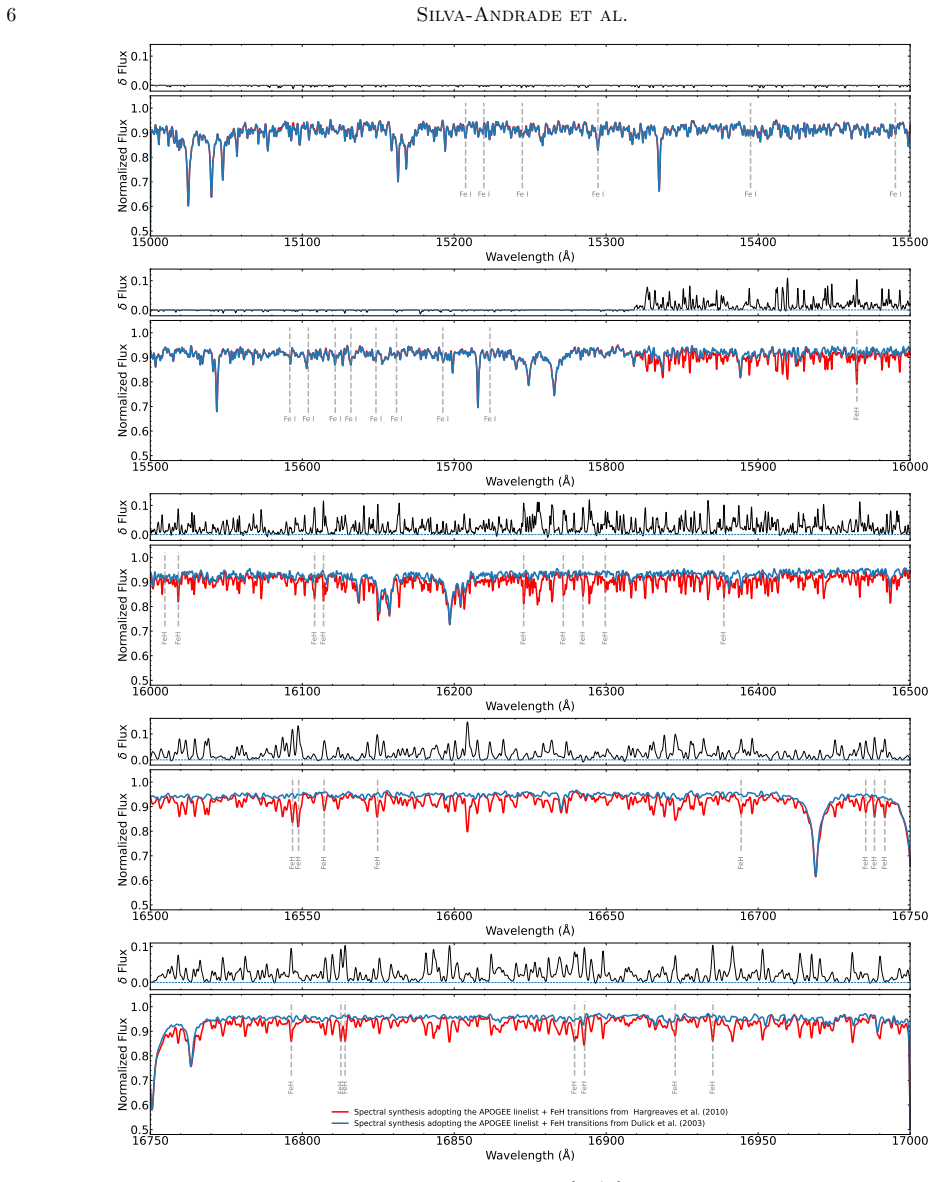
- [Figure 1] Caption says the left panels show log gf vs. wavelength, but the rendered left panels appear to show normalized flux (0.8–1.0) vs. wavelength, duplicating the right panels. Please check that the intended log gf panels are included; the log gf distributions and the E-A/F-X line-density argument are referenced from this figure.
- [Table 1] Column header 'D0' (constant 2.410) is never defined — presumably the dissociation energy in eV used in the gf conversion; state this. The '<delta(x-y)>' notation in §5.2.2/Fig. 8 is also undefined; define x and y explicitly.
- [§4] xi = 1.00 +/- 0.25 km/s is held fixed for all stars. A brief note on the sensitivity of the derived delta log gf adjustments to this choice would strengthen the systematic budget, since Fe I and FeH lines respond differently to xi.
- [Figure 5] Fig. 5 bottom-left labels give '[Fe/H] = 0.06 +/- 0.06' (giants) and '0.05 +/- 0.02' (dwarfs) while the text quotes differences of -0.06 and -0.05 dex; check sign conventions between figure and text.
- [§4.1] Since Teff and log g are set by enforcing Fe I = FeH, internal Fe I–FeH agreement is by construction; stating this explicitly in §4.1 would help readers see why the external anchors carry the full weight of the test.
- [§5.2.1 / Acknowledgments] Typo: 'uncertanties'. The acknowledgement thanking the referee is premature for a submitted draft. Citation 'S. Collaboration et al. 2025' needs proper author list formatting for the DR19 paper.
Circularity Check
Mild by-construction Fe I–FeH equality in the Teff/log g method; the load-bearing gf-value conclusion is tested on external binary, cluster, and interferometric anchors.
specific steps
-
self definitional
[Section 4.1 (Effective Temperatures and Surface Gravities); Figure 4]
"We derived stellar parameters for the M dwarfs by enforcing consistency between the iron abundances obtained from Fe I and FeH lines. We follow the procedure of D. Souto et al. (2018). The method consists of iteratively varying first Teff and then log g, while deriving the corresponding iron abundances. ... In this approach, we determine a Teff that yields consistent abundances from both indicators (Fe I and FeH)."
Teff and log g are defined as the intersection where A(Fe I)=A(FeH). Therefore internal equality of Fe I- and FeH-based iron abundances at the adopted parameters is true by construction and cannot be cited as independent evidence that the FeH gf-values are correct. External anchors (binaries, clusters, interferometry) carry the validation; this step only fixes the parameter scale under the baseline line list.
full rationale
The only structural circularity is methodological and limited: M-dwarf Teff and log g are chosen so that mean A(Fe) from Fe I equals mean A(Fe) from FeH, so internal Fe I–FeH abundance agreement at the adopted parameters is true by construction and cannot itself validate the Hargreaves et al. (2010) gf-values. That is standard ionization/molecular equilibrium practice, not a tautological proof of the paper’s claim. The actual claim—that zero global adjustment to those gf-values gives the best overall concordance—is supported by three external comparisons that are not forced by the fit: (i) M-secondary [Fe/H] vs G-primary Fe I [Fe/H] in 18 wide binaries (mean difference ~0.01±0.07 dex; line-by-line mean δlog gf ≈ −0.016±0.055), (ii) Hyades/Coma Berenices M-dwarf means vs independent optical/APOGEE literature, and (iii) spectroscopic vs interferometric Teff (offset +72±79 K, with forced Teff agreement via δlog gf ~ −0.2 worsening the metallicity matches). Prior Souto/Cunha/Smith papers supply the analysis pipeline and the original Fe I–FeH offset report, but they are not used as a uniqueness theorem that forbids alternatives; the present work re-tests the line list against new benchmarks. Atomic-diffusion caveats on G primaries affect correctness of the binary zero-point, not circularity of the derivation. Score 2 reflects one minor self-definitional step that is not load-bearing for the central conclusion.
Axiom & Free-Parameter Ledger
free parameters (3)
- microturbulence ξ =
1.00 ± 0.25 km s−1
- optional global δ(log gf) for FeH E–A lines =
0 (preferred); −0.18 to −0.2 if Teff forced
- per-line astrophysical δ(log gf) for diagnostic FeH lines =
⟨δ log gf⟩ = −0.016 ± 0.055 (binaries)
axioms (7)
- domain assumption 1-D LTE plane-parallel MARCS model atmospheres and Turbospectrum radiative transfer suffice for H-band Fe I and FeH in M dwarfs.
- domain assumption Wide binary components share the same bulk iron abundance at formation; residual G-dwarf diffusion is small compared with the tested offsets.
- domain assumption Open-cluster members are chemically homogeneous at the level of the abundance precision.
- domain assumption Interferometric angular diameters plus Gaia parallaxes and Mann et al. luminosities define a reliable fundamental Teff scale for the four stars.
- domain assumption APOGEE Fe I gf-values (tuned to Sun/Arcturus) are accurate enough that any Fe I–FeH offset should be ascribed to FeH data or analysis, not to atomic Fe I.
- domain assumption Hargreaves et al. (2010) wavelengths, lower-state energies, and intensity-derived gf-values are the correct physical baseline for E4Π–A4Π FeH in the APOGEE window.
- standard math Standard spectral synthesis, chi-square line fitting, and Gaussian-like uncertainty propagation from abundance scatter to Teff/log g.
read the original abstract
Recent studies have suggested a mismatch of up to 0.20 dex between iron abundances derived from Fe I and FeH lines in the H-band spectra of M dwarfs, and in this work we investigate the nature of this possible offset. We analyze near-infrared H-band APOGEE spectra of stars in 18 binaries composed of a G-dwarf primary and an M-dwarf secondary, together with four M-dwarf stars having measured angular diameters from the literature, and six M-dwarf members of the Hyades and Coma Berenices open clusters. These three families of benchmarks were used to evaluate the FeH line list and check for possible systematic uncertainties in the FeH $gf$-values. Our tests used 1-D LTE plane-parallel model atmospheres, a radiative transfer code, and the baseline APOGEE spectral line list to derive metallicities for the binary G-dwarf primaries using Fe I lines, while stellar parameters and metallicities for the M dwarfs used both FeH and Fe I lines. The mean metallicity obtained for the Hyades M-dwarfs was $\langle$[Fe/H]$\rangle$=+0.08$\pm$0.04, and for Coma Berenices $\langle$[Fe/H]$\rangle$=+0.02$\pm$0.08. The metallicities of the G- and M-dwarfs in binary systems showed excellent agreement (0.06 dex), and the mean metallicities for the open clusters were also consistent with literature values from high-resolution optical analyses. We investigated the consistency between the spectroscopic and interferometric $T_{\rm eff}$ scales, finding agreement within the uncertainties. Forcing full agreement between the spectroscopic and interferometric $T_{\rm eff}$ scales resulted in a poorer match for the metallicities in the binaries and the open clusters. We conclude that the best overall concordance is obtained when no adjustments are made to the FeH $gf$-values, which are based on the Hargreaves et al. (2010) line list.
Figures



Reference graph
Works this paper leans on
-
[1]
Ag¨ ueros, M. A., Curtis, J. L., N´ u˜ nez, A., et al. 2025, ApJ, 993, 144, doi: 10.3847/1538-4357/ae03a3
-
[2]
Allard, F., Hauschildt, P. H., Alexander, D. R., Tamanai, A., & Schweitzer, A. 2000, The Astrophysical Journal, 540, 1005, doi: 10.1086/309290
-
[3]
Alvarez, R., & Plez, B. 1997, Near-infrared narrow-band photometry of M-giant and Mira stars: models meet observations, https://arxiv.org/abs/astro-ph/9710157
Pith/arXiv arXiv 1997
-
[4]
Asplund, M., Amarsi, A. M., & Grevesse, N. 2021, A&A, 653, A141, doi: 10.1051/0004-6361/202140445
-
[5]
Balfour, W. J., Brown, J. M., & Wallace, L. 2004, JChPh, 121, 7735, doi: 10.1063/1.1797731
-
[6]
2018, A&A, 619, A177, doi: 10.1051/0004-6361/201834062
Baraffe, I., & Chabrier, G. 2018, A&A, 619, A177, doi: 10.1051/0004-6361/201834062
-
[7]
Bernath, P. F. 2020, Journal of Quantitative Spectroscopy and Radiative Transfer, 240, 106687, doi: https://doi.org/10.1016/j.jqsrt.2019.106687
arXiv 2020
-
[8]
Bowen, I. S., & Vaughan, A. H. 1973, Appl. Opt., 12, 1430, doi: 10.1364/AO.12.001430
-
[9]
S., von Braun, K., van Belle, G., et al
Boyajian, T. S., von Braun, K., van Belle, G., et al. 2012, ApJ, 757, 112, doi: 10.1088/0004-637X/757/2/112
-
[10]
Brown, A. G. A., Vallenari, A., Prusti, T., et al. 2021, Astronomy & Astrophysics, 650, C3, doi: 10.1051/0004-6361/202039657e
-
[11]
2011, Astronomy and Astrophysics, 535, A30, doi: 10.1051/0004-6361/201117753 Cayrel de Strobel, G
Carrera, R., & Pancino, E. 2011, Astronomy and Astrophysics, 535, A30, doi: 10.1051/0004-6361/201117753 Cayrel de Strobel, G. 1990, Mem. Soc. Astron. Italiana, 61, 613
-
[12]
2016, The Astrophysical Journal, 823, 102, doi: 10.3847/0004-637x/823/2/102
Choi, J., Dotter, A., Conroy, C., et al. 2016, The Astrophysical Journal, 823, 102, doi: 10.3847/0004-637x/823/2/102
-
[13]
Collaboration, S., Pallathadka, G. A., Aghakhanloo, M., et al. 2025, The Nineteenth Data Release of the Sloan Digital Sky Survey, https://arxiv.org/abs/2507.07093
Pith/arXiv arXiv 2025
-
[14]
Crozet, P., Morin, J., Ross, A. J., et al. 2023, A&A, 679, A116, doi: 10.1051/0004-6361/202347498
-
[15]
Cushing, M. C., Rayner, J. T., Davis, S. P., & Vacca, W. D. 2003, ApJ, 582, 1066, doi: 10.1086/344525 da Silva, L., Girardi, L., Pasquini, L., et al. 2006, Astronomy and Astrophysics, 458, 609, doi: 10.1051/0004-6361:20065105 da Silva, R., Milone, A. d. C., & Rocha-Pinto, H. J. 2015, A&A, 580, A24, doi: 10.1051/0004-6361/201525770
-
[16]
2017, ApJ, 840, 99, doi: 10.3847/1538-4357/aa6d10
Dotter, A., Conroy, C., Cargile, P., & Asplund, M. 2017, ApJ, 840, 99, doi: 10.3847/1538-4357/aa6d10
-
[17]
Dulick, M., Bauschlicher, C. W., Burrows, A. S., et al. 2003, The Astrophysical Journal, 594, 651, doi: 10.1086/376791
doi:10.1086/376791 2003
-
[18]
1991, A&A, 248, 485
Duquennoy, A., & Mayor, M. 1991, A&A, 248, 485
1991
-
[19]
El-Badry, K., Rix, H.-W., & Heintz, T. M. 2021, Monthly Notices of the Royal Astronomical Society, 506, 2269, doi: 10.1093/mnras/stab323
-
[20]
Fernandez-Villacanas, J. L., Rego, M., & Cornide, M. 1990, AJ, 99, 1961, doi: 10.1086/115478
-
[21]
Friel, E. D., & Boesgaard, A. M. 1992, ApJ, 387, 170, doi: 10.1086/171069 18Silva-Andrade et al. Garc ´ ıa P´ erez, A. E., Prieto, C. A., Holtzman, J. A., et al. 2016, The Astronomical Journal, 151, 144, doi: 10.3847/0004-6256/151/6/144
-
[22]
2008, A&A, 479, 189, doi: 10.1051/0004-6361:20078807
Gebran, M., Monier, R., & Richard, O. 2008, A&A, 479, 189, doi: 10.1051/0004-6361:20078807
-
[23]
2024, MNRAS, 534, 3005, doi: 10.1093/mnras/stae2209
Grilo, V., Souto, D., Cunha, K., et al. 2024, MNRAS, 534, 3005, doi: 10.1093/mnras/stae2209
-
[24]
Gunn, J. E., Siegmund, W. A., Mannery, E. J., et al. 2006, AJ, 131, 2332, doi: 10.1086/500975
doi:10.1086/500975 2006
-
[25]
2008, A&A, 486, 951, doi: 10.1051/0004-6361:200809724
Gustafsson, B., Edvardsson, B., Eriksson, K., et al. 2008, A&A, 486, 951, doi: 10.1051/0004-6361:200809724
-
[26]
Hargreaves, R. J., Hinkle, K. H., Bauschlicher, Jr., C. W., et al. 2010, AJ, 140, 919, doi: 10.1088/0004-6256/140/4/919
-
[27]
Hartman, Z. D., & L´ epine, S. 2020, The Astrophysical Journal Supplement Series, 247, 66, doi: 10.3847/1538-4365/ab79a6
-
[28]
2007, Astronomy and Astrophysics, 475, 1003, doi: 10.1051/0004-6361:20078233
Hekker, S., & Melendez, J. 2007, Astronomy and Astrophysics, 475, 1003, doi: 10.1051/0004-6361:20078233
-
[29]
Holtzman, J. A., Shetrone, M., Johnson, J. A., et al. 2015, AJ, 150, 148, doi: 10.1088/0004-6256/150/5/148
-
[30]
A., Hasselquist, S., Shetrone, M., et al
Holtzman, J. A., Hasselquist, S., Shetrone, M., et al. 2018, The Astronomical Journal, 156, 125, doi: 10.3847/1538-3881/aad4f9 Jofr´ e, P., Heiter, U., & Soubiran, C. 2019, ARA&A, 57, 571, doi: 10.1146/annurev-astro-091918-104509 J¨ onsson, H., Holtzman, J. A., Prieto, C. A., et al. 2020, The Astronomical Journal, 160, 120, doi: 10.3847/1538-3881/aba592
-
[31]
2011, The Astrophysical Journal, 736, 87, doi: 10.1088/0004-637X/736/2/87
Kang, W., Lee, S.-G., & Kim, K.-M. 2011, The Astrophysical Journal, 736, 87, doi: 10.1088/0004-637X/736/2/87
-
[32]
A., Rix, H.-W., Aerts, C., et al
Kollmeier, J. A., Rix, H.-W., Aerts, C., et al. 2025, Sloan Digital Sky Survey-V: Pioneering Panoptic Spectroscopy, https://arxiv.org/abs/2507.06989
Pith/arXiv arXiv 2025
-
[33]
2017, Astronomy & Astrophysics, 604, A97, doi: 10.1051/0004-6361/201730715
Lindgren, S., & Heiter, U. 2017, Astronomy & Astrophysics, 604, A97, doi: 10.1051/0004-6361/201730715
-
[34]
2016, Astronomy &; Astrophysics, 586, A100, doi: 10.1051/0004-6361/201526602
Lindgren, S., Heiter, U., & Seifahrt, A. 2016, Astronomy &; Astrophysics, 586, A100, doi: 10.1051/0004-6361/201526602
-
[35]
2016, MNRAS, 457, 3934, doi: 10.1093/mnras/stw247
Liu, F., Yong, D., Asplund, M., Ram ´ ırez, I., & Mel´ endez, J. 2016, MNRAS, 457, 3934, doi: 10.1093/mnras/stw247
-
[36]
Luck, R. E., & Challener, S. L. 1995, Astronomical Journal, 110, 2968, doi: 10.1086/117734
-
[37]
Majewski, S. R., Schiavon, R. P., Frinchaboy, P. M., et al. 2017, AJ, 154, 94, doi: 10.3847/1538-3881/aa784d
-
[38]
2016, Astronomy and Astrophysics, 588, A98, doi: 10.1051/0004-6361/201527211
Maldonado, J., & Villaver, E. 2016, Astronomy and Astrophysics, 588, A98, doi: 10.1051/0004-6361/201527211
-
[39]
Mann, A. W., Gaidos, E., & Ansdell, M. 2013, The Astrophysical Journal, 779, 188, doi: 10.1088/0004-637X/779/2/188
-
[40]
2016, Astrophysics Source Code Library, record ascl:1605.004,, https://ascl.net/1605.004
Masseron, T., Merle, T., & Hawkins, K. 2016, Astrophysics Source Code Library, record ascl:1605.004,, https://ascl.net/1605.004
2016
-
[41]
1990, Astrophysical Journal Supplement Series, 74, 1075, doi: 10.1086/191527
McWilliam, A. 1990, Astrophysical Journal Supplement Series, 74, 1075, doi: 10.1086/191527
-
[42]
2024, Monthly Notices of the Royal Astronomical Society, 2406, 00111, doi: 10.48550/arXiv.2406.00111
Melo, E., Souto, D., Cunha, K., et al. 2024, Monthly Notices of the Royal Astronomical Society, 2406, 00111, doi: 10.48550/arXiv.2406.00111
-
[43]
2006, Astronomy and Astrophysics, 456, 1109, doi: 10.1051/0004-6361:20064987
Mishenina, T., Bienayme, O., Gorbaneva, T., et al. 2006, Astronomy and Astrophysics, 456, 1109, doi: 10.1051/0004-6361:20064987
-
[44]
Mortier, A., Santos, N. C., Sousa, S. G., et al. 2013, Astronomy and Astrophysics, 558, A106, doi: 10.1051/0004-6361/201321641
-
[45]
Muirhead, P. S., Becker, J., Feiden, G. A., et al. 2014, The Astronomical Journal, 213, 5, doi: 10.1088/0067-0049/213/1/5
-
[46]
R., Charbonneau, D., Irwin, J., et al
Newton, E. R., Charbonneau, D., Irwin, J., et al. 2013, The Astronomical Journal, 147, 20, doi: 10.1088/0004-6256/147/1/20
-
[47]
Nidever, D. L., Holtzman, J. A., Prieto, C. A., et al. 2015, The Astronomical Journal, 150, 173, doi: 10.1088/0004-6256/150/6/173
-
[48]
L., Lindgren, B., & Wing, R
Nordh, H. L., Lindgren, B., & Wing, R. F. 1977, A&A, 56, 1
1977
-
[49]
Paulson, D. B., Sneden, C., & Cochran, W. D. 2003, AJ, 125, 3185, doi: 10.1086/375209
-
[50]
Phillips, J. G., & Davis, S. P. 1988, ApJS, 66, 227, doi: 10.1086/191254
-
[51]
2012, Turbospectrum: Code for spectral synthesis,, Astrophysics Source Code Library, record ascl:1205.004
Plez, B. 2012, Turbospectrum: Code for spectral synthesis,, Astrophysics Source Code Library, record ascl:1205.004
2012
-
[52]
Raghavan, D., McAlister, H. A., Henry, T. J., et al. 2010, The Astrophysical Journal Supplement Series, 190, 1, doi: 10.1088/0067-0049/190/1/1
-
[53]
2006, ApJ, 644, 497, doi: 10.1086/503324
Reiners, A., & Basri, G. 2006, ApJ, 644, 497, doi: 10.1086/503324
-
[54]
Rojas-Ayala, B., Covey, K. R., Muirhead, P. S., & Lloyd, J. P. 2012, The Astrophysical Journal, 748, 93, doi: 10.1088/0004-637X/748/2/93
-
[55]
Schiavon, R. P., Barbuy, B., & Singh, P. D. 1997, ApJ, 484, 499, doi: 10.1086/304332
-
[56]
Schuler, S. C., King, J. R., Hatzes, A. P., & Cochran, W. D. 2006, Astrophysical Journal, 636, 432, doi: 10.1086/498746
-
[57]
2019, A&A, 626, A86, doi: 10.1051/0004-6361/201935315
Shulyak, D., Reiners, A., Nagel, E., et al. 2019, A&A, 626, A86, doi: 10.1051/0004-6361/201935315
-
[58]
Skrutskie, M. F., Cutri, R. M., Stiening, R., et al. 2006, The Astronomical Journal, 131, 1163, doi: 10.1086/498708 A test of FeH line parameters using DR19 APOGEE spectra of benchmark M dwarfs19
doi:10.1086/498708 2006
-
[59]
V., Bizyaev, D., Cunha, K., et al
Smith, V. V., Bizyaev, D., Cunha, K., et al. 2021, The Astronomical Journal, 161, 254, doi: 10.3847/1538-3881/abefdc
-
[60]
Souto, D., Cunha, K., & Smith, V. V. 2021, The Astrophysical Journal, 917, 11, doi: 10.3847/1538-4357/abfdb5
-
[61]
Souto, D., Cunha, K., Garc ´ ıa-Hern´ andez, D. A., et al. 2017, ApJ, 835, 239, doi: 10.3847/1538-4357/835/2/239
-
[62]
Souto, D., Cunha, K., Smith, V. V., et al. 2018, ApJ, 857, doi: 10.3847/1538-4357/aab612
-
[63]
Souto, D., Cunha, K., Smith, V. V., et al. 2020, The Astrophysical Journal, 890, 133, doi: 10.3847/1538-4357/ab6d07
-
[64]
M., Montes, D., & Gonzalez Hernandez, J
Tabernero, H. M., Montes, D., & Gonzalez Hernandez, J. I. 2012, Astronomy and Astrophysics, 547, A13, doi: 10.1051/0004-6361/201219829
-
[65]
2013, Publications of the Astronomical Society of Japan, 65, 53, doi: 10.1093/pasj/65.3.53
Takeda, Y., Honda, S., Ohnishi, T., et al. 2013, Publications of the Astronomical Society of Japan, 65, 53, doi: 10.1093/pasj/65.3.53
-
[66]
C., Mahadevan, S., Deshpande, R., & Bender, C
Terrien, R. C., Mahadevan, S., Deshpande, R., & Bender, C. F. 2015, The Astrophysical Journal Supplement Series, 220, 16, doi: 10.1088/0067-0049/220/1/16
-
[67]
Vilar, D., Souto, D., Cunha, K., et al. 2025, The Astrophysical Journal, 993, 241, doi: 10.3847/1538-4357/ae0930 ˇSimeˇ ckov´ a, M., Jacquemart, D., Rothman, L. S., Gamache, R. R., & Goldman, A. 2006, JQSRT, 98, 130, doi: 10.1016/j.jqsrt.2005.07.003
-
[68]
Wallace, L., Meyer, M. R., Hinkle, K., & Edwards, S. 2000, ApJ, 535, 325, doi: 10.1086/308835
-
[69]
2023, The Astrophysical Journal, 951, 90, doi: 10.3847/1538-4357/acd4bd
Wanderley, F., Cunha, K., Souto, D., et al. 2023, The Astrophysical Journal, 951, 90, doi: 10.3847/1538-4357/acd4bd
-
[70]
Wende, S., Reiners, A., Seifahrt, A., & Bernath, P. F. 2010, A&A, 523, A58, doi: 10.1051/0004-6361/201015220
-
[71]
Wilson, J. C., Hearty, F., Skrutskie, M. F., et al. 2010, in Proc. SPIE, Vol. 7735, Ground-based and Airborne Instrumentation for Astronomy III, 77351C, doi: 10.1117/12.856708
-
[72]
Wing, R. F., & Ford, Jr., W. K. 1969, PASP, 81, 527, doi: 10.1086/128814
-
[73]
Winters, J. G., Henry, T. J., Jao, W.-C., et al. 2019, The Astronomical Journal, 157, 216, doi: 10.3847/1538-3881/ab05dc
discussion (0)
Sign in with ORCID, Apple, or X to comment. Anyone can read and Pith papers without signing in.