REVIEW 2 major objections 4 minor 79 references
Under a leak-free cross-validated stacking protocol that closes both the tuning-leak and synthetic-descendant leak, a five-backbone sand-boil ensemble (IoU 0.681) does not beat the best single model (0.694), while the modernized single netw
Reviewed by Pith at T0; open to challenge. T0 means a machine referee read the full paper against a public rubric. the ladder, T0–T4 →
T0 review · deepseek-v4-flash
2026-08-01 02:37 UTC pith:62BSCZRS
load-bearing objection A careful, honest negative-result study of stacking and synthetic augmentation for a scarce-data segmentation task — worth refereeing, but the architecture-selection split must be clarified before the headline numbers can be trusted. the 2 major comments →
Leak-Free Cross-Validated Stacking with Per-Architecture Calibration for Sand-Boil Segmentation in Earthen Levees
The pith
A machine-rendered reading of the paper's core claim, the machinery that carries it, and where it could break.
Core claim
This paper claims that when both common leakage paths are closed, the measured value of ensembling in a scarce-data defect-segmentation regime is negative: the calibrated stack (0.681 IoU) falls short of the best fold-averaged single model (0.694 IoU), a result reproduced by eight meta-learner families and explained by a mean pairwise member error correlation of 0.894. It further claims that the modernized SandBoilNet (ConvNeXt-S encoder with scSE skip attention) reaches 0.707 IoU against 0.608 for the published original re-evaluated on the same held-out split, and that filtering the synthetic augmentation pool for label fidelity lifts the champion to 0.718. The author's own account is that
What carries the argument
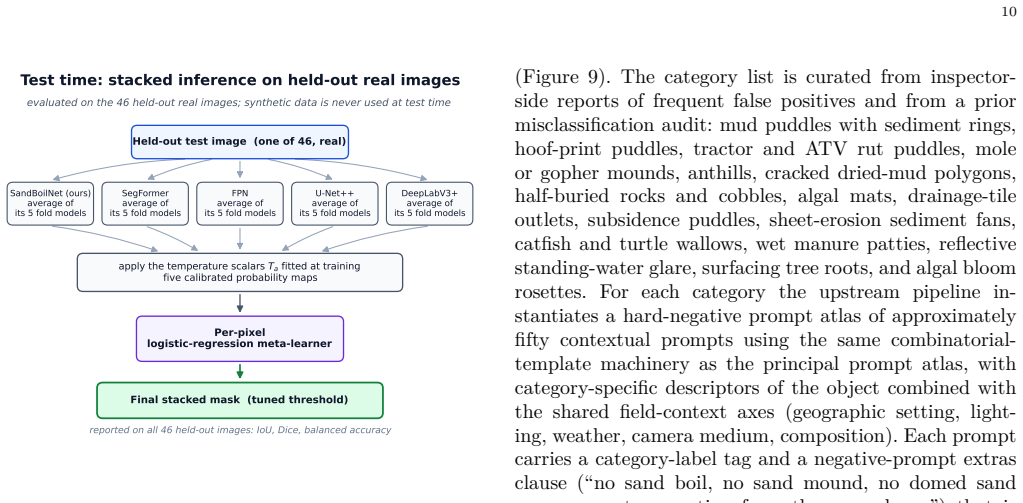
The central object is the leak-free cross-validated stacking protocol: each of five encoder–decoder backbones is trained once per fold, predicts only on its held-out fold, and the resulting out-of-fold cube is recalibrated by one temperature scalar per architecture and combined by a per-pixel logistic-regression meta-learner fitted exclusively on those out-of-fold predictions. The companion mechanism is the parent-image filter: each synthetic record carries a source_image_id pointer to its real parent, and a per-fold set operation excludes any synthetic descendant whose parent sits in that fold's validation split, closing the synthetic-descendant leakage path in O(1). A second, complementary
Load-bearing premise
The synthetic training masks are produced by running the published SandBoilNet probability map through a convex-hull cleaning pipeline, and the label-fidelity admission filter checks a held-out segmenter's agreement with those same auto-generated labels — if the baseline's systematic errors are passed on to its successor, the observed synthetic-data gain (0.718 vs 0.707) may reflect reinforcement of those biases rather than genuinely new, correct signal.
What would settle it
Re-train the champion on a synthetic pool whose labels are generated by an independent segmenter or human-verified masks, using the same diffusion source and filter logic; if the IoU gain over the 0.707 control disappears or reverses, the filter was selecting for agreement with the baseline's own errors, not for label fidelity. Concretely, compare the current filtered-pool result against a pool filtered on human-verified IoU rather than the held-out segmenter's agreement with pseudo-labels.
If this is right
- If the leak-free protocol is correct, any reported gain from weighted-averaging or naive synthetic augmentation in this domain must be re-read as partly an artifact of tuning on the scored split or of parent leakage.
- Stacking's measured failure is attributed to member correlation (mean pairwise error correlation 0.894; five backbones share only three encoders), so future ensemble gains will require genuinely independent feature extractors rather than more decoders on the same encoders.
- Label-fidelity-filtered synthetic data lifts the champion from 0.707 to 0.718 IoU, while unfiltered pools do not; the action is in filtering, not in the generator configuration, since sweeping guidance scale over four values produced no difference.
- The negative hard-negative result (IoU −0.010, false-positive rate up) suggests that confusion-score-weighted synthetic negatives require a closed loop that re-scores against the model being trained, not the frozen baseline.
- The modernized encoder (ConvNeXt-S + scSE) transfers to a second scarce-data defect dataset, indicating the architecture ranking is not an artifact of this particular split.
Where Pith is reading between the lines
- A natural extension is to apply the same parent-image filter and out-of-fold discipline to other synthetic-augmentation regimes in medical or infrastructure imaging, where diffusion-generated descendants of real patient or structure images are becoming common; the source_image_id field is cheap to add at generation time.
- The error-correlation diagnosis suggests a testable recipe: decorrelate by pairing each backbone with a distinct pretrained encoder, and check whether the stacking shortfall (−0.013 IoU) shrinks further than the −0.008 observed when only two encoders were swapped.
- Since the label-fidelity filter leans on the same baseline pseudo-labels that seed the synthetic masks, an editorial caution is warranted: the observed synthetic-data gain may partly reinforce the baseline's biases; re-validating with human-checked masks or a second independent annotator would disentangle genuine signal from inherited error.
- MaskCN's zero-annotation labelling, if it generalises, would decouple dataset size from annotation budget for any segmentation task with a well-defined mask shape, potentially shifting the scarce-data bottleneck from labelling to mask design.
Editorial analysis
A structured set of objections, weighed in public.
Referee Report
Summary. The paper proposes a sand-boil segmentation framework built around a 'leak-free' five-fold cross-validated stacking protocol with per-architecture temperature calibration, a per-fold filter that excludes synthetic descendants of held-out parents, a synthetic hard-negative phase, and a mask-conditioned synthesis route (MaskCN). On 199 training / 46 test images, the Updated SandBoilNet reaches 0.707 IoU versus 0.608 for the published baseline; the calibrated stack reaches 0.681 IoU versus 0.694 for the best fold-averaged member; a label-fidelity-filtered synthetic pool lifts the champion to 0.718 versus a 0.707 control. The paper reports that stacking does not improve on the best single model and that the hard-negative phase does not help, framing these as honest negative results. The central methodological claims are (1) that the protocol closes two named leakage paths and therefore gives unbiased ensemble measurements, and (2) that the updated backbone improves on the published baseline.
Significance. If the protocol is valid, the paper makes a useful contribution to scarce-data defect segmentation: a carefully specified out-of-fold stacking pipeline, a simple parent-tagging filter for synthetic data, per-architecture calibration, extensive meta-learner ablations, bootstrap uncertainty intervals, a cross-dataset check on DeepCrack, and a reproducible artifact with code, checkpoints, and manifests. The reporting of negative results is candid and the sensitivity analysis is more thorough than typical for this area. However, the central validation is undermined by the fact that architecture selection is performed on the held-out test split, which contradicts the 'leak-free/unbiased by construction' claim and calls the headline numbers into question. The synthetic-label circularity is a further load-bearing concern for the synthetic-augmentation contribution.
major comments (2)
- [Section V-A, Table I; Algorithm 1] The family champions are selected on the held-out test set: Section V-A states that the search keeps 'the best performer in each family' and that 'Table I reports the resulting family champions on the held-out test set'; Table I's caption identifies a single 85/15 split, and Table VII uses the same kind of split to choose the scSE attention variant. The same 46-image test set is later used to report the champion's 0.707 IoU and the stack-vs-single comparison (0.681 vs 0.694). Algorithm 1's assertion that 'the held-out test set is first touched at line 6' is therefore false for the overall pipeline: model selection touched it earlier. On 46 test images, selecting among 11 architectures plus attention variants on test IoU can inflate the reported numbers and can change which member is 'best' or whether stacking closes the gap. Please state clearly whether the 85/15 split is an internal val
- [Section III-B; Section V-G] The synthetic positive masks are generated by thresholding the public SandBoilNet probability map through Convex_Hull_Annotator, and the label-fidelity filter admits a synthetic pair only if a held-out segmenter reaches IoU >= 0.70 against that same pseudo-label. The filtered-pool gain (0.718 vs 0.707, Section V-G) may therefore reflect reinforcement of the baseline's biases rather than genuinely new signal. This is load-bearing for the synthetic-augmentation contribution. Please provide independent validation of a sample of synthetic masks (manual review, or agreement with a segmenter trained without SandBoilNet-derived labels), and report the rejection rate of the fidelity filter. Re-deriving labels with 'the strongest segmenter available here' does not remove the concern if that segmenter inherits the same training labels.
minor comments (4)
- [Tables I and II] The 'best single' model differs between Table I (Updated SandBoilNet, 0.707) and Table II (SegFormer, 0.694) because one is a single-split comparison and the other uses fold-averaged predictions. This is stated in captions but should be flagged prominently in the main text to avoid confusion.
- [Section III-B] The label-fidelity admission criterion ('all five cross-validation folds of a held-out segmenter reach IoU 0.70 against the image's own mask') is ambiguous: which segmenter, and what does 'all five folds' mean for a held-out segmenter? Please clarify.
- [Figure 5] The IoU values shown in Figure 5 come from Table I, which is the architecture-search score on the test split. The figure should be labeled as such so readers do not mistake these for unbiased estimates.
- [Section V-G] The three-seed filtered-pool gain of 0.012 ± 0.012 is appropriately described as suggestive, but reporting the individual per-seed values would strengthen this transparency.
Circularity Check
Two leaky/circular steps: architecture selection on the held-out test set and a label-fidelity filter defined against baseline-derived pseudo-labels; the real-only stack negative result retains independent content.
specific steps
-
other
[Section V-A (Table I) and Algorithm 1 comment]
"Table I reports the resulting family champions on the held-out test set, with the original SandBoilNet shown for reference. ... Both the temperature scalars and the meta-learner are fitted only on out-of-fold predictions (lines 5 and 6); the held-out test set is first touched at line 6."
The architecture search and the scSE attention-variant ablation (Table VII) select models using the same 46-image split later used for the headline 0.707 and the 0.681-vs-0.694 stack comparison. Algorithm 1's assertion that the held-out test set is first touched at line 6 is therefore false for the overall pipeline: model selection touched it earlier. Reporting test IoU after selecting the best of 11 architectures and attention variants on that test set makes the reported numbers a selected maximum, not an unbiased estimate. Even if the 'single 85/15 split' is an internal validation split, the text as written identifies the held-out test set as the selection ground truth.
-
self definitional
[Section III-B (synthetic labels and label-fidelity filter); Section V-G]
"The synthetic ground-truth mask is produced by running the synthetic image through the Convex_Hull_Annotator pipeline of [3], [62], which thresholds the public SandBoilNet probability map... Candidates are admitted only where all five cross-validation folds of a held-out segmenter reach an intersection-over-union of 0.70 against the image's own mask, a label-fidelity filter..."
The 'image's own mask' is the pseudo-label obtained by thresholding the public SandBoilNet probability map. The label-fidelity admission filter therefore measures agreement with the same baseline's output, not with independent ground truth. A pool selected for agreement with baseline-derived labels is self-consistent by construction, so the 0.718-vs-0.707 gain attributed to 'filtered for label fidelity' may partly reflect reinforcement of the baseline's systematic errors rather than genuinely correct new signal. The final evaluation on human-labeled test images keeps this from being a fully forced circularity.
full rationale
The paper's central real-only stacking result (calibrated stack 0.681 vs best single 0.694, replicated across eight meta-learners) is an empirical finding with independent content: it is not obtained by fitting a parameter to the same target being predicted, and the out-of-fold protocol is a legitimate construction. However, the paper's 'leak-free' claim is overstated because architecture selection and the scSE attention choice are reported against the held-out test set before the final numbers are measured on that same set. In addition, the synthetic-data contribution relies on a label-fidelity filter whose ground truth is itself derived from the public SandBoilNet probability map, making the 'fidelity' criterion self-referential. The companion-paper self-citation [5] is also load-bearing for the synthetic augmentation claims, though not for the real-only stack conclusion. These issues warrant a moderate circularity/leakage score; they do not reduce the entire derivation to its inputs.
Axiom & Free-Parameter Ledger
free parameters (7)
- Per-architecture temperature T_a =
T_a = 1.10, 1.50, 1.70, 1.20, 1.10 (Table VI)
- Meta-learner weights w and bias b =
Normalized weights 0.201, 0.225, 0.273, 0.152, 0.149; bias not stated
- Decision threshold tau =
Not reported
- Synthetic admission IoU threshold =
0.70
- Loss weights w_bce and w_dice =
0.5 each
- Training hyperparameters (learning rates, weight decay, warmup, early stopping) =
LR 6e-5 to 1e-4; weight decay 1e-4 to 1e-2; patience 30
- Number of folds K and partition seed =
K=5, seed=42
axioms (6)
- standard math Wolpert stacking validity: a meta-learner fitted only on out-of-fold predictions is unbiased
- domain assumption Synthetic pseudo-labels produced by the public SandBoilNet probability map are accurate enough to train on
- domain assumption ImageNet-pretrained encoders transfer to levee-inspection imagery
- domain assumption The 46-image held-out split is representative and sufficiently clean
- domain assumption The diffusion generator's training set excluded the held-out test images
- domain assumption MaskCN's mask-ControlNet reliably renders a sand boil inside the target mask
read the original abstract
Sand boils, points where water seeping beneath an earthen levee re-emerges at the surface, are early warnings of internal erosion, and deep segmentation networks are increasingly used to find them in inspection photographs. Annotated examples are scarce, and two common ways of working around that scarcity quietly inflate reported accuracy: tuning ensemble weights on the same images later used to score them, and training on synthetic images derived from the very photographs held out for testing. We present a sand-boil segmentation framework that closes both loopholes. Every synthetic image carries a pointer to its real parent, and a per-fold filter excludes any image whose parent is held out; five encoder-decoder backbones are trained under five-fold cross-validation, calibrated by one temperature scalar each, and combined by a per-pixel meta-learner fitted only on out-of-fold predictions. On the held-out test set the proposed Updated SandBoilNet reaches an intersection-over-union of 0.707 over three seeds, against 0.608 for the published original re-evaluated on the same split. Under the stacking protocol the calibrated stack reaches 0.681 against 0.694 for the strongest fold-averaged member, so it does not improve on the best single model; eight meta-learner families reproduce that outcome, which we trace to a mean pairwise error correlation of 0.894 among members. A synthetic pool filtered for label fidelity lifts the champion to 0.718 over three seeds against a 0.707 control. We also introduce a mask-conditioned synthesis route that makes the conditioning mask the label by construction, giving labelled training images at zero annotation cost.
Figures




Reference graph
Works this paper leans on
-
[1]
Investigation of the performance of the new orleans flood protection systems in hurricane katrina on august 29, 2005,
R.Seed,R.Bea,A.Athanasopoulos-Zekkosetal.,“Investigation of the performance of the new orleans flood protection systems in hurricane katrina on august 29, 2005,” Independent Levee Investigation Team, University of California Berkeley, Tech. Rep., 2006
2005
-
[2]
Deep learning approach for accurate segmen- tation of sand boils in levee systems,
M. Panta, M. T. Hoque, K. N. Niles, J. Tom, M. Abdelguerfi, and M. Flanagin, “Deep learning approach for accurate segmen- tation of sand boils in levee systems,”IEEE Access, vol. 11, pp. 126263–126282, 2023
2023
-
[3]
Toward robust semantic segmentation in levee in- frastructure monitoring: Enhancing accuracy with high-fidelity synthetic data and ensemble learning,
P. J. Thapa, “Toward robust semantic segmentation in levee in- frastructure monitoring: Enhancing accuracy with high-fidelity synthetic data and ensemble learning,” Master’s Thesis, Uni- versity of New Orleans, New Orleans, LA, USA, 2025, uni- versity of New Orleans Theses and Dissertations No. 3231. https://scholarworks.uno.edu/td/3231/
2025
-
[4]
Stacked generalization,
D. H. Wolpert, “Stacked generalization,”Neural Networks, vol. 5, no. 2, pp. 241–259, 1992
1992
-
[5]
Multi-conditioned diffusion synthesis of sand boils for low-resource earthen-levee inspection,
P. J. Thapa, A. B. Naeem, A. Dey, A. Katwal, and M. T. Hoque, “Multi-conditioned diffusion synthesis of sand boils for low-resource earthen-levee inspection,”arXiv preprint arXiv:2607.08794, 2026. 23
Pith/arXiv arXiv 2026
-
[6]
Deeplearning approaches in pavement distress identification: A review,
S.Guan,H.Liu,H.R.Pourreza,andH.Mahyar,“Deeplearning approaches in pavement distress identification: A review,”arXiv preprint arXiv:2308.00828, 2023
Pith/arXiv arXiv 2023
-
[7]
IterLUNet: Deep learning architecture for pixel-wise crack detection in levee systems,
M. Panta, M. T. Hoque, M. Abdelguerfi, and M. C. Flanagin, “IterLUNet: Deep learning architecture for pixel-wise crack detection in levee systems,”IEEE Access, vol. 11, pp. 12249– 12262, 2023
2023
-
[8]
Application of deeplearningforsegmentingseepagesinleveesystems,
M. Panta, P. J. Thapa, M. T. Hoque, K. N. Niles, S. Sloan, M. Flanagin, K. Pathak, and M. Abdelguerfi, “Application of deeplearningforsegmentingseepagesinleveesystems,”Remote Sensing, vol. 16, no. 13, p. 2441, 2024
2024
-
[9]
Application of deep learning for segmenting seepages in levee systems,
M. Panta, P. J. Thapa, M. T. Hoque, K. N. Niles, S. Sloan, M. Flanagin, K. Pathak, and M. Abdelguerfi, “Application of deep learning for segmenting seepages in levee systems,” Engineer Research and Development Center (US), Vicksburg, MS, Miscellaneous Paper ERDC MP-24-8, Nov. 2024. [Online]. Available: https://hdl.handle.net/11681/49453
2024
-
[10]
Imbalance-aware culvert-sewer defect segmentation using an enhanced feature pyramid network,
R. Alshawi, M. M. Ferdaus, M. Abdelguerfi, K. Niles, K. Pathak, and S. Sloan, “Imbalance-aware culvert-sewer defect segmentation using an enhanced feature pyramid network,”arXiv preprint arXiv:2408.10181, 2024. [Online]. Available: https://arxiv.org/abs/2408.10181
Pith/arXiv arXiv 2024
-
[11]
OilSpillNet: A deep learning framework for accurate detection and segmentation of marine oil spills from imagery,
M. Elsheref, P. J. Thapa, A. Katwal, A. B. Naeem, M. A. Tarr, and M. T. Hoque, “OilSpillNet: A deep learning framework for accurate detection and segmentation of marine oil spills from imagery,”Journal of Environmental Chemical Engineer- ing, vol. 14, no. 2, p. 121714, Apr. 2026
2026
-
[12]
B. Chen, Q. Duan, and L. Luo, “From manual to uav-based inspection: Efficient detection of levee seepage hazards driven by thermal infrared image and deep learning,”International Journal of Disaster Risk Reduction, vol. 114, p. 104982, 2024. [Online]. Available: https://doi.org/10.1016/j.ijdrr.2024.104982
arXiv 2024
-
[13]
Rapid and automatic uav detection of river embankment piping,
Q. Duan, B. Chen, and L. Luo, “Rapid and automatic uav detection of river embankment piping,”Water Resources Research, vol. 61, no. 2, 2025. [Online]. Available: https: //doi.org/10.1029/2024WR038931
-
[14]
Z. Wang, R. Liet al., “Automated detection of embankment piping and leakage hazards using uav visible light imagery: A frequency-enhanced deep learning approach,”Remote Sensing, vol. 17, no. 21, p. 3602, 2025. [Online]. Available: https: //doi.org/10.3390/rs17213602
-
[15]
Pruned u-net with multi-scale feature fusion and attention for real-time uav remote sensing of levee defects,
B. Wu, B. Chen, X. Jiang, and Z. Liu, “Pruned u-net with multi-scale feature fusion and attention for real-time uav remote sensing of levee defects,”Scientific Reports, vol. 15, p. 42354, 2025. [Online]. Available: https://doi.org/10.1038/ s41598-025-26431-0
2025
-
[16]
Machine learning applications in detecting sand boils from images,
A. Kuchi, M. T. Hoque, M. Abdelguerfi, and M. C. Flanagin, “Machine learning applications in detecting sand boils from images,”Array, vol. 3, p. 100012, 2019
2019
-
[17]
A depth-wise separable U-Net architecture with multiscale filters to detect sinkholes,
R. Alshawi, M. T. Hoque, and M. C. Flanagin, “A depth-wise separable U-Net architecture with multiscale filters to detect sinkholes,”Remote Sensing, vol. 15, no. 5, p. 1384, 2023
2023
-
[18]
Earthen levee monitoring with synthetic aperture radar,
J. V. Aanstoos, K. Hasan, C. G. O’Hara, S. Prasad, L. Dab- biru, M. Mahrooghy, B. Gokaraju, and R. Nobrega, “Earthen levee monitoring with synthetic aperture radar,” in2011 IEEE Applied Imagery Pattern Recognition Workshop (AIPR), 2011
2011
-
[19]
A survey on deep learning techniques for image and video semantic seg- mentation,
A. Garcia-Garcia, S. Orts-Escolano, S. Opreaet al., “A survey on deep learning techniques for image and video semantic seg- mentation,”Applied Soft Computing, vol. 70, pp. 41–65, 2018
2018
-
[20]
Fully convolutional networks for semantic segmentation,
J. Long, E. Shelhamer, and T. Darrell, “Fully convolutional networks for semantic segmentation,” inProceedings of the IEEE Conference on Computer Vision and Pattern Recognition (CVPR), 2015
2015
-
[21]
Pyramid scene parsing network,
H. Zhao, J. Shi, X. Qi, X. Wang, and J. Jia, “Pyramid scene parsing network,” inProceedings of the IEEE Conference on Computer Vision and Pattern Recognition (CVPR), 2017
2017
-
[22]
SegNet: A deep convolutional encoder-decoder architecture for image seg- mentation,
V. Badrinarayanan, A. Kendall, and R. Cipolla, “SegNet: A deep convolutional encoder-decoder architecture for image seg- mentation,”IEEE Transactions on Pattern Analysis and Ma- chine Intelligence, vol. 39, no. 12, pp. 2481–2495, 2017
2017
-
[23]
Rethink- ing atrous convolution for semantic image segmentation,
L.-C.Chen, G.Papandreou,F. Schroff, and H.Adam, “Rethink- ing atrous convolution for semantic image segmentation,”arXiv preprint arXiv:1706.05587, 2017
Pith/arXiv arXiv 2017
-
[24]
U-Net:Convolutional networks for biomedical image segmentation,
O.Ronneberger,P.Fischer,andT.Brox,“U-Net:Convolutional networks for biomedical image segmentation,” inMedical Image Computing and Computer-Assisted Intervention (MICCAI), 2015
2015
-
[25]
MultiResUNet: Rethinking the u-net architecture for multimodal biomedical image segmenta- tion,
N. Ibtehaz and M. S. Rahman, “MultiResUNet: Rethinking the u-net architecture for multimodal biomedical image segmenta- tion,”Neural Networks, vol. 121, pp. 74–87, 2020
2020
-
[26]
UNet++: A nested U-Net architecture for medical image segmentation,
Z. Zhou, M. M. Rahman Siddiquee, N. Tajbakhsh, and J. Liang, “UNet++: A nested U-Net architecture for medical image segmentation,” inDeep Learning in Medical Image Analysis (DLMIA), 2018
2018
-
[27]
Attention U- Net: Learning where to look for the pancreas,
O. Oktay, J. Schlemper, L. L. Folgocet al., “Attention U- Net: Learning where to look for the pancreas,”arXiv preprint arXiv:1804.03999, 2018
Pith/arXiv arXiv 2018
-
[28]
Deepcrack: A deep hierarchical feature learning architecture for crack segmentation,
Y. Liu, J. Yao, X. Lu, R. Xie, and L. Li, “Deepcrack: A deep hierarchical feature learning architecture for crack segmentation,”Neurocomputing, vol. 338, pp. 139–153, 2019. [Online]. Available: https://doi.org/10.1016/j.neucom.2019.01. 036
-
[29]
Crackformer network for pavement crack segmentation,
H. Liu, J. Yang, X. Miao, C. Mertz, and H. Kong, “Crackformer network for pavement crack segmentation,”IEEE Transactions onIntelligentTransportationSystems,2023.[Online].Available: https://doi.org/10.1109/TITS.2023.3266776
arXiv 2023
-
[30]
Masked-attention mask transformer for universal image segmentation,
B. Cheng, I. Misra, A. G. Schwing, A. Kirillov, and R. Girdhar, “Masked-attention mask transformer for universal image segmentation,” inProceedings of the IEEE/CVF Conference on Computer Vision and Pattern Recognition (CVPR), 2022. [Online]. Available: https://arxiv.org/abs/2112.01527
Pith/arXiv arXiv 2022
-
[31]
Fine-tuning vision foundation model for crack segmentation in civil infrastructures,
K. Ge, C. Wang, Y. Guo, Y. Tang, Z. Hu, and H. Chen, “Fine-tuning vision foundation model for crack segmentation in civil infrastructures,”arXiv preprint arXiv:2312.04233, 2023. [Online]. Available: https://arxiv.org/abs/2312.04233
Pith/arXiv arXiv 2023
-
[32]
Application of segment anything model for civil infrastructure defect assessment,
M. Ahmadi, A. G. Lonbar, H. K. Naeini, A. T. Beris, M. Nouri, A. S. Javidi, and A. Sharifi, “Application of segment anything model for civil infrastructure defect assessment,” arXiv preprint arXiv:2304.12600, 2023. [Online]. Available: https://arxiv.org/abs/2304.12600
Pith/arXiv arXiv 2023
-
[33]
Crackseg9k: A collection and benchmark for crack segmentation datasets and frameworks,
S. Kulkarni, S. Singh, D. Balakrishnan, S. Sharma, S. Devunuri, and S. C. R. Korlapati, “Crackseg9k: A collection and benchmark for crack segmentation datasets and frameworks,” in European Conference on Computer Vision (ECCV) Workshops, ser. Lecture Notes in Computer Science, vol. 13807, 2022. [Online]. Available: https://arxiv.org/abs/2208.13054
Pith/arXiv arXiv 2022
-
[34]
Omnicrack30k: A benchmark for crack segmentation and the reasonable effectiveness of transfer learning,
C. Benz and V. Rodehorst, “Omnicrack30k: A benchmark for crack segmentation and the reasonable effectiveness of transfer learning,” inProceedings of the IEEE/CVF Conference on Computer Vision and Pattern Recognition (CVPR) Workshops,
-
[35]
Few-shot semantic segmentation: a review of methodologies, benchmarks, and open challenges,
N. Catalano and M. Matteucci, “Few-shot semantic segmentation: a review of methodologies, benchmarks, and open challenges,”arXiv preprint arXiv:2304.05832, 2023. [Online]. Available: https://arxiv.org/abs/2304.05832
Pith/arXiv arXiv 2023
-
[36]
R. Jiao, Y. Zhang, L. Ding, B. Xue, J. Zhang, R. Cai, and C. Jin, “Learning with limited annotations: A survey on deep semi-supervised learning for medical image segmentation,” Computers in Biology and Medicine, 2023. [Online]. Available: https://arxiv.org/abs/2207.14191
Pith/arXiv arXiv 2023
-
[37]
Datasetgan: Efficient labeled data factory with minimal human effort,
Y. Zhang, H. Ling, J. Gao, K. Yin, J.-F. Lafleche, A. Barriuso, A. Torralba, and S. Fidler, “Datasetgan: Efficient labeled data factory with minimal human effort,” inProceedings of the IEEE/CVF Conference on Computer Vision and Pattern Recognition (CVPR), 2021. [Online]. Available: https: //arxiv.org/abs/2104.06490
Pith/arXiv arXiv 2021
-
[38]
T. Jin, X. W. Ye, and Z. X. Li, “Establishment and evaluationofconditionalGAN-basedimagedatasetforsemantic segmentation of structural cracks,”Engineering Structures, vol. 285, p. 116058, 2023. [Online]. Available: https://doi.org/10. 1016/j.engstruct.2023.116058
arXiv 2023
-
[39]
Diffumask: Synthesizing images with pixel-level annotations for semantic segmentation using diffusion models,
W.Wu,Y.Zhao,M.Z.Shou,H.Zhou,andC.Shen,“Diffumask: Synthesizing images with pixel-level annotations for semantic segmentation using diffusion models,” inProceedings of the IEEE/CVF International Conference on Computer Vision (ICCV), 2023. [Online]. Available: https://arxiv.org/abs/2303. 11681
2023
-
[41]
Adding conditional control to text-to-image diffusion models,
L. Zhang, A. Rao, and M. Agrawala, “Adding conditional control to text-to-image diffusion models,” inProceedings of 24 the IEEE/CVF International Conference on Computer Vision (ICCV), 2023
2023
-
[42]
Dreambooth: Fine tuning text-to-image diffu- sion models for subject-driven generation,
N. Ruiz, Y. Li, V. Jampani, Y. Pritch, M. Rubinstein, and K. Aberman, “Dreambooth: Fine tuning text-to-image diffu- sion models for subject-driven generation,” inProceedings of the IEEE/CVF Conference on Computer Vision and Pattern Recognition (CVPR), 2023
2023
-
[43]
LoRA: Low-rank adaptation of large language models,
E. J. Hu, Y. Shen, P. Wallis, Z. Allen-Zhu, Y. Li, S. Wang, L. Wang, and W. Chen, “LoRA: Low-rank adaptation of large language models,” inInternational Conference on Learning Representations (ICLR), 2022
2022
-
[44]
J. Leiñena, F. A. Saiz, and I. Barandiaran, “Latent diffusion models to enhance the performance of visual defect segmentation networks in steel surface inspection,” Sensors, vol. 24, no. 18, p. 6016, 2024. [Online]. Available: https://doi.org/10.3390/s24186016
-
[45]
Synthetic data from diffusion models improves ImageNet clas- sification,
S. Azizi, S. Kornblith, C. Saharia, M. Norouzi, and D. J. Fleet, “Synthetic data from diffusion models improves ImageNet clas- sification,”Transactions on Machine Learning Research, 2023
2023
-
[46]
Effective data augmentation with diffusion models,
B. Trabucco, K. Doherty, M. Gurinas, and R. Salakhutdinov, “Effective data augmentation with diffusion models,” in International Conference on Learning Representations (ICLR),
-
[47]
Simple copy-paste is a strong data augmentation method for instance segmentation,
G. Ghiasi, Y. Cui, A. Srinivas, R. Qian, T.-Y. Lin, E. D. Cubuk, Q. V. Le, and B. Zoph, “Simple copy-paste is a strong data augmentation method for instance segmentation,” in Proceedings of the IEEE/CVF Conference on Computer Vision and Pattern Recognition (CVPR), 2021. [Online]. Available: https://arxiv.org/abs/2012.07177
Pith/arXiv arXiv 2021
-
[48]
Cutmix: Regularization strategy to train strong classifiers with localizable features,
S. Yun, D. Han, S. J. Oh, S. Chun, J. Choe, and Y. J. Yoo, “Cutmix: Regularization strategy to train strong classifiers with localizable features,” inProceedings of the IEEE/CVF International Conference on Computer Vision (ICCV), 2019. [Online]. Available: https://arxiv.org/abs/1905.04899
Pith/arXiv arXiv 2019
-
[49]
Available: https://arxiv.org/abs/2302.07944
[Online]. Available: https://arxiv.org/abs/2302.07944
-
[50]
Leakage and the reproducibility crisis in machine-learning-based science,
S. Kapoor and A. Narayanan, “Leakage and the reproducibility crisis in machine-learning-based science,”Patterns, vol. 4, no. 9, p. 100804, 2023. [Online]. Available: https://doi.org/10.1016/j. patter.2023.100804
arXiv 2023
-
[51]
Don’t push the button! exploring data leakage risks in machine learning and transfer learning,
A. Apicella, F. Isgrò, and R. Prevete, “Don’t push the button! exploring data leakage risks in machine learning and transfer learning,”Artificial Intelligence Review, vol. 58, 2025. [Online]. Available: https://doi.org/10.1007/s10462-025-11326-3
-
[52]
Syntheticallyenhanced: unveiling synthetic data’s potential in medical imaging research,
B.Khosravi,F.Li,T.Dapamedeetal.,“Syntheticallyenhanced: unveiling synthetic data’s potential in medical imaging research,”eBioMedicine, vol. 104, p. 105174, 2024. [Online]. Available: https://www.thelancet.com/journals/ebiom/article/ PIIS2352-3964(24)00209-3/fulltext
2024
-
[53]
Improvement of concrete crack segmentation performance using stacking ensemble learning,
T. Lee, J.-H. Kim, S.-J. Lee, S.-K. Ryu, and B.-C. Joo, “Improvement of concrete crack segmentation performance using stacking ensemble learning,”Applied Sciences, vol. 13, no. 4, p. 2367, 2023. [Online]. Available: https://doi.org/10. 3390/app13042367
2023
-
[54]
Simple and scalable predictive uncertainty estimation using deep ensembles,
B. Lakshminarayanan, A. Pritzel, and C. Blundell, “Simple and scalable predictive uncertainty estimation using deep ensembles,” inAdvances in Neural Information Processing Systems (NeurIPS), 2017. [Online]. Available: https://arxiv. org/abs/1612.01474
Pith/arXiv arXiv 2017
-
[55]
A performance improvement strategy for concrete damage detection using stacking ensemble learning of multiple semantic segmentation networks,
S. Li and X. Zhao, “A performance improvement strategy for concrete damage detection using stacking ensemble learning of multiple semantic segmentation networks,”Sensors, vol. 22, no. 9, p. 3341, 2022. [Online]. Available: https://doi.org/10. 3390/s22093341
2022
-
[56]
On calibrating semantic segmentation models: Analyses and an algorithm,
D. Wang, B. Gong, and L. Wang, “On calibrating semantic segmentation models: Analyses and an algorithm,” in Proceedings of the IEEE/CVF Conference on Computer Vision and Pattern Recognition (CVPR), 2023. [Online]. Available: https://arxiv.org/abs/2212.12053
Pith/arXiv arXiv 2023
-
[57]
Training region- based object detectors with online hard example mining,
A. Shrivastava, A. Gupta, and R. Girshick, “Training region- based object detectors with online hard example mining,” in Proceedings of the IEEE Conference on Computer Vision and Pattern Recognition (CVPR), 2016
2016
-
[58]
On calibra- tion of modern neural networks,
C. Guo, G. Pleiss, Y. Sun, and K. Q. Weinberger, “On calibra- tion of modern neural networks,” inInternational Conference on Machine Learning (ICML), 2017
2017
-
[59]
Segment anything,
A. Kirillov, E. Mintun, N. Ravi, H. Mao, C. Rolland, L. Gustafsonet al., “Segment anything,” inProceedings of the IEEE/CVF International Conference on Computer Vision (ICCV), 2023
2023
-
[60]
Synthetic sand boil dataset for levee monitoring,
P. J. Thapa and M. T. Hoque, “Synthetic sand boil dataset for levee monitoring,” IEEE DataPort, Sep. 2024. [Online]. Available: https://ieee-dataport.org/ documents/synthetic-sand-boil-dataset-levee-monitoring
2024
-
[61]
Levee owner’s manual for non- federal flood control works,
U. A. C. of Engineers, “Levee owner’s manual for non- federal flood control works,” https://www.mvr.usace.army.mil/ Portals/48/docs/EC/LSP/LeveeOwnersManual.pdf, accessed 2025-02-17
2025
-
[62]
Convex_Hull_Annotator: Automated convex- hull mask annotation from a SandBoilNet probability map,
P. J. Thapa, “Convex_Hull_Annotator: Automated convex- hull mask annotation from a SandBoilNet probability map,” https://github.com/padam56/Convex_Hull_Annotator, 2024, companion tool to [3]; applies thresholding, connected- component analysis, and per-component convex hulls to a CNN- predicted sandboil probability map
2024
-
[63]
DPM- Solver: A fast ODE solver for diffusion probabilistic model sampling in around 10 steps,
C. Lu, Y. Zhou, F. Bao, J. Chen, C. Li, and J. Zhu, “DPM- Solver: A fast ODE solver for diffusion probabilistic model sampling in around 10 steps,”Advances in Neural Information Processing Systems (NeurIPS), 2022
2022
-
[64]
Synthetic animal burrow dataset for levee monitoring,
P. J. Thapa and M. T. Hoque, “Synthetic animal burrow dataset for levee monitoring,” IEEE DataPort, Jun. 2025. [Online]. Available: https://ieee-dataport.org/ documents/synthetic-animal-burrow-dataset-levee-monitoring
2025
-
[65]
A ConvNet for the 2020s,
Z. Liu, H. Mao, C.-Y. Wu, C. Feichtenhofer, T. Darrell, and S. Xie, “A ConvNet for the 2020s,” inProceedings of the IEEE/CVFConferenceonComputerVisionandPatternRecog- nition (CVPR), 2022
2022
-
[66]
SegFormer: Simple and efficient design for semantic segmentation with transformers,
E. Xie, W. Wang, Z. Yu, A. Anandkumar, J. M. Alvarez, and P. Luo, “SegFormer: Simple and efficient design for semantic segmentation with transformers,” inAdvances in Neural Infor- mation Processing Systems (NeurIPS), 2021
2021
-
[67]
Concurrent spatial and channel squeeze & excitation in fully convolutional net- works,
A. G. Roy, N. Navab, and C. Wachinger, “Concurrent spatial and channel squeeze & excitation in fully convolutional net- works,” inMedical Image Computing and Computer Assisted Intervention (MICCAI), 2018
2018
-
[68]
Feature pyramid networks for object detection,
T.-Y. Lin, P. Dollár, R. Girshick, K. He, B. Hariharan, and S. Belongie, “Feature pyramid networks for object detection,” inProceedings of the IEEE Conference on Computer Vision and Pattern Recognition (CVPR), 2017
2017
-
[69]
MA-Net: A multi-scale attention network for liver and tumor segmentation,
T. Fan, G. Wang, Y. Li, and H. Wang, “MA-Net: A multi-scale attention network for liver and tumor segmentation,”IEEE Access, vol. 8, pp. 179656–179665, 2020
2020
-
[70]
EfficientNet: Rethinking model scaling for convolutional neural networks,
M. Tan and Q. V. Le, “EfficientNet: Rethinking model scaling for convolutional neural networks,” inProceedings of the 36th International Conference on Machine Learning (ICML), 2019
2019
-
[71]
Squeeze-and-excitation networks,
J. Hu, L. Shen, and G. Sun, “Squeeze-and-excitation networks,” inProceedings of the IEEE Conference on Computer Vision and Pattern Recognition (CVPR), 2018. [Online]. Available: https://arxiv.org/abs/1709.01507
Pith/arXiv arXiv 2018
-
[72]
XGBoost: A scalable tree boosting system,
T. Chen and C. Guestrin, “XGBoost: A scalable tree boosting system,” inProceedings of the 22nd ACM SIGKDD Interna- tional Conference on Knowledge Discovery and Data Mining (KDD), 2016
2016
-
[73]
Encoder-decoder with atrous separable convolution for seman- tic image segmentation,
L.-C. Chen, Y. Zhu, G. Papandreou, F. Schroff, and H. Adam, “Encoder-decoder with atrous separable convolution for seman- tic image segmentation,” inEuropean Conference on Computer Vision (ECCV), 2018
2018
-
[74]
Segmentation models PyTorch,
P. Iakubovskii, “Segmentation models PyTorch,” https:// github.com/qubvel/segmentation_models.pytorch, 2019
2019
-
[75]
Albumentations: Fast and flexible image augmentations,
A. Buslaev, V. I. Iglovikov, E. Khvedchenya, A. Parinov, M. Druzhinin, and A. A. Kalinin, “Albumentations: Fast and flexible image augmentations,”Information, vol. 11, no. 2, p. 125, 2020
2020
-
[76]
PyTorch: An imperative style, high-performance deep learning library,
A. Paszke, S. Gross, F. Massa, A. Lerer, J. Bradbury, G.Chanan,T.Killeen,Z.Lin,N.Gimelshein,L.Antiga,A.Des- maison, A. Köpf, E. Yang, Z. DeVito, M. Raison, A. Tejani, S. Chilamkurthy, B. Steiner, L. Fang, J. Bai, and S. Chintala, “PyTorch: An imperative style, high-performance deep learning library,” inAdvances in Neural Information Processing Systems (Ne...
2019
-
[77]
Sam 2: Segment anything in images and videos,
N. Ravi, V. Gabeur, Y.-T. Huet al., “Sam 2: Segment anything in images and videos,”arXiv preprint arXiv:2408.00714, 2024. [Online]. Available: https://arxiv.org/abs/2408.00714
Pith/arXiv arXiv 2024
-
[79]
Scikit-learn: Ma- chine learning in Python,
F. Pedregosa, G. Varoquaux, A. Gramfort, V. Michel, B. Thirion, O. Grisel, M. Blondel, P. Prettenhofer, R. Weiss, V. Dubourg, J. Vanderplas, A. Passos, D. Cournapeau, M. Brucher, M. Perrot, and É. Duchesnay, “Scikit-learn: Ma- chine learning in Python,”Journal of Machine Learning Re- search, vol. 12, pp. 2825–2830, 2011
2011
-
[2023]
Available: https://arxiv.org/abs/2311.17121
[Online]. Available: https://arxiv.org/abs/2311.17121
-
[2024]
Available: https://openaccess.thecvf.com/ content/CVPR2024W/VAND/papers/Benz_OmniCrack30k_ A_Benchmark_for_Crack_Segmentation_and_the_ Reasonable_Effectiveness_CVPRW_2024_paper.pdf
[Online]. Available: https://openaccess.thecvf.com/ content/CVPR2024W/VAND/papers/Benz_OmniCrack30k_ A_Benchmark_for_Crack_Segmentation_and_the_ Reasonable_Effectiveness_CVPRW_2024_paper.pdf
discussion (0)
Sign in with ORCID, Apple, or X to comment. Anyone can read and Pith papers without signing in.