REVIEW 3 major objections 6 minor 55 references
SpeechLLM Meets Federated Learning for End-to-End ASR: English and Italian Case Studies
T0 review · 3 major / 6 minor · reviewed 2026-08-15 · deepseek-v4-flash
Pith's one-line read This paper argues that a SpeechLLM-based ASR system can be trained federatively, with raw audio kept on devices, by exchanging only low-rank adapter and projector parameters, reaching near-centralized word error rates on English and…
desk verdict Useful empirical recipe for PEFT-only federated SpeechLLM ASR, with plausible results; the central-baseline budget is missing and Section V-E has a numeric inconsistency that needs fixing. read the letter →
The pith
A machine-rendered reading of the paper's core claim, the machinery that carries it, and where it could break.
The reading
What carries the argument
The load-bearing mechanism is a federated aggregation loop that transmits only the trainable parameters—the two-stage linear projector and the LoRA low-rank matrices attached to the frozen language model backbone—plus a modified FedAvg rule in which every client uses the same exponentially decaying learning rate, $\eta_t = \eta_0 \gamma^{\lfloor t/\tau \rfloor}$ with $\eta_0 = 0.001$, $\gamma = 0.9$, and $\tau = 10$. This schedule is what distinguishes Adaptive FedAvg from vanilla FedAvg in the comparison, and the architecture's separation of frozen backbone from small trainable adapters keeps communication and local computation low enough for federated training to be practical.
What would settle it
Retrain the centralized models with the same effective number of optimizer updates as the federated pipeline (100 rounds, 30% of clients per round, 10 local epochs per client) and compare WER; if central WER drops below the reported 6.1% on LibriSpeech or 20.1% on MLS Italian, the claimed parity is an artifact of unequal compute rather than an efficient federated method.
Extended reading notes
Core claim
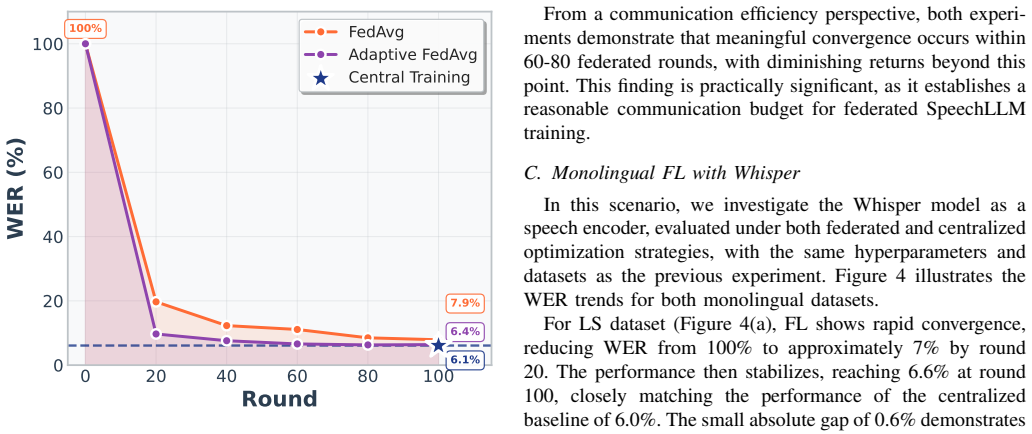
The central discovery is that federated optimization of a SpeechLLM-based ASR system is stable and effective when the trainable parameter set is restricted to the projector and LoRA modules, and when client learning rates follow a shared exponential decay. With WavLM as encoder, federated training reaches 6.4% WER on LibriSpeech test-clean against 6.1% for centralized training; with Whisper-medium, 6.6% against 6.0%. On Italian MLS, the federated model trails centralized training by roughly 2 percentage points with WavLM (22.6% vs 20.1%) and by about 1 point with Whisper (18.7% vs 17.5%). The paper also reports that full fine-tuning of the encoder does not converge in the federated setting, while the modular SpeechLLM converges, and that a multilingual joint run attains near-parity on Italian but a larger gap on English.
Load-bearing premise
The claim that federated training is competitive depends on the centralized baseline having been given a fair training budget; the paper reports the federated schedule in detail but omits the central baseline's optimizer, schedule, and number of updates, so the parity comparisons could reflect an under-trained central model.
Editorial extensions
If this is right
- Federated SpeechLLM ASR can reach word error rates within a few tenths of a point of centralized training on LibriSpeech and within about one to two points on MLS Italian in the monolingual setups.
- Communication cost scales with the roughly 8.4 million trainable parameters of the adapter path, not the 1.1-billion-parameter backbone, so federated deployment of larger LLM backbones remains feasible as long as adapters stay small.
- The unified exponential learning-rate schedule yields faster early convergence than vanilla FedAvg, with 9.7% versus 19.7% WER at round 20 on LibriSpeech and a better final model at round 100.
- Encoder choice matters: Whisper-medium, with multilingual pretraining, shows smaller centralized-federated gaps than WavLM, especially on Italian, suggesting that multilingual robustness transfers to federated optimization.
- Full fine-tuning of the speech encoder is not viable under this federated protocol because it fails to converge, so parameter-efficient adaptation is not just a bandwidth convenience but a stability requirement.
Reading between the lines
- Editorial inference: if the parity holds under matched compute budgets, the practical baseline for private ASR shifts from small on-device models to federated fine-tuning of large speech LLMs; the main remaining bottleneck would be client-side memory for running the frozen backbone.
- Editorial inference: the unified decay schedule can be read as a form of global learning-rate control that reduces client drift, and a testable extension is to replace the round-indexed schedule with a client-adaptive or loss-based schedule to handle stronger non-IID conditions.
- Editorial inference: the multilingual result, near-parity on Italian but a larger gap on English, suggests the joint federated model underfits the larger or lower-error language; a testable extension is to weight client aggregation by language or use per-language learning rates.
- Editorial inference: the communication-cost argument would be strengthened by reporting bytes-per-round directly; a reader could estimate it from the adapter size, but a direct measurement would let operators trade round count against bandwidth.
Signed reviews
Editorial analysis
A structured set of objections, weighed in public.
Referee Report
Summary. The paper proposes a federated learning framework for SpeechLLM-based end-to-end ASR. The architecture freezes a speech encoder (WavLM-Large or Whisper-Medium) and a TinyLlama-1.1B backbone, training only LoRA adapters and a linear projector; federated aggregation is performed with a modified FedAvg that uses a unified exponential learning-rate decay. Experiments are reported on LibriSpeech-100 (English) and the Italian portion of MLS, comparing federated training against centralized training, comparing WavLM and Whisper encoders, and comparing SpeechLLM against full fine-tuning and adapter baselines. The central claim is that federated training with only PEFT parameters updated achieves near-centralized WER on English and competitive WER on Italian while reducing communication costs.
Significance. If the claims hold, the paper would provide a useful empirical datapoint: a frozen SpeechLLM with only LoRA and projector parameters can be federated across per-speaker clients and approach centralized performance on clean read speech. The experimental design is clear in its use of two languages, two encoders, and a PEFT ablation, and the communication-efficiency argument is underpinned by explicit parameter counts. The paper also ships a public code repository, which is a reproducibility strength even though the preprint does not pin a version. However, the central empirical comparison is currently under-specified: the federated budget is detailed while the centralized baseline budget is not, and at least one numeric claim in the multilingual section is internally inconsistent. These issues bear directly on the paper's main conclusion and must be resolved before the results can be accepted at face value.
major comments (3)
- [§IV-C, §V-A–V-E] The central-training comparison is not controlled. Section IV-C specifies the federated budget in detail (100 rounds, 30% of clients sampled per round, 10 local epochs per client), which implies roughly 300 full-data passes over the corpus. Nowhere do the authors report the central baselines' optimizer, learning-rate schedule, number of epochs or steps, or early-stopping criterion. If the centralized runs in Figures 2–5 and Table II used a conventional 20–30 epoch fine-tune, the federated runs consumed an order of magnitude more updates, and the 'near-centralized performance' claim in Section VI would reflect a compute advantage rather than an efficient method. Please report the full central training budget and, ideally, compare at matched update counts or state why the comparison is fair despite the budget asymmetry.
- [§V-E, Fig. 5] The multilingual results are numerically inconsistent. The text states that federated training achieves 19.7% WER on MLS Italian and centralized training 18.4%, then calls the gap 'negligible 0.3 percentage points (actually outperforming)'. The arithmetic is 19.7 − 18.4 = 1.3 percentage points, and the gap favors centralized training, not federated learning. This contradicts the claim and the conclusion of near-parity on Italian; the numbers and the wording must be corrected.
- [§V-A–V-E, Table II] All reported WERs appear to come from single runs, yet several central claims rest on small absolute differences: 6.4% vs 6.1% in Section V-A, 6.6% vs 6.0% in Section V-C, and 18.7% vs 17.5% in Section V-C. Without multiple seeds, error bars, or a significance test, statements such as 'effectively matching' and 'negligible gap' are not statistically supported. Please provide variance estimates or repeated-run results for the key comparisons, or explicitly justify why single runs are sufficient.
minor comments (6)
- [§IV-C] The sentence 'All FL results marked as —-,—- ... compared with those achieved with central training marked as ⋆,⋆' appears to have lost its formatting; please define the symbols in the text and in each figure legend so the comparisons are unambiguous.
- [§V-B, Fig. 3(b)] The text reports the federated Italian WER as 'approximately 22%' while the figure label shows 22.6%; please harmonize the numbers.
- [§V-E] There is a typo in 'both datsets' and a stray period in '18.4.%'; please proofread the final version.
- [§III-D] The text says 'only the adapter parameters are updated' while Section III-A and III-E state that LoRA and projector parameters are trained; please clarify whether 'adapter' refers to the projector only or to both the projector and LoRA modules.
- [§III-E, Eq. (1)] The symbol N is used both for the total number of clients in Figure 1 and for the number of participating clients in Equation (1); please use distinct notation to avoid ambiguity.
- [§II, Abstract] The abstract claims the 'first systematic study' of federated SpeechLLM training, but the related work already discusses FL for PEFT-based ASR; please temper the novelty statement or explicitly distinguish the present contribution from [8], [19]–[22].
Circularity Check
No significant circularity: the WER claims are empirical measurements against external benchmarks and internal training runs, and the only self-citations are background/comparative, not load-bearing.
full rationale
The paper makes no first-principles derivation that could reduce to its inputs. The central claims, e.g., 'the FL pipeline achieves a WER of 6.4%, effectively matching the centralized training baseline of approximately 6.1%' (Section V-B) and 'federated training achieves 18.7% WER compared to 17.5%' (Section V-C), are direct experimental measurements on held-out test sets, computed by a standard FedAvg loop (Eq. 1) plus the explicit exponential scheduler in Eq. (2). No parameter is fitted to the reported WER outcome and then renamed a prediction, and no result is derived from the definition of another result. The only self-citations are [8]-[10] in related-work framing and the WavLM EL-adapter row in Table II; these are not used to force the SpeechLLM federated-versus-central comparison, so removing them would not change the main measured result. The comparison against 'central training' is an internal empirical baseline; the manuscript does not report the central runs' optimizer, epochs, or schedule, which is a reproducibility/fairness weakness of the evaluation, but it is not circular: a fair or unfair baseline is still an independent measurement, not a restatement of the model definition. External anchors (LibriSpeech/MLS, WavLM, Whisper, TinyLlama, LoRA, Flower) make the evaluation self-contained against external benchmarks. Hence no self-definitional, fitted-input, uniqueness-import, ansatz-smuggling, or renaming pattern is present, and no circular step can be quoted.
Assumptions & free parameters
free parameters (6)
- initial learning rate eta_0 =
0.001
- LR decay factor gamma =
0.9
- LR decay period tau =
10 rounds
- local epochs per client per round =
10
- client participation fraction =
30%
- number of FL rounds =
100
assumptions (4)
- domain assumption Averaging LoRA and projector weights from clients with FedAvg (Eq. 1) produces a valid global model that converges on non-IID speech data.
- domain assumption Freezing the speech encoder and LLM while training only LoRA and projector layers preserves enough task-specific knowledge for ASR.
- domain assumption Partitioning LibriSpeech and MLS by speaker creates a realistic federated non-IID setting.
- domain assumption WER is the appropriate and sufficient metric for comparing federated and centralized ASR quality.
Cite this review
Pith. "Pith review of SpeechLLM Meets Federated Learning for End-to-End ASR: English and Italian Case Studies." pith.science (2026). https://pith.science/paper/TQZAHDAJ
@misc{pith2026260725716,
  author       = {Pith},
  title        = {Pith review of: SpeechLLM Meets Federated Learning for End-to-End ASR: English and Italian Case Studies},
  year         = {2026},
  howpublished = {\url{https://pith.science/paper/TQZAHDAJ}},
  note         = {Machine review of arXiv:2607.25716}
}
read the original abstract
Federated learning (FL) enables privacy-preserving training of automatic speech recognition (ASR) systems across distributed data sources, yet its application to large-scale speech language models (SpeechLLMs) remains unexplored. This paper presents the first systematic study of federated training for SpeechLLM-based end-to-end ASR systems. We design a communication-efficient federated optimization strategy tailored to the unique challenges of SpeechLLM architectures, addressing high-dimensional parameter spaces, gradient communication overhead, and computational constraints in distributed settings. Through extensive empirical evaluation on monolingual ASR tasks in English and Italian, we demonstrate the effectiveness and stability of our federated approach compared to centralized training baselines across diverse acoustic conditions and speaking styles. Additionally, we conduct a comprehensive ablation study analyzing the impact of different speech encoder architectures on monolingual English ASR performance within the federated framework, providing insights into optimal model configurations for decentralized training. Our results achieve competitive word error rates while reducing communication costs, establishing practical foundations for federated SpeechLLM deployment in real-world multilingual scenarios.
Figures


Figures from the paper (2 more)


Reference graph
Works this paper leans on
-
[1]
M. U. Hadiet al., “Large language models: a comprehensive survey of its applications, challenges, limitations, and future prospects,”Authorea preprints, vol. 1, no. 3, pp. 1–26, 2023
work page 2023
-
[2]
Mm-llms: Recent advances in multimodal large language models,
D. Zhanget al., “Mm-llms: Recent advances in multimodal large language models,”In Proc. of ACL 2024, pp. 12 401–12 430, 2024
work page 2024
-
[3]
Speech recognition meets large language model: Bench- marking, models, and exploration,
Z. Maet al., “Speech recognition meets large language model: Bench- marking, models, and exploration,” inProceedings of the AAAI Confer- ence on Artificial Intelligence, vol. 39, no. 23, 2025, pp. 24 840–24 848
work page 2025
-
[4]
J. Yooet al., “Speechllm: Unified speech and language model for enhanced multi-task understanding in low resource settings,”arXiv preprint arXiv:2509.04473, 2025
arXiv 2025
-
[5]
Asr systems using llms a review,
S. Alhumoud, “Asr systems using llms a review,”International Journal of Computer Science & Network Security, vol. 25, no. 1, pp. 1–12, 2025
work page 2025
-
[6]
Llm-pbe: Assessing data privacy in large language models,
Q. Liet al., “Llm-pbe: Assessing data privacy in large language models,” arXiv preprint arXiv:2408.12787, 2024
arXiv 2024
-
[7]
L. Cheng, J. Han, and J. Nasirov, “Ethical considerations related to personal data collection and reuse: Trust and transparency in language and speech technologies,”International Journal of Legal Discourse, vol. 9, no. 2, pp. 217–235, 2024
work page 2024
-
[8]
Efl-peft: A communication efficient federated learning framework using peft sparsification for asr,
M. N. Ali, D. Falavigna, and A. Brutti, “Efl-peft: A communication efficient federated learning framework using peft sparsification for asr,” inIn Proc. of ICASSP. IEEE, 2025, pp. 1–5
work page 2025
Show all 55 references
-
[9]
Fed-ee: Federating hetero- geneous asr models using early-exit architectures,
M. Nabih, D. Falavigna, and A. Brutti, “Fed-ee: Federating hetero- geneous asr models using early-exit architectures,” inProceedings of 3rd Neurips Workshop on Efficient Natural Language and Speech Processing, 2023
2023
-
[10]
Federating dynamic models using early-exit architectures for automatic speech recognition on het- erogeneous clients,
M. N. Ali, D. Falavigna, and A. Brutti, “Federating dynamic models using early-exit architectures for automatic speech recognition on het- erogeneous clients,”Progress in Artificial Intelligence, pp. 1–14, 2025
2025
-
[11]
Federated continual learning: Concepts, challenges, and solutions,
P. Hamedi, R. Razavi-Far, and E. Hallaji, “Federated continual learning: Concepts, challenges, and solutions,”Neurocomputing, p. 130844, 2025
2025
-
[12]
A comparison of transformer and lstm encoder decoder models for asr,
A. Zeyer, P. Bahar, K. Irie, R. Schl ¨uter, and H. Ney, “A comparison of transformer and lstm encoder decoder models for asr,” inProc. of ASRU. IEEE, 2019, pp. 8–15
2019
-
[13]
Improving scheduled sampling for neural transducer-based asr,
T. Moriya, T. Ashihara, H. Sato, K. Matsuura, T. Tanaka, and R. Ma- sumura, “Improving scheduled sampling for neural transducer-based asr,” inProc. of ICASSP. IEEE, 2023, pp. 1–5
2023
-
[14]
Conformer-based hybrid asr system for switchboard dataset,
M. Zeineldeen, J. Xu, C. L ¨uscher, W. Michel, A. Gerstenberger, R. Schl ¨uter, and H. Ney, “Conformer-based hybrid asr system for switchboard dataset,” inProc. of ICASSP. IEEE, 2022, pp. 7437–7441
2022
-
[15]
Long short-term memory recurrent neural network for automatic speech recognition,
J. Oruh, S. Viriri, and A. Adegun, “Long short-term memory recurrent neural network for automatic speech recognition,”IEEE Access, vol. 10, pp. 30 069–30 079, 2022
2022
-
[16]
VoxPopuli: A large-scale multilingual speech corpus for representation learning, semi-supervised learning and interpretation,
C. Wanget al., “VoxPopuli: A large-scale multilingual speech corpus for representation learning, semi-supervised learning and interpretation,” inIn Proc. of ACL, Online, 2021, pp. 993–1003
2021
-
[17]
Importance of smoothness induced by optimizers in fl4asr: Towards understanding federated learning for end-to-end asr,
S. S. Azamet al., “Importance of smoothness induced by optimizers in fl4asr: Towards understanding federated learning for end-to-end asr,” in Proc. of ASRU. IEEE, 2023, pp. 1–8
2023
-
[18]
Federated learning in ASR: Not as easy as you think,
W. Yu, J. Freiwald, S. Tewes, F. Huennemeyer, and D. Kolossa, “Federated learning in ASR: Not as easy as you think,” inSpeech Communication; 14th ITG Conference. VDE, 2021, pp. 1–5
2021
-
[19]
A federated approach in training acoustic models
D. Dimitriadis, R. G. Ken’ichi Kumatani, R. Gmyr, Y . Gaur, and S. E. Eskimez, “A federated approach in training acoustic models.” inProc. of Interspeech, 2020, pp. 981–985
2020
-
[20]
Federated self-supervised speech representations: Are we there yet?
Y . Gaoet al., “Federated self-supervised speech representations: Are we there yet?”arXiv preprint arXiv:2204.02804, 2022
2022 arXiv
-
[21]
End-to-end speech recognition from feder- ated acoustic models,
Y . Gao, T. Parcolletet al., “End-to-end speech recognition from feder- ated acoustic models,” inProc. of ICASSP. IEEE, 2022, pp. 7227–7231
2022
-
[22]
Federated learning for ASR based on Wav2vec 2.0,
T. Nguyenet al., “Federated learning for ASR based on Wav2vec 2.0,” inProc. of ICASSP. IEEE, 2023, pp. 1–5
2023
-
[23]
wav2vec 2.0: A framework for self-supervised learning of speech representations,
A. Baevski, Y . Zhou, A. Mohamed, and M. Auli, “wav2vec 2.0: A framework for self-supervised learning of speech representations,” Advances in neural information processing systems, vol. 33, pp. 12 449– 12 460, 2020
2020
-
[24]
Federated domain adaptation for asr with full self-supervision,
J. Jia, J. Mahadeokar, W. Zheng, Y . Shangguan, O. Kalinli, and F. Seide, “Federated domain adaptation for asr with full self-supervision,”arXiv preprint arXiv:2203.15966, 2022
2022 arXiv
-
[25]
Robust and communication-efficient federated learning from non-iid data,
F. Sattleret al., “Robust and communication-efficient federated learning from non-iid data,”IEEE transactions on neural networks and learning systems, vol. 31, no. 9, pp. 3400–3413, 2019
2019
-
[26]
To talk or to work: Flexible communication compression for energy efficient federated learning over heterogeneous mobile edge devices,
L. Liet al., “To talk or to work: Flexible communication compression for energy efficient federated learning over heterogeneous mobile edge devices,” inProc. of INFOCOM. IEEE, 2021, pp. 1–10
2021
-
[27]
Sparsified SGD with memory,
S. U. Stich, J.-B. Cordonnier, and M. Jaggi, “Sparsified SGD with memory,”Advances in neural information processing systems, vol. 31, 2018
2018
-
[28]
Neural network quantization in federated learning at the edge,
N. Tonellottoet al., “Neural network quantization in federated learning at the edge,”Information Sciences, vol. 575, pp. 417–436, 2021
2021
-
[29]
Communication-efficient personalized federated meta- learning in edge networks,
F. Yuet al., “Communication-efficient personalized federated meta- learning in edge networks,”IEEE Transactions on Network and Service Management, vol. 20, no. 2, pp. 1558–1571, 2023
2023
-
[30]
Hierarchical federated learning with quantization: Convergence analysis and system design,
L. Liu, J. Zhang, S. Song, and K. B. Letaief, “Hierarchical federated learning with quantization: Convergence analysis and system design,” IEEE Transactions on Wireless Communications, vol. 22, no. 1, pp. 2– 18, 2022
2022
-
[31]
Data-free knowledge distillation for het- erogeneous federated learning,
Z. Zhu, J. Hong, and J. Zhou, “Data-free knowledge distillation for het- erogeneous federated learning,” inInternational conference on machine learning. PMLR, 2021, pp. 12 878–12 889
2021
-
[32]
FedHM: Efficient federated learning for heterogeneous models via low-rank factorization,
D. Yaoet al., “FedHM: Efficient federated learning for heterogeneous models via low-rank factorization,”arXiv preprint arXiv:2111.14655, 2021
2021 arXiv
-
[33]
Federating dynamic models using early-exit architectures for automatic speech recognition on het- erogeneous clients,
M. N. Ali, A. Brutti, and D. Falavigna, “Federating dynamic models using early-exit architectures for automatic speech recognition on het- erogeneous clients,”arXiv preprint arXiv:2405.17376, 2024
2024 arXiv
-
[34]
Recurrent early exits for federated learning with hetero- geneous clients,
R. Leeet al., “Recurrent early exits for federated learning with hetero- geneous clients,”arXiv preprint arXiv:2405.14791, 2024
2024 arXiv
-
[35]
LoRA: Low-rank adaptation of large language models,
E. Huet al., “LoRA: Low-rank adaptation of large language models,” inIn Proc. of ICLR, 2022
2022
-
[36]
Adaptive budget allocation for parameter-efficient fine- tuning,
Q. Zhanget al., “Adaptive budget allocation for parameter-efficient fine- tuning,” inICLR, 2023
2023
-
[37]
Adapterfusion: Non-destructive task composition for transfer learning,
J. Pfeifferet al., “Adapterfusion: Non-destructive task composition for transfer learning,” inEACL, 2021
2021
-
[38]
Parameter-efficient transfer learning for NLP,
N. Houlsbyet al., “Parameter-efficient transfer learning for NLP,” in ICML, 2019
2019
-
[39]
Llama: Open and efficient foundation language models,
H. Touvronet al., “Llama: Open and efficient foundation language models,”arXiv preprint arXiv:2302.13971, 2023
2023 arXiv
-
[40]
Gemini: a family of highly capable multimodal models,
G. Teamet al., “Gemini: a family of highly capable multimodal models,” arXiv preprint arXiv:2312.11805, 2023
2023 arXiv
- [41]
-
[42]
SLoRA: Federated parameter efficient fine-tuning of language models,
S. Babakniyaet al., “SLoRA: Federated parameter efficient fine-tuning of language models,” inInternational Workshop on Federated Learning in the Age of Foundation Models, NeurIPS, 2023
2023
-
[43]
Wavlm: Large-scale self-supervised pre-training for full stack speech processing,
S. Chenet al., “Wavlm: Large-scale self-supervised pre-training for full stack speech processing,”IEEE Journal of Selected Topics in Signal Processing, vol. 16, no. 6, pp. 1505–1518, 2022
2022
-
[44]
Wavllm: Towards robust and adaptive speech large language model,
S. Huet al., “Wavllm: Towards robust and adaptive speech large language model,” inIn Proc. of EMNLP 2024, 2024, pp. 4552–4572
2024
-
[45]
Robust speech recognition via large-scale weak supervision,
A. Radfordet al., “Robust speech recognition via large-scale weak supervision,” inInternational conference on machine learning. PMLR, 2023, pp. 28 492–28 518
2023
-
[46]
Tinyllama: An open-source small language model,
P. Zhang, G. Zeng, T. Wang, and W. Lu, “Tinyllama: An open-source small language model,”arXiv preprint arXiv:2401.02385, 2024
2024 arXiv
-
[47]
Efficient and personalized mobile health event predic- tion via small language models,
X. Wanget al., “Efficient and personalized mobile health event predic- tion via small language models,” inIn Proc. of Annual International Conference on Mobile Computing and Networking, 2024, pp. 2353– 2358
2024
-
[48]
When scaling meets llm finetuning: The effect of data, model and finetuning method,
B. Zhanget al., “When scaling meets llm finetuning: The effect of data, model and finetuning method,”arXiv preprint arXiv:2402.17193, 2024
2024 arXiv
-
[49]
LoRA: Low-rank adaptation of large language models,
E. J. Huet al., “LoRA: Low-rank adaptation of large language models,” inInternational Conference on Learning Representations, 2022. [Online]. Available: https://openreview.net/forum?id=nZeVKeeFYf9
2022
-
[50]
How much knowledge can you pack into a lora adapter without harming llm?
S. Pletenevet al., “How much knowledge can you pack into a lora adapter without harming llm?” inIn Proc. of NAACL, 2025, pp. 4309– 4322
2025
-
[51]
Slam-llm: A modular, open-source multimodal large language model framework and best practice for speech, language, audio and music processing,
Z. Maet al., “Slam-llm: A modular, open-source multimodal large language model framework and best practice for speech, language, audio and music processing,”IEEE Journal of Selected Topics in Signal Processing, 2026
2026
-
[52]
Communication-efficient learning of deep networks from decentralized data,
B. McMahanet al., “Communication-efficient learning of deep networks from decentralized data,” inArtificial intelligence and statistics. PMLR, 2017, pp. 1273–1282
2017
-
[53]
Librispeech: an asr corpus based on public domain audio books,
V . Panayotovet al., “Librispeech: an asr corpus based on public domain audio books,” inIn Proc. of ICASSP. IEEE, 2015, pp. 5206–5210
2015
-
[54]
Mls: A large-scale multilingual dataset for speech research,
V . Pratapet al., “Mls: A large-scale multilingual dataset for speech research,”arXiv preprint arXiv:2012.03411, 2020
2012 arXiv
-
[55]
Flower: A friendly federated learning research framework,
D. J. Beutelet al., “Flower: A friendly federated learning research framework,”arXiv preprint arXiv:2007.14390, 2020
2007 arXiv
Reviewed August 15, 2026 · model on record in the stance chip above.
Discussion (0). Continue with ORCID to comment.