REVIEW 3 major objections 6 minor 22 references
Fine-Grained Food Image Understanding via Target-Aware Data Alignment
T0 review · 3 major / 6 minor · reviewed 2026-08-01 · deepseek-v4-flash
Pith's one-line read The paper argues that rewriting noisy web captions with a vision-language model, not adding more data or changing model architecture, is the main lever for fine-grained food image-to-text retrieval.
desk verdict A useful data-curation recipe for fine-grained food retrieval, but the headline gains partly come from teaching the caption generator the test set's caption style, so the 19% number should be treated with caution. read the letter →
The pith
A machine-rendered reading of the paper's core claim, the machinery that carries it, and where it could break.
The reading
What carries the argument
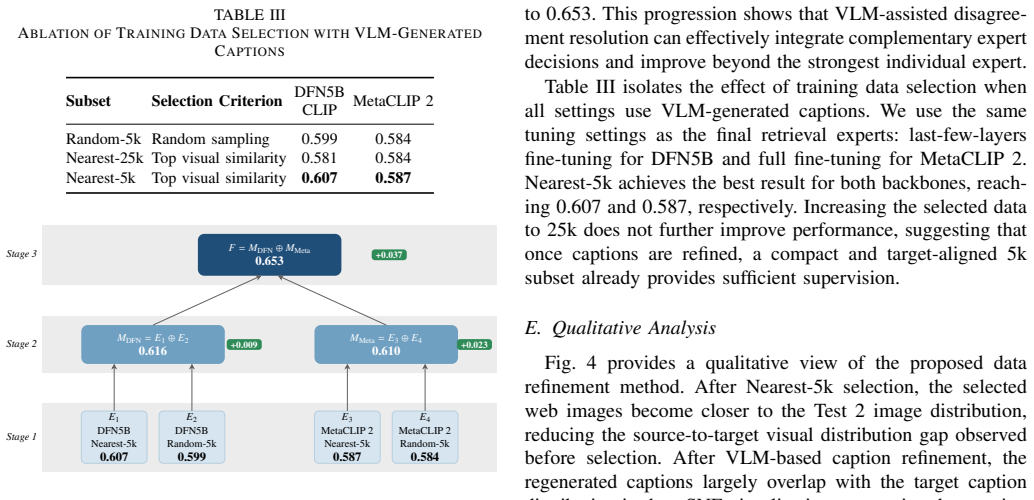
The load-bearing machinery has three parts. (1) Target-aware selection: an averaged, L2-normalized image embedding of the unlabeled test images serves as a prototype; each web image is scored by cosine similarity to this prototype, and the top 5k are kept as the Nearest-5k subset, with a Random-5k subset kept for diversity. (2) VLM caption refinement: a vision-language model regenerates each selected image's caption, prompted with unpaired target captions as in-context examples, constrained to visible food attributes such as ingredients, sauces, textures, colors, and plate composition. (3) Hierarchical VLM-assisted decision fusion: four experts are trained with symmetric InfoNCE; identical p
What would settle it
Run the Nearest-5k + VLM Cap. training setting twice: once with normal images and once with the same images heavily corrupted at caption-generation time, such as grayscale, blurred, or randomly cropped, while keeping the prompt identical. If the corrupted-image version retains most of the ~0.607 retrieval score, the captions are not visually grounded and the gain is style imitation rather than visual alignment.
Extended reading notes
Core claim
The paper's central claim is that three interventions on the training data, not on the model, produce most of the gains. First, ranking web images by cosine similarity to a prototype embedding of the unlabeled test images and keeping the nearest 5k reduces the source-to-target visual domain gap. Second, replacing raw web captions with VLM-generated, target-style captions yields an average ~19% improvement and dominates the choice of backbone or fine-tuning strategy. Third, fusing four complementary CLIP-style retrieval experts (two backbones × two subsets) through a two-stage, disagreement-only VLM resolution rule reaches 0.653, surpassing the strongest single expert (0.607), and does so wit
Load-bearing premise
The ~19% caption-refinement gain depends on the vision-language model describing only observable food details from the image, rather than imitating the target caption style or hallucinating ingredients; if the generated captions are style-matched but not visually grounded, the gains could be lexical overlap with test captions instead of genuine visual-semantic alignment.
Editorial extensions
If this is right
- Increasing raw web-caption data can hurt rather than help: across fine-tuning methods, 25k raw-caption pairs often score worse than 5k, and raw-caption fine-tuning frequently degrades below the pretrained zero-shot model.
- Caption quality is the single largest lever: VLM caption refinement gives roughly 19% average gains across seven fine-tuning strategies and two backbones, outweighing the choice of fine-tuning method.
- Target-aware selection consistently helps under raw captions: Nearest-5k beats Random-5k and Random-25k in almost every raw-caption setting, supporting the claim that visual relevance of training data matters more than volume.
- The full method exceeds every single expert and pure VLM retrieval while using far fewer VLM resources, so a selective-judge fusion strategy can beat a strong generative model used naively for retrieval.
- The same official score harmonically combines multi-ingredient recognition and single-caption retrieval, so the reported gains apply to both fine-grained recognition and retrieval, not just one task.
Reading between the lines
- A clean testable extension: corrupt or blank the visual input during VLM caption generation while keeping the same prompt; if retrieval scores stay near 0.607, the gain comes from caption style rather than visual grounding.
- The target-aware prototype uses unlabeled test images, making the selection stage transductive; in a real deployment without a target pool, one would need a small representative sample or online update, and performance under that shift is not measured.
- The VLM-as-judge pattern suggests a general recipe: train cheap diverse experts and spend a strong model only on disagreements; this could transfer to other multimodal retrieval settings where end-to-end use of a large generative model is too expensive.
Editorial analysis
A structured set of objections, weighed in public.
Referee Report
Summary. The paper proposes a three-stage data-centric pipeline for fine-grained food image-to-text retrieval on the Dishcovery Mission II challenge. Stage 1 selects target-relevant web images by ranking their CLIP-image similarity to a prototype of the (unlabeled) test images; Stage 2 regenerates captions for selected images with Gemma 4, using unpaired target captions as in-context style exemplars; Stage 3 trains four CLIP-style retrieval experts on the curated subsets and fuses their outputs with a hierarchical, VLM-assisted disagreement-resolution rule. The paper reports that VLM caption refinement alone gives an average gain of about 19%, that a curated 5k subset can beat a raw 25k subset, and that the full method reaches 0.653 versus 0.226 for pure VLM retrieval while using far fewer VLM tokens.
Significance. If the empirical claims survive scrutiny, the paper would make a useful contribution by demonstrating that data curation—selection, caption rewriting, and multi-expert fusion—can matter more than architecture or scale for a fine-grained retrieval task. The framework is modular, the comparison across seven fine-tuning strategies is thorough, and the efficiency reporting in terms of VLM calls and tokens is commendable. However, the central empirical protocol contaminates the evaluation: target test captions are used as in-context examples when generating the training captions, and the final expert configuration is selected from test-set scores. The headline gains may therefore reflect transductive fitting to the test caption distribution rather than a general data-centric improvement. The paper is well written and the methods are clearly described, but the current evidence does not establish the stated conclusions.
major comments (3)
- [Sec. III-C; Table I] The caption-refinement stage randomly samples 'unpaired target captions' as in-context examples for Gemma 4. These are ground-truth captions from the same Dishcovery Mission II test set on which Table I and Fig. 3 are evaluated. The VLM is effectively conditioned on the exact text register, vocabulary, and sentence templates of the retrieval targets when it writes the training captions. The generated captions can imitate that style without being visually grounded in the food content. The pure-VLM baseline in Sec. IV-C does not receive such in-context style exemplars, so the comparison is unbalanced. This leakage threatens the load-bearing claim that VLM caption refinement alone gives ~19% average gain, and it also weakens the fusion results. Please re-run with an evaluation split whose captions are never used for in-context examples, or use style exemplars from a disjoint source, and add
- [Sec. III-B, Eq. (1)-(2); Sec. IV-A/IV-C] Target-aware selection computes the target prototype from the unlabeled test images, and the final expert settings (last-few-layers for DFN5B, full fine-tuning for MetaCLIP 2) are selected by inspecting Table I, which reports test-set scores. There is no validation split; subset size, in-context example count, multi-label threshold, and per-backbone tuning are chosen with test-set feedback. The reported 0.653 and the comparisons against baselines are therefore optimistic. Please introduce a held-out validation partition for all model-selection decisions and report results on a truly held-out test set, or at minimum report repeated-run variance. Without this, the gains cannot be distinguished from test-set overfitting.
- [Sec. IV-B, 'approximately 19%'] The claimed average gain is not defined in the text. In Table I the absolute improvements from VLM captions range from -0.027 (DFN5B, Nearest-5k, WiSE-FT) to +0.190, and the ~19% figure appears to be a relative gain averaged over the raw-caption baseline. The manuscript should state the exact computation (relative vs absolute, which settings are averaged) and report dispersion. More importantly, because the caption-refinement comparisons are contaminated by the leakage above, the current tables cannot support the broad conclusion that caption quality, rather than data scale or architecture, is the bottleneck.
minor comments (6)
- [Sec. IV-A] Hyperparameters for CLIP-Adapter, LoRA, DoRA, NegCLIP, and WiSE-FT are not specified beyond epochs/batch/warmup. Add the exact adapter setup, LoRA rank/alpha, and any per-method settings for reproducibility.
- [Sec. III-D] Multi-label ingredient prediction uses 'thresholding' but the threshold value and how it is selected are not reported. This is a free parameter and should be documented.
- [Sec. III-C] The prompt details for caption generation are incomplete: how many in-context target captions are sampled, and what is the exact prompt template? This matters for assessing prompt sensitivity and for reproducibility.
- [Tables I-III] No error bars or repeated runs are reported. Differences such as 0.607 vs 0.599 are likely within noise; report variance across seeds or at least multiple runs.
- [Sec. IV-D] The claim that 5k curated beats 25k raw is not universal: for MetaCLIP 2 with full fine-tuning, Random-25k raw (0.490) exceeds Random-5k raw (0.466). Qualify the claim accordingly.
- [General] The t-SNE visualizations in Figs. 1 and 4 are illustrative; consider quantitative distribution-distance measures (e.g., FID/MMD) for the image- and text-space gap. Also, code and curated data are not mentioned for release; providing them would substantially increase reproducibility.
Circularity Check
VLM caption refinement is conditioned on test captions used as in-context examples, so the ~19% caption-refinement gain is partly a transductive fit to the evaluation text distribution.
-
fitted input called prediction
[Sec. III-C; Sec. IV-A/B, Table I]
"To make the generated captions closer to the target evaluation style, we randomly sample unpaired target captions as in-context examples and prompt the VLM to describe only observable food details, such as visible ingredients, side dishes, sauces, textures, colors, and plate composition. The prompt constrains the output to a concise food caption without bullet points, explanations, or irrelevant non-food details."
The 'target captions' used as in-context examples are the retrieval candidates from the same Dishcovery test set on which Table I reports scores. Conditioning Gemma 4's caption generation on these target captions makes the generated training captions lexically and stylistically dependent on the exact text distribution used in evaluation. The CLIP experts are then trained on captions that mimic the test caption register, while the raw-caption baselines ('Raw Cap.' rows) receive no such test-caption exposure. The reported ~19% caption-refinement gain is therefore not a clean measure of improved visual grounding; it is partly a test-set information leak that structurally favors the VLM-caption condition.
full rationale
I evaluated the paper's claimed derivation chain. The three main components are (1) target-aware data selection via a test-image prototype, (2) VLM-based caption refinement, and (3) hierarchical VLM-assisted fusion. Component (1) is transductive rather than circular: Eq. (1)-(2) compute a prototype from unlabeled test images and rank web images by cosine similarity; this affects training-data selection but does not by itself determine the retrieval score. Component (3) is an empirical engineering choice with no definitional reduction. Component (2), however, is a genuine circularity concern: Sec. III-C explicitly states that 'unpaired target captions' are sampled as in-context examples to make generated captions closer to the 'target evaluation style,' and evaluation (Sec. IV-A/B) is performed on those same test captions. This leaks the test caption distribution into the caption-refinement stage, so the headline claim that 'VLM-based caption refinement alone yielding an average performance gain of approximately 19%' is partly a transductive fit to the evaluation text distribution rather than independent evidence for the data-centric bottleneck claim. No load-bearing self-citations or imported uniqueness theorems are present. Overall score 6 reflects partial construction of the central caption-refinement claim.
Assumptions & free parameters
free parameters (5)
- subset size k =
5000 (Nearest-5k / Random-5k); 25k also tested
- VLM prompt in-context target captions count
- multi-ingredient label threshold
- per-backbone fine-tuning configuration =
DFN5B: last 8 vision + last 4 text layers; MetaCLIP2: full fine-tuning
- pure-VLM baseline chunk size =
1000 captions per chunk
assumptions (5)
- domain assumption Cosine similarity in a fixed CLIP embedding space is a valid proxy for target-relevance of fine-grained food images.
- domain assumption Gemma 4 generates visually grounded captions describing only observable food details.
- domain assumption Using unlabeled test images to define the target prototype is legitimate and does not invalidate benchmark scores.
- domain assumption Official score (harmonic mean of ingredient F1 and caption retrieval accuracy) measures the intended 'fine-grained food visual-semantic understanding'.
- standard math Standard InfoNCE CLIP fine-tuning on curated pairs transfers to the two retrieval tasks.
Cite this review
Pith. "Pith review of Fine-Grained Food Image Understanding via Target-Aware Data Alignment." pith.science (2026). https://pith.science/paper/NTSCKTPT
@misc{pith2026260725794,
  author       = {Pith},
  title        = {Pith review of: Fine-Grained Food Image Understanding via Target-Aware Data Alignment},
  year         = {2026},
  howpublished = {\url{https://pith.science/paper/NTSCKTPT}},
  note         = {Machine review of arXiv:2607.25794}
}
read the original abstract
Fine-grained food visual--semantic understanding requires models to capture subtle distinctions across ingredients, cooking methods, doneness, color, texture, and plate composition. Although CLIP-style vision-language models provide a natural framework for this task, their effectiveness is limited when training relies on heterogeneous web-collected image--text pairs. Such data often exhibit a web-to-target domain gap and cross-modal misalignment, where images differ from the target distribution and captions are noisy, multilingual, or weakly grounded in visual content. We propose a data-centric multimodal alignment method for fine-grained food description and recognition. Our method first performs target-aware data selection to identify visually relevant training subsets, then applies VLM-based caption refinement to generate visually grounded, target-style descriptions. Using these curated image--caption pairs, we train complementary CLIP-style retrieval experts and further combine their decisions through a hierarchical VLM-assisted multi-expert decision-level fusion strategy that invokes the VLM only when experts disagree. Experiments show that our data refinement strategy significantly improves retrieval performance over naive web supervision, with VLM-based caption refinement alone yielding an average performance gain of approximately 19%. Our full method also achieves more than twice the retrieval score of pure VLM-based retrieval while remaining substantially more efficient.
Figures


Figures from the paper (1 more)

Reference graph
Works this paper leans on
-
[1]
Large scale visual food recognition,
W. Min, Z. Wang, Y . Liu, M. Luo, L. Kang, X. Wei, X. Wei, and S. Jiang, “Large scale visual food recognition,”IEEE Transactions on Pattern Analysis and Machine Intelligence, vol. 45, no. 8, pp. 9932–9949, August 2023. [Online]. Available: http://dx.doi.org/10. 1109/TPAMI.2023.3237871 Nearest-5k images Test images (a) Image-space distribution after Neares...
arXiv 2023
-
[2]
Food-101: Mining discriminative components with random forests,
L. Bossard, M. Guillaumin, and L. Van Gool, “Food-101: Mining discriminative components with random forests,”Proceedings of the European Conference on Computer Vision, vol. 8694, pp. 446–461, September 2014, Zurich, Switzerland. [Online]. Available: http://dx.doi.org/10.1007/978-3-319-10599-4 29
-
[3]
Dishcovery Mission II Challenge: Where VLM meets food,
P. Radeva, B. Nagarajan, I. G. Estepa, and J. M. Rodr ´ıguez de Vera, “Dishcovery Mission II Challenge: Where VLM meets food,” https: //dishcoveryvlmchallenge.com/, February 2026, IEEE/CVF Conference on Computer Vision and Pattern Recognition 2026 MetaFood Workshop Challenge. Accessed: 2026-05-08
2026
-
[4]
Learning transferable visual models from natural language supervision,
A. Radford, J. W. Kim, C. Hallacy, A. Ramesh, G. Goh, S. Agarwal, G. Sastry, A. Askell, P. Mishkin, J. Clark, G. Krueger, and I. Sutskever, “Learning transferable visual models from natural language supervision,”Proceedings of the 38th International Conference on Machine Learning, vol. 139, pp. 8748–8763, July 2021, Virtual Event. [Online]. Available: htt...
2021
-
[5]
Scaling up visual and vision-language representation learning with noisy text supervision,
C. Jia, Y . Yang, Y . Xia, Y .-T. Chen, Z. Parekh, H. Pham, Q. V . Le, Y .-H. Sung, Z. Li, and T. Duerig, “Scaling up visual and vision-language representation learning with noisy text supervision,” Proceedings of the 38th International Conference on Machine Learning, vol. 139, pp. 4904–4916, July 2021, Virtual Event. [Online]. Available: http://proceedin...
2021
-
[6]
G. Ilharco, M. Wortsman, R. Wightman, C. Gordon, N. Carlini, R. Taori, A. Dave, V . Shankar, H. Namkoong, J. Miller, H. Hajishirzi, A. Farhadi, and L. Schmidt, “OpenCLIP,” https://github.com/mlfoundations/open clip, July 2021, software repository. Accessed: 2026-05-29. [Online]. Available: http://dx.doi.org/10.5281/zenodo.5143773
-
[7]
Sigmoid loss for language image pre-training,
X. Zhai, B. Mustafa, A. Kolesnikov, and L. Beyer, “Sigmoid loss for language image pre-training,”Proceedings of the IEEE/CVF International Conference on Computer Vision, pp. 11 975–11 986, October 2023, Paris, France. [Online]. Available: http://dx.doi.org/10. 1109/ICCV51070.2023.01100
arXiv 2023
-
[8]
Recipe1M+: A dataset for learning cross-modal embeddings for cooking recipes and food images,
J. Marin, A. Biswas, F. Ofli, N. Hynes, A. Salvador, Y . Aytar, I. Weber, and A. Torralba, “Recipe1M+: A dataset for learning cross-modal embeddings for cooking recipes and food images,” IEEE Transactions on Pattern Analysis and Machine Intelligence, vol. 43, no. 1, pp. 187–203, January 2021. [Online]. Available: http://dx.doi.org/10.1109/TPAMI.2019.2927476
arXiv 2021
Show all 22 references
- [9]
-
[10]
Reciprocal rank fusion outperforms Condorcet and individual rank learning methods,
G. V . Cormack, C. L. A. Clarke, and S. Buettcher, “Reciprocal rank fusion outperforms Condorcet and individual rank learning methods,”Proceedings of the 32nd International ACM SIGIR Conference on Research and Development in Information Retrieval, pp. 758–759, July 2009, Bosto...
2009
-
[11]
Is ChatGPT good at search? Investigating large language models as re-ranking agents,
W. Sun, L. Yan, X. Ma, S. Wang, P. Ren, Z. Chen, D. Yin, and Z. Ren, “Is ChatGPT good at search? Investigating large language models as re-ranking agents,”Proceedings of the 2023 Conference on Empirical Methods in Natural Language Processing, pp. 14 918–14 937, December 2023, ...
2023 doi
-
[12]
CLIP-Adapter: Better vision-language models with feature adapters,
P. Gao, S. Geng, R. Zhang, T. Ma, R. Fang, Y . Zhang, H. Li, and Y . Qiao, “CLIP-Adapter: Better vision-language models with feature adapters,”International Journal of Computer Vision, vol. 132, no. 2, pp. 581–595, February 2024. [Online]. Available: http://dx.doi.org/10.1007/...
2024 doi
-
[13]
LoRA: Low-rank adaptation of large language models,
E. J. Hu, Y . Shen, P. Wallis, Z. Allen-Zhu, Y . Li, S. Wang, L. Wang, and W. Chen, “LoRA: Low-rank adaptation of large language models,”Proceedings of the International Conference on Learning Representations, April 2022, Virtual Event. [Online]. Available: https://openreview....
2022
-
[14]
DoRA: Weight-decomposed low-rank adaptation,
S.-Y . Liu, C.-Y . Wang, H. Yin, P. Molchanov, Y .-C. F. Wang, K.-T. Cheng, and M.-H. Chen, “DoRA: Weight-decomposed low-rank adaptation,”Proceedings of the 41st International Conference on Machine Learning, vol. 235, pp. 32 100–32 121, July 2024, Vienna, Austria. [Online]. Av...
2024
-
[15]
When and why vision-language models behave like bags-of-words, and what to do about it?
M. Yuksekgonul, F. Bianchi, P. Kalluri, D. Jurafsky, and J. Zou, “When and why vision-language models behave like bags-of-words, and what to do about it?”Proceedings of the International Conference on Learning Representations, May 2023, Kigali, Rwanda. [Online]. Available: htt...
2023
-
[16]
Robust fine-tuning of zero-shot models,
M. Wortsman, G. Ilharco, J. W. Kim, M. Li, S. Kornblith, R. Roelofs, R. G. Lopes, H. Hajishirzi, A. Farhadi, H. Namkoong, and L. Schmidt, “Robust fine-tuning of zero-shot models,”Proceedings of the IEEE/CVF Conference on Computer Vision and Pattern Recognition, pp. 7959– 7971,...
2022
-
[17]
Data filtering networks,
A. Fang, A. M. Jose, A. Jain, L. Schmidt, A. Toshev, and V . Shankar, “Data filtering networks,”Proceedings of the International Conference on Learning Representations, May 2024, Vienna, Austria. [Online]. Available: https://openreview.net/forum?id=KAk6ngZ09F
2024
-
[18]
Meta CLIP 2: A worldwide scaling recipe,
Y .-S. Chuang, Y . Li, D. Wang, C.-F. Yeh, K. Lyu, R. Raghavendra, J. Glass, L. Huang, J. Weston, L. Zettlemoyer, X. Chen, Z. Liu, S. Xie, W.-t. Yih, S.-W. Li, and H. Xu, “Meta CLIP 2: A worldwide scaling recipe,”arXiv preprint arXiv:2507.22062, July 2025. [Online]. Available:...
-
[19]
Gemma 4 31B Instruct,
Google DeepMind, “Gemma 4 31B Instruct,” https://huggingface.co/ google/gemma-4-31B-it, March 2026, model card. Accessed: 2026-05- 29
2026
-
[20]
Representation learning with contrastive predictive coding,
A. van den Oord, Y . Li, and O. Vinyals, “Representation learning with contrastive predictive coding,”arXiv preprint arXiv:1807.03748, July
-
[21]
Hugging Face Hub,
Hugging Face, “Hugging Face Hub,” https://huggingface.co/docs/hub, May 2026, documentation. Accessed: 2026-05-29
2026
- [2018]
Reviewed August 1, 2026 · model on record in the stance chip above.
Discussion (0). Sign in to comment.