REVIEW 4 major objections 6 minor 89 references
Foundational Refinement Proofs for Deployed Bytecode, at the Price of Tokens
T0 review · 4 major / 6 minor · reviewed 2026-08-01 · deepseek-v4-flash
Pith's one-line read LLM agents produce machine-checked refinement proofs for deployed Ethereum bytecode.
desk verdict A genuinely new post-hoc foundational refinement framework for arbitrary EVM bytecode whose headline claim overruns the shipped evidence: the external-call rule makes the refinement certificate substantially weaker than 'proved correct', and the reported counts don't match the tables. read the letter →
The pith
A machine-rendered reading of the paper's core claim, the machinery that carries it, and where it could break.
The reading
What carries the argument
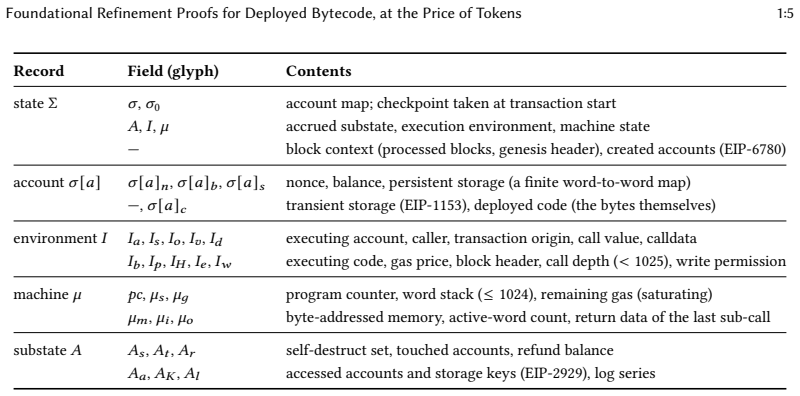
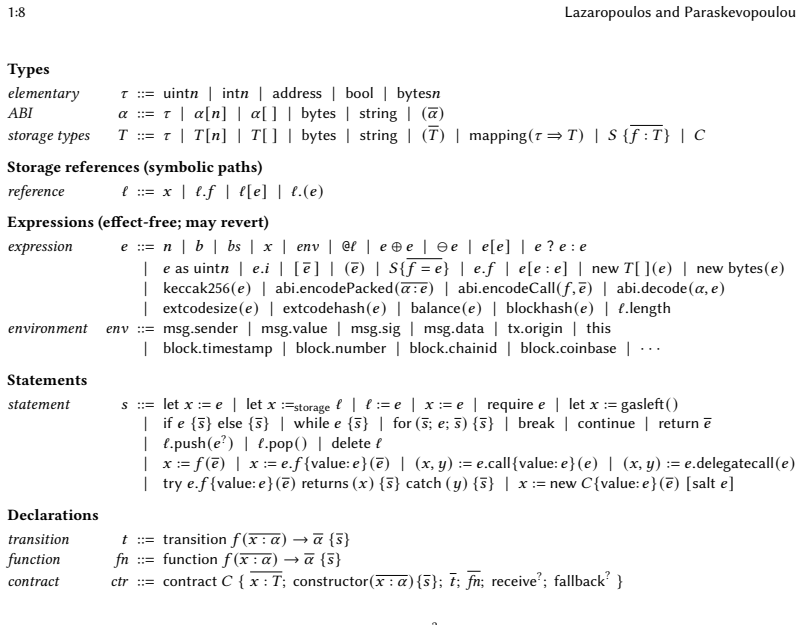
The argument rides on a refinement judgment between the EVM's code-execution function Ξ and a big-step judgment over Sol−, a small imperative specification language whose semantics is parametric in storage layout. Sol− deliberately gives meaning to external calls by invoking the EVM's own message-call function Θ on the live account map, so interaction with unknown bytecode is handled by the semantics rather than by a linking theorem. The proof side is a compositional library built around a reach invariant: a cursor exposing pc, stack, memory, return data, and world, with combinators for forward symbolic execution of the bytecode, so whole-contract proofs reduce to chaining per-opcode lemmas.
What would settle it
Recover the original Sol− specification for a contract whose agent was authorized to change it after a mismatch report (e.g., Flipper or Cure), and check whether the deployed bytecode refines that original; if it does not, the theorem only holds for the revised spec. Alternatively, re-run the official EVM conformance suite against the modified semantics and compare the pass rate to the 99.99% reported for the base model.
Extended reading notes
Core claim
The central claim is the runtime refinement theorem: for any protocol-conforming EVM state, calldata, gas, and substate, executing the deployed bytecode via Ξ either matches a run of the Sol− specification with the same created accounts, account maps up to representation, and return bytes; or reverts when the specification does not dispatch; or exhausts gas. The authors further claim this theorem was discharged by frontier LLM agents for twenty-three deployed contracts at up to a hundred million tokens and a hundred hours per contract, including most of MakerDAO, and conclude that foundational mechanized proofs can now be bought at the price of tokens.
Load-bearing premise
The proof only certifies what the Sol− specification says, so the load-bearing premise is that the specification was written before, not retrofitted after, the bytecode behavior was observed; a second fragile premise is that the modified EVM semantics still faithfully models the Cancun EVM.
Editorial extensions
If this is right
- A verified contract comes with a replayable, independently checkable Lean certificate that does not name or rely on the compiler that produced the bytecode.
- Auditors and analyzers can work from the Sol− specification rather than decompiled bytecode, for bytecode of any provenance.
- Interoperation with arbitrary deployed code is part of the semantics, so compositional reasoning across contract boundaries does not require a linking theorem.
- Verification frameworks can be architected around an untrusted LLM proof agent plus a trusted kernel, shifting cost from human labor to tokens.
Reading between the lines
- The technique inherits the risk that a specification may be edited to match observed bytecode behavior; the paper's own appendix records such authorizations, so the durable guarantee is for the adjusted description, not necessarily the original intent.
- Because Sol− models no gas, the refinement theorem allows vacuous equivalence on runs that exhaust gas; a natural extension is to add explicit gas bounds or upper-bound gas proofs.
- The same per-artifact certification could transfer to other bytecode platforms with a formal semantics and a high-level spec language, not just the EVM.
- A cheap test of the framework's validity is to re-run the official EVM conformance suite against the modified semantics; without that, a silent mismatch between the model and the Cancun EVM would invalidate all certificates.
Signed reviews
Editorial analysis
A structured set of objections, weighed in public.
Referee Report
Summary. The paper introduces EquiVM, a Lean framework for proving that deployed EVM bytecode refines a high-level specification written in Sol−, a Solidity-like language with big-step semantics. The refinement theorem (Fig. 9) is stated against an executable EVM model extending Nethermind's EVMYulLean; the specification language handles external calls by invoking the same EVM message-call function Θ, and a proof library provides reach-invariant combinators for forward symbolic execution. An LLM agent is used to construct proofs, and the paper reports telemetry for exploratory examples and deployed MakerDAO, WETH9, and Nouns contracts. The claimed contribution is the first combination of foundational, replayable, per-artifact refinement proofs for arbitrary bytecode, including interaction with unknown code, at a cost dominated by LLM tokens.
Significance. If the claims are borne out, the paper would demonstrate a genuine shift: per-contract, compiler-independent, machine-checked equivalence certificates for deployed EVM bytecode, with the LLM agent untrusted because the Lean kernel checks the proof. The design of Sol−, especially the external-call boundary that reuses the EVM's own Θ, is elegant and avoids a linking theorem for unknown callees. The paper is unusually honest about costs, failures, and trusted components (native_decide axioms, opaque Keccak, underspecified gas). However, the headline strength is not supported by the current theorem: the existential gas in external-call rules makes the specification over-approximate to the point that always-revert bytecode refines any external-calling spec, and no artifact is provided to verify the empirical claims. The core idea is promising and the formal development appears substantial, but the main theorem as stated does not deliver the advertised correctness guarantee.
major comments (4)
- [§4.2, Fig. 7 (Θ-Call); §5, Fig. 9 (R-Exec)] The existential quantification over call gas g in Θ-Call gives every external-calling transition a spurious revert derivation: for any callee, choosing g below the intrinsic call cost makes Θ return z=false, so ExtCallFail allows the specification to revert on any input. Since R-Exec only requires the bytecode result to equal some Sol− derivation, a bytecode that reverts unconditionally on such a transition is refined by a specification that was written to succeed. Thus the end-to-end theorem for contracts with external calls does not establish that those transitions can ever complete their intended effects. Section 5.2's disclosure of underspecified gas is also weaker than this: the problem is not just absence of gas bounds, but that the spec itself contains unconditional failure paths. Please either make gas a tracked component of the Sol− state and force the two sides to use the same
- [§6, Tables 1-2; no artifact section] The paper claims replayable machine-checked certificates but provides no artifact: no repository, commit hash, build instructions, or list of Lean files. Tables 1 and 2 report proof line counts and check times, but without the development the reader cannot verify that the proofs exist, that they contain no `sorry`/axioms beyond those disclosed, or that the native_decide-generated axioms are benign. This is a hard requirement for a foundational-verification paper. Please make the full development available and pin the exact versions (Lean, mathlib, EVMYulLean, solc, bytecode hashes).
- [§1 Abstract and §8 Conclusion vs §6 Evaluation] The abstract and conclusion state that twenty-three real-world contracts were proved end to end, and the conclusion says twenty-seven contracts total. Section 6, however, says 'Nineteen contracts are proved complete at the time of writing, and two more are in progress with partial proofs,' and Table 2 shows Clipper (26/29) and Auction (18/20) incomplete, with 21 deployed contracts listed. The numbers must be reconciled; the current text is self-contradictory and overstates the shipped results.
- [§3, 'The EVM, Formally'] The paper states that the semantics were modified from EVMYulLean — changing gas arithmetic, reducing FFI reliance, adding dependent types — but does not report a re-run of the conformance suite. The original model was validated against 99.99% of the Cancun tests; the modified model may no longer conform. Since the refinement theorem is only as good as the EVM model, please report the conformance result for the exact semantics used in the proofs, or list and justify any failing tests.
minor comments (6)
- [§2.2] Typo: 'A refinement relations s fixes' should be 'A refinement relation fixes'.
- [§4.2] 'it let's us' should be 'it lets us'.
- [§5.2] Typo: 'the the refinement relation' -> 'the refinement relation'.
- [Throughout] Inconsistent spelling: the abstract uses 'EquiVM' while the body uses 'EqiVM'. Please standardize.
- [Table 2] The Auction row reports Check as '?' (timeout); make this explicit in the caption or as a footnote so it is not confused with a complete check.
- [§6] The specification-editing incidents (Flipper, Cure, Auction, Clipper) should be highlighted in the main text as a limitation: the certificate only proves that bytecode matches the final edited spec, not that the spec matches original human intent. This is partially disclosed in Appendix C but deserves prominence in Section 6.
Circularity Check
Existential call gas and post-hoc specification edits make the 'end-to-end proof' claims partially reduce to the definitions and to fitted specs.
-
self definitional
[Section 4.2 (Fig. 7, Θ-Call) and Section 5 (Fig. 9, R-Exec / r≈R)]
"Because Sol− tracks neither gas nor the accrued substate, the call’s gas allowance and input substate are existentially quantified in the premise: the call “behaves as Θ would, for some gas and substate.” ... R-Exec ... Ξ(cA, σ_evm, σ0, g, A, I) = r; χ; ctr ⊢ (σ_solm, g, A, I) ⇓tx R; r ≈ R ... revert g' o ≈ rev"
With ∃g A_in in Θ-Call, every typed external call has a spec-level rev derivation: choose g small enough that the callee fails, and ExtCallFail fires. Since R-Exec only requires the bytecode result to equal some Sol− judgment R, and revert g' o ≈ rev, any bytecode that reverts on an external-calling transition is trivially refined by a specification written to succeed. The theorem therefore cannot certify the transition's intended storage/return effect on the success path; the 'end-to-end proof' conclusion is forced, on the failure side, by the over-approximate definition of the external-call rule rather than by the bytecode's actual intended behavior.
-
fitted input called prediction
[Section 6 (Autonomy, Semantic blockers) and Appendix C (Flipper, Auction)]
"Flipper’s agent reported a specification mismatch and was authorized to correct the specification. ... In order to overcome this semantic mismatch, we added a well-formed storage hypothesis in the refinement relation, requiring that the size in bytes of the array does not exceed the UInt256 range. ... Auction ... 'can you add it and update the spec and keep working on the proof?'"
The specification and refinement relation are modified after observing bytecode behavior, and the same pipeline then proves that the bytecode refines the edited specification. The certificate is therefore a check of consistency between the bytecode and a retrofitted description, not of the original intended behavior. The evaluation's 'twenty-three contracts proved end to end' claim is fitted to the data: the proof target was adjusted based on the mismatches it reported, so the successful proofs are partially forced by construction.
full rationale
The kernel-checked refinement theorem itself is not circular in the sense of an unproved equality: R-Exec is a genuine Lean statement and using the same Θ on both sides of external calls is a sound congruence, not a tautology. No load-bearing self-citation or imported uniqueness theorem appears; the citation to the authors' prior ICFP work is contextual only. However, two steps reduce the advertised strength of the results. First, the existential gas/substate in Sol−'s external-call rule gives every external-calling transition a spurious revert derivation, so the existential matching in R-Exec makes always-revert bytecode refine a succeeding specification; the theorem no longer establishes intended effects. Second, the paper explicitly discloses that the same agent was authorized to correct specifications after reporting mismatches and that a well-formedness hypothesis was inserted after a semantic mismatch; this makes the 'proved end to end' evaluation a fitted-input result rather than an independent prediction. These are disclosed limitations, but they are load-bearing for the headline claim, hence a partial-circularity score of 6.
Assumptions & free parameters
free parameters (4)
- per-contract storage layout L =
Solidity layout: declaration-order slots, keccak-derived mapping slots, packed bytes/string layouts
- external ABI encode/decode functions encode_χ/decode_χ =
ABI standard encoders/decoders, instantiated per callee interface
- constructor payload assembly and immutable splice offsets =
Template runtime code and published offsets for contracts with immutables
- well-formed storage array bound =
Array byte-size must not exceed UInt256 range
assumptions (9)
- domain assumption The extended EVM formalization faithfully models the Cancun EVM after modifications to gas arithmetic and FFI use.
- standard math The Lean kernel and imported standard axioms are sound.
- domain assumption The opaque Lean constant for Keccak-256 is correctly implemented externally.
- ad hoc to paper native_decide-generated axioms from Lean's compiled evaluator are sound.
- domain assumption Per-contract selector facts are trusted: the first four bytes of a signature's Keccak hash match the bytes hard-coded in the dispatcher.
- domain assumption The official EVM conformance test suite is correct and sufficiently covers the intended EVM semantics.
- domain assumption The Sol− specification, including authorized edits, faithfully captures the intended contract behavior.
- ad hoc to paper For dynamic-array returns, the stored array byte-size is within UInt256, so bytecode copy and Sol− semantics agree.
- domain assumption Protocol preconditions such as calldata length below 2^256, write permission, and call depth bounds hold for top-level calls.
invented entities (2)
-
Sol− specification language
-
Reach-invariant proof combinator algebra (RD)
Cite this review
Pith. "Pith review of Foundational Refinement Proofs for Deployed Bytecode, at the Price of Tokens." pith.science (2026). https://pith.science/paper/KTYWHZL7
@misc{pith2026260726306,
  author       = {Pith},
  title        = {Pith review of: Foundational Refinement Proofs for Deployed Bytecode, at the Price of Tokens},
  year         = {2026},
  howpublished = {\url{https://pith.science/paper/KTYWHZL7}},
  note         = {Machine review of arXiv:2607.26306}
}
read the original abstract
Relating low-level executable code to a high-level account of its behavior has been a central concern of programming-language research for decades. From formally verified compilers to translation validators, certifying compilers, and proof-carrying code, each approach chooses between laborious but foundational mechanized proofs and automation that costs completeness, generality, and an increased trusted base. Recently, large language models (LLMs) have begun to change the economics of formal verification. Agentic proof development is now capable of producing machine-checked proofs at a scale and speed that were previously out of reach. In this paper, we evaluate the capabilities of LLMs to produce foundational, machine-checked proofs of refinement between executable code and its high-level specification, as post hoc, per-artifact certificates. We study this in the context of the Ethereum Virtual Machine (EVM), a low-level virtual machine that executes smart contracts on the Ethereum blockchain. We build EquiVM, a foundational framework in Lean comprising an executable EVM semantics and a specification language that characterizes the intended behavior of smart contracts, but commits to no source language or compilation toolchain. In EquiVM, refinement is stated for deployed bytecode of arbitrary provenance, interaction with unknown code is part of the semantics, and each proof is a replayable, machine-checked certificate. No previous technique achieves this combination. Using frontier commercial LLMs, twenty-three real-world contracts are proved end to end with minimal human guidance, among them most of the MakerDAO stablecoin system, at up to a hundred million tokens and a hundred hours of proof time per contract. We conclude that foundational mechanized proofs can now be bought at the price of tokens, and that this shift can reshape how verification frameworks are architected.
Figures


Figures from the paper (10 more)


Reference graph
Works this paper leans on
-
[1]
Hayden Adams, Noah Zinsmeister, and Dan Robinson. 2020. Uniswap v2 Core. Whitepaper, https://app.uniswap.org/ whitepaper.pdf
2020
-
[2]
Amal Ahmed. 2015. Verified Compilers for a Multi-Language World. In1st Summit on Advances in Programming Languages (SNAPL 2015) (LIPIcs, Vol. 32). Schloss Dagstuhl – Leibniz-Zentrum für Informatik, 15–31. https://doi.org/ 10.4230/LIPIcs.SNAPL.2015.15
-
[3]
Sidney Amani, Myriam Bégel, Maksym Bortin, and Mark Staples. 2018. Towards Verifying Ethereum Smart Contract Bytecode in Isabelle/HOL. InProceedings of the 7th ACM SIGPLAN International Conference on Certified Programs and Proofs (CPP). ACM, 66–77. https://doi.org/10.1145/3167084
doi:10.1145/3167084 2018
-
[4]
Danil Annenkov, Mikkel Milo, Jakob Botsch Nielsen, and Bas Spitters. 2021. Extracting Smart Contracts Tested and Verified in Coq. InProceedings of the 10th ACM SIGPLAN International Conference on Certified Programs and Proofs (CPP). ACM, 105–121. https://doi.org/10.1145/3437992.3439934
arXiv 2021
-
[5]
Andrew W. Appel. 2001. Foundational Proof-Carrying Code. InProceedings of the 16th Annual IEEE Symposium on Logic in Computer Science (LICS). IEEE Computer Society, 247–256. https://doi.org/10.1109/LICS.2001.932501
arXiv 2001
-
[6]
Gilles Barthe, Benjamin Grégoire, César Kunz, and Tamara Rezk. 2006. Certificate Translation for Optimizing Compilers. InStatic Analysis, 13th International Symposium (SAS) (Lecture Notes in Computer Science, Vol. 4134). Springer, 301–317
2006
-
[7]
Gilles Barthe, Benjamin Grégoire, César Kunz, and Tamara Rezk. 2009. Certificate Translation for Optimizing Compilers. ACM Transactions on Programming Languages and Systems (TOPLAS)31, 5, Article 18 (2009), 18:1–18:45 pages
2009
-
[8]
Sandrine Blazy, Zaynah Dargaye, and Xavier Leroy. 2006. Formal Verification of a C Compiler Front-End. InFM 2006: Int. Symp. on Formal Methods (Lecture Notes in Computer Science, Vol. 4085). Springer, 460–475. http://xavierleroy.org/ publi/cfront.pdf
2006
Show all 89 references
-
[9]
Jan Olaf Blech and Benjamin Grégoire. 2008. Certifying Code Generation with Coq. InProceedings of the Workshop on Compiler Optimization Meets Compiler Verification (COCV 2008) (Electronic Notes in Theoretical Computer Science). Elsevier
2008
-
[10]
Jan Olaf Blech and Arnd Poetzsch-Heffter. 2007. A Certifying Code Generation Phase.Electronic Notes in Theoretical Computer Science190, 4 (2007), 65–82
2007
-
[11]
Sergiu Bursuc, Theodore Ehrenborg, Shaowei Lin, Lacramioara Astefanoaei, Ionel Emilian Chiosa, Jure Kukovec, Alok Singh, Oliver Butterley, Adem Bizid, Quinn Dougherty, Miranda Zhao, Max Tan, and Max Tegmark. 2025. A Benchmark for Vericoding: Formally Verified Program Synthesis...
2025
-
[12]
Ghale, David J
Franck Cassez, Joanne Fuller, Milad K. Ghale, David J. Pearce, and Horacio Mijail Anton Quiles. 2023. Formal and Executable Semantics of the Ethereum Virtual Machine in Dafny. InFormal Methods (FM 2023) (Lecture Notes in Computer Science, Vol. 14000). Springer, 571–583. https:...
2023 doi
-
[13]
Certora. 2025. The Certora Prover. https://github.com/Certora/CertoraProver. Open-sourced February 2025. Accessed July 2026
2025
-
[14]
Dapphub. [n.d.]. WETH9: Wrapped Ether. Deployed contract https://etherscan.io/address/ 0xC02aaA39b223FE8D0A0e5C4F27eAD9083C756Cc2. Accessed July 2026
2026
-
[15]
dxo, Mate Soos, Zoe Paraskevopoulou, Martin Lundfall, and Mikael Brockman. 2024. Hevm, a Fast Symbolic Execution Framework for EVM Bytecode. InComputer Aided Verification (CA V 2024) (Lecture Notes in Computer Science). Springer, 453–465. https://doi.org/10.1007/978-3-031-65627-9_22
2024 doi
-
[16]
Yueyang Feng, Dipesh Kafle, Vladimir Gladshtein, Vitaly Kurin, George Pîrlea, Qiyuan Zhao, Peter Müller, and Ilya Sergey. 2026. Certified Program Synthesis with a Multi-Modal Verifier. arXiv:2604.16584 [cs.SE]
2026 arXiv
-
[17]
Rabe, Talia Ringer, and Yuriy Brun
Emily First, Markus N. Rabe, Talia Ringer, and Yuriy Brun. 2023. Baldur: Whole-Proof Generation and Repair with Large Language Models. InProceedings of the 31st ACM Joint European Software Engineering Conference and Symposium on the Foundations of Software Engineering(San Fran...
2023
-
[18]
Benjamin Goldberg, Lenore Zuck, and Clark Barrett. 2005. Into the Loops: Practical Issues in Translation Validation for Optimizing Compilers. InProceedings of the Workshop on Compiler Optimization Meets Compiler Verification (COCV
2005
-
[19]
Neville Grech, Lexi Brent, Bernhard Scholz, and Yannis Smaragdakis. 2019. Gigahorse: Thorough, Declarative Decompilation of Smart Contracts. InProceedings of the 41st International Conference on Software Engineering (ICSE). IEEE, 1176–1186. https://doi.org/10.1109/ICSE.2019.00120
2019
-
[20]
Neville Grech, Sifis Lagouvardos, Ilias Tsatiris, and Yannis Smaragdakis. 2022. Elipmoc: Advanced Decompilation of Ethereum Smart Contracts.Proceedings of the ACM on Programming Languages6, OOPSLA1 (2022), 77:1–77:27. https://doi.org/10.1145/3527321
2022 doi
-
[21]
Ilya Grishchenko, Matteo Maffei, and Clara Schneidewind. 2018. A Semantic Framework for the Security Analysis of Ethereum Smart Contracts. InPrinciples of Security and Trust (POST 2018) (Lecture Notes in Computer Science, Vol. 10804). Springer, 243–269. https://doi.org/10.1007...
2018 doi
-
[22]
Shelly Grossman, John Toman, Alexander Bakst, Sameer Arora, Mooly Sagiv, and Chandrakana Nandi. 2024. Practical Verification of Smart Contracts using Memory Splitting.Proceedings of the ACM on Programming Languages8, OOPSLA2 (2024), 2402–2433. https://doi.org/10.1145/3689796
2024 doi
-
[24]
Pollard, Nadesh Ramanathan, and John Wickerson
Yann Herklotz, James D. Pollard, Nadesh Ramanathan, and John Wickerson. 2021. Formal Verification of High-Level Synthesis.Proceedings of the ACM on Programming Languages5, OOPSLA, Article 117 (2021), 117:1–117:30 pages. https://doi.org/10.1145/3485494
2021 doi
-
[25]
Moore, Daejun Park, Yi Zhang, Andrei Stefanescu, and Grigore Rosu
Everett Hildenbrandt, Manasvi Saxena, Nishant Rodrigues, Xiaoran Zhu, Philip Daian, Dwight Guth, Brandon M. Moore, Daejun Park, Yi Zhang, Andrei Stefanescu, and Grigore Rosu. 2018. KEVM: A Complete Formal Semantics of the Ethereum Virtual Machine. In31st IEEE Computer Security...
2018
-
[26]
Yoichi Hirai. 2017. Defining the Ethereum Virtual Machine for Interactive Theorem Provers. InFinancial Cryptography and Data Security – FC 2017 International Workshops (WTSC) (Lecture Notes in Computer Science, Vol. 10323). Springer, 520–535. https://doi.org/10.1007/978-3-319-...
2017 doi
-
[27]
Childers, and Mary Lou Soffa
Yuqiang Huang, Bruce R. Childers, and Mary Lou Soffa. 2006. Catching and Identifying Bugs in Register Allocation. In Static Analysis, 13th International Symposium (SAS) (Lecture Notes in Computer Science, Vol. 4134). Springer, 281–300
2006
-
[28]
Eleftherios Ioannidis, Nikhil Swamy, Gabriel Ebner, Matthai Philipose, and Tahina Ramananandro. 2026. Proofs Promptly: An Experience Report on Proof-Oriented Programming with AI Agents.Proceedings of the ACM on Programming Languages10, ICFP (2026). To appear
2026
-
[29]
Jacques-Henri Jourdan, François Pottier, and Xavier Leroy. 2012. Validating LR(1) Parsers. InESOP 2012 - Programming Languages and Systems - 21st European Symposium on Programming (Lecture Notes in Computer Science, Vol. 7211). Springer, Tallinn, Estonia, 397–416. https://doi....
2012 doi
-
[30]
Jeehoon Kang, Yoonseung Kim, Chung-Kil Hur, Derek Dreyer, and Viktor Vafeiadis. 2016. Lightweight Verification of Separate Compilation.SIGPLAN Not.51, 1 (Jan. 2016), 178–190. https://doi.org/10.1145/2914770.2837642
2016
-
[31]
Gerwin Klein, Kevin Elphinstone, Gernot Heiser, June Andronick, David Cock, Philip Derrin, Dhammika Elkaduwe, Kai Engelhardt, Rafal Kolanski, Michael Norrish, Thomas Sewell, Harvey Tuch, and Simon Winwood. 2009. seL4: Formal Verification of an OS Kernel. InProceedings of the A...
2009
-
[32]
Jérémie Koenig and Zhong Shao. 2021. CompCertO: Compiling Certified Open C Components. InProceedings of the 42nd ACM SIGPLAN International Conference on Programming Language Design and Implementation (PLDI). ACM, 1095–1109. https://doi.org/10.1145/3453483.3454097
2021
-
[33]
Jacco O. G. Krijnen, Manuel M. T. Chakravarty, Gabriele Keller, and Wouter Swierstra. 2024. Translation Certification for Smart Contracts.Science of Computer Programming233 (2024), 103051
2024
-
[34]
Myreen, Michael Norrish, and Scott Owens
Ramana Kumar, Magnus O. Myreen, Michael Norrish, and Scott Owens. 2014. CakeML: A Verified Implementation of ML.SIGPLAN Not.49, 1 (Jan. 2014), 179–191. https://doi.org/10.1145/2578855.2535841
2014
-
[35]
Peter Lammich. 2019. Generating Verified LLVM from Isabelle/HOL. In10th International Conference on Interactive Theorem Proving (ITP 2019) (LIPIcs, Vol. 141). Schloss Dagstuhl – Leibniz-Zentrum für Informatik, 22:1–22:19. https: //doi.org/10.4230/LIPIcs.ITP.2019.22
2019 doi
-
[36]
Xavier Leroy. 2009. Formal verification of a realistic compiler.Commun. ACM52, 7 (2009), 107–115. http://xavierleroy. org/publi/compcert-CACM.pdf
2009
-
[37]
Guodong Li, Scott Owens, and Konrad Slind. 2007. Structure of a Proof-Producing Compiler for a Subset of Higher Order Logic. InEuropean Symposium on Programming (ESOP) (Lecture Notes in Computer Science, Vol. 4421). Springer, 205–219
2007
-
[38]
Lopes, Juneyoung Lee, Chung-Kil Hur, Zhengyang Liu, and John Regehr
Nuno P. Lopes, Juneyoung Lee, Chung-Kil Hur, Zhengyang Liu, and John Regehr. 2021. Alive2: Bounded Transla- tion Validation for LLVM. InProceedings of the ACM SIGPLAN Conference on Programming Language Design and Implementation (PLDI). ACM, 65–79
2021
-
[39]
Minghai Lu, Benjamin Delaware, and Tianyi Zhang. 2024. Proof Automation with Large Language Models. In Proceedings of the 39th IEEE/ACM International Conference on Automated Software Engineering(Sacramento, CA, USA) (ASE ’24). Association for Computing Machinery, New York, NY,...
2024 doi
-
[40]
Loi Luu, Duc-Hiep Chu, Hrishi Olickel, Prateek Saxena, and Aquinas Hobor. 2016. Making Smart Contracts Smarter. InProceedings of the 2016 ACM SIGSAC Conference on Computer and Communications Security (CCS). ACM, 254–269. https://doi.org/10.1145/2976749.2978309 1:28 Lazaropoulo...
2016
-
[41]
Haoyang Ma, Wuqi Zhang, Qingchao Shen, Yongqiang Tian, Junjie Chen, and Shing-Chi Cheung. 2024. Towards Understanding the Bugs in Solidity Compiler. InProceedings of the 33rd ACM SIGSOFT International Symposium on Software Testing and Analysis (ISSTA). ACM, 1312–1324. https://...
2024
-
[42]
MakerDAO. [n.d.]. DSS: The Dai Stablecoin System. https://github.com/makerdao/dss. Accessed July 2026
2026
-
[43]
Thomas Marchand. 2026. Verity: A Verified Compiler for a Core Fragment of EVM Smart Contracts in Lean 4. LFG Labs report, https://lfglabs.dev/papers/verity.pdf; code at https://github.com/lfglabs-dev/verity. Accessed July 2026
2026
-
[44]
Jacob Matthews and Robert Bruce Findler. 2007. Operational Semantics for Multi-Language Programs. InProceedings of the 34th Annual ACM SIGPLAN-SIGACT Symposium on Principles of Programming Languages(Nice, France)(POPL ’07). Association for Computing Machinery, New York, NY, US...
2007
-
[45]
John Mccarthy and James Painter. 1967. Correctness of a compiler for arithmetic expressions. InProceedings of a Symposium in Applied Mathematics, Vol. 19(Providence, R.I.), J.T. Schwartz (Ed.). American Mathematical Society, 33–41
1967
-
[46]
Weyhrauch
Robin Milner and R.W. Weyhrauch. 1972. Proving compiler correctness in a mechanised logic.Machine Intelligence7 (1972), 51–73
1972
-
[47]
Myreen, Michael J
Magnus O. Myreen, Michael J. C. Gordon, and Konrad Slind. 2012. Decompilation into Logic — Improved. InFormal Methods in Computer-Aided Design (FMCAD). IEEE, 78–81
2012
-
[48]
Myreen, Konrad Slind, and Michael J
Magnus O. Myreen, Konrad Slind, and Michael J. C. Gordon. 2008. Machine-Code Verification for Multiple Architectures — An Application of Decompilation into Logic. InFormal Methods in Computer-Aided Design (FMCAD). IEEE
2008
-
[49]
Myreen, Konrad Slind, and Michael J
Magnus O. Myreen, Konrad Slind, and Michael J. C. Gordon. 2009. Extensible Proof-Producing Compilation. In Compiler Construction, 18th International Conference (CC) (Lecture Notes in Computer Science, Vol. 5501). Springer, 2–16
2009
-
[50]
George C. Necula. 1997. Proof-Carrying Code. InProceedings of the ACM SIGPLAN-SIGACT Symposium on Principles of Programming Languages (POPL). ACM, 106–119
1997
-
[51]
George C. Necula. 2000. Translation Validation for an Optimizing Compiler. InProceedings of the ACM SIGPLAN Conference on Programming Language Design and Implementation (PLDI). ACM, 83–94
2000
-
[52]
Necula and Peter Lee
George C. Necula and Peter Lee. 1996. Safe Kernel Extensions Without Run-Time Checking. InProceedings of the Second USENIX Symposium on Operating Systems Design and Implementation (OSDI). ACM/USENIX, 229–243. https://doi.org/10.1145/238721.238781
1996
-
[53]
Necula and Peter Lee
George C. Necula and Peter Lee. 1998. The Design and Implementation of a Certifying Compiler. InProceedings of the ACM SIGPLAN Conference on Programming Language Design and Implementation (PLDI). ACM, 333–344
1998
-
[54]
Georg Neis, Chung-Kil Hur, Jan-Oliver Kaiser, Craig McLaughlin, Derek Dreyer, and Viktor Vafeiadis. 2015. Pilsner: A Compositionally Verified Compiler for a Higher-Order Imperative Language. InProceedings of the 20th ACM SIGPLAN International Conference on Functional Programmi...
2015
-
[55]
Nethermind Formal Verification Team. 2025. EVMYulLean: Executable Formal Model of the EVM and Yul in Lean 4. https://github.com/NethermindEth/EVMYulLean. Validated against 99.99% of the Ethereum Cancun conformance tests. Accessed July 2026
2025
-
[56]
Nouns DAO. [n.d.]. Nouns Auction House. https://github.com/nounsDAO/nouns-monorepo. Accessed July 2026
2026
-
[57]
OpenZeppelin. [n.d.]. OpenZeppelin Contracts: A Library for Secure Smart Contract Development. https://github. com/OpenZeppelin/openzeppelin-contracts. Accessed July 2026
2026
-
[58]
Zoe Paraskevopoulou. 2026. Machine-Generated, Machine-Checked Proofs for a Verified Compiler (Experience Report). Proceedings of the ACM on Programming Languages10, ICFP (2026). To appear
2026
-
[59]
Li, and Andrew W
Zoe Paraskevopoulou, John M. Li, and Andrew W. Appel. 2021. Compositional Optimizations for CertiCoq.Proc. ACM Program. Lang.5, ICFP, Article 86 (July 2021), 30 pages. https://doi.org/10.1145/3473591
2021 doi
-
[60]
Daejun Park, Yi Zhang, and Grigore Roşu. 2020. End-to-End Formal Verification of Ethereum 2.0 Deposit Smart Contract. InComputer Aided Verification (CA V 2020), Part I (Lecture Notes in Computer Science, Vol. 12224). Springer, 151–164. https://doi.org/10.1007/978-3-030-53288-8_8
2020 doi
-
[61]
Daejun Park, Yi Zhang, Manasvi Saxena, Philip Daian, and Grigore Rosu. 2018. A Formal Verification Tool for Ethereum VM Bytecode. InProceedings of the 2018 ACM Joint Meeting on European Software Engineering Conference and Symposium on the Foundations of Software Engineering (E...
2018
-
[62]
Daniel Patterson and Amal Ahmed. 2019. The next 700 Compiler Correctness Theorems (Functional Pearl).Proc. ACM Program. Lang.3, ICFP, Article 85 (July 2019), 29 pages. https://doi.org/10.1145/3341689
2019 doi
-
[63]
Daniel Patterson, Noble Mushtak, Andrew Wagner, and Amal Ahmed. 2022. Semantic Soundness for Language Interoperability. InProceedings of the 43rd ACM SIGPLAN International Conference on Programming Language Design and Implementation (PLDI). ACM, 609–624. https://doi.org/10.114...
2022
-
[64]
Daniel Patterson, Jamie Perconti, Christos Dimoulas, and Amal Ahmed. 2017. FunTAL: Reasonably Mixing a Functional Language with Assembly. InProceedings of the 38th ACM SIGPLAN Conference on Programming Language Design and Implementation (PLDI). ACM, 495–509. https://doi.org/10...
2017
-
[65]
Perconti and Amal Ahmed
James T. Perconti and Amal Ahmed. 2014. Verifying an Open Compiler Using Multi-Language Semantics. InProceedings of the 23rd European Symposium on Programming Languages and Systems - Volume 8410. Springer-Verlag, Berlin, Heidelberg, 128–148. https://doi.org/10.1007/978-3-642-54833-8_8
2014 doi
-
[66]
Amir Pnueli, Michael Siegel, and Eli Singerman. 1998. Translation Validation. InTools and Algorithms for the Construction and Analysis of Systems (TACAS) (Lecture Notes in Computer Science, Vol. 1384). Springer, 151–166
1998
-
[67]
Nadia Polikarpova and Ilya Sergey. 2019. Structuring the Synthesis of Heap-Manipulating Programs.Proceedings of the ACM on Programming Languages3, POPL, Article 72 (2019), 72:1–72:30 pages. https://doi.org/10.1145/3290385
2019 doi
-
[68]
Jianxing Qin, Alexander Du, Danfeng Zhang, Matthew Lentz, and Danyang Zhuo. 2025. Can Large Language Models Verify System Software? A Case Study Using FSCQ as a Benchmark. InProceedings of the 2025 Workshop on Hot Topics in Operating Systems(Banff, AB, Canada)(HotOS ’25). Asso...
2025
-
[69]
Tahina Ramananandro, Zhong Shao, Shu-Chun Weng, Jérémie Koenig, and Yuchen Fu. 2015. A Compositional Semantics for Verified Separate Compilation and Linking. InProceedings of the 2015 Conference on Certified Programs and Proofs(Mumbai, India)(CPP ’15). Association for Computin...
2015
- [70]
-
[71]
Xavier Rival. 2004. Symbolic Transfer Function-based Approaches to Certified Compilation. InProceedings of the ACM SIGPLAN-SIGACT Symposium on Principles of Programming Languages (POPL). ACM Press, 1–13
2004
-
[72]
Clara Schneidewind, Ilya Grishchenko, Markus Scherer, and Matteo Maffei. 2020. eThor: Practical and Provably Sound Static Analysis of Ethereum Smart Contracts. InProceedings of the 2020 ACM SIGSAC Conference on Computer and Communications Security (CCS). ACM, 621–640. https://...
2020
-
[73]
Ilya Sergey, Vaivaswatha Nagaraj, Jacob Johannsen, Amrit Kumar, Anton Trunov, and Ken Chan Guan Hao. 2019. Safer Smart Contract Programming with Scilla.Proceedings of the ACM on Programming Languages3, OOPSLA (2019), 185:1–185:30. https://doi.org/10.1145/3360611
2019 doi
-
[74]
Myreen, and Gerwin Klein
Thomas Arthur Leck Sewell, Magnus O. Myreen, and Gerwin Klein. 2013. Translation Validation for a Verified OS Kernel. InProceedings of the ACM SIGPLAN Conference on Programming Language Design and Implementation (PLDI). ACM, 471–482. https://doi.org/10.1145/2491956.2462183
2013
-
[75]
Schett, Xinyuan Sun, Qinshi Wang, Sean Noble Anderson, Steve Reeves, and Zhong Shao
Vilhelm Sjöberg, Kinnari Dave, Daniel Britten, Maria A. Schett, Xinyuan Sun, Qinshi Wang, Sean Noble Anderson, Steve Reeves, and Zhong Shao. 2024. Foundational Verification of Smart Contracts through Verified Compilation. https://doi.org/10.48550/arXiv.2405.08348 arXiv:2405.08...
-
[76]
Vilhelm Sjöberg, Yuyang Sang, Shu-Chun Weng, and Zhong Shao. 2019. DeepSEA: A Language for Certified System Software.Proceedings of the ACM on Programming Languages3, OOPSLA (2019), 136:1–136:27. https://doi.org/10. 1145/3360562
2019
-
[77]
Solidity Team. [n.d.]. List of Known Bugs — Solidity Documentation. https://docs.soliditylang.org/en/latest/bugs.html. Machine-readable list at https://github.com/ethereum/solidity/blob/develop/docs/bugs.json. Accessed July 2026
2026
-
[78]
Solidity Team. [n.d.]. Solidity Documentation. https://docs.soliditylang.org. Accessed July 2026
2026
-
[79]
Youngju Song, Minki Cho, Dongjoo Kim, Yonghyun Kim, Jeehoon Kang, and Chung-Kil Hur. 2019. CompCertM: CompCert with C-Assembly Linking and Lightweight Modular Verification.Proc. ACM Program. Lang.4, POPL, Article 23 (Dec. 2019), 31 pages. https://doi.org/10.1145/3371091
2019 doi
-
[80]
Gordon Stewart, Lennart Beringer, Santiago Cuellar, and Andrew W. Appel. 2015. Compositional CompCert. In Proceedings of the 42Nd Annual ACM SIGPLAN-SIGACT Symposium on Principles of Programming Languages(Mumbai, India)(POPL ’15). ACM, New York, NY, USA, 275–287. https://doi.o...
2015
-
[81]
Ferreira, Sorin Lerner, and Emily First
Kyle Thompson, Nuno Saavedra, Pedro Carrott, Kevin Fisher, Alex Sanchez-Stern, Yuriy Brun, João F. Ferreira, Sorin Lerner, and Emily First. 2025. Rango: Adaptive Retrieval-Augmented Proving for Automated Software Verification. InProceedings of the IEEE/ACM 47th International C...
2025
-
[82]
Jean-Baptiste Tristan and Xavier Leroy. 2008. Formal Verification of Translation Validators: A Case Study on Instruction Scheduling Optimizations. InProceedings of the ACM SIGPLAN-SIGACT Symposium on Principles of Programming Languages (POPL). ACM, 17–27
2008
-
[83]
Jean-Baptiste Tristan and Xavier Leroy. 2009. Verified Validation of Lazy Code Motion. InProceedings of the ACM SIGPLAN Conference on Programming Language Design and Implementation (PLDI). ACM, 316–326
2009
-
[84]
Petar Tsankov, Andrei Dan, Dana Drachsler-Cohen, Arthur Gervais, Florian Bünzli, and Martin Vechev. 2018. Securify: Practical Security Analysis of Smart Contracts. InProceedings of the 2018 ACM SIGSAC Conference on Computer and Communications Security (CCS). ACM, 67–82. https:...
2018
-
[85]
Vyper Team. [n.d.]. Vyper Documentation. https://docs.vyperlang.org. Accessed July 2026. 1:30 Lazaropoulos and Paraskevopoulou
2026
-
[86]
Yuting Wang, Pierre Wilke, and Zhong Shao. 2019. An Abstract Stack Based Approach to Verified Compositional Compilation to Machine Code.Proc. ACM Program. Lang.3, POPL, Article 62 (Jan. 2019), 30 pages. https://doi.org/10. 1145/3290375
2019
-
[87]
Yasunari Watanabe, Kiran Gopinathan, George Pîrlea, Nadia Polikarpova, and Ilya Sergey. 2021. Certifying the Synthesis of Heap-Manipulating Programs.Proceedings of the ACM on Programming Languages5, ICFP, Article 84 (2021), 84:1–84:29 pages. https://doi.org/10.1145/3473589
2021 doi
-
[88]
Gavin Wood. 2014. Ethereum: A Secure Decentralised Generalised Transaction Ledger. Ethereum project yellow paper, https://ethereum.github.io/yellowpaper/paper.pdf. Continuously revised; page and equation references follow the Shanghai–Cancun revisions
2014
-
[89]
why did you stop? The goal was to finish the whole proof
Jingyi Emma Zhong, Kevin Cheang, Shaz Qadeer, Wolfgang Grieskamp, Sam Blackshear, Junkil Park, Yoni Zohar, Clark W. Barrett, and David L. Dill. 2020. The Move Prover. InComputer Aided Verification (CA V 2020) (Lecture Notes in Computer Science, Vol. 12225). Springer, 137–150. ...
2020 doi
-
[2004]
(Electronic Notes in Theoretical Computer Science, Vol. 132). Elsevier, 53–71
Reviewed August 1, 2026 · model on record in the stance chip above.
Discussion (0). Continue with ORCID to comment.