REVIEW 4 major objections 4 minor 49 references
Quantum Geometry-Driven RKKY: From Flat to Dispersive Bands
T0 review · 4 major / 4 minor · reviewed 2026-08-01 · deepseek-v4-flash
Pith's one-line read This paper claims that the RKKY exchange range in a filled flat band is set by the complex-momentum poles of the band projectors, giving a decay length that can shrink as the band's quantum geometry strengthens.
desk verdict Solid analytic flat-band RKKY result with a checkable core, but the headline claims about generic Chern bands and the 1/R^3 selection lean on SM that isn't in the listing. read the letter →
The pith
A machine-rendered reading of the paper's core claim, the machinery that carries it, and where it could break.
The reading
What carries the argument
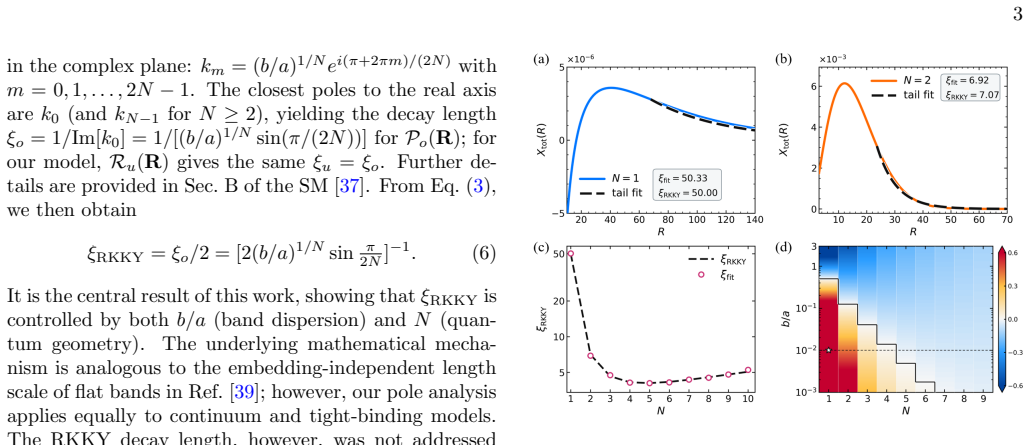
The central object is the analytically continued band projector and its pole structure: for the ideal Chern flat band H(k) = |v_N(k)⟩⟨v_N(k)| + λk²I₂, the poles of the unoccupied projector sit at k_m = (b/a)^{1/N} e^{i(π+2πm)/2N}, and the decay length follows from the inverse of the imaginary part of the closest pole. The non-monotonicity arises from the competition between the prefactor (b/a)^{1/N} and the geometric factor sin(π/2N) in Eq. (6). A second key object is the antipodal overlap F_back(k_F), whose zero at x_F = 1 enforces the power-law change in the dispersive case.
What would settle it
Compute the RKKY kernel numerically for a tight-binding Chern flat band (e.g., the flattened Qi–Wu–Zhang model) with a small gap and Chern numbers N=1 and N=2: if ξ(N=2) is not shorter than ξ(N=1) when b/a < 1/2, the predicted non-monotonicity fails. Similarly, evaluate the intraband response near q=2k_F at exactly x_F=1: if the leading singularity scales as ν^{1/2} rather than ν^{3/2}, the geometric selection mechanism is not operative.
Extended reading notes
Core claim
For an isolated, fully occupied flat band, the intraband RKKY channel vanishes and the exchange proceeds through virtual interband transitions. The resulting kernel is a trace product of real-space projectors, which decay exponentially because the momentum-space projectors are analytic and their analytic continuations have poles at complex momenta. The decay length is ξ_RKKY = [2(b/a)^{1/N} sin(π/2N)]^{-1}, where b/a encodes the gap and N is the Chern order of an ideal Chern flat band. This length depends on both the gap and the quantum metric weight l_QM = √N, and for small gaps it is non-monotonic in N: increasing the Chern number can shorten the exchange range, violating the single-quantu
Load-bearing premise
The non-monotonic decay-length formula relies on the model's band structure having the special analytic form a²k^{2N}+b², so the V-shaped dependence on N may be an artifact of that monomial Hamiltonian rather than a generic property of Chern flat bands; the paper's claim of the same scaling in tight-binding models is deferred to a supplement not shown in the main text.
Editorial extensions
If this is right
- Flat-band RKKY exchange is exponentially short-ranged, with a length scale that can be engineered by tuning the band gap (e.g., via moiré twist angle) rather than being fixed by the quantum metric alone.
- For small gaps, a Chern number N=2 flat band can exhibit a shorter exchange range than N=1, directly contradicting the expectation that more quantum geometry always lengthens spatial correlations.
- In the dispersive regime, gating the Fermi level to x_F = 1 switches the 2k_F RKKY tail from 1/R^2 to 1/R^3 with no change in dispersion, providing a geometric control knob for magnetic ordering.
- The geometric contributions to the RKKY response oppose the conventional mass (Lindhard) response at 2k_F, which can frustrate antiferromagnetic ordering in dispersive bands with strong quantum geometry.
- For realistic parameters in a moiré-type model, the predicted decay length is about 2.5 nm, accessible to spin-polarized scanning tunneling microscopy.
Reading between the lines
- The pole-analysis mechanism should apply to any gapped flat-band model, not just Chern bands; non-monotonic decay lengths may appear whenever the gap enters as a momentum power, not only in the monomial model presented.
- The x_F=1 overlap node is analogous to anti-backscattering selection in chiral systems; similar inversion-representation nodes could exist in other multi-orbital models and might be probed as gate-tunable RKKY power-law switches.
- The result suggests that spatial correlation functions probe different aspects of quantum geometry: while superfluid weight and coherence length are bounded by the quantum metric, RKKY exchange is governed by the full analytic structure of projectors, including the gap-resolvent, so a single geometric scale cannot universally control all correlations.
- A testable extension: in a series of Chern flat bands with increasing N and fixed small gap, measure the RKKY decay length via spin-polarized STM; the predicted V-shaped dependence on N would confirm the competition between gap and geometric factors.
Editorial analysis
A structured set of objections, weighed in public.
Referee Report
Summary. The paper studies RKKY exchange in a filled flat band and in the crossover to dispersive bands. For a model flat band H(k)=|v_N(k)><v_N(k)|+λk^2 I_2 with v_N(k)=(a k_+^N,b), the authors show that the flat-band RKKY kernel decays exponentially, with decay length ξ_RKKY = [2(b/a)^{1/N} sin(π/2N)]^{-1} (Eq. 6), set by complex-momentum poles of the analytically continued band projectors. They derive a nonmonotonicity condition in N (Eq. 7), so that increasing the Chern number and quantum metric length √N can shorten the exchange range when the gap is small. The paper then restores dispersion, decomposes the response into mass, intraband geometric, and interband geometric parts, and shows that the antipodal Bloch-state overlap F_back = [(1-x_F^2)/(1+x_F^2)]^2 can vanish at x_F = ak_F/b = 1. This geometric node suppresses the leading ν^{1/2} threshold singularity, changing the real-space RKKY tail from 1/R^2 to 1/R^3 (Sec. "Geometric selection at 2k_F"). The central analytic derivation for the monomial model is internally consistent, and the numerical plots in Figs. 1 and 2 support Eq. (6) for that model.
Significance. If the results hold as stated, the paper makes a useful conceptual contribution to flat-band physics: it identifies the RKKY decay length as a distinct geometric-gap scale rather than a pure quantum-metric length, and it proposes a gate-tunable geometric selection of the RKKY power law. The flat-band exponential-decay result and the pole-based derivation are clean and explicit, with a closed-form formula that is easy to test. The comparison with the material estimate (α≈1 eV·nm², β≈0.2 eV·nm, ξ≈2.5 nm) gives a concrete experimental target. The main strength is the analytic transparency: the pole analysis, the nonmonotonicity criterion, and the overlap node are all expressed in simple closed forms. The main weakness is that the generalization from the monomial toy model to generic Chern flat bands is asserted but not demonstrated in the available text; the tight-binding validation is deferred to a Supplemental Material section that is not present in the listing. Similarly, the threshold expansion used to convert F_back=0 into a 1/R^3 tail is stated without derivation in the main text. These omissions affect the paper's central claims of generality, so the current version is not yet
major comments (4)
- [Sec. "Ideal Chern flat-band model" and Eq. (6)] The central result Eq. (6) is derived for the specific monomial model H(k)=|v_N(k)><v_N(k)|+λk²I_2, where the gap enters as a²k^{2N}+b². The nearest singularities are simple poles at (b/a)^{1/N} e^{i(π+2πm)/2N}. The paper claims this pole structure transfers to tight-binding Chern bands, including the flattened Qi–Wu–Zhang model, but the only support is a sentence pointing to "Sec. C of the SM", which is not present in the provided manuscript or listing. Without that calculation, the claim that ξ_RKKY shows the same (b/a)^{1/N} scaling and nonmonotonic V-shape for generic Chern flat bands is unverified. This is load-bearing because the "paradigm violation" for real lattice models rests on it. Please add the deferred calculation or explicitly downgrade the claim to a model result.
- [Sec. "Geometric selection at 2k_F" and Fig. 4] The 1/R^3 tail relies on the threshold expansion X_intra(q) ≈ Re[-ρ_0 F_back ν^{1/2} + A_{3/2} ν^{3/2}] near ν=(q-2k_F)/k_F. This expansion is stated in the main text without derivation, and the coefficient A_{3/2} is not given. The reader is left to accept that the ν^{3/2} term has a nonzero coefficient that survives when F_back=0. For the power-law change to be a rigorous consequence of the geometric node, the expansion must be derived or at least the coefficient A_{3/2} specified. Please include the derivation (or a clear reference to Sec. E of the SM) and verify that A_{3/2} does not vanish simultaneously at x_F=1.
- [Fig. 3 and Eq. (9)] The decomposition X_tot = X_mass_intra + X_geom_intra + X_geom_inter is used to compute η_geom^{2k_F}, and the conclusion that geometry "opposes" the mass response relies on the sign and magnitude of these terms. The explicit expressions are deferred to Sec. D of the SM. At minimum, define the sign convention and provide the leading-order small-q coefficients in the main text, so that the reader can check the physical sign of the geometric contribution. As written, Fig. 3(c) depends on unshown formulas.
- [Eq. (1) and general analysis] Eq. (1) omits the spin degeneracy factor and the Kondo coupling constant, and the definition of the trace is not fully specified. This is not fatal, but the normalization affects the prefactor of X(R) in Eq. (2) and the numerical amplitudes in Fig. 3(d). Please clarify the normalization, especially whether the trace includes spin and orbital indices and whether the 2 in Eq. (2) is a spin factor.
minor comments (4)
- [Abstract and Eq. (7)] The statement "e.g., b/a<1/2 already yields ξ(N=1)>ξ(N=2)" is consistent with Eq. (7) for N=1, but the threshold for N=1 vs N=2 is actually [sin(π/6)/sin(π/4)]^2 ≈ 0.5, so the wording "already" is acceptable. Please check the numerical phase diagram in Fig. 2(d) for consistency with the exact boundary, since the boundary for larger N is not smooth.
- [References and SM listing] The manuscript points to Secs. A–E of the Supplemental Material, but the SM is not included in the arXiv listing. Even if the SM will be available in the final version, the main text should state which results are derived in the SM and which are numerical, so that the reader can distinguish assertions from derivations. Several references are given with incomplete journal information (e.g., Ref. [19] is an arXiv preprint, Refs. [23,39,40] have tentative volume numbers). Please update.
- [Eq. (4) and Fig. 1] The model is written with |v_N(k)>=(a k_+^N, b)^T, but the band energy E_u(k)=a²k^{2N}+b² uses k^{2N} while k_+^N is holomorphic. This is fine for the spectrum, but the projector P_u(k)=|v_N><v_N|/E_u(k) has poles at k_+^N = -(b/a)²? Actually the zeros of E_u are at k = (b/a)^{1/N} e^{i(π+2πm)/2N}, which is consistent with the paper. Still, the notation k^{2N} in the text is ambiguous; please use |k|^{2N} or (k_+ k_-)^N to avoid confusion.
- [Fig. 4(b) and 4(c)] In Fig. 4(b) the label "analytical corrections subtracted" is vague. Please state explicitly which terms are subtracted (e.g., the analytic ν² and constant parts) and how the numerical derivative or fit isolates the ν^{1/2} vs ν^{3/2} scaling. This will make the power-law comparison reproducible.
Circularity Check
No significant circularity: Eq. (6) and Eq. (10) are analytic consequences of the stated model, checked numerically against the same integrals; the deferred SM Sec. C is an unverified generalization, not a circular fit.
full rationale
The paper's central result Eq. (6) is derived in-text from the model Hamiltonian Eq. (4): the projectors in Eq. (5) are Fourier-transformed, their complex-plane poles k_m=(b/a)^(1/N) e^(i(pi+2pi m)/2N) are computed from analytic continuation of E_u(k)=a^2|k|^(2N)+b^2, and Eq. (3) combines the equal decay lengths to give xi_RKKY=xi_o/2. This is a self-contained analytic derivation; the numerical tails in Figs. 1-2 are evaluated from the same integrals and serve as consistency checks, not as fits that feed parameters back into Eq. (6). The nonmonotonicity Eq. (7) is an algebraic consequence of Eq. (6). Similarly, Eq. (10) for F_back follows from the model's Bloch states and inversion representation, and the 1/R^3 tail is derived from the stated threshold expansion (SM E), not imported from any fit. The only self-citation, Ref. [30] in the introduction, supports a background statement on quantum-metric bounds and is corroborated by Refs. [27-29]; it is not load-bearing in any derivation. The in-text claim that the pole analysis transfers to tight-binding Chern bands is deferred to SM Sec. C, which is absent from the supplied listing; this is a missing proof/generalization gap and a correctness risk, but not circularity, because the in-model result does not depend on that transfer. Overall, no step reduces to its own input by construction.
Assumptions & free parameters
free parameters (6)
- N
- a
- b
- λ
- E_F
- α, β (material estimate) =
α ≈ 1 eV·nm², β ≈ 0.2 eV·nm
assumptions (6)
- standard math RKKY kernel Eq. (1): static spin susceptibility as a band-resolved sum of energy-denominator × projector overlap F_mn.
- standard math Kato analyticity: projectors of an isolated gapped band are analytic in a strip of the complex momentum plane.
- standard math Paley–Wiener theorem: Fourier transform of a strip-analytic function decays exponentially with the strip width.
- domain assumption Filled-flat-band regime: E_F sits between the flat band and the upper band; the flat band is fully occupied and the intraband channel is absent.
- ad hoc to paper Threshold expansion X_intra(q) ≈ Re[−ρ₀ F_back ν^{1/2} + A_{3/2} ν^{3/2}] near ν = (q−2k_F)/k_F with the leading coefficient proportional to the antipodal overlap.
- domain assumption Decomposition of the dispersive response into mass-intraband + geometric-intraband + geometric-interband channels (Eq. 8).
Cite this review
Pith. "Pith review of Quantum Geometry-Driven RKKY: From Flat to Dispersive Bands." pith.science (2026). https://pith.science/paper/74OF25Q5
@misc{pith2026260726516,
  author       = {Pith},
  title        = {Pith review of: Quantum Geometry-Driven RKKY: From Flat to Dispersive Bands},
  year         = {2026},
  howpublished = {\url{https://pith.science/paper/74OF25Q5}},
  note         = {Machine review of arXiv:2607.26516}
}
abstract
In flat-band systems, quantum metric bounds physical observables like superfluid weight and coherence length, suggesting a single geometric scale for spatial correlations. Here, we show that the RKKY exchange in an isolated filled flat band can violate this expectation. With the intraband channel absent, the exchange proceeds via virtual interband transitions across the gap; the kernel becomes the inverse-gap-weighted trace product of the real-space flat-band projector and empty-band projectors. Because the corresponding momentum-space projectors are analytic, the kernel decays exponentially, with a decay length $\xi_\text{RKKY}$ set by the closest singularities of the analytically continued projectors in the complex momentum plane. Thus, this length depends on both the flat-band geometry and the band gap. Applying this formalism to Chern flat-band systems, we find that for small gaps, $\xi_\text{RKKY}$ depends non-monotonically on the quantum metric length: it first decreases, then increases, revealing that stronger quantum geometry can shorten the magnetic exchange range. Upon restoring dispersion, a nontrivial inversion representation can force the overlap between Bloch states at antipodal Fermi points to vanish under gate tuning, producing a $1/R^3$ RKKY tail instead of the conventional $1/R^2$---a geometric selection effect.
Figures


Figures from the paper (1 more)

Reference graph
Works this paper leans on
-
[1]
Mielke and H
A. Mielke and H. Tasaki, Ferromagnetism in the hubbard model: Examples from models with degenerate single- electron ground states, Communications in mathematical physics158, 341 (1993)
1993
-
[2]
Bistritzer and A
R. Bistritzer and A. H. MacDonald, Moir´ e bands in twisted double-layer graphene, Proceedings of the Na- tional Academy of Sciences108, 12233 (2011)
2011
-
[3]
Y. Cao, V. Fatemi, S. Fang, K. Watanabe, T. Taniguchi, E. Kaxiras, and P. Jarillo-Herrero, Unconventional super- conductivity in magic-angle graphene superlattices, Na- ture556, 43 (2018)
2018
-
[4]
F. Wu, T. Lovorn, E. Tutuc, and A. H. MacDonald, Hub- bard model physics in transition metal dichalcogenide moir´ e bands, Phys. Rev. Lett.121, 026402 (2018)
2018
-
[5]
Y. Tang, L. Li, T. Li, Y. Xu, S. Liu, K. Bar- mak, K. Watanabe, T. Taniguchi, A. H. MacDonald, J. Shan,et al., Simulation of hubbard model physics in WSe2/WS2 moir´ e superlattices, Nature579, 353 (2020)
2020
-
[6]
Regnault, Y
N. Regnault, Y. Xu, M.-R. Li, D.-S. Ma, M. Jovanovic, A. Yazdani, S. S. Parkin, C. Felser, L. M. Schoop, N. P. Ong,et al., Catalogue of flat-band stoichiometric mate- rials, Nature603, 824 (2022)
2022
-
[7]
N. B. Kopnin, T. T. Heikkil¨ a, and G. E. Volovik, High-temperature surface superconductivity in topolog- ical flat-band systems, Phys. Rev. B83, 220503(R) (2011)
2011
-
[8]
Peotta and P
S. Peotta and P. T¨ orm¨ a, Superfluidity in topologically nontrivial flat bands, Nature communications6, 8944 (2015)
2015
Show all 49 references
-
[9]
Julku, S
A. Julku, S. Peotta, T. I. Vanhala, D.-H. Kim, and P. T¨ orm¨ a, Geometric origin of superfluidity in the lieb- lattice flat band, Phys. Rev. Lett.117, 045303 (2016)
2016
-
[10]
Liang, T
L. Liang, T. I. Vanhala, S. Peotta, T. Siro, A. Harju, and P. T¨ orm¨ a, Band geometry, berry curvature, and super- fluid weight, Phys. Rev. B95, 024515 (2017)
2017
-
[11]
Regnault and B
N. Regnault and B. A. Bernevig, Fractional chern insu- 6 lator, Phys. Rev. X1, 021014 (2011)
2011
-
[12]
Neupert, L
T. Neupert, L. Santos, C. Chamon, and C. Mudry, Frac- tional quantum hall states at zero magnetic field, Phys. Rev. Lett.106, 236804 (2011)
2011
-
[13]
K. Sun, Z. Gu, H. Katsura, and S. Das Sarma, Nearly flatbands with nontrivial topology, Phys. Rev. Lett.106, 236803 (2011)
2011
-
[14]
Tang, J.-W
E. Tang, J.-W. Mei, and X.-G. Wen, High-temperature fractional quantum hall states, Phys. Rev. Lett.106, 236802 (2011)
2011
-
[15]
Sheng, Z.-C
D. Sheng, Z.-C. Gu, K. Sun, and L. Sheng, Fractional quantum hall effect in the absence of landau levels, Na- ture communications2, 389 (2011)
2011
-
[16]
C. Wu, D. Bergman, L. Balents, and S. Das Sarma, Flat bands and wigner crystallization in the honeycomb opti- cal lattice, Phys. Rev. Lett.99, 070401 (2007)
2007
-
[17]
T¨ orm¨ a, Essay: Where can quantum geometry lead us?, Phys
P. T¨ orm¨ a, Essay: Where can quantum geometry lead us?, Phys. Rev. Lett.131, 240001 (2023)
2023
-
[18]
J. Yu, B. A. Bernevig, R. Queiroz, E. Rossi, P. T¨ orm¨ a, and B.-J. Yang, Quantum geometry in quantum materi- als, npj Quantum Materials10, 101 (2025)
2025
-
[19]
A. Gao, N. Nagaosa, N. Ni, and S.-Y. Xu, Quantum ge- ometry phenomena in condensed matter systems, arXiv preprint arXiv:2508.00469 (2025)
2025 arXiv
-
[20]
Liu, X.-B
T. Liu, X.-B. Qiang, H.-Z. Lu, and X. Xie, Quantum geometry in condensed matter, National Science Review 12, nwae334 (2025)
2025
-
[21]
Jiang, T
Y. Jiang, T. Holder, and B. Yan, Revealing quantum geometry in nonlinear quantum materials, Reports on Progress in Physics88, 076502 (2025)
2025
-
[22]
Verma, P
N. Verma, P. J. Moll, T. Holder, and R. Queiroz, Quan- tum geometry and the hidden scales in materials, Nature Reviews Physics8, 226–239 (2026)
2026
-
[23]
Kitamura, A
T. Kitamura, A. Daido, and Y. Yanase, Quantum ge- ometry in correlated electron phases: From flatband to dispersive band, Applied Physics Letters128(2026)
2026
-
[24]
Huhtinen, J
K.-E. Huhtinen, J. Herzog-Arbeitman, A. Chew, B. A. Bernevig, and P. T¨ orm¨ a, Revisiting flat band supercon- ductivity: Dependence on minimal quantum metric and band touchings, Phys. Rev. B106, 014518 (2022)
2022
-
[25]
H. Tian, X. Gao, Y. Zhang, S. Che, T. Xu, P. Che- ung, K. Watanabe, T. Taniguchi, M. Randeria, F. Zhang, et al., Evidence for dirac flat band superconductivity en- abled by quantum geometry, Nature614, 440 (2023)
2023
-
[26]
Tanaka, J
M. Tanaka, J. ˆI.-J. Wang, T. H. Dinh, D. Rodan-Legrain, S. Zaman, M. Hays, A. Almanakly, B. Kannan, D. K. Kim, B. M. Niedzielski,et al., Superfluid stiffness of magic-angle twisted bilayer graphene, Nature638, 99 (2025)
2025
-
[27]
S. A. Chen and K. T. Law, Ginzburg-landau theory of flat-band superconductors with quantum metric, Phys. Rev. Lett.132, 026002 (2024)
2024
-
[28]
Iskin, Extracting quantum-geometric effects from ginzburg-landau theory in a multiband hubbard model, Phys
M. Iskin, Extracting quantum-geometric effects from ginzburg-landau theory in a multiband hubbard model, Phys. Rev. B107, 224505 (2023)
2023
-
[29]
J.-X. Hu, S. A. Chen, and K. T. Law, Anomalous co- herence length in superconductors with quantum metric, Communications Physics8, 20 (2025)
2025
-
[30]
Li, F.-C
C. Li, F.-C. Zhang, and L.-H. Hu, Vortex states and coherence lengths in flat-band superconductors, arXiv preprint arXiv:2505.01682 (2025)
2025 arXiv
-
[31]
Marzari and D
N. Marzari and D. Vanderbilt, Maximally localized gen- eralized wannier functions for composite energy bands, Phys. Rev. B56, 12847 (1997)
1997
-
[32]
Coleman,Introduction to many-body physics(Cam- bridge University Press, 2015)
P. Coleman,Introduction to many-body physics(Cam- bridge University Press, 2015)
2015
-
[33]
Kato and T
T. Kato and T. Kat ˚ ao,Perturbation theory for linear op- erators, Vol. 132 (Springer, 1966)
1966
-
[34]
Y. Liu, A. Aryal, D. Calugaru, Z. Fang, K. Yang, H. Hu, Q. Yan, B. A. Bernevig, and C.-X. Liu, “ideal” topologi- cal heavy fermion model in two-dimensional moir\’e het- erostructures with type-ii band alignment, arXiv preprint arXiv:2507.06168 (2025)
2025
-
[35]
Onishi and L
Y. Onishi and L. Fu, Quantum weight: A fundamen- tal property of quantum many-body systems, Phys. Rev. Res.7, 023158 (2025)
2025
-
[36]
Kitamura, A
T. Kitamura, A. Daido, and Y. Yanase, Spin-triplet superconductivity from quantum-geometry-induced fer- romagnetic fluctuation, Phys. Rev. Lett.132, 036001 (2024)
2024
-
[37]
A), the pole analysis of projects (Sec
See the Supplemental Material for details on the small-q response (Sec. A), the pole analysis of projects (Sec. B), the tight-binding generalization (Sec. C), the dispersive RKKY decomposition (Sec. D), and the geometric selec- tion analysis of the power laws (Sec. E)
-
[38]
R. E. A. C. Paley and N. Wiener,Fourier transforms in the complex domain, Vol. 19 (American Mathematical Soc., 1934)
1934
-
[39]
S. Lee, S. H. Lee, and B.-J. Yang, Embedding indepen- dent length scale of flat bands, Phys. Rev. Lett.137, 016401 (2026)
2026
-
[40]
H. Hu, O. Vafek, K. Haule, and B. A. Bernevig, Fer- romagnetism versus antiferromagnetism in narrow-band systems: Competition between quantum geometry and band dispersion, Phys. Rev. Lett.136, 256505 (2026)
2026
-
[41]
Meier, L
F. Meier, L. Zhou, J. Wiebe, and R. Wiesendanger, Re- vealing magnetic interactions from single-atom magneti- zation curves, Science320, 82–86 (2008)
2008
-
[42]
L. Zhou, J. Wiebe, S. Lounis, E. Vedmedenko, F. Meier, S. Bl¨ ugel, P. H. Dederichs, and R. Wiesendanger, Strength and directionality of surface Ruderman–Kittel– Kasuya–Yosida interaction mapped on the atomic scale, Nature Physics6, 187 (2010)
2010
-
[43]
Wiesendanger, Spin mapping at the nanoscale and atomic scale, Rev
R. Wiesendanger, Spin mapping at the nanoscale and atomic scale, Rev. Mod. Phys.81, 1495 (2009)
2009
-
[44]
D.-J. Choi, N. Lorente, J. Wiebe, K. von Bergmann, A. F. Otte, and A. J. Heinrich, Colloquium: Atomic spin chains on surfaces, Rev. Mod. Phys.91, 041001 (2019)
2019
-
[45]
Qi, Y.-S
X.-L. Qi, Y.-S. Wu, and S.-C. Zhang, Topological quan- tization of the spin hall effect in two-dimensional param- agnetic semiconductors, Phys. Rev. B74, 085308 (2006)
2006
-
[46]
L. Brey, H. A. Fertig, and S. Das Sarma, Diluted graphene antiferromagnet, Phys. Rev. Lett.99, 116802 (2007)
2007
-
[47]
Sherafati and S
M. Sherafati and S. Satpathy, Analytical expression for the rkky interaction in doped graphene, Phys. Rev. B84, 125416 (2011)
2011
-
[48]
Bouzerar, RKKY couplings in the lieb lattice: Flat- band induced frustration, Phys
G. Bouzerar, RKKY couplings in the lieb lattice: Flat- band induced frustration, Phys. Rev. B104, 155151 (2021)
2021
-
[49]
Luo and M.-F
Y.-D. Luo and M.-F. Yang, Influence of flat bands on RKKY interaction: Perspective of fano defects, Phys. Rev. B110, 144402 (2024)
2024
Reviewed August 1, 2026 · model on record in the stance chip above.
Discussion (0). Continue with ORCID to comment.