REVIEW 3 major objections 5 minor 23 references
Autoregressive video distillation works when the student already covers the teacher’s modes—and stays covering them while DMD sharpens.
Reviewed by Pith at T0; open to challenge. T0 means a machine referee read the full paper against a public rubric. the ladder, T0–T4 →
T0 review · grok-4.5
2026-07-30 20:20 UTC pith:GHJH5PNW
load-bearing objection Solid empirical methods paper: match init to the DMD teacher and keep a CD anchor; the weak-teacher headline slightly overclaims what Table 4 isolates. the 3 major comments →
DistillAlign: Coordinating Mode Covering and Mode Seeking in Autoregressive Video Distillation
The pith
A machine-rendered reading of the paper's core claim, the machinery that carries it, and where it could break.
Core claim
Final quality in autoregressive video distillation is governed by distributional alignment, not by intermediate visual scores or teacher size alone: the pre-DMD student must cover the DMD teacher’s modes, and DMD must be paired with a mode-covering constraint so reverse-KL refinement does not collapse coverage and diversity. When both hold, a weaker matched teacher can outperform stronger mismatched pipelines.
What carries the argument
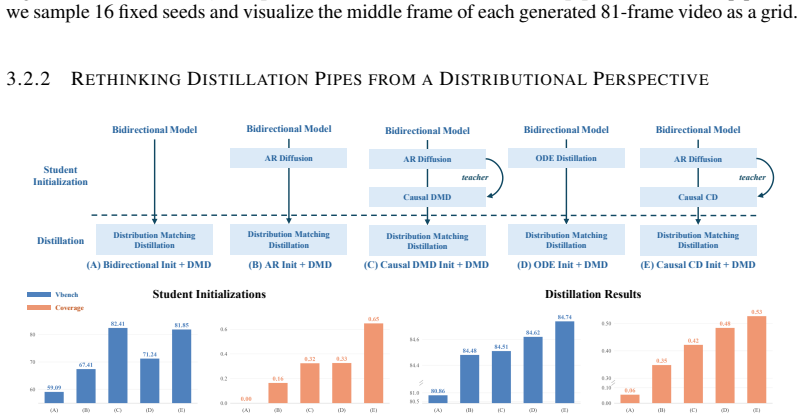
Joint distillation: L_joint = L_DMD + λ L_CD, plus a teacher-normalized precision/coverage protocol (re-noise initializer latents with a shared teacher, then k-NN support in V-JEPA2 feature space) that ranks initializers by mode coverage rather than raw sharpness.
Load-bearing premise
The claim rests on treating precision and coverage in one frozen video feature space, after a shared re-noising step, as a faithful stand-in for the semantic modes DMD can actually refine.
What would settle it
Hold the matched joint recipe fixed and swap or ablate the feature space and re-noising protocol: if initializer rankings and the link from higher coverage to better post-DMD VBench/diversity reverse or disappear under another encoder, radius rule, or no re-noising, the distributional story fails.
If this is right
- Initialization checkpoints should be selected by matched teacher coverage, not peak VBench alone.
- Scaling the DMD teacher helps less if the student never covered that teacher’s modes.
- Pure reverse-KL DMD needs an explicit mode-covering anchor to avoid late diversity and quality drop.
- Matched weak teachers can beat mismatched strong-teacher baselines in few-step causal video generation.
Where Pith is reading between the lines
- The same cover-then-seek logic likely applies to other multi-stage score-distillation stacks beyond video (image, audio, 3D) wherever reverse-KL refinement follows a trajectory or consistency init.
- If coverage is the bottleneck, collecting more diverse teacher samples for the init stage may beat simply swapping in a larger DMD teacher.
- Online monitoring of coverage during DMD could serve as an early-stopping signal before visual scores peak and then fall.
Editorial analysis
A structured set of objections, weighed in public.
Referee Report
Summary. The paper argues that multi-stage autoregressive video distillation fails when pre-DMD initialization and DMD refinement target misaligned distributions, and when pure reverse-KL DMD is run long enough to collapse coverage. It introduces a teacher-normalized precision/coverage protocol in V-JEPA2 feature space to diagnose mode coverage independently of raw visual scores, shows via controlled teacher-source swaps and pipeline comparisons that matched mode-covering initializations (especially causal CD) support better DMD refinement, and proposes joint distillation L_DMD + λ L_CD to retain coverage while sharpening modes. Empirically, matched joint training improves VBench, coverage, and Vendi diversity; a full Wan-14B setting reaches the best scores, and a weak Wan-1.3B setting is reported to beat prior Wan-14B-refined baselines.
Significance. If the distributional account holds, the work reframes AR video distillation practice away from chasing intermediate VBench and toward explicit target matching and mode-cover/mode-seek coordination—an actionable design principle for few-step causal generators. Strengths include a clear two-hypothesis structure, controlled target-swap experiments (Tables 1 and 3), multi-pipeline coverage diagnostics (Figure 3, Table 7), training-dynamics evidence of late DMD drift versus joint anchoring (Figure 5, Tables 5–6 and weak-setting Tables 8–9), and a simple joint objective that is easy to adopt. The contribution is primarily empirical and systems-level rather than theoretical, but it is timely for real-time world-model and interactive video pipelines where both fidelity and diversity matter.
major comments (3)
- [Abstract; §4.2 Table 4; §1 Table 1] Abstract and §4.2 / Table 4 over-attribute the headline “Wan-1.3B DMD teacher outperforms Wan-14B-refined baselines.” Ours (weak) couples matched 1.3B data, causal CD init, and joint DMD+CD; Self-Forcing and Causal-Forcing are different recipes with 14B teachers and no joint anchor. Table 1 already shows matched pure DMD 1.3B→1.3B at 84.50, nearly identical to Ours (weak) 84.54, so most of the lift over mismatched Causal Forcing (83.89) is target matching, not joint loss or “alignment rivals 14B scale.” Please either (i) add a same-recipe ablation (matched CD init ± joint loss under both 1.3B and 14B teachers, reported side-by-side) or (ii) rewrite the claim as “full DistillAlign pipeline with a 1.3B teacher beats prior published 14B pipelines,” without implying a pure teacher-scale swap.
- [§4.1 Evaluation; §4.2 Table 4] In Table 4, precision/coverage for Ours (weak) are computed against the Wan-1.3B teacher while all 14B baselines and Ours (full) are scored against Wan-14B. §4.1 correctly warns that cross-teacher values are not on one absolute scale, yet the text still ranks “strongest coverage among distilled autoregressive models” in a way that invites direct comparison of 0.59 (vs 1.3B) to 0.29/0.53 (vs 14B). Restrict cross-method coverage ranking to rows that share the same reference teacher (e.g., emphasize Ours full 0.69 vs Causal-Forcing 0.29 / Self-Forcing 0.53), and report weak-setting coverage only within the 1.3B reference (as in Tables 8–9).
- [§3.1 Eqs. 8–11; Appendix A; Table 7] The causal story that higher teacher-normalized coverage causes better DMD refinement rests on the V-JEPA2 k-NN protocol (Sec. 3.1, Eqs. 8–11; Appendix A: ρ=0.9, shared 14B re-noise, k=5, N=M=256, 8-frame short window). Figure 8 and Table 7 make a good case that re-noising removes low-level confounds for ODE vs Causal DMD, but there is no sensitivity check to encoder (e.g., alternative video SSL or CLIP-style features), k, ρ, or temporal window. A compact ablation showing that initializer rankings and the CD-vs-DMD coverage gap are stable under at least one alternate feature space or (k, ρ) setting would substantially strengthen the load-bearing diagnostic.
minor comments (5)
- [Figure 1; Figure 2] Figure 1/2 labels contain typos (“Hyposis”, “Matche d”, “probabil ity”) and should be cleaned for camera-ready.
- [§2.3; §4.1] Eq. (6)–(7) present DMD as reverse KL on perturbed marginals; a brief note on how the online fake score is trained in the AR/causal setting (history conditioning, which frames enter the critic) would help reproducibility.
- [§3.3.2; §4.1 Implementation details] Joint loss uses the Stage-2 causal CD teacher while DMD uses the matched data-source teacher; state explicitly whether these coincide in the full 14B setting and how λ interacts when they differ.
- [§4.1; Tables 4–7] Diversity is raw Vendi on the same features as coverage; consider also reporting a teacher-relative diversity ratio so absolute scale is easier to interpret across tables.
- [§5.2] Related work §5.2 cites several concurrent mode-cover/mode-seek hybrids (f-Distill, rCM, ADM/DMDX, SGMD, HiAR, BiWM); a short explicit contrast of what is specific to causal multi-stage AR video (matched init across stages + CD anchor during DMD) would sharpen novelty.
Circularity Check
No significant circularity: empirical distillation methods paper with external benchmarks, not a self-sealing derivation.
full rationale
DistillAlign does not present a first-principles derivation whose outputs reduce to its inputs by construction. The central claims are empirical: (i) matching pre-DMD initialization support to the DMD teacher improves refinement, supported by a controlled teacher-source swap (Table 1) and pipeline comparison (Fig. 3, Table 7) that report external VBench scores; (ii) pure reverse-KL DMD can drift late even under matched targets (Table 2/6); (iii) joint loss L_joint = L_DMD + λ L_CD with ablated λ (Tables 5–6, 8–9) improves the quality–coverage–diversity trade-off. Precision/coverage (Eqs. 10–11) are post-hoc diagnostics in a frozen V-JEPA2 space, not training objectives optimized to force the headline. Mode-seeking vs mode-covering is standard reverse-KL vs consistency/ODE behavior from the cited literature, not a uniqueness theorem imported from the authors. Baselines (Self-Forcing, Causal-Forcing, CausVid) and VBench are external. No fitted parameter is renamed a prediction; no load-bearing self-citation chain closes the argument. Attribution debates about Table 4 (recipe vs teacher scale) are causal-identification issues, not circularity.
Axiom & Free-Parameter Ledger
free parameters (5)
- joint loss weight λ =
0.01
- teacher-normalized re-noise level ρ =
0.9
- k-NN support parameter k =
5
- distributional sample budget N=M =
256
- stage training lengths and data size =
5K / 2.5K / 1.5K; 25K samples
axioms (5)
- domain assumption DMD’s reverse-KL / score-difference objective is inherently mode-seeking and tends to reduce coverage under prolonged training.
- domain assumption ODE/consistency-style regression onto teacher trajectories is mode-covering and preserves broader support at the cost of sharpness.
- ad hoc to paper Frozen V-JEPA2 features on a short temporal window represent the high-level semantic modes relevant to distillation success.
- ad hoc to paper Shared teacher re-noising mostly removes low-level fidelity confounds while preserving initializer-induced semantic support.
- standard math Flow-matching / PF-ODE teacher maps and standard reverse-KL DMD gradient estimators are valid training targets for the student.
invented entities (2)
-
Teacher-normalized distributional evaluation protocol (precision/coverage after shared re-noising)
no independent evidence
-
Joint DMD+CD distillation objective L_DMD + λ L_CD for AR video students
no independent evidence
read the original abstract
Existing autoregressive video distillation methods commonly adopt a Distribution Matching Distillation (DMD)-based multi-stage pipeline. However, they typically decouple the initialization and DMD stages -- which then pursue different target distributions -- and judge the intermediate student mainly by visual scores such as VBench. In this paper, we revisit this design from a distributional perspective. Given the mode-seeking nature of the distribution matching loss, a good initialization should match the mode coverage of the target DMD teacher, rather than merely pursuing high quality. To analyze this, we introduce a distributional evaluation protocol that measures precision and coverage between student and teacher distributions in a shared latent space. It exposes differences hidden by visual scores: some initializations reach high precision but low coverage, leading to suboptimal refinement, while mode-covering ones preserve broader support. Furthermore, even when the target distributions are aligned, DMD's reverse-KL objective can still drive the student toward high-probability teacher regions in late training, reducing coverage and diversity. To address this, we propose joint distillation, which combines DMD's mode-seeking objective with a Consistency Distillation-based mode-covering constraint. Experiments show that our method improves generation quality, coverage, and diversity; notably, even with a Wan-1.3B DMD teacher, it outperforms baselines refined with Wan-14B, underscoring the importance of distributional alignment in autoregressive video distillation.
Figures




Reference graph
Works this paper leans on
-
[1]
Mido Assran, Adrien Bardes, David Fan, Quentin Garrido, Russell Howes, Mojtaba Komeili, Matthew Muckley, Ammar Rizvi, Claire Roberts, Koustuv Sinha, et al. V-JEPA 2: Self-supervised video models enable understanding, prediction and planning.arXiv preprint arXiv:2506.09985,
-
[5]
Dynamics- boost: Dynamic plausible video generation via annotation-free continuation preference optimiza- tion
12 arXivPreprint, 2026 Jiaxing Li, Jiepeng Wang, Junyao Gao, Yang Liu, Eric Li, Bo An, and Hao-Xiang Guo. Dynamics- boost: Dynamic plausible video generation via annotation-free continuation preference optimiza- tion. InProceedings of the IEEE/CVF Conference on Computer Vision and Pattern Recognition, pp. 20024–20033,
2026
-
[8]
Xingchao Liu, Chengyue Gong, and Qiang Liu. Flow straight and fast: Learning to generate and transfer data with rectified flow.arXiv preprint arXiv:2209.03003,
-
[9]
Eric Luhman and Troy Luhman. Knowledge distillation in iterative generative models for improved sampling speed.arXiv preprint arXiv:2101.02388,
-
[10]
Riemann Dynamics
Accessed: 2026-06-20. Riemann Dynamics. Matrix-game 3.5: Enhancing real-time streaming interactive world models with patch memory. Project page,
2026
-
[11]
URLhttps://matrix-game-v3-5.github.io/. Shaohao Rui, Xiaofeng Mao, Zhanyu Zhang, Peijia Lin, Yansong Zhu, Yibo Zhang, Haibin Wan, and Weijie Ma. Biwm: Advancing open-source interactive video world models with bidirectional autoregression.arXiv preprint arXiv:2606.10135,
-
[12]
Advancing open-source world models.arXiv preprint arXiv:2601.20540,
Robbyant Team, Zelin Gao, Qiuyu Wang, Yanhong Zeng, Jiapeng Zhu, Ka Leong Cheng, Yixuan Li, Hanlin Wang, Yinghao Xu, Shuailei Ma, et al. Advancing open-source world models.arXiv preprint arXiv:2601.20540,
-
[13]
Wan: Open and advanced large-scale video generative models.arXiv preprint arXiv:2503.20314,
Wan Team. Wan: Open and advanced large-scale video generative models.arXiv preprint arXiv:2503.20314,
-
[14]
Videolcm: Video latent consistency model.arXiv preprint arXiv:2312.09109,
Xiang Wang, Shiwei Zhang, Han Zhang, Yu Liu, Yingya Zhang, Changxin Gao, and Nong Sang. Videolcm: Video latent consistency model.arXiv preprint arXiv:2312.09109,
-
[15]
13 arXivPreprint, 2026 Zile Wang, Zexiang Liu, Jiaxing Li, Kaichen Huang, Baixin Xu, Fei Kang, Mengyin An, Peiyu Wang, Biao Jiang, Yichen Wei, et al. Matrix-game 3.0: Real-time and streaming interactive world model with long-horizon memory.arXiv preprint arXiv:2604.08995,
Pith/arXiv arXiv 2026
-
[16]
One-step diffusion models withf-divergence distribution matching.arXiv preprint arXiv:2502.15681,
Yilun Xu, Weili Nie, and Arash Vahdat. One-step diffusion models withf-divergence distribution matching.arXiv preprint arXiv:2502.15681,
-
[17]
Longlive: Real-time interactive long video generation
Shuai Yang, Wei Huang, Ruihang Chu, Yicheng Xiao, Yuyang Zhao, Xianbang Wang, Muyang Li, Enze Xie, Yingcong Chen, Yao Lu, et al. Longlive: Real-time interactive long video generation. arXiv preprint arXiv:2509.22622,
-
[18]
Zhuoyi Yang, Jiayan Teng, Wendi Zheng, Ming Ding, Shiyu Huang, Jiazheng Xu, Yuanming Yang, Wenyi Hong, Xiaohan Zhang, Guanyu Feng, et al. Cogvideox: Text-to-video diffusion models with an expert transformer.arXiv preprint arXiv:2408.06072,
-
[19]
Min Zhao, Hongzhou Zhu, Kaiwen Zheng, Zihan Zhou, Bokai Yan, Xinyuan Li, Xiao Yang, Chongxuan Li, and Jun Zhu. Causal forcing++: Scalable few-step autoregressive diffusion distil- lation for real-time interactive video generation.arXiv preprint arXiv:2605.15141,
-
[20]
Kai Zou, Dian Zheng, Hongbo Liu, Tiankai Hang, Bin Liu, and Nenghai Yu. Hiar: Efficient au- toregressive long video generation via hierarchical denoising.arXiv preprint arXiv:2603.08703,
-
[21]
14 arXivPreprint, 2026 A MOREDETAILS OFCOVERAGEMETRICS This section specifies the complete evaluation pipeline used for the precision, coverage, and diversity results in the paper. We distinguish thenormalization teacherT norm, which removes nuisance differences among raw initializer outputs, from thereference teacherTref, whose sample distribution define...
2026
-
[22]
on the same normalized V-JEPA2 descriptors. For a method feature matrixU∈R N×2560 , we form the shifted cosine kernel K= U U⊤ +11 ⊤ 2 , ¯K= K N .(18) If{λ q}are the positive eigenvalues of ¯K, the reported score is Vendi(U) = exp − X q λq logλ q ! .(19) We report this raw effective-rank value, not a ratio to the teacher. It is a within-method diversity st...
2026
-
[23]
For fair comparison, all methods in the same figure use the same prompt, and when applicable, the same set of fixed random seeds
VBench Metrics↑Distributional Metrics↑VBench Metrics↑Distributional Metrics↑ Total Quality Semantic Precision Coverage Diversity Total Quality Semantic Precision Coverage Diversity 0 82.16 83.38 77.29 0.61 0.52 1.301 82.16 83.38 77.29 0.61 0.52 1.301 500 83.84 85.07 78.92 0.66 0.52 1.295 84.44 85.52 80.09 0.68 0.48 1.293 1000 84.17 85.38 79.29 0.69 0.51 1...
2026
-
[2022]
Rolling forcing: Autoregressive long video diffusion in real time.arXiv preprint arXiv:2509.25161,
Kunhao Liu, Wenbo Hu, Jiale Xu, Ying Shan, and Shijian Lu. Rolling forcing: Autoregressive long video diffusion in real time.arXiv preprint arXiv:2509.25161,
-
[2023]
Charactershot: Controllable and consistent 4d character animation.arXiv preprint arXiv:2508.07409,
Junyao Gao, Jiaxing Li, Wenran Liu, Yanhong Zeng, Fei Shen, Kai Chen, Yanan Sun, and Cairong Zhao. Charactershot: Controllable and consistent 4d character animation.arXiv preprint arXiv:2508.07409,
-
[2024]
Shuo Chen, Cong Wei, Sun Sun, Ping Nie, Kai Zhou, Ge Zhang, Ming-Hsuan Yang, and Wenhu Chen. Context forcing: Consistent autoregressive video generation with long context.arXiv preprint arXiv:2602.06028,
-
[2025]
Xianglong He, Chunli Peng, Zexiang Liu, Boyang Wang, Yifan Zhang, Qi Cui, Fei Kang, Biao Jiang, Mengyin An, Yangyang Ren, et al. Matrix-game 2.0: An open-source real-time and stream- ing interactive world model.arXiv preprint arXiv:2508.13009,
-
[2026]
Flow matching for generative modeling.arXiv preprint arXiv:2210.02747,
Yaron Lipman, Ricky TQ Chen, Heli Ben-Hamu, Maximilian Nickel, and Matt Le. Flow matching for generative modeling.arXiv preprint arXiv:2210.02747,
discussion (0)
Sign in with ORCID, Apple, or X to comment. Anyone can read and Pith papers without signing in.