REVIEW 3 major objections 5 minor 40 references
The paper argues that natural-language audience tags, converted into a collaborative factor query, can restore the collaborative signal missing from semantic-ID recommendation without retraining.
Reviewed by Pith at T0; open to challenge. T0 means a machine referee read the full paper against a public rubric. the ladder, T0–T4 →
T0 review · deepseek-v4-flash
2026-08-01 03:23 UTC pith:H4FWBVEN
load-bearing objection Useful training-free collaborative reranking for frozen SID recommenders, with a solid main result and an under-supported HPF-specificity claim. the 3 major comments →
Restoring Collaborative Signals in Semantic-ID Generative Recommendation via Personalized Natural Language
The pith
A machine-rendered reading of the paper's core claim, the machinery that carries it, and where it could break.
Core claim
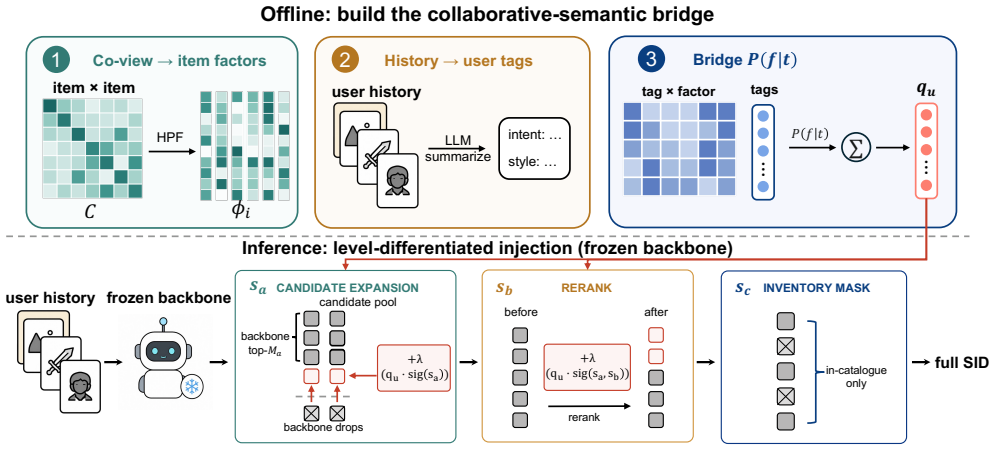
The central claim is that the collaboration deficit of content-built semantic IDs can be repaired without retraining the tokenizer or the generator: factorising a second-order item–item co-view matrix gives per-item collaborative factors that, aggregated onto SID prefixes, yield a content-agnostic signature addressable by exactly the codes the generator emits. A learned bridge translates an LLM's natural-language audience tags into this factor space, producing a user query that is faithful to the behavioural one and leakage-free. At inference the query adds a collaborative residual at the coarse and mid levels of the frozen backbone's own beam search — candidate expansion at the first code l
What carries the argument
The load-bearing object is the second-order item–item co-view matrix, counting how many users consumed each unordered pair of items, factorised by hierarchical Poisson factorization (a Gamma–Poisson probabilistic model) into non-negative per-item latent vectors. These are averaged onto SID prefixes to give signatures indexed by the very codes the generator emits. A learned bridge maps natural-language audience tags into this factor space to build a user query. The inference-time rule adds a collaborative residual to the backbone's own candidate scores level by level under a fixed beam.
Load-bearing premise
The load-bearing premise is that the second-order co-view matrix encodes genuine audience structure rather than popularity or content similarity already present in the SID; if it mostly reflects frequency, the mid-level reranking gain would collapse to a popularity artifact.
What would settle it
Construct a perturbed version of the benchmark where the item–item co-view matrix is rebuilt after randomly shuffling a user's history items while keeping the same marginals, then run the method on the frozen backbone. If hit@10 on the larger model still rises near 15.50, the reported gain comes from frequency rather than audience structure; if the gain vanishes, the collaborative interpretation is confirmed.
If this is right
- Enabling a frozen backbone's native reasoning lowers full-SID accuracy at every cutoff, so the text-interface route cannot supply the missing collaborative signal.
- The gain is carried by the mid-level reranking: adding coarse-code expansion alone is within noise, and the mid-level residual produces the significant jump.
- The benefit is representation-specific: HPF co-watch factors improve over TF-IDF+SVD and K-means co-watch representations, both of which fall below the frozen baseline.
- The language-reconstructed query matches the history-derived query in downstream utility, so collaborative signal survives the language bottleneck; it also separates users at the ranking level.
- Because the channel acts only on the collaborative factor space and never on the SID embeddings, it in principle extends to other semantic-ID generators, including encoder-decoder ones.
Where Pith is reading between the lines
- If the content–collaborative exclusivity diagnosis is right, then any content-only SID tokenizer caps the accuracy of frozen generators at roughly the prefix-reachability ceiling, making external collaborative injection a necessary complement rather than a luxury.
- The modest user differentiation suggests the profile, not the channel, is the bottleneck; a per-user memory that retrieves tags conditioned on the current need — which the authors flag as future work — is a testable extension that should sharpen the query and enlarge the effect.
- The method's ceiling is the reachability of the target prefix in the candidate pool; a natural stress test is to measure how the gain varies with the candidate budgets, since expansion beyond the pool requires either a wider beam or a hybrid retrieve-and-generate scheme.
- The same ladder — factor query, language bridge, level-wise residual — could be reused outside full-SID recommendation, e.g., for controlled generation with other hierarchical discrete codes, where the language-conditioned factor query acts as a steerable knob.
Editorial analysis
A structured set of objections, weighed in public.
Referee Report
Summary. The paper proposes a training-free, inference-time method for injecting collaborative signals into a frozen semantic-ID (SID) generative recommender. It factorizes a second-order item–item co-view matrix with hierarchical Poisson factorization (HPF), summarizes each user's history into natural-language audience tags, learns a bridge P(f|t) mapping tags to the HPF factor space, and reranks the frozen backbone's own SID candidates level-by-level (coarse-code expansion at s_a, residual reranking at s_b, and an inventory mask at s_c). Experiments on two OneRec backbones (1.7B and 8B) on the RecIF benchmark report consistent full-SID hit-rate gains (e.g., 8B hit@10 from 11.14 to 15.50), with level-wise ablations attributing most of the gain to the s_b reranking step. Controls include a popularity reranker, a semantic-similarity reranker, a history-derived factor query, and a user-specificity analysis showing a modest but statistically significant audience-differentiation effect.
Significance. If the findings hold, the paper offers a practical recipe for supplying collaborative signal to SID generators without retraining the backbone or the semantic IDs, which is appealing because SID codebooks are expensive to relearn. The empirical study is careful in several respects: paired-bootstrap confidence intervals are reported, the ablation in Table 2 isolates the contribution of each level, and the limitations section honestly states the single-benchmark and single-backbone-family scope. The paper also includes useful controls (popularity, text-interface, history-derived query). However, the central claim of HPF-specificity—that the gain depends on this particular collaborative representation rather than any low-dimensional embedding—is not yet adequately supported by the evidence in Table 3, and the headline number mixes a non-collaborative inventory constraint with the collaborative reranking effect. These issues need to be resolved before the paper's main claims can be accepted as stated.
major comments (3)
- [Methodology, Eq. (3)] The central bridge equation P(f|t) is typeset in a way that is not interpretable: the fraction as rendered has no clear denominator or normalization. Since this equation defines the natural-language bridge that is a core contribution, the method is underspecified. Please rewrite Eq. (3) with explicit terms, including the normalization over f and the role of the smoothing constant μ.
- [Experiments, Table 3 and 'Dependence on the collaborative representation'] The claim that the gain depends on HPF rather than an arbitrary low-dimensional representation is supported only by comparisons against TF-IDF+SVD and K-means. These are not standard collaborative-filtering baselines: TF-IDF is an unusual normalization for a co-view count matrix, and K-means discards fine-grained similarity. A generic low-rank embedding such as truncated SVD on the raw counts, or a standard MF baseline (ALS or logistic MF), should be tested. If a generic SVD or MF also yields large gains, the HPF-specificity claim collapses to 'any collaborative vector helps'. This is load-bearing because the contributions explicitly argue for HPF specificity. Please add such baselines or substantially soften the claim.
- [Experiments, Table 2 vs. Table 1 and Abstract/Contributions] The baseline Base in Table 2 appears not to include the s_c inventory constraint, while Ours does. In the cumulative ablation, the inventory constraint adds a non-collaborative gain (e.g., 8B: +0.85pp on hit@10, from 14.65 to 15.50). The abstract and contributions quote the full 11.14→15.50 improvement without decomposing it. This conflates a trivial inventory mask with the collaborative channel. Please report a baseline that already includes the inventory constraint (so the comparison isolates the collaborative signal), and in the abstract/contributions either quote the collaborative-only gain or explicitly state that the headline number includes the inventory mask.
minor comments (5)
- [Abstract and Contributions] The phrase 'the channel yields consistent hit-rate gains' should be qualified: the gain decomposes into the s_b collaborative reranking and the s_c inventory mask. Consider reporting both numbers in the abstract.
- [Experimental Setup] The LLM prompt used to summarize user histories into audience tags is not described. The tag ontology is also only given by two examples. For reproducibility, please provide the full prompt template and a list of canonical tags in an appendix.
- [Figure 2] The PCA plot is stated to be 'quantified in full embedding dimension', but the quantitative separation percentage (75–79%) is only reported for the PCA-projected visualization. Give the actual overlap measure in the embedding space.
- [Notation in Eq. (5)] The subscript of the softmax in 'softmax_sa' is ambiguous; it should be clear whether the softmax is over all s_a codes or over the candidate set. This affects the scale of the collaborative residual at the coarse level.
- [Limitations] The limitations paragraph on reachability is helpful, but it could be more explicit that the reported (s_a,s_b)@20 reachability improves precisely because the collaborative reranking changes which prefixes are in the beam, not because the beam width grows.
Circularity Check
Minor definitional circularity in the natural-language query bridge; the central held-out hit-rate result is externally grounded.
specific steps
-
self definitional
[Methodology, Natural-Language Bridge to the Factor Space, Eqs. (3)-(4)]
"Writing q^F_u for a training user’s behavioural factor query (the row-normalized mean of their history-item factors φ_i)... we accumulate each user’s factors, split evenly across their tags, and smooth toward the global factor prior π: P(f|t) = Σ_{u:t∈T_u} 1/|T_u| q^F_u + µπ ... (3) ... the natural-language query is the normalized sum of the corresponding tag distributions, q_u = normalize(Σ_{t∈T_u} P(f|t)) (4), which lies in the same factor space as the behavioural query."
The 'natural-language' query q_u is not an independent language-derived signal: Eq. (3) defines each tag distribution P(f|t) as a smoothed average of training users' behavioural factor queries q^F_u, and Eq. (4) makes q_u a normalized sum of those same training-user behavioural queries. Therefore the claim that the bridge is 'faithful (the language-reconstructed query matches the behavioural one)' is true by construction rather than by independent measurement. The paper's downstream hit-rate gains, however, are evaluated on held-out next-item targets and do not reduce to this definition, so the circularity is partial and confined to the 'language channel preserves the behavioural query' claim.
full rationale
The central empirical claim — that a frozen SID generator's hit-rate improves when a collaborative factor-space query is injected at inference — is tested on held-out next-item targets from the open RecIF/OpenOneRec benchmark, with a GT-disjoint evaluation set and a shared candidate budget. Hit@10 gains (e.g., OneRec-8B 11.14 to 15.50) are external outcomes, not consequences of fitting the reranking weight (λ=0.1 fixed) or of the bridge equations. The level-wise ablation (Table 2) and representation control (Table 3) are likewise empirical, even though the HPF-vs-SVD/K-means comparison is a weak control set; that is an evidence-strength concern, not circularity. Self-citations to OneRec Team 2026 and He et al. 2026 for 'reasoning hurts' are not load-bearing because the paper reproduces that result with its own experiments (8B hit@10 10.90→7.26). The only definitional reduction is the natural-language query: by Eqs. (3)-(4) it is a smoothed average of the very behavioural factor queries it is said to reconstruct, making the 'faithful bridge' claim partially self-fulfilling. This is a minor, non-central circularity; the main accuracy result stands on independent held-out evaluation.
Axiom & Free-Parameter Ledger
free parameters (6)
- HPF rank d =
64
- Reranking weight λ =
0.1
- Bridge smoothing μ =
not reported
- Affinity smoothing ϵ =
not reported
- Beam budgets M_a, M_b =
20, 20 (top-40 prefixes)
- HPF prior/VI hyperparameters =
not reported
axioms (6)
- domain assumption Compact content-derived SIDs under-express collaborative signal; content and collaborative objectives compete (DiscRec, Liu et al. 2025).
- domain assumption The second-order item–item co-view matrix C (Eq. 1), counting unordered pairs within each user's full history, captures audience structure rather than popularity or session artifacts.
- domain assumption HPF Gamma–Poisson factorization of C yields item factors whose per-prefix averages (Eq. 2) are discriminative at the (s_a,s_b) level.
- ad hoc to paper LLM-summarized audience tags plus the bridge P(f|t) (Eq. 3) reconstruct the user's behavioral factor query well enough to preserve accuracy.
- domain assumption The frozen backbone's in-pool candidates contain the target prefix often enough that reranking can recover it.
- domain assumption The GT-disjoint split (826 of 1,000 RecIF cases) and training-only co-view statistics make evaluation leakage-free.
read the original abstract
Making LLM-based generative recommendation models stronger and more personalized through natural language and explicit reasoning is a widely anticipated yet still unsolved goal. Such models cast recommendation as autoregressively generating an item's semantic-ID (SID), a short tuple of discrete codes, so that recommending well reduces to emitting the right SID. In this setting the model verbalizes its knowledge poorly, and text and SID tokens live in misaligned embedding spaces. Deep reasoning therefore rarely turns into a correct SID, and enabling explicit "thinking" often gives no gain or even hurts. The deeper cause is that a compact SID cannot hold content and collaborative signal at once: the two compete, and collaboration loses. Because a mis-predicted SID is a wrong recommendation, this caps accuracy directly. Costly multi-round training barely helps, and few methods try to supply the missing signal at inference time. What is missing is a reliable channel that carries collaborative signal into SID generation. We therefore propose a framework, guided by personalized natural language, that adds hierarchical collaborative cues as the model generates, without altering the backbone or retraining the SIDs. Rather than mapping language onto SIDs directly, it uses language to attach analyzable links between collaborative patterns and their audiences, restoring the collaborative signal that SIDs miss. The result is consistent gains in recommendation accuracy, grounding generation in collaborative structure at inference time rather than relying on explicit reasoning or retraining.
Figures



Reference graph
Works this paper leans on
-
[1]
Communication, Simulation, and Intelligent Agents: Implications of Personal Intelligent Machines for Medical Education
Clancey, William J. Communication, Simulation, and Intelligent Agents: Implications of Personal Intelligent Machines for Medical Education. Proceedings of the Eighth International Joint Conference on Artificial Intelligence (IJCAI-83)
-
[2]
Classification Problem Solving
Clancey, William J. Classification Problem Solving. Proceedings of the Fourth National Conference on Artificial Intelligence
-
[3]
, title =
Robinson, Arthur L. , title =. 1980 , doi =. https://science.sciencemag.org/content/208/4447/1019.full.pdf , journal =
1980
-
[4]
New Ways to Make Microcircuits Smaller---Duplicate Entry
Robinson, Arthur L. New Ways to Make Microcircuits Smaller---Duplicate Entry. Science
-
[5]
Clancey and Glenn Rennels , abstract =
Diane Warner Hasling and William J. Clancey and Glenn Rennels , abstract =. Strategic explanations for a diagnostic consultation system , journal =. 1984 , issn =. doi:https://doi.org/10.1016/S0020-7373(84)80003-6 , url =
-
[6]
and Rennels, Glenn R
Hasling, Diane Warner and Clancey, William J. and Rennels, Glenn R. and Test, Thomas. Strategic Explanations in Consultation---Duplicate. The International Journal of Man-Machine Studies
-
[7]
Poligon: A System for Parallel Problem Solving
Rice, James. Poligon: A System for Parallel Problem Solving
-
[8]
Transfer of Rule-Based Expertise through a Tutorial Dialogue
Clancey, William J. Transfer of Rule-Based Expertise through a Tutorial Dialogue
-
[9]
The Engineering of Qualitative Models
Clancey, William J. The Engineering of Qualitative Models
-
[10]
2023 , eprint=
Attention Is All You Need , author=. 2023 , eprint=
2023
-
[11]
Pluto: The 'Other' Red Planet
NASA. Pluto: The 'Other' Red Planet
-
[12]
and Vu, Trung and Heldt, Lukasz and Hong, Lichan and Tay, Yi and Tran, Vinh Q
Rajput, Shashank and Mehta, Nikhil and Singh, Anima and Keshavan, Raghunandan H. and Vu, Trung and Heldt, Lukasz and Hong, Lichan and Tay, Yi and Tran, Vinh Q. and Samost, Jonah and Kula, Maciej and Chi, Ed H. and Sathiamoorthy, Maheswaran. Recommender Systems with Generative Retrieval. Advances in Neural Information Processing Systems (NeurIPS)
-
[13]
OneRec : Unifying Retrieve and Rank with Generative Recommender and Iterative Preference Alignment
Deng, Jiaxin and Wang, Shiyao and Cai, Kuo and Ren, Lejian and Hu, Qigen and Ding, Weifeng and Luo, Qiang and Zhou, Guorui. OneRec : Unifying Retrieve and Rank with Generative Recommender and Iterative Preference Alignment. arXiv:2502.18965
-
[14]
Adapting Large Language Models by Integrating Collaborative Semantics for Recommendation
Zheng, Bowen and Hou, Yupeng and Lu, Hongyu and Chen, Yu and Zhao, Wayne Xin and Chen, Ming and Wen, Ji-Rong. Adapting Large Language Models by Integrating Collaborative Semantics for Recommendation. IEEE 40th International Conference on Data Engineering (ICDE)
-
[15]
Learnable Item Tokenization for Generative Recommendation
Wang, Wenjie and Bao, Honghui and Lin, Xinyu and Zhang, Jizhi and Li, Yongqi and Feng, Fuli and Ng, See-Kiong and Chua, Tat-Seng. Learnable Item Tokenization for Generative Recommendation. Proceedings of the 33rd ACM International Conference on Information and Knowledge Management (CIKM)
-
[16]
DiscRec : Disentangled Semantic-Collaborative Modeling for Generative Recommendation
Liu, Chang and Bai, Yimeng and Zhao, Xiaoyan and Zhang, Yang and Feng, Fuli and Rong, Wenge. DiscRec : Disentangled Semantic-Collaborative Modeling for Generative Recommendation. arXiv:2506.15576
-
[17]
Implicit Reasoning for Large Language Model-based Generative Recommendation
He, Yinhan and Collins, Liam and Kumar, Bhuvesh and Li, Jundong and Shah, Neil and Loveland, Donald. Implicit Reasoning for Large Language Model-based Generative Recommendation. arXiv:2606.14142
-
[18]
OneRec-Think : In-Text Reasoning for Generative Recommendation
Liu, Zhanyu and Wang, Shiyao and Wang, Xingmei and Zhang, Rongzhou and Deng, Jiaxin and Bao, Honghui and Zhang, Jinghao and Li, Wuchao and Zheng, PengFei and Wu, Xiangyu and Hu, Yifei and Hu, Qigen and Luo, Xinchen and Ren, Lejian and Zhang, Zixing and Wang, Qianqian and Cai, Kuo and Wu, Yunfan and Cheng, Hongtao and Cheng, Zexuan and Ren, Lu and Wang, Hu...
-
[19]
OneRec Team. OneReason Technical Report. arXiv:2606.06260
-
[20]
and Blei, David M
Gopalan, Prem and Hofman, Jake M. and Blei, David M. Scalable Recommendation with Hierarchical Poisson Factorization. Proceedings of the 31st Conference on Uncertainty in Artificial Intelligence (UAI)
-
[21]
Rethinking LLM -Based Recommendations: A Personalized Query-Driven Parallel Integration
Han, Donghee and Song, Hwanjun and Yi, Mun Yong. Rethinking LLM -Based Recommendations: A Personalized Query-Driven Parallel Integration. Findings of the Association for Computational Linguistics: EMNLP 2025
2025
-
[22]
Language Representations Can be What Recommenders Need: Findings and Potentials
Sheng, Leheng and Zhang, An and Zhang, Yi and Chen, Yuxin and Wang, Xiang and Chua, Tat-Seng. Language Representations Can be What Recommenders Need: Findings and Potentials. International Conference on Learning Representations (ICLR)
-
[23]
Language Models Don't Always Say What They Think: Unfaithful Explanations in Chain-of-Thought Prompting
Turpin, Miles and Michael, Julian and Perez, Ethan and Bowman, Samuel R. Language Models Don't Always Say What They Think: Unfaithful Explanations in Chain-of-Thought Prompting. Advances in Neural Information Processing Systems (NeurIPS)
- [24]
-
[25]
Self-Attentive Sequential Recommendation
Kang, Wang-Cheng and McAuley, Julian J. Self-Attentive Sequential Recommendation. IEEE International Conference on Data Mining (ICDM)
-
[26]
BERT4Rec : Sequential Recommendation with Bidirectional Encoder Representations from Transformer
Sun, Fei and Liu, Jun and Wu, Jian and Pei, Changhua and Lin, Xiao and Ou, Wenwu and Jiang, Peng. BERT4Rec : Sequential Recommendation with Bidirectional Encoder Representations from Transformer. ACM International Conference on Information and Knowledge Management (CIKM)
-
[27]
Session-based Recommendations with Recurrent Neural Networks
Hidasi, Bal\'azs and Karatzoglou, Alexandros and Baltrunas, Linas and Tikk, Domonkos. Session-based Recommendations with Recurrent Neural Networks. International Conference on Learning Representations (ICLR)
-
[28]
BPR : Bayesian Personalized Ranking from Implicit Feedback
Rendle, Steffen and Freudenthaler, Christoph and Gantner, Zeno and Schmidt-Thieme, Lars. BPR : Bayesian Personalized Ranking from Implicit Feedback. Conference on Uncertainty in Artificial Intelligence (UAI)
-
[29]
and Volinsky, Chris
Koren, Yehuda and Bell, Robert M. and Volinsky, Chris. Matrix Factorization Techniques for Recommender Systems. Computer
-
[30]
Neural Collaborative Filtering
He, Xiangnan and Liao, Lizi and Zhang, Hanwang and Nie, Liqiang and Hu, Xia and Chua, Tat-Seng. Neural Collaborative Filtering. International Conference on World Wide Web (WWW)
-
[31]
Recommendation as Language Processing ( RLP ): A Unified Pretrain, Personalized Prompt & Predict Paradigm ( P5 )
Geng, Shijie and Liu, Shuchang and Fu, Zuohui and Ge, Yingqiang and Zhang, Yongfeng. Recommendation as Language Processing ( RLP ): A Unified Pretrain, Personalized Prompt & Predict Paradigm ( P5 ). ACM Conference on Recommender Systems (RecSys)
-
[32]
TALLRec : An Effective and Efficient Tuning Framework to Align Large Language Model with Recommendation
Bao, Keqin and Zhang, Jizhi and Zhang, Yang and Wang, Wenjie and Feng, Fuli and He, Xiangnan. TALLRec : An Effective and Efficient Tuning Framework to Align Large Language Model with Recommendation. ACM Conference on Recommender Systems (RecSys)
-
[33]
LLaRA : Large Language-Recommendation Assistant
Liao, Jiayi and Li, Sihang and Yang, Zhengyi and Wu, Jiancan and Yuan, Yancheng and Wang, Xiang and He, Xiangnan. LLaRA : Large Language-Recommendation Assistant. International ACM SIGIR Conference on Research and Development in Information Retrieval (SIGIR)
-
[34]
CoLLM : Integrating Collaborative Embeddings Into Large Language Models for Recommendation
Zhang, Yang and Feng, Fuli and Zhang, Jizhi and Bao, Keqin and Wang, Qifan and He, Xiangnan. CoLLM : Integrating Collaborative Embeddings Into Large Language Models for Recommendation. IEEE Transactions on Knowledge and Data Engineering
-
[35]
Text Is All You Need: Learning Language Representations for Sequential Recommendation
Li, Jiacheng and Wang, Ming and Li, Jin and Fu, Jinmiao and Shen, Xin and Shang, Jingbo and McAuley, Julian J. Text Is All You Need: Learning Language Representations for Sequential Recommendation. ACM SIGKDD Conference on Knowledge Discovery and Data Mining (KDD)
-
[36]
A Survey on Large Language Models for Recommendation
Wu, Likang and Zheng, Zhi and Qiu, Zhaopeng and Wang, Hao and Gu, Hongchao and Shen, Tingjia and Qin, Chuan and Zhu, Chen and Zhu, Hengshu and Liu, Qi and Xiong, Hui and Chen, Enhong. A Survey on Large Language Models for Recommendation. World Wide Web
-
[37]
Autoregressive Image Generation using Residual Quantization
Lee, Doyup and Kim, Chiheon and Kim, Saehoon and Cho, Minsu and Han, Wook-Shin. Autoregressive Image Generation using Residual Quantization. IEEE/CVF Conference on Computer Vision and Pattern Recognition (CVPR)
-
[38]
and Sathiamoorthy, Maheswaran and Zheng, Yilin and Hong, Lichan and Heldt, Lukasz and Wei, Li and Tandon, Devansh and Chi, Ed H
Singh, Anima and Vu, Trung and Mehta, Nikhil and Keshavan, Raghunandan H. and Sathiamoorthy, Maheswaran and Zheng, Yilin and Hong, Lichan and Heldt, Lukasz and Wei, Li and Tandon, Devansh and Chi, Ed H. and Yi, Xinyang. Better Generalization with Semantic IDs : A Case Study in Ranking for Recommendations. ACM Conference on Recommender Systems (RecSys)
-
[39]
and Le, Quoc V
Wei, Jason and Wang, Xuezhi and Schuurmans, Dale and Bosma, Maarten and Ichter, Brian and Xia, Fei and Chi, Ed H. and Le, Quoc V. and Zhou, Denny. Chain-of-Thought Prompting Elicits Reasoning in Large Language Models. Advances in Neural Information Processing Systems (NeurIPS)
-
[40]
and Chi, Ed H
Wang, Xuezhi and Wei, Jason and Schuurmans, Dale and Le, Quoc V. and Chi, Ed H. and Narang, Sharan and Chowdhery, Aakanksha and Zhou, Denny. Self-Consistency Improves Chain of Thought Reasoning in Language Models. International Conference on Learning Representations (ICLR)
discussion (0)
Sign in with ORCID, Apple, or X to comment. Anyone can read and Pith papers without signing in.