REVIEW 2 major objections 5 minor 107 references
Comoving driver equations produce long, accurate black-hole binary waveforms in scalar Gauss-Bonnet gravity without spurious spin growth.
Reviewed by Pith at T0; open to challenge. T0 means a machine referee read the full paper against a public rubric. the ladder, T0–T4 →
T0 review · grok-4.5
2026-07-31 20:43 UTC pith:7IH3K76Y
load-bearing objection Solid methods paper: the Lie-derivative comoving driver (CD2) is a real fix for long sGB binary runs, and the waveforms are finally long enough to matter. the 2 major comments →
High-accuracy drivers to simulate black hole binaries beyond general relativity with the fixing-the-equations approach
The pith
A machine-rendered reading of the paper's core claim, the machinery that carries it, and where it could break.
Core claim
A new family of comoving driver equations—especially the tensor generalization that Lie-drags auxiliary fields along the orbital frame velocity—makes the fixing-the-equations approach accurate enough that intrinsic black-hole quantities stay nearly independent of driver timescales, spins do not spuriously grow, single-hole scalar charges match analytic predictions, and binary waveforms reach nearly 40 cycles with phase error of order one radian at eccentricity ≲10^{-3}.
What carries the argument
Comoving drivers: second-order equations that drive auxiliary scalar and tensor fields toward the beyond-GR source terms using a material (Lie) derivative along an approximate helical frame velocity, so quasistationary binary solutions are recovered without treating tensor components as independent scalars.
Load-bearing premise
Finite driver timescales that cannot be taken much smaller than the coupling scale still produce solutions faithful to the original theory, even though gauge constraints do not vanish and higher-derivative corrections to wave propagation are dropped.
What would settle it
Evolve the same equal-mass nonspinning binary at fixed coupling with the tensor-aware comoving driver at several driver timescales and resolutions; if intrinsic spins grow secularly, scalar charge departs from the analytic single-hole formula after relaxation, or phase differences between timescales exceed the resolution error and rival the GR-versus-beyond-GR difference, the central claim fails.
If this is right
- Equal-mass nonspinning sGB binaries can be simulated long enough for waveform-model calibration and Bayesian model comparison with general relativity.
- Tensor auxiliary variables in fixing-the-equations schemes must be Lie-dragged; scalar-style drivers on components are unsafe for long inspirals.
- Eccentricity-reduction and Cauchy-characteristic extraction tools developed for general relativity remain effective for these scalarized binaries at small coupling.
- Waveforms naturally include gravitational memory and scalar radiation channels for tests of gravity.
- The same driver construction extends in principle to other shift-symmetric or effective-field-theory corrections once the source terms are supplied.
Where Pith is reading between the lines
- If complete quasistationary initial data in the full theory become available, the remaining mass-scale ambiguity between general relativity and sGB comparisons would shrink, sharpening phase-difference claims.
- The spin-growth pathology is a warning for any beyond-GR evolution that freezes tensor structure into componentwise scalar filters.
- Adaptive mesh refinement plus coupling-dependent driver floors could push the method into the larger-coupling regime where smoking-gun deviations are stronger.
- Once unequal-mass and spinning cases are under control, the same pipeline could supply the calibration set for the first full effective-one-body model beyond general relativity.
Editorial analysis
A structured set of objections, weighed in public.
Referee Report
Summary. The manuscript implements the fixing-the-equations approach for shift-symmetric scalar Gauss-Bonnet gravity in the SpECTRE discontinuous-Galerkin code. It introduces a family of comoving driver equations (CD1 treating tensor components as scalars; CD2 using Lie derivatives along the frame velocity) designed to recover exact (quasi-)stationary solutions of the fully coupled theory. Single-BH solutions are validated against analytic scalar-charge formulae. For equal-mass nonspinning binaries the authors show that CD1 produces spurious spin growth over long inspirals, while CD2 eliminates that pathology, improves tensor tracking by orders of magnitude, and yields waveforms with eccentricity ≲10^{-3} and phase errors ≲O(1) rad over ~40 GW cycles (including memory via CCE). Intrinsic BH quantities in the early inspiral are relatively insensitive to the driver timescales.
Significance. If the reported accuracy and stability hold, this is a substantial methodological advance for beyond-GR numerical relativity. Prior sGB binary waveforms were limited to few orbits and suffered secular amplitude errors or strong driver-parameter dependence. The CD2 construction, the clean isolation of the tensor-driver pathology, the use of eccentricity reduction and CCE, and the explicit single-BH analytic validation are concrete strengths that move the field toward waveforms usable for EOB calibration and tests of GR. The work is reproducible in spirit (multiple σ values, resolutions, GR controls, App. A–B comparisons) and clearly documents its free parameters and limitations.
major comments (2)
- [Secs. II C–D, IV D 1, V.2] Secs. II C–D, IV C–D and V.2: The empirical floor σ ≳ ℓ², residual non-zero gauge-constraint violations, and the deliberate dropping of O(ℓ²) principal-part and CCE propagation terms are correctly flagged, but their quantitative impact on the claimed phase accuracy (≲O(1) rad over ~40 cycles) is not fully separated from pure numerical resolution error. For the benchmark couplings shown, a short additional table or paragraph that reports ΔΦ between the smallest stable σ and the next larger σ (at fixed high resolution) versus ΔΦ between L1 and L2 (at fixed smallest σ), including near merger, would make the central accuracy claim load-bearing rather than partly deferred to the companion Letter.
- [Sec. V.1, Fig. 13] Sec. V.1 and the GR comparison in Fig. 13: Waveforms are rescaled by the sum of Christodoulou masses after the transient, yet the paper itself notes that the GR Christodoulou formula is not known to be the correct quasi-local mass in sGB. Because the accelerated-merger claim relative to GR rests on this alignment, the manuscript should either (i) show that the phase offset is robust under a plausible range of alternative mass normalizations (e.g., irreducible mass or ADM-like quantities at large radius), or (ii) reframe the GR comparison more cautiously as an illustration under a conventional but unproven mass identification.
minor comments (5)
- [Sec. II B, Eq. (14)] Eq. (14) and the surrounding text: the action of Dt on Σ_ab is written with mixed index placement; a one-line clarification that the last term is the standard Lie-drag contribution for a (0,2) tensor would help readers implementing CD2.
- [Figs. 6 and 10] Fig. 6 vs Fig. 10: the vertical scales for ΔS differ by orders of magnitude; stating the scale factor explicitly in the captions would make the CD1/CD2 contrast immediate without cross-referencing the text.
- [Appendix A] App. A: the advection-driver comparison is valuable; adding the corresponding CD2 curves (even for a shorter run) would complete the hierarchy CD2 > CD1 ≫ advection for both tracking and spin control.
- [Abstract, Introduction, passim] Typographical: “Christodolou” appears repeatedly; the standard spelling is “Christodoulou.” Also “inspectre” / “inspectre” spacing and “fixing-the-equationsapproach” missing spaces occur in the abstract and introduction.
- [Sec. III B] Sec. III B: the ramp-up function F(x) is given; a brief statement of whether results (especially residual eccentricity and final scalar charge) change when tramp is varied by a factor of two would reassure readers that the transient mitigation is not finely tuned.
Circularity Check
No significant circularity: methodological NR paper with external analytic benchmarks and free numerical parameters, not forced predictions.
full rationale
The paper implements fixing-the-equations drivers (CD1/CD2) for shift-symmetric sGB in SpECTRE and reports numerical performance (eccentricity, phase error, spin control, tracking diagnostics). The comoving form is explicitly engineered so that stationary fields satisfy Σ=S independent of timescales; that is a design property of the filter, not a physical prediction derived from itself. Load-bearing checks are external or independent: single-BH scalar charge vs analytic Q_p (Refs. 82–84), CD2 vs CD1 spin-growth contrast, resolution and σ-variation convergence, GR control runs, and CCE waveforms. Driver timescales are free parameters whose sensitivity is measured, not fitted to a target observable. Self-citations (Paper I, companion Letter, original Cayuso et al.) supply prior method context and do not define or force the reported waveform accuracy. No step reduces a claimed first-principles result to its own fitted inputs or to an unverified author-only uniqueness claim.
Axiom & Free-Parameter Ledger
free parameters (5)
- driver timescale σ (and τ or ζ_d) =
case-by-case; e.g. σ̂=1/16 benchmark
- beyond-GR coupling ℓ (or ℓ̂²=√κ ℓ²/m²) =
1/40 to 3/40 in binary runs
- ramp-up timescale t_ramp and start t_s
- constraint-damping parameters γ0,1,2 and γ^(Ψ)
- initial scalar perturbation amplitude c0 =
c0/M=10^{-3}
axioms (6)
- domain assumption Fixing-the-equations auxiliary drivers with finite λ produce physically meaningful approximations to the original sGB IVP when relevant scales are kept and UV modes filtered.
- domain assumption O(ℓ²) corrections may be moved out of the principal part and sources closed by substituting the fixed equations (EFT truncation).
- ad hoc to paper Approximate helical/comoving Killing vector can be replaced by the code’s frame velocity v^i=(1,v^i) without needing the true dynamical Killing field.
- domain assumption GR XCTS initial data plus eccentricity-reduction fits designed for GR remain adequate after scalarization transients for equal-mass nonspinning (and limited other) systems.
- domain assumption GR Christodoulou mass, angular momentum, and horizon diagnostics remain useful proxies for comparing sGB runs.
- standard math Standard spectral DG, generalized-harmonic, damped-harmonic, and CCE infrastructure from GR carries over once sources are supplied.
invented entities (2)
-
Comoving driver family (CD1 scalar-style and CD2 Lie-derivative tensor form)
no independent evidence
-
Auxiliary driver fields Σ and Σ_ab (as used here)
independent evidence
read the original abstract
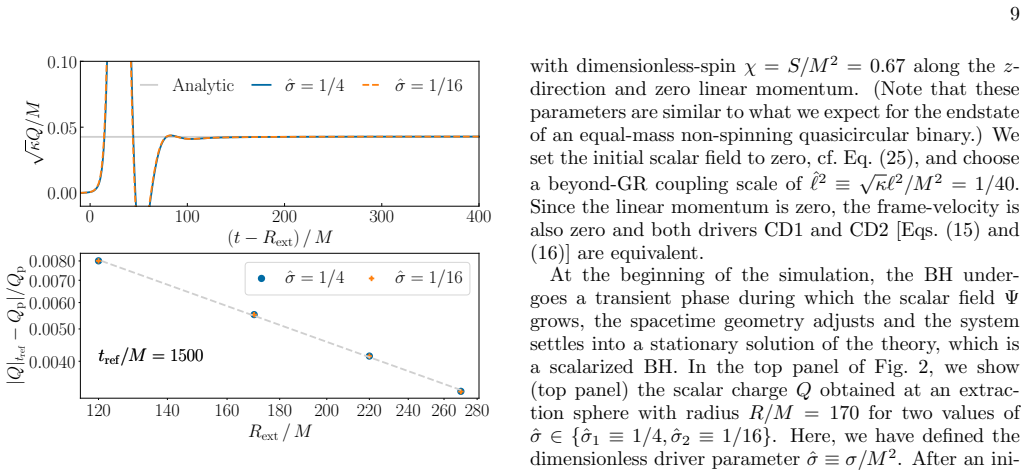
We implement the "fixing-the-equations" approach [Phys.Rev.D 96 (2017) 8, 084043] in spectre, an NR code using a pseudo-spectral discontinuous Galerkin scheme, to produce long and accurate NR waveforms in the well-known shift-symmetric version of scalar Gauss-Bonnet (sGB) gravity. To achieve this, we introduce a new family of comoving driver equations that exploits the approximate symmetries of quasicircular binary systems and is designed to recover the exact (quasi-)stationary solutions of the fully-coupled theory. We validate our single black hole (BH) solutions against analytic predictions and show that, even for binary BHs in the early inspiral, the intrinsic BH quantities are relatively insensitive to the timescales entering the driver equation. Attention is given to the prescription of driver equations for tensors, for which we give an example of how treating tensor components as scalars can lead to undesired behaviour over long timescales, including spurious growth of the BH spins. A more appropriate generalization to the tensor case is given for the comoving driver, which is shown to avoid these issues. Overall, our implementation leverages state-of-the-art methods for eccentricity reduction and wave extraction with Cauchy Characteristic Evolution to simulate systems with eccentricity $\lesssim 10^{-3}$. We obtain waveforms with phase errors $\lesssim \mathcal{O}(1) \, \mathrm{rad}$ over almost 40 GW-cycles, which naturally incorporate memory contributions.
Figures



Reference graph
Works this paper leans on
-
[1]
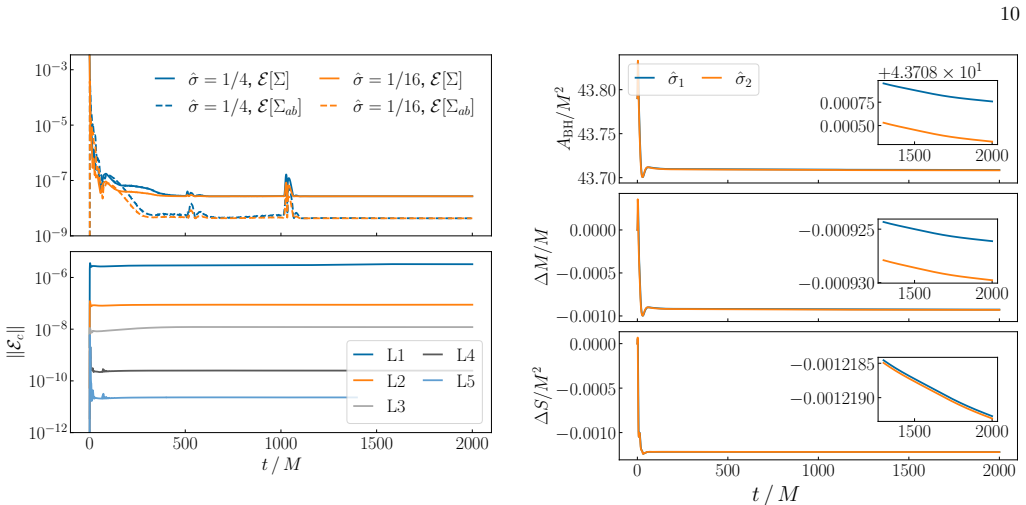
Transient phase, convergence and tracking Consider a system with dimensionless coupling param- eter ˆℓ≡ √κℓ2/m2 = 1/40 and ˆσ∈ {ˆσ0 ≡1,ˆσ 1 ≡ 1/4,ˆσ2 ≡1/16,ˆσ 3 ≡1/32}. In Fig. 6, we show the area, mass, spin and total scalar charge of the system during the first few orbits. The change in the mass scale of the system, quantified here by the sum of Christo...
2000
-
[2]
For larger coupling simulations, we find that we can- not set ˆσarbitrarily low and still retain stability in the numerical evolution
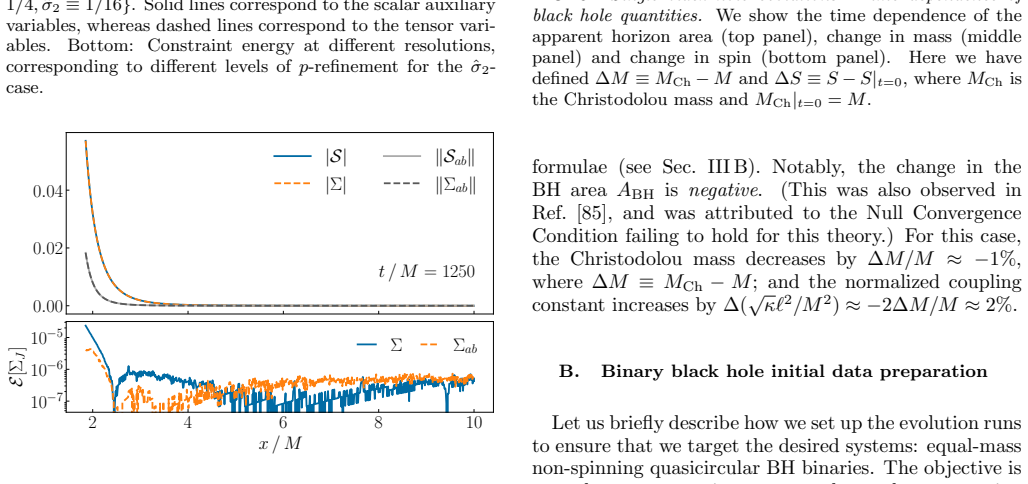
Larger couplings and spin growth Having quantified the behaviour of the code and of the CD1 driver for a specific small coupling example, we now consider larger values of the beyond-GR coupling and investigate the spin growth issue in more detail. For larger coupling simulations, we find that we can- not set ˆσarbitrarily low and still retain stability in...
2000
-
[3]
The GW strainhis ex- tracted at future null-infinityI + using data recorded at R/M= 170 for Cauchy Characteristic Evolution (CCE) —see also Sec
Extracted gravitational and scalar waves With the orbital dynamics under control, we now move on to examine the GW signal. The GW strainhis ex- tracted at future null-infinityI + using data recorded at R/M= 170 for Cauchy Characteristic Evolution (CCE) —see also Sec. III D for more details. To study the dependence of the waveform on ˆσand resolution, we f...
-
[4]
when computing phase differences as in our companionLetter[45]
System comparison ambiguity Changes in the system parameters due to junk radia- tion and initial transients may be particularly important when comparing observables between GR and beyond- GR, e.g. when computing phase differences as in our companionLetter[45]. In our simulations, we have fixed the scale of the system in terms of quasi-local quantities. Na...
2000
-
[5]
However, constraint-satisfying quasistationary initial data has not yet been constructed for scalarized binaries in this theory —in Ref
Limitations Among the main limitations in our work is our use of binary BH initial data constructed in GR for our simula- tions in sGB, which does not describe an equilibrium con- figuration, thus leading to transients that alter the initial parameters of the system. However, constraint-satisfying quasistationary initial data has not yet been constructed ...
-
[6]
Relation to other work Ref. [42] (hereinafter Paper B) is the only other work that carried out binary evolutions in the shift-symmetric version of sGB using thefixing-the-equationsapproach, mainly with the objective of comparing results between different formulations (thefixing-the-equations, modified GH and reduction-of-order systems). We therefore com- ...
2000
-
[7]
Curvature quantities In the following, whenever there could be ambiguity, we refer to the curvature quantities computed in terms of the spatial or spacetime metrics with superscipts (3) or (4), respectively. For example, the spatial Christoffel symbols are (3)Γk ij = 1 2 γkl (∂iγjl +∂ jγil −∂ lγij),(D2) whereas the spacetime Christoffel symbols are (4)Γc ...
-
[8]
Both Eab andB ab are symmetric spatial tensors
Electric and Magnetic Parts The electricE ab and magneticB ab parts of the Weyl tensorC abcd are Eab ≡n cndCacbd,(D7) Bab ≡ −ncnd∗ C acbd,(D8) where ∗C abcd ≡ 1 2 ϵabef C ef cd is the left-dual tensor. Both Eab andB ab are symmetric spatial tensors. The electric part of the Weyl tensor is Eab = (3)Rab +γ cd(KcdKab −K adKcb)− 1 2 γc aγd b (4)Rcd − 1 2 (4)R...
-
[9]
(5)] in two parts Hab =−8( ˆH (C) ab + ˆH (R) ab ),(D13) where ˆH (C) ab ≡C acbd∇c∇df(Ψ) (D14) ˆH (R) ab ≡(P acbd −C acbd)∇c∇df(Ψ),(D15) andP acbd was defined in Eq
The interaction tensorℓ 2H (TR) ab We find it useful to split the computation ofH ab [de- fined in Eq. (5)] in two parts Hab =−8( ˆH (C) ab + ˆH (R) ab ),(D13) where ˆH (C) ab ≡C acbd∇c∇df(Ψ) (D14) ˆH (R) ab ≡(P acbd −C acbd)∇c∇df(Ψ),(D15) andP acbd was defined in Eq. (5). To evaluate the tensor source termsS ab, we then com- pute the trace-reverseH (TR) ...
-
[10]
F our-tensors from projections We can reconstruct a 4-tensor from its projections as Tab =ρ (T) nanb −2γ i (anb)j(T) i +γ i aγj b S(T) ij .(D28) In terms of 4-spacetime components T00 =α 2ρ(T) + 2αβij(T) i +β iβjS(T) ij , T0k =αj (T) k +β iS(T) ik , Tij =S (T) ij .(D29) Here, we have defined the projectionsρ (T) ≡n anbTab, j(T) i ≡n aγb i Tab andS (T) ij ...
-
[11]
Scalar source Here, we describe how to computeSin Eq. (4). We decompose the Riemann tensor in terms of the Weyl and the 4-Ricci tensors we can write the Gauss-Bonnet scalar can be rewritten in terms{E ab, Bab}as G=R abcdRabcd −4 (4)Rab (4)Rab + (4)R2 = 8 EabEab −B abBab −2 (4)Rab (4)Rab + 2 3 (4)R2. (D30) Using Eq. (7), G= 8 EabEab −B abBab −2Σ abΣab + 2 ...
-
[12]
Bertiet al., Testing General Relativity with Present and Future Astrophysical Observations, Class
E. Bertiet al., Testing General Relativity with Present and Future Astrophysical Observations, Class. Quant. Grav.32, 243001 (2015), arXiv:1501.07274 [gr-qc]
Pith/arXiv arXiv 2015
-
[13]
J. M. Ezquiaga and M. Zumalac´ arregui, Dark Energy in light of Multi-Messenger Gravitational-Wave astronomy, Front. Astron. Space Sci.5, 44 (2018), arXiv:1807.09241 [astro-ph.CO]
Pith/arXiv arXiv 2018
-
[14]
Abacet al.(ET), The Science of the Einstein Tele- scope, (2025), arXiv:2503.12263 [gr-qc]
A. Abacet al.(ET), The Science of the Einstein Tele- scope, (2025), arXiv:2503.12263 [gr-qc]
Pith/arXiv arXiv 2025
-
[15]
M. Evanset al., A Horizon Study for Cosmic Explorer: Science, Observatories, and Community, arXiv:2109.09882 [astro-ph.IM] (2021)
Pith/arXiv arXiv 2021
-
[16]
Colpiet al.(LISA), LISA Definition Study Report, (2024), arXiv:2402.07571 [astro-ph.CO]
M. Colpiet al.(LISA), LISA Definition Study Report, (2024), arXiv:2402.07571 [astro-ph.CO]
Pith/arXiv arXiv 2024
-
[17]
J. Cayuso, N. Ortiz, and L. Lehner, Fixing extensions to general relativity in the nonlinear regime, Phys. Rev. D 96, 084043 (2017), arXiv:1706.07421 [gr-qc]
Pith/arXiv arXiv 2017
-
[18]
H. Witek, L. Gualtieri, P. Pani, and T. P. Sotiriou, Black holes and binary mergers in scalar Gauss-Bonnet gravity: scalar field dynamics, Phys. Rev. D99, 064035 (2019), arXiv:1810.05177 [gr-qc]
Pith/arXiv arXiv 2019
-
[19]
Okounkova, Stability of Rotating Black Holes in Ein- stein Dilaton Gauss-Bonnet Gravity, Phys
M. Okounkova, Stability of Rotating Black Holes in Ein- stein Dilaton Gauss-Bonnet Gravity, Phys. Rev. D100, 124054 (2019), arXiv:1909.12251 [gr-qc]
Pith/arXiv arXiv 2019
-
[20]
M. Okounkova, L. C. Stein, J. Moxon, M. A. Scheel, and S. A. Teukolsky, Numerical relativity simulation of GW150914 beyond general relativity, Phys. Rev. D101, 104016 (2020), arXiv:1911.02588 [gr-qc]
Pith/arXiv arXiv 2020
-
[21]
M. Okounkova, Numerical relativity simulation of GW150914 in Einstein dilaton Gauss-Bonnet gravity, Phys. Rev. D102, 084046 (2020), arXiv:2001.03571 [gr- qc]
Pith/arXiv arXiv 2020
-
[22]
´A. D. Kov´ acs, Well-posedness of cubic Horndeski theo- ries, Phys. Rev. D100, 024005 (2019), arXiv:1904.00963 [gr-qc]
Pith/arXiv arXiv 2019
-
[23]
´A. D. Kov´ acs and H. S. Reall, Well-Posed Formulation of Scalar-Tensor Effective Field Theory, Phys. Rev. Lett. 124, 221101 (2020), arXiv:2003.04327 [gr-qc]
Pith/arXiv arXiv 2020
-
[24]
´A. D. Kov´ acs and H. S. Reall, Well-posed formulation of Lovelock and Horndeski theories, Phys. Rev. D101, 124003 (2020), arXiv:2003.08398 [gr-qc]
Pith/arXiv arXiv 2020
-
[25]
R. Cayuso and L. Lehner, Nonlinear, noniterative treat- ment of EFT-motivated gravity, Phys. Rev. D102, 084008 (2020), arXiv:2005.13720 [gr-qc]
Pith/arXiv arXiv 2020
-
[26]
W. E. East and J. L. Ripley, Evolution of Einstein- scalar-Gauss-Bonnet gravity using a modified har- monic formulation, Phys. Rev. D103, 044040 (2021), arXiv:2011.03547 [gr-qc]
Pith/arXiv arXiv 2021
-
[27]
M. Bezares, R. Aguilera-Miret, L. ter Haar, M. Crisos- tomi, C. Palenzuela, and E. Barausse, No Evidence of Kinetic Screening in Simulations of Merging Binary Neu- tron Stars beyond General Relativity, Phys. Rev. Lett. 128, 091103 (2022), arXiv:2107.05648 [gr-qc]
Pith/arXiv arXiv 2022
-
[28]
G. Lara, M. Bezares, and E. Barausse, UV completions, fixing the equations, and nonlinearities in k-essence, Phys. Rev. D105, 064058 (2022), arXiv:2112.09186 [gr- qc]
Pith/arXiv arXiv 2022
-
[29]
P. Figueras and T. Fran¸ ca, Black hole binaries in cubic Horndeski theories, Phys. Rev. D105, 124004 (2022), arXiv:2112.15529 [gr-qc]
Pith/arXiv arXiv 2022
-
[30]
N. Franchini, M. Bezares, E. Barausse, and L. Lehner, Fixing the dynamical evolution in scalar-Gauss- Bonnet gravity, Phys. Rev. D106, 064061 (2022), arXiv:2206.00014 [gr-qc]
Pith/arXiv arXiv 2022
-
[31]
M. Corman, J. L. Ripley, and W. E. East, Nonlinear studies of binary black hole mergers in Einstein-scalar- Gauss-Bonnet gravity, Phys. Rev. D107, 024014 (2023), arXiv:2210.09235 [gr-qc]
Pith/arXiv arXiv 2023
-
[32]
L. Arest´ e Sal´ o, K. Clough, and P. Figueras, Well- Posedness of the Four-Derivative Scalar-Tensor Theory of Gravity in Singularity Avoiding Coordinates, Phys. Rev. Lett.129, 261104 (2022), arXiv:2208.14470 [gr-qc]
Pith/arXiv arXiv 2022
-
[33]
R. Cayuso, P. Figueras, T. Fran¸ ca, and L. Lehner, Self- Consistent Modeling of Gravitational Theories beyond General Relativity, Phys. Rev. Lett.131, 111403 (2023), 23 arXiv:2303.07246 [gr-qc]
Pith/arXiv arXiv 2023
-
[34]
A. Held and H. Lim, Nonlinear evolution of quadratic gravity in 3+1 dimensions, Phys. Rev. D108, 104025 (2023), arXiv:2306.04725 [gr-qc]
Pith/arXiv arXiv 2023
-
[35]
P. Figueras, A. Held, and ´A. D. Kov´ acs, Well-posed ini- tial value formulation of general effective field theories of gravity, (2024), arXiv:2407.08775 [gr-qc]
Pith/arXiv arXiv 2024
-
[36]
H. L. H. Shum, L. Arest´ e Sal´ o, F. Thaalba, M. Bezares, and T. P. Sotiriou, A well-posed BSSN-type formulation for scalar-tensor theories of gravity with second-order field equations, (2025), arXiv:2512.11034 [gr-qc]
arXiv 2025
-
[37]
P. Figueras, ´A. D. Kov´ acs, and S. Yao, Stable non-linear evolution in regularised higher derivative effective field theories, JHEP10, 150, arXiv:2505.00082 [hep-th]
-
[38]
Pretorius, Evolution of binary black hole spacetimes, Phys
F. Pretorius, Evolution of binary black hole spacetimes, Phys. Rev. Lett.95, 121101 (2005), arXiv:gr-qc/0507014
Pith/arXiv arXiv 2005
-
[39]
J. G. Baker, J. Centrella, D.-I. Choi, M. Koppitz, and J. van Meter, Gravitational wave extraction from an in- spiraling configuration of merging black holes, Phys. Rev. Lett.96, 111102 (2006), arXiv:gr-qc/0511103
Pith/arXiv arXiv 2006
-
[40]
M. Campanelli, C. O. Lousto, P. Marronetti, and Y. Zlo- chower, Accurate evolutions of orbiting black-hole bina- ries without excision, Phys. Rev. Lett.96, 111101 (2006), arXiv:gr-qc/0511048
Pith/arXiv arXiv 2006
-
[41]
F.-L. Juli´ e, L. Pompili, and A. Buonanno, Inspiral- merger-ringdown waveforms in Einstein-scalar-Gauss- Bonnet gravity within the effective-one-body formalism, Phys. Rev. D111, 024016 (2025), arXiv:2406.13654 [gr- qc]
Pith/arXiv arXiv 2025
-
[42]
A. H. Mroueet al., Catalog of 174 Binary Black Hole Sim- ulations for Gravitational Wave Astronomy, Phys. Rev. Lett.111, 241104 (2013), arXiv:1304.6077 [gr-qc]
Pith/arXiv arXiv 2013
-
[43]
Boyleet al., The SXS Collaboration catalog of binary black hole simulations, Class
M. Boyleet al., The SXS Collaboration catalog of binary black hole simulations, Class. Quant. Grav.36, 195006 (2019), arXiv:1904.04831 [gr-qc]
Pith/arXiv arXiv 2019
-
[44]
M. A. Scheelet al., The SXS collaboration’s third catalog of binary black hole simulations, Class. Quant. Grav.42, 195017 (2025), arXiv:2505.13378 [gr-qc]
arXiv 2025
-
[45]
C. Armendariz-Picon, T. Damour, and V. F. Mukhanov, k - inflation, Phys. Lett. B458, 209 (1999), arXiv:hep- th/9904075
arXiv 1999
-
[46]
G. W. Horndeski, Second-order scalar-tensor field equa- tions in a four-dimensional space, Int. J. Theor. Phys. 10, 363 (1974)
1974
-
[47]
L. Bernard, L. Lehner, and R. Luna, Challenges to global solutions in Horndeski’s theory, Phys. Rev. D100, 024011 (2019), arXiv:1904.12866 [gr-qc]
Pith/arXiv arXiv 2019
-
[48]
M. Bezares, M. Crisostomi, C. Palenzuela, and E. Ba- rausse, K-dynamics: well-posed 1+1 evolutions in K- essence, JCAP03, 072, arXiv:2008.07546 [gr-qc]
Pith/arXiv arXiv 2008
-
[49]
M. D. Duez, L. E. Kidder, and S. A. Teukolsky, Evolving relativistic fluid spacetimes using pseudospectral meth- ods and finite differencing, in11th Marcel Grossmann Meeting on General Relativity(2007) pp. 1570–1572, arXiv:gr-qc/0702126
Pith/arXiv arXiv 2007
-
[50]
M. D. Duez, F. Foucart, L. E. Kidder, H. P. Pfeiffer, M. A. Scheel, and S. A. Teukolsky, Evolving black hole- neutron star binaries in general relativity using pseu- dospectral and finite difference methods, Phys. Rev. D 78, 104015 (2008), arXiv:0809.0002 [gr-qc]
Pith/arXiv arXiv 2008
-
[51]
S. Ma, V. Varma, L. C. Stein, F. Foucart, M. D. Duez, L. E. Kidder, H. P. Pfeiffer, and M. A. Scheel, Numer- ical simulations of black hole-neutron star mergers in scalar-tensor gravity, Phys. Rev. D107, 124051 (2023), arXiv:2304.11836 [gr-qc]
Pith/arXiv arXiv 2023
-
[52]
N. Deppeet al., Binary neutron star mergers using a discontinuous Galerkin-finite difference hybrid method, Class. Quant. Grav.41, 245002 (2024), arXiv:2406.19038 [gr-qc]
Pith/arXiv arXiv 2024
-
[53]
M. Corman, L. Lehner, W. E. East, and G. Dideron, Non- linear studies of modifications to general relativity: Com- paring different approaches, Phys. Rev. D110, 084048 (2024), arXiv:2405.15581 [gr-qc]
Pith/arXiv arXiv 2024
-
[54]
J. T. G´ alvez Ghersi and L. C. Stein, Numerical renormalization-group-based approach to secular per- turbation theory, Phys. Rev. E104, 034219 (2021), arXiv:2106.08410 [hep-th]
Pith/arXiv arXiv 2021
-
[55]
Deppe, W
N. Deppe, W. Throwe, L. E. Kidder, N. L. Vu, K. C. Nelli, C. Armaza, M. S. Bonilla, F. H´ ebert, Y. Kim, P. Kumar, G. Lovelace, A. Macedo, J. Moxon, E. O’Shea, H. P. Pfeiffer, M. A. Scheel, S. A. Teukolsky, N. A. Wit- tek, I. Anantpurkar, C. Anderson, M. Boyle, A. Car- penter, A. Ceja, H. Chaudhary, N. Corso, C. Dittmer, N. Fayyazuddin Ljungberg, F. Fouca...
2026
-
[56]
G. Lara, H. P. Pfeiffer, N. Deppe, L. E. Kidder, G. Lovelace, S. Ma, A. Macedo, J. Moxon, K. C. Nelli, M. A. Scheel, W. Throwe, and N. L. Vu, Towards long and accurate numerical relativity waveforms of binary black holes beyond general relativity, in prep
-
[57]
T. P. Sotiriou and S.-Y. Zhou, Black hole hair in general- ized scalar-tensor gravity, Phys. Rev. Lett.112, 251102 (2014), arXiv:1312.3622 [gr-qc]
Pith/arXiv arXiv 2014
-
[58]
T. P. Sotiriou and S.-Y. Zhou, Black hole hair in gener- alized scalar-tensor gravity: An explicit example, Phys. Rev. D90, 124063 (2014), arXiv:1408.1698 [gr-qc]
Pith/arXiv arXiv 2014
-
[59]
D. D. Doneva, F. M. Ramazano˘ glu, H. O. Silva, T. P. Sotiriou, and S. S. Yazadjiev, Spontaneous scalarization, Rev. Mod. Phys.96, 015004 (2024), arXiv:2211.01766 [gr-qc]
Pith/arXiv arXiv 2024
-
[60]
E. M. S¨ angeret al., Tests of General Relativity with GW230529: a neutron star merging with a lower mass- gap compact object, (2024), arXiv:2406.03568 [gr-qc]
Pith/arXiv arXiv 2024
-
[61]
G. Allwright and L. Lehner, Towards the nonlinear regime in extensions to GR: assessing possible options, Class. Quant. Grav.36, 084001 (2019), arXiv:1808.07897 [gr-qc]
Pith/arXiv arXiv 2019
-
[62]
G. Lara, H. P. Pfeiffer, N. A. Wittek, N. L. Vu, K. C. Nelli, A. Carpenter, G. Lovelace, M. A. Scheel, and W. Throwe, Scalarization of isolated black holes in scalar Gauss-Bonnet theory in the fixing-the- equations approach, Phys. Rev. D110, 024033 (2024), arXiv:2403.08705 [gr-qc]
Pith/arXiv arXiv 2024
-
[63]
A. Besharat, L. Lehner, and J. Radkovski, Fix- ing EFT equations with a reservoir model, (2026), arXiv:2602.13431 [hep-th]
arXiv 2026
-
[64]
Lovelaceet al., Simulating binary black hole merg- ers using discontinuous Galerkin methods, Class
G. Lovelaceet al., Simulating binary black hole merg- ers using discontinuous Galerkin methods, Class. Quant. Grav.42, 035001 (2025), arXiv:2410.00265 [gr-qc]. 24
Pith/arXiv arXiv 2025
-
[65]
J. Moxon, M. A. Scheel, S. A. Teukolsky, N. Deppe, N. Fischer, F. H´ ebert, L. E. Kidder, and W. Throwe, SpECTRE Cauchy-characteristic evolution system for rapid, precise waveform extraction, Phys. Rev. D107, 064013 (2023), arXiv:2110.08635 [gr-qc]
Pith/arXiv arXiv 2023
-
[66]
S. Ma, K. C. Nelli, J. Moxon, M. A. Scheel, N. Deppe, L. E. Kidder, W. Throwe, and N. L. Vu, Ein- stein–Klein–Gordon system via Cauchy-characteristic evolution: computation of memory and ringdown tail, Class. Quant. Grav.42, 055006 (2025), arXiv:2409.06141 [gr-qc]
Pith/arXiv arXiv 2025
-
[67]
L. Capuano, L. Santoni, and E. Barausse, Black hole hairs in scalar-tensor gravity and the lack thereof, Phys. Rev. D108, 064058 (2023), arXiv:2304.12750 [gr-qc]
Pith/arXiv arXiv 2023
-
[68]
L. Lindblom, K. D. Matthews, O. Rinne, and M. A. Scheel, Gauge Drivers for the Generalized Harmonic Einstein Equations, Phys. Rev. D77, 084001 (2008), arXiv:0711.2084 [gr-qc]
Pith/arXiv arXiv 2008
-
[69]
J. L. Ripley and F. Pretorius, Hyperbolicity in Spheri- cal Gravitational Collapse in a Horndeski Theory, Phys. Rev. D99, 084014 (2019), arXiv:1902.01468 [gr-qc]
Pith/arXiv arXiv 2019
-
[70]
Weinberg, Effective Field Theory for Inflation, Phys
S. Weinberg, Effective Field Theory for Inflation, Phys. Rev. D77, 123541 (2008), arXiv:0804.4291 [hep-th]
Pith/arXiv arXiv 2008
-
[71]
M. A. Scheel, H. P. Pfeiffer, L. Lindblom, L. E. Kid- der, O. Rinne, and S. A. Teukolsky, Solving Einstein’s equations with dual coordinate frames, Phys. Rev. D74, 104006 (2006), arXiv:gr-qc/0607056
Pith/arXiv arXiv 2006
-
[72]
Friedrich, On the hyperbolicity of Einstein’s and other gauge field equations, Commun
H. Friedrich, On the hyperbolicity of Einstein’s and other gauge field equations, Commun. Math. Phys.100, 525 (1985)
1985
-
[73]
L. Lindblom, M. A. Scheel, L. E. Kidder, R. Owen, and O. Rinne, A New generalized harmonic evolution system, Class. Quant. Grav.23, S447 (2006), arXiv:gr- qc/0512093
arXiv 2006
-
[74]
M. W. Choptuik and F. Pretorius, Ultra Relativistic Par- ticle Collisions, Phys. Rev. Lett.104, 111101 (2010), arXiv:0908.1780 [gr-qc]
Pith/arXiv arXiv 2010
-
[75]
B. Szilagyi, L. Lindblom, and M. A. Scheel, Simulations of Binary Black Hole Mergers Using Spectral Methods, Phys. Rev. D80, 124010 (2009), arXiv:0909.3557 [gr-qc]
Pith/arXiv arXiv 2009
-
[76]
N. Deppe, L. E. Kidder, M. A. Scheel, and S. A. Teukol- sky, Critical behavior in 3D gravitational collapse of massless scalar fields, Phys. Rev. D99, 024018 (2019), arXiv:1802.08682 [gr-qc]
Pith/arXiv arXiv 2019
-
[77]
S. A. Teukolsky, Formulation of discontinuous Galerkin methods for relativistic astrophysics, J. Comput. Phys. 312, 333 (2016), arXiv:1510.01190 [gr-qc]
Pith/arXiv arXiv 2016
-
[78]
D. A. Hemberger, M. A. Scheel, L. E. Kidder, B. Szil´ agyi, G. Lovelace, N. W. Taylor, and S. A. Teukolsky, Dynami- cal Excision Boundaries in Spectral Evolutions of Binary Black Hole Spacetimes, Class. Quant. Grav.30, 115001 (2013), arXiv:1211.6079 [gr-qc]
Pith/arXiv arXiv 2013
-
[79]
K. C. Nelli, W. Throwe, N. Deppe, M. A. Scheel, L. E. Kidder, N. L. Vu, and S. A. Teukolsky, Horizon tracking for asynchronous parallel black hole simulations, (2025), arXiv:2508.08408 [gr-qc]
Pith/arXiv arXiv 2025
-
[80]
N. L. Vuet al., A scalable elliptic solver with task-based parallelism for the SpECTRE numerical relativity code, Phys. Rev. D105, 084027 (2022), arXiv:2111.06767 [gr- qc]
Pith/arXiv arXiv 2022
discussion (0)
Sign in with ORCID, Apple, or X to comment. Anyone can read and Pith papers without signing in.