REVIEW 3 major objections 6 minor 58 references
A3266 is still assembling along the cosmic web: an X-ray filament links it to an infalling cool-core group with a leading cold front.
Reviewed by Pith at T0; open to challenge. T0 means a machine referee read the full paper against a public rubric. the ladder, T0–T4 →
T0 review · grok-4.5
2026-07-31 16:36 UTC pith:UFWVOI6Y
load-bearing objection Solid eROSITA outskirts study of A3266 with a carefully residual-modeled 3.6σ filament and a clean cool-core/cold-front NW group; systematics are real but already flagged, and the paper is worth engaging. the 3 major comments →
A study of the large-scale formation in the environment of A3266: Infalling groups, filaments, and a premerger cold front
The pith
A machine-rendered reading of the paper's core claim, the machinery that carries it, and where it could break.
Core claim
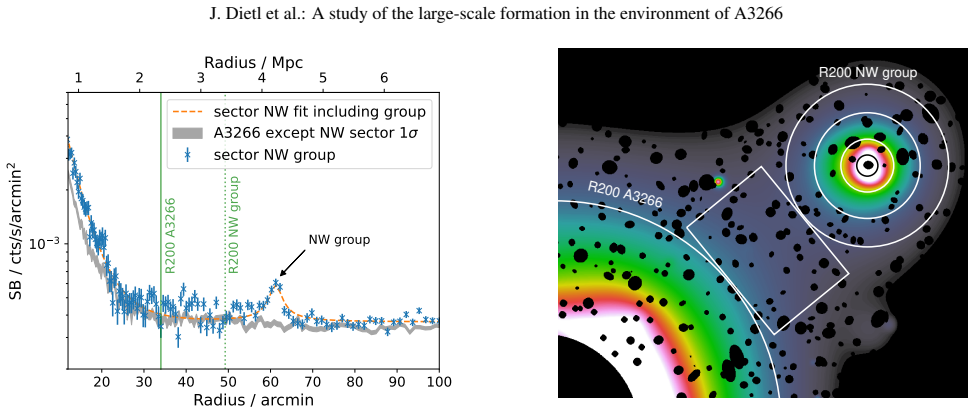
An X-ray filament connects A3266 to its nearest northwestern galaxy group over a three-dimensional length of about 1.1 Mpc between their R200 radii, at 3.6σ above a surface-brightness model that already accounts for the cluster’s northwestern elongation plus the group. The group is a cool core embedded in that filament and shows a density jump of 2.8±0.7 on the cluster-facing side, interpreted as a cold front from motion through the filament toward the main cluster. The filament gas has T ≈ 1.2 keV, low metallicity ≈ 0.07 solar, and electron density ≈ 8×10⁻⁵ cm⁻³, hotter and denser than expected for untouched warm-hot intergalactic medium.
What carries the argument
Residual surface-brightness excess in the northwest sector after subtracting a double-β model of A3266’s elongated outskirts plus a single-β model of the NW group; that excess, plus sector spectroscopy and a broken power-law density jump on the group’s leading edge, carries the filament-plus-premerger-cold-front claim.
Load-bearing premise
The leftover few-percent X-ray glow between cluster and group is a real connecting filament, not leftover overlap from imperfect models of the stretched cluster gas, the group, background, or projection along the line of sight.
What would settle it
Deeper X-ray imaging and spectroscopy that resolve temperature and density across the claimed bridge and the group’s leading edge: if the residual excess disappears once a better multi-component ICM model is fit, or if the dense side of the jump is hotter rather than cooler, the filament-plus-cold-front reading fails; a precise group redshift that forces a near line-of-sight geometry would also collapse the density and length claims.
If this is right
- A3266’s outskirts trace ongoing assembly along a preferred northwest axis aligned with neighboring groups and the larger supercluster environment.
- Filament gas next to massive merging clusters can be preheated and compressed above pristine warm-hot intergalactic medium expectations.
- Cool-core groups can retain a leading cold front while still embedded in an inflow filament before full merger.
- Galaxy overdensities and faint X-ray bridges together map which neighboring groups are physically feeding the cluster versus projected neighbors.
- Constrained local simulations that show similar group counts and filament links support reading A3266 as a typical actively accreting system in the cosmic web.
Where Pith is reading between the lines
- If many nearby massive clusters host similar short, dense, metal-poor bridges, stacked eROSITA outskirts may systematically overestimate pristine filament densities unless group infall is modeled.
- The SE galaxy bridge without X-ray excess suggests a testable split: past mergers may displace or heat gas while galaxies still mark the large-scale spine.
- A sharper temperature map across the group edge would turn the cold-front claim from morphology-plus-cool-core consistency into a direct contact-discontinuity measurement.
- Metallicity at the low end of AGN-feedback expectations, if confirmed with tighter errors, would constrain how far metals are mixed into circumcluster filaments.
Editorial analysis
A structured set of objections, weighed in public.
Referee Report
Summary. The manuscript presents an eROSITA eRASS:5 study of the outskirts of the merging cluster A3266 out to ~3R_100. Using imaging, sector surface-brightness profiles, and spectral fitting, complemented by NED galaxy densities and a qualitative comparison to the constrained SLOW simulation, the authors report an X-ray filament linking A3266 to a northwestern group at 3.6σ above a model that already includes elongated NW cluster emission plus the group. They measure filament properties T ≈ 1.2 keV, Z ≈ 0.07 Z_⊙, and n_e ≈ 8×10^{-5} cm^{-3} (cylindrical geometry, fiducial inclination), identify the NW group as a cool core with a leading-edge density jump of 2.8±0.7 interpreted as a premerger cold front, and place the system in a network of groups along the Horologium–Reticulum large-scale structure.
Significance. If the residual excess and cold-front reading hold, this is a solid, timely contribution to cluster-assembly and circumcluster filament studies with eROSITA. The detection is more conservative than a simple excess over the azimuthal average: significance is quoted against a combined NW-sector double-β plus group single-β model. Spectral background treatment (PIB, LHB/MWH/CXB), multi-TM energy cuts, and explicit checks with alternate background parameters are carefully described. Galaxy overdensity alignment and qualitative SLOW resemblance provide independent morphological context without circular use of the simulation. The filament T, Z, and δ_b add a scarce individual (non-stacked) constraint in the processed outskirts regime. The result is systematics-limited rather than transformative, but appropriate in scope and method for A&A.
major comments (3)
- [§3.1, Fig. 6] §3.1 and Fig. 6: The 3.6σ filament claim rests on residual SB after subtracting a double-β fit to the NW sector plus a single-β for the NW group. Please state explicitly whether the inter-R_200 filament annulus/box enters that double-β fit, which radial range and free parameters are used, and whether the residual significance changes if the filament region is masked during the cluster fit (or if a single β / NFW-like outskirts model is substituted). A short robustness table or sentence is needed so the residual cannot be read as an artifact of a smooth model absorbing or missing elongated ICM.
- [§3.2, §4.4, Fig. 7, Fig. 9] §3.2–4.4 and Fig. 7/9: The density jump 2.8±0.7 at r_f=(1.83±0.02)' is clear, but the cold-front (vs shock) identification is load-bearing for the “premerger cold front” title claim and is not supported by a resolved temperature or pressure jump across the edge—the spectral annuli are much broader than the discontinuity, and facing/opposite temperatures are only said to be consistent within large errors. Either add a narrower extraction straddling the edge (even upper/lower limits) or soften the abstract/title/conclusions language to “candidate cold front” / “density discontinuity consistent with a cold front,” and state clearly what would falsify the shock alternative with the present data.
- [§3.3 Eq. (1), §4.5] §3.3 Eq. (1) and §4.5: n_e and δ_b assume a cylinder with chosen r=0.72 Mpc, h=1 Mpc, f=0.88, and a fiducial inclination i=20° (0–50°). The group redshift from the X-ray fit (0.06^{+0.01}_{-0.02}) does not tightly constrain i. Please propagate geometry (r, depth≠width, non-cylindrical filling factor) into the reported systematic band on equal footing with i, and quote n_e, δ_b in the abstract/conclusions only with that full systematic range—or label them more clearly as order-of-magnitude under the stated geometry so the “hotter and denser than pristine WHIM” comparison is not over-precise.
minor comments (6)
- [Table 1, Fig. 1] Table 1 vs Fig. 1 caption: R_500 is taken from Ettori et al. (2019) in the analysis but the eROSITA catalog R_500 is shown in Fig. 1 (12% smaller). State once in the main text which R_Δ set is used for all physical scales (filament length, annuli) to avoid reader confusion.
- [Fig. 3, Fig. 11] Fig. 3/11: Wavelet-filtered images are for visualization; a one-sentence reminder in the captions that quantitative SB and spectra use unsmoothed, cheesemasked data would help non-specialists.
- [§4.1] §4.1: Arm significances (4.6σ, 4.9σ) use adjacent control regions; briefly note whether those controls avoid the NW filament/tail and residual excised-source wings.
- [§4.2, §5] §4.2 / Fig. 10: SE galaxy bridge relies heavily on photometric redshifts; the caveat is present but could be sharper in the conclusions bullet list where “potential connection” is stated.
- [Abstract, Fig. 1, §3.1] Typographical/consistency: abstract and body swap asymmetric error order on T and Z in places (e.g., T={1.2}_{-0.2}^{+0.3} vs +0.3/-0.2); unify. “dependin” in Fig. 1 caption; “surface-surface brightness” in §3.1.
- [§3.2, Appendix C] Appendix C: Table C.1 norm/area units and the two-temperature filament test (norm→0) are useful; consider one sentence in §3.2 pointing to that failed 2T attempt so readers need not reach the appendix for a negative result.
Circularity Check
No significant circularity: standard observational residual detection and spectral fitting against external data and models.
full rationale
This is an eROSITA imaging/spectral study of A3266 outskirts. The load-bearing filament claim is a measured surface-brightness residual of (8±2)% at 3.6σ after subtracting a double-β model fitted to the NW sector plus a single-β model for the NW group (Sec. 3.1, Fig. 6)—a residual test, not a quantity forced by the fit parameters. Temperatures, metallicities, and apec normalizations come from spectral fits to eRASS:5 counts with background components constrained from a blank field and cross-checked against literature background values; n_e follows from the emission measure under an explicit cylindrical geometry and a stated inclination prior (Sec. 3.3–4.5), which is a modeling assumption, not a self-definitional loop. Galaxy overdensities are taken from NED; SLOW is used only for qualitative morphological comparison. Method citations (e.g., Veronica et al. 2024, Reiprich et al. 2021) supply analysis procedures, not uniqueness theorems or fitted constants renamed as predictions. No step reduces the central result to its inputs by construction.
Axiom & Free-Parameter Ledger
free parameters (5)
- Fiducial filament inclination i=20° (range 0–50°) =
i=20° (0–50° → L_R200–R200=1.1^{+0.5}_{-0.1} Mpc)
- Cylinder radius r and height h for filament EM→n_e =
r=0.72 Mpc, h=1 Mpc (plane-of-sky); f=0.88 point-source retention
- Double-β + single-β surface-brightness model parameters (NW sector + NW group) =
Not tabulated numerically; shown in Fig. 6
- Broken power-law break radius and density jump for NW group edge =
jump=2.8±0.7 at 1.83±0.02 arcmin
- Background spectral parameters (MWH T,Z; CXB Γ) and apec norms =
T_MWH=0.209±0.003 keV, Z_MWH=0.5±0.1 Z_⊙, Γ=1.50±0.02
axioms (8)
- domain assumption Flat ΛCDM with h=0.7, Ω_m=0.3, Ω_Λ=0.7; angular scale 1″=1.15 kpc at z=0.0596
- domain assumption Particle-induced background scales from 6.7–9 keV using filter-wheel-closed hardness ratios; soft-proton flares cut at 3σ in 5–10 keV
- domain assumption Unresolved CXB + LHB + MWH + absorbed thermal apec adequately describe spectra; single-temperature apec for filament
- domain assumption R100≈1.36 R200 and catalog/literature R500, R200 values define physical apertures
- domain assumption Density jump with cooler gas on the dense side implies a cold front (contact discontinuity), not a shock
- domain assumption Galaxies with z in [0.0462, 0.0730] (±3 v_disp) trace physically associated large-scale structure around A3266
- standard math Asplund et al. (2009) abundance table for plasma emission/absorption
- ad hoc to paper Simple cylindrical filament geometry with n_H=n_e/1.17 for EM inversion (Eq. 1)
read the original abstract
Abell 3266 (A3266) is a dynamically active galaxy cluster embedded in a dense environment of galaxy groups and clusters at similar redshift. Data from the Spektrum Roentgen Gamma (SRG)/eROSITA all-sky survey enable the study of faint X-ray emission in cluster outskirts. We investigate the previously unexplored outskirts of A3266 out to $3R_{100}$, characterize its nearest neighboring galaxy group, and search for connecting filaments using X-ray emission and galaxy number density. We performed X-ray imaging, surface brightness, and spectral analyses in selected regions and sectors. These were complemented by the distribution of member galaxies from the NASA/IPAC Extragalactic Database NED and by comparison with the cosmological simulation Simulating the LOcal Web (SLOW). We detect an X-ray filament connecting A3266 to its nearest northwestern group over a 3D length of $L_{R_{200}\text{--}R_{200}} = {1.1}_{-0.1}^{+0.5},\mathrm{Mpc}$ with a significance of $3.6,\sigma$. The group exhibits cool-core properties and is embedded within the filament. The filament has a temperature of $T={1.2}_{-0.2}^{+0.3},\mathrm{keV}$, metallicity $Z={0.07}_{-0.05}^{+0.09},Z{\odot}$, and, assuming a simple geometry, an electron number density of $n_{\rm e}={8}_{-2}^{+1}\times 10^{-5},\mathrm{cm}^{-3}$. Our findings reveal a coherent network of galaxy groups around A3266, tracing its ongoing assembly along the large-scale structure. The filament is hotter and denser than expected for pristine warm-hot intergalactic medium, consistent with gas processed in the cluster environment and influenced by the infall of the northwestern group. Comparison with SLOW shows that the observed group distribution and filamentary connections are qualitatively consistent with an actively accreting cluster embedded in the cosmic web.
Figures




Reference graph
Works this paper leans on
-
[1]
The local hot bubble in the western Galactic hemisphere
The SRG/eROSITA diffuse soft X-ray background: I. The local hot bubble in the western Galactic hemisphere. , keywords =. doi:10.1051/0004-6361/202451045 , archivePrefix =. 2410.23345 , primaryClass =
-
[2]
The Chandra COSMOS Legacy Survey: Energy Spectrum of the Cosmic X-Ray Background and Constraints on Undetected Populations. , keywords =. doi:10.3847/1538-4357/aa5ea4 , archivePrefix =. 1702.01660 , primaryClass =
-
[3]
A Puzzling Merger in A3266: The Hydrodynamic Picture from XMM-Newton. , keywords =. doi:10.1086/503285 , archivePrefix =. astro-ph/0505036 , primaryClass =
-
[4]
An optical view of a complex merging cluster
Dynamics of Abell 3266 - I. An optical view of a complex merging cluster. , keywords =. doi:10.1093/mnras/stx582 , archivePrefix =. 1703.02616 , primaryClass =
-
[5]
Measuring the intracluster medium velocity structure within the A3266 galaxy cluster. , keywords =. doi:10.1051/0004-6361/202451640 , archivePrefix =. 2408.00837 , primaryClass =
-
[6]
Chemical enrichment of the intracluster medium within the A3266 cluster: I. Radial profiles. , keywords =. doi:10.1051/0004-6361/202453360 , archivePrefix =. 2504.10588 , primaryClass =
-
[7]
The merging galaxy cluster Abell 3266 at low radio frequencies. , keywords =. doi:10.1093/mnras/stac335 , archivePrefix =. 2201.09629 , primaryClass =
-
[8]
One Source, Two Source(s): Ribs and Tethers. Galaxies , keywords =. doi:10.3390/galaxies9040081 , archivePrefix =. 2110.09961 , primaryClass =
-
[9]
Radio fossils, relics, and haloes in Abell 3266: cluster archaeology with ASKAP-EMU and the ATCA. , keywords =. doi:10.1093/mnras/stac1771 , archivePrefix =. 2208.00395 , primaryClass =
-
[10]
The Horologium-Reticulum supercluster of galaxies. , keywords =. doi:10.1093/mnras/203.2.545 , adsurl =
-
[11]
CHANCES, the Chilean Cluster Galaxy Evolution Survey: Selection and initial characterisation of clusters and superclusters. , keywords =. doi:10.1051/0004-6361/202452710 , archivePrefix =. 2411.13655 , primaryClass =
-
[12]
Studying the merging cluster Abell 3266 with eROSITA. , keywords =. doi:10.1051/0004-6361/202141501 , archivePrefix =. 2106.14534 , primaryClass =
-
[13]
Hydrostatic mass profiles in X-COP galaxy clusters. , keywords =. doi:10.1051/0004-6361/201833323 , archivePrefix =. 1805.00035 , primaryClass =
-
[14]
First catalog of superclusters in the western Galactic hemisphere
The SRG/eROSITA All-Sky Survey. First catalog of superclusters in the western Galactic hemisphere. , keywords =. doi:10.1051/0004-6361/202348884 , archivePrefix =. 2402.08454 , primaryClass =
-
[15]
The SRG/eROSITA All-Sky Survey. Optical identification and properties of galaxy clusters and groups in the western galactic hemisphere. , keywords =. doi:10.1051/0004-6361/202349031 , archivePrefix =. 2402.08453 , primaryClass =
-
[16]
The Abell 3391/95 galaxy cluster system. A 15 Mpc intergalactic medium emission filament, a warm gas bridge, infalling matter clumps, and (re-) accelerated plasma discovered by combining SRG/eROSITA data with ASKAP/EMU and DECam data. , keywords =. doi:10.1051/0004-6361/202039590 , archivePrefix =. 2012.08491 , primaryClass =
Pith/arXiv arXiv 2012
-
[17]
Outskirts of Galaxy Clusters. , keywords =. doi:10.1007/s11214-013-9983-8 , archivePrefix =. 1303.3286 , primaryClass =
-
[18]
The first catalog of galaxy clusters and groups in the Western Galactic Hemisphere
The SRG/eROSITA All-Sky Survey. The first catalog of galaxy clusters and groups in the Western Galactic Hemisphere. , keywords =. doi:10.1051/0004-6361/202348264 , archivePrefix =. 2402.08452 , primaryClass =
-
[19]
HI4PI: A full-sky H I survey based on EBHIS and GASS. , keywords =. doi:10.1051/0004-6361/201629178 , archivePrefix =. 1610.06175 , primaryClass =
-
[20]
VizieR Online Data Catalog , keywords =
VizieR Online Data Catalog: MCXC Meta-Catalogue X-ray galaxy Clusters (Piffaretti+, 2011). VizieR Online Data Catalog , keywords =
2011
-
[21]
Observations of the missing baryons in the warm-hot intergalactic medium. , keywords =. doi:10.1038/s41586-018-0204-1 , archivePrefix =. 1806.08395 , primaryClass =
-
[22]
Where Are the Baryons?. , keywords =. doi:10.1086/306949 , archivePrefix =. astro-ph/9806281 , primaryClass =
-
[23]
The eROSITA X-ray telescope on SRG. , keywords =. doi:10.1051/0004-6361/202039313 , archivePrefix =. 2010.03477 , primaryClass =
Pith/arXiv arXiv 2010
-
[24]
The eROSITA Final Equatorial Depth Survey (eFEDS). X-ray catalogue. , keywords =. doi:10.1051/0004-6361/202141266 , archivePrefix =. 2106.14517 , primaryClass =
-
[25]
Structure detection in low intensity X-ray images. , keywords =. doi:10.1051/aas:1998150 , archivePrefix =. astro-ph/9707305 , primaryClass =
-
[26]
The XXL Survey. XXIV. The final detection pipeline. , keywords =. doi:10.1051/0004-6361/201832931 , archivePrefix =. 1809.05036 , primaryClass =
-
[27]
SExtractor: Software for source extraction. , keywords =. doi:10.1051/aas:1996164 , adsurl =
-
[28]
The XMM Large-Scale Structure survey: the X-ray pipeline and survey selection function. , keywords =. doi:10.1111/j.1365-2966.2006.10881.x , archivePrefix =. astro-ph/0607177 , primaryClass =
arXiv 2006
-
[29]
Handbook of Mathematical Methods in Imaging , editor =
Starck, Jean-Luc and Murtagh, Fionn and Bertero, Mario , title =. Handbook of Mathematical Methods in Imaging , editor =. 2015 , pages =
2015
-
[30]
Discovery of a > 13 Mpc long X-ray filament between two galaxy clusters beyond three times their virial radii. , keywords =. doi:10.1051/0004-6361/202449354 , archivePrefix =. 2401.17281 , primaryClass =
-
[31]
How filaments of galaxies are woven into the cosmic web. , keywords =. doi:10.1038/380603a0 , archivePrefix =. astro-ph/9512141 , primaryClass =
-
[32]
Low-scatter galaxy cluster mass proxies for the eROSITA all-sky survey. OJAp , keywords =. doi:10.21105/astro.2009.13944 , archivePrefix =. 2009.03944 , primaryClass =
Pith/arXiv arXiv 2009
-
[33]
SRG/eROSITA X-ray shadowing study of giant molecular clouds. , keywords =. doi:10.1051/0004-6361/202345867 , archivePrefix =. 2306.05858 , primaryClass =
-
[34]
The Chemical Composition of the Sun. , keywords =. doi:10.1146/annurev.astro.46.060407.145222 , archivePrefix =. 0909.0948 , primaryClass =
-
[35]
Simulating the LOcal Web (SLOW). I. Anomalies in the local density field. , keywords =. doi:10.1051/0004-6361/202346213 , archivePrefix =. 2302.10960 , primaryClass =
-
[36]
Simulating the LOcal Web (SLOW). II. Properties of local galaxy clusters. , keywords =. doi:10.1051/0004-6361/202449460 , archivePrefix =. 2402.01834 , primaryClass =
-
[37]
Not all that is close will merge in the end: Superclusters and their Lagrangian collapse regions
Simulating the LOcal Web (SLOW): IV. Not all that is close will merge in the end: Superclusters and their Lagrangian collapse regions. , keywords =. doi:10.1051/0004-6361/202453421 , archivePrefix =. 2412.08708 , primaryClass =
-
[38]
Properties of gas phases around cosmic filaments at z = 0 in the IllustrisTNG simulation. , keywords =. doi:10.1051/0004-6361/202039781 , archivePrefix =. 2010.15139 , primaryClass =
Pith/arXiv arXiv 2010
-
[39]
Computational Astrophysics and Cosmology , keywords =
The IllustrisTNG simulations: public data release. Computational Astrophysics and Cosmology , keywords =. doi:10.1186/s40668-019-0028-x , archivePrefix =. 1812.05609 , primaryClass =
-
[40]
Cluster outskirts and filaments
The eROSITA view of the Abell 3391/95 field. Cluster outskirts and filaments. , keywords =. doi:10.1051/0004-6361/202347037 , adsurl =
-
[41]
The SRG/eROSITA All-Sky Survey: Large-scale view of the Centaurus cluster. , keywords =. doi:10.1051/0004-6361/202450277 , archivePrefix =. 2404.04909 , primaryClass =
-
[42]
Radial metal abundance profiles in the intra-cluster medium of cool-core galaxy clusters, groups, and ellipticals. , keywords =. doi:10.1051/0004-6361/201630075 , archivePrefix =. 1703.01183 , primaryClass =
-
[43]
The SRG/eROSITA all-sky survey: X-ray emission from the warm-hot phase gas in long cosmic filaments. , keywords =. doi:10.1051/0004-6361/202450933 , archivePrefix =. 2406.00105 , primaryClass =
-
[44]
Detection of hot gas in the filament connecting the clusters of galaxies Abell 222 and Abell 223. , keywords =. doi:10.1051/0004-6361:200809599 , archivePrefix =. 0803.2525 , primaryClass =
-
[45]
Gas and galaxies in filaments between clusters of galaxies. The study of A399-A401. , keywords =. doi:10.1051/0004-6361/201731699 , archivePrefix =. 1710.08699 , primaryClass =
-
[46]
Soft X-ray emission from warm gas in IllustrisTNG circum-cluster environments. I. Sample properties, methods, and initial results. , keywords =. doi:10.1051/0004-6361/202347125 , archivePrefix =. 2306.04694 , primaryClass =
-
[47]
Properties of the diffuse gas component in filaments detected in the Dianoga cosmological simulations. , keywords =. doi:10.1051/0004-6361/202450072 , archivePrefix =. 2407.21636 , primaryClass =
-
[48]
Suzaku Observations of the Cluster Outskirts and Intercluster Filament in the Triple Merger Cluster A98. , keywords =. doi:10.3847/1538-4357/ac91d3 , archivePrefix =. 2206.08430 , primaryClass =
-
[49]
Warm-hot baryons comprise 5-10 per cent of filaments in the cosmic web. , keywords =. doi:10.1038/nature16058 , archivePrefix =. 1512.00454 , primaryClass =
-
[50]
Probing the Outskirts of the Early-Stage Galaxy Cluster Merger A1750. , keywords =. doi:10.3847/0004-637X/818/2/131 , archivePrefix =. 1510.00017 , primaryClass =
-
[51]
First X-ray catalogues and data release of the western Galactic hemisphere
The SRG/eROSITA all-sky survey. First X-ray catalogues and data release of the western Galactic hemisphere. , keywords =. doi:10.1051/0004-6361/202347165 , archivePrefix =. 2401.17274 , primaryClass =
-
[52]
Discovery of a Premerger Shock in an Intercluster Filament in Abell 98. , keywords =. doi:10.3847/2041-8213/ac86d4 , archivePrefix =. 2208.03401 , primaryClass =
Pith/arXiv arXiv 2041
-
[53]
Astronomical Data Analysis Software and Systems V , year = 1996, editor =
XSPEC: The First Ten Years. Astronomical Data Analysis Software and Systems V , year = 1996, editor =
1996
-
[54]
Calibration of X-ray absorption in our Galaxy. , keywords =. doi:10.1093/mnras/stt175 , archivePrefix =. 1303.0843 , primaryClass =
-
[55]
X-ray emission from cosmic web filaments in SRG/eROSITA data. , keywords =. doi:10.1051/0004-6361/202244158 , archivePrefix =. 2206.00084 , primaryClass =
-
[56]
The Baryon Census in a Multiphase Intergalactic Medium: 30\. , keywords =. doi:10.1088/0004-637X/759/1/23 , archivePrefix =. 1112.2706 , primaryClass =
-
[57]
Martizzi, Davide and Vogelsberger, Mark and Artale, Maria Celeste and Haider, Markus and Torrey, Paul and Marinacci, Federico and Nelson, Dylan and Pillepich, Annalisa and Weinberger, Rainer and Hernquist, Lars and Naiman, Jill and Springel, Volker , title = ". MNRAS , volume =. 2019 , month =. doi:10.1093/mnras/stz1106 , url =
-
[58]
Cosmic gas highways in C-EAGLE simulations. , keywords =. doi:10.1051/0004-6361/202243904 , archivePrefix =. 2303.03244 , primaryClass =
discussion (0)
Sign in with ORCID, Apple, or X to comment. Anyone can read and Pith papers without signing in.