REVIEW 2 major objections 7 minor 83 references
JWST spectra of NGC 2024 show no evidence for a substellar IMF turnover below 12 Jupiter masses.
Reviewed by Pith at T0; open to challenge. T0 means a machine referee read the full paper against a public rubric. the ladder, T0–T4 →
T0 review · grok-4.5
2026-07-31 12:26 UTC pith:NLAEXLGS
load-bearing objection Solid negative result: new NIRSpec types show the D25 NIRCam field cannot support a substellar IMF turnover or minimum-mass detection. the 2 major comments →
JWST's Constraints on the Substellar IMF in NGC 2024
The pith
A machine-rendered reading of the paper's core claim, the machinery that carries it, and where it could break.
Core claim
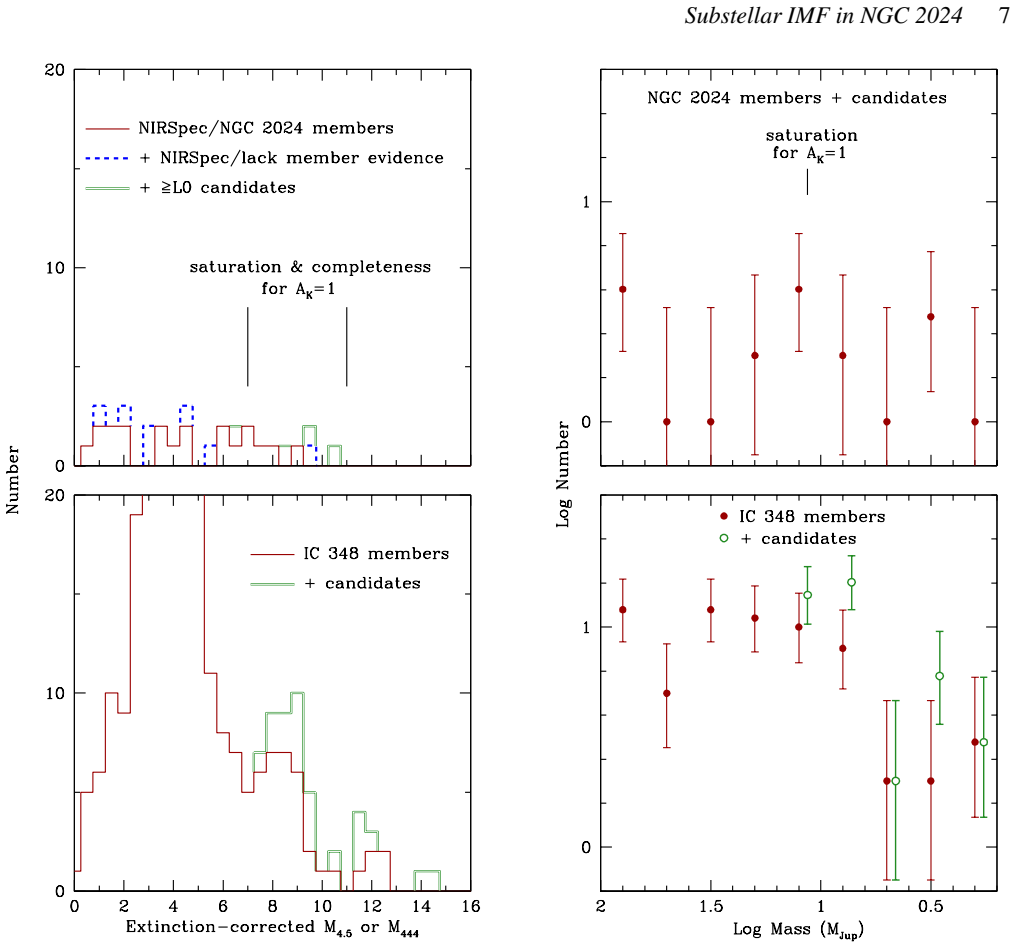
There is no evidence in the JWST data for a turnover in the substellar initial mass function of NGC 2024 below 12 Jupiter masses. Confirmed and candidate members extend to the completeness limit of the NIRCam images, so a minimum mass has not been detected, and the field is too small, too extincted, and too saturated at higher masses to yield a trustworthy IMF shape.
What carries the argument
NIRSpec spectral classification of youth and spectral type (triangular H-band continua, weak CO, comparison to young standards) combined with extinction-corrected F444W magnitudes used as a luminosity-to-mass proxy via evolutionary models at an adopted age of 0.5 Myr.
Load-bearing premise
The conversion of observed brightness into mass rests on evolutionary models whose accuracy is untested at ages under a million years and masses of only a few Jupiter masses; systematic errors in those models would shift the entire mass scale.
What would settle it
Spectroscopic confirmation or rejection of the remaining faint photometric candidates in the NIRCam field, together with a larger, extinction-limited sample of members that reaches below the present saturation limit, would show whether the mass function turns over or continues flat.
If this is right
- Prior photometric claims of an IMF turnover or cutoff in NGC 2024 cannot be regarded as established.
- Any future substellar IMF in this cluster requires spectroscopy or proper motions for membership plus an extinction limit that keeps the sample complete at low masses.
- Confirmed brown dwarfs already reach model masses near 4 Jupiter masses, placing a practical lower bound only at the image completeness floor of about 2 Jupiter masses.
- The same JWST data set that was used to claim a turnover is instead consistent with the roughly flat substellar IMFs found in other young clusters.
Where Pith is reading between the lines
- If the remaining faint candidates prove to be contaminants, the confirmed sample becomes even smaller and the statistical power to detect any cutoff vanishes entirely.
- The spectral-type/reddening degeneracy for the coolest L dwarfs means some mass estimates could move by several Jupiter masses once higher-resolution or longer-wavelength data break the degeneracy.
- Saturation incompleteness above 10 Jupiter masses implies that any claimed change in slope near that mass is especially vulnerable to missing higher-mass members.
Editorial analysis
A structured set of objections, weighed in public.
Referee Report
Summary. This paper reanalyzes JWST/NIRCam imaging of the embedded cluster NGC 2024 together with archival NIRSpec MSA prism spectra (program 5409) for 87 sources (67 in the NIRCam footprint). Using youth diagnostics (triangular H-band continua, weak CO, disks, X-rays, emission lines) and comparison to young spectral standards, the author classifies 45 targets as members, including 17 with M6.5–L types (13 inside the NIRCam field) and mass estimates down to ~4 Mjup. Photometric L-type candidates from prior work extend near the F444W 50% completeness limit (~2 Mjup at Ak≳1). The central claim is negative and carefully scoped: the NIRCam field cannot support a reliable substellar IMF because of small confirmed brown-dwarf numbers, extinction bias against lower masses, and saturation incompleteness at ≳10 Mjup; consequently there is no evidence in these JWST data for the turnover below 12 Mjup (or a minimum mass near 3 Mjup) reported by De Furio et al. (2025) from photometry alone.
Significance. The result is a timely, observationally grounded corrective to a high-profile JWST claim on the low-mass IMF. Negative conclusions that explicitly map saturation, completeness, extinction bias, and spectroscopic contamination rates are scientifically valuable and often under-published. Strengths include release of reduced NIRSpec spectra and classifications for 87 sources, conventional membership criteria tied to external standards and multiwavelength youth indicators, and transparent comparison sequences (IC 348). The paper does not overclaim a precise IMF shape; it shows why one cannot yet be measured in this field. If the community accepts the argument, it will reset expectations for what single NIRCam pointings plus sparse spectroscopy can deliver in heavily extincted clusters and reinforce the necessity of spectroscopy or proper motions before IMF turnovers are reported.
major comments (2)
- [§6, Fig. 8] §6 and Fig. 8: The negative claim (no evidence for a turnover below 12 Mjup; IMF unmeasurable) is supported by sample size and completeness limits, but the quantitative comparison to D25 would be stronger with a brief sensitivity test on the mass scale. Masses splice Baraffe et al. (2015) above 10 Mjup and Chabrier et al. (2023) below, with the latter extrapolated from 1 Myr to the adopted 0.5 Myr age; the text already notes possible substantial systematic errors. Showing the same histogram/IMF at fixed 1 Myr (or with a uniform model grid) would demonstrate that the absence of a clear break relative to D25’s 12 Mjup scale is not an artifact of the age/model splice. This is load-bearing only for the numerical alignment with D25, not for the qualitative incompleteness argument.
- [§4, §6, Fig. 7–8] §4 and §6: Four L25 photometric candidates (plus source 84 with incomplete wavelength coverage) remain unconfirmed and populate the lowest-mass bins that approach the 50% completeness limit. The paper correctly states that a minimum mass has not been detected and that even rejecting them leaves too few objects for a robust cutoff. For reproducibility against D25 (who did not tabulate candidates), the IMF and m444 histogram should be shown explicitly both with and without these five objects, and the text should state how many of the eight L25 ≥L0 candidates are spectroscopically confirmed, rejected, or still open. That single accounting paragraph would make the contamination contrast with D25’s 28 candidates fully checkable.
minor comments (7)
- [Abstract] Abstract and throughout: standardize ‘Mjup’ / ‘M_Jup’ notation and fix the truncated ‘12jup’ in the abstract’s final sentence.
- [§1] §1: ‘NGC 2024, which is is a heavily obscured cluster’ — duplicate ‘is’.
- [§4, Fig. 5] Fig. 5 caption and §4: the 50% completeness limits (m360~20, m444~19.5) are useful; briefly note how they were derived from artificial-star recovery as a function of local background so readers can judge spatial variation.
- [§3, Fig. 2, Table 2] §3 / Fig. 2: the spectral-type–reddening degeneracy for early-to-late L is well illustrated; consider adding the adopted type (or type range) used for the mass of source 412 and similar objects in Table 2 so the IMF binning is traceable.
- [§5, Fig. 6] §5: the ~0.5 Myr age inferred from the offset relative to the IC 348 sequence plus Baraffe fading rates is reasonable; cite the precise M4–M6 offset used so the age can be reproduced.
- [Data availability] Table 1 / data availability: confirm that the online supplemental spectra and full Tables 1–2 will be permanently archived (e.g., MAST/Zenodo DOIs already noted) at acceptance.
- Minor PDF/text artifacts visible in the submitted version (‘Web b’, ‘T wenty’, occasional ligature drops) should be cleaned in production.
Circularity Check
No significant circularity: negative IMF claim follows from sample size, completeness, and external diagnostics
full rationale
The paper’s central result is negative and observational: NIRCam+NIRSpec cannot support a reliable substellar IMF or a turnover below 12 Mjup, because of small confirmed BD numbers, saturation incompleteness ≳10 Mjup, and extinction bias. Membership rests on conventional youth diagnostics (triangular H-band, weak CO, X-rays, disks) and comparison to published young spectral standards (Luhman et al. 2017); masses are read from external evolutionary models (Baraffe et al. 2015; Chabrier et al. 2023) with the paper’s own caveat of possible large systematics. Self-citations (L25 photometry/candidates, IC 348 sequences, extinction-law checks) supply comparison data and prior reductions but do not define membership or force the null turnover. No quantity is fitted and then re-predicted; no uniqueness theorem or ansatz is imported to close the argument. The derivation is self-contained against the data and external benchmarks.
Axiom & Free-Parameter Ledger
free parameters (3)
- cluster age =
~0.5 Myr
- extinction law (Schlafly et al. 2016, RV-related parameter) =
Schlafly et al. 2016 with stated parameter -0.015
- model grid splice and 0.5 Myr extrapolation =
splice at 10 Mjup; offset extrapolated to 0.5 Myr
axioms (4)
- domain assumption Young M/L spectral standards and youth diagnostics (triangular H-band continuum, weak CO) correctly identify <1 Myr cluster members versus field contaminants.
- domain assumption Evolutionary models (Baraffe 2015; Chabrier 2023) give usable mass–luminosity relations at 0.5 Myr down to a few Mjup, up to substantial systematic error.
- domain assumption 50% completeness limits from artificial-star tests (m360~20, m444~19.5) and NIRCam saturation bound the reliable mass range at given Ak.
- standard math Standard statistical error bars on sparse histograms (Gehrels 1986) and logarithmic mass bins with Salpeter reference slope 1.35.
read the original abstract
A recent study has reported the detection of a turnover in the initial mass function (IMF) below 12 Mjup and the possible detection of a minimum mass near 3 Mjup in the heavily embedded cluster NGC 2024 (<1 Myr), which was based on a sample of brown dwarf candidates in NIRCam images from the James Webb Space Telescope (JWST). I have used those NIRCam data in conjunction with archival spectra from JWST's Near-Infrared Spectrograph (NIRSpec) to constrain the substellar IMF in NGC 2024. I present NIRSpec data for 87 sources, 67 of which are within the NIRCam field. Based on those spectra and data from previous studies (e.g., X-ray emission), I have classified 45 of the NIRSpec targets as members of NGC 2024, 17 of which have spectral types indicative of brown dwarfs (M6.5-L; 13 are within NIRCam). The latter have mass estimates as low as 4 Mjup according to theoretical evolutionary models. There remain a few photometric candidates lacking spectra that extend down to the completeness limit of the images (>=2 Mjup for Ak>=1), so the minimum mass of the IMF has not been detected. It is not possible to measure a reliable substellar IMF from the NIRCam images because of the small number of brown dwarfs encompassed by them, a bias against objects at lower masses due to the high extinctions, and incompleteness at >=10 Mjup due to the saturation limit. Thus, there is no evidence in the JWST data for a turnover below 12jup.
Figures


Reference graph
Works this paper leans on
-
[1]
The low-mass initial mass function in the Orion nebula cluster based on HST/NICMOS III imaging. , keywords =. doi:10.1051/0004-6361/201117062 , archivePrefix =. 1108.5581 , primaryClass =
-
[2]
Evolutionary models for solar metallicity low-mass stars: mass-magnitude relationships and color-magnitude diagrams. , keywords =. doi:10.48550/arXiv.astro-ph/9805009 , archivePrefix =. astro-ph/9805009 , primaryClass =
-
[3]
On the properties of free-floating planets originating in circumbinary planetary systems. , keywords =. doi:10.1093/mnras/stae903 , archivePrefix =. 2403.18481 , primaryClass =
-
[4]
The Initial Mass Function of the Orion Nebula Cluster across the H-burning Limit. , keywords =. doi:10.1088/0004-637X/748/1/14 , archivePrefix =. 1112.2711 , primaryClass =
-
[5]
Modelling for dense cores and disks
Influence of grain growth on CO _ 2 ice spectroscopic profiles. Modelling for dense cores and disks. , keywords =. doi:10.1051/0004-6361/202243929 , archivePrefix =. 2207.09411 , primaryClass =
-
[6]
Formation of Jupiter-mass Binary Objects through Photoerosion of Fragmenting Cores. , keywords =. doi:10.3847/1538-4357/ad8644 , archivePrefix =. 2410.09159 , primaryClass =
-
[7]
The bimodal initial mass function in the Orion nebula cloud. , keywords =. doi:10.1093/mnras/stw1094 , archivePrefix =. 1605.03600 , primaryClass =
-
[8]
Investigating Protostellar Accretion-driven Outflows across the Mass Spectrum: JWST NIRSpec Integral Field Unit 3 5 m Spectral Mapping of Five Young Protostars. , keywords =. doi:10.3847/1538-4357/ad2fa0 , archivePrefix =. 2310.03803 , primaryClass =
-
[9]
The Near-Infrared Spectrograph (NIRSpec) on the James Webb Space Telescope. II. Multi-object spectroscopy (MOS). , keywords =. doi:10.1051/0004-6361/202142673 , archivePrefix =. 2202.03306 , primaryClass =
-
[10]
The James Webb Space Telescope Mission. , keywords =. doi:10.1088/1538-3873/acd1b5 , archivePrefix =. 2304.04869 , primaryClass =
-
[11]
HST Survey of the Orion Nebula Cluster in the H _ 2 O 1.4 m Absorption Band. II. The Substellar IMF Down to Planetary Masses. , keywords =. doi:10.3847/1538-4357/ab911a , archivePrefix =. 2004.13920 , primaryClass =
Pith/arXiv arXiv 2004
-
[12]
, year = 1997, month = may, volume =
On the Stellar Population and Star-Forming History of the Orion Nebula Cluster. , year = 1997, month = may, volume =. doi:10.1086/118389 , adsurl =
doi:10.1086/118389 1997
-
[13]
Constraints on the Stellar/Substellar Mass Function in the Inner Orion Nebula Cluster. , keywords =. doi:10.1086/309309 , archivePrefix =. astro-ph/0003293 , primaryClass =
-
[14]
An Enhanced Spectroscopic Census of the Orion Nebula Cluster. , keywords =. doi:10.1088/0004-6256/146/4/85 , archivePrefix =. 1307.5533 , primaryClass =
-
[15]
Dynamics of Binary Planets within Star Clusters. , keywords =. doi:10.3847/2041-8213/ad8925 , archivePrefix =. 2407.04261 , primaryClass =
Pith/arXiv arXiv 2041
-
[16]
Near-infrared (JHK) Spectroscopy of Young Stellar and Substellar Objects in Orion. , keywords =. doi:10.1088/0004-637X/782/1/8 , adsurl =
-
[17]
The Near-Infrared Spectrograph (NIRSpec) on the James Webb Space Telescope. I. Overview of the instrument and its capabilities. , keywords =. doi:10.1051/0004-6361/202142663 , archivePrefix =. 2202.03305 , primaryClass =
-
[18]
No wide spread of stellar ages in the Orion Nebula Cluster. , keywords =. doi:10.1111/j.1365-2966.2011.19613.x , archivePrefix =. 1108.2052 , primaryClass =
arXiv 2011
-
[19]
Binary planet formation through tides. , keywords =. doi:10.1093/mnras/stad3443 , archivePrefix =. 2311.01618 , primaryClass =
-
[20]
A population of very young brown dwarfs and free-floating planets in Orion. , keywords =. doi:10.1046/j.1365-8711.2000.03515.x , archivePrefix =. astro-ph/0003061 , primaryClass =
arXiv 2000
-
[21]
Infrared spectroscopy of substellar objects in Orion. , keywords =. doi:10.1046/j.1365-8711.2001.04666.x , archivePrefix =. astro-ph/0105154 , primaryClass =
arXiv 2001
-
[22]
A deep survey of brown dwarfs in Orion with Gemini. , keywords =. doi:10.1111/j.1365-2966.2005.09156.x , archivePrefix =. astro-ph/0504570 , primaryClass =
arXiv 2005
-
[23]
Spectroscopy of planetary mass brown dwarfs in Orion. , keywords =. doi:10.1111/j.1745-3933.2006.00244.x , archivePrefix =. astro-ph/0609086 , primaryClass =
arXiv 2006
-
[24]
Candidates for Substellar Members of the Orion Nebula Cluster from JWST/NIRCam. , keywords =. doi:10.3847/1538-3881/ad812a , archivePrefix =. 2410.10406 , primaryClass =
-
[25]
A New Spectral Class of Brown Dwarfs at the Bottom of the IMF in IC 348. , keywords =. doi:10.3847/2041-8213/addc55 , adsurl =
-
[26]
A JWST Survey for Planetary Mass Brown Dwarfs in IC 348. , keywords =. doi:10.3847/1538-3881/ad00b7 , adsurl =
-
[27]
JWST/NIRSpec Observations of Brown Dwarfs in the Orion Nebula Cluster. , keywords =. doi:10.3847/1538-4357/ad7b19 , archivePrefix =. 2410.10000 , primaryClass =
-
[28]
A Survey for New Members of the Taurus Star-forming Region with the Sloan Digital Sky Survey. , keywords =. doi:10.3847/1538-3881/153/1/46 , archivePrefix =. 1610.09412 , primaryClass =
-
[29]
The Initial Mass Function of Low-Mass Stars and Brown Dwarfs in Young Clusters. , keywords =. doi:10.1086/309365 , archivePrefix =. astro-ph/0004386 , primaryClass =
-
[30]
JWST/NIRSpec Observations of the Planetary Mass Companion TWA 27B. , keywords =. doi:10.3847/2041-8213/acd635 , archivePrefix =. 2305.18603 , primaryClass =
Pith/arXiv arXiv 2041
-
[31]
The Villafranca catalog of Galactic OB groups. II. From Gaia DR2 to EDR3 and ten new systems with O stars. , keywords =. doi:10.1051/0004-6361/202142364 , archivePrefix =. 2110.01464 , primaryClass =
-
[32]
A JWST survey of the Trapezium Cluster & inner Orion Nebula. I. Observations & overview. arXiv e-prints , keywords =. doi:10.48550/arXiv.2310.03552 , archivePrefix =. 2310.03552 , primaryClass =
-
[33]
High Resolution Near-Infrared Imaging of the Trapezium: A Stellar Census. , keywords =. doi:10.1086/117160 , adsurl =
-
[34]
VISION - Vienna survey in Orion. I. VISTA Orion A Survey. , keywords =. doi:10.1051/0004-6361/201527160 , archivePrefix =. 1601.01687 , primaryClass =
-
[35]
Star Formation in the Orion Nebula I: Stellar Content
Star Formation in the Orion Nebula I: Stellar Content. Handbook of Star Forming Regions, Volume I , year = 2008, editor =. doi:10.48550/arXiv.0812.1323 , adsurl =
work page internal anchor Pith review Pith/arXiv arXiv doi:10.48550/arxiv.0812.1323 2008
-
[36]
The Luminosity and Mass Function of the Trapezium Cluster: From B Stars to the Deuterium-burning Limit. , keywords =. doi:10.1086/340554 , archivePrefix =. astro-ph/0203122 , primaryClass =
-
[37]
Handbook of Star Forming Regions, Volume I , year = 2008, editor =
Star Formation in the Orion Nebula II: Gas, Dust, Proplyds and Outflows. Handbook of Star Forming Regions, Volume I , year = 2008, editor =
2008
-
[38]
Can planet planet binaries survive in star-forming regions?. , keywords =. doi:10.1093/mnrasl/slaf045 , archivePrefix =. 2505.00762 , primaryClass =
-
[39]
Jupiter Mass Binary Objects in the Trapezium Cluster. arXiv e-prints , keywords =. doi:10.48550/arXiv.2310.01231 , archivePrefix =. 2310.01231 , primaryClass =
-
[40]
The Hubble Space Telescope/Advanced Camera for Surveys Atlas of Protoplanetary Disks in the Great Orion Nebula. , keywords =. doi:10.1088/0004-6256/136/5/2136 , adsurl =
-
[41]
An optical spectroscopic HR diagram for low-mass stars and brown dwarfs in Orion. , keywords =. doi:10.1111/j.1365-2966.2007.12308.x , archivePrefix =. 0708.1280 , primaryClass =
arXiv 2007
-
[42]
Cryogenic Optical Systems and Instruments XI , year = 2005, editor =
Overview of James Webb Space Telescope and NIRCam's Role. Cryogenic Optical Systems and Instruments XI , year = 2005, editor =. doi:10.1117/12.615554 , adsurl =
-
[43]
Performance of NIRCam on JWST in Flight. , keywords =. doi:10.1088/1538-3873/acac53 , archivePrefix =. 2212.12069 , primaryClass =
-
[44]
HST Survey of the Orion Nebula Cluster in the H _ 2 O 1.4 m Absorption Band. I. A Census of Substellar and Planetary-mass Objects. , keywords =. doi:10.3847/1538-4357/ab911e , archivePrefix =. 2004.13915 , primaryClass =
Pith/arXiv arXiv 2004
-
[45]
A Wide-Field Survey of the Orion Nebula Cluster in the Near-Infrared. , keywords =. doi:10.1088/0004-6256/139/3/950 , archivePrefix =. 0910.4194 , primaryClass =
-
[46]
The Optical-infrared Extinction Curve and Its Variation in the Milky Way. , keywords =. doi:10.3847/0004-637X/821/2/78 , archivePrefix =. 1602.03928 , primaryClass =
-
[47]
Adaptive Optics Imaging of the Orion Trapezium Cluster. , keywords =. doi:10.1086/300767 , adsurl =
-
[48]
The Spectroscopically Determined Substellar Mass Function of the Orion Nebula Cluster. , keywords =. doi:10.1086/421898 , archivePrefix =. astro-ph/0404292 , primaryClass =
-
[49]
JWST Observations of Young protoStars (JOYS): overview of program and early results. arXiv e-prints , keywords =. doi:10.48550/arXiv.2505.08002 , archivePrefix =. 2505.08002 , primaryClass =
-
[50]
Evolution of Extremely Soft Binaries in Dense Star Clusters: On the Jupiter Mass Binary Objects. , keywords =. doi:10.3847/1538-4357/adb8e9 , archivePrefix =. 2407.20416 , primaryClass =
-
[51]
Infrared spectroscopy and analysis of brown dwarf and planetary mass objects in the Orion nebula cluster. , keywords =. doi:10.1111/j.1365-2966.2008.14096.x , archivePrefix =. 0810.3584 , primaryClass =
arXiv 2008
-
[52]
Free-floating Planets, Survivor Planets, Captured Planets, and Binary Planets from Stellar Flybys. , keywords =. doi:10.3847/1538-4357/ad4f81 , archivePrefix =. 2403.07224 , primaryClass =
-
[53]
New evolutionary models for pre-main sequence and main sequence low-mass stars down to the hydrogen-burning limit. , keywords =. doi:10.1051/0004-6361/201425481 , archivePrefix =. 1503.04107 , primaryClass =
-
[54]
New determination of the hydrogen burning limit
Impact of a new H/He equation of state on the evolution of massive brown dwarfs. New determination of the hydrogen burning limit. , keywords =. doi:10.1051/0004-6361/202243832 , archivePrefix =. 2212.07153 , primaryClass =
-
[55]
Direct VLT/NACO observations using IR wavefront sensing
A giant planet candidate near a young brown dwarf. Direct VLT/NACO observations using IR wavefront sensing. , keywords =. doi:10.1051/0004-6361:200400056 , archivePrefix =. astro-ph/0409323 , primaryClass =
-
[56]
A Search for Companions to Brown Dwarfs in the Taurus and Chamaeleon Star-Forming Regions. , keywords =. doi:10.1088/0004-637X/788/1/40 , archivePrefix =. 1404.0213 , primaryClass =
-
[57]
Protostars and Planets V , year = 2007, editor =
Not Alone: Tracing the Origins of Very-Low-Mass Stars and Brown Dwarfs Through Multiplicity Studies. Protostars and Planets V , year = 2007, editor =. doi:10.48550/arXiv.astro-ph/0602122 , archivePrefix =. astro-ph/0602122 , primaryClass =
-
[58]
Membership of the Orion Nebula Population from the Chandra Orion Ultradeep Project. , keywords =. doi:10.1086/432097 , archivePrefix =. astro-ph/0504370 , primaryClass =
-
[59]
Evolution of X-Ray Activity in <25 Myr Old Pre-main Sequence Stars. , keywords =. doi:10.3847/1538-4357/ac7c69 , archivePrefix =. 2203.02047 , primaryClass =
-
[60]
A Census of Young Stars and Brown Dwarfs in IC 348 and NGC 1333. , keywords =. doi:10.3847/0004-637X/827/1/52 , archivePrefix =. 1605.08907 , primaryClass =
-
[61]
An HST Study of the Substellar Population of NGC 2024. , keywords =. doi:10.3847/1538-4357/ad0785 , archivePrefix =. 2310.04888 , primaryClass =
Pith/arXiv arXiv 2024
-
[62]
Handbook of Star Forming Regions, Volume I , year = 2008, editor =
Star Formation in NGC 2023, NGC 2024, and Southern L1630. Handbook of Star Forming Regions, Volume I , year = 2008, editor =
2023
-
[63]
Low-Mass Stars and Brown Dwarfs in NGC 2024: Constraints on the Substellar Mass Function. , keywords =. doi:10.1086/504964 , archivePrefix =. astro-ph/0604315 , primaryClass =
Pith/arXiv arXiv 2024
-
[64]
Core-Halo Age Gradients and Star Formation in the Orion Nebula and NGC 2024 Young Stellar Clusters. , keywords =. doi:10.1088/0004-637X/787/2/109 , archivePrefix =. 1403.2742 , primaryClass =
Pith/arXiv arXiv 2024
-
[65]
Properties of Low-Mass Objects in NGC 2024. , keywords =. doi:10.1086/178144 , adsurl =
-
[66]
Stellar Populations of Deeply Embedded Young Clusters: Near--Infrared Spectroscopy and Emergent Mass Distributions
-
[67]
Kinematics of young stellar objects in NGC 2024 based on infrared proper motions. , keywords =. doi:10.1051/0004-6361/202557533 , archivePrefix =. 2512.02124 , primaryClass =
arXiv 2024
-
[68]
Identification of a Turnover in the Initial Mass Function of a Young Stellar Cluster Down to 0.5 M _ J. , keywords =. doi:10.3847/2041-8213/adb96a , archivePrefix =. 2409.04624 , primaryClass =
Pith/arXiv arXiv 2041
-
[69]
Spectroscopy of a Young Brown Dwarf in the rho Ophiuchi Cluster 1. , keywords =. doi:10.1086/316784 , adsurl =
-
[70]
A Search for Very Low Mass Pre-Main-Sequence Stars in Taurus. , keywords =. doi:10.1086/300338 , adsurl =
-
[71]
A Search for Very Low Mass Stars and Brown Dwarfs in the Young Orionis Cluster. , keywords =. doi:10.1086/307583 , archivePrefix =. astro-ph/9903217 , primaryClass =
-
[72]
An L-Type Substellar Object in Orion: Reaching the Mass Boundary between Brown Dwarfs and Giant Planets. , keywords =. doi:10.1086/312317 , archivePrefix =. astro-ph/9908223 , primaryClass =
-
[73]
Dynamical masses of young stellar objects with the VLBA: DYNAMO-VLBA: Trigonometric parallaxes and proper motions of YSOs in Orion. , keywords =. doi:10.1051/0004-6361/202558169 , archivePrefix =. 2602.22048 , primaryClass =
-
[74]
The JWST/NIRISS Deep Spectroscopic Survey for Young Brown Dwarfs and Free-floating Planets. , keywords =. doi:10.3847/1538-3881/ad6f0c , archivePrefix =. 2408.12639 , primaryClass =
-
[75]
Identifying Young Stars in Massive Star-forming Regions for the MYStIX Project. , keywords =. doi:10.1088/0067-0049/209/2/32 , archivePrefix =. 1309.4500 , primaryClass =
-
[76]
One Relation for All Wavelengths: The Far-ultraviolet to Mid-infrared Milky Way Spectroscopic R(V)-dependent Dust Extinction Relationship. , keywords =. doi:10.3847/1538-4357/accb59 , archivePrefix =. 2304.01991 , primaryClass =
-
[77]
The Massive Young Star-Forming Complex Study in Infrared and X-Ray: Mid-infrared Observations and Catalogs. , keywords =. doi:10.1088/0067-0049/209/2/29 , archivePrefix =. 1309.4490 , primaryClass =
-
[78]
The Optical to Infrared 0.6-5.3 m Dust Extinction Law of the Milky Way with JWST NIRSpec: Westerlund 2. , keywords =. doi:10.3847/2041-8213/ad2e98 , archivePrefix =. 2402.17239 , primaryClass =
Pith/arXiv arXiv 2041
-
[79]
Confidence Limits for Small Numbers of Events in Astrophysical Data. , keywords =. doi:10.1086/164079 , adsurl =
-
[80]
The Initial Mass Function of Stars and Brown Dwarfs in the Upper Sco Association. , keywords =. doi:10.3847/1538-3881/add68c , archivePrefix =. 2505.21747 , primaryClass =
discussion (0)
Sign in with ORCID, Apple, or X to comment. Anyone can read and Pith papers without signing in.