REVIEW 3 major objections 2 minor 44 references
A framework called LAWFUL claims to certify when a neural network has learned and internally uses a physical law, and demonstrates on a MoCap-to-radar transformer that the Doppler law f=2v/λ is carried by a nine-component temporal circuit d
Reviewed by Pith at T0; open to challenge. T0 means a machine referee read the full paper against a public rubric. the ladder, T0–T4 →
T0 review · deepseek-v4-flash
2026-08-03 00:42 UTC pith:ONKYNQYP
load-bearing objection A clean formal framework for testing whether a network internally uses a physics law, but the headline Doppler result rests on an unquantified counterfactual approximation—referee it, but require the error analysis. the 3 major comments →
LAWFUL: Law-Aligned Witness for Faithful Use of Latents
The pith
A machine-rendered reading of the paper's core claim, the machinery that carries it, and where it could break.
Core claim
The paper claims to close two interpretability gaps for physics laws over continuous variables: it defines a coverage-aware causal-consistency measure over continuous counterfactual families, and a domain-of-validity test for the identified circuit. Instantiating on the MoCap-to-Radar transformer, it reports that the unpatched model achieves M0 = 0.988 consistency with the Doppler model g under radial-velocity scaling, and that the primary circuit C† = {T:MLP,h0,h1,h2,h4,h6,h7; S:MLP,h4} recovers 91% of that consistency. The circuit's response to scaling is shown to be carried predominantly by attention patterns (QK) rather than value transformations, which the authors interpret as an adapti
What carries the argument
The central machinery is the physical consistency score M_P(f,g), defined by bridging both the learned model and the physics model into a shared observable (the Doppler centroid) and measuring the agreement of their response slopes over a perturbation family that scales radial velocities continuously. Around this score, the paper defines a τ-physically consistent circuit as a minimal subgraph that recovers the unpatched baseline under sufficiency and necessity activation patching. The counterfactual construction in Eq. (8) attempts to realize exactly scaled radial velocities by projecting frame-to-frame displacements onto the line-of-sight, and the QK-versus-value patching distinguishes whet
Load-bearing premise
The counterfactual inputs in Eq. (8) are assumed to actually scale radial velocity by α while preserving tangential motion, which holds only approximately because the line-of-sight direction changes as the body moves; if this approximation degrades for larger |α| or for individual markers, the consistency scores and circuit are measuring a corrupted perturbation rather than the law.
What would settle it
Compute the finite-difference radial velocity of x'(α) in Eq. (8) directly and compare it to α times the original radial velocity, for α over the claimed domain [−1.16, 1.16] and for individual markers; if the deviation grows significantly within the certified range, the reported consistency and circuit scores are measuring a distorted perturbation. Alternatively, test the circuit on a perturbation that rescales only part of the body, which the paper states is untested; a failure there would bound the claim of lawful internal use.
If this is right
- If the framework is correct, it provides a general template for verifying whether any neural predictor of a physical system has internalized a known law, rather than merely matching outputs.
- The identification of a minimal circuit that recovers most of the law-consistency score implies that physical-law compliance can be localized to a small subset of components, enabling targeted auditing and intervention.
- The finding that temporal attention patterns (QK) carry the velocity-scaling response rather than value transformations suggests that attention heads can implement multi-scale temporal differentiation, a new mechanistic hypothesis for sequence-to-sequence transformers.
- The domain-of-validity test shows the consistency holds within the radar-resolvable range but degrades beyond it, implying that the model's lawful behavior is bounded by physical constraints of the sensor, not just by training distribution.
- The tangential-invariance test demonstrates that the framework can verify forbidden behaviors and invariances of a physics law, not just positive correlations.
Where Pith is reading between the lines
- The same framework could be extended to test whether other derived physical quantities (e.g., acceleration or higher-order derivatives) are computed and used by the network, using analogous perturbation families on frame-to-frame differences.
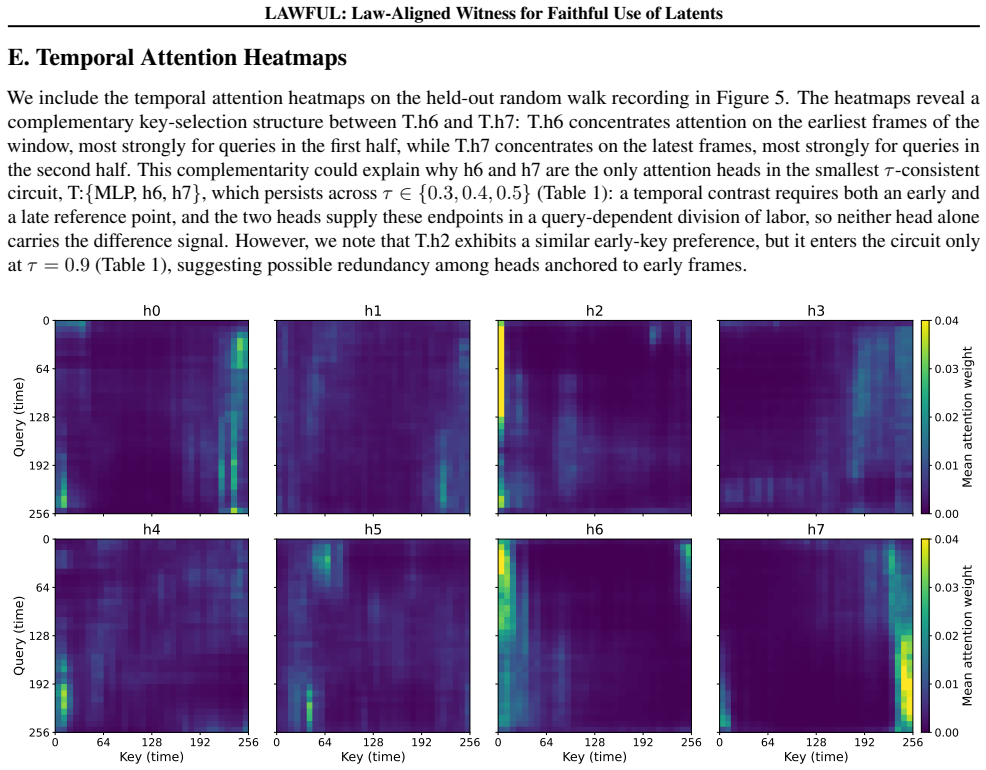
- The QK-dominant mechanism suggests a testable prediction: attention distances in the temporal heads should adjust with target speed, mirroring how the optimal finite-difference gap scales with velocity; this could be checked directly from attention heatmaps.
- The body-level domain bound αmax≈1.16 is an average; per-marker radial velocities may exceed the radar's resolvable limit within the certified range, so a marker-level domain-of-validity analysis could yield a tighter or different circuit.
- The framework's reliance on a supplied physics law leaves open the possibility of using it to compare competing candidate laws or levels of description, where the one yielding a higher consistency score with a smaller circuit might be preferred.
Editorial analysis
A structured set of objections, weighed in public.
Referee Report
Summary. The paper proposes LAWFUL, a framework for assessing whether a neural network has internalized a known physical law over continuous variables and whether that representation is causally used. The framework defines an input bridge B from raw inputs to a physics space, output bridges Df, Dg to a common observable, a perturbation family P, and a consistency score M_P; it then identifies τ-physically consistent circuits via activation patching in sufficiency/necessity configurations. The framework is instantiated on a MoCap-to-Radar transformer that predicts Doppler spectrograms without explicit velocity or frequency supervision. The authors report unpatched Doppler consistency M0=0.988, a nine-component circuit C† that recovers 91% of M0, source-randomized controls that support the causal specificity of the circuit, a domain-of-validity sweep α∈[-1.16,1.16], a tangential-invariance check, and an analysis showing QK attention-pattern patching is more sufficient than value patching for recovering consistency. The paper also lists limitations, including the centroid-only output bridge and uniform body-wide rescaling.
Significance. The formalization is clear and the case study is a genuine attempt to move from correlation to causal usage of a physical law. Strengths include the explicit component-graph formalism, the use of source-randomized controls, the QK/value decomposition, and the honest limitations section. If the perturbation construction is validated, the framework would be a useful addition to mechanistic interpretability for continuous physics domains. However, two features of the current presentation substantially weaken the empirical claims: the unverified approximation in Eq. (8) and the fact that the 91% recovery is fixed by the chosen τ threshold. Both are addressable within the paper's scope.
major comments (3)
- [§3.2, Eq. (8)] The counterfactual construction in Eq. (8) is the load-bearing step of the entire empirical study, but the paper only states that it realizes B(x'(α))≈αB(x). The construction projects each frame-to-frame displacement onto the line-of-sight unit vector at x_{m,t-1} and scales that component. Because the counterfactual positions are generated iteratively, the line-of-sight directions at the counterfactual positions differ from the ones used in the projection, so the central-difference radial velocities in Eq. (5) will differ from α times the original radial velocities by terms that are not controlled. No error bound, per-marker bound, or empirical check is reported. Since M0, Table 1, Fig. 4a, and all circuit scores are computed on these x'(α), an unquantified degradation of the approximation would mean the framework is measuring the model's response to a corrupted perturbation rather than
- [§4 (Domain of validity)] The domain-of-validity bound αmax=2.6/2.24≈1.16 in §4 is computed from body-level RCS-weighted average radial velocity, using the same weights w_m as the output bridge in Eq. (7). However, the physics model g in Eq. (4) is a per-marker law, and the consistency score aggregates per-marker Doppler shifts. Within the certified interval |α|≤1.16, individual markers can have radial velocities exceeding the radar's 2.6 m/s resolvable limit, so part of the evaluation may use physically unresolvable Doppler shifts for some markers. Please report per-marker radial-velocity quantiles over the evaluation set under the scaling bound, and either tighten αmax to a per-marker bound or argue explicitly that the body-level centroid is the correct physical quantity whose resolvability limits the perturbation domain.
- [§2.3/§4.1, Eq. (3), Table 1] The statement in §4.1 and the Abstract that C† 'recovers 91% of M0' is a direct consequence of the τ threshold, not an empirical finding. Definition 2.3 declares C τ-consistent when Δsuf(C)≤(1-τ)M0, which for τ=0.9 means the patched sufficiency score is at least 0.9M0. Table 1 reports Δsuf=0.09 for C† with M0=0.988, i.e., M_suf≈0.898, which is 90.9% of M0. Because C† was selected at τ=0.9, this recovery percentage is enforced by the search criterion. The substantive results are the specific minimal component set, the nesting across τ, and the superiority over source-randomized controls. Please rephrase the 91% claim as 'by construction at τ=0.9' and place the evidential weight on the component selection and controls.
minor comments (2)
- [§4.1, Table 1] Uncertainty: Table 1 reports standard errors for the randomized controls but not for M0, Δsuf, or Δnec. Given the small evaluation set and the single checkpoint, report bootstrap or seed-based variability for the central quantities.
- [§4.2] Tangential test: the counterfactual zeros the radial displacement rather than preserving it. This is explained, but the text should state clearly that this tests a null response to tangential-only motion, not invariance to tangential scaling in the presence of radial motion. The current wording 'near-invariance under tangential scaling' is slightly stronger than what the construction measures.
Circularity Check
No significant circularity: external Doppler law drives the consistency test; circuit recovery figures are search outcomes.
full rationale
LAWFUL's derivation chain is not circular. The Doppler law g(v)=2v/λ and the wavelength λ are external physical inputs, not fitted to the model. The consistency score M_P compares the learned-side Doppler centroid D_f(f(x')) against the physics-side D_g(g(B(x'))) under counterfactual positions x'(α) generated by Eq. (8); the model's response is measured, not imposed. Although the paper states B(x')≈αB(x) without an error bound, this is a validity threat to the perturbation implementation, not a definitional equivalence: the network is free to fail the scaling test, and the source-randomized controls likewise probe a genuinely causal quantity. The '91% recovery' figure at τ=0.9 restates the sufficiency threshold (Δsuf≤(1−τ)M0 ⇒ ≥90% recovery by definition), but the paper presents it as the outcome of a search, and the substantive claims—C† composition, temporal concentration, QK vs VAL patching, tangential invariance—are empirically determined rather than forced by construction. The companion-paper citation (Chen et al. 2026) supplies the trained model and data pipeline; it does not itself certify the internal-use conclusion. Hence no step reduces the law-learning claim to its own inputs.
Axiom & Free-Parameter Ledger
free parameters (3)
- RCS/BSA weights w_m =
not reported (proportions from BSA)
- radar-resolvable scaling bound αmax =
≈1.16
- circuit threshold τ =
0.9 for primary circuit C†
axioms (4)
- domain assumption Doppler frequency law f=2v/λ is the correct physics model for the radar returns.
- domain assumption Radial velocity can be recovered by central finite differencing of marker range.
- ad hoc to paper Scaling radial displacement components by α realizes B(x')≈αB(x).
- domain assumption Body-level Doppler centroid with BSA weights w_m is the correct observable comparison.
read the original abstract
When a neural network predicts a physical system accurately, has it learned the governing law as formal, structured knowledge, and if so, does the network's internal computation actually use that representation throughout the law's domain of validity? We identify four interpretability gaps that limit answering these questions for {\em physics laws over continuous variables}: the absence of a coverage-aware causal-consistency measure over continuous counterfactuals; of a domain-of-validity test for the identified circuit; of a verification of the law's invariants and forbidden behaviors; and of a quantification of how a derived physical quantity flows through the circuit. We develop a foundational framework, LAWFUL, that closes the first two and lays groundwork for the remaining two, and illustrate it on the Mocap2Radar transformer, validating whether it learns and internally uses the Doppler frequency law $f(t) = \frac{2 v(t)}{\lambda}$ from motion-capture and radar data in which neither $f(t)$ nor $v(t)$ appears.
Figures


Reference graph
Works this paper leans on
-
[1]
and Arora, Anish , booktitle =
Chen, Kevin and Parker, Kenneth W. and Arora, Anish , booktitle =. 2026 , address =
2026
-
[2]
and Arora, Anish , booktitle =
Chen, Kevin and Parker, Kenneth W. and Arora, Anish , booktitle =. What Physics Do Data-Driven. 2026 , address =
2026
-
[3]
Hand Gesture Recognition Using
Kim, Youngwook and Toomajian, Brian , journal=. Hand Gesture Recognition Using. 2016 , publisher=
2016
-
[4]
International Conference on Learning Representations (ICLR) , year =
An Image is Worth 16x16 Words: Transformers for Image Recognition at Scale , author =. International Conference on Learning Representations (ICLR) , year =
-
[5]
Advances in Neural Information Processing Systems (NeurIPS) , volume =
Do Vision Transformers See Like Convolutional Neural Networks? , author =. Advances in Neural Information Processing Systems (NeurIPS) , volume =
-
[6]
Proceedings of the 57th Annual Meeting of the Association for Computational Linguistics (ACL) , pages =
Adaptive Attention Span in Transformers , author =. Proceedings of the 57th Annual Meeting of the Association for Computational Linguistics (ACL) , pages =
-
[7]
, booktitle =
Clark, Kevin and Khandelwal, Urvashi and Levy, Omer and Manning, Christopher D. , booktitle =. What Does
-
[8]
arXiv preprint arXiv:1610.01644 , year=
Understanding Intermediate Layers Using Linear Classifier Probes , author=. arXiv preprint arXiv:1610.01644 , year=
-
[9]
Hypothesis Testing the Circuit Hypothesis in
Shi, Claudia and Beltran-Velez, Nicolas and Nazaret, Achille and Zheng, Carolina and Garriga-Alonso, Adri. Hypothesis Testing the Circuit Hypothesis in. Advances in Neural Information Processing Systems (NeurIPS) , volume=
-
[10]
Transformer Circuits Thread , year =
A Mathematical Framework for Transformer Circuits , author =. Transformer Circuits Thread , year =
-
[11]
arXiv preprint arXiv:2404.15255 , year =
How to Use and Interpret Activation Patching , author =. arXiv preprint arXiv:2404.15255 , year =
-
[12]
2024 , eprint=
Mechanistic Interpretability for AI Safety -- A Review , author=. 2024 , eprint=
2024
-
[13]
arXiv preprint arXiv:2304.05969 , year=
Localizing Model Behavior with Path Patching , author=. arXiv preprint arXiv:2304.05969 , year=
-
[14]
Transactions of the Association for Computational Linguistics , volume =
Amnesic Probing: Behavioral Explanation with Amnesic Counterfactuals , author =. Transactions of the Association for Computational Linguistics , volume =
-
[15]
arXiv preprint arXiv:2309.08600 , year =
Sparse Autoencoders Find Highly Interpretable Features in Language Models , author =. arXiv preprint arXiv:2309.08600 , year =
-
[16]
Journal of Machine Learning Research , volume =
Causal Abstraction: A Theoretical Foundation for Mechanistic Interpretability , author =. Journal of Machine Learning Research , volume =. 2025 , eprint =
2025
-
[17]
Advances in Neural Information Processing Systems (NeurIPS) , year =
Causal Abstractions of Neural Networks , author =. Advances in Neural Information Processing Systems (NeurIPS) , year =. 2106.02997 , archivePrefix=
-
[18]
Causal Learning and Reasoning (CLeaR) , year =
Finding Alignments Between Interpretable Causal Variables and Distributed Neural Representations , author =. Causal Learning and Reasoning (CLeaR) , year =. 2303.02536 , archivePrefix=
-
[19]
, booktitle =
Wu, Zhengxuan and Geiger, Atticus and Icard, Thomas and Potts, Christopher and Goodman, Noah D. , booktitle =. Interpretability at Scale: Identifying Causal Mechanisms in
-
[20]
Advances in Neural Information Processing Systems (NeurIPS) , year =
The Non-Linear Representation Dilemma: Is Causal Abstraction Enough for Mechanistic Interpretability? , author =. Advances in Neural Information Processing Systems (NeurIPS) , year =. 2507.08802 , archivePrefix=
-
[21]
International Conference on Learning Representations (ICLR) , year =
Is This the Subspace You Are Looking For? An Interpretability Illusion for Subspace Activation Patching , author =. International Conference on Learning Representations (ICLR) , year =. 2311.17030 , archivePrefix=
-
[22]
arXiv preprint arXiv:2502.20914 , year =
Everything, Everywhere, All at Once: Is Mechanistic Interpretability Identifiable? , author =. arXiv preprint arXiv:2502.20914 , year =. 2502.20914 , archivePrefix=
-
[23]
arXiv preprint arXiv:2604.22128 , year =
Dissociating Decodability and Causal Use in Bracket-Sequence Transformers , author =. arXiv preprint arXiv:2604.22128 , year =. 2604.22128 , archivePrefix=
-
[24]
Causality Decodability, and Vice Versa: Lessons from Interpreting Counting
Huang, Lianghuan and Chang, Yingshan , journal =. Causality Decodability, and Vice Versa: Lessons from Interpreting Counting. 2025 , eprint =
2025
-
[25]
Conference on Empirical Methods in Natural Language Processing (EMNLP) , year =
Designing and Interpreting Probes with Control Tasks , author =. Conference on Empirical Methods in Natural Language Processing (EMNLP) , year =
-
[26]
Computational Linguistics , volume =
Probing Classifiers: Promises, Shortcomings, and Advances , author =. Computational Linguistics , volume =
-
[27]
International Conference on Machine Learning (ICML) , year =
Validating Mechanistic Interpretations: An Axiomatic Approach , author =. International Conference on Machine Learning (ICML) , year =. 2407.13594 , archivePrefix=
-
[28]
Causal Scrubbing: a Method for Rigorously Testing Interpretability Hypotheses , author =
-
[29]
Interpretability in the Wild: A Circuit for Indirect Object Identification in
Wang, Kevin Ro and Variengien, Alexandre and Conmy, Arthur and Shlegeris, Buck and Steinhardt, Jacob , booktitle =. Interpretability in the Wild: A Circuit for Indirect Object Identification in. 2023 , eprint =
2023
-
[30]
Advances in Neural Information Processing Systems (NeurIPS) , year =
Towards Automated Circuit Discovery for Mechanistic Interpretability , author =. Advances in Neural Information Processing Systems (NeurIPS) , year =. 2304.14997 , archivePrefix=
-
[31]
Attribution Patching Outperforms Automated Circuit Discovery , author =. Workshop on Mechanistic Interpretability at the International Conference on Machine Learning , year =. 2310.10348 , archivePrefix=
-
[32]
International Conference on Learning Representations (ICLR) , year =
Sparse Feature Circuits: Discovering and Editing Interpretable Causal Graphs in Language Models , author =. International Conference on Learning Representations (ICLR) , year =. 2403.19647 , archivePrefix=
-
[33]
2023 , eprint =
Belrose, Nora and Schneider-Joseph, David and Ravfogel, Shauli and Cotterell, Ryan and Raff, Edward and Biderman, Stella , booktitle =. 2023 , eprint =
2023
-
[34]
International Conference on Machine Learning (ICML) , year =
What Has a Foundation Model Found? Using Inductive Bias to Probe for World Models , author =. International Conference on Machine Learning (ICML) , year =. 2507.06952 , archivePrefix=
-
[35]
Liu, Ziming and Sanborn, Sophia and Ganguli, Surya and Tolias, Andreas , journal =. From. 2026 , eprint =
2026
-
[36]
arXiv preprint arXiv:2508.12448 , year =
Uncovering Emergent Physics Representations Learned In-Context by Large Language Models , author =. arXiv preprint arXiv:2508.12448 , year =. 2508.12448 , archivePrefix=
-
[37]
arXiv preprint arXiv:2602.07050 , year =
Interpreting Physics in Video World Models , author =. arXiv preprint arXiv:2602.07050 , year =. 2602.07050 , archivePrefix=
-
[38]
arXiv preprint arXiv:2601.12913 , year =
Actionable Interpretability Must Be Defined in Terms of Symmetries , author =. arXiv preprint arXiv:2601.12913 , year =. 2601.12913 , archivePrefix=
-
[39]
Advances in Neural Information Processing Systems (NeurIPS) , year =
Evaluating the Robustness of Interpretability Methods through Explanation Invariance and Equivariance , author =. Advances in Neural Information Processing Systems (NeurIPS) , year =. 2304.06715 , archivePrefix=
-
[40]
International Conference on Machine Learning (ICML) , year =
Interpretability Illusions in the Generalization of Simplified Models , author =. International Conference on Machine Learning (ICML) , year =. 2312.03656 , archivePrefix=
-
[41]
International Conference on Learning Representations (ICLR) , year =
Progress Measures for Grokking via Mechanistic Interpretability , author =. International Conference on Learning Representations (ICLR) , year =. 2301.05217 , archivePrefix=
-
[42]
Advances in Neural Information Processing Systems (NeurIPS) , year =
Investigating Gender Bias in Language Models Using Causal Mediation Analysis , author =. Advances in Neural Information Processing Systems (NeurIPS) , year =. 2004.12265 , archivePrefix=
Pith/arXiv arXiv 2004
-
[43]
Locating and Editing Factual Associations in
Meng, Kevin and Bau, David and Andonian, Alex and Belinkov, Yonatan , booktitle =. Locating and Editing Factual Associations in. 2022 , eprint =
2022
-
[44]
International Conference on Learning Representations (ICLR) , year =
Hadad, Itamar and Katz, Guy and Bassan, Shahaf , title =. International Conference on Learning Representations (ICLR) , year =. 2602.16823 , archivePrefix =
discussion (0)
Sign in with ORCID, Apple, or X to comment. Anyone can read and Pith papers without signing in.