REVIEW 3 major objections 5 minor 169 references
Population III stars will likely evade current line-intensity surveys: SPHEREx will only set joint limits on the first stars' star formation efficiency and IMF shape, and a next-generation instrument is needed to discriminate models.
Reviewed by Pith at T0; open to challenge. T0 means a machine referee read the full paper against a public rubric. the ladder, T0–T4 →
T0 review · deepseek-v4-flash
2026-08-03 00:15 UTC pith:BE7ARU33
load-bearing objection Solid Pop III LIM forecasting tool, but the headline detectability claims are conditional on the unconstrained Pop III SFRD amplitude; treat the instrument thresholds as fiducial-model statements, not robust predictions. the 3 major comments →
Searching for Population III stars with line intensity mapping cross-correlations
The pith
A machine-rendered reading of the paper's core claim, the machinery that carries it, and where it could break.
Core claim
The paper's central claim is that, once Pop III star formation is modeled self-consistently with Lyman-Werner feedback, the streaming motion between dark matter and baryons, and IMF-dependent line luminosities, the Pop III line-intensity signal is nearly two orders of magnitude weaker than earlier forecasts. As a result, the HeII 1640-A auto-power spectrum—the cleanest Pop III tracer—is undetectable with SPHEREx and even with the proposed CDIM; only the H-alpha x HeII cross-power, observed with an improved CDIM+ configuration, reaches S/N>=5, doing so at z~5 and out to z~16. The paper also shows that 'exotic' Pop III models, in which pristine star formation extends into more massive atomic-c
What carries the argument
The central object is the lognormal bias expansion: the star formation rate density and line luminosity density in a region are written as an exponential of the local overdensity (with linear and nonlinear bias coefficients), so all power spectra reduce to analytically computed correlation functions of a lognormal field. For Pop III stars, the density building block is multiplied by a log-chi-squared factor that encodes the dark-matter-baryon streaming velocity, and Lyman-Werner feedback is folded into the biases. Line luminosities per unit star formation are computed by IMF-averaging ionizing photon production from Pop III stellar tables, allowing flexible variation of the IMF slope and cha
Load-bearing premise
The forecasts stand or fall on the assumed amplitude of Pop III star formation (inherited from the fiducial model) combined with the simplifying choice that no ionizing photons escape to alter the H-alpha and HeII line luminosities; if the true Pop III star formation rate density is lower, even the improved CDIM+ survey would miss the signal.
What would settle it
Run the H-alpha x HeII cross-correlation analysis at z≈5 with an instrument reaching σ_noise ≈ 1e-20 erg s^-1 cm^-2 sr^-1 Hz^-1: if no cross-power with S/N ≥ 5 appears, the fiducial Pop III model is too optimistic; if the HeII auto-power is detected with current CDIM specifications at z>5, the pessimistic forecast is wrong.
If this is right
- SPHEREx's deep survey will at best place joint upper limits on the Pop III star formation efficiency and IMF slope at z~5; it will not detect the HeII line or the H-alpha x HeII cross-power in the fiducial classical Pop III model.
- A CDIM-like instrument offers only a factor ~2 improvement; the 'CDIM+' configuration (10x lower noise, higher spectral resolution) is required for a S/N>=5 detection of the H-alpha x HeII cross-power, which would then tightly constrain the Pop III SFE.
- The HeII line is a much more sensitive IMF diagnostic than H-alpha (factor ~30 variation in luminosity across plausible IMFs), but only useful in cross-correlation because its auto-power is too faint.
- Combining SPHEREx H-alpha measurements with JWST UV luminosity function measurements can constrain the Pop III host-halo mass threshold to within ~2 dex and distinguish bursty from massive-halo extensions of the classical model.
- The analytical model reproduces the semi-numerical simulation results once differences in SFRD, stellar lifetimes, and feedback are accounted for, providing a fast tool for future survey design.
Where Pith is reading between the lines
- The paper's own sensitivity study shows the predicted signal can shift by up to two orders of magnitude with plausible changes to the Pop III SFRD; this means the CDIM+ detectability claim is conditional on that amplitude, and the decisive next step is to anchor the Pop III SFRD with independent probes (e.g., 21-cm or deep UVLF) before finalizing next-generation LIM designs.
- Because the z~5 cross-power varies by only ~a factor of a few over a wide range of IMF slopes, single-redshift measurements will struggle to separate SFE from IMF shape; this argues for surveys with wide frequency coverage that capture the redshift evolution, as the paper notes multi-redshift bins add significant constraining power.
- The forecast assumes clean foreground subtraction and no line interlopers; while the paper argues results are robust to a factor-of-5 variance inflation, realistic interlopers could introduce correlated biases, so a natural extension is to inject interloper cleaning into the Fisher formalism.
- The framework's separation of Pop II and III contributions suggests an immediate test: at z>10, where SPHEREx cannot see H-alpha, cross-correlating HeII with the 21-cm signal could extend the Pop III search to higher redshifts and break degeneracies with Pop II.
Editorial analysis
A structured set of objections, weighed in public.
Referee Report
Summary. This paper extends the analytic Zeus21/oLIMpus line-intensity-mapping framework to include Population III stars with a flexible IMF, computing Hα and HeII line emissivities from stellar-population tables and forecasting auto- and cross-power spectra for SPHEREx, a proposed CDIM, and an improved CDIM+ configuration. The authors validate the analytic SFRD power spectrum against a numerical box to within a factor of two and reproduce LIMFAST predictions when model settings are matched (Appendix A). They then use Fisher forecasts to show that SPHEREx will mostly be able to place joint limits on the Pop III SFE and IMF slope, that a CDIM-like instrument improves those limits only modestly, and that a more sensitive CDIM+ configuration could detect the Hα×HeII cross-power at z~5 and constrain the Pop III SFE tightly. They also explore extensions to non-classical Pop III models, including higher-mass host halos and bursty star formation, and combine LIM forecasts with JWST UV luminosity-function measurements.
Significance. If the forecasts hold, the paper provides a fast, publicly available tool for Pop III LIM science and a concrete, physically motivated set of instrument requirements: current-generation LIM cannot survey the classical Pop III landscape, while a CDIM-like upgrade can. The validation against a numerical box and against LIMFAST, together with the careful isolation of modeling differences in Appendix A, are genuine strengths; the released code would be a useful community resource. The main significance is therefore real but conditional: the headline detectability and Fisher constraints depend on the assumed Pop III SFRD amplitude and on setting f_esc=0, so the instrument requirements should be read as statements about the adopted fiducial model rather than robust upper limits on the Pop III signal.
major comments (3)
- [Sec. IVB and Eq. (31), Sec. VIIB] The assumption f_esc,nu ~ 0 is stated after Eq. (31) and used throughout. Because the mean intensity J_nu is proportional to (1 - f_esc,nu), this choice maximizes every predicted signal and thus every S/N and Fisher constraint. For HeII at z~5, nonzero escape of HeII-ionizing photons is physically plausible and would lower the already weak cross-power; even f_esc=0.5 reduces the signal and S/N by roughly a factor of two. The claims that 'CDIM+ ... cross-correlation signal is in principle detectable at z~5' and that SPHEREx will only place joint limits are therefore f_esc=0 upper-limit statements. I recommend adding a simple sensitivity test over f_esc (the formalism already contains the prefactor) and softening the wording in Section VIIB accordingly.
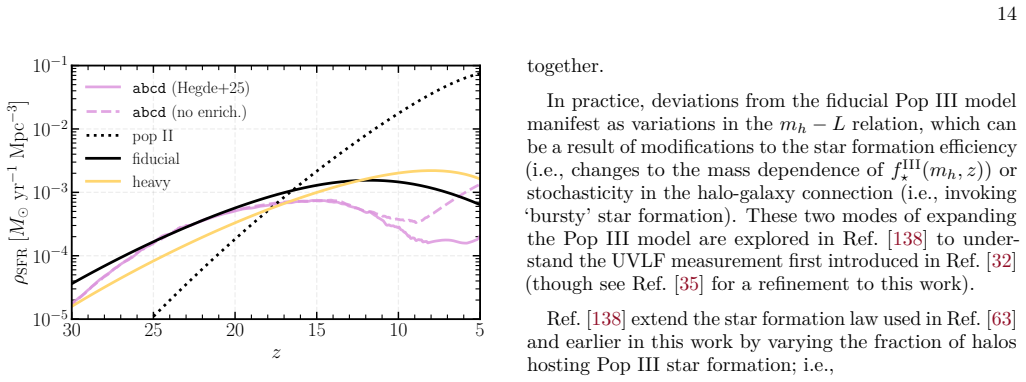
- [Sec. IIE, Sec. VA, Appendix A, Figs. 7-9] The fiducial Pop III SFRD is adopted from Ref. [63] (Sec. IIE), and Appendix A shows that changing the SFRD, IMF lifetime treatment, feedback, and astrophysical matching moves the predicted power by up to two orders of magnitude relative to Ref. [87]. The Fisher forecasts in Figs. 7, 9, and 12, and the instrument-threshold conclusions in Sec. VA/VIIB, are all evaluated only for this single fiducial amplitude. The authors' own Fig. 8 shows the fiducial SFRD is broadly consistent with the abcd model at early times but overpredicts at z<15, and the 'heavy' model or the no-enrichment abcd curve could plausibly lie at either end of the allowed range. I ask the authors to propagate at least one high and one low SFRD scenario through the S/N and Fisher pipeline, or to state explicitly in the abstract and conclusion that the reported detectability boundaries are conditional on the fiducial SFRD
- [Sec. IID, Eq. (18)] The text says 'we set the line luminosity ... to be the median of a lognormal relation', but Eq. (18) as written integrates L' times a Gaussian in log L', which is the mean of the lognormal distribution, not the median. If the code uses Eq. (18) literally, the mean luminosity and the shot-noise second moment are inflated by exp(σ_L^2/2) in natural-log units; for σ_L=1.2 dex this is a large factor and would affect the shot-noise contribution and any luminosity-density normalization. Please clarify whether the implementation uses the mean or the median, and correct either the formula or the wording, and state the effect on the quoted constraints.
minor comments (5)
- [Appendix D title] The heading reads 'Appendix D: Appendix D: UVLF parameter variations'; the duplicated prefix should be removed.
- [Eq. (17)] The angle-bracket notation in the shot-noise expression is never defined. Specify that the average is over the lognormal scatter in Eq. (18), especially since that scatter is promoted to a free parameter in the Fisher forecasts.
- [Sec. IVA, Eq. (33)] The definition of the thermal noise power spectrum would be clearer if the units of σ_noise were explicitly tied to the spectral and spatial resolution; the current text states the scaling but leaves the reader to assemble the factors.
- [Sec. VIC.1] The phrase 'distinguish the burstiness of this population to within 5%' is ambiguous: σ_L is in dex, so a 5% statement should specify whether it is 5% of the parameter value or of the relative precision, and the corresponding marginalized uncertainty in Fig. 12 should be quoted consistently.
- [Sec. III, Eq. (29)] The IMF in Eq. (29) is described as 'Chabrier-like', but the functional form with m_char^β in the exponential is more general than a standard Chabrier IMF. A brief justification of the parameter range and the normalization convention would help readers reproduce the coefficients in Fig. 2.
Circularity Check
No circular construction: forecasts are model outputs, not fits to the predicted signals; self-citations set the fiducial amplitude but are explicitly flagged as model assumptions.
full rationale
The paper's derivation chain is a forward model: adopt a star-formation/luminosity model (largely inherited from the authors' prior Zeus21/oLIMpus work and Ref. [63]), compute line-emissivity power spectra from that model, add an observation-noise formalism, and then produce S/N and Fisher forecasts. The predicted H-alpha and HeII power spectra are not fitted to the observables being forecast; instead, parameters such as f_star^III, alpha_IMF, and m_char^IMF are varied, and the Fisher matrix is evaluated at the derivative of model predictions with respect to those parameters. There is therefore no reduction of a 'prediction' to a fitted input by construction. The paper is explicit that its conclusions rest on the adopted fiducial model: Section IVB states 'All of these conclusions, however, rest on the assumed fiducial Pop III model, which, while motivated by the latest theoretical work, is ultimately unconstrained,' and Section VIIA cautions that the tight constraints assume idealized signal variance and neglect foregrounds. These are honest sensitivity limitations rather than circular steps. The self-citations (Zeus21/oLIMpus, the Ref. [63] fiducial model, and the abcd benchmark of Ref. [6]) are load-bearing in the sense that the forecast amplitude inherits the authors' prior model, but the paper validates the analytic machinery against an independent numerical box (Section IIF) and against the semi-numerical LIMFAST/Ref. [87] results in Appendix A, and compares the SFRD with the abcd semi-analytic model in Fig. 8. Those external benchmarks give the central claims independent content. Consequently, the paper is not circular; the appropriate score reflects only the substantial but non-circular reliance on the authors' own prior modeling choices.
Axiom & Free-Parameter Ledger
free parameters (10)
- f_III,* (Pop III star formation efficiency normalization) =
fiducial from Ref. [63]; varied 10^-3.5 to 10^-1.5
- alpha_IMF (Pop III IMF high-mass slope) =
fiducial -2.35; varied -3 to 0
- m_char (Pop III IMF characteristic mass) =
fiducial 20 M_sun; varied 10-300 M_sun
- beta_IMF (IMF exponential index in Eq. 29) =
1.6 (fixed by hand)
- sigma^III_L (lognormal scatter in Pop III L-m_h relation) =
varied 0.2-1.2 dex (free parameter, footnote 7)
- m_III,up (upper halo mass for Pop III) =
fiducial atomic-cooling threshold; varied up to 10^11.5 M_sun
- epsilon_* (Pop II SFE normalization) =
fiducial from Ref. [63]; varied log10 -2 to 0
- log10 xi_ion (Pop II ionizing photon production efficiency) =
10^25.29 Hz/erg (Pahl+25), varied in Fig. 11
- f_esc,nu (escape fraction for recombination lines) =
0 (assumed)
- R (smoothing scale) =
R_min ~ 1 Mpc / survey resolution
axioms (10)
- domain assumption SFRD and line luminosity density are lognormal-biased tracers of the matter density field (Eq. 1)
- domain assumption EPS/SMT halo mass function with calibrated constants a_ST=0.707 and C=0.3222 describes minihalo abundance
- domain assumption Second-order lognormal closure with NR normalization and the analytic correlator Eq. (11) capture nonlinear clustering
- domain assumption Pop III forms only in minihalos m_h ~ 1e6-1e8 M_sun in the fiducial 'classical' model, with a double power-law SFE
- ad hoc to paper IMF shape Eq. (29) with beta=1.6 spans plausible Pop III IMFs
- domain assumption Case-B recombination and mass-lifetime tables of Ref. [86] map ionizing photon counts to H-alpha/HeII luminosity (Eqs. 27-28)
- ad hoc to paper f_esc,nu = 0 for H-alpha and HeII
- domain assumption Quasar/AGN HeII contamination is subdominant at early times and neglected in forecasts
- domain assumption Instrument noise follows Gaussian, spherically averaged sample variance, and the Fisher covariance neglects H-alpha/H-alpha x HeII correlation
- ad hoc to paper CDIM+ is a plausible instrument with sigma_noise=1e-20, spectral resolution R=500, and 1 arcsec pixels
read the original abstract
Decades of searches for Population III stars in individual galaxies have yielded a few potential candidates, but a statistically robust characterization of the demographics of the first stars in the lowest-mass systems remains elusive. Line intensity mapping (LIM), an observational technique that measures fluctuations in the aggregate emission from the entire galaxy population --- including the faintest sources --- offers an alternative strategy that is especially well-suited for the Pop III era. With the recent launch of SPHEREx and the rapid development of a number of complementary LIM studies, we are poised to place some of the first LIM constraints on sites of star formation at high-redshift. In this work, we expand an analytical model for LIM power spectra, Zeus21/oLIMpus, to include Pop III stars and the emission lines identified as diagnostic signatures of star formation with a low-metallicity, top-heavy IMF, such as H$\alpha$ and HeII. We introduce a flexible framework to estimate the measurement uncertainties associated with instrument and survey configurations, and apply these to study LIM signatures of the first stars in mock surveys carried out with SPHEREx and potential next-generation instruments. We quantify the sensitivity of the LIM signal to variations in Pop II and III parameters and forecast joint limits that can be placed on the Pop III star formation efficiency (SFE) and IMF shape with SPHEREx. We find that next-generation instruments will be necessary to comprehensively survey the Pop III theoretical landscape --- both with respect to `classical' and `exotic' Pop III models --- and identify design improvements that will enable such studies. Finally, we carry out a Fisher analysis to characterize synergies between SPHEREx and JWST, suggesting that joint constraints on the Pop III SFE and extensions to conventional Pop III models may be within reach.
Figures




Reference graph
Works this paper leans on
-
[1]
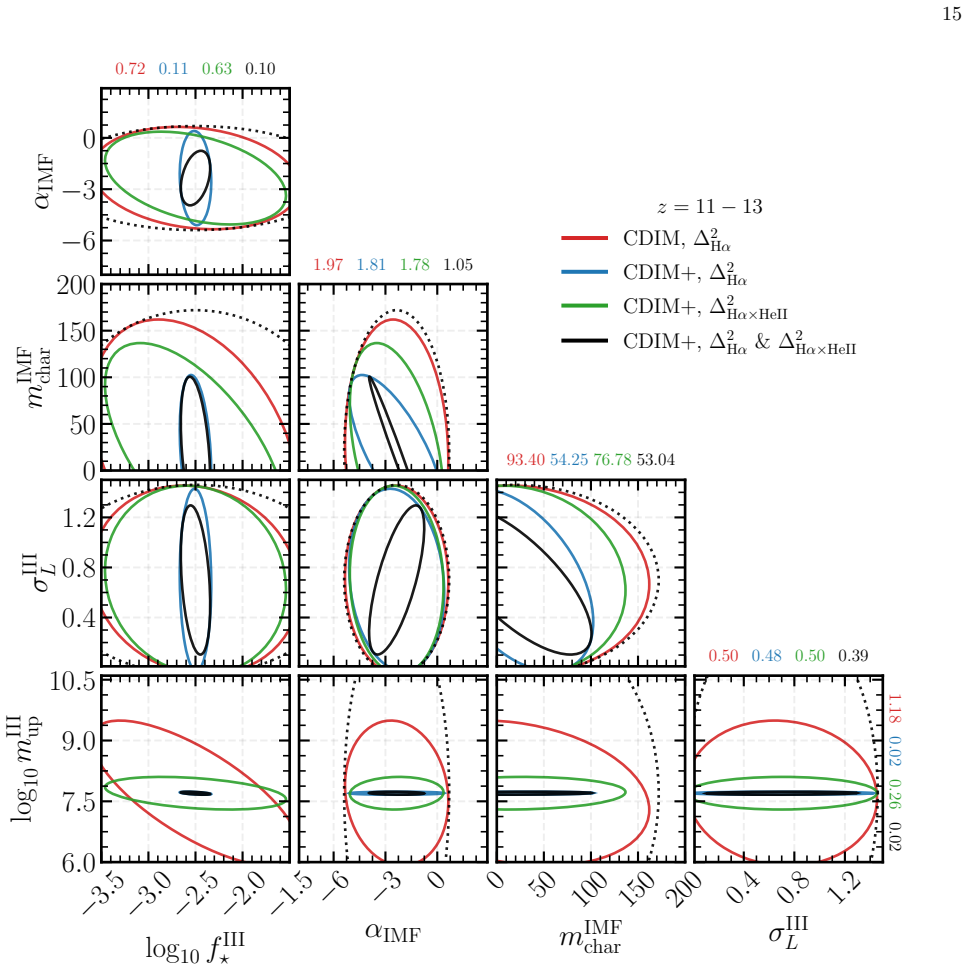
Near-term forecasts In Fig. 12, we show the potential parameter constraints that can be achieved by combining a JWST measurement of the UVLF with a SPHEREx measurement of the Hα auto power atz = 5− 6(the highest redshift range for which the Hα line is detectable with SPHEREx)—a fore- cast of what could be currently achievable given continued deep JWST obs...
-
[2]
V. Bromm, Formation of the first stars, Reports on Progress in Physics76, 112901 (2013), arXiv:1305.5178 [astro-ph.CO]
Pith/arXiv arXiv 2013
-
[3]
Loeb and S
A. Loeb and S. R. Furlanetto,The First Galaxies in the Universe(Princeton University Press, 2013)
2013
-
[4]
R. S. Klessen and S. C. O. Glover, The First Stars: Formation, Properties, and Impact, Annual Review of Astronomy and Astrophysics61, 65 (2023), aDS Bibcode: 2023ARA&A..61...65K
2023
-
[5]
C. F. McKee and J. C. Tan, The Formation of the First Stars. II. Radiative Feedback Processes and Implications for the Initial Mass Function, The Astrophysical Journal 681, 771 (2008)
2008
-
[6]
S. Chon, T. Hosokawa, K. Omukai, and R. Schneider, Impact of radiative feedback on the initial mass func- tion of metal-poor stars, Monthly Notices of the Royal Astronomical Society530, 2453 (2024), publisher: OUP ADS Bibcode: 2024MNRAS.530.2453C
2024
-
[7]
S. Hegde and S. R. Furlanetto, Efficient semi-analytic modelling of Pop III star formation from Cosmic Dawn to Reionization, The Open Journal of Astrophysics8, 147 (2025), arXiv:2507.19581 [astro-ph.GA]
arXiv 2025
-
[8]
T. Abel, G. L. Bryan, and M. L. Norman, The Formation of the First Star in the Universe, Science295, 93 (2002), arXiv:astro-ph/0112088 [astro-ph]
Pith/arXiv arXiv 2002
-
[9]
V.Bromm, P.S.Coppi,andR.B.Larson,TheFormation of the First Stars. I. The Primordial Star-forming Cloud, The Astrophysical Journal564, 23 (2002), aDS Bibcode: 2002ApJ...564...23B
2002
-
[10]
A. Stacy and V. Bromm, Constraining the statistics of Population III binaries, MNRAS433, 1094 (2013), arXiv:1211.1889 [astro-ph.CO]
Pith/arXiv arXiv 2013
-
[11]
S. Hirano, T. Hosokawa, N. Yoshida, H. Umeda, K. Omukai, G. Chiaki, and H. W. Yorke, One Hundred First Stars: Protostellar Evolution and the Final Masses, ApJ781, 60 (2014), arXiv:1308.4456 [astro-ph.CO]
Pith/arXiv arXiv 2014
-
[12]
S. Hirano, T. Hosokawa, N. Yoshida, K. Omukai, and H. W. Yorke, Primordial star formation under the in- fluence of far ultraviolet radiation: 1540 cosmological haloes and the stellar mass distribution, MNRAS448, 568 (2015), arXiv:1501.01630 [astro-ph.GA]
Pith/arXiv arXiv 2015
-
[13]
O. Jaura, S. C. O. Glover, K. M. J. Wollenberg, R. S. Klessen, S. Geen, and L. Haemmerlé, Trapping of H II regions in Population III star formation, MNRAS512, 116 (2022), arXiv:2202.09803 [astro-ph.SR]
Pith/arXiv arXiv 2022
-
[14]
L. R. Prole, P. C. Clark, R. S. Klessen, and S. C. O. Glover, Fragmentation-induced starvation in Population III star formation: a resolution study, MNRAS510, 4019 (2022), arXiv:2112.10800 [astro-ph.GA]
Pith/arXiv arXiv 2022
-
[15]
P. Sharda, O. Ginzburg, M. R. Krumholz, J. C. Forbes, E. Wisnioski, M. Mingozzi, H. R. M. Zovaro, and A. Dekel, The interplay between feedback, accretion, transport and winds in setting gas-phase metal distribu- tion in galaxies (2023), arXiv:2303.15853 [astro-ph]
Pith/arXiv arXiv 2023
-
[16]
P. Sharda, S. H. Menon, R. Gerasimov, V. Bromm, B. Burkhart, L. Haemmerlé, L. van Veenen, and B. D. Wibking, Magnetic fields limit the mass of Population III stars even before the onset of protostellar radiation feedback, MNRAS541, L1 (2025), arXiv:2501.12734 [astro-ph.GA]
Pith/arXiv arXiv 2025
-
[17]
P.ShardaandS.H.Menon,PopulationIIIstarformation in the presence of turbulence, magnetic fields and ioniz- ing radiation feedback, MNRAS 10.1093/mnras/staf803 (2025), arXiv:2405.18265 [astro-ph.GA]
Pith/arXiv arXiv 2025
-
[18]
W. Lake, M. Y. Grudić, S. Naoz, N. Yoshida, C. E. Williams, B. Burkhart, F. Marinacci, M. Vogelsberger, and A. Chen, The Stellar Initial Mass Function of Early Dark Matter–free Gas Objects, ApJ985, L6 (2025), arXiv:2410.02868 [astro-ph.GA]
Pith/arXiv arXiv 2025
-
[19]
Barkat, G
Z. Barkat, G. Rakavy, and N. Sack, Dynamics of Supernova Explosion Resulting from Pair Formation, Phys. Rev. Lett.18, 379 (1967)
1967
-
[20]
C. L. Fryer, S. E. Woosley, and A. Heger, Pair-Instability Supernovae, GravityWaves, andGamma-RayTransients, ApJ550, 372 (2001), arXiv:astro-ph/0007176 [astro-ph]
Pith/arXiv arXiv 2001
-
[21]
A. Heger and S. E. Woosley, The Nucleosynthetic Signa- ture of Population III, ApJ567, 532 (2002), arXiv:astro- ph/0107037 [astro-ph]
arXiv 2002
-
[22]
Hartmann, How Massive Single Stars End Their Life, The Astrophysical Journal591, 288 (2003), publisher: IOP ADS Bibcode: 2003ApJ...591..288H
A.Heger, C.L.Fryer, S.E.Woosley, N.Langer,andD.H. Hartmann, How Massive Single Stars End Their Life, The Astrophysical Journal591, 288 (2003), publisher: IOP ADS Bibcode: 2003ApJ...591..288H
2003
-
[23]
Heger and S
A. Heger and S. E. Woosley, Nucleosynthesis and Evolu- tion of Massive Metal-free Stars, The Astrophysical Jour- nal724, 341 (2010), aDS Bibcode: 2010ApJ...724..341H
2010
-
[24]
Kasen, S
D. Kasen, S. E. Woosley, and A. Heger, PAIR INSTA- BILITY SUPERNOVAE: LIGHT CURVES, SPECTRA, AND SHOCK BREAKOUT, The Astrophysical Journal 734, 102 (2011)
2011
-
[25]
J. A. Hummel, A. H. Pawlik, M. Milosavljević, and V. Bromm, THE SOURCE DENSITY AND OBSERV- ABILITY OF PAIR-INSTABILITY SUPERNOVAE FROM THE FIRST STARS, The Astrophysical Journal 755, 72 (2012), publisher: The American Astronomical Society
2012
-
[26]
D. J. Whalen, W. Even, L. H. Frey, J. Smidt, J. L. John- son, C. C. Lovekin, C. L. Fryer, M. Stiavelli, D. E. Holz, A. Heger, S. E. Woosley, and A. L. Hungerford, FIND- ING THE FIRST COSMIC EXPLOSIONS. I. PAIR- INSTABILITY SUPERNOVAE, The Astrophysical Jour- nal777, 110 (2013)
2013
-
[27]
Tolstov, K
A. Tolstov, K. Nomoto, N. Tominaga, M. N. Ishigaki, S. Blinnikov, and T. Suzuki, MULTICOLOR LIGHT CURVE SIMULATIONS OF POPULATION III CORE- COLLAPSE SUPERNOVAE: FROM SHOCK BREAK- OUT TO 56 CO DECAY, The Astrophysical Journal 821, 124 (2016)
2016
-
[28]
Lazar and V
A. Lazar and V. Bromm, Probing the initial mass func- tion of the first stars with transients, Monthly Notices of the Royal Astronomical Society511, 2505 (2022)
2022
-
[29]
J. Jeon, V. Bromm, A. Venditti, S. L. Finkelstein, and T. Y.-Y. Hsiao, Hunting for the First Explosions at the High-Redshift Frontier, arXiv e-prints , arXiv:2601.02469 (2026), arXiv:2601.02469 [astro-ph.GA]
arXiv 2026
-
[30]
R. Maiolino, H. Übler, M. Perna, J. Scholtz, F. D’Eugenio, C. Witten, N. Laporte, J. Witstok, S. Carniani, S. Tacchella, W. M. Baker, S. Arribas, K. Nakajima, D. J. Eisenstein, A. J. Bunker, S. Char- lot, G. Cresci, M. Curti, E. Curtis-Lake, A. de Graaff, E. Egami, Z. Ji, B. D. Johnson, N. Kumari, T. J. Looser, M. Maseda, E. Nelson, B. Robertson, B. Rodrí...
Pith/arXiv arXiv 2024
-
[31]
X.Wang, C.Cheng, J.Ge, X.-L.Meng, E. Daddi, H. Yan, Z. Ji, Y. Jin, T. Jones, M. A. Malkan, P. Arrabal Haro, G. Brammer, M. Oguri, M. Hou, and S. Zhang, A Strong HeII λ1640EmitterwithanExtremelyBlueUVSpectral Slope at z = 8.16: Presence of Population III Stars?, ApJ967, L42 (2024), arXiv:2212.04476 [astro-ph.GA]
Pith/arXiv arXiv 2024
-
[32]
E. Vanzella, M. Messa, A. Zanella, A. Bolamperti, M. Castellano, F. Loiacono, P. Bergamini, G. Roberts- Borsani, A. Adamo, A. Fontana, T. Treu, F. Calura, C. Grillo, M. Lombardi, P. Rosati, R. Gilli, and M. Meneghetti, A Pristine Star-Forming Complex at z=4.19, arXiv e-prints , arXiv:2509.07073 (2025), arXiv:2509.07073 [astro-ph.GA]
arXiv 2025
-
[33]
S. Fujimoto, R. P. Naidu, J. Chisholm, H. Atek, R. Ends- ley, V. Kokorev, L. J. Furtak, R. Pan, B. Liu, V. Bromm, A. Venditti, E. Visbal, R. Sarmento, A. Weibel, P. A. Oesch, G. Brammer, D. Schaerer, A. Adamo, D. A. Berg, R. Bezanson, R. Bouwens, I. Chemerynska, A. Claeyssens, M. Dessauges-Zavadsky, A. Frebel, D. Ko- rber, I. Labbe, R. Marques-Chaves, J. ...
Pith/arXiv arXiv 2025
-
[34]
T. Morishita, Z. Liu, M. Stiavelli, T. Treu, P. Bergamini, and Y. Zhang, Pristine Massive Star Formation Caught at the Break of Cosmic Dawn, arXiv e-prints , arXiv:2507.10521 (2025), arXiv:2507.10521 [astro- ph.CO]
Pith/arXiv arXiv 2025
-
[35]
S. Cai, M. Li, Z. Cai, Y. Wu, F. Yu, M. Dickinson, F. Sun, X. Fan, B. Wang, F. Cullen, F. Bian, X. Lin, and J. Zou, A metal-free galaxy atz = 3.19? evidence of late population iii star formation at cosmic noon (2025), arXiv:2507.17820 [astro-ph.GA]
arXiv 2025
-
[36]
S. Fujimoto, Y. Asada, R. P. Naidu, J. Chisholm, H. Atek, G. Brammer, D. A. Berg, D. Schaerer, V. Koko- rev, L. J. Furtak, J. Richard, A. Venditti, V. Bromm, A. Adamo, A. Claeyssens, M. Dessauges-Zavadsky, Q. Fei, T. Y.-Y. Hsiao, D. Korber, J. B. Munoz, R. Pan, and A. Saldana-Lopez, GLIMPSE-D: An Ex- otic Balmer-Jump Object at z=6.20? Revisiting Pho- tome...
arXiv 2025
-
[37]
J. A. A. Trussler, D. J. Eisenstein, A. J. Bunker, A. J. Cameron, S. Carniani, S. Charlot, J. Chevallard, C. J. Conselice, M. Curti, E. Curtis-Lake, F. D’Eugenio, E. Egami, K. Hainline, R. Hausen, J. M. Helton, T. Y.-Y. Hsiao, Z. Ji, B. D. Johnson, T. J. Looser, R. Maiolino, D. Puskás, P. Rinaldi, B. Robertson, F. Sun, S. Tacchella, H. Übler, C. C. Willia...
arXiv 2026
-
[38]
H. Reumert, K. E. Heintz, C. L. Pollock, A. J. Cameron, G. B. Brammer, H. Katz, A. Sneppen, J. Witstok, C. Terp, and D. Watson, A hot, nebular-dominated galaxy interacting with a pristine PopIII system uncov- ered by JWST, arXiv e-prints , arXiv:2603.13471 (2026), arXiv:2603.13471 [astro-ph.GA]
arXiv 2026
-
[39]
R. Maiolino, H. Übler, M. Perna, J. Witstok, G. C. Jones, P. G. Perez-Gonzalez, K. Nakajima, E. Rusta, S. Salvadori, S. Tacchella, P. Madau, J. A. A. Trussler, F. D’Eugenio, X. Ji, J. Scholtz, S. Carniani, Y. Isobe, S. Arribas, W. M. Baker, T. Böker, V. Bromm, A. J. Bunker, S. Charlot, J. Chevallard, M. Curti, E. Curtis- Lake, D. Eisenstein, E. Egami, A. ...
Pith/arXiv arXiv 2026
-
[40]
Schaerer, On the properties of massive Population III stars and metal-free stellar populations, Astron- omy and Astrophysics382, 28 (2002), aDS Bibcode: 2002A&A...382...28S
D. Schaerer, On the properties of massive Population III stars and metal-free stellar populations, Astron- omy and Astrophysics382, 28 (2002), aDS Bibcode: 2002A&A...382...28S
2002
-
[41]
Zackrisson, C.-E
E. Zackrisson, C.-E. Rydberg, D. Schaerer, G. Östlin, and M. Tuli, The Spectral Evolution of the First Galax- ies. I. James Webb Space Telescope Detection Limits and Color Criteria for Population III Galaxies, The As- trophysical Journal740, 13 (2011), publisher: IOP ADS Bibcode: 2011ApJ...740...13Z
2011
-
[42]
H. Katz, T. Kimm, R. S. Ellis, J. Devriendt, and A. Slyz, The challenges of identifying Population III stars in the early Universe, MNRAS524, 351 (2023), arXiv:2207.04751 [astro-ph.GA]
Pith/arXiv arXiv 2023
-
[43]
E. Zackrisson, A. Hultquist, A. Kordt, J. M. Diego, A. Nabizadeh, A. Vikaeus, A. K. Meena, A. Zitrin, G. Volpato, E. Lundqvist, B. Welch, G. Costa, and R. A. Windhorst, The detection and characterization of highly magnified stars with JWST: prospects of finding Popu- lation III, MNRAS533, 2727 (2024), arXiv:2312.09289 [astro-ph.GA]
Pith/arXiv arXiv 2024
-
[44]
J. A. A. Trussler, C. J. Conselice, N. J. Adams, R. Maiolino, K. Nakajima, E. Zackrisson, D. Austin, L. Ferreira, and T. Harvey, On the observability and identification of Population III galaxies with JWST, MN- RAS525, 5328 (2023), arXiv:2211.02038 [astro-ph.GA]
Pith/arXiv arXiv 2023
-
[45]
D. Schaerer, J. Guibert, R. Marques-Chaves, and F. Mar- tins, Observable and ionizing properties of star-forming galaxies with very massive stars and different initial mass functions, A&A693, A271 (2025), arXiv:2407.12122 [astro-ph.GA]
Pith/arXiv arXiv 2025
-
[46]
A. Chiti, A. Frebel, A. P. Ji, M. K. Mardini, X. Ou, J. D. Simon, H. Jerjen, D. Kim, and J. E. Norris, Detailed Chemical Abundances of Stars in the Outskirts of the Tucana II Ultrafaint Dwarf Galaxy, AJ165, 55 (2023), arXiv:2205.01740 [astro-ph.GA]
Pith/arXiv arXiv 2023
-
[47]
A. Chiti, M. Mardini, G. Limberg, A. Frebel, A. P. Ji, H. Reggiani, P. Ferguson, H. D. Andales, K. Brauer, T. S. Li, and J. D. Simon, Enrichment by extragalactic first stars in the Large Magellanic Cloud, Nature Astronomy 8, 637 (2024), arXiv:2401.11307 [astro-ph.GA]
Pith/arXiv arXiv 2024
-
[48]
A. Chiti, V. M. Placco, A. B. Pace, A. P. Ji, D. S. Prabhu, W. Cerny, G. Limberg, G. S. Stringfellow, A. Drlica- Wagner, K. R. Atzberger, Y. Choi, D. Crnojević, P. S. 27 Ferguson, N. Kallivayalil, N. E. D. Noël, A. H. Riley, D. J. Sand, J. D. Simon, A. R. Walker, C. R. Bom, J. A. Carballo-Bello, D. J. James, C. E. Martínez-Vázquez, G. E. Medina, and A. K....
arXiv 2026
-
[49]
P. Bonifacio, E. Caffau, P. François, and M. Spite, The most metal-poor stars, A&A Rev.33, 2 (2025), arXiv:2504.06335 [astro-ph.GA]
Pith/arXiv arXiv 2025
-
[50]
A. P. Ji, V. Chandra, S. Mejias-Torres, Z. Zhang, P. Eit- ner, K. C. Schlaufman, H. D. Andales, H. Do, N. M. Orrantia, R. Tudmilla, P. N. Thibodeaux, K. G. Stassun, M. Howell, J. Tayar, M. Bergemann, A. R. Casey, J. A. Johnson, J. K. Carlberg, W. Cerny, J. G. Fernández- Trincado, K. Hawkins, J. A. Kollmeier, C. F. P. Laporte, G. Limberg, T. Matsuno, S. Mé...
arXiv 2026
-
[51]
Frebel, Metal-poor stars in the Milky Way system, in Encyclopedia of Astrophysics, Volume 2, Vol
A. Frebel, Metal-poor stars in the Milky Way system, in Encyclopedia of Astrophysics, Volume 2, Vol. 2 (2026) pp. 533–557, arXiv:2411.15415 [astro-ph.GA]
Pith/arXiv arXiv 2026
-
[52]
E. D. Kovetz, M. P. Viero, A. Lidz, L. Newburgh, M. Rahman, E. Switzer, M. Kamionkowski, J. Aguirre, M. Alvarez, J. Bock, J. R. Bond, G. Bower, C. M. Bradford, P. C. Breysse, P. Bull, T.-C. Chang, Y.-T. Cheng, D. Chung, K. Cleary, A. Corray, A. Crites, R. Croft, O. Doré, M. Eastwood, A. Ferrara, J. Fonseca, D. Jacobs, G. K. Keating, G. Lagache, G. Lakhlan...
2017
-
[53]
J. L. Bernal and E. D. Kovetz, Line-intensity map- ping: theory review with a focus on star-formation lines, A&A Rev.30, 5 (2022), arXiv:2206.15377 [astro-ph.CO]
Pith/arXiv arXiv 2022
-
[54]
T.-C. Chang and A. Lidz, Line-Intensity Mapping, arXiv e-prints , arXiv:2602.03011 (2026), arXiv:2602.03011 [astro-ph.CO]
arXiv 2026
-
[55]
S. R. Furlanetto and A. Lidz, The Cross-Correlation of High-Redshift 21 cm and Galaxy Surveys, ApJ660, 1030 (2007), arXiv:astro-ph/0611274 [astro-ph]
Pith/arXiv arXiv 2007
-
[56]
A.Lidz, O.Zahn, S.R.Furlanetto, M.McQuinn, L.Hern- quist, and M. Zaldarriaga, Probing Reionization with the 21 cm Galaxy Cross-Power Spectrum, ApJ690, 252 (2009), arXiv:0806.1055 [astro-ph]
Pith/arXiv arXiv 2009
-
[57]
Visbal and A
E. Visbal and A. Loeb, Measuring the 3D clustering of undetected galaxies through cross correlation of their cumulative flux fluctuations from multiple spectral lines, Journal of Cosmology and Astroparticle Physics2010 (11), 016
-
[58]
E. Visbal and M. McQuinn, Cross Correlation of Pencil- beam Galaxy Surveys and Line-intensity Maps: An Ap- plication of the James Webb Space Telescope, ApJ956, 84 (2023), arXiv:2212.05096 [astro-ph.CO]
Pith/arXiv arXiv 2023
-
[59]
G. Sun, L. Mas-Ribas, T.-C. Chang, S. R. Furlan- etto, R. H. Mebane, M. O. Gonzalez, J. Parsons, and A. C. Trapp, LIMFAST. II. Line Intensity Mapping as a Probe of High-redshift Galaxy Formation, The Astrophysical Journal950, 40 (2023), aDS Bibcode: 2023ApJ...950...40S
2023
-
[60]
G. Sun, T. Nguyen, C.-A. Faucher-Giguère, A. Lidz, T. Starkenburg, B. R. Scott, T.-C. Chang, and S. R. Furlanetto, LIMFAST. IV. Learning high-redshift galaxy formation from multiline intensity mapping with im- plicit likelihood inference, J. Cosmology Astropart. Phys. 2026, 008 (2026), arXiv:2509.07060 [astro-ph.GA]
arXiv 2026
-
[61]
S. R. Furlanetto, S. P. Oh, and F. Briggs, Cosmology at low frequencies: The 21 cm transition and the high- redshift Universe (2006)
2006
-
[62]
J. B. Muñoz, S. Bohr, F.-Y. Cyr-Racine, J. Zavala, and M. Vogelsberger, ETHOS - an effective theory of struc- ture formation: Impact of dark acoustic oscillations on cosmic dawn, Physical Review D103, 043512 (2021), aDS Bibcode: 2021PhRvD.103d3512M
2021
-
[64]
H. A. G. Cruz, J. B. Muñoz, N. Sabti, and M. Kamionkowski, Effective model for the 21-cm sig- nal with population III stars, Physical Review D111, 083503 (2025)
2025
-
[65]
G. Sun, A. Lidz, T.-C. Chang, J. Mirocha, and S. R. Furlanetto, LIMFAST. III. Timing Cosmic Reionization with the 21 cm and Near-infrared Backgrounds, ApJ 981, 92 (2025), arXiv:2410.21410 [astro-ph.CO]
Pith/arXiv arXiv 2025
-
[67]
S. Libanore, E. D. Kovetz, J. B. Munoz, Y. Sklan- sky, and E. Thélie, A New Boundary Condition on Reionization, arXiv e-prints , arXiv:2509.08886 (2025), arXiv:2509.08886 [astro-ph.CO]
Pith/arXiv arXiv 2025
-
[68]
E. D. Kovetz, H. Lazare, S. Libanore, J. B. Muñoz, and E. Vanzan, When galaxies burst: enhanced shot- noise for line-intensity mapping in the JWST era, arXiv e-prints , arXiv:2605.13967 (2026), arXiv:2605.13967 [astro-ph.GA]
Pith/arXiv arXiv 2026
-
[69]
H. Lazare, S. Libanore, E. Vanzan, J. B. Muñoz, and E. D. Kovetz, When galaxies burst II. Implica- tions of enhanced burstiness for the 21-cm Cosmic Dawn signal, arXiv e-prints , arXiv:2607.20651 (2026), arXiv:2607.20651 [astro-ph.CO]
Pith/arXiv arXiv 2026
-
[70]
H. A. G. Cruz, G. Montefalcone, J. B. Muñoz, E. D. Kovetz, and A. Venditti, The Rise and Fall of Acoustic Oscillations at Cosmic Dawn, arXiv e-prints , arXiv:2607.09846 (2026), arXiv:2607.09846 [astro- ph.CO]
Pith/arXiv arXiv 2026
-
[71]
A. Lidz, S. R. Furlanetto, S. P. Oh, J. Aguirre, T.-C. Chang, O. Doré, and J. R. Pritchard, Intensity Mapping with Carbon Monoxide Emission Lines and the Red- shifted 21 cm Line, The Astrophysical Journal741, 70 (2011), aDS Bibcode: 2011ApJ...741...70L
2011
-
[72]
S. Yang, R. S. Somerville, A. R. Pullen, G. Popping, P. C. Breysse, and A. S. Maniyar, Multitracer Cosmological Line Intensity Mapping Mock Light-cone Simulation, ApJ911, 132 (2021), arXiv:2009.11933 [astro-ph.GA]
Pith/arXiv arXiv 2021
-
[73]
E. Schaan and M. White, Multi-tracer intensity mapping: cross-correlations, line noise & decorrelation, J. Cosmol- 28 ogy Astropart. Phys.2021, 068 (2021), arXiv:2103.01964 [astro-ph.CO]
Pith/arXiv arXiv 2021
-
[74]
E. Schaan and M. White, Astrophysics & cosmology from line intensity mapping vs galaxy surveys, J. Cosmology Astropart. Phys.2021, 067 (2021), arXiv:2103.01971 [astro-ph.CO]
Pith/arXiv arXiv 2021
-
[75]
R. Kannan, A. Smith, E. Garaldi, X. Shen, M. Vogels- berger, R. Pakmor, V. Springel, and L. Hernquist, The THESAN project: predictions for multitracer line inten- sity mapping in the epoch of reionization, MNRAS514, 3857 (2022), arXiv:2111.02411 [astro-ph.CO]
Pith/arXiv arXiv 2022
-
[76]
G. Sato-Polito, N. Kokron, and J. L. Bernal, A mul- titracer empirically driven approach to line-intensity mapping light cones, MNRAS526, 5883 (2023), arXiv:2212.08056 [astro-ph.CO]
Pith/arXiv arXiv 2023
-
[77]
L.-J. Liu, G. Sun, T.-C. Chang, S. R. Furlanetto, and C. M. Bradford, Effects of Bursty Star Formation on [C II] Line Intensity Mapping of High-redshift Galaxies, ApJ974, 175 (2024), arXiv:2401.04204 [astro-ph.GA]
Pith/arXiv arXiv 2024
-
[78]
J. S. Bracks, R. P. Keenan, S. Agrawal, G. K. Keating, J. E. Aguirre, A. Lidz, C. M. Bradford, B. Brendal, J. P. Filippini, J. Fu, K. Garcia, C. Groppi, S. Hailey- Dunsheath, R. M. J. Janssen, W. Kang, L.-j. Liu, I. Lowe, A. Manduca, D. P. Marrone, P. Mauskopf, E. C. Mayer, S. O’Donnell, T. Saeid, S. Tartakovsky, M. Van Cuyck, J. Vieira, and J. A. Zebrows...
2026
-
[79]
M. Zaldarriaga, S. R. Furlanetto, and L. Hernquist, 21 Centimeter Fluctuations from Cosmic Gas at High Red- shifts, ApJ608, 622 (2004), arXiv:astro-ph/0311514 [astro-ph]
Pith/arXiv arXiv 2004
-
[80]
S. R. Furlanetto, The global 21-centimeter background from high redshifts, Monthly Notices of the Royal Astro- nomical Society371, 867 (2006)
2006
-
[81]
Mesinger, S
A. Mesinger, S. Furlanetto, and R. Cen, 21cmfast: a fast, seminumerical simulation of the high-redshift 21-cm signal: 21cmfast, Monthly Notices of the Royal Astro- nomical Society411, 955 (2011)
2011
-
[82]
G. Sun, J. Mirocha, R. H. Mebane, and S. R. Furlanetto, Revealing the formation histories of the first stars with the cosmic near-infrared background, Monthly Notices of the Royal Astronomical Society508, 1954 (2021), aDS Bibcode: 2021MNRAS.508.1954S
1954
discussion (0)
Sign in with ORCID, Apple, or X to comment. Anyone can read and Pith papers without signing in.