REVIEW 4 major objections 4 minor 44 references
Mixture-of-Translators: Translating KV Caches Across Heterogeneous Large Language Models
T0 review · 4 major / 4 minor · reviewed 2026-08-03 · deepseek-v4-flash
Pith's one-line read This paper claims that key-value caches of one LLM can be translated into another LLM's cache space with almost no quality loss, by attacking two opposing failure modes at once.
desk verdict Decent within-family cache translation with an oversold heterogeneity claim; deserves a serious referee after a major re-scope. read the letter →
The pith
A machine-rendered reading of the paper's core claim, the machinery that carries it, and where it could break.
The reading
What carries the argument
The central object is the cache-translation channel set C, a collection of connected source–target layer pairs through which source KV states are injected into the target. MoT combines recurrent cross-attention backbone translators into a token-level Top-K gated mixture, so different tokens can use different translation mappings. The Context Correction Loss compares the replayed target KV cache (or hidden states) against the native one across the upper layers. Channel selection uses Depth-Ratio Mapping, which connects layers of similar relative depth, chosen by sliding a contiguous window and picking the lowest validation loss.
What would settle it
Take a pair of models from genuinely different architecture families with different tokenizers, translate a context cache with the same MoT pipeline, and measure closed-set QA accuracy against direct prefill; if accuracy collapses to near random, the cross-model generality of the claim fails.
Extended reading notes
Core claim
MoT translates a source model's context KV cache into the target model's cache space using several translator modules with token-level gating, and trains them with a Context Correction Loss that aligns the replayed target trajectory with the native target trajectory. The paper identifies two competing translation errors: a propagated translation shift that grows when translation happens too early, and a last-state shift that appears when translation happens too late and leaves too few upper layers for correction. It formalizes both as bounds under a residual-transformer recurrence and shows that an optimal translator mixture cannot increase the translation shift, while the context-correction
Load-bearing premise
The load-bearing premise is that layers at similar relative depths in different models encode corresponding information, so a depth-ratio mapping between source and target layers yields a usable translation channel; the paper's own appendix concedes this weakens across instruction tuning, data distribution, or representation differences.
Editorial extensions
If this is right
- A shared context prefix could be stored once in one model's cache format and translated on demand, eliminating duplicate prefills across heterogeneous models.
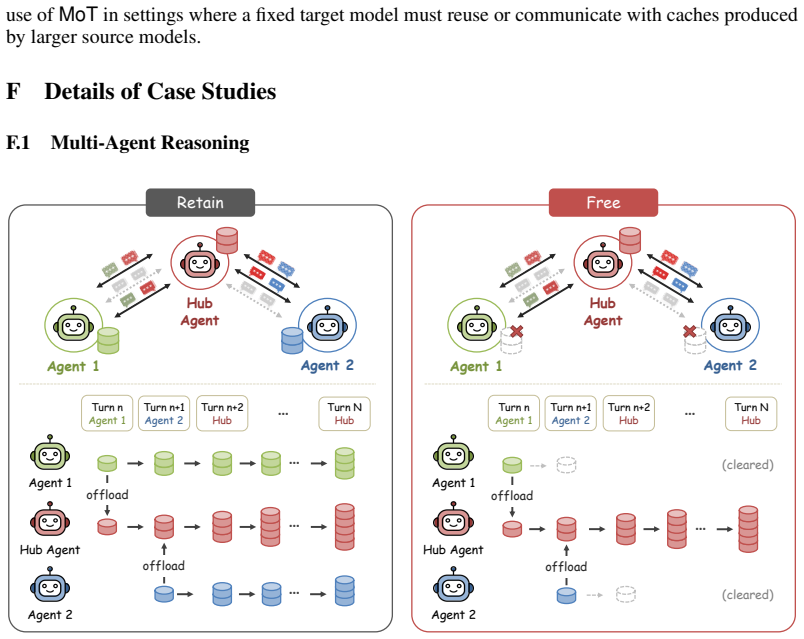
- Multi-agent reasoning can offload completed agents' caches to a hub and free local memory, keeping peak memory nearly constant as the number of agents grows.
- Long-context cache-augmented generation could reuse precomputed document caches without per-model stores, retaining about 96% of direct-context F1.
- Translator training scales with the number of model pairs rather than requiring a shared latent space for all models, avoiding quadratic alignment costs.
- Token-level routing implies that different tokens' cache states benefit from different translation maps, so input-dependent translator selection matters more than simply adding more translators.
Reading between the lines
- The depth-ratio channel mapping is the least-tested assumption: it is only stress-tested within a few model families, so a genuine cross-family or cross-tokenizer pair could still break the pipeline unless channel selection becomes learned or attention-based.
- The context-correction loss mainly reduces the last-state shift by shrinking the translation shift and its orthogonal component, while the correction-deficit coefficient barely changes; explicitly training the target's own correction ability would be a natural next step.
- Cross-tokenizer translation is unexplored; if token-position correspondence could be established, MoT would apply to the pairs where cache reuse is most valuable, since tokenizer mismatch is the main obstacle to truly general heterogeneous reuse.
- The practical memory win depends on translation overhead staying smaller than prefill cost; the paper's fixed translator overhead suggests the break-even point comes with larger source models, and its activation-based variant already offers a leaner alternative.
Editorial analysis
A structured set of objections, weighed in public.
Referee Report
Summary. This paper proposes Mixture-of-Translators (MoT), a method for translating a source LLM's KV cache into the cache space of a target LLM. The method uses token-level gated combinations of backbone cross-attention translators and a Context Correction Loss that replays the translated cache and aligns it with the native target trajectory. The authors identify two competing failure modes—propagated translation shift from early injection and correction-deficit error from late injection—and provide analytic bounds and a shift decomposition (Props. 2.3–2.5). They evaluate on BoolQ, PubMedQA, MMLU-Redux, SQuAD, NewsQA, plus multi-agent and long-context CAG case studies, reporting that MoT roughly matches native performance in same-family settings (e.g., Qwen2.5-7B→0.5B: 51.0% accuracy, 0.43 F1) and retains 96.3% of native F1 in long-context CAG.
Significance. If the results hold, MoT is a useful step toward KV-cache reuse in multi-model systems: it addresses a real bottleneck, and the competing-error analysis is a reasonable design lens. The paper compares against multiple baselines, provides detailed ablations and case studies, and is unusually candid in its limitations. However, the headline 'heterogeneous' claim is currently supported only for same-family depth/width variation, not cross-family or cross-tokenizer translation, and the headline numbers are single-run. The idea is promising, but the empirical scope and statistical reliability need to be strengthened before the abstract's claims are warranted.
major comments (4)
- [Abstract; §4.2; App. C.3; App. H] The central claim 'across heterogeneous LLMs' is not tested in the downstream evaluations. Table 1, Tables 5–6, and Fig. 28 use only same-family pairs: Qwen2.5-7B→0.5B, gpt2-xl→large, and opt-6.7b→125m. There is no Qwen→GPT, GPT→OPT, or any cross-tokenizer translation. The channel set C on which the whole pipeline depends is fixed by Depth-Ratio Mapping (App. C.3), and the paper itself says this mapping weakens under instruction-tuning/data/tokenizer mismatch and that cross-tokenization is not addressed (App. H; Fig. 15(e)). Thus the abstract's 'heterogeneous LLMs' claim is supported only for size heterogeneity within a family. Please either add cross-family/cross-tokenizer experiments or narrow the claim.
- [Tables 1, 5, 6; Fig. 31] All reported numbers appear to be single runs. Headline differences are small: Table 1 has MoT 51.0% vs Native 52.0% accuracy, and Fig. 31 has MoT 0.2047 vs Native 0.2125 F1 (96.3% retention). With 500 training steps and batch size 4 (App. E.1), these gaps are within normal run-to-run variability. Please report multiple seeds or confidence intervals for at least the main QA tables and the 96.3% claim; otherwise 'preserves performance' is not statistically supported.
- [App. E.5, Fig. 28] The OPT capacity-scaling analysis excludes opt-125m as a source because it 'behaves as an outlier.' Excluding an inconvenient data point without explanation undermines the claim that MoT remains stable as source capacity varies. Please report the excluded values and justify the exclusion on a stated criterion (e.g., convergence failure) or include the point in the analysis.
- [App. C.1, Prop. C.1] Proposition C.1 assumes the stacked final-layer key/value projection has full column rank. This fails for GQA models such as Qwen2.5-7B, where the number of KV heads is smaller than the number of query heads: the stacked W^KV_L matrix has more columns than rows and cannot be full column rank. Therefore the proof that reducing the final-layer KV matching error reduces an upper bound on ||s_L|| does not apply to the main experimental model. The loss may still be a useful heuristic, but the theoretical justification should be restricted or the assumption verified.
minor comments (4)
- [§3.1, Prop. 3.2] Proposition 3.2 states that the optimal MoT cannot be worse than the optimal single translator because the MoT class contains the single translator as a special case. This is true by construction and should be described as a containment property, not a substantive reduction theorem. The empirical evidence in Table 2 is what actually supports the claim.
- [§5, Fig. 13] The phrase 'scale-invariant memory' is too strong: MoT(Free) offloads non-hub caches to the hub, so total stored cache across the system may still grow; only the active peak memory is bounded. Please clarify the metric being reported.
- [§4.1, App. E.1] C2C-Project and LSC are 'implemented by us' with no code or detailed hyperparameters beyond the shared setup. Please provide exact configurations or release code so the baselines can be verified.
- [Throughout] The term 'heterogeneous' is used both for within-family size differences (Qwen2.5-7B vs 0.5B) and for cross-architecture differences. Define the term at first use and keep the claim consistent with the experimental scope.
Circularity Check
Internal validation of the shift-reduction story is partly constructed from the same quantities the losses minimize, but the central QA claim rests on independent held-out benchmarks.
-
self definitional
[Section 3.1, Proposition 3.2 and Appendix B.5]
"For a fixed channel set C, the optimal Mixture-of-Translators cannot induce a larger translation shift ∥sT∥ than the optimal single translator. ... This class contains the single backbone translator as a special case. Indeed, choose one translator index m0, set Trm0 = TrSingle, and choose the routing scores so that, for every token u, gm0(zu)=1, gm(zu)=0 for all m≠m0."
The proof of the proposition is a containment argument: MoT's translator class includes the single-backbone translator by setting all routing weight on one expert. Therefore the claimed 'Translation-Shift Reduction by Translator Mixtures' is the trivial superset inequality—minimizing a nonnegative objective over a larger class cannot give a larger optimum than minimizing it over a subset. The result is true by construction and carries no empirical content; it cannot be falsified by any experiment. This does not undermine the held-out QA evaluations, but the proposition is presented as a theoretical finding when it is actually a definitional property of the search class.
-
fitted input called prediction
[Section 3.2 (Eq. 6) and Section 4.3 (Fig. 10)]
"The ideal objective of the Context Correction Loss is to directly align the hidden-state trajectory after translation with the native trajectory: L^{Src→Tgt}_{CC}(C) = Σ_{ℓ=TStart+1}^{L} ||\b h^{Tgt}_ℓ - h^{Tgt}_ℓ||^2. ... Since the loss includes the final-layer term ||\b h^{Tgt}_L - h^{Tgt}_L||^2 = ||s_L||^2, it directly reduces the last-state shift. ... Fig. 10 shows that ... the proposed MoT & Context Correction Loss sharply reduces both the translation shift ||s_T|| and the last-state shift ||s_L|| ... This supports that the two components suppress their target error dynamics."
The quantities reported as evidence are exactly the quantities the loss minimizes. The final-layer term of the Context Correction Loss is ||s_L||^2 by construction, and the summed replay-trajectory error covers the translation-shift layers, so observing that these errors decrease after training is a restatement of the optimization objective rather than an independent validation of the competing-error-dynamics story. The informative evidence for the paper's central claim is the held-out downstream QA performance in Tables 1, 5, and 6, not the reduction of the same error terms that were directly penalized. This is a partial internal circularity, not a collapse of the main empirical claim.
full rationale
The paper's central claim—that MoT preserves downstream QA quality across same-family size/width variation—is supported by held-out benchmarks (closed-set QA, extractive QA, case studies) and by comparisons to external baselines; those results are not circular. I found no load-bearing self-citations: the cited LSC [12], C2C [9], and HCache [8] have disjoint author lists and are used for architecture/channel-mapping inspiration rather than to forbid alternatives. The two genuine circularity concerns are localized. First, Proposition 3.2 is a trivial superset-containment statement: because MoT can exactly emulate a single translator, its optimal shift cannot be worse; this is definitionally true and adds no evidence. Second, Section 4.3 presents the reduction of ||s_T|| and ||s_L|| as support for the method, but these are the very quantities minimized by the Context Correction Loss, so that particular 'validation' is by construction. Neither of these affects the held-out QA numbers, which are the actual basis for the main claim. The broader 'heterogeneous LLM' claim is narrower than the abstract suggests—all QA translations are within one model family (Qwen2.5, GPT-2, OPT), and Appendix H admits depth-ratio alignment weakens under instruction/data mismatch and that cross-tokenization is unaddressed—but that is an external-validity limitation, not circularity. The appropriate overall score is therefore modest: 3.
Assumptions & free parameters
free parameters (5)
- ChannelRatio / channel window size |C| =
0.3
- (Top-K, NTr) =
(1, 2)
- Top-S sparse-attention candidates =
128
- LFull bottom full-attention layers =
2
- Training hyperparameters =
LR=1e-4, 500 steps, batch 4, grad-accum 4
assumptions (4)
- domain assumption Transformer decoder residual recurrence with local Lipschitz residual branches (Assumption 2.2)
- domain assumption Depth-ratio layer correspondence across source and target models
- domain assumption Final-layer stacked K/V projection of target model has full column rank
- domain assumption Source and target tokenizers and cache positions correspond
Cite this review
Pith. "Pith review of Mixture-of-Translators: Translating KV Caches Across Heterogeneous Large Language Models." pith.science (2026). https://pith.science/paper/REIRJQED
@misc{pith2026260728979,
  author       = {Pith},
  title        = {Pith review of: Mixture-of-Translators: Translating KV Caches Across Heterogeneous Large Language Models},
  year         = {2026},
  howpublished = {\url{https://pith.science/paper/REIRJQED}},
  note         = {Machine review of arXiv:2607.28979}
}
read the original abstract
Heterogeneous Large Language Model (LLM) systems increasingly rely on shared contexts, retrieved evidence, and multi-agent dialogue histories, yet their internal key-value (KV) caches remain model-specific and cannot be reused across architectures. Consequently, each model must repeatedly prefill or store caches for the same context, limiting the scalability of multi-model reasoning and long-context generation. We propose Mixture-of-Translators(MoT), a cache translation framework that maps context KV caches from a source LLM into the cache space of a target LLM. Unlike prior approaches that depend on a single projection path or global shared latent space, MoT uses multiple translator modules to capture diverse source--target mappings. To further reduce residual translation error, we introduce a Context Correction Loss that aligns the replayed target trajectory with the native target trajectory. We reveal two competing failure modes in cache translation: propagated translation shift from early injection and last-state shift from late injection. MoT addresses them through translator mixtures and target-side correction. Across homogeneous and heterogeneous translations among Qwen2.5, GPT-2, and OPT models, MoT preserves downstream QA performance, including Qwen2.5-7B-scale translation with 51.0% average closed-set QA accuracy and 0.43 average extractive QA F1. In practical case studies, MoT enables quality-preserving memory reuse for multi-agent reasoning and retains 96.3% of direct-context quality in long-context cache-augmented generation, demonstrating scalable KV cache reuse across heterogeneous LLMs.
Figures


Figures from the paper (18 more)



Reference graph
Works this paper leans on
-
[1]
Prompt caching (openai api guide), 2025
OpenAI. Prompt caching (openai api guide), 2025. Accessed 2026-03-02
2025
-
[2]
Prompt caching with the claude api (cookbook), 2024
Anthropic. Prompt caching with the claude api (cookbook), 2024. Accessed 2026-03-02
2024
-
[3]
Don’t do rag: When cache-augmented generation is all you need for knowledge tasks
Brian J Chan, Chao-Ting Chen, Jui-Hung Cheng, and Hen-Hsen Huang. Don’t do rag: When cache-augmented generation is all you need for knowledge tasks. InCompanion Proceedings of the ACM on Web Conference 2025, pages 893–897, 2025
2025
-
[4]
S. Lu, H. Wang, Y . Rong, Z. Chen, and Y . Tang. TurboRAG: Accelerating retrieval-augmented generation with precomputed KV caches for chunked text. InProceedings of the 2025 Con- ference on Empirical Methods in Natural Language Processing, 2025. Also available as arXiv:2410.07590
arXiv 2025
-
[5]
Tenenbaum, and Igor Mordatch
Yilun Du, Shuang Li, Antonio Torralba, Joshua B. Tenenbaum, and Igor Mordatch. Improving factuality and reasoning in language models through multiagent debate. InProceedings of the 41st International Conference on Machine Learning, volume 235 ofProceedings of Machine Learning Research, pages 11733–11763. PMLR, 2024
2024
-
[6]
Camel: Communicative agents for “mind” exploration of large language model society
Guohao Li, Hasan Abed Al Kader Hammoud, Hani Itani, Dmitrii Khizbullin, and Bernard Ghanem. Camel: Communicative agents for “mind” exploration of large language model society. InAdvances in Neural Information Processing Systems, volume 36, pages 51991–52008, 2023
2023
-
[7]
White, Doug Burger, and Chi Wang
Qingyun Wu, Gagan Bansal, Jieyu Zhang, Yiran Wu, Beibin Li, Erkang Zhu, Li Jiang, Xiaoyun Zhang, Zhang Shaokun, Jiale Liu, Ahmed Hassan Awadallah, Ryen W. White, Doug Burger, and Chi Wang. Autogen: Enabling next-gen llm applications via multi-agent conversations. In First Conference on Language Modeling, 2024
2024
-
[8]
Fast state restoration in llm serving with hcache
Shiwei Gao, Youmin Chen, and Jiwu Shu. Fast state restoration in llm serving with hcache. InProceedings of the Twentieth European Conference on Computer Systems, pages 128–143, 2025
2025
Show all 44 references
-
[9]
Cache-to-cache: Direct semantic communication between large language models.arXiv preprint arXiv:2510.03215, 2025
Tianyu Fu, Zihan Min, Hanling Zhang, Jichao Yan, Guohao Dai, Wanli Ouyang, and Yu Wang. Cache-to-cache: Direct semantic communication between large language models.arXiv preprint arXiv:2510.03215, 2025
2025
-
[10]
Kvcomm: Enabling efficient llm communication through selective kv sharing.arXiv preprint arXiv:2510.03346, 2025
Xiangyu Shi, Marco Chiesa, Gerald Q Maguire Jr, and Dejan Kostic. Kvcomm: Enabling efficient llm communication through selective kv sharing.arXiv preprint arXiv:2510.03346, 2025
2025
-
[11]
Enabling agents to communicate entirely in latent space.arXiv preprint arXiv:2511.09149, 2025
Zhuoyun Du, Runze Wang, Huiyu Bai, Zouying Cao, Xiaoyong Zhu, Yu Cheng, Bo Zheng, Wei Chen, and Haochao Ying. Enabling agents to communicate entirely in latent space.arXiv preprint arXiv:2511.09149, 2025
2025 arXiv
-
[12]
Latent space communication via kv cache alignment.arXiv preprint arXiv:2601.06123, 2026
Lucio M Dery, Zohar Yahav, Henry Prior, Qixuan Feng, Jiajun Shen, and Arthur Szlam. Latent space communication via kv cache alignment.arXiv preprint arXiv:2601.06123, 2026
2026
-
[13]
Spurious forgetting in continual learning of language models.arXiv preprint arXiv:2501.13453, 2025
Junhao Zheng, Xidi Cai, Shengjie Qiu, and Qianli Ma. Spurious forgetting in continual learning of language models.arXiv preprint arXiv:2501.13453, 2025
2025 arXiv
-
[14]
Deep transformers without shortcuts: Modifying self-attention for faithful signal propagation.arXiv preprint arXiv:2302.10322, 2023
Bobby He, James Martens, Guodong Zhang, Aleksandar Botev, Andrew Brock, Samuel L Smith, and Yee Whye Teh. Deep transformers without shortcuts: Modifying self-attention for faithful signal propagation.arXiv preprint arXiv:2302.10322, 2023
2023 arXiv
-
[15]
On the convergence of gradient descent on learning transformers with residual connections.arXiv preprint arXiv:2506.05249, 2025
Zhen Qin, Jinxin Zhou, and Zhihui Zhu. On the convergence of gradient descent on learning transformers with residual connections.arXiv preprint arXiv:2506.05249, 2025
2025 arXiv
-
[16]
Information-theoretical analysis of a transformer-based generative ai model.Entropy, 27(6):589, 2025
Manas Deb and Tokunbo Ogunfunmi. Information-theoretical analysis of a transformer-based generative ai model.Entropy, 27(6):589, 2025
2025
-
[17]
Kqml as an agent commu- nication language
Tim Finin, Richard Fritzson, Don McKay, and Robin McEntire. Kqml as an agent commu- nication language. InProceedings of the Third International Conference on Information and Knowledge Management, pages 456–463. Association for Computing Machinery, 1994. 10
1994
-
[18]
Brendan McMahan, Eider Moore, Daniel Ramage, Seth Hampson, and Blaise Agüera y Arcas
H. Brendan McMahan, Eider Moore, Daniel Ramage, Seth Hampson, and Blaise Agüera y Arcas. Communication-efficient learning of deep networks from decentralized data. InProceedings of the 20th International Conference on Artificial Intelligence and Statistics, volume 54 of Procee...
2017
-
[19]
Communication-efficient on-device machine learning: Federated distillation and augmentation under non-iid private data.arXiv preprint arXiv:1811.11479, 2018
Eunjeong Jeong, Seungeun Oh, Hyesung Kim, Jihong Park, Mehdi Bennis, and Seong-Lyun Kim. Communication-efficient on-device machine learning: Federated distillation and augmentation under non-iid private data.arXiv preprint arXiv:1811.11479, 2018
2018 arXiv
-
[20]
Fedmd: Heterogenous federated learning via model distillation
Daliang Li and Junpu Wang. Fedmd: Heterogenous federated learning via model distillation. In FL-NeurIPS 2019: International Workshop on Federated Learning for User Privacy and Data Confidentiality, 2019
2019
-
[21]
Foerster, Yannis M
Jakob N. Foerster, Yannis M. Assael, Nando de Freitas, and Shimon Whiteson. Learning to communicate with deep multi-agent reinforcement learning. InAdvances in Neural Information Processing Systems, volume 29, pages 2145–2153, 2016
2016
-
[22]
Emergent multi-agent communication in the deep learning era.arXiv preprint arXiv:2006.02419, 2020
Angeliki Lazaridou and Marco Baroni. Emergent multi-agent communication in the deep learning era.arXiv preprint arXiv:2006.02419, 2020
2006 arXiv
-
[23]
Metagpt: Meta programming for a multi-agent collaborative framework
Sirui Hong, Mingchen Zhuge, Jonathan Chen, Xiawu Zheng, Yuheng Cheng, Jinlin Wang, Ceyao Zhang, Zili Wang, Steven Ka Shing Yau, Zijuan Lin, Liyang Zhou, Chenyu Ran, Lingfeng Xiao, Chenglin Wu, and Jürgen Schmidhuber. Metagpt: Meta programming for a multi-agent collaborative fr...
2024
-
[24]
Mixture-of-agents enhances large language model capabilities
Junlin Wang, Jue Wang, Ben Athiwaratkun, Ce Zhang, and James Zou. Mixture-of-agents enhances large language model capabilities. InThe Thirteenth International Conference on Learning Representations, 2025
2025
-
[25]
Gonzalez, M
Isaac Ong, Amjad Almahairi, Vincent Wu, Wei-Lin Chiang, Tianhao Wu, Joseph E. Gonzalez, M. Waleed Kadous, and Ion Stoica. Routellm: Learning to route llms from preference data. In The Thirteenth International Conference on Learning Representations, 2025
2025
-
[26]
Learning to decode collaboratively with multiple language models
Zejiang Shen, Hunter Lang, Bailin Wang, Yoon Kim, and David Sontag. Learning to decode collaboratively with multiple language models. InProceedings of the 62nd Annual Meeting of the Association for Computational Linguistics (Volume 1: Long Papers), pages 12974–12990, Bangkok, ...
2024
-
[27]
Plummer, Zhaoran Wang, and Hongxia Yang
Chau Pham, Boyi Liu, Yingxiang Yang, Zhengyu Chen, Tianyi Liu, Jianbo Yuan, Bryan A. Plummer, Zhaoran Wang, and Hongxia Yang. Let models speak ciphers: Multiagent debate through embeddings. InThe Twelfth International Conference on Learning Representations, 2024
2024
-
[28]
Communicating activations between language model agents
Vignav Ramesh and Kenneth Li. Communicating activations between language model agents. InForty-second International Conference on Machine Learning, 2025
2025
-
[29]
Augmenting multi-agent communication with state delta trajectory
Yichen Tang, Weihang Su, Yujia Zhou, Yiqun Liu, Min Zhang, Shaoping Ma, and Qingyao Ai. Augmenting multi-agent communication with state delta trajectory. InProceedings of the 2025 Conference on Empirical Methods in Natural Language Processing, pages 10219–10240, Suzhou, China,...
2025
-
[30]
HeteroTune: Efficient federated learning for large heterogeneous models, 2024
Ruofan Jia, Weiying Xie, Jie Lei, Jitao Ma, Haonan Qin, and Leyuan Fang. HeteroTune: Efficient federated learning for large heterogeneous models, 2024
2024
-
[31]
Tenenbaum, and Igor Mordatch
Yilun Du, Shuang Li, Antonio Torralba, Joshua B. Tenenbaum, and Igor Mordatch. Improv- ing factuality and reasoning in language models through multiagent debate.arXiv preprint arXiv:2305.14325, 2023
2023 arXiv
-
[32]
Chunkattention: Efficient self-attention with prefix- aware KV cache and two-phase partition, 2024
Lu Ye, Ze Tao, Yong Huang, and Yang Li. Chunkattention: Efficient self-attention with prefix- aware KV cache and two-phase partition, 2024. 11
2024
-
[33]
Prompt cache: Modular attention reuse for low-latency inference
In Gim, Guojun Chen, Seung-seob Lee, Nikhil Sarda, Anurag Khandelwal, and Lin Zhong. Prompt cache: Modular attention reuse for low-latency inference. InProceedings of Machine Learning and Systems, volume 6, pages 325–338, 2024
2024
-
[34]
KVFlow: Efficient prefix caching for accelerating LLM-based multi-agent workflows, 2025
Zaifeng Pan, Ajjkumar Patel, Zhengding Hu, Yipeng Shen, Yue Guan, Wan-Lu Li, Lianhui Qin, Yida Wang, and Yufei Ding. KVFlow: Efficient prefix caching for accelerating LLM-based multi-agent workflows, 2025
2025
-
[35]
IMPRESS: An importance-informed multi-tier prefix KV storage system for LLM serving
Youmin Chen, Chenggang Huang, Lianhui Qin, Zheng Zhang, Yin Yan, Yihua Cheng, Zizhe Han, Yizhang Wu, and Junchen Jiang. IMPRESS: An importance-informed multi-tier prefix KV storage system for LLM serving. In23rd USENIX Conference on File and Storage Technologies (FAST 25), pag...
2025
-
[36]
SemshareKV: Efficient KVcache sharing for semantically similar prompts via token-level LSH matching
Xinye Zhao and Spyridon Mastorakis. SemshareKV: Efficient KVcache sharing for semantically similar prompts via token-level LSH matching. InFindings of the Association for Computational Linguistics: IJCNLP 2025, pages 455–466, Hanoi, Vietnam, January 2025. Association for Compu...
2025
-
[37]
KVShare: An LLM service system with efficient and effective multi-tenant KV cache reuse, 2025
Huan Yang, Renji Zhang, Mingzhe Huang, Weijun Wang, Yin Tang, Yuanchun Li, Yunxin Liu, and Deyu Zhang. KVShare: An LLM service system with efficient and effective multi-tenant KV cache reuse, 2025
2025
-
[38]
Towards a collaborative memory for agentic workflow: Breaking the prefix barrier with segment-level KV cache sharing
Anonymous. Towards a collaborative memory for agentic workflow: Breaking the prefix barrier with segment-level KV cache sharing. OpenReview (ICLR 2026 Submission), 2026
2026
-
[39]
Yang, Tony Q
Zihan Chen, Zeshen Li, Howard H. Yang, Tony Q. S. Quek, and Jihong Park. Federated inference for heterogeneous llm communication and collaboration. InAAAI 2026 Workshop on ML4Wireless, 2026. Position Paper
2026
-
[40]
Droidspeak: KV cache sharing for cross-LLM communication and multi-LLM serving, 2024
Yuhan Liu, Yuyang Huang, Jiayi Yao, Zhuohan Gu, Kuntai Du, Hanchen Li, Yihua Cheng, Junchen Jiang, Shan Lu, Madan Musuvathi, and Esha Choukse. Droidspeak: KV cache sharing for cross-LLM communication and multi-LLM serving, 2024
2024
-
[41]
LRAgent: Efficient KV cache sharing for multi-LoRA LLM agents, 2026
Hyesung Jeon, Hyeongju Ha, and Jae-Joon Kim. LRAgent: Efficient KV cache sharing for multi-LoRA LLM agents, 2026
2026
-
[42]
The vision wormhole: Latent-space communication in heterogeneous multi-agent systems.arXiv preprint arXiv:2602.15382, 2026
Xiaoze Liu, Ruowang Zhang, Weichen Yu, Siheng Xiong, Liu He, Feijie Wu, Hoin Jung, Matt Fredrikson, Xiaoqian Wang, and Jing Gao. The vision wormhole: Latent-space communication in heterogeneous multi-agent systems.arXiv preprint arXiv:2602.15382, 2026
2026 arXiv
-
[43]
Retrieval-augmented generation for knowledge-intensive nlp tasks.Advances in neural information processing systems, 33:9459–9474, 2020
Patrick Lewis, Ethan Perez, Aleksandra Piktus, Fabio Petroni, Vladimir Karpukhin, Naman Goyal, Heinrich Küttler, Mike Lewis, Wen-tau Yih, Tim Rocktäschel, et al. Retrieval-augmented generation for knowledge-intensive nlp tasks.Advances in neural information processing systems,...
2020
-
[44]
Venite Ad Me Omnes
Jingbo Yang, Bairu Hou, Wei Wei, Yujia Bao, and Shiyu Chang. KVLink: Accelerating large language models via efficient KV cache reuse.arXiv preprint arXiv:2502.16002, 2025. 12 A Related Work A.1 Communication between Models Communication between models has been studied at multi...
2025
Reviewed August 3, 2026 · model on record in the stance chip above.
Discussion (0). Sign in to comment.