REVIEW 3 major objections 5 minor 60 references
Deleting a vector from a graph-based approximate nearest neighbor index can be made as cheap as inserting one: mark it invalid, recover a bounded subset of its in-neighbors, repair locally with a k_r-MST, and stamp every edge with the targe
Reviewed by Pith at T0; open to challenge. T0 means a machine referee read the full paper against a public rubric. the ladder, T0–T4 →
T0 review · deepseek-v4-flash
2026-08-04 03:15 UTC pith:OZR2BGT6
load-bearing objection MERIT is a serious dynamic-deletion system with a genuinely new repair/invalidation combination; the stable-recall headline is softer than the abstract claims, but it is worth refereeing. the 3 major comments →
MERIT: Efficient In-Place Deletion for Dynamic Graph-Based Approximate Nearest Neighbor Indexes
The pith
A machine-rendered reading of the paper's core claim, the machinery that carries it, and where it could break.
Core claim
The central claim is that in-place deletion in graph-based ANNS can be both immediate and approximate-by-design, without sacrificing recall. MERIT marks the target vertex invalid, snapshots its outgoing neighbors, runs a beam search with the deleted vector's embedding as query to recover a subset of its in-neighbors, and then rebuilds a small local subgraph over the union of surviving out-neighbors and recovered in-neighbors using a k_r-MST repair. The load-bearing insight is the versioned edge word: each stored edge encodes the current version of its target vertex, so incrementing the deleted vertex's version instantly invalidates every residual stale incoming edge regardless of whether it
What carries the argument
The key mechanism is the versioned edge word: a 64-bit encoding where the high 16 bits store the target vertex's current version and the low 48 bits store its identifier. Deleting a vertex increments its version, which instantly makes every previously stamped edge to it invalid, even if that edge is never physically removed. Around this lives a three-stage repair: a bounded beam search (width e f'_c) proposes in-neighbor candidates, an adjacency-list test certifies which candidates really point to the deleted vertex, and a k_r-MST graph over the resulting candidate set inserts a minimum spanning tree plus up to k_r-1 extra short edges per vertex, all inserted bidirectionally and pruned to th
Load-bearing premise
The bounded search for in-neighbors runs on the graph after the deleted vertex has been marked invalid and therefore cannot expand through the deleted vertex; the method assumes this search still reaches enough of the affected in-neighborhood—especially for hub vertices whose in-neighbors were mostly reachable only through it—to let the k_r-MST repair preserve navigability.
What would settle it
Run a deletion workload on a graph where the target vertices are always high-degree hubs (e.g., the top 1% by in-degree), with uniform random deletion as control. If recall after 50% deletions drops significantly more under hub-focused deletion than under uniform deletion, the bounded recovery assumption is violated.
If this is right
- Deletion latency in graph-based ANNS becomes comparable to insertion latency, removing the asymmetry that forces lazy deletion or periodic rebuilds.
- Search recall remains stable under high deletion rates (up to 50% of vectors) because residual stale edges are filtered by version mismatch rather than consuming search budget.
- The same three-stage mechanism applies to both hierarchical multi-layer graphs and single-layer graphs, suggesting a generic recipe for dynamic graph indexes.
- Versioned-edge invalidation eliminates the need for full-graph scans or explicit reverse-adjacency maintenance to locate affected in-neighbors.
- Per-deletion cost is bounded by local parameters (beam width, repair degree, max out-degree) rather than global reverse-degree, so cost does not blow up for hub vertices.
Where Pith is reading between the lines
- Because the version counter is only 16 bits, slot reuse is capped by the counter's lifetime; the paper's probabilistic analysis assumes uniform slot reuse, so workloads that repeatedly reuse a small set of hot slots could exhaust version space much sooner and would need a wider counter or a compaction step.
- The bounded recovery search cannot expand the deleted vertex itself, so a natural stress test is deleting only high-degree hub vertices in an adversarial order; the paper's stable-recall results use the given deletion schedules, not worst-case hub-focused churn.
- The k_r-MST repair is agnostic to the graph's construction rule, so the same framework may extend to other directed proximity graphs where local connectivity matters, such as navigable small-world graphs.
- Sensitivity to the recovery beam width e f'_c is worth testing explicitly: the paper fixes it at 2M, but lowering it further might degrade recall for hub-heavy workloads, while raising it would approach exact reverse-edge recovery and erode the deletion-latency advantage.
Editorial analysis
A structured set of objections, weighed in public.
Referee Report
Summary. The paper proposes MERIT, an in-place deletion mechanism for dynamic graph-based approximate nearest neighbor search. Deletion is decomposed into three stages: (i) logical invalidation of the deleted vertex and snapshotting of its outgoing neighbors (Algorithm 2), (ii) bounded-search recovery of approximate in-neighbors followed by k_r-MST local repair over the union of outgoing and recovered incoming neighbors (Algorithm 3), and (iii) versioned-edge invalidation that logically filters any residual stale edges without scanning the graph (§4.4). The authors give a complexity analysis of a single deletion, a probabilistic lifetime analysis of the 16-bit version counter, and extensive experiments on Sift1M, Gist1M, Deep1M/10M/100M, GloVe, and MSong, comparing against Wolverine, FreshVamana, and IP-Vamana. The central claims are that MERIT achieves deletion latency close to insertion latency, provides up to 3.02x–18.87x speedups over existing methods, and keeps search recall stable or even improves it as deletions accumulate.
Significance. If the claims hold, MERIT would be a practical contribution to dynamic graph-based ANNS, which is relevant to vector databases, RAG, and recommendation workloads. The paper has clear strengths: a clean decomposition of the deletion problem, explicit algorithmic components, an analytical cost model, a versioned encoding that avoids global reverse-edge cleanup, a component ablation studying the contribution of MST repair and versioned edges, and a 100M-scale experiment. The main risk is structural: the recovery of in-neighbors happens after the deleted vertex is invalidated, so in-neighbors reachable only through the deleted hub may be missed. The reported GloVe recall drop to 0.847 at 50% deletion and the reachability loss in Table 3 indicate that this concern is real and must be addressed before the stability claim can be accepted.
major comments (3)
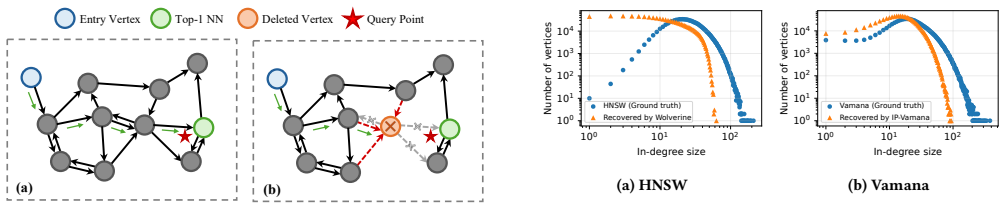
- [§4.2–§4.3, Algorithms 2 and 3] The core stability claim depends on recovering enough of the in-neighborhood of the deleted vertex. In Algorithm 2, v_d is marked logically invalid (line 5) before MeritRepair is called (line 7). Algorithm 3 then runs KnnSearch for x_{v_d} with v_d invalid (line 1), so v_d can neither be expanded nor returned. Consequently, any in-neighbor u for which the only route from the entry point passes through v_d will not be in R and will not be added to the repair candidate set C. Versioned-edge invalidation (§4.4) filters the stale edge u→v_d but does not provide a replacement route; if u had no other path to the live graph, it becomes disconnected. The paper's own Table 3 shows vertex reachability dropping from 99.22% to 97.90% with k_r-MST after 50% deletion on Gist1M, and the RQ2 text reports GloVe Recall@10 falling to 0.8473 at 50% deletion. Both are consistent with this incomplete recover
- [§6.1 and §6.2] The related-work section mentions CleANN [54] as a recent dynamic graph-based ANNS approach with semi-lazy cleaning, but the experimental comparison (Figures 7–12, Table 3) includes only Wolverine, FreshVamana, and IP-Vamana. Since the abstract claims superiority over 'state-of-the-art (SOTA) methods', omitting a recently published dynamic baseline leaves the 3.02x–18.87x speedup and recall-stability claims incompletely supported. CleANN should be added to the experiments, or the authors should explicitly justify why it is not directly comparable in this evaluation context.
- [§4.3, Definition 4.3 and following paragraph] The connectivity guarantee of k_r-MST repair is asserted, not proven under the degree bound. The text argues that any MST of C is contained in the RNG, so RNG-based pruning preserves the MST backbone. However, InsertAndPrune also enforces the graph degree bound M. If a vertex's adjacency list is already saturated, inserting a bidirectional repair edge can evict existing edges — possibly including an MST edge just added. The manuscript does not specify InsertAndPrune's eviction policy or prove that the MST backbone survives degree-bounded pruning. Without such an invariant, the claim that 'the preserved backbone maintains reachability of the repaired candidate set' is not established. Define InsertAndPrune precisely and prove the backbone invariant, or state and verify experimentally that MST edges are never pruned under the used parameter settings.
minor comments (5)
- [§6.3 and §6.4] There are duplicated 'Answer to RQ2.' and 'Answer to RQ3.' phrases in the text; these should be cleaned up.
- [Table 3] 'Vertex Reachability' is not defined. Please state explicitly how it is measured (e.g., BFS from the entry point over the live graph) and why the 'before' value is not 100%.
- [§6.1] Each configuration is repeated three times and only the mean is reported. Adding standard deviations or min–max ranges would be valuable, especially because the stability claim is about variation across deletion batches.
- [§6.6] The Deep100M experiment says 'tuned initial recall' but does not explain what was tuned or how the initial recall was set. Please specify the parameter settings.
- [Algorithm 3, line 2] The adjacency test `v_d ∈ N(u)` is used to certify in-neighbors. Since edges carry target versions, clarify whether this test checks the raw stored identifier or the version-validated view of the adjacency list.
Circularity Check
No significant circularity; MERIT's claims are empirical and its self-citations are not load-bearing.
full rationale
MERIT's headline results are obtained by running the proposed algorithms against external baselines on standard public datasets under identical update sequences, with no parameter fitted to the reported recall or latency numbers. The complexity analysis in §5.1 is a direct accounting of the algorithm's bounded operations (O(M + ef'_c log n + |C|^2 log |C| + |C| k_r M)) rather than an inversion of empirical results, and the lifetime bound in §5.2 explicitly states its idealized uniform-reuse assumption and derives a Chernoff bound. The one self-citation, [48], appears alongside external references [35,47] for the standard beam-search complexity fact and is therefore not load-bearing. The skeptic's concern about in-neighbors reachable only through v_d is a genuine robustness limitation—reflected in the paper's own Table 3 reachability decline—but the paper explicitly states that recovery is approximate and delegates residual edges to versioned invalidation, so this is an empirical design limitation, not a circular derivation. No central claim reduces to its own inputs by construction.
Axiom & Free-Parameter Ledger
free parameters (3)
- k_r =
2 (default; 3 also viable)
- e'_c =
2M
- version_bits =
16
axioms (4)
- standard math The MST of any candidate set C is contained in the Relative Neighborhood Graph (RNG) of C.
- domain assumption Graph beam search with beam width e'_c performs O(e'_c log n) distance computations on navigable proximity graphs.
- ad hoc to paper The searchable in-neighbors recovered by a bounded search from x_{v_d}, after v_d is marked invalid, suffice to preserve routing.
- domain assumption Version increments select vertex slots uniformly at random across deletions (idealized reuse model).
invented entities (1)
-
Version-stamped edge word (16-bit target version + 48-bit ID)
no independent evidence
read the original abstract
Graph-based indexes have become the dominant approach to approximate nearest neighbor search (ANNS) over high-dimensional data and play a crucial role in real-world applications such as retrieval-augmented generation, recommendation systems, and vector databases. Despite extensive progress in static graph construction and search, efficient in-place deletion remains challenging because obsolete vectors must be removed without allowing stale incoming edges to consume search capacity or expensive graph-wide maintenance to interrupt online services, e.g., retrieval-augmented generation (RAG) and recommendation platforms. To address this problem, we propose MERIT (MST-based Efficient Repair with In-place updaTes), an in-place update framework with three core techniques: (1) bounded search-based recovery that combines a deleted vertex's outgoing neighbors with its readily searchable in-neighbors, (2) $k_r$-Minimum Spanning Tree (MST) local repair that promotes local connectivity while retaining multiple routing choices for graph search, and (3) versioned-edge invalidation that immediately filters all stale incoming edges to the deleted vertex and progressively removes them as adjacency lists are rewritten. Its integration with the hierarchical HNSW index and the single-layer Vamana index demonstrates applicability across distinct graph structures. Extensive experiments on multiple real-world datasets show that MERIT processes deletion at nearly the cost of inserting one vector, achieves up to $3.02\times$--$18.87\times$ faster deletion than state-of-the-art (SOTA) methods, and keeps search recall stable or even improves it as deletions accumulate.
Figures




Reference graph
Works this paper leans on
-
[1]
Cecilia Aguerrebere, Ishwar Bhati, Mark Hildebrand, Mariano Tepper, and Ted Willke. 2023. Similarity search in the blink of an eye with compressed indices. arXiv preprint arXiv:2304.04759(2023)
Pith/arXiv arXiv 2023
-
[2]
Sunil Arya and David M Mount. 1993. Approximate nearest neighbor queries in fixed dimensions.. InSODA, Vol. 93. Citeseer, 271–280
1993
-
[3]
Akari Asai, Sewon Min, Zexuan Zhong, and Danqi Chen. 2023. Retrieval-based language models and applications. InProceedings of the 61st Annual Meeting of the Association for Computational Linguistics (Volume 6: Tutorial Abstracts). 41–46. 12
2023
-
[4]
Martin Aumüller, Erik Bernhardsson, and Alexander Faithfull. 2020. ANN- Benchmarks: A benchmarking tool for approximate nearest neighbor algorithms. Information Systems87 (2020), 101374
2020
-
[5]
Artem Babenko and Victor Lempitsky. 2014. The inverted multi-index.IEEE transactions on pattern analysis and machine intelligence37, 6 (2014), 1247–1260
2014
-
[6]
Artem Babenko and Victor Lempitsky. 2016. Efficient indexing of billion-scale datasets of deep descriptors. InProceedings of the IEEE Conference on Computer Vision and Pattern Recognition. 2055–2063
2016
-
[7]
Jon Louis Bentley. 1975. Multidimensional binary search trees used for associative searching.Commun. ACM18, 9 (1975), 509–517
1975
-
[8]
Ellis, Brian Whitman, and Paul Lamere
Thierry Bertin-Mahieux, Daniel P.W. Ellis, Brian Whitman, and Paul Lamere
-
[9]
Mingyue Cheng, Yucong Luo, Jie Ouyang, Qi Liu, Huijie Liu, Li Li, Shuo Yu, Bohou Zhang, Jiawei Cao, Jie Ma, Daoyu Wang, and Enhong Chen. 2025. A Survey on Knowledge-Oriented Retrieval-Augmented Generation.arXiv preprint arXiv:2503.10677(2025)
Pith/arXiv arXiv 2025
-
[10]
Scott Cost and Steven Salzberg. 1993. A weighted nearest neighbor algorithm for learning with symbolic features.Machine learning10 (1993), 57–78
1993
-
[11]
Abhinandan S Das, Mayur Datar, Ashutosh Garg, and Shyam Rajaram. 2007. Google news personalization: scalable online collaborative filtering. InProceed- ings of the 16th international conference on World Wide Web. 271–280
2007
-
[12]
Damian Dechev, Peter Pirkelbauer, and Bjarne Stroustrup. 2010. Understanding and Effectively Preventing the ABA Problem in Descriptor-Based Lock-Free Designs. In2010 13th IEEE International Symposium on Object/Component/Service- Oriented Real-Time Distributed Computing. 185–192. https://doi.org/10.1109/ ISORC.2010.10
2010
-
[13]
Blelloch, Laxman Dhulipala, Yan Gu, Harsha Vardhan Simhadri, and Yihan Sun
Magdalen Dobson, Zheqi Shen, Guy E. Blelloch, Laxman Dhulipala, Yan Gu, Harsha Vardhan Simhadri, and Yihan Sun. 2024. Scaling Graph-Based ANNS Algorithms to Billion-Size Datasets: A Comparative Analysis. InProceedings of the 29th ACM SIGPLAN Annual Symposium on Principles and Practice of Parallel Programming (PPoPP ’24). 270–285
2024
-
[14]
Wei Dong, Charikar Moses, and Kai Li. 2011. Efficient k-nearest neighbor graph construction for generic similarity measures. InProceedings of the 20th interna- tional conference on World wide web. 577–586
2011
-
[15]
Matthijs Douze, Alexandr Guzhva, Chengqi Deng, Jeff Johnson, Gergely Szilvasy, Pierre-Emmanuel Mazaré, Maria Lomeli, Lucas Hosseini, and Hervé Jégou. 2024. The faiss library.arXiv preprint arXiv:2401.08281(2024)
Pith/arXiv arXiv 2024
-
[16]
Cong Fu, Changxu Wang, and Deng Cai. 2021. High dimensional similarity search with satellite system graph: Efficiency, scalability, and unindexed query compatibility.IEEE Transactions on Pattern Analysis and Machine Intelligence44, 8 (2021), 4139–4150
2021
-
[17]
Cong Fu, Chao Xiang, Changxu Wang, and Deng Cai. 2017. Fast Approximate Nearest Neighbor Search With The Navigating Spreading-out Graph.Proceedings of the VLDB Endowment12, 5 (2017)
2017
-
[18]
Hao Guo and Youyou Lu. 2025. Achieving Low-Latency Graph-Based Vector Search via Aligning Best-First Search Algorithm with SSD. InProceedings of the 19th USENIX Symposium on Operating Systems Design and Implementation (OSDI ’25). USENIX Association, 171–186
2025
-
[19]
Qiang Huang, Jianlin Feng, Yikai Zhang, Qiong Fang, and Wilfred Ng. 2015. Query-aware locality-sensitive hashing for approximate nearest neighbor search. Proceedings of the VLDB Endowment9, 1 (2015), 1–12
2015
-
[20]
Piotr Indyk and Rajeev Motwani. 1998. Approximate nearest neighbors: towards removing the curse of dimensionality. InProceedings of the thirtieth annual ACM symposium on Theory of computing. 604–613
1998
-
[21]
Suhas Jayaram Subramanya, Fnu Devvrit, Harsha Vardhan Simhadri, Ravishankar Krishnawamy, and Rohan Kadekodi. 2019. Diskann: Fast accurate billion-point nearest neighbor search on a single node.Advances in Neural Information Processing Systems32 (2019)
2019
-
[22]
Herve Jegou, Matthijs Douze, and Cordelia Schmid. 2010. Product quantization for nearest neighbor search.IEEE transactions on pattern analysis and machine intelligence33, 1 (2010), 117–128
2010
-
[23]
Donald B. Johnson. 1975. Priority queues with update and finding minimum spanning trees.Inform. Process. Lett.4, 3 (1975), 53–57. https://doi.org/10.1016/ 0020-0190(75)90001-0
1975
-
[24]
Ruoxuan Li, Xiaoyao Zhong, Jiabao Jin, Peng Cheng, Wangze Ni, Lei Chen, Zhitao Shen, Wei Jia, Xiangyu Wang, Xuemin Lin, et al. 2025. SINDI: an Efficient Index for Approximate Maximum Inner Product Search on Sparse Vectors.arXiv preprint arXiv:2509.08395(2025)
arXiv 2025
-
[25]
Wen Li, Ying Zhang, Yifang Sun, Wei Wang, Mingjie Li, Wenjie Zhang, and Xuemin Lin. 2019. Approximate nearest neighbor search on high dimensional data—experiments, analyses, and improvement.IEEE Transactions on Knowledge and Data Engineering32, 8 (2019), 1475–1488
2019
-
[26]
Dawei Liu, Bolong Zheng, Ziyang Yue, Fuhao Ruan, Xiaofang Zhou, and Chris- tian S Jensen. 2025. Wolverine: Highly Efficient Monotonic Search Path Repair for Graph-Based ANN Index Updates.Proceedings of the VLDB Endowment18, 7 (2025), 2268–2280
2025
-
[27]
Yury Malkov, Alexander Ponomarenko, Andrey Logvinov, and Vladimir Krylov
-
[28]
Yu A Malkov and Dmitry A Yashunin. 2018. Efficient and robust approximate nearest neighbor search using hierarchical navigable small world graphs.IEEE transactions on pattern analysis and machine intelligence42, 4 (2018), 824–836
2018
-
[29]
Yitong Meng, Xinyan Dai, Xiao Yan, James Cheng, Weiwen Liu, Jun Guo, Benben Liao, and Guangyong Chen. 2020. Pmd: An optimal transportation-based user distance for recommender systems. InAdvances in Information Retrieval: 42nd European Conference on IR Research, ECIR 2020, Lisbon, Portugal, April 14–17, 2020, Proceedings, Part II 42. Springer, 272–280
2020
-
[30]
Rajeev Motwani and Prabhakar Raghavan. 1996. Randomized algorithms.ACM Computing Surveys (CSUR)28, 1 (1996), 33–37
1996
-
[31]
Marius Muja and David Lowe. 2009. Flann-fast library for approximate nearest neighbors user manual.Computer Science Department, University of British Columbia, Vancouver, BC, Canada5, 6 (2009), 12–29
2009
-
[32]
Marius Muja and David G Lowe. 2014. Scalable nearest neighbor algorithms for high dimensional data.IEEE transactions on pattern analysis and machine intelligence36, 11 (2014), 2227–2240
2014
-
[33]
Emir Öztürk and Altan Mesut. 2024. Performance Analysis Of Chroma, Qdrant, And Faiss Databases.UNITECH–Sel. Pap(2024)
2024
-
[34]
Patrick O’Neil, Edward Cheng, Dieter Gawlick, and Elizabeth O’Neil. 1996. The log-structured merge-tree (LSM-tree).Acta Informatica33 (1996), 351–385
1996
-
[35]
Yun Peng, Byron Choi, Tsz Nam Chan, Jianye Yang, and Jianliang Xu. 2023. Efficient approximate nearest neighbor search in multi-dimensional databases. Proceedings of the ACM on Management of Data1, 1 (2023), 1–27
2023
-
[36]
Jeffrey Pennington, Richard Socher, and Christopher D Manning. 2014. Glove: Global vectors for word representation. InProceedings of the 2014 conference on empirical methods in natural language processing (EMNLP). 1532–1543
2014
-
[37]
Liudmila Prokhorenkova and Aleksandr Shekhovtsov. 2020. Graph-based nearest neighbor search: From practice to theory. InInternational Conference on Machine Learning. PMLR, 7803–7813
2020
-
[38]
William Pugh. 1990. Skip lists: a probabilistic alternative to balanced trees. Commun. ACM33, 6 (1990), 668–676
1990
-
[39]
Chanop Silpa-Anan and Richard Hartley. 2008. Optimised KD-trees for fast image descriptor matching. In2008 IEEE Conference on Computer Vision and Pattern Recognition. IEEE, 1–8
2008
-
[40]
Aditi Singh, Suhas Jayaram Subramanya, Ravishankar Krishnaswamy, and Har- sha Vardhan Simhadri. 2021. Freshdiskann: A fast and accurate graph-based ann index for streaming similarity search.arXiv preprint arXiv:2105.09613(2021)
Pith/arXiv arXiv 2021
-
[41]
Yifang Sun, Wei Wang, Jianbin Qin, Ying Zhang, and Xuemin Lin. 2014. SRS: solving c-approximate nearest neighbor queries in high dimensional euclidean space with a tiny index.Proceedings of the VLDB Endowment(2014)
2014
-
[42]
Nenad Tomasev, Milos Radovanovic, Dunja Mladenic, and Mirjana Ivanovic
-
[43]
Godfried T Toussaint. 1980. The relative neighbourhood graph of a finite planar set.Pattern recognition12, 4 (1980), 261–268
1980
-
[44]
Jing Wang, Jingdong Wang, Gang Zeng, Zhuowen Tu, Rui Gan, and Shipeng Li. 2012. Scalable k-nn graph construction for visual descriptors. In2012 IEEE Conference on Computer Vision and Pattern Recognition. IEEE, 1106–1113
2012
-
[45]
Jianguo Wang, Xiaomeng Yi, Rentong Guo, Hai Jin, Peng Xu, Shengjun Li, Xi- angyu Wang, Xiangzhou Guo, Chengming Li, Xiaohai Xu, et al. 2021. Milvus: A purpose-built vector data management system. InProceedings of the 2021 International Conference on Management of Data. 2614–2627
2021
-
[46]
Meng Wang, Weijie Fu, Xiangnan He, Shijie Hao, and Xindong Wu. 2020. A survey on large-scale machine learning.IEEE Transactions on Knowledge and Data Engineering34, 6 (2020), 2574–2594
2020
-
[47]
Mengzhao Wang, Xiaoliang Xu, Qiang Yue, and Yuxiang Wang. 2021. A com- prehensive survey and experimental comparison of graph-based approximate nearest neighbor search.Proceedings of the VLDB Endowment14, 11 (2021), 1964–1978
2021
-
[48]
Zekai Wu, Jiabao Jin, Peng Cheng, Xiaoyao Zhong, Lei Chen, Yongxin Tong, Zhitao Shen, Jingkuan Song, Heng Tao Shen, and Xuemin Lin. 2026. FGIM: a Fast Graph-based Indexes Merging Framework for Approximate Nearest Neighbor Search.Proceedings of the ACM on Management of Data4, 1 (SIGMOD (2026), 1–27
2026
-
[49]
Haike Xu, Magdalen Dobson Manohar, Philip A Bernstein, Badrish Chandramouli, Richard Wen, and Harsha Vardhan Simhadri. 2025. In-Place Updates of a Graph Index for Streaming Approximate Nearest Neighbor Search.arXiv preprint arXiv:2502.13826(2025)
Pith/arXiv arXiv 2025
-
[50]
Yuming Xu, Hengyu Liang, Jin Li, Shuotao Xu, Qi Chen, Qianxi Zhang, Cheng Li, Ziyue Yang, Fan Yang, Yuqing Yang, et al. 2023. Spfresh: Incremental in-place update for billion-scale vector search. InProceedings of the 29th Symposium on Operating Systems Principles. 545–561
2023
-
[51]
Shuo Yang, Jiadong Xie, Yingfan Liu, Jeffrey Xu Yu, Xiyue Gao, Qianru Wang, Yanguo Peng, and Jiangtao Cui. 2025. Revisiting the Index Construction of Proximity Graph-Based Approximate Nearest Neighbor Search.Proceedings of 13 the VLDB Endowment18 (2025), 1825–1838
2025
-
[52]
Xiao Yang, Kai Sun, Hao Xin, Yushi Sun, Nikita Bhalla, Xiangsen Chen, Sa- jal Choudhary, Rongze D Gui, Ziran W Jiang, Ziyu Jiang, et al . 2024. Crag- comprehensive rag benchmark.Advances in Neural Information Processing Sys- tems37 (2024), 10470–10490
2024
-
[53]
Kun Yu, Jiabao Jin, Xiaoyao Zhong, Peng Cheng, Lei Chen, Zhitao Shen, Jingkuan Song, Hengtao Shen, and Xuemin Lin. 2025. Approximate Nearest Neigh- bor Search of Large Scale Vectors on Distributed Storage.arXiv preprint arXiv:2510.17326(2025)
arXiv 2025
-
[54]
Ziyu Zhang, Yuanhao Wei, Joshua Engels, and Julian Shun. 2026. CleanANN: Effi- cient and Robust Full Dynamism in Graph-based Approximate Nearest Neighbor Search. InProceedings of the 38th ACM Symposium on Parallelism in Algorithms and Architectures (SPAA ’26). 247–260. https://doi.org/10.1145/3816782.3819219
arXiv 2026
-
[55]
Penghao Zhao, Hailin Zhang, Qinhan Yu, Zhengren Wang, Yunteng Geng, Fangcheng Fu, Ling Yang, Wentao Zhang, Jie Jiang, and Bin Cui. 2026. Retrieval- augmented generation for ai-generated content: A survey.Data Science and Engineering(2026), 1–29
2026
-
[56]
Xiaoyao Zhong, Haotian Li, Jiabao Jin, Mingyu Yang, Deming Chu, Xiangyu Wang, Zhitao Shen, Wei Jia, George Gu, Yi Xie, Xuemin Lin, Heng Tao Shen, Jingkuan Song, and Peng Cheng. 2025. VSAG: An Optimized Search Framework for Graph-Based Approximate Nearest Neighbor Search.Proc. VLDB Endow.18, 12 (Aug. 2025), 5017–5030
2025
-
[57]
Chun Jiang Zhu, Tan Zhu, Haining Li, Jinbo Bi, and Minghu Song. 2019. Accel- erating large-scale molecular similarity search through exploiting high perfor- mance computing. In2019 IEEE International Conference on Bioinformatics and Biomedicine (BIBM). IEEE, 330–333. 14
2019
-
[2011]
InProceedings of the 12th International Conference on Music Information Retrieval (ISMIR 2011)
The Million Song Dataset. InProceedings of the 12th International Conference on Music Information Retrieval (ISMIR 2011)
2011
-
[2013]
The role of hubness in clustering high-dimensional data.IEEE transactions on knowledge and data engineering26, 3 (2013), 739–751
2013
-
[2014]
Approximate nearest neighbor algorithm based on navigable small world graphs.Information Systems45 (2014), 61–68
2014
discussion (0)
Sign in with ORCID, Apple, or X to comment. Anyone can read and Pith papers without signing in.