REVIEW 3 major objections 5 minor 27 references
Diagnosing Compositional Generalization in Sequential Robot Tasks
T0 review · 3 major / 5 minor · reviewed 2026-08-03 · deepseek-v4-flash
Pith's one-line read This paper establishes that exhaustive instruction-tuple enumeration is unnecessary: a structured subset covering pairwise dependencies can match full-task performance in sequential robot manipulation.
desk verdict Strong empirical paper on data coverage for compositional generalization; the theory is correctly derived but does not prove the pairwise-coverage claim — the headline result is an empirical regularity that deserves follow-up. read the letter →
The pith
A machine-rendered reading of the paper's core claim, the machinery that carries it, and where it could break.
The reading
What carries the argument
The load-bearing mechanism is the three-term generalization-gap bound of Proposition 4.1, written for any fixed stage i as |Δq(θ)| ≤ M(||q(li)-p(li)||1 + E[||q(l-i|li)-p(l-i|li)||1] + E[||q(z,a|l)-p(z,a|l)||1]). The middle term, instruction-compositional shift, is what sparse training leaves uncontrolled; the experiments operationalize it through the seen-pair count, the number of factor pairs observed together in the training set. The orthogonal task set is the combinatorial device that maximizes pair coverage with a small number of tuples. The stage-wise modular policy bound (Corollary 4.2) shows how removing inactive instructions from the policy input eliminates the explicit compositional
What would settle it
Construct a sequential task where the correct action is a unique function of a three-way combination (e.g., pick object o, place in container c, press button b, with the requirement that o, c, and b are all distinct or that a specific (o,c,b) triple maps to a unique reward). Train on an orthogonal set covering all factor pairs—so every pair appears—but none of the full triples, then evaluate on held-out triples. If success on those triples is low while a model trained on the full Cartesian space succeeds, the pairwise-coverage claim is false.
Extended reading notes
Core claim
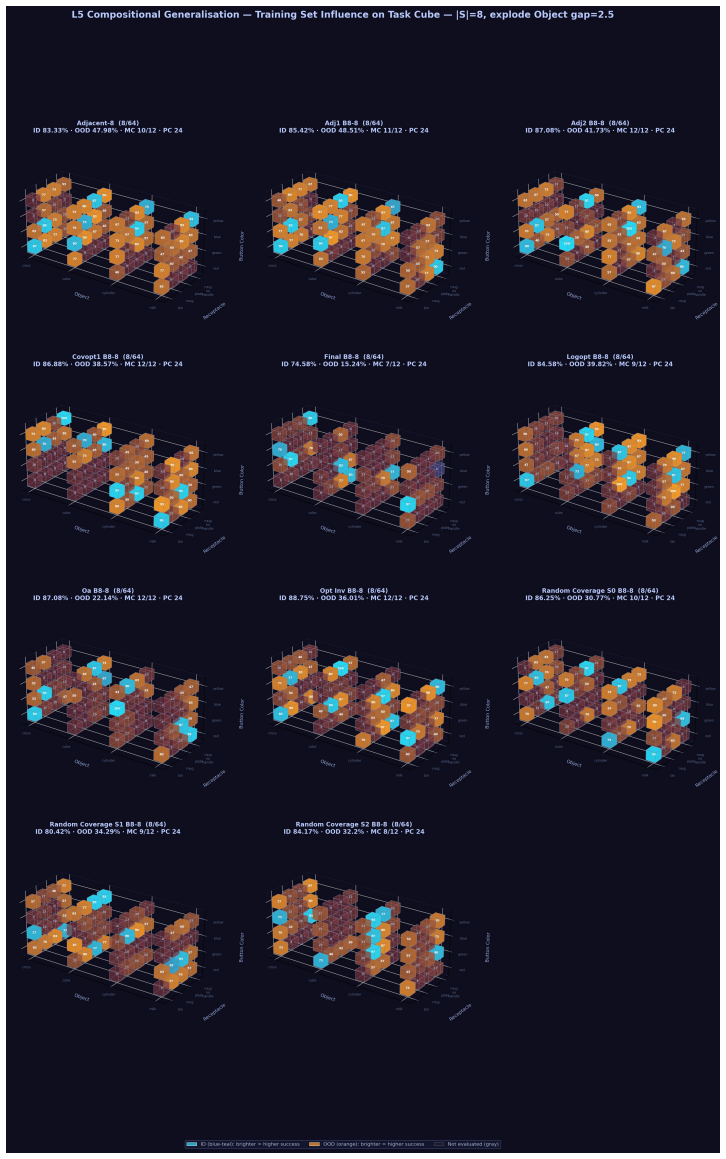
The paper's central assertion is that the compositional generalization gap in instruction-conditioned policies is governed by three additive L1 discrepancy terms (Proposition 4.1): a marginal term for the active subtask, a compositional term for how familiar subtasks are recombined, and a context–action term for behavior conditioned on the full instruction. Because the compositional term measures mismatch in the conditional distribution of surrounding instructions given the active one, controlling it does not require full Cartesian coverage. Empirically, the number of observed instruction pairs in training (seen-pair count) predicts OOD success, and a 16-task orthogonal design that covers al
Load-bearing premise
The central claim rests on the assumption that the action-relevant dependencies among instruction factors are at most pairwise—that training data covering every pair of factors also controls the conditional distribution of leftover factor combinations—so a task whose correct action depends on a genuine three-way interaction would defeat the coverage principle.
Editorial extensions
If this is right
- Robot data collection can replace exhaustive task enumeration with orthogonal or covering designs that hit every pair of instruction factors, at significant cost savings (e.g., 16 tasks instead of 64).
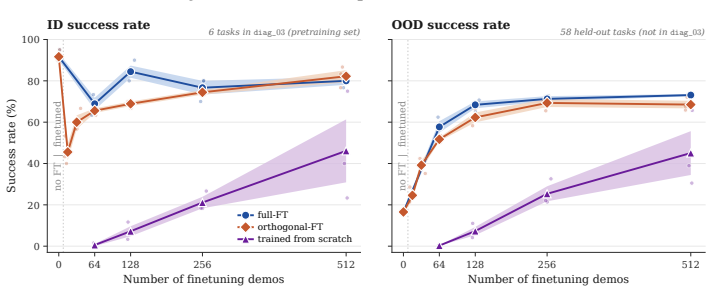
- Sparse pretrained policies retain reusable subtask skills; a tiny amount of broad-coverage finetuning (one demonstration per task) can recover most out-of-distribution success, so new data should prioritize breadth of instruction pairs.
- When instruction factors semantically constrain each other, the training set must cover the dependent pairs jointly, or the policy will learn spurious correlations (e.g., same-container violations).
- A stage-wise modular policy reduces, but does not eliminate, the need for coverage, because inactive instructions can still reshape the context distribution; a dependency-preserving planner or dataset is still required.
- The seen-pair count offers a simple, pre-training diagnostic: a training set with high pairwise coverage should generalize better than one with same marginal coverage but low pair coverage.
Reading between the lines
- The same pairwise-coverage principle could be used to audit large pretraining corpora for robotics: databases collected without attention to higher-order dependencies may silently fail on recombinations, and the seen-pair count could flag which instruction pairs are undertrained.
- If the pairwise assumption generalizes, then a model trained on orthogonal, pair-covered data might be a stronger starting checkpoint for finetuning on novel tasks than a model trained on more, but more redundant, demonstrations.
- The decomposition is not specific to imitation learning; it could diagnose compositional failures in offline RL or learned planners, where the context–action shift term would capture distribution shift in the visited state-action distribution.
- One testable extension: measure whether seen-pair count predicts OOD success on instruction spaces with 4+ factors; if the trend continues, the principle would support covering arrays of strength 2 rather than strength 3+, though the paper leaves that to future work.
Editorial analysis
A structured set of objections, weighed in public.
Referee Report
Summary. The paper studies compositional generalization in sequential robot manipulation from an instruction-space coverage perspective. It derives an upper bound (Proposition 4.1 / A.1) that decomposes the compositional generalization gap into marginal instruction shift, instruction-compositional shift, and context–action shift, and a corollary for stage-wise modular policies. The authors then present simulated robomimic experiments on three task families (PP, PPP, 2S-PP). The central empirical claim is that full Cartesian enumeration of instruction tuples is unnecessary: a structured subset covering action-relevant dependencies — in particular a 16-task orthogonal array for the 64-task PPP space, one quarter of the full space — can reach OOD success close to full-task training. Additional findings concern finetuning from sparse diagonal pretraining (one demonstration per task raises OOD success from 0.4% to 54.7%) and the need for dependent-pair coverage in semantically dependent tasks. The paper also proposes a data-collection principle: prioritize dependency coverage over exhaustive task expansion.
Significance. If the claims are ultimately supported, the work would be a valuable contribution to data-efficient imitation learning and compositional generalization in robotics. Proposition 4.1 is a correct triangle-inequality identity and is presented with a clean proof; Corollary 4.2 is also correctly derived. The experimental program is unusually thorough for a short paper: 55 training-set configurations for PPP, multiple fixed-budget comparisons, finetuning ablations, and failure-case Sankey diagrams. The paper also makes a falsifiable prediction — that pairwise coverage of instruction factors is sufficient for tasks whose action-relevant dependencies are at most pairwise — and provides a website with supplementary material. The main risk is that the theoretical framework is used to explain an empirical regularity it does not actually imply, as detailed in the major comments. The empirical findings remain interesting, but the theory-driven interpretation needs substantial revision before the paper can be accepted.
major comments (3)
- [Section 5.2, Eq. (5)] The claim that 'pairwise coverage mitigates the instruction-compositional discrepancy q(l_{-i}|l_i)-p(l_{-i}|l_i)' is not supported by Proposition 4.1. In PPP with n=3 and a strength-2 orthogonal array of 16 tasks, for any fixed l_i the training conditional p(l_{-i}|l_i) has support only 4 points, while the test conditional q(l_{-i}|l_i) is uniform over 16 points. The L1 distance is 1.5, which is large, not small. Therefore the second term in the bound (5) is not controlled by pairwise coverage; the bound is vacuous in exactly the regime claimed to support it. The observed success of the orthogonal design is better explained by the stage-wise structure of the task — stage 2 depends on (o,c) and stage 3 on (c,b), with no action depending on all three factors jointly. The paper should either (i) reframe the one-quarter claim as an empirical coverage principle and provide a sharper formaliz
- [Section 5.2, Figures 2c and 8b] The 'seen pair count' analysis is post-hoc and in-sample. The same PPP configurations are used to discover the correlation between seen-pair count and OOD success, and the orthogonal set is deliberately constructed to maximize pairwise coverage. Thus the experiment does not independently validate the coverage principle; the design choice and the metric are on the same data. Additionally, the correlation is reported descriptively without statistical measures (e.g., error bars, permutation tests, or a hold-out task family). The one-quarter result therefore remains an observational finding on two simulated task families, not a consequence of Proposition 4.1. I recommend either pre-specifying the orthogonal design before measuring performance, or validating the principle on held-out task families with different interaction orders and reporting the associated uncertainty.
- [Section 5.3, Figures 5 and 10] The interpretation 'sparse pretraining learns reusable skills but not steering' is reasonable, but it is supported only indirectly. The finetuning experiments show that one demonstration per task improves OOD success, yet Appendix D (Figure 10) also reports that finetuning can degrade OOD performance when the pretrained checkpoint is already strong, e.g., the orthogonal-set pretraining. This nuance should be integrated into the main text; otherwise the narrative overstates the universality of the finetuning benefit. The paper should acknowledge that the steering-vs-skills dichotomy is a conceptual interpretation, not a direct measurement.
minor comments (5)
- [References] References [12] and [13] are identical (Lake and Baroni, ICML 2018); one should be removed or replaced with a distinct citation.
- [Acknowledgments] The Acknowledgments section contains a placeholder text ('If a paper is accepted...'). In a submitted manuscript this should be replaced with actual acknowledgments or omitted entirely.
- [Numbering] The main text uses Proposition 4.1 / Corollary 4.2 while the appendix and several references use Proposition A.1 / Corollary A.2. Unify the numbering to avoid reader confusion.
- [Section 5.4 / Appendix E] The transition from the general 2S-PP definition (where the full instruction has four components o1, c1, o2, c2) to the experimental instantiation with 36 or 48 tasks is abrupt. The relation between the hidden container c1, the observed instruction l=(o1,o2,c2), and the same-container violation rate should be stated more clearly in the main text.
- [Figures 3 and 11] In the fixed-budget comparison, confounds between total demonstration count and per-task demonstration count are inherent to the design, but the captions should explicitly state the per-task allocation for each curve. This is especially important in Figure 11, where the random baseline uses one demonstration per sampled task while the orthogonal set uses two demonstrations per task in the 32-demonstration case.
Circularity Check
No significant circularity; the generalization-gap bound is self-contained and the one-quarter claim is empirical, not derived by construction.
full rationale
The paper's theoretical core, Proposition 4.1 (restated as Proposition A.1), is a direct triangle-inequality decomposition of the compositional generalization gap; it introduces no fitted parameters and no equation reduces to its own inputs. Corollary A.2 follows by the same type of exact decomposition under the modular-policy assumption. The experiments do not fit constants to the theory, and the paper does not claim to derive the 78.2% OOD number from the bound. Section 5.2 explicitly says the pairwise-coverage observation 'motivates' the orthogonal design, and then reports 'Experiments show' the result—this is empirical validation of a design principle, not a circular derivation. The citations to orthogonal-array theory are external and not self-referential; the self-citations (e.g., Interleave-VLA) are contextual and not load-bearing. The main weakness is that the paper asserts pairwise coverage 'supports Proposition 4.1' in the sense of controlling the instruction-compositional discrepancy, but the proposition itself does not logically imply that pairwise coverage bounds that term for the tested regime; this is an interpretive overreach and a correctness risk, not a circularity. Section 6 acknowledges the restriction to a small set of tasks, which limits generality but does not make the derivation circular.
Assumptions & free parameters
assumptions (4)
- standard math Loss is measurable and uniformly bounded on supp(p) ∪ supp(q), i.e., 0 ≤ Lθ ≤ M.
- domain assumption A stage indicator σ(z) exists that identifies the active subtask for the stage-wise modular policy.
- domain assumption Pairwise coverage of instruction factors is sufficient to control the instruction-compositional shift.
- ad hoc to paper Success rate is a valid monotone proxy for the bounded loss in the theory.
Cite this review
Pith. "Pith review of Diagnosing Compositional Generalization in Sequential Robot Tasks." pith.science (2026). https://pith.science/paper/JOK3LIAX
@misc{pith2026260729687,
  author       = {Pith},
  title        = {Pith review of: Diagnosing Compositional Generalization in Sequential Robot Tasks},
  year         = {2026},
  howpublished = {\url{https://pith.science/paper/JOK3LIAX}},
  note         = {Machine review of arXiv:2607.29687}
}
abstract
Sequential robot manipulation requires policies to execute novel combinations of familiar instruction components. However, collecting demonstrations for all possible instruction tuples is combinatorially expensive, while sparsely covered datasets often fail under out-of-distribution recombination. This paper studies compositional generalization through the lens of instruction-space coverage. We decompose the generalization gap into three sources: \textit{marginal instruction shift}, \textit{instruction-compositional shift}, and \textit{context--action shift}. This decomposition allows us to diagnose when sparse training coverage is sufficient, and what structure the training set must preserve for reliable action prediction. Our results show that exhaustive tuple enumeration is unnecessary: a structured subset, as small as one quarter of the full task space, can recover strong out-of-distribution performance when it covers action-relevant dependencies. We further find that sparse training often fails due to instruction steering rather than missing low-level skills; finetuning only one demonstration per task improves OOD success from \(0.4\%\) to \(54.7\%\). For semantically dependent tasks, effective coverage must capture relational structure rather than only factor diversity. These findings suggest that efficient robot data collection should prioritize dependency coverage in instruction space over exhaustive task expansion. More results are available in the supplementary material. Project website: https://yixiaowang7.github.io/Diagnosing_Compositional_Generalization_Robot_Page/.
Figures


Figures from the paper (13 more)





Reference graph
Works this paper leans on
-
[2]
P. Intelligence, K. Black, N. Brown, J. Darpinian, K. Dhabalia, D. Driess, A. Esmail, M. Equi, C. Finn, N. Fusai, et al. π0.5: A vision-language-action model with open-world generalization. arXiv preprint arXiv:2504.16054, 2025
arXiv 2025
-
[3]
G. R. Team, A. Abdolmaleki, S. Abeyruwan, J. Ainslie, J.-B. Alayrac, M. G. Arenas, A. Balakr- ishna, N. Batchelor, A. Bewley, J. Bingham, et al. Gemini robotics 1.5: Pushing the frontier of generalist robots with advanced embodied reasoning, thinking, and motion transfer.arXiv preprint arXiv:2510.03342, 2025
arXiv 2025
-
[4]
O. M. Team, D. Ghosh, H. Walke, K. Pertsch, K. Black, O. Mees, S. Dasari, J. Hejna, T. Kreiman, C. Xu, et al. Octo: An open-source generalist robot policy.arXiv preprint arXiv:2405.12213, 2024
arXiv 2024
-
[5]
C. Fan, X. Jia, Y . Sun, Y . Wang, J. Wei, Z. Gong, X. Zhao, M. Tomizuka, X. Yang, J. Yan, et al. Interleave-vla: Enhancing robot manipulation with interleaved image-text instructions.arXiv preprint arXiv:2505.02152, 2025
arXiv 2025
-
[6]
Zitkovich, T
B. Zitkovich, T. Yu, S. Xu, P. Xu, T. Xiao, F. Xia, J. Wu, P. Wohlhart, S. Welker, A. Wahid, et al. Rt-2: Vision-language-action models transfer web knowledge to robotic control. InConference on Robot Learning, pages 2165–2183. PMLR, 2023
2023
-
[7]
M. J. Kim, K. Pertsch, S. Karamcheti, T. Xiao, A. Balakrishna, S. Nair, R. Rafailov, E. Foster, G. Lam, P. Sanketi, et al. Openvla: An open-source vision-language-action model.arXiv preprint arXiv:2406.09246, 2024
arXiv 2024
-
[8]
Vaswani, N
A. Vaswani, N. Shazeer, N. Parmar, J. Uszkoreit, L. Jones, A. N. Gomez, Ł. Kaiser, and I. Polosukhin. Attention is all you need.Advances in neural information processing systems, 30, 2017
2017
-
[9]
K. Pertsch, K. Stachowicz, B. Ichter, D. Driess, S. Nair, Q. Vuong, O. Mees, C. Finn, and S. Levine. Fast: Efficient action tokenization for vision-language-action models.arXiv preprint arXiv:2501.09747, 2025
arXiv 2025
Show all 27 references
-
[10]
C. Chi, Z. Xu, S. Feng, E. Cousineau, Y . Du, B. Burchfiel, R. Tedrake, and S. Song. Diffusion policy: Visuomotor policy learning via action diffusion.The International Journal of Robotics Research, page 02783649241273668, 2023
2023
-
[11]
Jiang, A
Y . Jiang, A. Gupta, Z. Zhang, G. Wang, Y . Dou, Y . Chen, L. Fei-Fei, A. Anandkumar, Y . Zhu, and L. Fan. Vima: General robot manipulation with multimodal prompts, 2023. URL https: //arxiv.org/abs/2210.03094. 9
2023 arXiv
-
[13]
Lake and M
B. Lake and M. Baroni. Generalization without systematicity: On the compositional skills of sequence-to-sequence recurrent networks. InInternational conference on machine learning, pages 2873–2882. PMLR, 2018
2018
-
[14]
Yagcioglu, O
S. Yagcioglu, O. B. Ince, A. Erdem, E. Erdem, D. Elliott, and D. Yuret. Sequential compositional generalization in multimodal models.arXiv preprint arXiv:2404.12013, 2024
2024 arXiv
-
[15]
Haresh, D
S. Haresh, D. Dijkman, A. Bhattacharyya, and R. Memisevic. Clevrskills: Compositional language and visual reasoning in robotics.Advances in Neural Information Processing Systems, 37:38235–38266, 2024
2024
-
[16]
Y . Chen, Z. Chen, N. T. Chan, J. Chen, J. Yin, J. Shi, Y . Gao, Y .-L. Li, and J. Huo. Robohiman: A hierarchical evaluation paradigm for compositional generalization in long-horizon manipulation. arXiv preprint arXiv:2510.13149, 2025
2025
-
[17]
Mandlekar, S
A. Mandlekar, S. Nasiriany, B. Wen, I. Akinola, Y . Narang, L. Fan, Y . Zhu, and D. Fox. Mimicgen: A data generation system for scalable robot learning using human demonstrations. arXiv preprint arXiv:2310.17596, 2023
2023 arXiv
-
[18]
J. Gao, A. Xie, T. Xiao, C. Finn, and D. Sadigh. Efficient data collection for robotic manipulation via compositional generalization.arXiv preprint arXiv:2403.05110, 2024
2024 arXiv
-
[19]
R. N. Kacker, E. S. Lagergren, and J. J. Filliben. Taguchi’s orthogonal arrays are classical designs of experiments.Journal of research of the National Institute of Standards and Technology, 96 (5):577, 1991
1991
-
[20]
A. S. Hedayat, N. J. A. Sloane, and J. Stufken.Orthogonal arrays: theory and applications. Springer Science & Business Media, 2012
2012
-
[21]
D. R. Kuhn, R. N. Kacker, and Y . Lei.Introduction to combinatorial testing. CRC press, 2013
2013
-
[22]
Bacon, J
P.-L. Bacon, J. Harb, and D. Precup. The option-critic architecture. InProceedings of the AAAI conference on artificial intelligence, volume 31, 2017
2017
-
[23]
Nachum, S
O. Nachum, S. S. Gu, H. Lee, and S. Levine. Data-efficient hierarchical reinforcement learning. Advances in neural information processing systems, 31, 2018
2018
-
[24]
C. R. Garrett, R. Chitnis, R. Holladay, B. Kim, T. Silver, L. P. Kaelbling, and T. Lozano-P´erez. Integrated task and motion planning.Annual review of control, robotics, and autonomous systems, 4(1):265–293, 2021
2021
-
[25]
M. Ahn, A. Brohan, N. Brown, Y . Chebotar, O. Cortes, B. David, C. Finn, C. Fu, K. Gopalakr- ishnan, K. Hausman, et al. Do as i can, not as i say: Grounding language in robotic affordances. arXiv preprint arXiv:2204.01691, 2022
2022 arXiv
-
[26]
L. X. Shi, M. R. Equi, L. Ke, K. Pertsch, Q. Vuong, J. Tanner, A. Walling, H. Wang, N. Fusai, A. Li-Bell, et al. Hi robot: Open-ended instruction following with hierarchical vision-language- action models. InForty-second International Conference on Machine Learning
-
[27]
Mandlekar, D
A. Mandlekar, D. Xu, J. Wong, S. Nasiriany, C. Wang, R. Kulkarni, L. Fei-Fei, S. Savarese, Y . Zhu, and R. Mart´ın-Mart´ın. What matters in learning from offline human demonstrations for robot manipulation. InConference on Robot Learning (CoRL), 2021
2021
-
[28]
Oquab, T
M. Oquab, T. Darcet, T. Moutakanni, H. V o, M. Szafraniec, V . Khalidov, P. Fernandez, D. Haziza, F. Massa, A. El-Nouby, et al. Dinov2: Learning robust visual features without supervision. Transactions on Machine Learning Research Journal, pages 1–31, 2024. 10
2024
-
[29]
J. Li, D. Li, S. Savarese, and S. Hoi. Blip-2: Bootstrapping language-image pre-training with frozen image encoders and large language models. InInternational conference on machine learning, pages 19730–19742. PMLR, 2023. 11 A Theoretical Analysis Proposition A.1(General upper...
2023
Reviewed August 3, 2026 · model on record in the stance chip above.
Discussion (0). Sign in to comment.