REVIEW 2 major objections 5 minor 293 references
The Dynamics of Planetary Ejection
T0 review · 2 major / 5 minor · reviewed 2026-08-07 · deepseek-v4-flash
Pith's one-line read Planetary ejection is a common, near-universal stage of planetary system evolution, and the observed census of free-floating planets is best explained by scattering, binary instabilities, and cluster flybys rather than by in-situ formation.
desk verdict A useful, honest review that consolidates ejection mechanisms and gives observers a comparative table; the central claim is conditional but explicitly flagged. read the letter →
The pith
A machine-rendered reading of the paper's core claim, the machinery that carries it, and where it could break.
The reading
What carries the argument
The carrying structure is a set of quantitative diagnostics, one per ejection channel, that convert a scenario into a testable prediction. The Safronov number $\Theta \equiv v_{\rm esc,p}^2/v_{\rm esc,*}^2$—the square of the ratio of a planet's surface escape velocity to the local escape velocity from its host star—decides whether close encounters end in collision or ejection. The angular momentum deficit (AMD) measures how far a planetary system is from circular, coplanar orbits and sets the threshold for secular chaos and orbit crossings. For binaries, empirical stability boundaries give the outermost stable orbit for a circumstellar planet and the innermost stable orbit for a circumbinary planet, while the mass-loss index $\Psi$ separates adiabatic from impulsive ejection during stellar evolution. Each channel also predicts an excess-velocity distribution, so measured FFP velocities can fingerprint the responsible mechanism.
What would settle it
Imaging the lens fields of a few dozen low-mass microlensing FFP candidates several years after the events, or searching archival precovery images, and finding host stars for a substantial fraction would show that many free-floating planets are actually bound, undercutting the census anchor. Conversely, a velocity sample from parallax measurements that clustered at 8–12 km/s rather than the 2–6 km/s predicted by planet-planet scattering would point to circumbinary or cluster mechanisms as dominant.
Extended reading notes
Core claim
This paper's central claim is that planetary ejection is not a rare accident but a standard phase of planetary system evolution: wherever planets form, some are later lost. The abstract states it directly, saying that the ubiquity of free-floating planets suggests that planetary ejection is common, and the summary sharpens it: planet-planet scattering, embedded cluster encounters, and binary instabilities are likely predominant in FFP production. The load-bearing evidence is the completeness-corrected microlensing census of roughly 20 free-floating planets per star for masses 0.33–6660 Earth masses, together with the direct-imaging limit that in-situ formation tapers off below about 3–5 Jupiter masses. The paper argues that the four reviewed mechanisms can account for all candidate FFPs, while acknowledging that some apparent FFPs may be wide-orbit bound planets rather than truly unbound ones.
Load-bearing premise
The load-bearing premise is that most microlensing free-floating planet candidates are truly unbound, so the inferred twenty per star is a real ejection count rather than a count of planets still orbiting faint host stars on very wide orbits.
Editorial extensions
If this is right
- If the completeness-corrected census is real, the ejected mass budget of about 80 Earth masses per star implies that protoplanetary disks must be heavier than the classic minimum-mass nebula, or the observed FFPs cannot all be explained by core accretion.
- Present-day giant-planet systems should carry vestiges of past ejection: high eccentricities, packed spacings near the stability limit, and a dearth of mean-motion resonances.
- Upcoming microlensing surveys are projected to find hundreds of FFPs, and parallax-measured velocities could separate ejection channels by their typical speeds.
- Directly imaged super-Jovian FFPs in star-forming regions are consistent with in-situ collapse, while low-mass microlensing FFPs are not, making the low-mass objects the crucial test bed for ejection models.
- A fraction of apparent FFPs may be wide-orbit bound planets, so host-star follow-up of microlensing events will decide how much of the census is truly unbound.
Reading between the lines
- The velocity-prediction table acts as a ready-made classification scheme: if Roman-era parallaxes yield a bimodal FFP velocity distribution, the peaks can be mapped directly onto ejection mechanisms—a test the paper describes but does not itself run.
- The review's relative rates assume planets form in unstable regions such as circumbinary zones and wide binary orbits; if future disk surveys show that planet formation avoids these zones, the binary and tidal channels would shrink dramatically.
- The same machinery applied to moons and planetesimals suggests that interstellar objects should share the velocity fingerprints of FFPs, so a joint census of interstellar objects and FFPs could test the universality of the ejection picture.
Editorial analysis
A structured set of objections, weighed in public.
Referee Report
Summary. This review synthesizes the dynamical mechanisms by which planets can be liberated from their host stars, organized into four channels: planet-planet scattering (Section 2), instabilities in binary and multi-star systems (Section 3), stellar and substellar flybys (Section 4), and post-main-sequence stellar evolution (Section 5). The paper develops the relevant analytic tools (Safronov number, angular momentum deficit, variable-mass two-body equations, impulse approximation), surveys the solar-system and extrasolar evidence for each channel, and compiles a comparative table (Table 1) listing the percentage of stars susceptible to each mechanism, the associated ejection efficiencies, the typical ejected planet masses, and predicted excess velocities. The central claims are that planetary ejection is common, that the four mechanisms can account for the completeness-corrected microlensing census of roughly 20 free-floating planets per star (Sumi et al. 2023, Eq. 14), and that planet-planet scattering, embedded-cluster encounters, and binary instabilities are likely the predominant FFP production channels. Section 6.1 transparently lists the assumptions behind Table 1 and explicitly acknowledges that apparent microlensing FFPs may include wide-orbit bound planets; however, the Abstract and Section 7 state the conclusions without carrying that conditionality through.
Significance. If the central claim holds, this is a valuable consolidation of a dispersed literature: it unifies four research communities around common quantitative diagnostics (velocity distributions, mass-function features, environmental signatures), updates the earlier Safronov-number analysis with the current exoplanet census (Figures 3 and 4), and offers falsifiable forecasts, including velocity peaks near 2 to 3 km/s for scattering, 8 to 12 km/s for circumbinary and globular-cluster channels, a predicted mass-function trough near 0.8 Earth masses, and a roughly factor-of-ten expansion of the FFP sample with Roman. The analytic kernels (Eqs. 6 to 9, 10, 25 to 30, and 36) are standard and correctly stated; I verified that the stated integral of Eq. (14) over 0.3 to 13 Jupiter masses indeed gives about 0.09 FFPs per star and that the 14.2 AU accretion-limit example from Eq. (7) checks out. The synthesis is not circular: the cited population-level results, including several co-authored by the present authors, are independent N-body simulations with stated initial conditions rather than free parameters fitted here, and the paper does not invent new entities.
major comments (2)
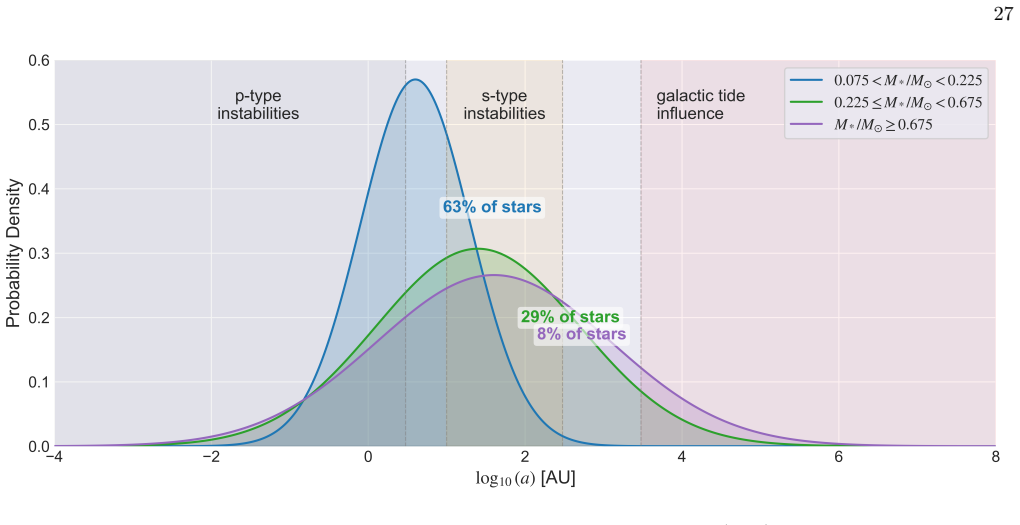
- [Section 6.1 / Table 1] The text states that the piecewise power-law IMF of Kroupa (2001) yields 63%, 29%, and 8% of stars in the mass bins 0.075-0.225, 0.225-0.675, and >0.675 solar masses, respectively, and these fractions feed the derived '9% of stars' (p-type) and '10% of stars' (s-type) binary-instability susceptibilities listed in Table 1. Direct integration of the standard Kroupa slopes (alpha = 1.3 for 0.08-0.5 solar masses and alpha = 2.3 above 0.5 solar masses), normalized over 0.075-120 solar masses, gives approximately 50/35/16 for these same bins, and I could not reproduce the quoted 63/29/8 regardless of whether the substellar (0.01-0.075 solar masses) regime is included. Please recompute the star-count fractions from the cited IMF and state the normalization convention and mass range explicitly, or cite the source from which the 63/29/8 values were taken; the affected Table 1 entries should then be regenerated.
- [Section 6.1; Abstract; Section 7] Section 6.1 transparently acknowledges that 'apparent FFPs observed through microlensing are not necessarily unbound' and cites Hadden and Wu (2025) predicting that roughly half of Neptune-mass apparent FFPs may reside on wide bound orbits, yet this ambiguity is not propagated to the load-bearing inference: the Abstract and the first bullet of Section 7 assert that the low-mass FFP census 'implies a high rate of planetary ejection' without the condition, and the cross-check in Section 2.4.1 (roughly one giant planet ejected per instability) together with the 'can account for all candidate FFPs' statement in Section 6.1 treat the Sumi et al. (2023) normalization of Eq. (14) as an unbound census. Because the required ejection efficiency scales linearly with the assumed unbound fraction, I recommend adding a one-sentence sensitivity analysis (for example, noting that a 50% bound-orbit fraction halves the required efficiency while leaving the qualitative ranking intact) and inserting the conditionality into the Abstract or Section 7 where the central claim is stated.
minor comments (5)
- [Section 5.4] In the sentence 'for e0 = 0 and the limiting case cos f0 -> 0, more than half of the stellar mass must be lost instantaneously to eject a planet,' the qualifier 'cos f0 -> 0' is unnecessary and potentially confusing: for e0 = 0, Equation 36 reduces to beta < 1/2 for every value of f0, so the limiting-case phrase should be removed or reworded.
- [Table 1 / Section 6.1] The '% stars' entries for evolved open clusters (10%), globular clusters (0.5%), AGB-phase evolution (5%), and Type II supernovae (0.1-1%) are not derived anywhere in Section 6.1, which supplies stated assumptions only for the binary and cluster-encounter rows; please add a sentence or footnote tracing each of these percentages to its source or to an explicitly stated stellar-population model.
- [References] P. Mroz, A. Udalski, J. Skowron, et al. (2017, Nature 548, 183) appears twice as an identical entry in the reference list; please deduplicate, and verify that the in-text citations in Sections 1 and 6.2 refer to the same paper or, if not, disambiguate them with distinct years or identifiers.
- [Section 6.2] The sentence 'Roughly a dozen microlensing FFP candidates have been reported to date that are attributed to low-mass (super-Earth-mass or below) planets' is followed by a list of fourteen citations; please reconcile the 'roughly a dozen' count with the length of the list, or clarify which of the cited events are considered low-mass candidates.
- [Section 1] The phrase 'at of order ≈20 FFPs' in the first section combines 'of order' with 'approximately' and reads awkwardly; consider revising to 'of order 20 FFPs' or 'approximately 20 FFPs'.
Circularity Check
No significant circularity; the synthesis rests on external microlensing data and independent N-body simulations, with self-citations that are not load-bearing.
full rationale
This paper is a review and synthesis rather than a derivation-from-principles paper. The load-bearing empirical anchor is the completeness-corrected microlensing FFP census of Sumi et al. (2023), which is external to the authors; the mechanism-by-mechanism yields cited for Table 1 are published N-body simulations with stated initial conditions (Holman & Wiegert 1999; Kaib et al. 2013; Coleman & DeRocco 2025; etc.), not parameters fitted here. The paper's own calculation in Section 2.4.1 (Eqs. 13-14) is a consistency check: it asks what ejection yield would be needed to match the observed FFP mass function, rather than 'predicting' that yield from a fitted input. The explicitly acknowledged ambiguities (Section 6.1: 'apparent FFPs observed through microlensing are not necessarily unbound' and direct collapse as an in-situ alternative) are empirical caveats, not circular reductions. Self-citations to works co-authored by Raymond and DeRocco are frequent, but they are real, independently testable simulation results and standard analytic formulas; under the review rules these do not raise the circularity score. No equation in the paper is equivalent to its own input by construction, no fitted parameter is renamed as a prediction, and no uniqueness claim is imported from the authors' prior work. Score 1 reflects the presence of self-citations while affirming that none are load-bearing.
Assumptions & free parameters
assumptions (4)
- domain assumption The Sumi et al. (2023) microlensing FFP mass function is correct and represents truly unbound planets.
- domain assumption Planets form and migrate into the unstable regions of parameter space at rates sufficient to populate them.
- standard math The isotropic variable-mass two-body equations (Eqs. 26-30) are valid for the mass-loss regimes considered.
- domain assumption Cited numerical simulation results for ejection rates and velocities (e.g., Holman & Wiegert 1999; Kaib et al. 2013; Coleman & DeRocco 2025) are reliable.
Cite this review
Pith. "Pith review of The Dynamics of Planetary Ejection." pith.science (2026). https://pith.science/paper/BGP3PPUG
@misc{pith2026260800173,
  author       = {Pith},
  title        = {Pith review of: The Dynamics of Planetary Ejection},
  year         = {2026},
  howpublished = {\url{https://pith.science/paper/BGP3PPUG}},
  note         = {Machine review of arXiv:2608.00173}
}
read the original abstract
The ubiquity of free-floating planets inferred from microlensing and direct imaging surveys suggests that planetary ejection---a process in which planets initially born encircling a stellar host become gravitationally unbound---is common. Four overarching mechanisms have been proposed to induce planetary ejection: close approaches of neighboring planets, instabilities in binary or multi-star systems, stellar and planetary flybys, and post-main-sequence stellar evolution. Here we review the mechanisms underlying planetary ejection, as well as predictions derived from each. Current and upcoming microlensing surveys offer the potential to test existing models and distinguish between potential planetary ejection mechanisms, offering further insight into the demographic-level architectures of exoplanets across stellar environments.
Figures


Figures from the paper (5 more)


Reference graph
Works this paper leans on
-
[1]
C., Hollenbach, D., Laughlin, G., & Gorti, U
Adams, F. C., Hollenbach, D., Laughlin, G., & Gorti, U. 2004, ApJ, 611, 360, doi: 10.1086/421989
doi:10.1086/421989 2004
-
[2]
Adams, F. C., & Laughlin, G. 2001, Icarus, 150, 151, doi: 10.1006/icar.2000.6567
arXiv 2001
-
[3]
Adams, F. C., & Laughlin, G. 2003, Icarus, 163, 290, doi: 10.1016/S0019-1035(03)00081-2
-
[4]
Adams, F. C., Proszkow, E. M., Fatuzzo, M., & Myers, P. C. 2006, ApJ, 641, 504, doi: 10.1086/500393
doi:10.1086/500393 2006
-
[5]
2019, arXiv e-prints, arXiv:1902.05569, doi: 10.48550/arXiv.1902.05569
Akeson, R., Armus, L., Bachelet, E., et al. 2019, arXiv e-prints, arXiv:1902.05569, doi: 10.48550/arXiv.1902.05569
-
[6]
Alvarado-Montes, J. A., Zuluaga, J. I., & Sucerquia, M. 2017, MNRAS, 471, 3019, doi: 10.1093/mnras/stx1745
-
[7]
2017, arXiv e-prints, arXiv:1702.00786, doi: 10.48550/arXiv.1702.00786
Amaro-Seoane, P., Audley, H., Babak, S., et al. 2017, arXiv e-prints, arXiv:1702.00786, doi: 10.48550/arXiv.1702.00786
-
[8]
M., Huang, J., P´ erez, L
Andrews, S. M., Huang, J., P´ erez, L. M., et al. 2018, ApJL, 869, L41
2018
Show all 293 references
- [9]
-
[10]
A., & Thorsett, S
Arzoumanian, Z., Joshi, K., Rasio, F. A., & Thorsett, S. E. 1996, in Astronomical Society of the Pacific Conference
1996
-
[11]
105, IAU Colloquium 160: Pulsars: Problems and Progress, ed
Series, Vol. 105, IAU Colloquium 160: Pulsars: Problems and Progress, ed. S. Johnston, M. A. Walker, & M. Bailes, 525–530, doi: 10.48550/arXiv.astro-ph/9605141 Astropy Collaboration, Robitaille, T. P., Tollerud, E. J., et al. 2013, A&A, 558, A33, doi: 10.1051/0004-6361/2013220...
-
[12]
Bailer-Jones, C. A. L., Farnocchia, D., Meech, K. J., et al. 2018, AJ, 156, 205, doi: 10.3847/1538-3881/aae3eb
2018 doi
-
[13]
Bailer-Jones, C. A. L., Farnocchia, D., Ye, Q., Meech, K. J., & Micheli, M. 2020, A&A, 634, A14, doi: 10.1051/0004-6361/201937231
2020 doi
-
[14]
2019, AJ, 158, 94, doi: 10.3847/1538-3881/ab2d2a
Bailey, N., & Fabrycky, D. 2019, AJ, 158, 94, doi: 10.3847/1538-3881/ab2d2a
2019 doi
-
[15]
2014, ApJL, 780, L4, doi: 10.1088/2041-8205/780/1/L4
Bailey, V., Meshkat, T., Reiter, M., et al. 2014, ApJL, 780, L4, doi: 10.1088/2041-8205/780/1/L4
2014 doi
-
[16]
V., Raymond, S
Barclay, T., Quintana, E. V., Raymond, S. N., & Penny, M. T. 2017, ApJ, 841, 86, doi: 10.3847/1538-4357/aa705b
2017 doi
-
[17]
2004, ApJ, 611, 494, doi: 10.1086/421321
Barnes, R., & Quinn, T. 2004, ApJ, 611, 494, doi: 10.1086/421321
2004 doi
-
[18]
Barnes, R., & Raymond, S. N. 2004, ApJ, 617, 569, doi: 10.1086/423419
2004 doi
-
[19]
2019, AJ, 158, 187, doi: 10.3847/1538-3881/ab4130
Baron, F., Lafreni` ere, D., Artigau,´E., et al. 2019, AJ, 158, 187, doi: 10.3847/1538-3881/ab4130
2019 doi
-
[20]
2021, MNRAS, 506, 6181, doi: 10.1093/mnras/stab1465
Urrutxua, H. 2021, MNRAS, 506, 6181, doi: 10.1093/mnras/stab1465
2021 doi
-
[21]
M., Rowe, J
Batalha, N. M., Rowe, J. F., Bryson, S. T., et al. 2013, ApJS, 204, 24, doi: 10.1088/0067-0049/204/2/24
2013 doi
-
[22]
Batygin, K., & Brown, M. E. 2010, ApJ, 716, 1323, doi: 10.1088/0004-637X/716/2/1323
2010 doi
-
[23]
E., & Betts, H
Batygin, K., Brown, M. E., & Betts, H. 2012, ApJL, 744, L3, doi: 10.1088/2041-8205/744/1/L3
2012 doi
-
[24]
1988a, Celestial Mechanics, 43, 47, doi: 10.1007/BF01234553
Benest, D. 1988a, Celestial Mechanics, 43, 47, doi: 10.1007/BF01234553
-
[25]
1993, Celestial Mechanics and Dynamical Astronomy, 56, 45, doi: 10.1007/BF00699718
Benest, D. 1993, Celestial Mechanics and Dynamical Astronomy, 56, 45, doi: 10.1007/BF00699718
1993 doi
-
[26]
G., & Perets, H
Bhaskar, H. G., & Perets, H. B. 2025, The Astrophysical Journal, 991, 132, doi: 10.3847/1538-4357/adf4e2
2025 doi
-
[27]
Black, D. C. 1982, AJ, 87, 1333, doi: 10.1086/113220
1982 doi
-
[28]
J., Kenworthy, M
Bohn, A. J., Kenworthy, M. A., Ginski, C., et al. 2020, ApJL, 898, L16, doi: 10.3847/2041-8213/aba27e
2020 doi
-
[29]
J., Ginski, C., Kenworthy, M
Bohn, A. J., Ginski, C., Kenworthy, M. A., et al. 2021, A&A, 648, A73, doi: 10.1051/0004-6361/202140508
2021 doi
-
[30]
C., Payne, M
Boley, A. C., Payne, M. J., & Ford, E. B. 2012, ApJ, 754, 57, doi: 10.1088/0004-637X/754/1/57
2012 doi
-
[31]
M., Christiansen, J
Boley, K. M., Christiansen, J. L., Zink, J., et al. 2024, AJ, 168, 128, doi: 10.3847/1538-3881/ad6570
2024 doi
-
[32]
T., Belyakov, M., Fremling, C., et al
Bolin, B. T., Belyakov, M., Fremling, C., et al. 2025, MNRAS, 542, L139, doi: 10.1093/mnrasl/slaf078
2025 doi
-
[33]
V., & Mordasini, C
Bolmont, E., Galantay, E., Blanco-Cuaresma, S., Oza, A. V., & Mordasini, C. 2025, A&A, 704, A9, doi: 10.1051/0004-6361/202554625
2025 doi
-
[35]
S., H´ ebrard, G., Raymond, S
Bonomo, A. S., H´ ebrard, G., Raymond, S. N., et al. 2017, A&A, 603, A43, doi: 10.1051/0004-6361/201730624
2017 doi
-
[36]
T., Sato, H., et al
Borisov, G., Durig, D. T., Sato, H., et al. 2019, Comet C/2019 Q4 (Borisov),, Central Bureau Electronic
2019
-
[37]
J., Koch, D., Basri, G., et al
Borucki, W. J., Koch, D., Basri, G., et al. 2010, Science, 327, 977
2010
-
[38]
J., Koch, D
Borucki, W. J., Koch, D. G., Basri, G., et al. 2011, ApJ, 736, 19, doi: 10.1088/0004-637X/736/1/19
2011 doi
-
[39]
2026, A&A, 708, A218, doi: 10.1051/0004-6361/202555031
Bouy, H., Duchˆ ene, G., Strampelli, G., et al. 2026, A&A, 708, A218, doi: 10.1051/0004-6361/202555031
2026 doi
-
[40]
Bowler, B. P. 2016, PASP, 128, 102001, doi: 10.1088/1538-3873/128/968/102001
2016 doi
-
[41]
Brasil, P. I. O., Roig, F., Nesvorn´ y, D., et al. 2016, Icarus, 266, 142, doi: 10.1016/j.icarus.2015.11.015
2016 doi
-
[42]
P., & Strader, J
Brodie, J. P., & Strader, J. 2006, ARA&A, 44, 193, doi: 10.1146/annurev.astro.44.051905.092441
2006
-
[43]
2025, The Open Journal of Astrophysics, 8, E161, doi: 10.33232/001c.146688
Brown, G., Malhotra, R., & Rein, H. 2025, The Open Journal of Astrophysics, 8, E161, doi: 10.33232/001c.146688
2025 doi
-
[44]
2022, MNRAS, 515, 5942, doi: 10.1093/mnras/stac1763
Brown, G., & Rein, H. 2022, MNRAS, 515, 5942, doi: 10.1093/mnras/stac1763
2022 doi
-
[45]
2014, A&A, 561, L9, doi: 10.1051/0004-6361/201322584
Brucalassi, A., Pasquini, L., Saglia, R., et al. 2014, A&A, 561, L9, doi: 10.1051/0004-6361/201322584
2014 doi
-
[46]
2018, A&A, 619, A91, doi: 10.1051/0004-6361/201833097
Busetti, F., Beust, H., & Harley, C. 2018, A&A, 619, A91, doi: 10.1051/0004-6361/201833097
2018 doi
-
[47]
X., Kouwenhoven, M
Cai, M. X., Kouwenhoven, M. B. N., Portegies Zwart, S. F., & Spurzem, R. 2017, MNRAS, 470, 4337, doi: 10.1093/mnras/stx1464
2017 doi
-
[48]
X., Portegies Zwart, S., & van Elteren, A
Cai, M. X., Portegies Zwart, S., & van Elteren, A. 2018, MNRAS, 474, 5114, doi: 10.1093/mnras/stx3064 ´Calovi´ c, A., Nayakshin, S., Casewell, S., & Miret-Roig, N. 2026, MNRAS, 545, staf2097, doi: 10.1093/mnras/staf2097
2018 doi
-
[49]
N., & Davies, M
Carrera, D., Raymond, S. N., & Davies, M. B. 2019, A&A, 629, L7, doi: 10.1051/0004-6361/201935744
2019 doi
-
[50]
Chambers, J. E. 2001, Icarus, 152, 205, doi: 10.1006/icar.2001.6639
2001
-
[51]
E., Wetherill, G
Chambers, J. E., Wetherill, G. W., & Boss, A. P. 1996, Icarus, 119, 261, doi: 10.1006/icar.1996.0019
1996
-
[52]
B., Geller, A
Chatterjee, S., Ford, E. B., Geller, A. M., & Rasio, F. A. 2012, MNRAS, 427, 1587, doi: 10.1111/j.1365-2966.2012.22057.x
2012
-
[53]
B., Matsumura, S., & Rasio, F
Chatterjee, S., Ford, E. B., Matsumura, S., & Rasio, F. A. 2008, ApJ, 686, 580
2008
-
[54]
2017, ApJ, 834, 17, doi: 10.3847/1538-4357/834/1/17
Chen, J., & Kipping, D. 2017, ApJ, 834, 17, doi: 10.3847/1538-4357/834/1/17
2017 doi
-
[55]
2013, MNRAS, 431, 3444, doi: 10.1093/mnras/stt424
Chiang, E., & Laughlin, G. 2013, MNRAS, 431, 3444, doi: 10.1093/mnras/stt424
2013 doi
-
[56]
Chirikov, B. V. 1979, PhR, 52, 263, doi: 10.1016/0370-1573(79)90023-1
1979 doi
- [57]
-
[58]
L., McElroy, D
Christiansen, J. L., McElroy, D. L., Harbut, M., et al. 2025, PSJ, 6, 186, doi: 10.3847/PSJ/ade3c2
2025 doi
-
[59]
Clanton, C., & Gaudi, B. S. 2014, ApJ, 791, 90, doi: 10.1088/0004-637X/791/2/90
2014 doi
-
[60]
Clanton, C., & Gaudi, B. S. 2016, ApJ, 819, 125, doi: 10.3847/0004-637X/819/2/125
2016 doi
-
[61]
J., & Pringle, J
Clarke, C. J., & Pringle, J. E. 1993, MNRAS, 261, 190, doi: 10.1093/mnras/261.1.190
1993 doi
-
[62]
S., Deienno, R., Kaib, N
Clement, M. S., Deienno, R., Kaib, N. A., et al. 2021a, Icarus, 367, 114556, doi: 10.1016/j.icarus.2021.114556
2021
-
[63]
S., Kaib, N
Clement, M. S., Kaib, N. A., Raymond, S. N., & Walsh, K. J. 2018, Icarus, 311, 340, doi: 10.1016/j.icarus.2018.04.008
2018 doi
-
[64]
S., Raymond, S
Clement, M. S., Raymond, S. N., Kaib, N. A., et al. 2021b, Icarus, 355, 114122, doi: 10.1016/j.icarus.2020.114122
2020
-
[65]
2015, ApJ, 813, 8, doi: 10.1088/0004-637X/813/1/8
Cloutier, R., Tamayo, D., & Valencia, D. 2015, ApJ, 813, 8, doi: 10.1088/0004-637X/813/1/8
2015 doi
-
[66]
Coleman, G. A. L. 2024, Monthly Notices of the Royal Astronomical Society, 530, 630, doi: 10.1093/mnras/stae903
2024 doi
-
[67]
Coleman, G. A. L., & DeRocco, W. 2025, Monthly Notices of the Royal Astronomical Society, 537, 2303, doi: 10.1093/mnras/staf138
2025 doi
-
[68]
A., & Gil-Hutton, R
Correa-Otto, J. A., & Gil-Hutton, R. A. 2017, A&A, 608, A116, doi: 10.1051/0004-6361/201731229 33
2017 doi
-
[69]
Craig, J., & Krumholz, M. R. 2013, ApJ, 769, 150, doi: 10.1088/0004-637X/769/2/150
2013 doi
-
[70]
Cresswell, P., & Nelson, R. P. 2006, A&A, 450, 833, doi: 10.1051/0004-6361:20054551
2006 doi
-
[71]
Cuello, N., M´ enard, F., & Price, D. J. 2023, European Physical Journal Plus, 138, 11, doi: 10.1140/epjp/s13360-022-03602-w
2023 doi
-
[72]
2020, MNRAS, 491, 504, doi: 10.1093/mnras/stz2938 ´Cuk, M
Cuello, N., Louvet, F., Mentiplay, D., et al. 2020, MNRAS, 491, 504, doi: 10.1093/mnras/stz2938 ´Cuk, M. 2018, ApJ, 852, L15, doi: 10.3847/2041-8213/aaa3db
2020 doi
-
[73]
P., Marcy, G
Cumming, A., Butler, R. P., Marcy, G. W., et al. 2008, PASP, 120, 531, doi: 10.1086/588487
2008 doi
-
[74]
C., & Parker, R
Daffern-Powell, E. C., & Parker, R. J. 2022, MNRAS, 517, 2103, doi: 10.1093/mnras/stac2797
2022 doi
-
[75]
2024, AJ, 168, 239, doi: 10.3847/1538-3881/ad83a6
Dai, F., Goldberg, M., Batygin, K., et al. 2024, AJ, 168, 239, doi: 10.3847/1538-3881/ad83a6
2024 doi
-
[76]
V., Fatuzzo, M., & Adams, F
David, E.-M., Quintana, E. V., Fatuzzo, M., & Adams, F. C. 2003, PASP, 115, 825, doi: 10.1086/376395
2003 doi
-
[77]
B., Adams, F
Davies, M. B., Adams, F. C., Armitage, P., et al. 2014, in Protostars and Planets VI, ed. H. Beuther, R. S. Klessen, C. P. Dullemond, & T. Henning, 787–808, doi: 10.2458/azu uapress 9780816531240-ch034
2014 doi
-
[79]
H., & Sigurdsson, S
Debes, J. H., & Sigurdsson, S. 2002, The Astrophysical Journal, 572, 556, doi: 10.1086/340291
2002 doi
-
[80]
H., & Sigurdsson, S
Debes, J. H., & Sigurdsson, S. 2007, ApJL, 668, L167, doi: 10.1086/523103
2007 doi
-
[81]
S., & Nesvorn´ y, D
Deienno, R., Morbidelli, A., Gomes, R. S., & Nesvorn´ y, D. 2017, AJ, 153, 153, doi: 10.3847/1538-3881/aa5eaa
2017 doi
-
[82]
2014, AJ, 148, 25, doi: 10.1088/0004-6256/148/2/25
Deienno, R., Nesvorn´ y, D., Vokrouhlick´ y, D., & Yokoyama, T. 2014, AJ, 148, 25, doi: 10.1088/0004-6256/148/2/25
2014 doi
-
[83]
2025, Minor Planet Electronic Circulars, 2025-N12, doi: 10.48377/MPEC/2025-N12
Denneau, L., Siverd, R., Tonry, J., et al. 2025, Minor Planet Electronic Circulars, 2025-N12, doi: 10.48377/MPEC/2025-N12
2025 doi
-
[84]
1983, Celestial Mechanics, 31, 1, doi: 10.1007/BF01272557
Deprit, A. 1983, Celestial Mechanics, 31, 1, doi: 10.1007/BF01272557
1983 doi
-
[85]
2026, AJ, 172, 7, doi: 10.3847/1538-3881/ae6e36
McGill, P. 2026, AJ, 172, 7, doi: 10.3847/1538-3881/ae6e36
2026 doi
-
[86]
L., & Parker, R
Diamond, J. L., & Parker, R. J. 2024, ApJ, 975, 204, doi: 10.3847/1538-4357/ad8644
2024 doi
-
[87]
A., & Tonry, J
Do, A., Tucker, M. A., & Tonry, J. 2018, ApJL, 855, L10
2018
-
[88]
Dobos, V., Charnoz, S., P´ al, A., Roque-Bernard, A., & Szab´ o, G. M. 2021, PASP, 133, 094401, doi: 10.1088/1538-3873/abfe04
2021 doi
-
[89]
2026, arXiv e-prints, arXiv:2603.22426, doi: 10.48550/arXiv.2603.22426
Gupta, A. 2026, arXiv e-prints, arXiv:2603.22426, doi: 10.48550/arXiv.2603.22426
2026 doi
-
[91]
2026b, Science, 391, 96, doi: 10.1126/science.adv9266
Dong, S., Wu, Z., Ryu, Y.-H., et al. 2026b, Science, 391, 96, doi: 10.1126/science.adv9266
-
[93]
R., Carter, J
Doyle, L. R., Carter, J. A., Fabrycky, D. C., et al. 2011, Science, 333, 1602, doi: 10.1126/science.1210923
2011 doi
-
[94]
2018, Nature Astronomy, 2, 407, doi: 10.1038/s41550-018-0440-1 Duchˆ ene, G., & Kraus, A
Drahus, M., Guzik, P., Waniak, W., et al. 2018, Nature Astronomy, 2, 407, doi: 10.1038/s41550-018-0440-1 Duchˆ ene, G., & Kraus, A. 2013, ARA&A, 51, 269, doi: 10.1146/annurev-astro-081710-102602
2018 doi
-
[95]
J., & Lissauer, J
Duncan, M. J., & Lissauer, J. J. 1998, Icarus, 134, 303, doi: 10.1006/icar.1998.5962
1998
-
[96]
1991, A&A, 248, 485
Duquennoy, A., & Mayor, M. 1991, A&A, 248, 485
1991
-
[97]
1984, Celestial Mechanics, 34, 369, doi: 10.1007/BF01235815
Dvorak, R. 1984, Celestial Mechanics, 34, 369, doi: 10.1007/BF01235815
1984 doi
-
[98]
1986, A&A, 167, 379
Dvorak, R. 1986, A&A, 167, 379
1986
-
[99]
1989, A&A, 226, 335 Dybczy´ nski, P
Dvorak, R., Froeschle, C., & Froeschle, C. 1989, A&A, 226, 335 Dybczy´ nski, P. A., & Kr´ olikowska, M. 2018, A&A, 610, L11, doi: 10.1051/0004-6361/201732309
1989 doi
-
[100]
2018, MNRAS, 480, 4884, doi: 10.1093/mnras/sty2186
El-Badry, K., & Rix, H.-W. 2018, MNRAS, 480, 4884, doi: 10.1093/mnras/sty2186
2018 doi
-
[101]
2019, MNRAS, 489, 5822, doi: 10.1093/mnras/stz2480
El-Badry, K., Rix, H.-W., Tian, H., Duchˆ ene, G., & Moe, M. 2019, MNRAS, 489, 5822, doi: 10.1093/mnras/stz2480
2019 doi
-
[102]
A., & Kaib, N
Ellithorpe, E. A., & Kaib, N. A. 2022, MNRAS, 515, 2914, doi: 10.1093/mnras/stac1973
2022 doi
-
[103]
2026, arXiv e-prints, arXiv:2603.22409, doi: 10.48550/arXiv.2603.22409
Esposito, J., Li, G., & Wang, S. 2026, arXiv e-prints, arXiv:2603.22409, doi: 10.48550/arXiv.2603.22409
2026 doi
-
[104]
Faber, P., & Quillen, A. C. 2007, MNRAS, 382, 1823, doi: 10.1111/j.1365-2966.2007.12490.x
2007
-
[105]
C., Lissauer, J
Fabrycky, D. C., Lissauer, J. J., Ragozzine, D., et al. 2014, ApJ, 790, 146
2014
-
[106]
2013, ApJ, 767, 115, doi: 10.1088/0004-637X/767/2/115
Fang, J., & Margot, J.-L. 2013, ApJ, 767, 115, doi: 10.1088/0004-637X/767/2/115
2013 doi
-
[108]
Williams, K. A. 2003, ApJL, 595, L53, doi: 10.1086/379005
2003 doi
-
[109]
Feng, F., & Jones, H. R. A. 2018, ApJL, 852, L27, doi: 10.3847/2041-8213/aaa404 34
2018 doi
-
[110]
B., Mulders, G
Fernandes, R. B., Mulders, G. D., Pascucci, I., Mordasini, C., & Emsenhuber, A. 2019, ApJ, 874, 81, doi: 10.3847/1538-4357/ab0300
2019 doi
-
[111]
A., & Ip, W.-H
Fernandez, J. A., & Ip, W.-H. 1984, Icarus, 58, 109, doi: 10.1016/0019-1035(84)90101-5
1984 doi
-
[112]
A., & Valenti, J
Fischer, D. A., & Valenti, J. 2005, ApJ, 622, 1102 Flammini Dotti, F., Kouwenhoven, M. B. N., Berczik, P.,
2005
-
[113]
2025, A&A, 693, A166, doi: 10.1051/0004-6361/202452441 Flammini Dotti, F., Kouwenhoven, M
Shu, Q., & Spurzem, R. 2025, A&A, 693, A166, doi: 10.1051/0004-6361/202452441 Flammini Dotti, F., Kouwenhoven, M. B. N., Wu, K., et al. 2026, A&A, 706, A219, doi: 10.1051/0004-6361/202557334
2025 doi
-
[114]
Ford, E. B. 2014, Proceedings of the National Academy of Science, 111, 12616, doi: 10.1073/pnas.1304219111
2014 doi
-
[115]
B., & Chiang, E
Ford, E. B., & Chiang, E. I. 2007, The Astrophysical Journal, 661, 602, doi: 10.1086/513598
2007 doi
-
[116]
B., Lystad, V., & Rasio, F
Ford, E. B., Lystad, V., & Rasio, F. A. 2005, Nature, 434, 873, doi: 10.1038/nature03427
2005 doi
- [117]
-
[118]
J., & Rice, K
Forgan, D., Parker, R. J., & Rice, K. 2015, MNRAS, 447, 836, doi: 10.1093/mnras/stu2504
2015 doi
-
[120]
H., Hall, C., Meru, F., & Rice, W
Forgan, D. H., Hall, C., Meru, F., & Rice, W. K. M. 2018, MNRAS, 474, 5036, doi: 10.1093/mnras/stx2870
2018 doi
-
[121]
M., & Nelson, R
Fragner, M. M., & Nelson, R. P. 2009, A&A, 505, 873, doi: 10.1051/0004-6361/200912292 Froeschl´ e, C., Gonczi, R., & Lega, E. 1997, Planet. Space Sci., 45, 881, doi: 10.1016/S0032-0633(97)00058-5
2009 doi
-
[122]
S., & Hori, Y
Fujii, M. S., & Hori, Y. 2019, Astronomy & Astrophysics, 624, A110, doi: 10.1051/0004-6361/201834677
2019 doi
-
[123]
J., Rosenthal, L
Fulton, B. J., Rosenthal, L. J., Hirsch, L. A., et al. 2021, ApJS, 255, 14
2021
-
[124]
2010, A&A, 516, A82, doi: 10.1051/0004-6361/200912698 Gagn´ e, J., Faherty, J
Eggl, S. 2010, A&A, 516, A82, doi: 10.1051/0004-6361/200912698 Gagn´ e, J., Faherty, J. K., Mamajek, E. E., et al. 2017, ApJS, 228, 18, doi: 10.3847/1538-4365/228/2/18
2010 doi
-
[125]
Gavino, S., & Lissauer, J. J. 2026, A&A, 710, A119, doi: 10.1051/0004-6361/202557642
2026 doi
-
[126]
2022, arXiv e-prints, arXiv:2206.06693, doi: 10.48550/arXiv.2206.06693
Ge, J., Zhang, H., Zang, W., et al. 2022, arXiv e-prints, arXiv:2206.06693, doi: 10.48550/arXiv.2206.06693
2022 doi
-
[127]
2020, ApJ, 896, 80, doi: 10.3847/1538-4357/ab911a
Gennaro, M., & Robberto, M. 2020, ApJ, 896, 80, doi: 10.3847/1538-4357/ab911a
2020 doi
-
[128]
2024, AJ, 168, 224, doi: 10.3847/1538-3881/ad7a78
Georgakarakos, N., Eggl, S., Ali-Dib, M., & Dobbs-Dixon, I. 2024, AJ, 168, 224, doi: 10.3847/1538-3881/ad7a78
2024 doi
-
[129]
L., Brown, T
Gilliland, R. L., Brown, T. M., Guhathakurta, P., et al. 2000, ApJL, 545, L47, doi: 10.1086/317334
2000 doi
-
[130]
M., Brasseur, C., et al
Ginsburg, A., Sip˝ ocz, B. M., Brasseur, C., et al. 2019, AJ, 157, 98
2019
-
[131]
1993, Icarus, 106, 247, doi: 10.1006/icar.1993.1169
Gladman, B. 1993, Icarus, 106, 247, doi: 10.1006/icar.1993.1169
1993
-
[132]
2002, Icarus, 157, 269, doi: 10.1006/icar.2002.6860
Gladman, B., Holman, M., Grav, T., et al. 2002, Icarus, 157, 269, doi: 10.1006/icar.2002.6860
2002
-
[133]
2004a, ARA&A, 42, 549, doi: 10.1146/annurev.astro.42.053102.134004
Goldreich, P., Lithwick, Y., & Sari, R. 2004a, ARA&A, 42, 549, doi: 10.1146/annurev.astro.42.053102.134004
-
[134]
2004b, ApJ, 614, 497, doi: 10.1086/423612
Goldreich, P., Lithwick, Y., & Sari, R. 2004b, ApJ, 614, 497, doi: 10.1086/423612
-
[135]
F., Tsiganis, K., & Morbidelli, A
Gomes, R., Levison, H. F., Tsiganis, K., & Morbidelli, A. 2005, Nature, 435, 466, doi: 10.1038/nature03676
2005 doi
-
[136]
2013, ApJL, 769, L14, doi: 10.1088/2041-8205/769/1/L14
Gong, Y.-X., Zhou, J.-L., Xie, J.-W., & Wu, X.-M. 2013, ApJL, 769, L14, doi: 10.1088/2041-8205/769/1/L14
2013 doi
-
[137]
K., Hwang, K.-H., et al
Gould, A., Jung, Y. K., Hwang, K.-H., et al. 2022, Journal of Korean Astronomical Society, 55, 173, doi: 10.5303/JKAS.2022.55.5.173
2022 doi
-
[138]
Grishin, E., Winter, J., & Alvarado-Montes, J. A. 2025, arXiv e-prints, arXiv:2512.13773, doi: 10.48550/arXiv.2512.13773
2025 doi
-
[139]
2024, A&A, 688, A202, doi: 10.1051/0004-6361/202450340
Morbidelli, A. 2024, A&A, 688, A202, doi: 10.1051/0004-6361/202450340
2024 doi
-
[140]
K., Saunders, N., Sun, M., et al
Grunblatt, S. K., Saunders, N., Sun, M., et al. 2022, AJ, 163, 120, doi: 10.3847/1538-3881/ac4972
2022 doi
-
[141]
2025, Formation of Free-Floating Planets via Ejection: Population Synthesis with a Realistic IMF and Comparison to Microlensing Observations, arXiv, doi: 10.48550/arXiv.2511.03246
Guo, K., Ida, S., & Ogihara, M. 2025, Formation of Free-Floating Planets via Ejection: Population Synthesis with a Realistic IMF and Comparison to Microlensing Observations, arXiv, doi: 10.48550/arXiv.2511.03246
2025 doi
-
[142]
2025, AJ, 170, 362, doi: 10.3847/1538-3881/ae1833
Guo, Y., Zhang, L., Feng, F., et al. 2025, AJ, 170, 362, doi: 10.3847/1538-3881/ae1833
2025 doi
-
[143]
2020, Nature Astronomy, 4, 53
Guzik, P., Drahus, M., Rusek, K., et al. 2020, Nature Astronomy, 4, 53
2020
- [144]
-
[145]
Hadjidemetriou, J. D. 1963, Icarus, 2, 440, doi: 10.1016/0019-1035(63)90072-1
1963 doi
-
[146]
S., & Tremaine, S
Hamers, A. S., & Tremaine, S. 2017, AJ, 154, 272, doi: 10.3847/1538-3881/aa9926
2017 doi
-
[147]
2019, MNRAS, 490, 21, doi: 10.1093/mnras/stz1069
Moore, B. 2019, MNRAS, 490, 21, doi: 10.1093/mnras/stz1069
2019 doi
-
[148]
Hao, W., Kouwenhoven, M. B. N., & Spurzem, R. 2013, MNRAS, 433, 867, doi: 10.1093/mnras/stt771
2013 doi
-
[149]
R., Millman, K
Harris, C. R., Millman, K. J., van der Walt, S. J., et al. 2020, Nature, 585, 357 35
2020
- [150]
-
[151]
Heggie, D. C. 1975, MNRAS, 173, 729, doi: 10.1093/mnras/173.3.729
1975 doi
- [152]
-
[153]
C., & Rasio, F
Heggie, D. C., & Rasio, F. A. 1996, MNRAS, 282, 1064, doi: 10.1093/mnras/282.3.1064
1996 doi
-
[154]
B., Gaudi, B
Henderson, C. B., Gaudi, B. S., Han, C., et al. 2014, ApJ, 794, 52, doi: 10.1088/0004-637X/794/1/52 H´ enon, M., & Guyot, M. 1970, in Periodic Orbits Stability and Resonances, ed. G. E. O. Giacaglia, 349
2014 doi
-
[155]
Hills, J. G. 1983, ApJ, 267, 322, doi: 10.1086/160871
1983 doi
-
[156]
Hills, J. G. 1984, AJ, 89, 1559, doi: 10.1086/113659
1984 doi
- [157]
- [158]
-
[159]
N., Nicholson, P
Hong, Y.-C., Raymond, S. N., Nicholson, P. D., & Lunine, J. I. 2018, The Astrophysical Journal, 852, 85, doi: 10.3847/1538-4357/aaa0db
2018 doi
-
[160]
2026, ApJ, 998, 245, doi: 10.3847/1538-4357/ae394f
Huang, X., & Lai, D. 2026, ApJ, 998, 245, doi: 10.3847/1538-4357/ae394f
2026 doi
-
[161]
Hunter, J. D. 2007, Computing in science & engineering, 9, 90
2007
- [162]
-
[163]
Hwang, H.-C., Ting, Y.-S., & Zakamska, N. L. 2022, MNRAS, 512, 3383, doi: 10.1093/mnras/stac675
2022 doi
-
[164]
Hwang, H.-C., & Zakamska, N. L. 2025, ApJ, 991, 226, doi: 10.3847/1538-4357/adfa1c
2025 doi
-
[165]
2018, ApJ, 864, 77, doi: 10.3847/1538-4357/aad69c
Tanigawa, T. 2018, ApJ, 864, 77, doi: 10.3847/1538-4357/aad69c
2018 doi
-
[166]
K., Yang, H., et al
Inyanya, T., Jung, Y. K., Yang, H., et al. 2026, KMT-2024-BLG-3237: Another Free-Floating Planet Candidate with Angular Einstein Radius Measurement, https://arxiv.org/abs/2602.22709
2026
-
[167]
N., et al
Izidoro, A., Bitsch, B., Raymond, S. N., et al. 2021, A&A, 650, A152, doi: 10.1051/0004-6361/201935336
2021 doi
-
[168]
2015, A&A, 582, A99, doi: 10.1051/0004-6361/201425525
Pierens, A. 2015, A&A, 582, A99, doi: 10.1051/0004-6361/201425525
2015 doi
-
[169]
N., et al
Izidoro, A., Ogihara, M., Raymond, S. N., et al. 2017, Monthly Notices of the Royal Astronomical Society, 470, 1750
2017
-
[170]
2025, Nature Astronomy, 9, 982, doi: 10.1038/s41550-025-02556-0
Isella, A. 2025, Nature Astronomy, 9, 982, doi: 10.1038/s41550-025-02556-0
2025 doi
-
[171]
2018, MNRAS: Letters, 478, L49 Jakub ´ ık, M., Morbidelli, A., Nesluˇ san, L., & Brasser, R
Rein, H. 2018, MNRAS: Letters, 478, L49 Jakub ´ ık, M., Morbidelli, A., Nesluˇ san, L., & Brasser, R. 2012, A&A, 540, A71, doi: 10.1051/0004-6361/201117687
2018 doi
-
[172]
2021, Nature, 600, 231, doi: 10.1038/s41586-021-04124-8
Janson, M., Gratton, R., Rodet, L., et al. 2021, Nature, 600, 231, doi: 10.1038/s41586-021-04124-8
2021 doi
-
[173]
2020, ApJL, 888, L23, doi: 10.3847/2041-8213/ab621b
Jewitt, D., Hui, M.-T., Kim, Y., et al. 2020, ApJL, 888, L23, doi: 10.3847/2041-8213/ab621b
2020 doi
-
[174]
2025, ApJL, 990, L2, doi: 10.3847/2041-8213/adf8d8
Jewitt, D., Hui, M.-T., Mutchler, M., Kim, Y., & Agarwal, J. 2025, ApJL, 990, L2, doi: 10.3847/2041-8213/adf8d8
2025 doi
-
[175]
2019, ApJL, 886, L29, doi: 10.3847/2041-8213/ab530b
Jewitt, D., & Luu, J. 2019, ApJL, 886, L29, doi: 10.3847/2041-8213/ab530b
2019 doi
-
[176]
2017, arXiv preprint arXiv:1711.05687
Jewitt, D., Luu, J., Rajagopal, J., et al. 2017, arXiv preprint arXiv:1711.05687
2017 arXiv
-
[177]
Jewitt, D., & Seligman, D. Z. 2023, ARA&A, 61, 197, doi: 10.1146/annurev-astro-071221-054221
2023 doi
-
[178]
2010, MNRAS, 401, 977, doi: 10.1111/j.1365-2966.2009.15744.x
Jiang, Y.-F., & Tremaine, S. 2010, MNRAS, 401, 977, doi: 10.1111/j.1365-2966.2009.15744.x
2010
-
[179]
A., Penny, M., Gaudi, B
Johnson, S. A., Penny, M., Gaudi, B. S., et al. 2020, AJ, 160, 123, doi: 10.3847/1538-3881/aba75b
2020 doi
-
[180]
K., Hwang, K.-H., Yang, H., et al
Jung, Y. K., Hwang, K.-H., Yang, H., et al. 2024, AJ, 168, 152, doi: 10.3847/1538-3881/ad6b12 Juri´ c, M., & Tremaine, S. 2008, ApJ, 686, 603, doi: 10.1086/590047
2024 doi
-
[181]
Clement, M. S. 2024, Icarus, 415, 116057, doi: 10.1016/j.icarus.2024.116057
2024
-
[182]
A., & Raymond, S
Kaib, N. A., & Raymond, S. N. 2025, Icarus, 439, 116632, doi: 10.1016/j.icarus.2025.116632
2025
-
[183]
A., Raymond, S
Kaib, N. A., Raymond, S. N., & Duncan, M. 2013, Nature, 493, 381, doi: 10.1038/nature11780
2013 doi
-
[184]
2026, A&A, 706, A110, doi: 10.1051/0004-6361/202555863
Kapusta, M., Mr´ oz, P., Ryu, Y.-H., et al. 2026, A&A, 706, A110, doi: 10.1051/0004-6361/202555863
2026 doi
-
[185]
2018, AJ, 155, 76, doi: 10.3847/1538-3881/aaa47b
Kim, D.-J., Kim, H.-W., Hwang, K.-H., et al. 2018, AJ, 155, 76, doi: 10.3847/1538-3881/aaa47b
2018 doi
-
[186]
2021, The Astronomical Journal, 162, 15, doi: 10.3847/1538-3881/abfc4a
Kim, H.-W., Hwang, K.-H., Gould, A., et al. 2021, The Astronomical Journal, 162, 15, doi: 10.3847/1538-3881/abfc4a
2021 doi
-
[187]
M., Protopapa, S., Kelley, M
Knight, M. M., Protopapa, S., Kelley, M. S., et al. 2017, ApJL, 851, L31
2017
-
[188]
1998, Icarus, 131, 171, doi: 10.1006/icar.1997.5840
Kokubo, E., & Ida, S. 1998, Icarus, 131, 171, doi: 10.1006/icar.1997.5840
1998
-
[189]
P., et al
Koshimoto, N., Sumi, T., Bennett, D. P., et al. 2023, AJ, 166, 107, doi: 10.3847/1538-3881/ace689 36
2023 doi
-
[190]
M., & Perets, H
Kratter, K. M., & Perets, H. B. 2012, The Astrophysical Journal, 753, 91, doi: 10.1088/0004-637X/753/1/91
2012 doi
-
[191]
Rasio, F. A. 2019, The Astrophysical Journal, 885, 2, doi: 10.3847/1538-4357/ab44d1
2019 doi
-
[192]
2001, MNRAS, 322, 231, doi: 10.1046/j.1365-8711.2001.04022.x
Kroupa, P. 2001, MNRAS, 322, 231, doi: 10.1046/j.1365-8711.2001.04022.x
2001
-
[193]
A., & Gilmore, G
Kroupa, P., Tout, C. A., & Gilmore, G. 1993, MNRAS, 262, 545, doi: 10.1093/mnras/262.3.545
1993 doi
-
[194]
J., & Lada, E
Lada, C. J., & Lada, E. A. 2003, ARA&A, 41, 57, doi: 10.1146/annurev.astro.41.011802.094844
2003 arXiv
-
[195]
2018, MNRAS, 476, 5692, doi: 10.1093/mnras/sty022
Lam, C., & Kipping, D. 2018, MNRAS, 476, 5692, doi: 10.1093/mnras/sty022
2018 doi
-
[196]
B., Scholz, A., Muˇ zi´ c, K., et al
Langeveld, A. B., Scholz, A., Muˇ zi´ c, K., et al. 2024, AJ, 168, 179, doi: 10.3847/1538-3881/ad6f0c
2024 doi
-
[197]
1997, A&A, 317, L75
Laskar, J. 1997, A&A, 317, L75
1997
-
[198]
2000, PhRvL, 84, 3240, doi: 10.1103/PhysRevLett.84.3240
Laskar, J. 2000, PhRvL, 84, 3240, doi: 10.1103/PhysRevLett.84.3240
2000 doi
-
[199]
Laskar, J., & Petit, A. C. 2017, A&A, 605, A72, doi: 10.1051/0004-6361/201630022
2017 doi
-
[200]
S., Johnson, S
Lastovka, M., Gaudi, B. S., Johnson, S. A., et al. 2025, AJ, 170, 258, doi: 10.3847/1538-3881/ae0196
2025 doi
-
[201]
Laughlin, G., & Adams, F. C. 1998, The Astrophysical Journal, 508, L171, doi: 10.1086/311736
1998 doi
-
[202]
Laughlin, G., & Adams, F. C. 2000, Icarus, 145, 614, doi: 10.1006/icar.2000.6355
2000
-
[203]
2017, Research Notes of the AAS, 1, 43
Laughlin, G., & Batygin, K. 2017, Research Notes of the AAS, 1, 43
2017
-
[204]
J., DeRocco, W., Hadden, S., & Gaudi, B
Lee, E. J., DeRocco, W., Hadden, S., & Gaudi, B. S. 2026, The Astrophysical Journal Letters, 1005, L18, doi: 10.3847/2041-8213/ae796f
2026 doi
-
[205]
H., & Peale, S
Lee, M. H., & Peale, S. J. 2002, ApJ, 567, 596
2002
-
[206]
F., Dones, L., Chapman, C
Levison, H. F., Dones, L., Chapman, C. R., et al. 2001, Icarus, 151, 286, doi: 10.1006/icar.2001.6608
2001
-
[207]
F., Morbidelli, A., Tsiganis, K., Nesvorn´ y, D., & Gomes, R
Levison, H. F., Morbidelli, A., Tsiganis, K., Nesvorn´ y, D., & Gomes, R. 2011, AJ, 142, 152, doi: 10.1088/0004-6256/142/5/152
2011 doi
-
[208]
J., & Davies, M
Li, D., Mustill, A. J., & Davies, M. B. 2019, MNRAS, 488, 1366, doi: 10.1093/mnras/stz1794
2019 doi
-
[209]
Li, G., & Adams, F. C. 2015, MNRAS, 448, 344, doi: 10.1093/mnras/stv012
2015 doi
-
[210]
J., & Tao, M
Li, G., Holman, M. J., & Tao, M. 2016, ApJ, 831, 96, doi: 10.3847/0004-637X/831/1/96
2016 doi
-
[211]
2022, ApJ, 934, 154, doi: 10.3847/1538-4357/ac7c0d
Li, J., Lai, D., & Rodet, L. 2022, ApJ, 934, 154, doi: 10.3847/1538-4357/ac7c0d
2022 doi
-
[212]
2008, Astronomy Reports, 52, 806, doi: 10.1134/S106377290810003X
Li, L.-S. 2008, Astronomy Reports, 52, 806, doi: 10.1134/S106377290810003X
2008 doi
-
[213]
Lin, D. N. C., & Ida, S. 1997, ApJ, 477, 781, doi: 10.1086/303738
1997 doi
-
[214]
J., & Gavino, S
Lissauer, J. J., & Gavino, S. 2021, Icarus, 364, 114470, doi: 10.1016/j.icarus.2021.114470
2021
-
[215]
J., Ragozzine, D., Fabrycky, D
Lissauer, J. J., Ragozzine, D., Fabrycky, D. C., et al. 2011, ApJS, 197, 8
2011
-
[216]
2011, ApJ, 739, 31
Lithwick, Y., & Wu, Y. 2011, ApJ, 739, 31
2011
-
[217]
2014, Proceedings of the National Academy of Science, 111, 12610, doi: 10.1073/pnas.1308261110
Lithwick, Y., & Wu, Y. 2014, Proceedings of the National Academy of Science, 111, 12610, doi: 10.1073/pnas.1308261110
2014 doi
-
[218]
N., & Jacobson, S
Liu, B., Raymond, S. N., & Jacobson, S. A. 2022, Nature, 604, 643, doi: 10.1038/s41586-022-04535-1
2022 doi
- [219]
-
[220]
2011, A&A, 528, A112, doi: 10.1051/0004-6361/201015577
Lovis, C., S´ egransan, D., Mayor, M., et al. 2011, A&A, 528, A112, doi: 10.1051/0004-6361/201015577
2011 doi
-
[221]
C., Rice, M., et al
Lu, T., Millholland, S. C., Rice, M., et al. 2026, arXiv preprint arXiv:2605.30177. https://arxiv.org/abs/2605.30177
2026 arXiv
-
[222]
W., & Roche, P
Lucas, P. W., & Roche, P. F. 2000, MNRAS, 314, 858, doi: 10.1046/j.1365-8711.2000.03515.x
2000
-
[223]
Luhman, K. L. 2004, ApJ, 617, 1216, doi: 10.1086/425647
2004 doi
-
[224]
Luhman, K. L. 2012, ARA&A, 50, 65, doi: 10.1146/annurev-astro-081811-125528
2012 doi
-
[225]
L., Alves de Oliveira, C., Baraffe, I., et al
Luhman, K. L., Alves de Oliveira, C., Baraffe, I., et al. 2024, AJ, 167, 19, doi: 10.3847/1538-3881/ad00b7
2024 doi
-
[226]
L., Burgasser, A
Luhman, K. L., Burgasser, A. J., & Bochanski, J. J. 2011, ApJL, 730, L9, doi: 10.1088/2041-8205/730/1/L9
2011 doi
-
[227]
L., Esplin, T
Luhman, K. L., Esplin, T. L., & Loutrel, N. P. 2016, ApJ, 827, 52, doi: 10.3847/0004-637X/827/1/52
2016 doi
-
[228]
Ma, S., Mao, S., Ida, S., Zhu, W., & Lin, D. N. C. 2016, MNRAS, 461, L107, doi: 10.1093/mnrasl/slw110
2016 doi
-
[229]
2016, A&A, 588, A118, doi: 10.1051/0004-6361/201527933
Malavolta, L., Nascimbeni, V., Piotto, G., et al. 2016, A&A, 588, A118, doi: 10.1051/0004-6361/201527933
2016 doi
-
[230]
F., Villaver, E., Mustill, A
Maldonado, R. F., Villaver, E., Mustill, A. J., & Ch´ avez, M. 2022, MNRAS, 512, 104, doi: 10.1093/mnras/stac481
2022 doi
-
[231]
1993, Nature, 365, 819, doi: 10.1038/365819a0
Malhotra, R. 1993, Nature, 365, 819, doi: 10.1038/365819a0
1993 doi
-
[232]
1995, AJ, 110, 420, doi: 10.1086/117532
Malhotra, R. 1995, AJ, 110, 420, doi: 10.1086/117532
1995 doi
-
[233]
1998, in Astronomical Society of the Pacific Conference Series, Vol
Malhotra, R. 1998, in Astronomical Society of the Pacific Conference Series, Vol. 149, Solar System Formation and Evolution, ed. D. Lazzaro, R. Vieira Martins, S. Ferraz-Mello, & J. Fernandez, 37
1998
-
[234]
B., & Chambers, J
Malmberg, D., Davies, M. B., & Chambers, J. E. 2007, MNRAS, 377, L1, doi: 10.1111/j.1745-3933.2007.00291.x
2007
-
[235]
B., & Heggie, D
Malmberg, D., Davies, M. B., & Heggie, D. C. 2011, MNRAS, 411, 859, doi: 10.1111/j.1365-2966.2010.17730.x
2011
-
[236]
W., Gaidos, E., Mace, G
Mann, A. W., Gaidos, E., Mace, G. N., et al. 2016, ApJ, 818, 46, doi: 10.3847/0004-637X/818/1/46 37
2016 doi
-
[237]
V., Triaud, A
Martin, D. V., Triaud, A. H. M. J., Udry, S., et al. 2019, A&A, 624, A68, doi: 10.1051/0004-6361/201833669
2019 doi
-
[238]
G., Lubow, S
Martin, R. G., Lubow, S. H., Vallet, D., Anugu, N., & Gies, D. R. 2023, ApJL, 957, L28, doi: 10.3847/2041-8213/ad0730
2023 doi
-
[239]
2014, MNRAS, 444, 1419, doi: 10.1093/mnras/stu1544
Marzari, F. 2014, MNRAS, 444, 1419, doi: 10.1093/mnras/stu1544
2014 doi
-
[240]
2025, MNRAS, 536, 422, doi: 10.1093/mnras/stae2602
Marzari, F. 2025, MNRAS, 536, 422, doi: 10.1093/mnras/stae2602
2025 doi
-
[241]
2013, A&A, 550, A64, doi: 10.1051/0004-6361/201220436
Marzari, F., & Picogna, G. 2013, A&A, 550, A64, doi: 10.1051/0004-6361/201220436
2013 doi
-
[242]
Marzari, F., & Weidenschilling, S. J. 2002, Icarus, 156, 570, doi: 10.1006/icar.2001.6786
2002
-
[243]
2005, ApJ, 618, 502, doi: 10.1086/425976
Granata, V. 2005, ApJ, 618, 502, doi: 10.1086/425976
2005 doi
-
[244]
Masuda, K., & Winn, J. N. 2017, AJ, 153, 187, doi: 10.3847/1538-3881/aa647c
2017 doi
- [245]
-
[246]
2010, in Proceedings of the 9th Python in Science Conference, Vol
McKinney, W. 2010, in Proceedings of the 9th Python in Science Conference, Vol. 445, Austin, TX, 51–56
2010
-
[247]
J., Weryk, R., Micheli, M., et al
Meech, K. J., Weryk, R., Micheli, M., et al. 2017, Nature, 552, 378
2017
-
[248]
2013, Nature, 499, 55, doi: 10.1038/nature12279
Meibom, S., Torres, G., Fressin, F., et al. 2013, Nature, 499, 55, doi: 10.1038/nature12279
2013 doi
-
[249]
N., et al
Miret-Roig, N., Bouy, H., Raymond, S. N., et al. 2022, Nature Astronomy, 6, 89, doi: 10.1038/s41550-021-01513-x
2022 doi
-
[250]
2017, ApJS, 230, 15, doi: 10.3847/1538-4365/aa6fb6
Moe, M., & Di Stefano, R. 2017, ApJS, 230, 15, doi: 10.3847/1538-4365/aa6fb6
2017 doi
-
[251]
2018, in Handbook of Exoplanets, ed
Morbidelli, A. 2018, in Handbook of Exoplanets, ed. H. J. Deeg & J. A. Belmonte, 145, doi: 10.1007/978-3-319-55333-7 145
2018 doi
-
[252]
Morbidelli, A., Batygin, K., Brasser, R., & Raymond, S. N. 2020, MNRAS, 497, L46, doi: 10.1093/mnrasl/slaa111
2020 doi
-
[253]
F., Tsiganis, K., & Gomes, R
Morbidelli, A., Levison, H. F., Tsiganis, K., & Gomes, R. 2005, Nature, 435, 462
2005
-
[254]
J., & Kratter, K
Morrison, S. J., & Kratter, K. M. 2016, ApJ, 823, 118, doi: 10.3847/0004-637X/823/2/118 Mr´ oz, P., Ban, M., Marty, P., & Poleski, R. 2024, AJ, 167, 40, doi: 10.3847/1538-3881/ad1106 Mr´ oz, P., Udalski, A., Skowron, J., et al. 2017, Nature, 548, 183, doi: 10.1038/nature23276 ...
2016 doi
-
[255]
R., & Wu, Y
Mudryk, L. R., & Wu, Y. 2006, The Astrophysical Journal, 639, 423, doi: 10.1086/499347
2006 doi
-
[256]
J., Veras, D., & Villaver, E
Mustill, A. J., Veras, D., & Villaver, E. 2014, MNRAS, 437, 1404, doi: 10.1093/mnras/stt1973 Muˇ zi´ c, K., Scholz, A., Geers, V., Jayawardhana, R., &
2014 doi
-
[257]
2012, ApJ, 744, 134, doi: 10.1088/0004-637X/744/2/134
Tamura, M. 2012, ApJ, 744, 134, doi: 10.1088/0004-637X/744/2/134
2012 doi
-
[258]
2008, ApJ, 678, 498, doi: 10.1086/529369
Nagasawa, M., Ida, S., & Bessho, T. 2008, ApJ, 678, 498, doi: 10.1086/529369
2008 doi
-
[259]
Rich, R. M. 2012, A&A, 541, A144, doi: 10.1051/0004-6361/201118655
2012 doi
-
[260]
2026, MNRAS, 546, stag043, doi: 10.1093/mnras/stag043 Nesvorn´ y, D
Nayakshin, S., Zhang, L., ´Calovi´ c, A., et al. 2026, MNRAS, 546, stag043, doi: 10.1093/mnras/stag043 Nesvorn´ y, D. 2015a, AJ, 150, 73, doi: 10.1088/0004-6256/150/3/73 Nesvorn´ y, D. 2015b, AJ, 150, 68, doi: 10.1088/0004-6256/150/3/68 Nesvorn´ y, D., Vokrouhlick´ y, D., & De...
2026 doi
-
[261]
L., De Rosa, R
Nielsen, E. L., De Rosa, R. J., Macintosh, B., et al. 2019, AJ, 158, 13
2019
-
[262]
Chambers, J. E. 2026, A&A, 706, A96, doi: 10.1051/0004-6361/202452890 Nordstr¨ om, B., Mayor, M., Andersen, J., et al. 2004, A&A, 418, 989, doi: 10.1051/0004-6361:20035959
2026 doi
-
[263]
1999, ApJ, 526, 336, doi: 10.1086/307964
Oasa, Y., Tamura, M., & Sugitani, K. 1999, ApJ, 526, 336, doi: 10.1086/307964
1999 doi
-
[264]
2017, Icarus, 293, 52, doi: 10.1016/j.icarus.2017.04.010 O’Brien, M
Obertas, A., Van Laerhoven, C., & Tamayo, D. 2017, Icarus, 293, 52, doi: 10.1016/j.icarus.2017.04.010 O’Brien, M. W., Tremblay, P.-E., Klein, B. L., et al. 2024, MNRAS, 527, 8687, doi: 10.1093/mnras/stad3773 O’Connor, C. E. 2026, ApJ, 998, 280, doi: 10.3847/1538-4357/ae3b26 38
2017 doi
- [265]
-
[266]
2009, ApJ, 699, 824, doi: 10.1088/0004-637X/699/1/824
Ogihara, M., & Ida, S. 2009, ApJ, 699, 824, doi: 10.1088/0004-637X/699/1/824
2009 doi
-
[267]
Oliphant, T. E. 2006, A guide to NumPy, Vol. 1 (Trelgol Publishing USA)
2006
-
[268]
Omarov, T. B. 1962, Akademiia Nauk Kazakhskoi SSR,
1962
-
[269]
T., Bhandare, A., et al
Izvestiia, Seriia Fiziko-Matematicheskaia, 14, 66 ’Oumuamua ISSI Team, Bannister, M. T., Bhandare, A., et al. 2019, Nature Astronomy, 3, 594, doi: 10.1038/s41550-019-0816-x
2019 doi
-
[270]
W., & Lissauer, J
Outland, B., Noble, G., Smith, A. W., & Lissauer, J. J. 2026, Icarus, 452, 117025, doi: 10.1016/j.icarus.2026.117025
2026
-
[271]
C., Nelson, R
Papaloizou, J. C., Nelson, R. P., & Masset, F. 2001, A&A, 366, 263
2001
-
[272]
Papaloizou, J. C. B., & Terquem, C. 2006, Reports on Progress in Physics, 69, 119, doi: 10.1088/0034-4885/69/1/R03
2006 doi
-
[273]
Goodwin, S. P. 2021, ApJ, 913, 95, doi: 10.3847/1538-4357/abf4cc
2021 doi
-
[275]
J., & Veras, D
Parker, R. J., & Veras, D. 2026, arXiv e-prints, arXiv:2607.00080. https://arxiv.org/abs/2607.00080
2026 arXiv
-
[276]
Peale, S. J. 1976, ARA&A, 14, 215, doi: 10.1146/annurev.aa.14.090176.001243
1976
- [277]
- [278]
-
[279]
T., Gaudi, B
Penny, M. T., Gaudi, B. S., Kerins, E., et al. 2019, ApJS, 241, 3, doi: 10.3847/1538-4365/aafb69
2019 doi
-
[280]
C., Pichierri, G., Davies, M
Petit, A. C., Pichierri, G., Davies, M. B., & Johansen, A. 2020, A&A, 641, A176, doi: 10.1051/0004-6361/202038764
2020 doi
-
[281]
L., Bhandare, A., & Veras, D
Pfalzner, S., Aizpuru Vargas, L. L., Bhandare, A., & Veras, D. 2021, A&A, 651, A38, doi: 10.1051/0004-6361/202140587
2021 doi
-
[282]
2014, A&A, 564, A28, doi: 10.1051/0004-6361/201322816
Picogna, G., & Marzari, F. 2014, A&A, 564, A28, doi: 10.1051/0004-6361/201322816
2014 doi
-
[283]
2003, A&A, 400, 1085, doi: 10.1051/0004-6361:20021811
Pilat-Lohinger, E., Funk, B., & Dvorak, R. 2003, A&A, 400, 1085, doi: 10.1051/0004-6361:20021811
2003 doi
-
[284]
2002, in ESA Special Publication, Vol
Pilat-Lohinger, E., Funk, B., Freistetter, F., & Dvorak, R. 2002, in ESA Special Publication, Vol. 518, Exo-Astrobiology, ed. H. Lacoste, 547–548
2002
-
[285]
2021, AcA, 71, 1, doi: 10.32023/0001-5237/71.1.1
Poleski, R., Skowron, J., Mr´ oz, P., et al. 2021, AcA, 71, 1, doi: 10.32023/0001-5237/71.1.1
2021 doi
-
[286]
2025, AcA, 75, 279, doi: 10.32023/0001-5237/75.4.1 Portegies Zwart, S
Poleski, R., Ryu, Y.-H., Udalski, A., et al. 2025, AcA, 75, 279, doi: 10.32023/0001-5237/75.4.1 Portegies Zwart, S. 2021, A&A, 647, A136, doi: 10.1051/0004-6361/202038888 Portegies Zwart, S., Torres, S., Pelupessy, I., B´ edorf, J., &
2025 doi
-
[287]
Cai, M. X. 2018, MNRAS, 479, L17, doi: 10.1093/mnrasl/sly088
2018 doi
-
[288]
M., Sip˝ ocz, B
Price-Whelan, A. M., Sip˝ ocz, B. M., G¨ unther, H. M., et al. 2018, AJ, 156, 123, doi: 10.3847/1538-3881/aabc4f
2018 doi
-
[289]
Proszkow, E.-M., & Adams, F. C. 2009, ApJS, 185, 486, doi: 10.1088/0067-0049/185/2/486
2009 doi
-
[290]
2021, MNRAS, 508, 597, doi: 10.1093/mnras/stab2504
Pu, B., & Lai, D. 2021, MNRAS, 508, 597, doi: 10.1093/mnras/stab2504
2021 doi
-
[291]
2015, ApJ, 807, 44, doi: 10.1088/0004-637X/807/1/44
Pu, B., & Wu, Y. 2015, ApJ, 807, 44, doi: 10.1088/0004-637X/807/1/44
2015 doi
-
[292]
2020, AJ, 159, 80, doi: 10.3847/1538-3881/ab64fa
Quarles, B., Li, G., Kostov, V., & Haghighipour, N. 2020, AJ, 159, 80, doi: 10.3847/1538-3881/ab64fa
2020 doi
-
[293]
Quarles, B., & Lissauer, J. J. 2016, AJ, 151, 111, doi: 10.3847/0004-6256/151/5/111
2016 doi
-
[294]
2018, ApJ, 856, 150, doi: 10.3847/1538-4357/aab264
Haghighipour, N. 2018, ApJ, 856, 150, doi: 10.3847/1538-4357/aab264
2018 doi
-
[295]
Quillen, A. C. 2011, MNRAS, 418, 1043, doi: 10.1111/j.1365-2966.2011.19555.x
2011
-
[296]
Rabago, I., & Steffen, J. H. 2019, MNRAS, 489, 2323, doi: 10.1093/mnras/sty2552
2019 doi
-
[297]
1988, A&A, 191, 385
Rabl, G., & Dvorak, R. 1988, A&A, 191, 385
1988
-
[298]
A., Henry, T
Raghavan, D., McAlister, H. A., Henry, T. J., et al. 2010, ApJS, 190, 1, doi: 10.1088/0067-0049/190/1/1
2010 doi
-
[299]
A., & Ford, E
Rasio, F. A., & Ford, E. B. 1996, Science, 274, 954
1996
-
[300]
N., Armitage, P
Raymond, S. N., Armitage, P. J., & Gorelick, N. 2009, ApJL, 699, L88, doi: 10.1088/0004-637X/699/2/L88
2009 doi
Reviewed August 7, 2026 · model on record in the stance chip above.
Discussion (0). Continue with ORCID to comment.