REVIEW 2 major objections 4 minor 32 references
Geometric Self-Supervised Pre-training for Neural Combinatorial Optimization
T0 review · 2 major / 4 minor · reviewed 2026-08-04 · deepseek-v4-flash
Pith's one-line read Pre-training a neural TSP encoder on rotated and reflected copies of training instances lets the same policy produce tours about 7% shorter at 1,000 nodes than training from scratch, with no inference slowdown.
desk verdict Sensible idea, real confound: the 7.23% extrapolation gain is not separated from a 3x larger training budget, so the central claim is currently under-supported. read the letter →
The pith
A machine-rendered reading of the paper's core claim, the machinery that carries it, and where it could break.
The reading
What carries the argument
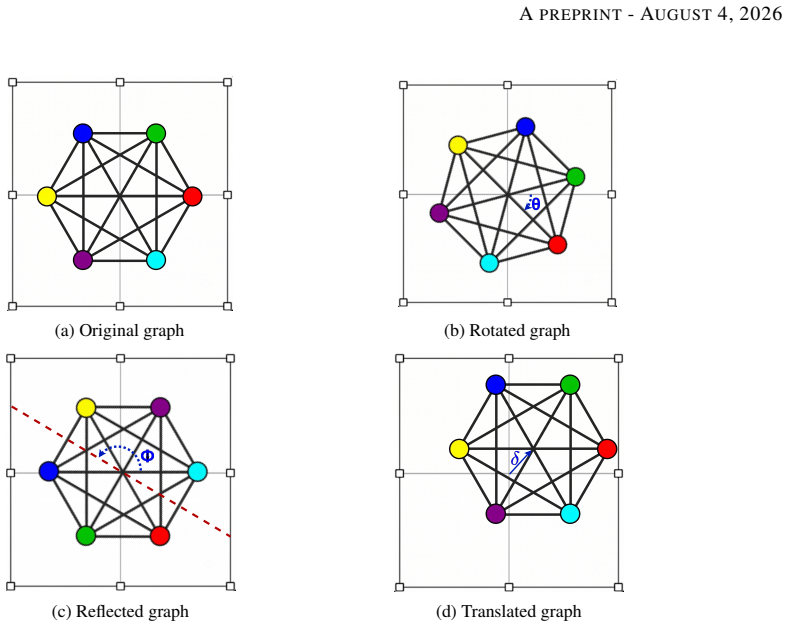
The load-bearing mechanism is the geometric pretext task: the InfoNCE loss applied to global graph embeddings of an instance and its isometrically transformed view. The transformations are central rotation, axial reflection, and translation, composed randomly; the encoder is a GatedGCN with edge-gated anisotropic message passing, and a temporary two-layer MLP projection head maps the global embedding to a lower-dimensional space for the contrastive loss and is discarded before RL. The paper's argument is that maximizing agreement between views with identical pairwise distances but different coordinates makes the encoder capture distance distributions rather than absolute positions.
What would settle it
Run the same architecture under three conditions with identical total training epochs: (1) proposed rotation+reflection pre-training then RL, (2) RL from scratch for the full budget, (3) a control pretext task such as predicting the rotation angle from the global embedding, then RL. Compare zero-shot optimality gaps at TSP1,000. If condition (2) or (3) matches condition (1)'s 55.1% gap, the geometric-invariance explanation is falsified.
Extended reading notes
Core claim
The paper's claim is that for the Euclidean TSP, the reason reinforcement-learned solvers fail at large scale is that their encoders memorize absolute coordinate distributions instead of relative distances. To fix this, the authors add a self-supervised phase before RL: they generate augmented views by rotating and reflecting each instance around its center, and train the GatedGCN encoder with the InfoNCE contrastive loss so that global embeddings of the original and transformed views agree. Because these isometric transformations preserve all pairwise distances, the optimal tour is unchanged, so the encoder is forced to represent structure that matters for routing. After this phase the proj
Load-bearing premise
The paper credits the geometric pre-training for the gains, but its baseline receives no pre-training phase, so the comparison mixes augmentation choice with a 100-epoch training advantage; if an equivalent-budget or non-geometric-pre-text baseline matches the results, the central claim loses support.
Editorial extensions
If this is right
- Pre-training with rotation and reflection cuts the zero-shot optimality gap at TSP1,000 from 67.2% to 55.1%, a 7.23% relative reduction in average tour length.
- The improvement comes without slowing inference: the pre-trained model runs at roughly the same time as the baseline and up to two orders of magnitude faster than Concorde at 1,000 nodes.
- Augmentation choice matters: translation as an augmentation makes extrapolation worse than no pre-training at TSP1,000 (76.2% vs 67.2% gap), so distance preservation alone is not enough.
- Training on a variable range of instance sizes (20–50 nodes) helps zero-shot extrapolation to moderate scales, but at ultra-dense scales a model trained at a fixed size can outperform it.
- These results hold for the GatedGCN encoder with a REINFORCE-trained attention decoder; the paper does not claim the same for other architectures.
Reading between the lines
- A natural next test is an equal-budget control: train the baseline from scratch for the same total number of epochs as pre-training plus fine-tuning, or with a non-geometric pretext task, to isolate whether the gain comes from geometric invariance or simply from extra encoder training.
- The translation failure suggests a design rule for geometric contrastive learning on metric graphs: augmentations must preserve not just distances but also local neighborhood identity at the resolution of the instance, a principle likely to transfer to other routing and packing problems.
- The pre-trained encoder might serve as a reusable geometric feature extractor for other optimization tasks beyond TSP, such as CVRP or facility location, without requiring the exact contrastive setup; this is an untested extension.
- If the geometric pretext task genuinely induces distance-aware representations, one could probe the embedding geometry directly, e.g., check whether encoder distances between node embeddings correlate with Euclidean distances across scales.
Editorial analysis
A structured set of objections, weighed in public.
Referee Report
Summary. The paper proposes a geometric self-supervised pre-training framework for neural TSP solvers. A GatedGCN encoder is pre-trained with an InfoNCE contrastive loss on pairs of TSP instances related by isometric transformations (rotation, axial reflection, translation), then fine-tuned with REINFORCE and a rollout baseline. The central claim is that this pre-training improves zero-shot extrapolation to large instances, with the abstract reporting a 7.23% improvement in tour length at TSP1,000, along with large speedups over Concorde. The authors include an ablation over transformation combinations, a scale-variability study, and comparisons to exact and heuristic solvers.
Significance. If validated, the method would be a simple and impactful contribution to neural combinatorial optimization, addressing a well-known generalization bottleneck. The paper's strengths are its clear problem motivation, the use of an invariance property that provably holds for Euclidean TSP tours, and the public release of code and pre-trained models. The ablation across transformation types is thorough, and the comparisons to Concorde are useful. However, the central empirical claim is currently confounded: the 'None' baseline receives no pre-training, so the reported gains cannot be attributed to geometric invariance as opposed to additional optimization budget. Controlled experiments are needed before the significance of the result can be assessed.
major comments (2)
- [Section 4.1, Table 1] The main comparison is not controlled for training budget. The 'None (Baseline)' model is trained from scratch for 50 RL epochs, while every pre-trained variant receives 100 contrastive pre-training epochs plus 50 RL epochs (Section 4.1). The differences in Table 1—especially the TSP1,000 gap reduction from 67.2% to 55.1%—therefore conflate the geometric pretext with an additional 100 epochs of gradient updates. To support the paper's central attribution, the authors must add (a) an RL-only baseline trained for the same total number of epochs (e.g., 150 RL epochs) and/or (b) a control pre-training with a non-geometric pretext that uses the same computational budget. Without such controls, the claim that 'pre-training consistently establishes a generalized superiority over random initialization' is not established.
- [Abstract, Section 4.2, Eq. (26)] The abstract's '7.23% improvement in tour length' is derived from a relative reduction in the optimality gap (12.1 percentage points relative to the baseline's 167.2% tour cost), not from directly measured tour lengths. This derivation should be stated explicitly, and the abstract should clarify what is being measured. As written, a reader could reasonably interpret the claim as a 7.23% reduction in average tour length, which is not what is reported.
minor comments (4)
- [Section 2.2, reference [8]] The reference for GraphCL is incorrect; [8] is 'Graph contrastive learning automated' (JOAO), not the original GraphCL paper. Please cite the original work and adjust the sentence accordingly.
- [Section 4.2, Table 2] The 'state-of-the-art comparison' does not include any recent neural NCO baselines (e.g., POMO, DIMES, or other attention-based models), only exact/heuristic solvers and the authors' own baseline. Either add published neural baselines or soften the 'state-of-the-art' language.
- [Section 4.3, Table 3] The row and column labels in Table 3 are difficult to parse in the current formatting; 'Pre-trainingTraining' is run together and the evaluation scale columns are not clearly separated. Please reformat for readability.
- [Section 4.2] The explanation for why translation hurts generalization is presented as a 'hypothesis' (Section 4.2). If this explanation is important to the narrative, support it with a targeted experiment (e.g., analyzing embedding distances or ablation with smaller translation magnitudes); otherwise, mark it clearly as speculative.
Circularity Check
No circularity found: the geometric pre-training claim is empirical and benchmarked externally (Concorde); no equation-level self-reference or load-bearing self-citation.
full rationale
The paper's central claim is that isometric-transformation-based contrastive pre-training improves zero-shot TSP extrapolation. This is an empirical claim evaluated against Concorde, an external exact solver, so the performance numbers are not constructed from the method's own definitions. The invariance property used to motivate the augmentation (optimal tour unchanged under rotations/reflections) is a mathematical property of Euclidean TSP, not an assumption that embeds the target result. The InfoNCE loss (Eq. 23) is a standard contrastive objective; it does not include tour length or optimality gap as an input. There is no fitted parameter that is subsequently renamed as a prediction, no uniqueness theorem imported from the authors' prior work, and no self-citation chain supporting the central premise. The strongest methodological weakness is that the 'None' baseline receives no 100-epoch contrastive pre-training, confounding augmentation choice with total training budget. That is a correctness/experimental-design concern, not circularity: it does not make the claimed improvement equivalent to the method's inputs by construction. The paper is self-contained against external benchmarks, so the honest circularity score is 0.
Assumptions & free parameters
free parameters (4)
- k-NN neighborhood size k
- Maximum translation displacement =
15% of coordinate range
- Bernoulli augmentation probability p =
0.5
- Scale variability range during pre-training/training =
U(20,50) or U(20,100)
assumptions (4)
- standard math Euclidean TSP optimal tour is invariant under rotations, reflections, and translations.
- domain assumption Contrastive agreement between graph-level global embeddings transfers to node-level policy quality.
- domain assumption A k-NN sparsified graph preserves enough metric structure for TSP solving at n up to 1,000.
- ad hoc to paper The 100-epoch pre-training phase can be credited to the geometric objective rather than to the added optimization budget.
Cite this review
Pith. "Pith review of Geometric Self-Supervised Pre-training for Neural Combinatorial Optimization." pith.science (2026). https://pith.science/paper/54S3I6VE
@misc{pith2026260800270,
  author       = {Pith},
  title        = {Pith review of: Geometric Self-Supervised Pre-training for Neural Combinatorial Optimization},
  year         = {2026},
  howpublished = {\url{https://pith.science/paper/54S3I6VE}},
  note         = {Machine review of arXiv:2608.00270}
}
read the original abstract
Neural Combinatorial Optimization (NCO) techniques have emerged as a highly efficient alternative to traditional exact algorithms for solving routing problems such as the Traveling Salesman Problem (TSP). However, the generalization capabilities of these Reinforcement Learning-based models are severely hindered when scaling to high-dimensional instances. This issue has been mitigated in other domains, like computer vision and natural language processing, by adopting a self-supervised pre-training strategy. Nevertheless, its application to routing graphs, which lack complex topological attributes beyond 2D spatial coordinates, remains a challenge. In this paper, we propose a geometric self-supervised pre-training framework specifically designed to capture spatial invariance and global relative distance distributions. By applying isometric transformations, such as rotations and axial reflections, the model learns robust structural representations prior to the policy optimization phase. Empirical results demonstrate that this strategy consistently outperforms models trained from scratch (baselines), achieving a 7.23\% improvement in tour length for massive zero-shot extrapolation scenarios (TSP1,000). Furthermore, the proposed model exhibits remarkable computational efficiency, delivering speedups of up to two orders of magnitude over the exact solver Concorde at massive scales. The source code and pre-trained models are publicly available at https://github.com/davidaguadocosano/TSP-GeoPretrain.git.
Figures


Reference graph
Works this paper leans on
-
[1]
Fu Luo, Xi Lin, Fei Liu, Qingfu Zhang, and Zhenkun Wang. Neural combinatorial optimization with heavy decoder: Toward large scale generalization.ArXiv, abs/2310.07985, 2023
arXiv 2023
-
[2]
Attention, learn to solve routing problems! InInternational Conference on Learning Representations, 2019
Wouter Kool, Herke van Hoof, and Max Welling. Attention, learn to solve routing problems! InInternational Conference on Learning Representations, 2019
2019
-
[3]
RRNCO: Towards real-world routing with neural combinatorial optimization
Jiwoo Son, Zhikai Zhao, Federico Berto, Chuanbo Hua, Zhiguang Cao, Changhyun Kwon, and Jinkyoo Park. RRNCO: Towards real-world routing with neural combinatorial optimization. InWorkshop on Differentiable Learning of Combinatorial Algorithms, 2025
2025
-
[4]
Toutanova
Jacob Devlin, Ming-Wei Chang, Kenton Lee, and Kristina N. Toutanova. Bert: Pre-training of deep bidirectional transformers for language understanding. 2018
2018
-
[5]
Masked autoencoders are scalable vision learners
Kaiming He, Xinlei Chen, Saining Xie, Yanghao Li, Piotr Dollár, and Ross Girshick. Masked autoencoders are scalable vision learners. In2022 IEEE/CVF Conference on Computer Vision and Pattern Recognition (CVPR), pages 15979–15988, 2022
2022
-
[6]
Graphmae2: A decoding-enhanced masked self-supervised graph learner
Zhenyu Hou, Yufei He, Yukuo Cen, Xiao Liu, Yuxiao Dong, Evgeny Kharlamov, and Jie Tang. Graphmae2: A decoding-enhanced masked self-supervised graph learner. InProceedings of the ACM Web Conference 2023, WWW ’23, page 737–746, New York, NY , USA, 2023. Association for Computing Machinery
2023
-
[7]
Hamilton, Pietro Liò, Yoshua Bengio, and R Devon Hjelm
Petar Veliˇckovi´c, William Fedus, William L. Hamilton, Pietro Liò, Yoshua Bengio, and R Devon Hjelm. Deep graph infomax. InInternational Conference on Learning Representations, 2019
2019
-
[8]
Graph contrastive learning automated
Yuning You, Tianlong Chen, Yang Shen, and Zhangyang Wang. Graph contrastive learning automated. In Marina Meila and Tong Zhang, editors,Proceedings of the 38th International Conference on Machine Learning, volume 139 ofProceedings of Machine Learning Research, pages 12121–12132. PMLR, 18–24 Jul 2021
2021
Show all 32 references
-
[9]
Applegate, Robert E
David L. Applegate, Robert E. Bixby, Vašek Chvatál, and William J. Cook.The Traveling Salesman Problem: A Computational Study. Princeton University Press, 2006
2006
-
[10]
Morrison, Sheldon H
David R. Morrison, Sheldon H. Jacobson, Jason J. Sauppe, and Edward C. Sewell. Branch-and-bound algorithms: A survey of recent advances in searching, branching, and pruning.Discrete Optimization, 19:79–102, 2016
2016
-
[11]
An extension of the lin-kernighan-helsgaun tsp solver for constrained traveling salesman and vehicle routing problems: Technical report
Keld Helsgaun. An extension of the lin-kernighan-helsgaun tsp solver for constrained traveling salesman and vehicle routing problems: Technical report. 2017
2017
-
[12]
David Astoquillca-Yaranga and Esther Berger-Vidal. Heurística de intercambio 2opt best improvement y nivel de eficacia de las soluciones del problema del agente viajero simétrico.Revista peruana de computación y sistemas, 5:65–81, 06 2023
2023
-
[13]
K. T. Chung, C. K. M. Lee, and Y . P. Tsang. Neural combinatorial optimization with reinforcement learning in industrial engineering: a survey.Artificial Intelligence Review, 58(5):130, 2025
2025
-
[14]
Pointer networks
Oriol Vinyals, Meire Fortunato, and Navdeep Jaitly. Pointer networks. In C. Cortes, N. Lawrence, D. Lee, M. Sugiyama, and R. Garnett, editors,Advances in Neural Information Processing Systems, volume 28. Curran Associates, Inc., 2015
2015
-
[15]
Kipf and Max Welling
Thomas N. Kipf and Max Welling. Semi-supervised classification with graph convolutional networks, 2017
2017
-
[16]
Graph attention networks, 2018
Petar Veliˇckovi´c, Guillem Cucurull, Arantxa Casanova, Adriana Romero, Pietro Liò, and Yoshua Bengio. Graph attention networks, 2018
2018
-
[17]
Gated graph sequence neural networks, 2017
Yujia Li, Daniel Tarlow, Marc Brockschmidt, and Richard Zemel. Gated graph sequence neural networks, 2017
2017
-
[18]
Joshi, Quentin Cappart, Louis-Martin Rousseau, and Thomas Laurent
Chaitanya K. Joshi, Quentin Cappart, Louis-Martin Rousseau, and Thomas Laurent. Learning the travelling salesperson problem requires rethinking generalization.Constraints, 27(1–2):70–98, April 2022
2022
-
[19]
Graphmae: Self-supervised masked graph autoencoders
Zhenyu Hou, Xiao Liu, Yukuo Cen, Yuxiao Dong, Hongxia Yang, Chunjie Wang, and Jie Tang. Graphmae: Self-supervised masked graph autoencoders. InProceedings of the 28th ACM SIGKDD Conference on Knowledge Discovery and Data Mining, KDD ’22, page 594–604, New York, NY , USA, 2022....
2022
-
[20]
Self-supervised graph representation learning via topology transformations
Xiang Gao, Wei Hu, and Guo-Jun Qi. Self-supervised graph representation learning via topology transformations. IEEE Transactions on Knowledge and Data Engineering, 35(4):4202–4215, April 2023
2023
-
[21]
Graph contrastive learning with personalized augmentation
Xin Zhang, Qiaoyu Tan, Xiao Huang, and Bo Li. Graph contrastive learning with personalized augmentation. IEEE Transactions on Knowledge and Data Engineering, 36(11):6305–6316, November 2024. 11 APREPRINT- AUGUST4, 2026
2024
-
[22]
Wen-Zhi Li, Chang-Dong Wang, Jian-Huang Lai, and Philip S. Yu. Towards effective and robust graph contrastive learning with graph autoencoding.IEEE Transactions on Knowledge and Data Engineering, 36(2):868–881, February 2024
2024
-
[23]
Multi-scale self- supervised graph contrastive learning with injective node augmentation.IEEE Transactions on Knowledge and Data Engineering, 36(1):261–274, January 2024
Haonan Zhang, Yuyang Ren, Luoyi Fu, Xinbing Wang, Guihai Chen, and Chenghu Zhou. Multi-scale self- supervised graph contrastive learning with injective node augmentation.IEEE Transactions on Knowledge and Data Engineering, 36(1):261–274, January 2024
2024
-
[24]
Sanfeng Zhang, Xinyi Liu, Zihao Qi, Xingchen Yan, and Wang Yang. GI-Graph: A generative invariant graph learning scheme towards out-of-distribution generalization.IEEE Transactions on Knowledge and Data Engineering, 37(10):5934–5947, October 2025
2025
-
[25]
Data augmentation on graphs: A technical survey.ACM Comput
Jiajun Zhou, Chenxuan Xie, Shengbo Gong, Zhenyu Wen, Xiangyu Zhao, Qi Xuan, and Xiaoniu Yang. Data augmentation on graphs: A technical survey.ACM Comput. Surv., 57(11), June 2025
2025
-
[26]
C. E. Miller, A. W. Tucker, and R. A. Zemlin. Integer programming formulation of traveling salesman problems. J. ACM, 7(4):326–329, 1960
1960
-
[27]
On layer normalization in the transformer architecture
Ruibin Xiong, Yunchang Yang, Di He, Kai Zheng, Shuxin Zheng, Chen Xing, Huishuai Zhang, Yanyan Lan, Liwei Wang, and Tie-Yan Liu. On layer normalization in the transformer architecture. InProceedings of the 37th International Conference on Machine Learning, ICML’20. JMLR.org, 2020
2020
-
[28]
A simple framework for contrastive learning of visual representations
Ting Chen, Simon Kornblith, Mohammad Norouzi, and Geoffrey Hinton. A simple framework for contrastive learning of visual representations. InProceedings of the 37th International Conference on Machine Learning, ICML’20. JMLR.org, 2020
2020
-
[29]
Householder
Alston S. Householder. Unitary triangularization of a nonsymmetric matrix.J. ACM, 5(4):339–342, October 1958
1958
-
[30]
Contrastive difference predictive coding
Chongyi Zheng, Ruslan Salakhutdinov, and Benjamin Eysenbach. Contrastive difference predictive coding. In The Twelfth International Conference on Learning Representations, 2024
2024
-
[31]
White and Douglas J
Chelsea C. White and Douglas J. White. Markov decision processes.European Journal of Operational Research, 39(1):1–16, 1989
1989
-
[32]
Williams
Ronald J. Williams. Simple statistical gradient-following algorithms for connectionist reinforcement learning. Machine Learning, 8(3):229–256, May 1992. 12 APREPRINT- AUGUST4, 2026 A Visual comparison Baseline Rotation Reflection Rot + Ref TSP20 TSP50 TSP100 Translation Concor...
1992
Reviewed August 4, 2026 · model on record in the stance chip above.
Discussion (0). Continue with ORCID to comment.