REVIEW 3 major objections 5 minor 55 references
Hybrid-Domain Posterior Sampling for Inverse Problems via Latent Flow Matching
T0 review · 3 major / 5 minor · reviewed 2026-08-05 · deepseek-v4-flash
Pith's one-line read Latent flow inverse solvers lose high-frequency detail because the decoder Jacobian is rank-deficient; HDPS fixes this by alternating pixel-space Langevin correction with decoder-inversion latent alignment.
desk verdict Strong empirical decoupling recipe for latent inverse solvers, but Theorem 4.1's claimed 'resolution of blindness' vanishes exactly at the stagnation point it is supposed to fix. read the letter →
The pith
A machine-rendered reading of the paper's core claim, the machinery that carries it, and where it could break.
The reading
What carries the argument
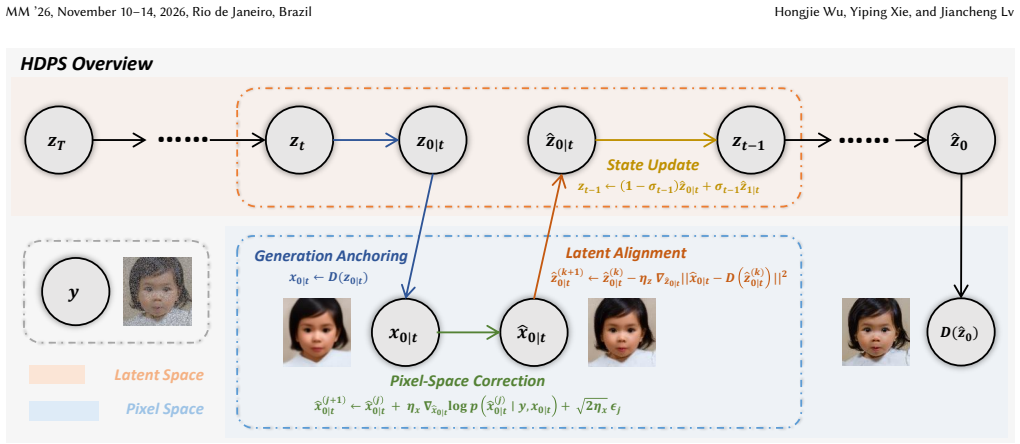
First-Order Manifold Blindness: the decoder's Jacobian maps a low-dimensional latent space (about 2% of pixel degrees of freedom) into pixel space, so latent gradients only see the projected component of the pixel gradient. HDPS replaces the composite backpropagation through A∘D with a decoupled loop: pixel-space Langevin dynamics absorb the full-rank measurement gradient, then optimization-based latent alignment inverts the decoder to return the corrected image to the manifold. Theorem 4.1 shows this loop yields a second-order correction along the orthogonal residual by leveraging the decoder's Hessian, without ever computing it explicitly.
What would settle it
Measure the orthogonal component of the pixel gradient before and after the decoder-inversion loop: for a fixed measurement, compute g⊥ (the part of ∇_x loss orthogonal to the decoder Jacobian's column space) at the decoded anchor and again after N_z=15 alignment steps. If the post-alignment image has no greater g⊥ component than a latent-only update, or if direct encoder projection matches decoder inversion in PSNR, the claimed mechanism resolving manifold blindness is not operating.
Extended reading notes
Core claim
The central claim is that the bottleneck in latent flow inverse solvers is geometric, not representational: even when the decoder can render the target image, first-order gradient updates on the latent code cannot reach the high-frequency residuals that lie in the orthogonal complement of the decoder Jacobian's column space. The paper proves that a decoupled procedure—Langevin dynamics in pixel space followed by projecting the corrected image back through decoder inversion—produces a nonzero update along those previously invisible directions, via the decoder's curvature, at second order in the pixel step size. The method, HDPS, is reported to outperform latent-only and baseline decoupled sol
Load-bearing premise
The early-stopped decoder inversion (about 15 steps) must map the pixel-corrected image back onto the decoder manifold without erasing the high-frequency corrections the Langevin steps just added; the paper itself calls this an 'anchored compromise'.
Editorial extensions
If this is right
- Latent flow inverse solvers can recover high-frequency structure without retraining or altering the decoder, as long as measurement consistency is enforced in pixel space.
- The pixel-space correction plus decoder-inversion pattern is a general template that can be layered onto any latent generative model with a fixed decoder.
- Because the composite gradient through A∘D is replaced by two simpler specialized operations, the decoupled loop can be cheaper per step than composite backpropagation at matched latent iterations.
- The method's ceiling is set by the decoder's capacity to represent the corrected image, so gains should be largest when the decoder is expressive but its Jacobian is rank-deficient.
- The framework extends in principle to nonlinear differentiable forward operators by replacing the linear adjoint in the Langevin step.
Reading between the lines
- The same decoupling likely applies to latent diffusion models, not just flow matching, since the first-order blindness argument depends only on the decoder Jacobian, not on the generative ODE.
- The early-stopped decoder inversion acts as an implicit regularizer; its step count N_z may need to be scheduled with noise level rather than fixed, and the alignment residual could serve as a data-dependent stopping criterion.
- A testable consequence is that the improvement over latent-only solvers should vanish for decoders that are locally linear, or when the residual happens to lie inside the Jacobian's column space.
- Replacing direct encoding with decoder inversion should matter most when pixel-space Langevin artifacts are non-Gaussian; measuring the artifact distribution could predict when direct encoding fails.
Editorial analysis
A structured set of objections, weighed in public.
Referee Report
Summary. The paper identifies a geometric limitation of latent-space inverse solvers, termed First-Order Manifold Blindness: because the decoder Jacobian is rank-deficient, pixel-space residuals orthogonal to its column space are invisible to first-order latent gradient updates. The authors propose Hybrid-Domain Posterior Sampling (HDPS), which alternates between pixel-space Langevin correction, optimization-based latent alignment by decoder inversion, and flow matching state updates. A theoretical result (Theorem 4.1) claims that this decoupled procedure resolves manifold blindness through a second-order curvature effect. Experiments are reported on FFHQ, AFHQ, and DIV2K at 768x768 resolution for inpainting, Gaussian/motion deblurring, and 12x super-resolution, with consistent large gains over several latent flow baselines when measured by PSNR/SSIM/LPIPS. Code is provided.
Significance. If the claimed mechanism is established, the decoupled framework is valuable: it offers a training-free way to inject pixel-space likelihood information into latent flow models, which is a timely problem. The paper's strengths include extensive benchmarking across five inverse problems and three datasets, public code, ablations of the main design choices, and a mostly correct local Taylor analysis. However, the central theoretical claim does not apply in the stagnation regime it sets out to fix, and the 'state-of-the-art' claim is stronger than Table 1 supports. The empirical results may still stand, but the theoretical narrative needs substantial correction or reframing.
major comments (3)
- [Theorem 4.1 / Appendix A] The theorem's conclusion does not cover the regime that motivates it. The proof's first-order optimality condition gives v = -(J_D^T J_D)^\dagger J_D^T g_parallel. In the stagnation regime described in Sec. 3.2, the latent gradient J_D^T g = 0; because g_perp is orthogonal to R(J_D), this implies J_D^T g_parallel = 0, hence g_parallel = 0 and v = 0. Then Eq. (10) gives <Δx, g_perp> = O(eta_x^3), not a second-order correction. Thus Theorem 4.1 demonstrates at most a second-order effect when g_parallel is nonzero, which is not the blindness case. Additionally, the Appendix A claim that pure latent optimization has <Δx, g_perp> = 0 'at all orders' is incorrect: a finite latent step z0 + eta v produces the curvature term (eta^2/2) v^T H_D v, whose projection onto g_perp is generally nonzero. The contrast with latent-only optimization is therefore overstated.
- [Sec. 4.3, Eq. (9); Sec. 5.6; Appendix D.2] Theorem 4.1 assumes that zhat is the exact argmin of ||xhat - D(z)||^2, while Algorithm 1 and Eq. (9) perform only N_z = 15 gradient steps initialized at z_{0|t}. Appendix D.2 itself describes the finite alignment as 'an anchored compromise.' The early-stopped projection may not satisfy the first-order optimality condition used in the theorem, so the claimed second-order correction is not a rigorous explanation for the behavior of the implemented algorithm. The empirical gains in Table 1 could plausibly arise from the anchoring/regularization effect of early stopping rather than from the exact-argmin curvature mechanism. Please either analyze the finite-N_z case explicitly or present the theoretical result as a heuristic motivation rather than as the resolution of manifold blindness.
- [Table 1 / Sec. 5.2] The text states that HDPS 'consistently achieves state-of-the-art performance' and reports 'best or second-best scores across all metrics,' but Table 1 contains counterexamples. On FFHQ SR x12 (Avgpool), FlowDPS achieves PSNR 27.11 / SSIM 0.770 versus HDPS 26.99 / SSIM 0.719; on DIV2K SR x12 (Bicubic), FlowDPS has LPIPS 0.246 versus HDPS 0.250; on DIV2K SR x12 (Avgpool), FlowDPS has SSIM 0.525 versus HDPS 0.504. The overall superiority should therefore be qualified by task and metric. The broad 'state-of-the-art' claim in the abstract and Sec. 5.2 is too strong in its present form.
minor comments (5)
- [Sec. 4.2, Eq. (8)] The schedule tau_t = sigma_t / sqrt(1 + sigma_t^2) is used but sigma_t is not explicitly defined as the same noise schedule appearing in Eq. (6) and Eq. (11). Please clarify the notation.
- [Table 1] Several numeric entries run together (e.g., '0.7700.158', '26.90 0.697 0.165'), making the table hard to read. Please fix the formatting.
- [Figure 1(b)] The labels g_pixel and g_latent are difficult to read at the printed size. Consider using separate panels with larger fonts.
- [Algorithm 1 / Sec. 4.1] The generation anchoring step uses classifier-free guidance with a condition c, but the unconditional forward pass is not defined explicitly. Please give the exact formula used for v_theta(z_t, t, empty).
- [Appendix B.2] FlowDPS is reported with 'step size 15' in the baseline configuration. This seems inconsistent with the original FlowDPS settings and should be verified; also report the search range if it was tuned.
Circularity Check
No significant circularity: HDPS's central claims are benchmarked externally and its theory is derived from explicit assumptions; the two self-citations are background only.
full rationale
The paper's derivation chain is not circular in any load-bearing sense. Proposition 3.1 (First-Order Manifold Blindness) is a direct linear-algebra identity: because g_perp is defined to lie in the orthogonal complement of the column space of J_D, J_D^T g_perp = 0 follows by definition; it is not a prediction derived from a fitted quantity. Theorem 4.1 is a Taylor expansion of the actual decoder-inversion objective in Eq. (9) applied to the actual pixel-correction update in Eq. (8); the displayed second-order term is derived from the first-order optimality condition J_D^T(D(zhat)-xhat)=0, not assumed. The empirical state-of-the-art claim is measured against external baselines (FLAIR, FlowDPS, FlowChef, ReSample, LatentDAPS) under a fixed SD3 backbone; no HDPS parameter is fitted to those test metrics and then reported as a prediction. The hyperparameter choices (N_x=20, N_z=15, t0=0.8) are ablation-tuned operating points, not disguised predictions. The two self-citations by the authors (refs [40] and [41]) appear only in the related-work enumeration of pixel-space solvers and are not used to define HDPS's alignment, Langevin step, or flow update; they are not load-bearing. A caveat that belongs to correctness, not circularity: the skeptic's observation that Theorem 4.1's second-order term vanishes when g_parallel=0 (the pure-blindness regime) is a potential overstatement of the theorem's scope, but the theorem is still derived rather than assumed, and the algorithm's empirical gains are not constructed from that theorem. The paper even states in Section D.2 that the finite alignment is 'an anchored compromise', which undercuts any claim that Eq. (9)'s early-stopped version is exactly the theorem's argmin; this is an admitted limitation, not a circular step. Overall, the central derivation is self-contained against external benchmarks and its key objects are not defined in terms of the conclusions, so the circularity burden is low.
Assumptions & free parameters
free parameters (5)
- t0 (initialization time) =
0.8
- N_x (pixel Langevin steps) =
20
- N_z (latent alignment steps) =
15
- eta_x (pixel Langevin step size) =
not reported
- eta_z (latent alignment step size) =
not reported
assumptions (5)
- standard math The measurement residuals orthogonal to the decoder Jacobian have zero latent gradient (J^T g_perp = 0)
- domain assumption The decoder D is twice differentiable with Hessian H_D and g_perp^T H_D != 0
- domain assumption The decoded anchor x0|t acts as a Gaussian prior for the pixel Langevin step with scale tau_t = sigma_t/sqrt(1+sigma_t^2)
- domain assumption The pre-trained encoder E maps off-manifold pixel artifacts into semantically corrupted latent codes, making direct encoding inferior
- ad hoc to paper Warm-start at t0=0.8 bypasses an uninformative zero-SNR regime
Cite this review
Pith. "Pith review of Hybrid-Domain Posterior Sampling for Inverse Problems via Latent Flow Matching." pith.science (2026). https://pith.science/paper/WWRBG6EU
@misc{pith2026260800537,
  author       = {Pith},
  title        = {Pith review of: Hybrid-Domain Posterior Sampling for Inverse Problems via Latent Flow Matching},
  year         = {2026},
  howpublished = {\url{https://pith.science/paper/WWRBG6EU}},
  note         = {Machine review of arXiv:2608.00537}
}
abstract
Latent Flow Models have revolutionized compressed-space image synthesis, yet their application to high-fidelity inverse problems remains bottlenecked. In this paper, we trace this dilemma to a fundamental geometric limitation of pre-trained autoencoders, which we term \emph{First-Order Manifold Blindness}. Severe decoder compression (e.g., retaining only $\sim\!2\%$ of the original degrees of freedom) produces a rank-deficient Jacobian, rendering high-frequency measurement residuals in its orthogonal complement invisible to latent gradients even when the decoder can represent the target image. To overcome this bottleneck, we propose Hybrid-Domain Posterior Sampling (HDPS), a decoupled inference framework that disentangles physical measurement consistency from semantic prior modeling. HDPS diverges into the pixel space, leveraging Langevin dynamics to absorb precise orthogonal measurement gradients, and subsequently projects these structural corrections back onto the generative manifold. An optimization-based latent alignment is introduced to filter pixel-space artifacts while avoiding the semantic drift of direct encoding. Extensive experiments on diverse inverse problems demonstrate that HDPS establishes a new state-of-the-art, successfully recovering the high-frequency structural precision that latent-only solvers inherently discard. The code is available at \href{https://github.com/74587887/HDPS}{https://github.com/74587887/HDPS}.
Figures


Figures from the paper (10 more)


Reference graph
Works this paper leans on
-
[1]
Eirikur Agustsson and Radu Timofte. 2017. Ntire 2017 challenge on single image super-resolution: Dataset and study. InProceedings of the IEEE conference on computer vision and pattern recognition workshops. 126–135
2017
- [2]
-
[3]
Hmrishav Bandyopadhyay, Rahim Entezari, Jim Scott, Reshinth Adithyan, Yi-Zhe Song, and Varun Jampani. 2025. SD3. 5-Flash: Distribution-Guided Distillation of Generative Flows.arXiv preprint arXiv:2509.21318(2025)
arXiv 2025
-
[4]
Heli Ben-Hamu, Omri Puny, Itai Gat, Brian Karrer, Uriel Singer, and Yaron Lipman
-
[5]
Dongdong Chen, Julián Tachella, and Mike E Davies. 2021. Equivariant imaging: Learning beyond the range space. InProceedings of the IEEE/CVF International Conference on Computer Vision. 4379–4388
work page 2021
-
[6]
Yunjey Choi, Youngjung Uh, Jaejun Yoo, and Jung-Woo Ha. 2020. Stargan v2: Diverse image synthesis for multiple domains. InProceedings of the IEEE/CVF conference on computer vision and pattern recognition. 8188–8197
2020
-
[7]
Hyungjin Chung, Jeongsol Kim, Michael Thompson Mccann, Marc Louis Klasky, and Jong Chul Ye. 2023. Diffusion Posterior Sampling for General Noisy In- verse Problems. InInternational Conference on Learning Representations. https: //openreview.net/forum?id=OnD9zGAGT0k
work page 2023
-
[8]
Hyungjin Chung, Suhyeon Lee, and Jong Chul Ye. 2024. Decomposed Diffusion Sampler for Accelerating Large-Scale Inverse Problems. InThe Twelfth Interna- tional Conference on Learning Representations. https://openreview.net/forum?id= DsEhqQtfAG
work page 2024
Show all 55 references
-
[9]
Hyungjin Chung, Byeongsu Sim, Dohoon Ryu, and Jong Chul Ye. 2022. Improving Diffusion Models for Inverse Problems using Manifold Constraints. InAdvances in Neural Information Processing Systems, Alice H. Oh, Alekh Agarwal, Danielle Bel- grave, and Kyunghyun Cho (Eds.). https:/...
2022
-
[10]
Hyungjin Chung, Jong Chul Ye, Peyman Milanfar, and Mauricio Delbracio. 2024. Prompt-tuning Latent Diffusion Models for Inverse Problems. InForty-first In- ternational Conference on Machine Learning. https://openreview.net/forum?id= hrwIndai8e
2024
-
[11]
Julius Erbach, Dominik Narnhofer, Andreas Dombos, Bernt Schiele, Jan Eric Lenssen, and Konrad Schindler. 2025. Solving Inverse Problems with FLAIR. arXiv preprint arXiv:2506.02680(2025)
2025
-
[12]
Patrick Esser, Sumith Kulal, Andreas Blattmann, Rahim Entezari, Jonas Müller, Harry Saini, Yam Levi, Dominik Lorenz, Axel Sauer, Frederic Boesel, et al. 2024. Scaling rectified flow transformers for high-resolution image synthesis. InForty- first International Conference on Ma...
2024
-
[13]
Linchao He, Hongyu Yan, Mengting Luo, Kunming Luo, Wang Wang, Wen- chao Du, Hu Chen, Hongyu Yang, and Yi Zhang. 2023. Iterative reconstruction based on latent diffusion model for sparse data reconstruction.arXiv preprint arXiv:2307.12070(2023)
2023 arXiv
-
[14]
Jonathan Ho, Ajay Jain, and Pieter Abbeel. 2020. Denoising diffusion probabilistic models.Advances in Neural Information Processing Systems33 (2020), 6840–6851
2020
-
[15]
Jonathan Ho and Tim Salimans. 2021. Classifier-Free Diffusion Guidance. In NeurIPS 2021 Workshop on Deep Generative Models and Downstream Applications. https://openreview.net/forum?id=qw8AKxfYbI
2021
-
[16]
Jonathan Ho, Tim Salimans, Alexey Gritsenko, William Chan, Mohammad Norouzi, and David J Fleet. 2022. Video diffusion models.Advances in Neu- ral Information Processing Systems35 (2022), 8633–8646
2022
-
[17]
Tero Karras, Samuli Laine, and Timo Aila. 2019. A style-based generator ar- chitecture for generative adversarial networks. InProceedings of the IEEE/CVF conference on computer vision and pattern recognition. 4401–4410
2019
-
[18]
Bahjat Kawar, Michael Elad, Stefano Ermon, and Jiaming Song. 2022. Denoising Diffusion Restoration Models. InAdvances in Neural Information Processing Sys- tems, Alice H. Oh, Alekh Agarwal, Danielle Belgrave, and Kyunghyun Cho (Eds.). https://openreview.net/forum?id=kxXvopt9pWK
2022
-
[19]
Jeongsol Kim, Bryan Sangwoo Kim, and Jong Chul Ye. 2025. Flowdps: Flow- driven posterior sampling for inverse problems. InProceedings of the IEEE/CVF International Conference on Computer Vision. 12328–12337
2025
-
[20]
Diederik P Kingma and Max Welling. 2013. Auto-encoding variational bayes. arXiv preprint arXiv:1312.6114(2013)
2013 arXiv
-
[21]
Black Forest Labs, Stephen Batifol, Andreas Blattmann, Frederic Boesel, Saksham Consul, Cyril Diagne, Tim Dockhorn, Jack English, Zion English, Patrick Esser, et al. 2025. FLUX. 1 Kontext: Flow Matching for In-Context Image Generation and Editing in Latent Space.arXiv preprint...
2025 arXiv
-
[22]
Yaron Lipman, Ricky T. Q. Chen, Heli Ben-Hamu, Maximilian Nickel, and Matthew Le. 2023. Flow Matching for Generative Modeling. InThe Eleventh International Conference on Learning Representations. https://openreview.net/ forum?id=PqvMRDCJT9t
2023
-
[23]
Xingchao Liu, Chengyue Gong, and qiang liu. 2023. Flow Straight and Fast: Learning to Generate and Transfer Data with Rectified Flow. InThe Eleventh International Conference on Learning Representations. https://openreview.net/ forum?id=XVjTT1nw5z
2023
-
[24]
Ségolène Tiffany Martin, Anne Gagneux, Paul Hagemann, and Gabriele Steidl
-
[25]
Alexander Quinn Nichol and Prafulla Dhariwal. 2021. Improved denoising diffu- sion probabilistic models. InInternational Conference on Machine Learning. PMLR, 8162–8171
2021
-
[26]
Jonghyun Park and Jong Chul Ye. 2025. FlowLPS: Langevin-Proximal Sampling for Flow-based Inverse Problem Solvers.arXiv preprint arXiv:2512.07150(2025)
2025 arXiv
-
[27]
Metaxas, and Yezhou Yang
Maitreya Patel, Song Wen, Dimitris N. Metaxas, and Yezhou Yang. 2025. Steering Rectified Flow Models in the Vector Field for Controlled Image Generation. In Frontiers in Probabilistic Inference: Learning meets Sampling. https://openreview. net/forum?id=p3DUUpd2No
2025
-
[28]
Mehrsa Pourya, Bassam El Rawas, and Michael Unser. 2025. FLOWER: A Flow- Matching Solver for Inverse Problems.arXiv preprint arXiv:2509.26287(2025)
2025
-
[29]
Robin Rombach, Andreas Blattmann, Dominik Lorenz, Patrick Esser, and Björn Ommer. 2022. High-resolution image synthesis with latent diffusion models. In Proceedings of the IEEE/CVF Conference on Computer Vision and Pattern Recognition. 10684–10695
2022
-
[30]
Litu Rout, Yujia Chen, Abhishek Kumar, Constantine Caramanis, Sanjay Shakkot- tai, and Wen-Sheng Chu. 2024. Beyond first-order tweedie: Solving inverse problems using latent diffusion. InProceedings of the IEEE/CVF Conference on Computer Vision and Pattern Recognition. 9472–9481
2024
-
[31]
Litu Rout, Negin Raoof, Giannis Daras, Constantine Caramanis, Alex Dimakis, and Sanjay Shakkottai. 2023. Solving Linear Inverse Problems Provably via Posterior Sampling with Latent Diffusion Models. InThirty-seventh Conference on Neural Information Processing Systems
2023
-
[32]
Bowen Song, Soo Min Kwon, Zecheng Zhang, Xinyu Hu, Qing Qu, and Liyue Shen. 2024. Solving Inverse Problems with Latent Diffusion Models via Hard Data Consistency. InThe Twelfth International Conference on Learning Representations. https://openreview.net/forum?id=j8hdRqOUhN
2024
-
[33]
Jiaming Song, Arash Vahdat, Morteza Mardani, and Jan Kautz. 2023. Pseudoinverse-Guided Diffusion Models for Inverse Problems. InInternational Conference on Learning Representations. https://openreview.net/forum?id=9_ gsMA8MRKQ
2023
-
[34]
Jiaming Song, Qinsheng Zhang, Hongxu Yin, Morteza Mardani, Ming-Yu Liu, Jan Kautz, Yongxin Chen, and Arash Vahdat. 2023. Loss-guided diffusion models for plug-and-play controllable generation. InInternational Conference on Machine Learning. PMLR, 32483–32498
2023
-
[35]
Yang Song, Jascha Sohl-Dickstein, Diederik P Kingma, Abhishek Kumar, Stefano Ermon, and Ben Poole. 2021. Score-Based Generative Modeling through Stochas- tic Differential Equations. InInternational Conference on Learning Representations. https://openreview.net/forum?id=PxTIG12RRHS
2021
-
[36]
2005.Inverse problem theory and methods for model parameter estimation
Albert Tarantola. 2005.Inverse problem theory and methods for model parameter estimation. SIAM
2005
-
[37]
Arash Vahdat, Karsten Kreis, and Jan Kautz. 2021. Score-based generative model- ing in latent space.Advances in Neural Information Processing Systems34 (2021), 11287–11302
2021
-
[38]
Yinhuai Wang, Jiwen Yu, and Jian Zhang. 2023. Zero-Shot Image Restora- tion Using Denoising Diffusion Null-Space Model. InThe Eleventh Interna- tional Conference on Learning Representations. https://openreview.net/forum?id= mRieQgMtNTQ
2023
-
[39]
Zhou Wang, Alan C Bovik, Hamid R Sheikh, and Eero P Simoncelli. 2004. Image quality assessment: from error visibility to structural similarity.IEEE transactions on image processing13, 4 (2004), 600–612
2004
-
[40]
Hongjie Wu, Linchao He, Mingqin Zhang, Dongdong Chen, Kunming Luo, Mengt- ing Luo, Ji-Zhe Zhou, Hu Chen, and Jiancheng Lv. 2024. Diffusion Posterior Proximal Sampling for Image Restoration. InProceedings of the 32nd ACM Inter- national Conference on Multimedia. 214–223
2024
-
[41]
Hongjie Wu, Mingqin Zhang, Linchao He, Ji-Zhe Zhou, and Jiancheng Lv. 2025. Enhancing Diffusion Model Stability for Image Restoration via Gradient Man- agement. InProceedings of the 33rd ACM International Conference on Multimedia. 10768–10777
2025
-
[42]
Rongyuan Wu, Tao Yang, Lingchen Sun, Zhengqiang Zhang, Shuai Li, and Lei Zhang. 2024. Seesr: Towards semantics-aware real-world image super-resolution. MM ’26, November 10–14, 2026, Rio de Janeiro, Brazil Hongjie Wu, Yiping Xie, and Jiancheng Lv InProceedings of the IEEE/CVF c...
2024
-
[43]
Zihui Wu, Yu Sun, Yifan Chen, Bingliang Zhang, Yisong Yue, and Katherine L Bouman. 2024. Principled Probabilistic Imaging using Diffusion Models as Plug- and-Play Priors.arXiv e-prints(2024), arXiv–2405
2024
-
[44]
Yici Yan, Yichi Zhang, Xiangming Meng, and Zhizhen Zhao. 2025. Fig: Flow with interpolant guidance for linear inverse problems. InThe Thirteenth International Conference on Learning Representations
2025
-
[45]
Bingliang Zhang, Wenda Chu, Julius Berner, Chenlin Meng, Anima Anandkumar, and Yang Song. 2025. Improving diffusion inverse problem solving with decoupled noise annealing. InProceedings of the Computer Vision and Pattern Recognition Conference. 20895–20905
2025
-
[46]
Lvmin Zhang, Anyi Rao, and Maneesh Agrawala. 2023. Adding conditional con- trol to text-to-image diffusion models. InProceedings of the IEEE/CVF international conference on computer vision. 3836–3847
2023
-
[47]
Richard Zhang, Phillip Isola, Alexei A Efros, Eli Shechtman, and Oliver Wang
-
[48]
Youyuan Zhang, Zehua Liu, Zenan Li, Zhaoyu Li, James J Clark, and Xujie Si
-
[49]
Yasi Zhang, Peiyu Yu, Yaxuan Zhu, Yingshan Chang, Feng Gao, Ying N Wu, and Oscar Leong. 2024. Flow priors for linear inverse problems via iterative corrupted trajectory matching.Advances in Neural Information Processing Systems37 (2024), 57389–57417
2024
-
[50]
Yuanzhi Zhu, Kai Zhang, Jingyun Liang, Jiezhang Cao, Bihan Wen, Radu Timofte, and Luc Van Gool. 2023. Denoising Diffusion Models for Plug-and-Play Image Restoration. InProceedings of the IEEE/CVF Conference on Computer Vision and Pattern Recognition. 1219–1229
2023
-
[51]
a photo of a closed face
Nicolas Zilberstein, Morteza Mardani, and Santiago Segarra. 2025. Repulsive Latent Score Distillation for Solving Inverse Problems. InThe Thirteenth Interna- tional Conference on Learning Representations. https://openreview.net/forum?id= bwJxUB0y46 Hybrid-Domain Posterior Samp...
2025
-
[52]
InProceedings of the Computer Vision and Pattern Recognition Conference
Decoupling training-free guided diffusion by admm. InProceedings of the Computer Vision and Pattern Recognition Conference. 23292–23302
-
[2018]
InProceedings of the IEEE conference on computer vision and pattern recognition
The unreasonable effectiveness of deep features as a perceptual metric. InProceedings of the IEEE conference on computer vision and pattern recognition. 586–595
-
[2024]
D-flow: Differentiating through flows for controlled generation.arXiv preprint arXiv:2402.14017(2024)
2024 arXiv
-
[2025]
In The Thirteenth International Conference on Learning Representations
PnP-Flow: Plug-and-Play Image Restoration with Flow Matching. In The Thirteenth International Conference on Learning Representations. https: //openreview.net/forum?id=5AtHrq3B5R
Reviewed August 5, 2026 · model on record in the stance chip above.
Discussion (0). Continue with ORCID to comment.