REVIEW 2 major objections 5 minor 101 references
This paper argues that axion-like particles produced in neutron stars are best sought in the MeV band, where archival COMPTEL data already constrain previously open parameter space and the future COSI telescope could test much more.
Reviewed by Pith at T0; open to challenge. T0 means a machine referee read the full paper against a public rubric. the ladder, T0–T4 →
T0 review · deepseek-v4-flash
2026-08-05 00:33 UTC pith:IOK4B3DP
load-bearing objection Solid, honest ALP flux study of four pulsars that makes a good case for MeV searches, but its headline COMPTEL exclusion sits on a nucleon-coupling benchmark five times above the SN1987A bound quoted in the same paper. the 2 major comments →
Gamma Rays from ALP-Photon Conversion and Inverse Compton Reprocessing in Neutron Star Magnetospheres
The pith
A machine-rendered reading of the paper's core claim, the machinery that carries it, and where it could break.
Core claim
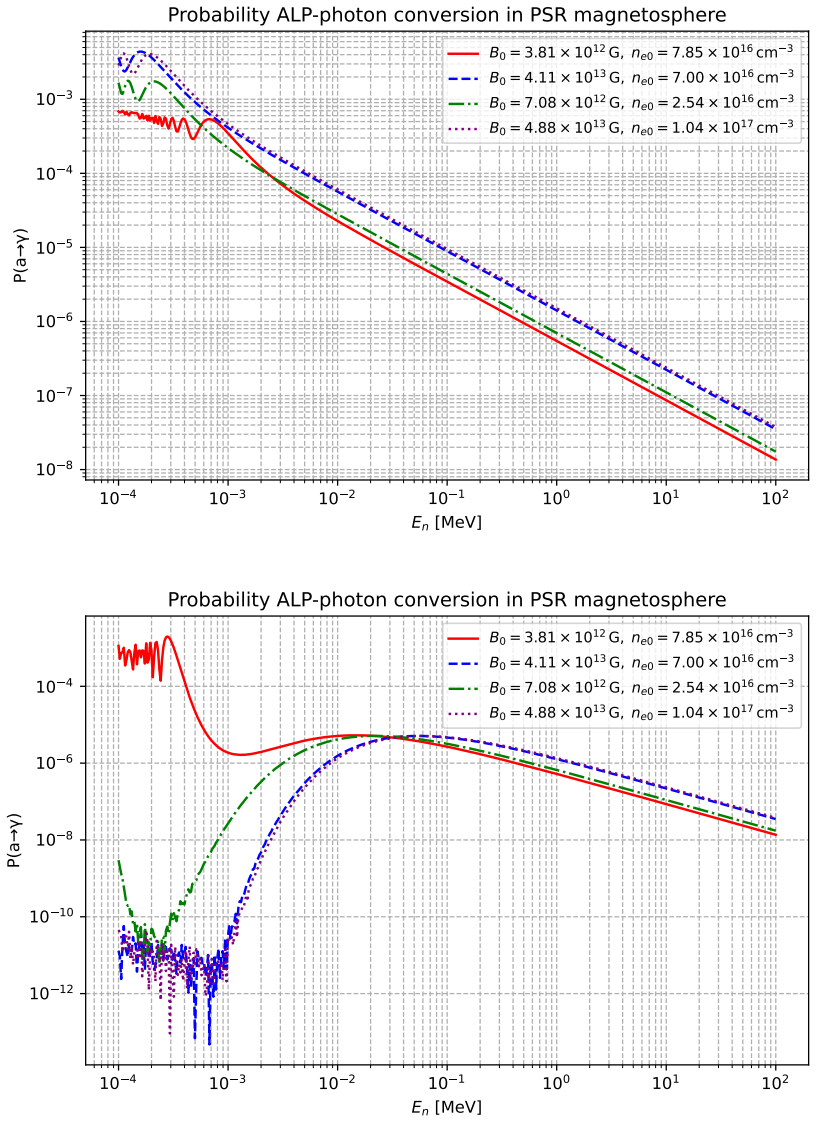
On the paper's own terms, the central claim is that neutron-star magnetospheres do produce observable ALP-induced gamma rays, but in the MeV gap rather than in the Fermi-LAT band. The chain runs from a core temperature of about 10^9 K, through T^6-scaling ALP emissivities, through ALP-photon conversion at radii roughly 10^3 to 10^4 stellar radii where the QED vacuum-polarization term, the plasma term, and the ALP mass term balance in the mixing matrix, to a resulting photon flux peaking below about 1 MeV. Inverse Compton reprocessing by magnetospheric electrons can shift emission above 100 MeV, but the resulting energy flux stays around 10^-11 MeV cm^-2 s^-1, below Fermi-LAT sensitivity. The
What carries the argument
The load-bearing object is the photon-ALP mixing system in the neutron-star magnetosphere, described by a three-state Schr\"odinger-like equation with diagonal photon terms from plasma frequency and QED vacuum birefringence, an ALP mass term, and an off-diagonal mixing term proportional to g_a\gamma B sin\theta. Efficient conversion occurs where the accumulated phase difference becomes of order one, defining a conversion radius, typically far from the stellar surface because strong-field QED suppresses mixing close to the star. The plasma density entering the mixing is taken from the standard corotating magnetospheric charge-density model, with a steep atmospheric layer near the surface and
Load-bearing premise
The absolute ALP luminosity rests on two imported inputs: a core temperature of about 10^9 K from the standard cooling law, and nucleon couplings g_an = g_ap = 5e-9 GeV^-1, which exceed the SN1987A bound of about 1e-9 GeV^-1 that the paper itself quotes; since every flux scales as the square of these couplings, a smaller coupling or colder core weakens the derived exclusions by a comparable factor.
What would settle it
Measure the 0.2-5 MeV spectrum of the Crab with COSI and test whether adding an ALP-conversion component improves the fit over a pure astrophysical pulsar model: if the residual is consistent with no ALP component across the masses where the paper predicts a best-fit feature, the central signal claim for those masses is falsified; conversely, a detection of the predicted oscillatory spectral feature would confirm it. A direct measurement or improved inference of the Crab's core temperature would also test the T_core normalization on which all predicted fluxes scale.
If this is right
- Fermi-LAT is not the right instrument for this channel: null results in the 100 MeV-to-GeV band do not constrain NS-produced ALPs, because the primary converted flux sits below about 1 MeV.
- Existing COMPTEL data on the Crab already exclude part of the ALP parameter space, and for m_a above about 10^-5 eV the limits reach previously unconstrained region.
- A future MeV telescope with COSI-like sensitivity could probe g_a\gamma values below current CAST limits for light ALPs and extend into new high-mass territory.
- The Crab, being the closest target, gives the strongest projected sensitivity despite its lower magnetic field, while magnetar-like pulsars add complementary reach through their stronger fields and different plasma environments.
- Combining several pulsar targets in a joint analysis should harden the constraints, since conversion probability depends on magnetic-field strength, distance, and magnetospheric conditions.
Where Pith is reading between the lines
- Our inference: if the nucleon couplings were lowered to the SN1987A bound that the paper itself quotes, roughly a factor of five below the adopted benchmark, all fluxes and derived g_a\gamma exclusions would shrink by the same factor-squared, likely erasing the new high-mass exclusion; this is a straightforward re-run rather than a paper claim.
- Our inference: the no-GeV-signal conclusion is conditional on the adopted magnetospheric pair spectrum and multiplicity; at the high end of the pair-multiplicity range, inverse-Compton reprocessing could bring the >100 MeV flux closer to Fermi-LAT sensitivity, so the negative GeV result is model-dependent.
- Our inference: the same production-and-conversion machinery could be applied to additional high-field neutron stars with accurately known distances to build a target list for MeV surveys, exploiting the diversity of magnetic fields, ages, and plasma densities in the population.
- Our inference: the assumption of radial, equatorial propagation maximizes the transverse magnetic field and thus likely sets an upper bound on conversion; a full ray-tracing treatment with non-dipolar field geometry could raise or lower individual source predictions, so source-by-source flux uncertainties are probably larger than the central values shown.
Editorial analysis
A structured set of objections, weighed in public.
Referee Report
Summary. The paper studies ALP production in neutron star cores via nucleon-nucleon bremsstrahlung, pion-assisted processes, electron bremsstrahlung, and Primakoff conversion, then calculates ALP-photon conversion in the NS magnetosphere and the Galactic magnetic field for four representative pulsars (Crab, PSR J1119-6127, PSR J1846-0258, PSR J1341-6220). It further considers inverse-Compton reprocessing of the converted photons. The central quantitative conclusions are (i) the ALP-induced flux is too small to be detectable in the Fermi-LAT band, (ii) the unconverted flux lies in the MeV gap and can be probed by COMPTEL and future instruments such as COSI, and (iii) for m_a ≳ 10^-5 eV the COMPTEL Crab data begin to exclude previously unconstrained (m_a, g_aγ) parameter space. The derivation chain is standard and transparently presented, and the paper is unusually honest about its limitations, explicitly disclaiming the COMPTEL best-fit points and the detectability of the IC-boosted component.
Significance. If the conclusions hold, the paper strengthens the scientific case for MeV gamma-ray observatories and provides a concrete, falsifiable target for COSI. The manuscript's main strengths are the clarity of the production/conversion formalism, the use of external validated codes and data (iminuit, 4FGL, 3PC, COMPTEL), and an honest assessment of systematics. The central result that the signal sits in the MeV gap rather than the Fermi-LAT band is robust to the main modeling uncertainties. However, the quantitative claim of a new high-mass COMPTEL exclusion rests on a benchmark nucleon coupling that exceeds the SN1987A bound quoted in the same paper, and the sensitivity of that claim to g_N and T_core is not quantified. This makes the headline exclusion provisional rather than established.
major comments (2)
- [Sec. 2.6, Sec. 5, Fig. 9] The COMPTEL exclusion for m_a ≳ 10^-5 eV is controlled by the ALP luminosity, which is set by the benchmark g_an = g_ap = 5×10^-9 GeV^-1 adopted in Sec. 2.6. This value exceeds the SN1987A bound g_ap ~ g_an < 10^-9 GeV^-1 that the paper itself quotes in Sec. 1 [13,14]. Since the emissivities (Eqs. 6, 8, 9) scale as g_N^2 and the flux (Eq. 48) scales as g_N^2 g_aγ^2, the derived upper limit on g_aγ scales inversely with g_N. Lowering g_N to the quoted 10^-9 GeV^-1 shifts the blue exclusion curve in Fig. 9 upward by a factor of about 5. The paper does not quantify the margin between this curve and the gray astrophysical bounds; if the margin is smaller than this factor, the claimed exclusion of previously unconstrained parameter space disappears. The same rescaling weakens the COSI projections in Fig. 11. The authors should either adopt a benchmark consistent with the quoted SN1987A bound
- [Eq. (1), Sec. 2.6, Sec. 5] The absolute ALP luminosity inherits a strong sensitivity to the core temperature, T_core, because the dominant nucleon-bremsstrahlung emissivities scale as T^6 and the electron channels as T^4. Equation (1) uses the simple cooling law T_core ~ 10^9 K (10^3 yr/t_NS)^(1/6), and the paper does not propagate any uncertainty in T_core into the exclusion or sensitivity curves. A factor-of-2 decrease in T_core reduces the ALP luminosity by a factor of 64 and weakens the derived g_aγ limits by a factor of about 8. This is comparable to or larger than the g_N rescaling discussed above, and could also erase the reported high-mass COMPTEL exclusion. The authors should provide a sensitivity band or a representative alternative cooling model (e.g., including superfluid pairing or different EoS) to show that the new exclusion is not an artifact of a single optimistic temperature choice.
minor comments (5)
- [Eq. (55)] The expression for the target photon density, nγ(E,r) ≃ 1/(4πr^2) dNγ/dE dt, is dimensionally inconsistent unless one works in units with c=1. The authors should either include the factor 1/c or explicitly state that c=1 is used throughout. As written, readers who reinstate c will find the IC emissivity (Eq. 51) and flux (Eq. 56) to be off by powers of c.
- [Sec. 2.6] The phrase 'benchmark values motivated by current limits' is misleading for g_ap = g_an = 5×10^-9 GeV^-1, since Sec. 1 quotes a stricter SN1987A bound of <10^-9 GeV^-1. Please rephrase to clarify that this is an optimistic benchmark, not a limit-satisfying value.
- [Sec. 4.1] Typo: 'PSR 1116-6127' should be 'PSR J1119-6127'.
- [Eq. (6)] Typo: 'where where' should be 'where'.
- [Fig. 9 caption] The right-panel axis label '2 = 2 null 2 best' is garbled; it should read 'χ²_null − χ²_best'.
Circularity Check
No significant circularity: the predicted fluxes are compared to independent external data (COMPTEL/Crab) and the production/conversion inputs are taken from external references, not fitted to the target.
full rationale
The derivation chain is self-contained against external anchors. ALP production rates (Eqs. 6, 8, 9, 13, 16, 19, 24) are taken from independent literature [22,56,62,68]; the core temperature scaling (Eq. 1) comes from Yakovlev–Pethick; the magnetospheric conversion uses the standard Raffelt–Stodolsky mixing formalism with Goldreich–Julian densities and QED polarization from Adler; and the Galactic conversion adopts the Jansson–Farrar magnetic-field model with a cross-check against Pshirkov et al. The observable flux of Eq. (48) is then compared to archival COMPTEL data through a profile-likelihood test, with no parameter fitted to the target being renamed as a prediction. The benchmark choice g_ap = g_an = 5e-9 GeV^-1 in Sec. 2.6 exceeds the SN1987A bound quoted in Sec. 1, and since all fluxes scale as g_N^2 the derived g_aγ exclusions scale inversely as g_N; this is a parameter-normalization/robustness concern, not circularity, because the prediction is not defined in terms of the data and is not a self-consistent reduction. Existing self-citations (e.g., [79] for Galactic propagation) are non-load-bearing and are independently cross-checked within the paper.
Axiom & Free-Parameter Ledger
free parameters (7)
- Pair multiplicity kappa =
10^4 (stated range 10^2-10^5)
- Benchmark nucleon couplings g_an, g_ap =
5x10^-9 GeV^-1
- Benchmark electron coupling g_ae =
1.3x10^-13 GeV^-1
- Core temperature T_core(t_NS) =
0.0465-0.086 MeV for the four pulsars (Eq. 1)
- Magnetospheric integration radius R_max =
10^4 r0
- Pion-nucleon correction factor C_pi =
1/4
- IC electron spectrum parameters =
p1 ~ 1.5 +/- 0.5, p2 ~ 2.5 +/- 0.5, gamma_break ~ 10^5, gamma_min ~ 10-100, gamma_max ~ 10^7-10^8
axioms (6)
- domain assumption The adopted emissivity formulas of Eqs. (6)-(24) correctly describe ALP production in neutron star matter
- domain assumption The neutron star core is isothermal and thermally relaxed, with T_core from Eq. (1)
- domain assumption The magnetosphere is a rotating vacuum dipole with Goldreich-Julian charge density and constant pair multiplicity kappa
- standard math The short-wavelength / perturbative conversion probability of Eq. (44) is valid
- domain assumption Resonant cyclotron absorption and pair production do not attenuate the signal
- domain assumption The Jansson-Farrar Galactic magnetic field model with the [82] update and the [85] electron-density model describe propagation to Earth
Cite this review
Pith. "Pith review of Gamma Rays from ALP-Photon Conversion and Inverse Compton Reprocessing in Neutron Star Magnetospheres." pith.science (2026). https://pith.science/paper/IOK4B3DP
@misc{pith2026260800589,
  author       = {Pith},
  title        = {Pith review of: Gamma Rays from ALP-Photon Conversion and Inverse Compton Reprocessing in Neutron Star Magnetospheres},
  year         = {2026},
  howpublished = {\url{https://pith.science/paper/IOK4B3DP}},
  note         = {Machine review of arXiv:2608.00589}
}
read the original abstract
Exploring axion-like particle (ALP) signatures from neutron stars (NSs) in the \emph{Fermi}-LAT energy range remains largely unexplored. Neutron stars with exceptionally strong magnetic fields, such as magnetars and pulsars with magnetar-like magnetic fields, provide particularly promising environments for ALP--photon conversion. Magnetars are characterized by surface magnetic fields as large as $B_0\sim(10^{14}$--$10^{15})\,\mathrm{G}$; however, despite their extreme magnetic fields, no steady magnetar emission has been firmly detected in the \emph{Fermi}-LAT energy range, with high-energy activity generally associated with rare flaring episodes. In this work, we investigate ALP production in the interiors of different classes of NSs and the subsequent conversion of ALPs into photons in their magnetospheres. The ALP emissivity is determined by the stellar density and temperature $T$, while the conversion probability is enhanced by the strong magnetic fields surrounding the star. We further account for photon propagation through the Galactic magnetic field, which can provide an additional contribution to the observable photon flux. We investigate the resulting gamma-ray signatures and assess whether ALP-induced emission from NS magnetospheres could be detectable at energies $E\gtrsim100,\mathrm{MeV}$ in the \emph{Fermi}-LAT band. In addition, we consider if the reprocessing of the magnetospheric photons through inverse Compton scattering can shift part of the emission to higher energies and provide an additional observational signature. We use the resulting fluxes to derive constraints from existing gamma-ray observations and to estimate the sensitivity of future MeV--GeV observations, taking COSI as a representative example.
Figures




Reference graph
Works this paper leans on
-
[1]
A. Arvanitaki, S. Dimopoulos, S. Dubovsky, N. Kaloper, J. March-Russell, String Axiverse, Phys. Rev. D 81 (2010) 123530.arXiv:0905.4720,doi:10.1103/PhysRevD.81.123530
Pith/arXiv arXiv 2010
-
[2]
J. Jaeckel, A. Ringwald, The Low-Energy Frontier of Particle Physics, Ann. Rev. Nucl. Part. Sci. 60 (2010) 405–437.arXiv:1002.0329,doi:10.1146/annurev.nucl.012809.104433
Pith/arXiv arXiv 2010
-
[3]
Ringwald, Exploring the Role of Axions and Other WISPs in the Dark Universe, Phys
A. Ringwald, Exploring the Role of Axions and Other WISPs in the Dark Universe, Phys. Dark Univ. 1 (2012) 116–135.arXiv:1210.5081,doi:10.1016/j.dark.2012.10.008
Pith/arXiv arXiv 2012
-
[4]
R. D. Peccei, H. R. Quinn, CP Conservation in the Presence of Instantons, Phys. Rev. Lett. 38 (1977) 1440– 1443.doi:10.1103/PhysRevLett.38.1440
-
[5]
R. D. Peccei, H. R. Quinn, Constraints Imposed by CP Conservation in the Presence of Instantons, Phys. Rev. D 16 (1977) 1791–1797.doi:10.1103/PhysRevD.16.1791
-
[6]
Hook, TASI Lectures on the Strong CP Problem and Axions, PoS TASI2018 (2019) 004.arXiv:1812
A. Hook, TASI Lectures on the Strong CP Problem and Axions, PoS TASI2018 (2019) 004.arXiv:1812. 02669,doi:10.22323/1.333.0004
-
[7]
P. Arias, D. Cadamuro, M. Goodsell, J. Jaeckel, J. Redondo, A. Ringwald, WISPy Cold Dark Matter, JCAP 06 (2012) 013.arXiv:1201.5902,doi:10.1088/1475-7516/2012/06/013
Pith/arXiv arXiv 2012
-
[8]
Albertus, et al., WISPedia – the WISPs Encyclopedia (2 2026).arXiv:2602.09089
C. Albertus, et al., WISPedia – the WISPs Encyclopedia (2 2026).arXiv:2602.09089
arXiv 2026
-
[9]
O’Hare, cajohare/axionlimits: Axionlimits,https://cajohare.github.io/AxionLimits/(Jul
C. O’Hare, cajohare/axionlimits: Axionlimits,https://cajohare.github.io/AxionLimits/(Jul. 2020). doi:10.5281/zenodo.3932430
-
[10]
K. Altenmüller, et al., New Upper Limit on the Axion-Photon Coupling with an Extended CAST Run with a Xe-Based Micromegas Detector, Phys. Rev. Lett. 133 (22) (2024) 221005.arXiv:2406.16840,doi:10. 1103/PhysRevLett.133.221005
Pith/arXiv arXiv 2024
-
[11]
A. Payez, C. Evoli, T. Fischer, M. Giannotti, A. Mirizzi, A. Ringwald, Revisiting the SN1987A gamma-ray limit on ultralight axion-like particles, JCAP 02 (2015) 006.arXiv:1410.3747,doi:10.1088/1475-7516/ 2015/02/006
Pith/arXiv arXiv 2015
-
[12]
F. Capozzi, G. Raffelt, Axion and neutrino bounds improved with new calibrations of the tip of the red-giant branch using geometric distance determinations, Phys. Rev. D 102 (8) (2020) 083007.arXiv:2007.03694, doi:10.1103/PhysRevD.102.083007
Pith/arXiv arXiv 2020
-
[13]
A. Lella, P. Carenza, G. Co’, G. Lucente, M. Giannotti, A. Mirizzi, T. Rauscher, Getting the most on supernova axions, Phys. Rev. D 109 (2) (2024) 023001.arXiv:2306.01048,doi:10.1103/PhysRevD.109.023001
Pith/arXiv arXiv 2024
-
[14]
P. Carenza, T. Fischer, M. Giannotti, G. Guo, G. Martínez-Pinedo, A. Mirizzi, Improved axion emissivity from a supernova via nucleon-nucleon bremsstrahlung, JCAP 10 (10) (2019) 016, [Erratum: JCAP 05, E01 (2020)]. arXiv:1906.11844,doi:10.1088/1475-7516/2019/10/016
Pith/arXiv arXiv 2019
-
[15]
M. S. Pshirkov, S. B. Popov, Conversion of Dark matter axions to photons in magnetospheres of neutron stars, J. Exp. Theor. Phys. 108 (2009) 384–388.arXiv:0711.1264,doi:10.1134/S1063776109030030
Pith/arXiv arXiv 2009
-
[16]
B. R. Safdi, Z. Sun, A. Y . Chen, Detecting Axion Dark Matter with Radio Lines from Neutron Star Populations, Phys. Rev. D 99 (12) (2019) 123021.arXiv:1811.01020,doi:10.1103/PhysRevD.99.123021. 25
Pith/arXiv arXiv 2019
-
[17]
A. Hook, Y . Kahn, B. R. Safdi, Z. Sun, Radio Signals from Axion Dark Matter Conversion in Neutron Star Mag- netospheres, Phys. Rev. Lett. 121 (24) (2018) 241102.arXiv:1804.03145,doi:10.1103/PhysRevLett. 121.241102
Pith/arXiv arXiv 2018
-
[18]
F. P. Huang, K. Kadota, T. Sekiguchi, H. Tashiro, Radio telescope search for the resonant conversion of cold dark matter axions from the magnetized astrophysical sources, Phys. Rev. D 97 (12) (2018) 123001.arXiv: 1803.08230,doi:10.1103/PhysRevD.97.123001
Pith/arXiv arXiv 2018
-
[19]
S. J. Lloyd, P. M. Chadwick, A. M. Brown, H.-k. Guo, K. Sinha, Axion Constraints from Quiescent Soft Gamma-ray Emission from Magnetars, Phys. Rev. D 103 (2) (2021) 023010.arXiv:2001.10849,doi: 10.1103/PhysRevD.103.023010
work page internal anchor Pith review Pith/arXiv arXiv 2021
-
[20]
T. D. P. Edwards, B. J. Kavanagh, L. Visinelli, C. Weniger, Transient Radio Signatures from Neutron Star Encounters with QCD Axion Miniclusters, Phys. Rev. Lett. 127 (13) (2021) 131103.arXiv:2011.05378, doi:10.1103/PhysRevLett.127.131103
Pith/arXiv arXiv 2021
-
[21]
Agrawal, et al., Feebly-interacting particles: FIPs 2020 workshop report, Eur
P. Agrawal, et al., Feebly-interacting particles: FIPs 2020 workshop report, Eur. Phys. J. C 81 (11) (2021) 1015. arXiv:2102.12143,doi:10.1140/epjc/s10052-021-09703-7
Pith/arXiv arXiv 2020
-
[22]
J.-F. Fortin, H.-K. Guo, S. P. Harris, E. Sheridan, K. Sinha, Magnetars and axion-like particles: probes with the hard X-ray spectrum, JCAP 06 (2021) 036.arXiv:2101.05302,doi:10.1088/1475-7516/2021/06/036
Pith/arXiv arXiv 2021
-
[23]
R. A. Battye, B. Garbrecht, J. I. McDonald, S. Srinivasan, Radio line properties of axion dark matter conversion in neutron stars, JHEP 09 (2021) 105.arXiv:2104.08290,doi:10.1007/JHEP09(2021)105
Pith/arXiv arXiv 2021
-
[24]
D. Noordhuis, A. Prabhu, C. Weniger, S. J. Witte, Axion Clouds around Neutron Stars, Phys. Rev. X 14 (4) (2024) 041015.arXiv:2307.11811,doi:10.1103/PhysRevX.14.041015
Pith/arXiv arXiv 2024
-
[25]
S. Roy, A. Prabhu, C. Thompson, S. J. Witte, C. Blanco, J. Zhang, Searching for axion dark matter near relaxing magnetars, Phys. Rev. D 113 (4) (2026) 043001.arXiv:2505.20450,doi:10.1103/glnt-t93q
Pith/arXiv arXiv 2026
-
[26]
U. Bhura, et al., Axion search with telescope for radio astronomy (ASTRA): forecast for observations between 0.5 and 4~GHz (3 2026).arXiv:2603.13194
arXiv 2026
-
[27]
D. R. Lorimer, M. Kramer, Handbook of Pulsar Astronomy, V ol. 4, 2004
2004
-
[28]
A. A. Abdo, et al., Search for Gamma-ray Emission from Magnetars with the Fermi Large Area Telescope, Astrophys. J. Lett. 725 (1) (2010) L73–L78.arXiv:1011.0091,doi:10.1088/2041-8205/725/1/L73
work page internal anchor Pith review Pith/arXiv arXiv 2010
-
[29]
J. Li, N. Rea, D. F. Torres, E. de Oña-Wilhelmi, Gamma-ray Upper Limits on Magnetars with Six Years of Fermi-LAT Observations, Astrophys. J. 835 (1) (2017) 30.arXiv:1607.03778,doi:10.3847/1538-4357/ 835/1/30
work page internal anchor Pith review Pith/arXiv arXiv 2017
-
[30]
Search for transient gamma-ray emission from magnetar flares using Fermi-LAT
V . Ramakrishnan, S. Desai, Search for transient gamma-ray emission from magnetar flares using Fermi-LAT, JCAP 07 (2025) 050.arXiv:2412.03900,doi:10.1088/1475-7516/2025/07/050
work page internal anchor Pith review Pith/arXiv arXiv 2025
-
[31]
V . M. Kaspi, A. Beloborodov, Magnetars, Ann. Rev. Astron. Astrophys. 55 (2017) 261–301.arXiv:1703. 00068,doi:10.1146/annurev-astro-081915-023329
-
[32]
P. Esposito, N. Rea, G. L. Israel, Magnetars: a short review and some sparse considerations, Astrophys. Space Sci. Libr. 461 (2020) 97–142.arXiv:1803.05716,doi:10.1007/978-3-662-62110-3_3
Pith/arXiv arXiv 2020
-
[33]
J. Ballet, P. Bruel, T. H. Burnett, B. Lott, Fermi Large Area Telescope Fourth Source Catalog Data Release 4 (4FGL-DR4) (7 2023).arXiv:2307.12546
Pith/arXiv arXiv 2023
-
[34]
D. A. Smith, et al., The Third Fermi Large Area Telescope Catalog of Gamma-Ray Pulsars, Astrophys. J. 958 (2) (2023) 191.arXiv:2307.11132,doi:10.3847/1538-4357/acee67
Pith/arXiv arXiv 2023
-
[36]
G. Raffelt, A. Caputo, Astrophysical axion bounds: The 2024 edition, in: Proceedings of 1st General Meeting and 1st Training School of the COST Action COSMIC WSIPers — PoS(COSMICWISPers), COSMICWIS- Pers, Sissa Medialab, 2024, p. 041.doi:10.22323/1.454.0041. URLhttp://dx.doi.org/10.22323/1.454.0041
-
[37]
C.-C. Li, T.-R. Hu, F.-K. Guo, U.-G. Meißner, Pion axioproduction revisited, Physical Review D 109 (7) (Apr. 2024).doi:10.1103/physrevd.109.075050. URLhttp://dx.doi.org/10.1103/PhysRevD.109.075050
- [38]
-
[40]
V . Schönfelder, H. Aarts, K. Bennett, H. de Boer, R. Diehl, W. Hermsen, G. Lichti, D. Morris, J. Ryan, A. Strong, D. J. Thompson, et al., Instrument Description and Performance of the Imaging Gamma-Ray Tele- scope COMPTEL aboard the Compton Gamma-Ray Observatory, Astrophys. J. Suppl. Ser. 86 (1993) 657–692. doi:10.1086/191794
-
[41]
Compton Telescopes for Gamma-ray Astrophysics
C. Kierans, T. Takahashi, G. Kanbach, Compton Telescopes for Gamma-ray Astrophysics (8 2022).arXiv: 2208.07819,doi:10.1007/978-981-16-4544-0_46-1
work page internal anchor Pith review Pith/arXiv arXiv 2022
-
[42]
Beechert, et al., Calibrations of the Compton Spectrometer and Imager, Nucl
J. Beechert, et al., Calibrations of the Compton Spectrometer and Imager, Nucl. Instrum. Meth. A 1031 (2022) 166510.arXiv:2203.00695,doi:10.1016/j.nima.2022.166510
Pith/arXiv arXiv 2022
-
[43]
Gallego, et al., Preflight Background Estimates for COSI, Astrophys
S. Gallego, et al., Preflight Background Estimates for COSI, Astrophys. J. 997 (2) (2026) 284.doi:10.3847/ 1538-4357/ae32f4
2026
- [44]
-
[45]
H. Georgi, D. B. Kaplan, L. Randall, Manifesting the Invisible Axion at Low-energies, Phys. Lett. B 169 (1986) 73–78.doi:10.1016/0370-2693(86)90688-X
-
[46]
L. Darmé, F. Giacchino, E. Nardi, M. Raggi, Invisible decays of axion-like particles: constraints and prospects, JHEP 06 (2021) 009.arXiv:2012.07894,doi:10.1007/JHEP06(2021)009
Pith/arXiv arXiv 2021
-
[47]
G. Raffelt, L. Stodolsky, Mixing of the Photon with Low Mass Particles, Phys. Rev. D 37 (1988) 1237.doi: 10.1103/PhysRevD.37.1237
-
[48]
G. G. Raffelt, Stars as laboratories for fundamental physics: The astrophysics of neutrinos, axions, and other weakly interacting particles, 1996
1996
-
[49]
A. De Angelis, M. Roncadelli, O. Mansutti, Evidence for a new light spin-zero boson from cosmological gamma-ray propagation?, Phys. Rev. D 76 (2007) 121301.arXiv:0707.4312,doi:10.1103/PhysRevD. 76.121301
Pith/arXiv arXiv 2007
-
[50]
K. A. Hochmuth, G. Sigl, Effects of Axion-Photon Mixing on Gamma-Ray Spectra from Magnetized As- trophysical Sources, Phys. Rev. D 76 (2007) 123011.arXiv:0708.1144,doi:10.1103/PhysRevD.76. 123011
Pith/arXiv arXiv 2007
-
[51]
M. A. Sanchez-Conde, D. Paneque, E. Bloom, F. Prada, A. Dominguez, Hints of the existence of Axion- Like-Particles from the gamma-ray spectra of cosmological sources, Phys. Rev. D 79 (2009) 123511.arXiv: 0905.3270,doi:10.1103/PhysRevD.79.123511
Pith/arXiv arXiv 2009
-
[52]
G. Galanti, Axion-like Particle Effects on Photon Polarization in High-Energy Astrophysics, Universe 10 (8) (2024) 312.arXiv:2407.21421,doi:10.3390/universe10080312
Pith/arXiv arXiv 2024
-
[53]
M. Fortin, C. Providência, A. R. Raduta, F. Gulminelli, J. L. Zdunik, P. Haensel, M. Bejger, Neutron star radii and crusts: Uncertainties and unified equations of state, Phys. Rev. C94 (3) (2016) 035804.arXiv: 1604.01944,doi:10.1103/PhysRevC.94.035804
Pith/arXiv arXiv 2016
-
[54]
M. Prakash, T. L. Ainsworth, J. M. Lattimer, Equation of state and the maximum mass of neutron stars, Physical Review Letters 61 (22) (1988) 2518–2521.doi:10.1103/PhysRevLett.61.2518
-
[55]
P. Haensel, A. Y . Potekhin, D. G. Yakovlev, Neutron stars 1: Equation of state and structure, V ol. 326, Springer, New York, USA, 2007.doi:10.1007/978-0-387-47301-7
-
[56]
P. Carenza, M. Giannotti, J. Isern, A. Mirizzi, O. Straniero, Axion astrophysics, Phys. Rept. 1117 (2025) 1–102. arXiv:2411.02492,doi:10.1016/j.physrep.2025.02.002
Pith/arXiv arXiv 2025
-
[57]
P. Carenza, B. Fore, M. Giannotti, A. Mirizzi, S. Reddy, Enhanced Supernova Axion Emission and its Impli- cations, Phys. Rev. Lett. 126 (7) (2021) 071102.arXiv:2010.02943,doi:10.1103/PhysRevLett.126. 071102
Pith/arXiv arXiv 2021
-
[58]
D. J. Dean, M. Hjorth-Jensen, Pairing in nuclear systems: from neutron stars to finite nuclei, Rev. Mod. Phys. 75 (2003) 607.doi:10.1103/RevModPhys.75.607
-
[59]
J. A. Pons, D. Viganò, Magnetic, thermal and rotational evolution of isolated neutron stars, Liv. Rev. Comput. Astrophys. 5 (1) (2019) 3.arXiv:1911.03095,doi:10.1007/s41115-019-0006-7
Pith/arXiv arXiv 2019
-
[60]
B. Fore, S. Reddy, Pions in hot dense matter and their astrophysical implications, Phys. Rev. C 101 (2020) 035809.doi:10.1103/PhysRevC.101.035809. URLhttps://link.aps.org/doi/10.1103/PhysRevC.101.035809
-
[61]
S. P. Harris, B. Fore, S. Reddy, Bulk viscosity of nuclear matter with pions in the neutrino-trapped regime, 27 Phys. Rev. C 111 (1) (2025) 015802.arXiv:2407.18890,doi:10.1103/PhysRevC.111.015802
Pith/arXiv arXiv 2025
-
[62]
Iwamoto, Axion Emission from Neutron Stars, Phys
N. Iwamoto, Axion Emission from Neutron Stars, Phys. Rev. Lett. 53 (1984) 1198–1201.doi:10.1103/ PhysRevLett.53.1198
1984
-
[63]
C. J. Horowitz, M. A. Pérez-García, J. Piekarewicz, Neutrino-“pasta” scattering: The opacity of nonuniform neutron-rich matter, Phys. Rev. C 69 (2004) 045804.doi:10.1103/PhysRevC.69.045804. URLhttps://link.aps.org/doi/10.1103/PhysRevC.69.045804
-
[64]
Haensel, A
P. Haensel, A. Y . Potekhin, D. G. Yakovlev, Neutron Stars 1: Equation of State and Structure, V ol. 326 of Astrophysics and Space Science Library, Springer, 2007
2007
-
[65]
J. A. Pons, D. Viganò, N. Rea, A unified approach to the evolution of isolated neutron stars, Physical Review D 99 (2019) 103009
2019
-
[66]
D. Barba-González, C. Albertus, M. A. Pérez-García, Crystallization in single- and multicomponent neutron star crusts, Phys. Rev. C 106 (2022) 065806.doi:10.1103/PhysRevC.106.065806. URLhttps://link.aps.org/doi/10.1103/PhysRevC.106.065806
-
[67]
Anomalous thermal relaxation in warm ion plasmas
D. Barba-González, C. Albertus, M. Á. Pérez-García, Anomalous thermal relaxation in warm ion plasmas, Mon. Not. Roy. Astron. Soc. 537 (2) (2025) 723–729.arXiv:2406.01700,doi:10.1093/mnras/staf040
work page internal anchor Pith review Pith/arXiv arXiv 2025
-
[68]
P. Carenza, O. Straniero, B. Döbrich, M. Giannotti, G. Lucente, A. Mirizzi, Constraints on the coupling with photons of heavy axion-like-particles from Globular Clusters, Phys. Lett. B 809 (2020) 135709.arXiv:2004. 08399,doi:10.1016/j.physletb.2020.135709
-
[69]
S. J. Witte, D. Noordhuis, T. D. P. Edwards, C. Weniger, Axion-photon conversion in neutron star magne- tospheres: The role of the plasma in the Goldreich-Julian model, Phys. Rev. D 104 (10) (2021) 103030. arXiv:2104.07670,doi:10.1103/PhysRevD.104.103030
Pith/arXiv arXiv 2021
-
[70]
J. I. McDonald, S. J. Witte, Generalized ray tracing for axions in astrophysical plasmas, Phys. Rev. D 108 (10) (2023) 103021.arXiv:2309.08655,doi:10.1103/PhysRevD.108.103021
work page internal anchor Pith review Pith/arXiv arXiv 2023
-
[71]
E. U. Ginés, D. Noordhuis, C. Weniger, S. J. Witte, Numerical analysis of resonant axion-photon mixing, Phys. Rev. D 110 (8) (2024) 083007.arXiv:2405.08865,doi:10.1103/PhysRevD.110.083007
Pith/arXiv arXiv 2024
-
[72]
D. F. G. Fiorillo, Á. Gil Muyor, H.-T. Janka, G. G. Raffelt, E. Vitagliano, Axion-photon conversion in transient compact stars: Systematics, constraints, and opportunities (9 2025).arXiv:2509.13322
Pith/arXiv arXiv 2025
-
[73]
P. Goldreich, W. H. Julian, Pulsar electrodynamics, Astrophys. J. 157 (1969) 869.doi:10.1086/150119
doi:10.1086/150119 1969
-
[74]
A. N. Timokhin, A. K. Harding, On the polar cap cascade pair multiplicity of young pulsars, Astrophys. J. 810 (2) (2015) 144.arXiv:1504.02194,doi:10.1088/0004-637X/810/2/144
Pith/arXiv arXiv 2015
-
[75]
W. Heisenberg, H. Euler, Consequences of Dirac’s theory of positrons, Z. Phys. 98 (11-12) (1936) 714–732. arXiv:physics/0605038,doi:10.1007/BF01343663
Pith/arXiv arXiv 1936
-
[76]
V . S. Weisskopf, K. Dan. Vidensk. Selsk. Mat. Fys. Medd. 14 (1936) 6
1936
-
[77]
J. S. Schwinger, On gauge invariance and vacuum polarization, Phys. Rev. 82 (1951) 664–679.doi:10.1103/ PhysRev.82.664
1951
-
[78]
S. L. Adler, Photon splitting and photon dispersion in a strong magnetic field, Annals Phys. 67 (1971) 599–647. doi:10.1016/0003-4916(71)90154-0
-
[79]
G. Galanti, F. Tavecchio, M. Roncadelli, C. Evoli, Blazar VHE spectral alterations induced by photon-ALP oscillations, Mon. Not. R. Astron. Soc.487 (1) (2019) 123–132.arXiv:1811.03548,doi:10.1093/mnras/ stz1144
Pith/arXiv arXiv 2019
-
[80]
R. Jansson, G. R. Farrar, A New Model of the Galactic Magnetic Field, Astrophys. J.757 (1) (2012) 14.arXiv: 1204.3662,doi:10.1088/0004-637X/757/1/14
Pith/arXiv arXiv 2012
-
[81]
R. Jansson, G. R. Farrar, The Galactic Magnetic Field, Astrophys. J. Lett.761 (1) (2012) L11.arXiv:1210. 7820,doi:10.1088/2041-8205/761/1/L11
-
[82]
M. Unger, G. R. Farrar, Uncertainties in the Magnetic Field of the Milky Way, in: 35th International Cosmic Ray Conference (ICRC2017), V ol. 301 of International Cosmic Ray Conference, 2017, p. 558.arXiv:1707. 02339,doi:10.22323/1.301.0558
discussion (0)
Sign in with ORCID, Apple, or X to comment. Anyone can read and Pith papers without signing in.