REVIEW 3 major objections 5 minor 22 references
Axient: Debt-Free Finality for Leveraged Binary Event Markets
T0 review · 3 major / 5 minor · reviewed 2026-08-04 · deepseek-v4-flash
Pith's one-line read A robust sale rule can make leveraged event bets debt-free before finality, within a precisely defined operating set.
desk verdict A clean conditional mechanism-design result whose every guarantee is tied to an uncalibrated, author-specified operating set — worth refereeing, not worth deploying on the strength of this paper. read the letter →
The pith
A machine-rendered reading of the paper's core claim, the machinery that carries it, and where it could break.
The reading
What carries the argument
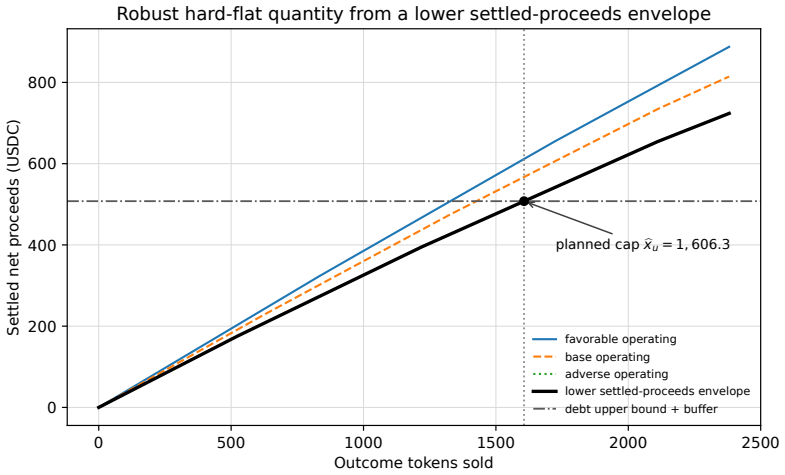
The central object is the lower settled-proceeds envelope: the worst-case confirmed cash available to repay debt by the settlement horizon across all paths in the registered operating set, for a fixed execution policy and cumulative sale quantity. Against this envelope the paper sets an upper debt-service envelope plus an explicit hard-flat buffer. The planned robust sale is the smallest admissible quantity whose envelope value, added to dedicated cash, covers the debt bound and buffer; after settlement, a realized audit minimum measures actual sufficiency without feeding back into the choice. The same logic extends to an exact book-dependent leverage envelope and to aggregate shared-book ca
What would settle it
On a live venue, record every hard-flat episode and check whether confirmed settled proceeds ever fall below the registered lower envelope, whether actual close ever occurs before the planned horizon, or whether a zero-liquidity or signer-failure path occurs while debt is positive. A single observed breach within the claimed coverage window would falsify the practical guarantee; the formal conditional theorem would remain true but vacuous for that registered set.
Extended reading notes
Core claim
Inside the registered operating set, with enforceable execution authority, collateral non-escape, and settlement by the horizon, the planned robust auto-deleverage clears debt by the hard-flat horizon; after confirmed extinction, lender credit-principal exposure is invariant to payout vector and dispute duration. The paper proves this through a robust ex-ante debt-clearing theorem, pathwise debt-extinguishment invariants, and debt-free-finality results, and complements them with an impossibility theorem: with leverage above one and no external collateral, no backend-only mechanism can promise zero shortfall if actual market closure, signer control, settlement, or executable liquidity falls o
Load-bearing premise
The guarantee holds only if the realized execution path actually lies inside the author-specified operating set, meaning the lower settled-proceeds envelope is a valid certificate for real venue behavior; if the path exits that set through premature close, zero liquidity, signer or collateral control failure, or unmodeled settlement, the debt-clearing theorem no longer applies.
Editorial extensions
If this is right
- Leverage can be offered on binary event markets with an explicit guarantee path: inside the operating set, loan principal becomes independent of the final payout and of dispute and redemption delay.
- The exact book-dependent leverage envelope supersedes the scalar recovery-ratio formula, which survives only as a linear-execution benchmark for interpretation.
- Aggregate hard-flat capacity, computed from shared execution paths, prevents several positions from double-counting the same bid liquidity.
- Ordinary finality states are guarded by confirmed debt-free status; positive debt is confined to explicit exception states pending reserve or recovery.
- The impossibility boundary forces any leverage-above-one product to choose among independent collateral, enforceable liquidity or settlement guarantees, venue-recognized liens, or a contractually restricted path set.
Reading between the lines
- If the operating set is calibrated from venue data, a natural empirical extension is to measure the breach rate of the lower settled-proceeds envelope and the distribution of actual close relative to scheduled close; the mechanism's practical value depends on those quantities, not on the algebra.
- The same envelope-and-settlement-confirmation discipline could transfer to other instruments whose underlying becomes non-tradable before finality, such as event-linked perpetuals or conditional-token baskets, provided execution authority and collateral non-escape are enforceable.
- A testable extension would run the robust sale rule against historical order-book and settlement records, comparing planned caps with realized audit minima to quantify conservative overshoot and detect operating-set violations.
- A chance-constraint variant could replace the deterministic lower envelope with a conditional quantile of settled proceeds, trading a small registered probability of breach for tighter leverage limits.
Editorial analysis
A structured set of objections, weighed in public.
Referee Report
Summary. The paper specifies Axient, a physically backed margin layer for binary event markets that separates the maturity of a repayable loan from the maturity of the financed outcome claim. It distinguishes quoted, matched, settled, and redeemed proceeds, and selects an ex-ante hard-flat sale as the minimum quantity whose lower settled-proceeds envelope over a registered operating set Uop covers an upper debt-service bound plus a buffer. The core results are: robust ex-ante debt clearing (Theorem 6.1), pathwise debt-clearing invariants, debt-free finality and dispute-duration invariance (Theorems 6.4, 6.5), a positive-debt impossibility boundary (Theorem 10.1), an exact book-dependent leverage envelope (Section 7), aggregate shared-book capacity constraints (Section 8), and scenario-conditional reserve bounds (Section 10). The paper also provides a deterministic verifier and an extensive implementation/trust discussion. The authors explicitly state that Uop and Ustress are author-specified and that empirical calibration is a separate research task; they disclaim production-safety claims.
Significance. If accepted as a conditional mechanism-design study, the paper makes a useful conceptual contribution: it separates execution objects that are often conflated and gives clean inequalities for when a pre-execution sale cap can be certified to extinguish debt. The paper is unusually explicit about its assumptions, negative results, and failure paths, and the deterministic verifier is a concrete reproducibility strength. The main limitation is the load-bearing condition: all robust guarantees apply only to an author-specified operating set whose empirical coverage is not tested, and the control assumptions are not currently supported by public venue interfaces. Thus the practical significance is conditional, and the title's 'debt-free finality' should be read as 'debt-free finality under a registered operating set and enforceable control assumptions.'
major comments (3)
- [§3.9, §14.1, Theorem 6.1] The central guarantee of Theorem 6.1 is conditional on the realized path lying in the author-specified operating set Uop, and the paper explicitly states in §3.9 that 'empirical calibration, target coverage, and out-of-sample validation are separate research tasks' and in §14.1 that the paper does not estimate how often a real venue leaves Uop. This is not an internal inconsistency, but it is the load-bearing gap between the conditional theorem and any practical reading of 'debt-free finality.' The title and abstract should be qualified accordingly, and the revision should either add a pre-registration/calibration protocol with explicit tolerances or state even more prominently that no real-venue coverage claim is made. Without this, readers may overstate the theorem's applicability.
- [§8.3, Theorem 8.4] The proof of segregated aggregate clearing is incomplete with respect to early stopping. The certified incremental lower bound in Eq. (71) is defined using the planned cumulative consumed quantity X_{j-1} before position πj. If an earlier position in the priority order clears its debt before selling its full allocation, the realized cumulative quantity consumed before πj is smaller than X_{j-1}. The proof says pathwise increments telescope, but it does not show that the certified lower bound based on the full planned execution remains valid for this altered execution path. The paper should add an explicit monotonicity or closure condition on Uop,agg (e.g., pathwise marginal proceeds are non-increasing in consumed depth, or the aggregate operating set is closed under earlier-stopping prefixes). Without such an assumption, the no-double-counting aggregate clearing claim is not fully establ
- [§12.7, §13.6, Assumptions 3.5 and 3.6] The paper's own capability mapping (Table 1) and trust ladder (Section 13.6) state that a user-only self-custodial signer cannot be forced to close, that the current public vault does not encode Axient debt priority or a liquidator role, and that the base reference implementation is T1 (semi-custodial). This means Assumptions 3.5 and 3.6 are not currently satisfiable on the documented public venue without operator trust or venue-side contract changes. The introduction and conclusion should state this clearly, so that the results are not cited as an implementable protocol on existing venues. This is a framing issue, but it is load-bearing for how the contribution is positioned.
minor comments (5)
- [§4.5, Eq. (16)] The conditional quantile notation Q_α is used without defining the quantile convention. Please specify whether it is a lower or upper quantile and how ties are handled.
- [§5.1, Eq. (25)] The admissible sale grid is defined as 0 = y_0 < y_1 < ... < y_m ≤ q. If q = 0, the definition is degenerate; this is a minor edge case but should be clarified for completeness.
- [§11.3, Table 6] The 'Residual' column in the robust-sale table appears to be a token quantity, but the column header and surrounding text do not specify units consistently. Please add units or a footnote.
- [§11.3, Table 6] For the thin-depth and zero-liquidity rows, the planned-cap and audit-minimum columns are dashes. It would be clearer to explicitly state 'not certified' or 'not applicable' rather than leaving dashes.
- [Appendix E.1] The release package contains files such as REVIEW_RESPONSE_r0.3.1.md and REVISION_NOTES_r0.3.1.md. If the paper is intended as an archival journal submission, these review-related artifacts should be removed or clearly separated from the scientific release, or their presence should be explained.
Circularity Check
No significant circularity: the ex-ante planned sale is chosen from a fixed lower envelope, the audit minimum is explicitly not used for order selection, and the uncalibrated operating set is an acknowledged limitation rather than a fitted input.
full rationale
The derivation chain is not circular. The central planned sale (Definition 5.2, Eq. 27) is selected before execution from the lower settled-proceeds envelope over the registered operating set (Eq. 15) and the upper debt-service envelope (Eq. 20); Theorem 6.1 is a conditional robust-feasibility statement whose proof uses exactly that the realized path lies in Uop and therefore Bset ≥ BΠ and H ≤ Hu (Supplementary B.4). The realized audit minimum (Eq. 30) is defined after settlement, is 'never substituted for x̂u in the ex-ante rule' (Section 5.3), and the paper explicitly states 'it is not used circularly to choose an order before execution' (Abstract). The author-specified Uop and Ustress are not fitted parameters: Section 3.9 and Section 14.1 state that 'empirical calibration, target coverage, and out-of-sample validation are separate research tasks,' and Section 11.3 says the numerical table is 'not empirical evidence about venue behavior.' Self-citations to the ForesightFlow programme (Sections 1.1 and 2.1) are motivational and contextual; they are not premises of Theorems 6.1, 6.4, or 10.1. The impossibility boundary in Theorem 10.1 is proved in the text (Supplementary B.10) rather than imported from a self-citation. The unquantified gap between the conditional theorem and real-venue deployment is a candidly disclosed limitation (Sections 14.1–14.16), not a circular reduction of the result to its inputs.
Assumptions & free parameters
free parameters (7)
- hard-flat buffer mu =
5 USDC
- borrowing rate r =
15% per year
- effective entry unit cost a_eff =
0.42
- operating bid ladders (favorable/base/adverse) =
three ladders (Table 5)
- hard-flat buffer schedule m(L) =
2.50 + 0.005*L*C
- stress transform parameters (k,h,s) =
e.g., k=1, h=0.35, s=1.5
- aggregate shared-book ladder =
500@0.380; 700@0.350; 900@0.310; 1200@0.260
assumptions (6)
- domain assumption Assumption 3.5: While debt is positive, the Axient controller can submit, replace, cancel, and settle risk-reducing orders without a fresh discretionary borrower signature.
- domain assumption Assumption 3.6: While debt is positive, the borrower cannot withdraw or re-pledge the financed tokens, and settled proceeds are applied to the loan before residual release.
- domain assumption Assumption 4.2: The mechanism can identify which matched fills have settled, and a fill reduces debt only after confirmed receipt.
- domain assumption Assumption 3.2: Final redemption is paid from collateral economically separate from the lender's loan receivable.
- ad hoc to paper Registered operating set Uop is author-specified and contains the realized path.
- standard math Finite filtered probability space and monotonicity of proceeds curves (Assumptions 4.1, 4.3, Lemma B.1).
Cite this review
Pith. "Pith review of Axient: Debt-Free Finality for Leveraged Binary Event Markets." pith.science (2026). https://pith.science/paper/WQT3XWAC
@misc{pith2026260800631,
  author       = {Pith},
  title        = {Pith review of: Axient: Debt-Free Finality for Leveraged Binary Event Markets},
  year         = {2026},
  howpublished = {\url{https://pith.science/paper/WQT3XWAC}},
  note         = {Machine review of arXiv:2608.00631}
}
read the original abstract
Leveraged event positions combine a repayable loan with an outcome claim that may become non-tradable before oracle payout is final. This paper specifies Axient, a physically backed margin layer for binary event markets that separates leverage maturity from claim maturity and makes the hard-flat decision under explicit execution uncertainty. The model distinguishes quoted book proceeds, matched proceeds, settled proceeds, and redemption. At decision time, the protocol selects the smallest sale whose lower settled-proceeds envelope covers an upper bound on debt at the settlement horizon plus a buffer. We prove robust ex-ante debt clearing, pathwise debt-extinguishment and debt-free-finality invariants, maximal residual spot exposure, payout-vector and dispute-duration invariance of lender principal after debt extinction, and an impossibility boundary when execution, signer control, settlement, or market closure leave the registered operating set. We also derive a book-dependent leverage envelope, aggregate hard-flat capacity without double-counting shared liquidity, and scenario-conditional reserve bounds. A deterministic verifier covers step books, partial fills, settlement delay, adversarial book transformations, shared-book liquidation, reserve allocation, zero liquidity, and multiple payout vectors. The operating and stress sets are author-specified; empirical calibration is separate. The contribution is a conditional mechanism-design result and reference-implementation boundary, not a production-safety claim.
Figures


Figures from the paper (4 more)


Reference graph
Works this paper leans on
-
[1]
Mathematical Finance , volume=
Coherent Measures of Risk , author=. Mathematical Finance , volume=. 1999 , doi=
1999
-
[2]
Operations Research , volume=
The Price of Robustness , author=. Operations Research , volume=. 2004 , doi=
2004
-
[3]
Journal of Financial Economics , volume=
Bid, Ask and Transaction Prices in a Specialist Market with Heterogeneously Informed Traders , author=. Journal of Financial Economics , volume=. 1985 , doi=
1985
-
[4]
Information Systems Frontiers , volume=
Combinatorial Information Market Design , author=. Information Systems Frontiers , volume=. 2003 , doi=
2003
-
[5]
Empirical Market Microstructure: The Institutions, Economics, and Econometrics of Securities Trading , author=
-
[6]
Econometrica , volume=
Continuous Auctions and Insider Trading , author=. Econometrica , volume=. 1985 , doi=
1985
-
[7]
Economics Letters , volume=
Interpreting the Predictions of Prediction Markets , author=. Economics Letters , volume=. 2006 , doi=
2006
-
[8]
Journal of Risk , volume=
Optimization of Conditional Value-at-Risk , author=. Journal of Risk , volume=. 2000 , doi=
2000
Show all 22 references
-
[9]
Journal of Economic Perspectives , volume=
Prediction Markets , author=. Journal of Economic Perspectives , volume=. 2004 , doi=
2004
-
[10]
Resolution-Aware Perpetual Futures on Binary Prediction Markets: An Empirical Risk-Design Framework Using
Nechepurenko, Maksym , year=. Resolution-Aware Perpetual Futures on Binary Prediction Markets: An Empirical Risk-Design Framework Using. doi:10.48550/arXiv.2605.10400 , url=. 2605.10400 , archivePrefix=
- [11]
- [12]
- [13]
- [14]
- [15]
-
[16]
2026 , howpublished=
2026
-
[17]
2020 , howpublished=
2020
-
[18]
2026 , howpublished=
How. 2026 , howpublished=
2026
-
[19]
Journal of Financial Markets , volume=
Optimal Control of Execution Costs , author=. Journal of Financial Markets , volume=. 1998 , doi=
1998
-
[20]
Journal of Risk , volume=
Optimal Execution of Portfolio Transactions , author=. Journal of Risk , volume=. 2001 , doi=
2001
-
[21]
Operations Research , volume=
A Stochastic Model for Order Book Dynamics , author=. Operations Research , volume=. 2010 , doi=
2010
-
[22]
2014 , doi=
Lectures on Stochastic Programming: Modeling and Theory , author=. 2014 , doi=
2014
Reviewed August 4, 2026 · model on record in the stance chip above.
Discussion (0). Continue with ORCID to comment.