pith. machine review for the scientific record. sign in

q-fin.TR

Trading and Market Microstructure

Market microstructure, liquidity, exchange and auction design, automated trading, agent-based modeling and market-making

0
q-fin.TR 2026-05-13 Recognition

Benchmark dataset labels 6,659 rejected trades with five outcomes

RED-2400: A Public Benchmark of Algorithmically-Rejected Trading Events with Outcome Labels

RED-2400 records post-rejection price movements to let researchers test filter accuracy on the reject side directly.
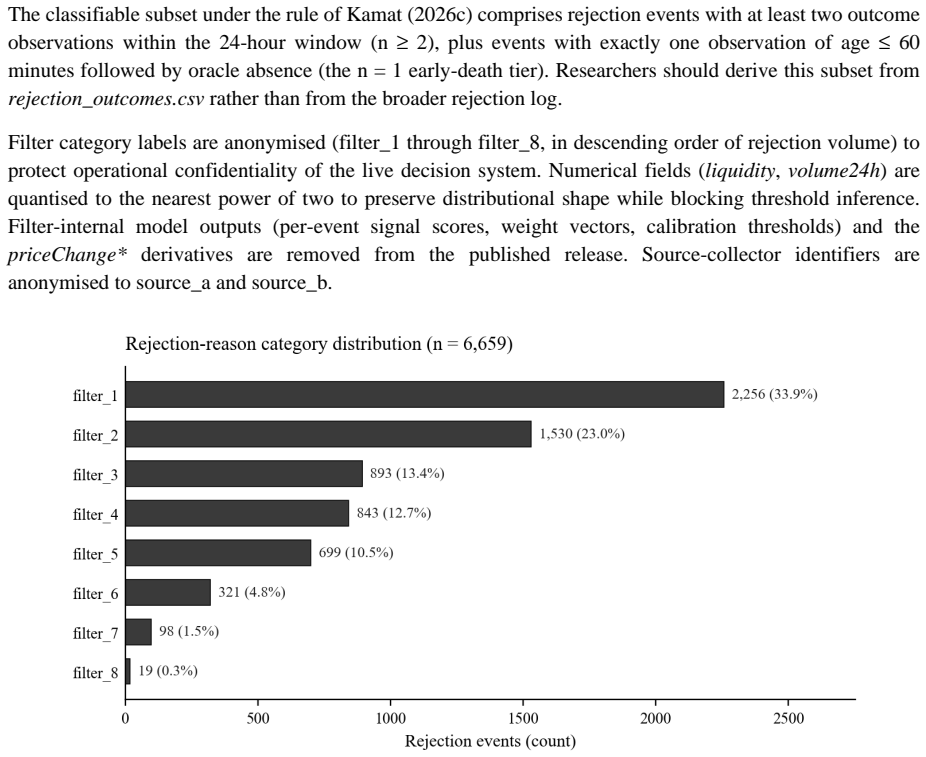
Figure from the paper full image
abstract click to expand
RED-2400 is a public benchmark of algorithmically-rejected trading events from a live Solana decentralized-exchange filter stack. I logged the data continuously between 2026-04-10 and 2026-05-02. The benchmark contains 6,659 rejection events linked to 169,122 post-rejection price and liquidity observations and 1,836 graveyard-tracker snapshots. Outcome labels follow the five-tier classification of Kamat (2026c): saved (windowed), saved (early-death), missed, flat, and unclassifiable. Thresholds use the trough-to-reference and peak-to-reference price ratios within a 24-hour window. Most filter-design datasets cover the accept side only. That gap leaves reject-side outcomes unmeasured and biases filter validation. RED-2400 lets researchers replicate filter-precision claims directly. RED-2400 is the first window in a planned dataset series; subsequent windows will extend the time horizon and enable regime-stratified analysis.
0
0
q-fin.TR 2026-05-13 Recognition

Polymarket shows single fill-side cluster for all addresses

Fill-Side Non-Retail Trading on Polymarket: An Empirical Study of Behavioral Tiers and Microstructure Signatures Under Quote-Attribution Constraints

Three non-retail tiers still account for over 80 percent of notional volume despite the lack of quote data.

Figure from the paper full image
abstract click to expand
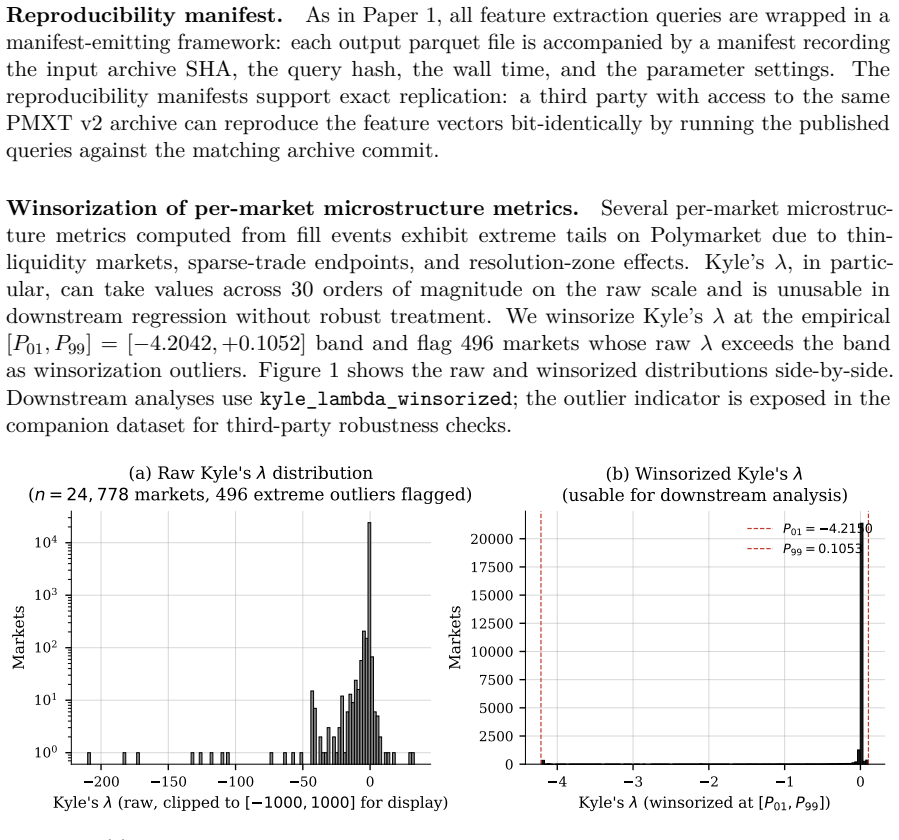
Prediction markets cannot exist without market makers, arbitrageurs, and other non-retail liquidity providers, yet the supply-side microstructure of Polymarket-class venues has not been characterized at on-chain pseudonymous-address scale. This paper studies non-retail participation on Polymarket using an empirical run on the PMXT v2 archive over 2026-04-21 through 2026-04-27 (13,356,931 OrderFilled events; 77,204 addresses with five+ fills; 43,116 markets). We report three findings. First, Polymarket's off-chain CLOB architecture renders address-level quote-lifecycle attribution permanently unavailable: OrderPlaced and OrderCancelled events are off-chain and absent from public archives, so quote-intensity, two-sided-ratio, and posted-spread features cannot be built at address level. We document this as a structural validity-gate failure (G-QUOTE-LIFE universal fail) and restrict analysis to a six-feature fill-side vector. Second, density-based clustering (DBSCAN, fifteen sensitivity configurations) on the fill-side vector produces a single dense cluster with zero noise: fill-side behavior in the empirical window is uni-modal under the six-feature vector, contradicting the pre-registered hypothesis of four-to-five separable archetypes. Third, robust retail vs non-retail separation is achievable through clustering-independent feature-tier stratification: whale-tier, high-frequency-operator, and power-trader tiers jointly hold 81.4% of total notional across 12.6% of addresses. Address-level market-making and liquidity-provision claims are withdrawn per the G-QUOTE-LIFE failure; spoof-by-non-fill manipulation detection is downgraded to market-level book diagnostics. A privacy-respecting derived-dataset deposit accompanies the paper as Bundle 3 of the PMXT family. Fourth paper in a four-paper programme on event-linked perpetuals and leveraged prediction-market microstructure.
0
0
q-fin.TR 2026-05-13 Recognition

VVG classifier spots MNQ regime days but no strategies survive costs

A Validated Volatility-Volume-Gap Classifier for Regime Identification in MNQ Intraday Data

Pre-market conditions mark mornings with drift and afternoons with reversal, yet every tested rule fails after transaction costs and year-by

abstract click to expand
This paper constructs and validates a composite day-classification system for Micro E-Mini Nasdaq 100 futures (MNQ) using three pre-market observable conditions: first-30-minute return magnitude, overnight gap magnitude, and abnormal opening-bar volume relative to a rolling baseline. Using 947 regular trading days of five-minute data from 2021-2025, we find that classifier-positive days exhibit statistically distinct intraday behavior, including directional morning drift followed by systematic late-session reversal. Despite these descriptive characteristics, all tested directional trading strategies fail institutional validation standards after transaction costs and multi-year consistency requirements are applied. The highest-performing configuration achieves T = 1.46 and mean net +7.80 points but fails year-stability criteria. The primary contribution is the validation of the Volatility-Volume-Gap (VVG) classifier as a descriptive regime-identification framework and the documentation of failed attempts to convert these statistical patterns into deployable trading signals under realistic execution constraints.
0
0
q-fin.TR 2026-05-12 1 theorem

Leverage scales price manipulation but shifts outcome thresholds

Manipulation, Insider Information, and Regulation in Leveraged Event-Linked Markets

In event-linked markets the two-axis taxonomy shows linear scaling for price manipulation, threshold shifts for outcome manipulation, and a

abstract click to expand
The introduction of leverage on prediction-market event contracts raises three structurally distinct questions that have not been addressed jointly: how leverage changes manipulation incentives, how it interacts with informed-trading rents, and how regulatory frameworks should respond. This paper develops a theoretical framework for the first two and a synthesis of the existing regulatory landscape for the third. The principal analytical move is a two-axis manipulation taxonomy distinguishing market-price manipulation from real-world outcome manipulation, where the manipulator affects the underlying event itself. Continuous-underlying derivative markets generally do not make outcome manipulation a venue-level payoff channel; event-linked markets do. Within this taxonomy, leverage plays asymmetric roles: it scales market-price manipulation linearly but shifts the cost-benefit threshold for outcome manipulation, and it scales informed-trading rents in three ways (direct multiplication, Sharpe-ratio preservation, detection-cost amortization). Section 7 connects Paper 1's pre-emption and halt-protocol findings (CC-007b, CC-008) to three manipulation channels: pre-emption introduced by the dynamic-margin engine, halt-arbitrage introduced by the resolution-zone halt protocol, and strategic bad-debt-shifting that no engine in Paper 1's framework family addresses. The framework's manipulation-resistance contribution is a re-allocation of attack surface, not a net reduction. The regulatory synthesis covers principal jurisdictions (US, EU, UK, Singapore, offshore) and identifies three regulatory-arbitrage pathways. The paper concludes with 14 recommendations for venue operators, regulatory bodies, and the research community, separated into framework-independent and framework-conditional categories.
0
0
q-fin.TR 2026-05-12 2 theorems

Taxonomy defines seven variants of event perpetual futures

A Taxonomy of Event-Linked Perpetual Futures: Variant Designs Beyond the Single-Market Binary Case

Organized by four design axes, each with payoff rules, inheritance maps and test criteria for historical data.

abstract click to expand
Paper 1 of this research programme develops a resolution-aware risk-design framework for the simplest event-linked perpetual: a contract whose underlying tracks a single binary prediction-market probability through resolution. The instrument class is broader. Variants span conditional probabilities P(A|B), spreads p^A - p^B, weighted baskets sum w_i p^(i), derivatives on variance or entropy of the probability process, contracts on liquidity itself, perpetual-on-expiring-event roll structures, and funding-only derivatives with no settlement. Each variant inherits some framework components from the single-market binary case and requires its own design adaptations. This paper develops a formal taxonomy of seven pure-form canonical variants beyond the probability-index perpetual of Paper 1, organised along four orthogonal design axes: underlying geometry, temporal structure, settlement structure, and venue composition. The list is not exhaustive; combinations are not treated separately. For each variant we provide a precise payoff definition; an inheritance map identifying which Paper 1 components carry over, are modified, or fail; variant-specific design constraints; microstructure properties; empirical evaluability on the PMXT v2 archive; and limitations. Notable findings: the conditional variant admits a candidate non-portability proposition (denominator instability as the conditioning event becomes improbable); the spread variant requires a three-channel decomposition of resolution risk; the volatility/entropy variant avoids random binary terminal-collapse but introduces estimator-convention and entropy-decay issues; the basket variant requires multi-period jump-aware margin whose aggregation is correlation-dependent. The paper is theoretical primarily; it specifies how demonstrative time series can be constructed and provides evaluability criteria to guide future work.
0
0
q-fin.TR 2026-05-12 1 theorem

Binary perpetuals need separate halt and margin rules

Resolution-Aware Perpetual Futures on Binary Prediction Markets: An Empirical Risk-Design Framework Using Polymarket Data

Counterfactual tests on 13k Polymarket archives show standard designs fail on resolution jumps; new framework distinguishes execution risk (

abstract click to expand
We develop and counterfactually evaluate a resolution-aware risk-design framework (PIRAP) for perpetual futures whose underlying tracks a single binary prediction-market probability through resolution. The framework specifies six components: an index estimator combining mid-price, depth-weighted mid, and time-decayed VWAP; jump-aware tiered margin sized against bounded-event terminal-collapse magnitude; leverage compression schedule contracting toward resolution; resolution-aware funding rule with boundary-aware correction; a multi-stage halt protocol; and an eligibility framework. Two formal non-portability propositions establish that standard basis-only funding paired with continuous-vol static margin fails on bounded-event underlyings. Empirical evaluation uses Polymarket's PMXT v2 archive for 2026-04-21 to 2026-04-27 (13,298-market analysis sample passing adequacy gates from 61,087 ingested; 13,115 resolved within the empirical window for E3). E1 evaluates two pre-registered stylized facts; E2 conducts counterfactual replay across three engine configurations; E3 isolates the resolution-zone protocol's contribution. Results are mixed. Five pre-registered floors: stylized-fact floors (boundary depth asymmetry, terminal-jump magnitude) PASS; welfare-side directional floors (final-hour liquidation -6%, drawdown -5.1% pooled, median PnL +14%) two FAIL one PASS; E3 mechanic floors (final-hour liquidation -80% by halt construction PASS; bad-debt frequency +2.4% FAIL). Three of five materiality floors fail: the framework as specified does not validate deployment, but the empirical record establishes a halt-versus-margin scope distinction (halt addresses execution-channel risk; terminal-jump bad-debt remains margin-side) and documents a pre-emption trade-off constraining the dynamic-margin component. The paper concludes with structural recommendations and explicit non-deployable status.
0
0
q-fin.TR 2026-05-07

Risk-constrained collateral stabilizes basis trades

Dynamic Collateral Control for Permissionless Spot Perpetual Basis Trading

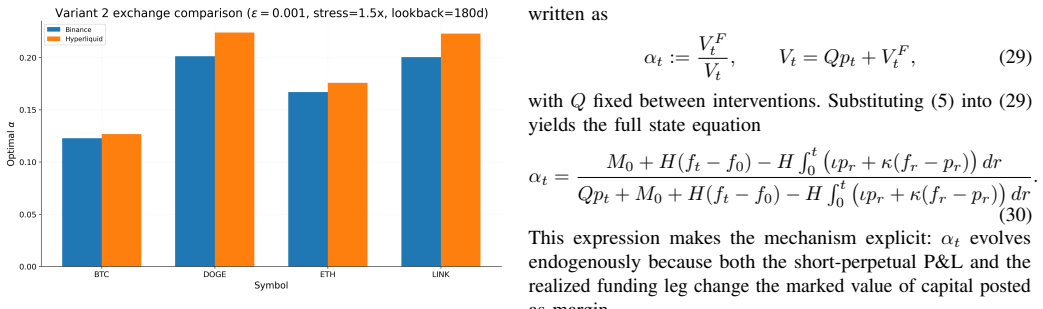
Static and dynamic models show solvency bounds matter most while funding explains performance in backtests.

Figure from the paper full image
abstract click to expand
We study permissionless spot--perpetual basis trading in decentralized finance as a collateral control problem. The strategy holds spot inventory, hedges directional exposure with a short perpetual, and allocates capital between spot inventory and derivative margin under on-chain liquidity and execution frictions. The paper delivers three results. First, it solves a static control problem for the collateral share and shows that the risk-constrained formulation provides a more robust operating benchmark relative to the economic optimum. In comparative calibration, the required collateral rises monotonically under volatility stress. The collateral is the lowest for BTC and increases significantly for long tail assets such as LINK and DOGE. Second, the paper derives an asymmetric dynamic extension in which the lower boundary of intervention is solvency driven, and the upper boundary is determined by a trade-off between carry-loss and the cost of rebalancing. Monte Carlo simulation shows that the lower boundary remains structurally relevant, whereas meaningful interior upper triggers survive mainly in the regimes with high carry and low costs. Third, the paper validates an execution-aware implementation with live routed execution and historical backtests. The execution layer shows that the realized wedges are significant, but become worse in the case of selling the basis. This justifies a minimum effective rebalancing size and a positive execution buffer. The historical validation shows that in the case of a fixed control rule the realized performance is predominantly explained by the funding environment.
0
0
q-fin.TR 2026-05-06

No OHLCV signal clears cost and stability hurdles in MNQ futures

Structural Limits of OHLCV-Based Intraday Signals in MNQ Futures: A Systematic Falsification Study

947 days of five-minute bars show gross edges capped below two-point round-trip costs for all fourteen signal families tested

abstract click to expand
This paper tests whether intraday momentum signals derived from open-high-low-close-volume (OHLCV) data produce a statistically significant trading edge in Micro E-mini Nasdaq 100 futures (MNQ) under realistic execution constraints. Using 947 trading days of five-minute data (2021-2025), fourteen signal families are evaluated, including opening range breakouts, gap strategies, volume signals, cross-session momentum, liquidity grabs, volatility-conditioned classifiers, and news-driven strategies. All signals are assessed using strict institutional criteria: out-of-sample walk-forward validation, minimum T-statistic of 2.0, at least 30 trades, positive net return after a fixed two-point round-trip cost, and multi-year stability. No signal satisfies all criteria simultaneously. The gross edge available to next-bar-open execution is constrained to approximately 0.07-1.50 points per trade, insufficient to overcome transaction costs. A gap-continuation signal achieves T = 3.23 and +14.52 points but fails minimum sample requirements (N = 22). Two validated signals from a separate research program are included as positive controls, confirming the methodology detects genuine edge when present. The primary contribution is a reproducible falsification framework and a documented null result, highlighting structural limits of OHLCV-based intraday strategies.
0
0
q-fin.TR 2026-05-05

Three distinct layers detect informed trading in prediction markets

Per-Market Information Leakage and Order-Flow Skill: Two Methodological Lenses on Informed Trading in Decentralized Prediction Markets

Account skill tests, insider heuristics and per-market leakage scores each filter a different dimension and gain precision when stacked.

abstract click to expand
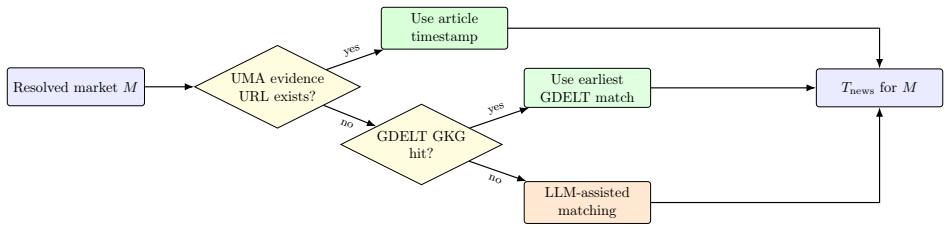
April 2026 saw notable methodological convergence in the academic study of informed trading on decentralized prediction markets. Three approaches surfaced almost simultaneously: Mitts and Ofir (2026) apply a composite screen to over 210,000 wallet-market pairs; Gomez-Cram et al. (2026) apply an event-level sign-randomization test to Polymarket's complete transaction history, classifying 3.14% of accounts as "skilled winners" and separately flagging 1,950 accounts as "insiders" via a lifecycle heuristic; Nechepurenko (2026) develops the Information Leakage Score (ILS) framework, which quantifies per-market information front-loading at an article-derived public-event timestamp. This paper provides a methodological comparison. The central claim is that these are three distinct layers of detection, not competing methods on a single layer. Sign-randomization is best understood as an account-level test of persistent directional skill conditional on opportunity selection -- not a direct test of insider trading, and not a per-market measure. The heuristic insider flag is separate from the skill classifier, applies to a population the classifier excludes by design, and has unknown precision. The Polymarket sample pools politics, sports, crypto, and other categories with different information technologies, so a platform-wide "skilled winner" classification is mechanism-ambiguous. The January 2026 U.S.-Venezuela operation cluster, where the DOJ indictment of Master Sergeant Gannon Van Dyke provides a rare external enforcement benchmark, illustrates how the layers stack: lifecycle heuristics identify suspicious accounts; legal investigation addresses non-public-information possession; per-market scoring would quantify how much information was leaked into each contract. A combined pipeline gains in precision because each layer filters a different dimension.
2 0
0
q-fin.TR 2026-05-05

Deadline score flips Iran contract leakage from negative to positive

Empirical Evaluation of Deadline-Resolved Information Leakage on Documented Polymarket Insider Cases

Test on largest Polymarket insider cluster shows the extension distinguishes pre-event signals from resolution proxies

abstract click to expand
This paper reports an end-to-end empirical evaluation of the deadline-Information Leakage Score (ILS-dl) extension introduced in the companion methodology paper. The deadline-ILS extends the original ILS to deadline-resolved prediction-market contracts, the dominant structural form of publicly documented insider trading on Polymarket. We anchor the evaluation in the 2026 U.S.-Iran conflict cluster of the ForesightFlow Insider Cases (FFIC) inventory, the largest documented deadline cluster. The evaluation has four parts: per-category exponential-hazard estimation, a single-case ILS-dl computation, cross-market wallet analysis, and methodological refinements. Hazard-rate estimation produces an adequate exponential fit for military-geopolitics markets (KS p = 0.609, half-life 2.3 days) and a preliminary fit for corporate-disclosure markets (n = 5). The regulatory-decision category is rejected as bimodal (p = 0.013). On the largest applicable FFIC contract ("US forces enter Iran by April 30," $269M volume), the article-derived public-event timestamp yields ILS-dl = +0.113 versus a resolution-anchored proxy value of -0.331: a 0.444 shift in magnitude on opposite sides of zero, demonstrating that the extension distinguishes signal from proxy artefact. Pre-event drift is mild, and short-window variants (30-min, 2-hour) are exactly zero. Cross-market wallet analysis identifies 332 wallets active in both major Iran-cluster markets, but the available trade history covers only the resolution-settlement window.
3 0
0
q-fin.TR 2026-05-04

New score measures pre-event price moves in prediction markets

ForesightFlow: An Information Leakage Score Framework for Prediction Markets

The Information Leakage Score and its deadline extension now reach the markets where insider trading has been documented.

Figure from the paper full image
abstract click to expand
ForesightFlow is an Information Leakage Score (ILS) framework for detecting informed trading on decentralized prediction markets. For an event-resolved binary market, the score quantifies the fraction of the terminal information move priced in before the public news event. Three operational scope conditions (edge effect, non-trivial total move, anchor sensitivity) are stated as preconditions for interpretation. The score admits a Murphy-decomposition reading that connects label generation to the proper-scoring-rule literature. A pilot empirical evaluation surfaces three findings. First, a resolution-anchored proxy for the public-event timestamp does not separate event-resolved markets from a matched control population (Mann-Whitney p = 1e-6, separation reversed), demonstrating that proxy quality is itself a binding constraint. Second, the article-derived timestamp on a single high-stakes case shifts the score by 0.444 in magnitude relative to the proxy and lies on the opposite side of zero. Third, an audit of the publicly documented Polymarket insider record reveals that documented cases are systematically deadline-resolved, falling outside the original ILS scope (0 of 24 FFIC inventory markets satisfied original scope conditions). This last finding motivates a deadline-ILS extension introduced in Section 7, anchored at the public-event timestamp rather than the news timestamp, and equipped with a per-category exponential hazard baseline for the time-to-event distribution. The extension closes the gap between the methodology and the population in which insider trading has been empirically documented. An end-to-end evaluation of the extension on the 2026 U.S.-Iran conflict cluster is reported in a companion paper. We release the FFIC inventory, the resolution-typology classification of the 911,237-market corpus, and all code at github.com/ForesightFlow.
2 0
0
q-fin.TR 2026-05-04

Information leakage score works for just 0.7% of Polymarket markets

Information Leakage at Population Scale: An Evaluation of the Polymarket Insider-Relevant Subpopulation, 2020-2026

Population-scale test shows resolution ambiguity blocks analysis of nearly all markets and shifts focus to clearer rules.

abstract click to expand
We carry the deadline-resolved Information Leakage Score (ILS-dl) framework of Nechepurenko (2026a, 2026b) from a single-case proof of concept to a population-scale evaluation across 12,708 Polymarket markets, October 2020 to April 2026. We frame the paper as a scope-discovery study: scaling reveals that the framework's effective domain is materially narrower than initial framing suggested, and the principal obstacle is not score computation but resolution semantics. We report four findings. First, only 88 of 12,708 candidate markets (0.7%) yield computable ILS-dl values; only 1 of 32 markets in the ForesightFlow Insider Cases (FFIC) inventory is in scope, and 14 of 32 FFIC markets are flagged unclassifiable due to genuine resolution-criterion ambiguity. Second, only 12 of the 88 computed markets (13.6%) satisfy anchor-sensitivity, and an independent-second-pass T_event validation reaches 57.8% exact-date agreement, below the 90% ex-ante criterion. Third, raw ILS-dl medians are negative across all six (sub-bucket by period) cells, but a hazard-decay baseline correction we introduce yields a heterogeneous result: regulatory_formal post-2024 shifts to near-zero (-0.21 to -0.02), while regulatory_announcement post-2024 retains a 95% bootstrap CI entirely below zero. Fourth, the constant-hazard exponential of Nechepurenko (2026b) is rejected in favor of Weibull on the pooled post-2024 cell, but a per-subcategory check confirms the preference reflects category mixture rather than within-cell duration dependence. The implication is that detection of informed flow requires methodological refinement on the resolution-typology and score-baseline axes, not only on the score-computation axis where prior work concentrated.
2 0
0
q-fin.TR 2026-04-29

Adjusted MACD beats standard version on U.S

A Volume-Price-Adjusted MACD Trading Strategy with Sensitivity Calibration for U.S. Equity Indices

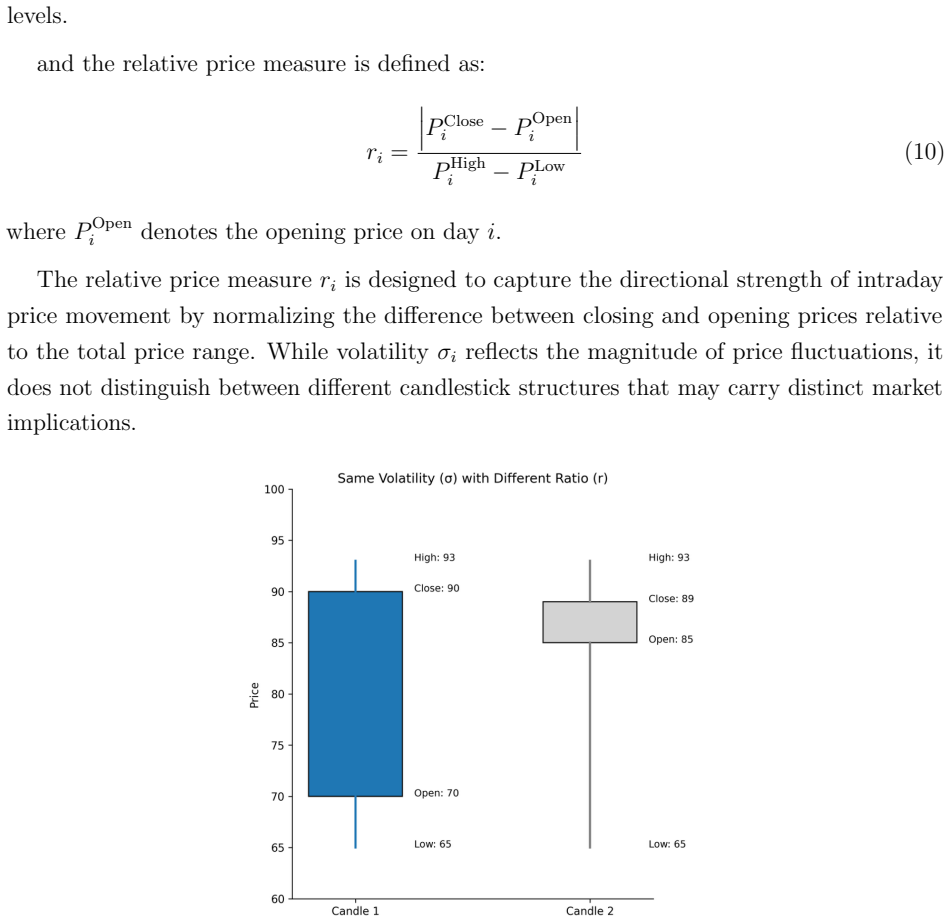
Volume, volatility, and intraday adjustments plus sensitivity tuning raise profitability and risk control while cutting signal count.

Figure from the paper full image
abstract click to expand
Traditional moving average convergence divergence (MACD) trading rules are often constrained by signal lag and susceptibility to false signals. To address these limitations, this study develops a volume-price-adjusted MACD (VP-MACD) framework that incorporates volume, volatility, and intraday price structure into the conventional indicator, and introduces a sensitivity parameter to allow earlier trade entry and improve responsiveness to market movements. Using the S&P 500, Nasdaq-100, and Dow Jones Industrial Average as representative U.S. equity indices, the model is calibrated over historical records from 2018 to 2022 and evaluated out of sample over 2023 to February 2026. The results indicate that the proposed framework generally delivers better economic performance than the baseline MACD strategy in terms of profitability, risk-adjusted return, and downside-risk control, while generating fewer but more selective trading signals. These findings suggest that incorporating additional market information into technical trading rules may enhance signal quality in U.S. equity index markets.
0
0
q-fin.TR 2026-04-28

Public order book gets Polymarket trade direction right only 59% of the time

The Anatomy of a Decentralized Prediction Market: Microstructure Evidence from the Polymarket Order Book

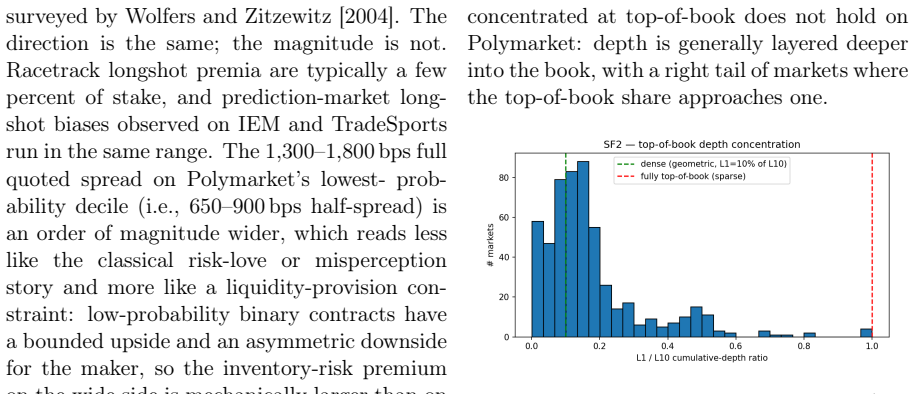
Common measures like effective spreads flip sign with the data source, requiring on-chain records for reliable microstructure analysis

Figure from the paper full image
abstract click to expand
We study the microstructure of Polymarket, the largest on-chain prediction market, using a continuous tick-level archive of the public WebSocket order-book feed (30 billion events over 52 days) joined to the authoritative on-chain trade record. On a pre-registered stratified panel of 600 markets we report eight stylized facts: a longshot spread premium; a depth-concentration profile closer to a uniform geometric grid than to the top-of-book pattern often assumed for prediction markets; a null block-clock alignment effect; broad maker-wallet diversity with a concentrated tail; category-conditional differences in effective spread; a sub-50 ms median archive-ingestion delay with a multi-second tail; a self-counterparty wash share with median 1% and a 22% upper tail, well below the network-classifier benchmarks of Cong et al. (2023) for unregulated cryptocurrency token exchanges (a sanity bound, not an apples-to-apples reference, since the venues face different wash incentives); and a depth decay near resolution with a within-category slope of 0.55 on log seconds-to-close (t=3.85). The paper also contributes a measurement result: trade direction inferred from Polymarket's public order-book feed agrees with on-chain ground truth only ~59% of the time (panel mean 0.615, 95% CI [0.58, 0.65]), barely above the 50% chance baseline. On the comparable subset of the top-100 panel, the effective half-spread changes sign between feed- and on-chain directions on 67% of markets in a first 7-day window and 50% in a second non-overlapping window, with Kyle's lambda flipping on 60% and 43% respectively; neither window recovers the on-chain sign at anything close to the ~80% rate that Lee-Ready achieves on equity venues. Microstructure work on Polymarket therefore needs to source trade direction from on-chain OrderFilled events; we release a replication package that performs the join.
0
0
q-fin.TR 2026-04-27

Non-unique time exposes deeper market incompleteness

Non-unique time and market incompleteness

Asynchronous event-driven markets lack a unique continuous clock, implying incompleteness beyond standard models and needing operational-to-

abstract click to expand
Financial markets are often modelled as if time were unique and continuous across assets and markets. Financial markets are however asynchronous, order flow is event-driven, and waiting times between events are often random. Many of the most influential formulations of financial market models presuppose a unique global calendar time and advocate for this or that preferred single latent continuous-time price system. Here we critically contrast these assumptions with event-time, renewal, point-process, and order-flow descriptions. We revisit no-arbitrage, no-dynamic-arbitrage, and risk-neutral option pricing in settings where the market is represented as a discrete event system and where the continuum limit of a discrete-time random walk need not be unique. The central suggestion is then that such non-uniqueness points to a more foundational form of market incompleteness than is usually emphasized. This highlights the importance of operational time at the level of decision making but reminds market practitioners that managing risk itself often requires reconciling operational time with a global calendar time. At these longer time scales forms of effective or average completeness may still emerge at lower frequencies and remain useful for portfolio construction and risk management, even if high-frequency hedging and execution expose a clock mismatch between trading, pricing, and longer-horizon allocation.
0
0
q-fin.TR 2026-04-24

Only one in six LPs avoids losses in Base CLMM pools

Liquidity provision in CLMMs: evidence from transactions data

On-chain reconstruction of WETH/USD positions shows most unhedged providers lose capital, with wins linked to early exits near current price

Figure from the paper full image
abstract click to expand
The emergence of Concentrated Liquidity Market Makers (CLMMs) has made liquidity provision on decentralized exchanges an active and risk-sensitive task. However, the standalone profitability of liquidity provision remains unclear for liquidity providers (LPs) who neither hedge their inventory risk nor receive off-pool profits. This paper studies the actual outcomes of LP activity using historical transaction-level data from WETH/USD liquidity pools on the Base chain across the Uniswap, Aerodrome, PancakeSwap and SushiSwap protocols. We propose a methodology for reconstructing LP PnL dynamics from on-chain events and introduce an original metric that captures both the terminal state of LP capital and its path over time. Based on this framework, we estimate the share of successful LPs, classify their behavior and develop a taxonomy of 15 position types as structural components of PnL. We further identify a distinct class of multi-LPs operating across several pools and show that the dominant profitable position configurations are concentrated around the current pool price. The results show that only about one out of six LPs avoids losses in the selected market segment, raising an open question about the true economic motives of LP participation. Evidence also suggests that successful LPs often close positions before the full range is traversed, making observed behavior closer to profit-target-based strategies.
0
0
q-fin.TR 2026-04-23

Polymarket NBA markets show rare arbitrage limited by liquidity

Arbitrage Analysis in Polymarket NBA Markets

75M snapshots find single-market anomalies last 3.6 seconds median while combinatorial ones yield 101 bps but average only 14.8 shares.

Figure from the paper full image
abstract click to expand
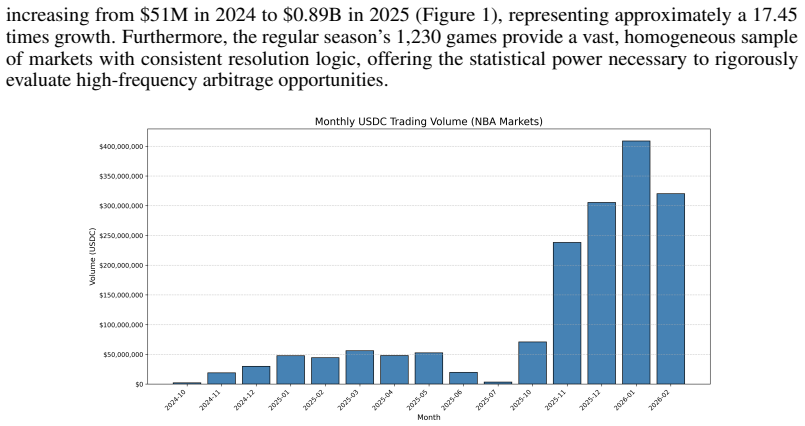
While decentralized prediction markets like Polymarket have gained significant traction, their market microstructure and high-frequency pricing efficiency remain underexplored. This paper conducts a systematic empirical analysis of algorithmic arbitrage within Polymarket's NBA game markets. By reconstructing continuous market states from over 75 million limit order book snapshots across 173 games, we evaluate the frequency, duration, and profitability of both single-market and combinatorial arbitrage opportunities. Our findings demonstrate profound microstructural efficiency. Single-market anomalies are exceedingly rare, yielding only 7 executable in-game episodes that persist for a median duration of just 3.6 seconds. Combinatorial inefficiencies are more frequent, producing 290 active episodes overwhelmingly concentrated in the final minutes of live play. While combinatorial execution yields a statistically meaningful median return of 101 basis points, we find that the theoretical "Middle" jackpot is never empirically realized. Furthermore, execution is severely bottlenecked by shallow order book depth, with 76.9\% of combinatorial opportunities constrained to an average executable size of just 14.8 shares. Ultimately, while executable mispricings exist, they are structurally bounded by liquidity, confining risk-free extraction strictly to the retail scale.
0
0
q-fin.TR 2026-04-23

Alternative greedy rule reverses fragmentation effects on execution and welfare

Testing replication for an agent-based model of market fragmentation and latency arbitrage

Replication finds shorter trade times in all tests and higher welfare in most when zero-intelligence agents follow a different reading of an

Figure from the paper full image
abstract click to expand
This study strengthens the foundations of multi-venue market modeling by attempting an independent replication of Wah and Wellman's 2016 model of latency arbitrage in a fragmented market. We find that faithful replication is hindered by missing implementation details in the original paper and limited quantitative reporting. We demonstrate that increasing the number of simulation runs beyond the original design allows for the creation of bootstrap confidence intervals to support rigorous tests of quantitative alignment, compensating for lacking distributional information (e.g. variance). We also demonstrate that increased complexity across the modeled scenarios corresponds with increased difficulty aligning to the original results. We draw on a codebase released by the original authors in connection with a later paper to recover additional implementation details; however, we reject quantitative alignment between that codebase and the published results. Combining information from the paper and the released code, we achieve relational equivalence for most metrics but reject quantitative alignment for model settings where latency is non-zero. We show that many of the qualitative takeaways from the original paper on the effects of market fragmentation and latency arbitrage are sensitive to the specifics of a `greedy strategy' extension given to the zero-intelligence (ZI) trader agents. Under an alternative interpretation of this strategy, we find that market fragmentation decreases execution times in all experiments and increases trader welfare in most experiments. Finally, to facilitate future replication, critique, and extension, we provide an ODD (Overview, Design concepts, Details) protocol for our implementations of the model.
0
0
q-fin.TR 2026-04-22

Cubic momentum rule reproduces periodic bubble-crash cycles

Dynamics of Periodic Bubbles and Crashes: Modeling Market Overheating and Panic Selling via Cubic Momentum

A minimal model sets buy-sell balance by a cubic function of momentum and makes trading frequency rise with accumulated momentum, yielding a

Figure from the paper full image
abstract click to expand
This paper proposes a simple and parsimonious discrete-time simulation model to describe the endogenous formation and periodic collapse of financial bubbles. While existing literature has extensively explored the statistical properties of locally explosive bubble dynamics, capturing the micro-level interplay of investor herd behavior and panic selling within a unified framework remains a challenge. Our model addresses this by introducing a cubic function of market momentum to determine the balance of trading directions. This mechanism drives both trend-following behavior during the bubble phase and sudden market crashes when the momentum exceeds a critical threshold. Furthermore, inspired by the self-exciting nature of the Hawkes process, the model endogenizes``market frenzy" by linking trading frequency directly to the accumulated momentum. Simulation results demonstrate that this minimal setup successfully replicates the complex, nonlinear dynamics of bubbles, including simultaneous surges in liquidity and price, followed by dramatic crashes.
0
0
q-fin.TR 2026-04-15

No trading strategy wins across all market paths

Against a Universal Trading Strategy: No-Arbitrage, No-Free-Lunch, and Adversarial Cantor Diagonalization

No-arbitrage, no-free-lunch, and diagonalization show that universal profit requires either arbitrage or non-computable foresight.

abstract click to expand
We investigate the impossibility of universally winning trading strategies -- those generating strict profit across all market trajectories -- through three distinct mathematical paradigms. Fundamentally, under standard admissibility constraints, the existence of such a strategy is a strict subset of strong arbitrage, which is mathematically precluded in competitive markets admitting an equivalent martingale measure. Beyond this rigorous measure-theoretic foundation, we explore analogous limitations in two alternative modeling regimes. Combinatorially, the No-Free-Lunch theorem demonstrates that outperformance requires exploitation of non-uniform market structure, as uniform averaging precludes universal dominance. Computationally, a Turing diagonalization argument constructs an adversarial environment that defeats any computable trading algorithm, shifting the impossibility from exogenous price paths to adaptive adversaries. These mathematical limits are framed by a time-reversal heuristic that establishes a formal analogy between financial martingale measures and thermodynamic detailed balance, resolving the Maxwell's Demon analogy for markets without relying on physically irrelevant Landauer erasure costs. Using the Wheel Options Strategy as a case study, we demonstrate that strategies succeeding ``for all practical purposes'' (FAPP) inherently depend on transient regime assumptions, meaning their automated execution systematically amplifies tail risks.
0
0
q-fin.TR 2026-04-15

Similar AI market encodings trigger synchronized deleveraging

Representation Homogeneity and Systemic Instability in AI-Dominated Financial Markets: A Structural Approach

Representation overlap compresses forecast diversity under stress and raises volatility clustering and tail risk even when predictions lookæ•£

abstract click to expand
This paper investigates how similarity in the informational representation of market states among Artificial Intelligence (AI) trading agents can generate systemic instability in financial markets. We construct a structural multi-agent market model calibrated using high-frequency microstructural moments. AI agents are modeled through a two-layer decision architecture consisting of a nonlinear representation layer and an adaptive linear readout layer. The representation layer maps raw market states into high-dimensional feature vectors, while the readout layer generates return forecasts that feed into a risk-controlled trading rule. This representation-based microfoundation separates two objects that are often conflated in the literature: representation homogeneity (the degree to which agents encode market states into similar feature spaces) and forecast overlap (the degree to which agents produce similar return predictions). We show theoretically that these two concepts are related but not equivalent, and that representation homogeneity can compress the effective space of forecast disagreement under stress even when predictions appear diverse in normal times. Through controlled factorial experiments that vary representation homogeneity while conditioning on alternative risk-aversion and learning-rate distributions, we hypothesize that increasing representation similarity amplifies synchronization in beliefs and positions, leading to volatility clustering, liquidity stress, and elevated tail risk. Our structural mechanisms suggest that low perceived volatility regimes can endogenously accumulate hidden leverage through position stickiness, which subsequently collapses when shocks trigger synchronized deleveraging. The results provide a structural foundation for macroprudential policies aimed at monitoring and preserving diversity in how AI systems represent and process market information.
0
0
q-fin.TR 2026-04-15

Analyst voices weigh heaviest in earnings-call sentiment for predicting returns

Which Voices Move Markets? Speaker Identity and the Cross-Section of Post-Earnings Returns

Weighting comments by speaker role improves return forecasts, generates alpha unexplained by risk factors, and outperforms dictionary-based

Figure from the paper full image
abstract click to expand
We utilize FinBERT, a domain-specific transformer model, to parse 6.5 million sentences from 16,428 S&P 500 quarterly earnings call transcripts (2015-2025) and demonstrate that post-earnings stock returns are not equally affected by all speakers in a conference call. Our section-weighted sentiment, with empirically derived speaker weights (Analyst 49%, CFO 30%, Executive 16%, Other 5%), achieves an out-of-sample Spearman IC of 0.142 versus 0.115 in-sample, generates monthly long-short alpha of 2.03% unexplained by the Fama-French five-factor model (t = 6.49), and remains significant after controlling for standardized unexpected earnings (SUE). FinBERT section-weighted sentiment entirely subsumes the Loughran-McDonald dictionary approach (FinBERT t = 5.90; LM t = 0.86 in the combined specification). Signal decay analysis and cumulative abnormal return charts confirm gradual price adjustment consistent with sluggish assimilation of soft information. All results undergo rigorous out-of-sample validation with an explicit temporal split, yielding improved rather than deteriorated predictive power.
0
0
q-fin.TR 2026-04-14

Rank correlation beats MAE for battery storage revenue

When Forecast Accuracy Fails: Rank Correlation and Decision Quality in Multi-Market Battery Storage Optimization

Forecasts with Kendall tau above 0.85-0.95 recover up to 100 percent of perfect-foresight value in German and Swiss multi-market trading.

Figure from the paper full image
abstract click to expand
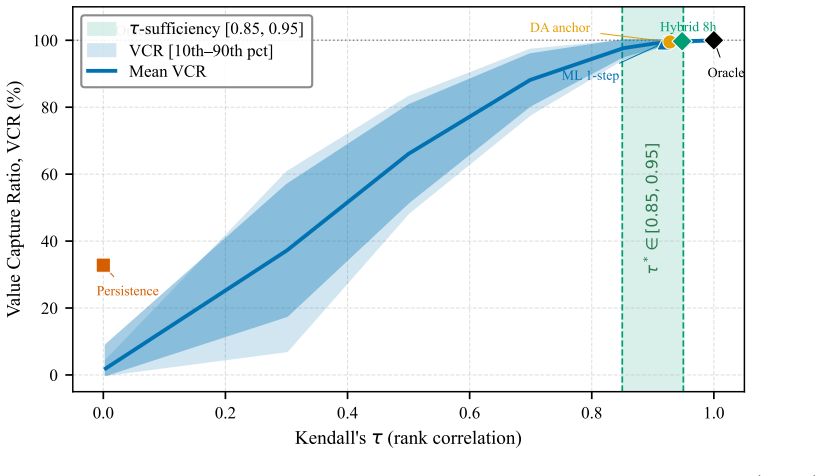
Battery energy storage systems (BESS) participating in multi-market electricity trading require price forecasts to optimize dispatch decisions. A widely held assumption is that forecast accuracy, measured by standard metrics such as mean absolute error (MAE), drives trading performance. We challenge this assumption using a hierarchical three-layer optimization system trading simultaneously on frequency containment reserve (FCR), automatic frequency restoration reserve (aFRR), day-ahead, and continuous intraday (XBID) markets in Germany and Switzerland over 2020-2025, with real market data from Regelleistung.net and Swissgrid. We find that rank correlation (Kendall tau), rather than MAE, is the primary predictor of intraday dispatch value: forecasts above an empirical threshold of tau approximately 0.85-0.95 capture up to 97-100% of perfect-foresight revenue, while persistence forecasts with near-zero tau capture only 33%. This threshold is stable across market regimes and volatility levels, and reflects the ordinal structure of the dispatch problem. Furthermore, under reserve market constraints, FCR capacity revenue exceeds XBID by 6.5x per MW, making capacity allocation -- not forecast accuracy -- the primary driver of total revenue. In the Swiss market, hydrological surplus anomalies are significantly associated with balancing market revenue (p = 0.0005), a mechanism absent from existing German-focused literature. These findings reframe forecast evaluation for BESS operators: the relevant question is not what the MAE is, but whether the forecast achieves tau-sufficiency.
0
0
q-fin.TR 2026-04-13

Disclosure cuts trading costs more when market makers compete less

Mandatory Disclosure in Oligopolistic Market Making

Theory and post-2002 data show the liquidity gains from mandatory disclosure are larger for stocks with fewer active market makers.

Figure from the paper full image
abstract click to expand
We develop a multi-period Kyle-type model that incorporates both mandatory disclosure of informed trades and imperfect competition among market makers. We prove the existence and uniqueness of a linear equilibrium and show that the liquidity-enhancing effect of disclosure is fundamentally linked to the degree of market-making competition. Disclosure lowers trading costs by reducing price impact, and its marginal benefit is strictly larger when competition is weak. We empirically validate this prediction using the 2002 Sarbanes-Oxley Act disclosure reform as a natural experiment. A difference-in-differences analysis of U.S. equities confirms that the spread reduction following enhanced disclosure is significantly larger for stocks with fewer active market makers.
0
0
q-fin.TR 2026-04-10

LLM agents spark bubbles in mixed asset markets

Machine Spirits: Speculation and Adaptation of LLM Agents in Asset Markets

Simulations reveal that adaptation among diverse AI traders increases volatility instead of stabilizing prices.

Figure from the paper full image
abstract click to expand
As Large Language Models (LLMs) become increasingly integrated into financial systems, understanding their behavioural properties is crucial. Do LLMs conform to the rational expectations paradigm, do they exhibit human-like "animal spirits", or do they instead manifest distinct "machine spirits"? We investigate these questions with a simulated financial market, exploring the behaviour of 15 LLMs spanning a range of sizes, capabilities, and providers. Our results show that LLMs exhibit a spectrum of economic behaviours, from stable coordination on the fundamental value to human-like speculative bubbles. These behaviours are generally inconsistent with the rational expectations hypothesis. We also consider an ecology of heterogeneous agents, a more realistic setting compared to markets with identical LLM agents. These mixed markets can produce outcomes which vary substantially across repeated simulations. Even the most advanced models fail to consistently stabilise the market, with price bubbles sometimes forming despite only a minority of agents naturally forming bubbles. Instead, advanced models in mixed markets adapt their forecasting strategies to the behaviour of other agents. This adaptation can allow them to successfully exploit less sophisticated counterparts and achieve higher profits, but can also contribute to increased market volatility. These findings suggest that the introduction of AI agents into financial markets fundamentally reshapes their ecology. In particular, heterogeneous populations of LLMs can generate endogenous instability, while individual-level adaptation may amplify, rather than mitigate, market volatility.
0

browse all of q-fin.TR → full archive · search · sub-categories