REVIEW 3 major objections 6 minor 39 references
Inverting the Hidden: Unveiling Multimodal Privacy Leakage in Collaborative LVLM Inference
T0 review · 3 major / 6 minor · reviewed 2026-08-06 · deepseek-v4-flash
Pith's one-line read In collaborative inference of large vision-language models, the hidden states sent from edge to cloud are not privacy-preserving; an attack can reconstruct both the user's image and text with high fidelity.
desk verdict First solid multimodal hidden-state inversion attack for LVLMs; strong numbers, but the attack needs white-box front-end weights and the abstract skips that caveat. read the letter →
The pith
A machine-rendered reading of the paper's core claim, the machinery that carries it, and where it could break.
The reading
What carries the argument
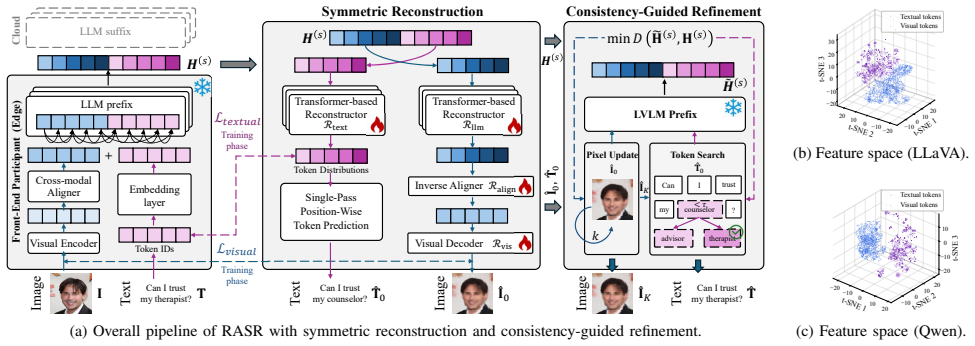
The central object is the quotient-transverse semantic margin: the smallest singular value of the semantic-response matrix after projecting out nuisance-induced hidden-state variations (Eqs. 1–2, with the projector $\Pi^\perp_u$ and the matrix $S_s = \Pi^\perp_u J_c$). If this margin is positive, Theorem 1 guarantees a Lipschitz-stable local decoder from hidden states to semantic coordinates. The attack operationalizes this with two machinery components: (1) symmetric reconstruction branches that reverse the forward paths—visual hidden state $H_v$ is mapped to aligned visual tokens $\hat{V}$, then to visual features $\hat{Z}$, then to the reconstructed image $\hat{I}$; textual hidden state $
What would settle it
Attempt the RASR attack on an LVLM with a different cross-modal alignment module (e.g., a Q-Former or a deep non-linear projector) at the same partition depth, measuring both the semantic–nuisance margin and reconstruction accuracy; if the margin is non-positive or the token/image reconstruction falls to baseline levels, the generality of the privacy-leakage claim is falsified.
Extended reading notes
Core claim
The paper establishes, both theoretically and empirically, that privacy-relevant visual semantics remain recoverable from the intermediate hidden states of a large vision-language model after cross-modal alignment and propagation through the LLM backbone. The core theorem (Theorem 1) shows that under local regularity conditions and a positive semantic–nuisance separation margin, there exists a locally stable semantic decoder that maps hidden states back to the semantic coordinates of the original image. On top of this, the proposed RASR attack achieves strong multimodal reconstruction: it uses symmetric reconstruction branches that approximately reverse the forward visual and textual pipelin
Load-bearing premise
The attack only works when the adversary (the cloud) has full access to the edge's front-end weights—including the visual encoder and cross-modal aligner—so it can compute gradients and run the consistency-guided refinement; if those weights are closed or hidden, the demonstrated reconstruction cannot be executed.
Editorial extensions
If this is right
- If the claim holds, any collaborative LVLM inference system that exposes deep hidden states to a cloud with white-box access is open to high-fidelity reconstruction of both images and text by an honest-but-curious server.
- The theoretical condition implies that privacy leakage is not an accident of specific models: it follows from a positive semantic–nuisance margin, which the paper measures as positive at all evaluated layers on two architectures.
- RASR's speed (about 0.2–0.3 seconds per text token) suggests the attack is practical for real-time interception, not just offline analysis.
- The results motivate representation-level defenses: mechanisms that reduce the semantic–nuisance margin, add calibrated noise to hidden states, or hide the front-end weights would be needed to restore privacy.
Reading between the lines
- The quotient semantic–nuisance margin could be adopted as a quantitative privacy-risk metric when choosing a split point: operators could measure it before deployment and prefer partition depths where the margin is smallest, thereby reducing recoverable semantics.
- The attack assumes the adversary knows the visual prefix length and the exact partition layer; if the edge device obfuscates the token layout (e.g., by shuffling visual tokens or inserting dummy tokens), the symmetric reconstruction might degrade—a testable extension the paper does not explore.
- The inversion idea may transfer to other modalities (audio, video) in multimodal models and to other split-inference protocols, since the theorem is phrased for general hidden-state mappings; adapting RASR to those settings is a natural next step.
Editorial analysis
A structured set of objections, weighed in public.
Referee Report
Summary. The paper investigates privacy leakage in collaborative inference of large vision-language models (LVLMs), where intermediate hidden states are transmitted from an edge device to a cloud backend. It first presents a theoretical analysis (Theorem 1) giving a sufficient condition under which selected visual semantic coordinates remain locally recoverable from hidden states. It then proposes RASR, a coarse-to-fine attack with a symmetric reconstruction stage and a hidden-state-consistency refinement stage, and evaluates it on Qwen3-VL-8B-Instruct and LLaVA-1.5-7B across several datasets. The experiments report consistent improvements over adapted baselines in both image reconstruction (about 50% MSE reduction) and text reconstruction (up to about 99% token accuracy), along with ablations and layer-depth analyses.
Significance. If the results hold, the paper provides useful evidence that collaborative LVLM inference is not privacy-preserving by default, and it proposes a concrete attack that outperforms existing unimodal inversion methods. The empirical study is fairly extensive: two architectures, five datasets, multiple partition depths, and ablations of key components. The theoretical section is internally coherent and the paper is transparent about several limitations, explicitly stating that the experiments probe finite-dimensional proxies rather than establishing global guarantees. The main value is in the attack and the systematic empirical demonstration; the theoretical result is less substantive than the abstract suggests, and the attack's practical scope depends critically on white-box access to the front-end model.
major comments (3)
- [IV-A, Theorem 1 and Condition (C3)] The proof is internally coherent, but Theorem 1 is largely a restatement of Condition (C3). The positive quotient margin gamma_0 = sigma_min(S_s) is exactly the condition that the semantic response J_c is injective modulo the nuisance response Im(J_u); the constant-rank theorem then supplies the local left inverse and the stability bound (6) is the corresponding linear-algebra estimate. Thus the theoretical contribution is a formalization of a sufficient condition rather than a substantive proof that privacy-relevant semantics are recoverable beyond what is assumed. The RQ1 measurements (Section VI-B) estimate finite-dimensional proxies on selected semantic/nuisance bases, not the actual C3 condition over natural-image neighborhoods. I recommend reframing the abstract and contributions to present Theorem 1 as making the needed margin explicit, and clearly stating that the condition is as
- [III-B.2, Eqs. (14)-(16)] The fine stage of RASR requires access to and differentiation through the complete front-end mapping Phi_{<=s}, including the visual encoder, aligner, embedding layer, and first s transformer layers. Equations (15) and (16) regenerate hidden states by re-running Phi_{<=s} and backpropagating through it. Without access to these weights, the consistency-guided refinement cannot execute. Table VII shows Token Acc. increases from 96.16% without refinement to 99.47% with tau=0.85, and Fig. 5 shows that K=100 refinement substantially reduces hidden-state MSE. Since the abstract and title make a general privacy-leakage claim, the white-box requirement should be either tested in a black-box or query-only setting, or explicitly stated as a scope condition in the abstract. This is a load-bearing boundary of the reported attack efficacy.
- [VI-C, Tables II-III] The headline quantitative comparisons do not report error bars or significance tests. The text evaluation uses only 120 evaluation samples per dataset, so a difference of a few EMR percentage points corresponds to only a handful of sequences; some of the smaller gaps in Table III may not be statistically robust. I recommend reporting multiple seeds or confidence intervals for the main tables, at least for the text results and the MSE reductions in Table II.
minor comments (6)
- [V-B] The symbol R_text is used in the description of textual reconstruction but is not defined before use; please introduce it explicitly.
- [Throughout] There are formatting inconsistencies: 'LLaV A' appears with a space in many places, 'figs. 2b/2c' is lowercase, and some inline symbols such as R_llm are inconsistently formatted. A careful proofreading pass is needed.
- [VI-A.1] FEVER and MS MARCO texts are paired with unrelated VQAv2 images. Please clarify why this pairing does not affect the multimodal validity of the text-reconstruction results, and consider reporting text recovery on naturally paired VQAv2 questions as the primary multimodal setting.
- [VI-D] The candidate-set size (8) and the visual refinement learning rates are fixed without sensitivity analysis. A short sweep or a sentence explaining the choice would strengthen the parameter analysis.
- [VI-B] Table I reports attribute-probe accuracies without confidence intervals, while Fig. 3 includes bootstrap intervals. Adding intervals to Table I would improve comparability.
- [Reproducibility] No code is released. Given the exact seed and fixed splits described in Section VI-A, providing code or a detailed reproduction recipe would greatly increase the value of the empirical results.
Circularity Check
No significant circularity: the recoverability theorem is a standard sufficient-condition result, and the attack's gains are measured against independent baselines on held-out data.
full rationale
The paper's central derivation chain is self-contained. Theorem 1 (Section IV-A) is a standard constant-rank/factorization argument: Condition (C3) is a Jacobian full-column-rank condition after nuisance projection, and the conclusion is the existence of a local left-inverse decoder. This is a genuine implication, not a restatement by definition: C3 is not defined as the existence of the decoder, and no equation of the theorem is substituted back into its own premise. The empirical RQ1 checks (Section VI-B) independently estimate rank and margins from the model's Jacobian and from attribute probes; these are not fitted parameters that are then reported as the attack's predictions. The RASR attack (Section V) is trained against ground-truth image/text losses (Eqs. 12-13) and evaluated on held-out splits against external baselines; the consistency-guided refinement (Eqs. 14-16) optimizes reconstructions to match the intercepted hidden states, which is the attack's objective, not a circular prediction. The white-box front-end assumption in the threat model is a scope limitation, not a circularity. The only self-citation ([23], FaceObfuscator) appears in related work and is not load-bearing. Hence no circularity.
Assumptions & free parameters
free parameters (6)
- confidence threshold tau =
0.85
- refinement step count K =
100
- candidate set size =
8
- visual refinement learning rates =
4.5e-3 (Qwen), 1.4e-2 (LLaVA)
- semantic basis V_c =
9-dim CelebA basis or 16-dim CLIP-PC basis from 192 images
- nuisance basis V_u =
16 right singular vectors of 960 augmented-image secants
assumptions (5)
- domain assumption Natural images can be locally parameterized by semantic coordinates c and nuisance coordinates u via a smooth map G(c,u) (Eq. 1).
- domain assumption The hidden-state map h_s is C^2 and J_u has constant rank in a neighborhood (Conditions C1-C2).
- ad hoc to paper The quotient semantic margin gamma_0 = sigma_min(S_s) is positive (Condition C3).
- standard math Standard differential geometry results: the constant-rank theorem and the local factorization theorem.
- domain assumption The adversary knows the target LVLM architecture and has access to the front-end parameters Phi_{<=s}.
Cite this review
Pith. "Pith review of Inverting the Hidden: Unveiling Multimodal Privacy Leakage in Collaborative LVLM Inference." pith.science (2026). https://pith.science/paper/2HK32FFX
@misc{pith2026260801020,
  author       = {Pith},
  title        = {Pith review of: Inverting the Hidden: Unveiling Multimodal Privacy Leakage in Collaborative LVLM Inference},
  year         = {2026},
  howpublished = {\url{https://pith.science/paper/2HK32FFX}},
  note         = {Machine review of arXiv:2608.01020}
}
abstract
Collaborative inference deploys Large Vision-Language Models (LVLMs) by partitioning computation between edge devices and the cloud. While withholding raw inputs supposedly ensures privacy, transmitting intermediate hidden states exposes a critical attack surface. However, it remains unclear whether deep-layer LVLM hidden states retain recoverable private information, given that visual content has been projected into the language embedding space. To address this concern, we theoretically analyze LVLM hidden-state recoverability and show that, under regularity assumptions and a positive semantic--nuisance margin, privacy-relevant visual semantics remain identifiable and stably recoverable. Motivated by this analysis, we propose RASR, a novel coarse-to-fine multimodal reconstruction attack. RASR obtains initial image and text reconstructions through modality-specific inverse paths that follow their respective forward processing pipelines in reverse, and then uses hidden-state consistency to refine both reconstructions. Evaluations on Qwen3-VL-8B-Instruct and LLaVA-1.5-7B across five datasets demonstrate that RASR reduces image reconstruction MSE by \(\sim\)50\% compared to the strongest baselines, while achieving up to 99\% token accuracy for text recovery. These results show that privacy-sensitive visual and textual information can be recovered even from deep-layer LVLM hidden states, exposing the privacy risks of collaborative inference.
Figures


Figures from the paper (2 more)


Reference graph
Works this paper leans on
-
[1]
G. Chen, Z. Qin, M. Yanget al., “Unveiling the vulnerability of private fine-tuning in split-based frameworks for large language models: A bidirectionally enhanced attack,” inProceedings of the 2024 on ACM SIGSAC Conference on Computer and Communications Security, 2024, pp. 2904–2918
work page 2024
-
[2]
Language models are injective and hence invertible,
G. Nikolaou, T. Mencattini, D. Crisostomiet al., “Language models are injective and hence invertible,”arXiv preprint arXiv:2510.15511, 2025
arXiv 2025
-
[3]
Rep2text: Decoding full text from a single llm token representation,
H. Zhao, Z. He, F. Yanget al., “Rep2text: Decoding full text from a single llm token representation,”arXiv preprint arXiv:2511.06571, 2025
arXiv 2025
-
[4]
Inverting visual representations with convolutional networks,
A. Dosovitskiy and T. Brox, “Inverting visual representations with convolutional networks,” inProceedings of the IEEE conference on computer vision and pattern recognition, 2016, pp. 4829–4837
work page 2016
-
[5]
Understanding Transformer-based Vision Models through Inversion
J. Rathjens, S. Reyhanian, D. Kappelet al., “Understanding transformer- based vision models through inversion,” 2025. [Online]. Available: https://arxiv.org/abs/2412.06534
work page Pith review arXiv 2025
-
[6]
Sparse model inversion: efficient inversion of vision transformers for data-free applications,
Z. Hu, Y . Wei, L. Shenet al., “Sparse model inversion: efficient inversion of vision transformers for data-free applications,” inProceedings of the 41st International Conference on Machine Learning, 2024, pp. 19 475– 19 490
work page 2024
-
[7]
A survey of attacks on large vi- sion–language models: Resources, advances, and future trends,
D. Liu, M. Yang, X. Quet al., “A survey of attacks on large vi- sion–language models: Resources, advances, and future trends,”IEEE Transactions on Neural Networks and Learning Systems, vol. 36, no. 11, pp. 19 525–19 545, 2025
work page 2025
-
[8]
Lvlm-ehub: A comprehensive evalu- ation benchmark for large vision-language models,
P. Xu, W. Shao, K. Zhanget al., “Lvlm-ehub: A comprehensive evalu- ation benchmark for large vision-language models,”IEEE Transactions on Pattern Analysis and Machine Intelligence, vol. 47, no. 3, pp. 1877– 1893, 2025
work page 2025
Show all 39 references
-
[9]
A survey of state of the art large vision language models: Benchmark evaluations and challenges,
Z. Li, X. Wu, H. Duet al., “A survey of state of the art large vision language models: Benchmark evaluations and challenges,” in Proceedings of the IEEE/CVF Conference on Computer Vision and Pattern Recognition (CVPR) Workshops, June 2025, pp. 1587–1606
2025
-
[10]
Learning transferable visual models from natural language supervision,
A. Radford, J. W. Kim, C. Hallacyet al., “Learning transferable visual models from natural language supervision,” inInternational conference on machine learning. PmLR, 2021, pp. 8748–8763
2021
-
[11]
Visual instruction tuning,
H. Liu, C. Li, Q. Wuet al., “Visual instruction tuning,”Advances in neural information processing systems, vol. 36, pp. 34 892–34 916, 2023
2023
-
[12]
Improved baselines with visual instruction tuning,
H. Liu, C. Li, Y . Liet al., “Improved baselines with visual instruction tuning,” inProceedings of the IEEE/CVF conference on computer vision and pattern recognition, 2024, pp. 26 296–26 306
2024
-
[13]
Llava-next: A strong zero- shot video understanding model,
Y . Zhang, B. Li, h. Liuet al., “Llava-next: A strong zero- shot video understanding model,” April 2024. [Online]. Available: https://llava-vl.github.io/blog/2024-04-30-llava-next-video/
2024
-
[14]
Qwen-vl: A versatile vision-language model for understanding, localization, text reading, and beyond,
J. Bai, S. Bai, S. Yanget al., “Qwen-vl: A versatile vision-language model for understanding, localization, text reading, and beyond,”arXiv preprint arXiv:2308.12966, 2023
2023 arXiv
-
[15]
Qwen2.5-vl technical report,
S. Bai, K. Chen, X. Liuet al., “Qwen2.5-vl technical report,” 2025. [Online]. Available: https://arxiv.org/abs/2502.13923
2025 arXiv
-
[16]
Qwen3-vl technical report,
S. Bai, Y . Cai, R. Chenet al., “Qwen3-vl technical report,” 2025. [Online]. Available: https://arxiv.org/abs/2511.21631
2025 arXiv
-
[17]
Neurosurgeon: Collaborative intelligence between the cloud and mobile edge,
Y . Kang, J. Hauswald, C. Gaoet al., “Neurosurgeon: Collaborative intelligence between the cloud and mobile edge,”ACM SIGARCH Computer Architecture News, vol. 45, no. 1, pp. 615–629, 2017
2017
-
[18]
Splitllm: Collaborative infer- ence of llms for model placement and throughput optimization,
A. Mudvari, Y . Jiang, and L. Tassiulas, “Splitllm: Collaborative infer- ence of llms for model placement and throughput optimization,”arXiv preprint arXiv:2410.10759, 2024
2024 arXiv
-
[19]
Model-distributed inference for large language models at the edge,
D. Macario, H. Seferoglu, and E. Koyuncu, “Model-distributed inference for large language models at the edge,” in2025 IEEE 31st International Symposium on Local and Metropolitan Area Networks (LANMAN), 2025, pp. 1–6
2025
-
[20]
Petals: Collaborative inference and fine-tuning of large models,
A. Borzunov, D. Baranchuk, T. Dettmerset al., “Petals: Collaborative inference and fine-tuning of large models,” inProceedings of the 61st Annual Meeting of the Association for Computational Linguistics (Volume 3: System Demonstrations), D. Bollegala, R. Huang, and A. Ritter, ...
2023
-
[21]
Understanding deep image represen- tations by inverting them,
A. Mahendran and A. Vedaldi, “Understanding deep image represen- tations by inverting them,” inProceedings of the IEEE conference on computer vision and pattern recognition, 2015, pp. 5188–5196
2015
-
[22]
The secret revealer: Generative model- inversion attacks against deep neural networks,
Y . Zhang, R. Jia, H. Peiet al., “The secret revealer: Generative model- inversion attacks against deep neural networks,” inProceedings of the IEEE/CVF conference on computer vision and pattern recognition, 2020, pp. 253–261
2020
-
[23]
FaceObfuscator: Defending deep learning-based privacy attacks with gradient descent-resistant features in face recognition,
S. Jin, H. Wang, Z. Wanget al., “FaceObfuscator: Defending deep learning-based privacy attacks with gradient descent-resistant features in face recognition,” in33rd USENIX Security Symposium (USENIX Security 24). Philadelphia, PA: USENIX Association, Aug. 2024, pp. 6849–6866. ...
2024
-
[24]
Gradvit: Gradient inversion of vision transformers,
A. Hatamizadeh, H. Yin, H. R. Rothet al., “Gradvit: Gradient inversion of vision transformers,” inProceedings of the IEEE/CVF conference on computer vision and pattern recognition, 2022, pp. 10 021–10 030
2022
-
[25]
What do we learn from inverting clip models?
H. Kazemi, A. Chegini, J. Geipinget al., “What do we learn from inverting clip models?”arXiv preprint arXiv:2403.02580, 2024
2024 arXiv
-
[26]
Information leakage in embedding models,
C. Song and A. Raghunathan, “Information leakage in embedding models,” inProceedings of the 2020 ACM SIGSAC conference on computer and communications security, 2020, pp. 377–390
2020
-
[27]
Privacy risks of general-purpose language models,
X. Pan, M. Zhang, S. Jiet al., “Privacy risks of general-purpose language models,” in2020 IEEE Symposium on Security and Privacy (SP). IEEE, 2020, pp. 1314–1331
2020
-
[28]
Extracting prompts by inverting llm outputs,
C. Zhang, J. X. Morris, and V . Shmatikov, “Extracting prompts by inverting llm outputs,” inProceedings of the 2024 Conference on Empirical Methods in Natural Language Processing, 2024, pp. 14 753– 14 777
2024
-
[29]
Text embeddings reveal (almost) as much as text,
J. Morris, V . Kuleshov, V . Shmatikovet al., “Text embeddings reveal (almost) as much as text,” inProceedings of the 2023 Conference on Empirical Methods in Natural Language Processing, 2023, pp. 12 448– 12 460
2023
-
[30]
Prompt inversion attack against collab- orative inference of large language models,
W. Qu, Y . Zhou, Y . Wuet al., “Prompt inversion attack against collab- orative inference of large language models,” in2025 IEEE Symposium on Security and Privacy (SP). IEEE, 2025, pp. 1695–1712
2025
-
[31]
Caprecover: A cross-modality feature inversion attack framework on vision language models,
K. Xiu and S. Q. Zhang, “Caprecover: A cross-modality feature inversion attack framework on vision language models,” inProceedings of the 33rd ACM International Conference on Multimedia, 2025, pp. 3808–3816
2025
-
[32]
Do vision-language models leak what they learn? adaptive token-weighted model inversion attacks,
N.-B. Nguyen, S.-T. Ho, K. J. Haoet al., “Do vision-language models leak what they learn? adaptive token-weighted model inversion attacks,”
-
[33]
Making the v in vqa matter: Elevating the role of image understanding in visual question answering,
Y . Goyal, T. Khot, D. Summers-Stayet al., “Making the v in vqa matter: Elevating the role of image understanding in visual question answering,” inProceedings of the IEEE conference on computer vision and pattern recognition, 2017, pp. 6904–6913
2017
-
[34]
Deep learning face attributes in the wild,
Z. Liu, P. Luo, X. Wanget al., “Deep learning face attributes in the wild,” inProceedings of the IEEE international conference on computer vision, 2015, pp. 3730–3738
2015
-
[35]
Automated flower classification over a large number of classes,
M.-E. Nilsback and A. Zisserman, “Automated flower classification over a large number of classes,” in2008 Sixth Indian conference on computer vision, graphics & image processing. IEEE, 2008, pp. 722–729
2008
-
[36]
Fever: a large- scale dataset for fact extraction and verification,
J. Thorne, A. Vlachos, C. Christodoulopouloset al., “Fever: a large- scale dataset for fact extraction and verification,”arXiv preprint arXiv:1803.05355, 2018
2018 arXiv
-
[37]
Ms marco: A human- generated machine reading comprehension dataset,
T. Nguyen, M. Rosenberg, X. Songet al., “Ms marco: A human- generated machine reading comprehension dataset,” 2016
2016
-
[38]
Anycost gans for interactive image synthesis and editing,
J. Lin, R. Zhang, F. Ganzet al., “Anycost gans for interactive image synthesis and editing,” inProceedings of the IEEE/CVF Conference on Computer Vision and Pattern Recognition (CVPR), June 2021, pp. 14 986–14 996
2021
-
[2026]
Available: https://arxiv.org/abs/2508.04097
[Online]. Available: https://arxiv.org/abs/2508.04097
Reviewed August 6, 2026 · model on record in the stance chip above.
Discussion (0). Sign in to comment.