REVIEW 4 major objections 5 minor 1 cited by
Prompt-Driven Simulation with Feature Perturbation for Cross-Domain Few-Shot Object Detection
T0 review · 4 major / 5 minor · reviewed 2026-08-07 · deepseek-v4-flash
Pith's one-line read Prompt-driven synthesis of domain-diverse training images, paired with noise-injected feature perturbation, consistently improves cross-domain few-shot object detection beyond prior augmentation methods.
desk verdict A plausible augmentation recipe with a genuinely new foreground-background synthesis step, but single-run results don't yet support the headline gains. read the letter →
The pith
A machine-rendered reading of the paper's core claim, the machinery that carries it, and where it could break.
The reading
What carries the argument
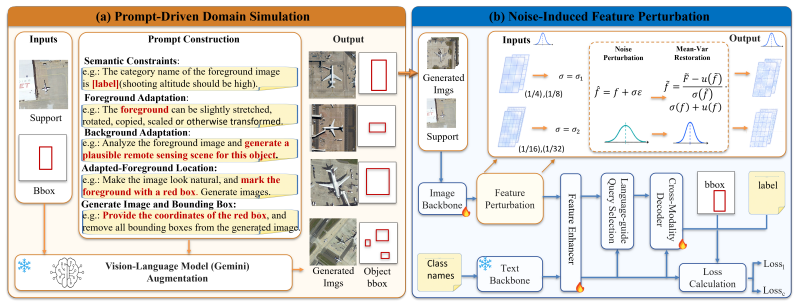
The load-bearing objects are the structured generation prompt and the noise-injection recipe. The prompt decomposes into five parts: semantic constraints, foreground adaptation, background adaptation, adapted-foreground location, and image-with-bounding-box generation, which together make the VLM's output semantically consistent yet domain-diverse. The perturbation recipe injects Gaussian noise into the four-level feature pyramid between the backbone and the feature enhancer of GroundingDINO, using stronger noise with strength 0.15 on the finer low-level features at 1/4 and 1/8 resolution and weaker noise with strength 0.10 on the coarser high-level features at 1/16 and 1/32, and then applies a distribution-correction step that rescales each noisy feature map to the mean and variance of its clean counterpart, so the injected perturbation changes local detail without shifting global feature statistics.
What would settle it
Regenerate all augmented samples with a different vision-language model, for example an open-weight one, using the same five-part prompt template and rerun the 1-shot protocol: if the roughly 10-point gap over the fine-tuned GroundingDINO baseline shrinks by more than half, the reported gains depend on the specific closed API rather than on the method itself. A cheaper check is to hand-label a random sample of the generated images and count how often the returned bounding box actually contains the named object, since mislabeled or misaligned samples would mean the semantic-consistency premise fails even if mAP still rises from added diversity.
Extended reading notes
Core claim
The paper's central claim is that jointly adapting foreground and background under a semantic-consistency constraint produces better cross-domain training supervision than adapting only the background, only the foreground, or applying low-level augmentations. Concretely, PSP-FSOD feeds each support image, its bounding box, the category label, and a target-domain description into a five-part prompt that instructs a VLM to keep the object's identity while varying appearance, background, and location, and to return a new image with a fresh bounding box; every returned sample is added to the support set for fine-tuning GroundingDINO. A second component, noise-induced feature perturbation, adds Gaussian noise of strength 0.15 to the low-level feature maps and 0.10 to the high-level ones, then re-normalizes each noisy map to the clean feature's mean and variance before the feature enhancer. The paper reports that this combination lifts average mAP from the fine-tuned GroundingDINO baseline of 26.3, 40.4, and 43.9 to 36.4, 45.0, and 47.1 under the 1-, 5-, and 10-shot settings, and that the gains are largest on domains with strong foreground variation and foreground-background coupling and smallest on the simpler style-shift domains.
Load-bearing premise
The pipeline trusts the VLM's output: every generated image and its returned bounding box is added to the support set with no stated check on whether the object category or box is correct, and the whole generation stage depends on a target-domain description written by an LLM from the dataset papers, with the actual prompts, descriptions, and API version not included in the paper, so the synthesis step cannot currently be reproduced or audited.
Editorial extensions
If this is right
- Generated domain simulation is the dominant driver of the gains: on the 1-shot protocol, prompt-driven synthesis alone adds 6.4 mAP over the fine-tuned baseline while noise perturbation adds 1.1, and combining them yields 8.6, showing the two mechanisms are complementary.
- Only one generated image per support image is needed on most datasets and two on ArTaxOr, versus five for the background-centric Domain-RAG baseline, so the simulation is sample-efficient.
- The method beats the search-based augmentation baseline ETS by 8.6, 3.9, and 2.7 mAP and the generation-based Domain-RAG by 2.8, 2.3, and 1.7 mAP under the 1-, 5-, and 10-shot settings.
- The two components target different failure modes: generated samples help most where foreground variation is strong, while noise perturbation helps most on domains with blurred boundaries and unstable imaging quality.
- The framework is built as a plug-in around an open-set detector and the authors state that it extends to other few-shot learning tasks beyond object detection.
Reading between the lines
- My inference: the distribution-correction step makes the noise module resemble feature-statistics style augmentation, since each noisy map is re-whitened to the clean map's mean and variance; a direct comparison against the style-randomization baselines the paper cites would settle whether the gain comes from domain invariance or simply from feature diversity.
- My inference: because the pipeline adds every generated sample without checking the returned box, it inherits the closed VLM's per-category biases; a category-wise breakdown of gains would test whether improvements concentrate in classes the generator renders well.
- My inference: since even one or two generated images per support sample produce most of the gain, scaling the number of generated images may saturate quickly, while scaling prompt diversity across backgrounds and layouts may be the higher-leverage axis; this is testable by varying images-per-support against prompt variants.
- The paper's own checklist reports that no error bars or multi-seed variance were computed; a five-seed rerun of the main table would show whether the 1.7 to 2.8 point margins over Domain-RAG are stable across runs.
Editorial analysis
A structured set of objections, weighed in public.
Referee Report
Summary. The paper proposes PSP-FSOD, a framework for cross-domain few-shot object detection that combines two components: prompt-driven domain simulation (PDS), which uses a VLM (Gemini) to generate target-domain-style images from support images and bounding-box annotations under semantic consistency constraints, and noise-induced feature perturbation (NFP), which injects Gaussian noise into multi-scale backbone features with a mean-variance restoration step before the GroundingDINO feature enhancer. The authors evaluate on the CD-ViTO benchmark across six target domains under 1/5/10-shot settings, reporting average mAP of 36.4/45.0/47.1 and gains over Domain-RAG of 2.8/2.3/1.7 and over the fine-tuned GroundingDINO baseline of 10.1/4.6/3.2. Ablations in Table 2 identify PDS as the dominant contributor and NFP as a smaller complementary regularizer.
Significance. If the reported gains are reliable, the work is a useful empirical contribution to CD-FSOD: it demonstrates that a closed VLM can be prompted to produce semantically consistent foreground-background variations from a handful of support images, and that feature-level noise perturbation with distribution correction is a cheap and complementary regularizer. The paper also ships an anonymized code repository, reports per-dataset training details, and compares against the strongest augmentation-based baselines. Its significance is currently bounded by the absence of statistical validation: all headline comparisons rest on single-run mAP, and the margins over Domain-RAG are modest in the 5- and 10-shot settings.
major comments (4)
- [Section 4.2, Table 1, and NeurIPS Checklist Item 7] The central claim of consistent improvement is supported only by single-run mAP values. The paper's own checklist answers [No] to whether error bars, confidence intervals, or significance tests are reported. The gains over Domain-RAG are 2.8, 2.3, and 1.7 mAP for 1/5/10-shot, and the NFP module alone contributes only 1.1, 0.6, and 0.9 mAP (Table 2). In few-shot detection, seed-to-seed variance from support-set sampling, augmentation, and optimization is typically on the order of several mAP points, so these margins may fall within run-to-run noise. I request multi-seed experiments (at least three seeds) with reported mean and standard deviation for the main results and key ablations, or an explicit statistical test; without this, the headline claim is not supported.
- [Table 1 vs. Table 2] There is an unexplained discrepancy between the GroundingDINO baseline in Table 1 and the Baseline+ in Table 2: the 1-shot average is 26.3 in Table 1 but 27.8 in Table 2, with similar differences of 0.7 and 0.6 in the 5-shot and 10-shot rows. If these entries are meant to be the same configuration, the discrepancy indicates the reported numbers are unstable; if they are different configurations (e.g., different training schedules or augmentation settings), then the headline gains over GroundingDINO in Section 4.2 are computed against a different baseline than the ablation gains, and the text should state this explicitly. Please reconcile the two tables and clarify which configuration is the reference baseline.
- [Section 3.1 and Appendix B] The prompt-driven component is not reproducible from the manuscript. The paper defines the prompt structure P(y,d) = {Psem, Pfg, Pbg, Ploc, Pann} and mentions a target-domain description d obtained by an LLM, but the actual prompt templates, the dataset-specific descriptions d, and the VLM model/API version are not provided. Appendix B.1 says the appendix includes the prompts used, but no full prompt text appears in the manuscript text provided. Since a closed API like Gemini can change behavior between versions, the authors should release the exact prompts, the generated descriptions, and representative generated samples for each dataset. They should also describe any verification or filtering of the generated images and bounding boxes, because unverified pseudo-labels are added directly to the support set and could introduce noise whose magnitude is currently unknown.
- [Section 4.4, Table 5, Table 6, and Table 7] Several key hyperparameters are selected on the target benchmarks themselves, which risks inflating the reported gains and weakens the generalization claim. Noise strengths are tuned on UODD (Table 5), per-dataset epochs, batch sizes, and LR milestones are dataset-specific (Table 6), and the number of generated images per support image is set to 1 or 2 per dataset (Table 7). The paper does not describe a held-out validation procedure or a protocol for choosing these values without access to the test query sets. Please clarify how these hyperparameters were chosen and whether they can be selected from the support set alone, or report results under a fixed protocol.
minor comments (5)
- [Table 2] In the 10-shot PDS row, the NEU-DET and UODD entries appear as "28.331.9" without a separating space; this should be "28.3 31.9".
- [Table 1] The entry "nan" for Distill-CDFSOD in the 1-shot rows should be replaced with "—" and a note explaining why those values are unavailable, to avoid confusion with actual numeric results.
- [Table 1 caption] The caption says best results are highlighted in pink; since the manuscript may be read in grayscale, please use bold text or another unambiguous marker instead.
- [Appendix B.1] The appendix promises a visualization of the prompts used for domain simulation, but the visible appendix text does not include the actual prompt strings; please add them or revise the claim.
- [Section 3.2] The notation sigma_i is used both for the noise strength and for the standard deviation of the feature map in the distribution correction formula; please use distinct symbols (e.g., alpha_i for noise strength) to avoid confusion.
Circularity Check
No significant circularity: PSP-FSOD is an empirical augmentation and regularization method evaluated against external benchmarks, and no central claim reduces by construction to its inputs.
full rationale
The paper's derivation chain is empirical rather than formal: it proposes prompt-driven domain simulation with Gemini and noise-induced feature perturbation on GroundingDINO, then measures mAP on six external CD-FSOD target domains. There is no equation in which a predicted quantity is defined in terms of the fitted quantity, and no fitted parameter is renamed as a prediction. The per-dataset hyperparameters (noise strengths, epochs, generation counts) are tuned and reported through ablations, which is standard empirical practice rather than circularity. The target-domain description d is summarized from dataset papers and a small set of target-domain samples; this uses the allowed few-shot support information and does not reduce the evaluation to the method's own outputs. The paper cites external baselines (GroundingDINO, ETS, Domain-RAG, CD-ViTO) and does not rely on a self-citation chain or an imported uniqueness theorem to force its design. The NeurIPS checklist's [No] answer on statistical significance and the absence of error bars are real threats to the strength of the empirical claim, but they are concerns about statistical support and reproducibility, not about circular reasoning. No specific step satisfies the required standard of exhibiting a reduction of a claimed result to its own inputs, so the circularity score is 0.
Assumptions & free parameters
free parameters (4)
- sigma_1, low-level feature noise strength =
0.15
- sigma_2, high-level feature noise strength =
0.10
- generated images per support image =
2 on ArTaxOr, 1 on other datasets
- per-dataset training schedule =
epochs and batch sizes in Appendix Table 6
assumptions (4)
- domain assumption The selected VLM (Gemini) can follow the structured prompt and return valid images and bounding boxes for all target categories.
- domain assumption The LLM-produced target-domain description d accurately captures each dataset's style, context, and imaging conditions.
- standard math Mean and variance are sufficient statistics for correcting Gaussian feature perturbation.
- domain assumption GroundingDINO with Swin-B is an appropriate base detector whose limitations are acceptable.
Cite this review
Pith. "Pith review of Prompt-Driven Simulation with Feature Perturbation for Cross-Domain Few-Shot Object Detection." pith.science (2026). https://pith.science/paper/SWW4WH6D
@misc{pith2026260801348,
  author       = {Pith},
  title        = {Pith review of: Prompt-Driven Simulation with Feature Perturbation for Cross-Domain Few-Shot Object Detection},
  year         = {2026},
  howpublished = {\url{https://pith.science/paper/SWW4WH6D}},
  note         = {Machine review of arXiv:2608.01348}
}
read the original abstract
Data augmentation, which simulates diverse visual variations to expand the source distribution and induce synthetic domain shifts, is a simple yet effective strategy for mitigating severe domain shifts and limited labeled target data in cross-domain few-shot object detection (CD-FSOD). Existing approaches rely on conventional data augmentation, such as Color-Jitter, Mosaic, and background-centric adaptation (e.g., Domain-RAG), which are limited in modeling complex domain shifts and often lead to suboptimal performance. In this paper, we propose PSP-FSOD, a principled framework that integrates prompt-driven domain simulation with feature perturbation regularization to improve generalization in CD-FSOD. To enable controllable domain synthesis, we design a prompt-driven strategy that leverages the visual grounding capability of large VLMs to jointly model foreground and background variations, generating semantically consistent yet domain-diverse training samples. Moreover, we adopt a grounding-aware generation scheme that guides object placement and alleviates semantic-spatial misalignment, thereby improving foreground adaptation. To ensure training stability and robustness, we further introduce a noise-induced feature perturbation mechanism that injects Gaussian noise into multi-scale intermediate features with distribution correction, encouraging consistent predictions under perturbations and reducing reliance on domain-specific cues. Extensive experiments demonstrate that PSP-FSOD produces high-quality domain-diverse supervision and learns domain-invariant representations, consistently improving performance across CD-FSOD benchmarks.
Figures


Figures from the paper (5 more)


Forward citations
Cited by 1 Pith paper
-
The First EgoCross Challenge at EgoVis 2026: Cross-Domain Egocentric Video Question Answering
At CVPR 2026, the EgoCross Challenge evaluated cross-domain egocentric video QA across four specialist domains, with the best system reaching 66.98% accuracy.
Reference graph
Works this paper leans on
-
[2]
Qwen3 technical report.arXiv preprint arXiv:2505.09388,
An Yang, Anfeng Li, Baosong Yang, Beichen Zhang, Binyuan Hui, Bo Zheng, Bowen Yu, Chang Gao, Chengen Huang, Chenxu Lv, et al. Qwen3 technical report.arXiv preprint arXiv:2505.09388,
-
[3]
Gemini: a family of highly capable multimodal models.arXiv preprint arXiv:2312.11805,
Gemini Team, Rohan Anil, Sebastian Borgeaud, Jean-Baptiste Alayrac, Jiahui Yu, Radu Soricut, Johan Schalk- wyk, Andrew M Dai, Anja Hauth, Katie Millican, et al. Gemini: a family of highly capable multimodal models.arXiv preprint arXiv:2312.11805,
-
[6]
mixup: Beyond empirical risk minimization.arXiv preprint arXiv:1710.09412,
Hongyi Zhang, Moustapha Cisse, Yann N Dauphin, and David Lopez-Paz. mixup: Beyond empirical risk minimization.arXiv preprint arXiv:1710.09412,
-
[8]
Lei Qi, Hongpeng Yang, Yinghuan Shi, and Xin Geng
doi: 10.1109/ TCSVT.2022.3152615. Lei Qi, Hongpeng Yang, Yinghuan Shi, and Xin Geng. Normaug: Normalization-guided augmentation for domain generalization.IEEE Transactions on Image Processing,
arXiv 2022
-
[9]
Yuqian Fu, Yu Xie, Yanwei Fu, Jingjing Chen, and Yu-Gang Jiang
doi: 10.1109/TIP.2024.3364516. Yuqian Fu, Yu Xie, Yanwei Fu, Jingjing Chen, and Yu-Gang Jiang. Wave-san: Wavelet based style augmentation network for cross-domain few-shot learning.arXiv preprint arXiv:2203.07656,
arXiv 2024
-
[11]
Ze Liu, Yutong Lin, Yue Cao, Han Hu, Yixuan Wei, Zheng Zhang, Stephen Lin, and Baining Guo
doi: 10.1109/CVPR52733.2024.01682. Ze Liu, Yutong Lin, Yue Cao, Han Hu, Yixuan Wei, Zheng Zhang, Stephen Lin, and Baining Guo. Swin transformer: Hierarchical vision transformer using shifted windows. InProceedings of the IEEE/CVF International Conference on Computer Vision, pages 10012–10022,
arXiv 2024
-
[14]
Defrcn: Decoupled faster r-cnn for few-shot object detection.arXiv preprint arXiv:2108.09017,
Limeng Qiao, Yuxuan Zhao, Zhiyuan Li, Xi Qiu, Jianan Wu, and Chi Zhang. Defrcn: Decoupled faster r-cnn for few-shot object detection.arXiv preprint arXiv:2108.09017,
-
[15]
Detect everything with few examples.arXiv preprint arXiv:2309.12969,
Xinyu Zhang, Yuhan Liu, Yuting Wang, and Abdeslam Boularias. Detect everything with few examples.arXiv preprint arXiv:2309.12969,
Show all 16 references
-
[16]
A.1 More Implementation Details Additional implementation details are summarized in Table 6, including dataset-specific epochs, batch sizes, and learning rate decay milestones
A More Implementation Details and Analysis This section presents additional implementation details of the proposed CD-FSOD method and comparison of the number of the generated samples. A.1 More Implementation Details Additional implementation details are summarized in Table 6,...
2019
-
[2019]
Frustratingly simple few-shot object detection.arXiv preprint arXiv:2003.06957,
Xin Wang, Thomas E Huang, Trevor Darrell, Joseph E Gonzalez, and Fisher Yu. Frustratingly simple few-shot object detection.arXiv preprint arXiv:2003.06957,
2003 arXiv
-
[2020]
Raphael Gontijo Lopes, Dong Yin, Ben Poole, Justin Gilmer, and Ekin D
doi: 10.1109/W ACV45572.2020.9093467. Raphael Gontijo Lopes, Dong Yin, Ben Poole, Justin Gilmer, and Ekin D. Cubuk. Improving robustness without sacrificing accuracy with patch gaussian augmentation.arXiv preprint arXiv:1906.02611,
2020
-
[2021]
Arthropod taxonomy orders object detection dataset
Geir Drange. Arthropod taxonomy orders object detection dataset. https://doi.org/10.34740/kaggle/ dsv/1240192,
-
[2022]
Cd-fsod: A benchmark for cross-domain few-shot object detection
Wuti Xiong. Cd-fsod: A benchmark for cross-domain few-shot object detection. InICASSP 2023-2023 IEEE International Conference on Acoustics, Speech and Signal Processing (ICASSP), pages 1–5. IEEE,
2023
-
[2023]
Gpt-4 technical report.arXiv preprint arXiv:2303.08774,
Josh Achiam, Steven Adler, Sandhini Agarwal, Lama Ahmad, Ilge Akkaya, Florencia Leoni Aleman, Diogo Almeida, Janko Altenschmidt, Sam Altman, Shyamal Anadkat, et al. Gpt-4 technical report.arXiv preprint arXiv:2303.08774,
-
[2024]
Andreas Bär, Neil Houlsby, Mostafa Dehghani, and Manoj Kumar
doi: 10.1145/3696409.3700174. Andreas Bär, Neil Houlsby, Mostafa Dehghani, and Manoj Kumar. Frozen feature augmentation for few- shot image classification. InProceedings of the IEEE/CVF Conference on Computer Vision and Pattern Recognition, pages 16067–16077,
-
[2025]
Sdxl: Improving latent diffusion models for high-resolution image synthesis.arXiv preprint arXiv:2307.01952,
Dustin Podell, Zion English, Kyle Lacey, Andreas Blattmann, Tim Dockhorn, Jonas Müller, Joe Penna, and Robin Rombach. Sdxl: Improving latent diffusion models for high-resolution image synthesis.arXiv preprint arXiv:2307.01952,
Reviewed August 7, 2026 · model on record in the stance chip above.
Discussion (0). Continue with ORCID to comment.