REVIEW 5 major objections 6 minor 126 references
Spatiotemporal Proximal Causal Inference under Hidden Confounding and Interference
T0 review · 5 major / 6 minor · reviewed 2026-08-06 · deepseek-v4-flash
Pith's one-line read The paper proves that, under proxy exclusion restrictions and a spatiotemporal completeness condition, a spatiotemporal outcome confounding bridge function $h_t$ satisfying a conditional moment equation identifies the potential outcome mean
desk verdict The spatiotemporal framing and neural pipeline are worth engaging with, but Theorem 1 is not proven as stated and the experiments overclaim; it needs major revision before the central claims can be accepted. read the letter →
The pith
A machine-rendered reading of the paper's core claim, the machinery that carries it, and where it could break.
The reading
What carries the argument
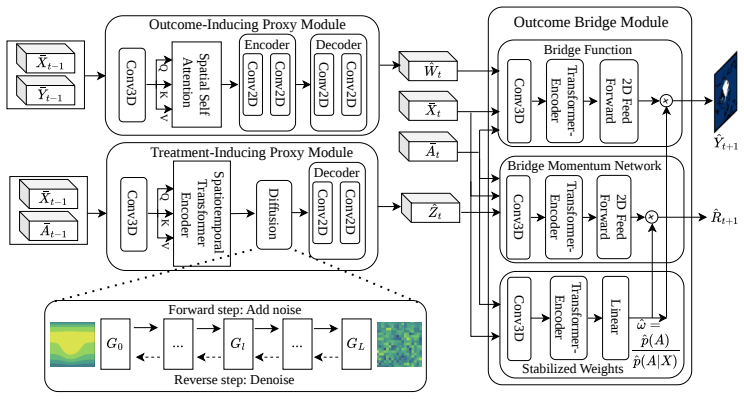
The spatiotemporal outcome confounding bridge function $h_t(A_t, W_t, X_t, \bar{H}_{t-1})$: a measurable function that solves the conditional moment equation $E[Y_t \mid A_t, Z_t, X_t, \bar{H}_{t-1}] = E[h_t \mid A_t, Z_t, X_t, \bar{H}_{t-1}]$, transferring the unmeasured confounder's influence onto the observed outcome-inducing proxy so the potential outcome mean is computable without $U$. Uniqueness of the bridge is exactly what the spatiotemporal completeness condition supplies. In the implementation, the bridge-moment network is the machinery that stops $h$ from collapsing to a plain regression $E[Y \mid W, A, X]$: an adversarial loss enforces the conditional restriction on $Z$, while th
What would settle it
Simulate the paper's data-generating process but give the hidden confounder $U$ a state space strictly larger than what the proxies $Z$ and $W$ can encode, or shrink the neighborhood proxy so completeness fails, fit the proposed estimator, and compare its ATE to the known ground truth: bias appearing as the confounder's complexity outruns the proxies' richness would show the completeness condition is carrying the identification. A more direct check: with $U$ observed in simulation, estimate $E[v(U) \mid A, Z, X, \bar{H}_{t-1}]$ for candidate nonzero $v$ and test whether any satisfy the complet
Extended reading notes
Core claim
The paper's central claim is Theorem 1: under the proximal causal structure (Assumption 3) and the spatiotemporal completeness condition (Assumption 4), there exists a measurable spatiotemporal outcome confounding bridge function $h_t(A_t, W_t, X_t, \bar{H}_{t-1})$ with $E[Y_t \mid A_t, Z_t, X_t, \bar{H}_{t-1}] = E[h_t(A_t, W_t, X_t, \bar{H}_{t-1}) \mid A_t, Z_t, X_t, \bar{H}_{t-1}]$, and this identity identifies the potential outcome for treatment $a$ as $\psi(a) = E[h_t(a, W_t, X_t, \bar{H}_{t-1})]$, so the average treatment effect between $a$ and $a'$ is the expectation of a difference of bridge-function evaluations. The bridge function is an identification object, not a prediction model:
Load-bearing premise
The load-bearing premise is the spatiotemporal completeness condition: the treatment-inducing proxy $Z$ must be rich enough that no nonzero function of the hidden confounder $U$ is mean-independent of $Z$ given treatment, covariates, and history — an untestable requirement that must hold together with the existence of an ideal proxy pair satisfying the exclusion restrictions.
Editorial extensions
If this is right
- For any two interventions $a$ and $a'$, the average treatment effect is identified as $E[h_t(a, W_t, X_t, \bar{H}_{t-1}) - h_t(a', W_t, X_t, \bar{H}_{t-1})]$, a proximal analogue of the g-computation formula for spatiotemporal data.
- The confounder itself never has to be reconstructed: once any function satisfies the bridge moment equation, potential outcome means follow by averaging over the observed proxy-covariate distribution, bypassing factor-model deconfounding entirely.
- Researchers with negative-control-style proxy variables in spatial panel data can in principle estimate policy effects in settings where standard g-computation and propensity-score methods fail because they assume away hidden confounding.
- The ablations (removing diffusion, stabilized weights, or the bridge-moment network) all degrade counterfactual accuracy on the synthetic benchmarks, supporting the paper's claim that each component enforces part of the identifying conditions.
- On the synthetic benchmarks the method exceeds the baselines on the single-confounder dataset and matches the best baseline on the two-confounder dataset while better preserving the spatial structure of the counterfactual outcome field.
Reading between the lines
- A testable extension follows from the paper's own concession that completeness 'becomes more erratic' as neighborhood size grows: bridge estimation should behave like an ill-posed inverse problem whose variance inflates with proxy dimension, so measuring that variance scaling could tell practitioners how much neighborhood to include.
- If the identification claim is right, it gives a principled alternative to spatial factor-model deconfounders: instead of recovering a substitute confounder from multiple causes, a step the critique literature shows is generally not nonparametrically identified, the proximal route only needs dedicated proxy variables satisfying exclusion restrictions.
- The consistency argument in Appendix C, that the learned proxy converges to the ideal proxy, invokes conditions essentially as strong as the conclusion (expressive encoder, consistent score estimation, global convergence), so the end-to-end guarantee inherits the identification assumptions rather than independently establishing them; real-world use would hinge on domain-level justification of the
- The bridge-moment objective is an instance of conditional moment restriction estimation, so off-the-shelf minimax or kernel estimators of the kind the paper cites could replace the transformer-based bridge without changing the identification claim.
Editorial analysis
A structured set of objections, weighed in public.
Referee Report
Summary. The manuscript proposes a spatiotemporal proximal causal inference framework for estimating potential outcomes under hidden confounding and interference. It introduces a treatment-inducing proxy Z and an outcome-inducing proxy W, defines a spatiotemporal outcome confounding bridge function h satisfying E[Y_t | A_t, Z_t, X_t, Hbar_{t-1}] = E[h_t(A_t, W_t, X_t, Hbar_{t-1}) | A_t, Z_t, X_t, Hbar_{t-1}], and claims in Theorem 1 that under Assumptions 3 and 4 such a bridge exists and identifies the potential outcome. The paper then proposes a neural implementation consisting of transformer/diffusion treatment-proxy learning, a spatial self-attention outcome-proxy autoencoder, CMI critics for exclusion restrictions, a bridge moment network, and stabilized weighting, with experiments on two synthetic datasets.
Significance. If the theoretical claims were correct, the paper would extend proximal causal inference to spatiotemporal settings with interference and hidden confounders, and the neural architecture would be a substantial operationalization. The paper has several strengths: the problem is well motivated, the related-work coverage is broad, the code is made available, and the architecture is explicitly tied to the bridge equation through a moment-matching objective with ablations. However, the central identification result is not established as stated: Assumptions 3 and 4 do not imply bridge existence, the proof contains an invalid independence claim, and the consistency result in Appendix C is largely assumption-conclusion. The synthetic experiments demonstrate internal fit but do not independently validate the proximal assumptions. The value of the paper is therefore conditional on a substantial theoretical revision.
major comments (5)
- [Theorem 1 / Definition 1, Eq. (4)] The theorem asserts existence of a bridge function h_t solving Eq. (4) under Assumptions 3 and 4, but the proof does not establish this. Assumption 4 is a completeness condition on Z; it guarantees uniqueness of a solution if one exists, not that E[Y_t|A_t,Z_t,X_t,Hbar] lies in the range of the operator h ↦ E[h(A,W,X,Hbar)|A,Z,X,Hbar]. A counterexample is U continuous, Z=U+noise (so Assumption 4 can hold), W=1{U>0}, Y=U+A: any h depending on W can only distinguish the sign of U, while E[Y|A,Z] depends on the full conditional mean of U, so Eq. (4) has no solution. An explicit outcome-proxy completeness or bridge-existence assumption must be added.
- [Theorem 1, ψ(a) expression] The potential outcome formula in Theorem 1 is written as E[h_t(a_t, W_t, X_t, Hbar_{t-1}) | A_t=a_t, Z_t, X_t, Hbar_{t-1}], which is a conditional expectation given Z. The marginal estimand E[Y_t(a)] is later defined as E[h_t(a_t, W_t, X_t, Hbar_{t-1})], and these two objects are not equal in general. The conditioning on Z does not identify the marginal potential outcome. The theorem statement, the proof, and the subsequent ATE derivation are therefore internally inconsistent; the conditional expression should be corrected or removed.
- [Appendix B, Proof of Theorem 1] The proof contains an invalid independence statement: 'From assumption 3, we know W is independent of X and Z.' Assumption 3 only gives W ⊥ (A,Z) | U,X, which does not imply W is independent of X and Z marginally. This assertion is used to justify including X and Z in the conditional distribution dP(w|u,X_t,Z_t,A_t,Hbar), and the subsequent application of the conditional law of total probability relies on it. As written, the proof does not validly eliminate U from the conditional expectation.
- [Appendix C, Proposition C.1 and Corollary C.1] The consistency guarantee for the learned treatment-inducing proxy is not independently established. Proposition C.1 assumes that the Transformer is sufficiently expressive, the diffusion model consistently estimates the conditional score, and optimization reaches a global minimum; these conditions effectively assume the conclusion that the estimated proxy converges to the ideal Z*. Corollary C.1 then invokes the Continuous Mapping Theorem and Slutsky's theorem for conditional expectations without verifying the required continuity and convergence-in-distribution conditions. This appendix should be rewritten as a heuristic discussion or removed, and cannot currently serve as a theoretical justification for the neural pipeline.
- [Section 6, Synthetic Data] The synthetic data generation process does not generate explicit treatment-inducing or outcome-inducing proxy variables; Z and W are learned representations. Consequently, the experiments show that the architecture can fit the bridge equation and predict counterfactual outcomes in this simulated setting, but they do not validate the key identifying assumptions (exclusion restrictions, completeness, bridge existence). The empirical results are thus a consistency check of the optimization, not a falsifiable test of the identification theory. The claims in the abstract and conclusion that the framework is 'theoretically grounded' on this basis should be moderated.
minor comments (6)
- [Throughout] The acronym SUTVA is misspelled as 'SUTV A' in several places (e.g., Sections 1 and Appendix A).
- [Appendix A] The text cites 'Egami and Tchetgen Tchetgen (2023)' but this reference is missing from the reference list.
- [Section 5, CMI critic] The notation for the treatment-proxy CMI loss uses I^W_CLUB(Y; \hat Z|X,A), which appears to be a typo; it should likely be I^Z_CLUB. Also, 'ramdomly' should be 'randomly'.
- [Table 1] The text states that the proposed method achieves better performance than baseline causal models on dataset 2, but Table 1 shows Spatial Deconfounder with RMSE_I=0.027 versus the proposed method's RMSE_I=0.066. The performance summary should be stated more accurately.
- [Appendix B] The phrase 'towers property' should be 'tower property'. Also, the proof says 'W is independent of X and Z' but does not specify whether this is conditional or unconditional; this needs clarification beyond the correction noted above.
- [Section 4, bridge function] The notation Hbar_{t-1} is used throughout but not defined precisely in the main text; the reader is left to infer it from the problem formulation. A concise definition would improve clarity.
Circularity Check
Theorem 1 assumes bridge existence; Appendix B's proof imports the conclusion, so the central identification claim is not derived from the stated assumptions.
-
self definitional
[Definition 1 / Eq. (4); Theorem 1; Appendix B (Proof of Theorem 1)]
"From the proximal causal inference, we found that there exists a function h_t such that E[Y_t|A_t,U_t,X_t,\bar H_{t-1}] = E[h_t(A_t,W_t,X_t,\bar H_{t-1})|U_t,X_t,\bar H_{t-1}]."
Theorem 1 is supposed to prove the existence of a bridge function h satisfying Eq. (4) from Assumptions 3 and 4. The proof's second step simply asserts that existence ('we found that there exists a function h_t...') without deriving it. Assumption 4 is a completeness/uniqueness condition for Z: it guarantees at most one solution to Eq. (4), not that a solution exists. The proof therefore assumes the central object it claims to establish; the identification result holds only conditional on an unstated bridge-existence assumption. Since Definition 1 already defines a bridge function as a solution to Eq. (4), the theorem reduces to taking the definition as existence.
-
other
[Appendix C, Proposition C.1 and Corollary C.1]
"Suppose ... The diffusion model consistently estimates the conditional score function associated with the latent treatment distribution; ... then the learned proxy \hat Z=f_Z(X,A) converges in probability to the latent treatment-inducing proxy ... \hat Z \xrightarrow{P} Z^*."
The 'consistency' proposition assumes, as a premise, that the diffusion model consistently estimates the conditional score of the latent treatment distribution, and then concludes that the learned proxy converges to Z^*. That is essentially the desired consistency guarantee restated as an assumption. Corollary C.1 then assumes 'the proximal proxy assumptions are satisfied by the latent proxy \hat Z' to conclude that identification is preserved. Thus the Appendix presents the validity of the learned proxy as a condition rather than as a result derived from more basic hypotheses, so the neural pipeline's theoretical guarantee is not independently established.
full rationale
The paper's core theoretical step, Theorem 1, is circular in a specific, quotable way: the proof asserts the existence of the outcome bridge function rather than deriving it from Assumptions 3 and 4. Assumption 4 supplies uniqueness only, not existence, so the claimed identification result is not established by the stated assumptions; it is assumed. Appendix C similarly packages the needed consistency of the learned proxy as an assumption and then announces that identification is preserved. These are genuine circular-support issues in the theoretical derivation. The synthetic experiments, by contrast, are not circular: the counterfactual simulator is external to the fitted model, so the empirical comparisons provide relatively independent evidence about the architecture's predictive performance. The g-computation connection and the uniqueness argument are standard non-circular pieces. Overall, the central identification claim partially reduces to its own assumption, warranting a score of 6 rather than a higher score, because the empirical validation and the standard parts of the derivation retain independent content.
Assumptions & free parameters
assumptions (6)
- domain assumption Consistency and positivity (Assumption 1): potential outcome equals observed outcome under observed treatment, and P(A_i,t = a | X) > 0.
- domain assumption Markov dynamics of hidden confounding (Assumption 2): U_i,t = f(U_i,t-1, xi_t).
- domain assumption Proximal causal structure (Assumption 3): Y ⟂ Z | A,U,X and W ⟂ (A,Z) | U,X.
- domain assumption Spatiotemporal completeness (Assumption 4): E[v(U)|A,Z,X,Hbar]=0 implies v(U)=0.
- ad hoc to paper Existence of ideal proxies Z* and W* and of a bridge function h_t
- ad hoc to paper Conditions of Proposition C.1 (expressive transformer, consistent diffusion score estimation, global minimum of diffusion objective)
invented entities (3)
-
Treatment-inducing proxy Z
-
Outcome-inducing proxy W
-
Spatiotemporal outcome confounding bridge function h_t
Cite this review
Pith. "Pith review of Spatiotemporal Proximal Causal Inference under Hidden Confounding and Interference." pith.science (2026). https://pith.science/paper/2KMKV6HZ
@misc{pith2026260801352,
  author       = {Pith},
  title        = {Pith review of: Spatiotemporal Proximal Causal Inference under Hidden Confounding and Interference},
  year         = {2026},
  howpublished = {\url{https://pith.science/paper/2KMKV6HZ}},
  note         = {Machine review of arXiv:2608.01352}
}
read the original abstract
Estimating causal effects from real-world spatiotemporal data is challenging due to hidden confounders and interference. Standard causal identification methods assume conditional exchangeability given observed covariates, which fails whenever hidden confounders affect both treatment and outcomes - a common setting in domains such as climate, environmental policy, epidemiology, and regional economics. In this paper, we propose a novel spatiotemporal proximal causal inference framework that extends proximal identification theory to spatiotemporal settings. The proposed method jointly captures local and neighborhood-level confounding information by introducing treatment- and outcome-inducing proxies, and we derive a spatiotemporal outcome confounding bridge function that identifies the potential outcome without requiring direct recovery of the hidden confounder. We establish the identifiability of this bridge function under proxy exclusion restrictions and a spatiotemporal completeness condition, and show that the resulting estimator recovers the outcome through a proximal generalization of the g-computation formula. To operationalize this identification result, we propose a neural architecture that learns proxies via transformer-based spatiotemporal encoders - coupled with a conditional mutual information critic to enforce exclusion restrictions and a moment-matching network to guarantee that the learned bridge function satisfies the underlying identifying equation. We further introduce a stabilized weighting scheme to address treatment support imbalance. Experiments on synthetic datasets demonstrate that our approach achieves comparable performance to baseline causal inference methods, while providing, to our knowledge, the first theoretically grounded outcomes for the hidden confounding in the presence of spatiotemporal interference through a proximal causal inference framework.
Figures


Figures from the paper (2 more)


Reference graph
Works this paper leans on
-
[1]
Patricia S. Abril and Robert Plant. The patent holder's dilemma: Buy, sell, or troll?. Communications of the ACM. doi:10.1145/1188913.1188915
-
[2]
Deciding equivalances among conjunctive aggregate queries
Sarah Cohen and Werner Nutt and Yehoshua Sagic. Deciding equivalances among conjunctive aggregate queries. doi:10.1145/1219092.1219093
-
[3]
Special issue: Digital Libraries. 1996
1996
-
[4]
Understanding Policy-Based Networking
David Kosiur. Understanding Policy-Based Networking
-
[7]
The title of book two. doi:10.1007/3-540-09237-4
-
[8]
Asad Z. Spector. Achieving application requirements. Distributed Systems. doi:10.1145/90417.90738
-
[9]
Douglass and David Harel and Mark B
Bruce P. Douglass and David Harel and Mark B. Trakhtenbrot. Statecarts in use: structured analysis and object-orientation. Lectures on Embedded Systems. doi:10.1007/3-540-65193-4_29
-
[10]
Donald E. Knuth. The Art of Computer Programming, Vol. 1: Fundamental Algorithms (3rd. ed.)
Show all 126 references
-
[11]
Donald E. Knuth. The Art of Computer Programming
-
[12]
Structured Variational Inference Procedures and their Realizations (as incol)
Dan Geiger and Christopher Meek. Structured Variational Inference Procedures and their Realizations (as incol). Proceedings of Tenth International Workshop on Artificial Intelligence and Statistics, The Barbados
-
[13]
Stan W. Smith. An experiment in bibliographic mark-up: Parsing metadata for XML export. Proceedings of the 3rd. annual workshop on Librarians and Computers
-
[14]
Catch me, if you can: Evading network signatures with web-based polymorphic worms
Matthew Van Gundy and Davide Balzarotti and Giovanni Vigna. Catch me, if you can: Evading network signatures with web-based polymorphic worms. Proceedings of the first USENIX workshop on Offensive Technologies
-
[15]
Predicate Path expressions
Sten Andler. Predicate Path expressions. Proceedings of the 6th. ACM SIGACT-SIGPLAN symposium on Principles of Programming Languages. doi:10.1145/567752.567774
-
[16]
LOGICS of Programs: AXIOMATICS and DESCRIPTIVE POWER
David Harel. LOGICS of Programs: AXIOMATICS and DESCRIPTIVE POWER
-
[17]
Anisi , title =
David A. Anisi , title =
-
[18]
Clarkson
Kenneth L. Clarkson. Algorithms for Closest-Point Problems (Computational Geometry)
-
[19]
Introduction to Bayesian Statistics
Harry Thornburg. Introduction to Bayesian Statistics. 2001
2001
-
[20]
CLIFFORD: a Maple 11 Package for Clifford Algebra Computations, version 11
Rafal Ablamowicz and Bertfried Fauser. CLIFFORD: a Maple 11 Package for Clifford Algebra Computations, version 11. 2007
2007
-
[21]
Stats and Analysis
Poker-Edge.Com. Stats and Analysis. 2006
2006
-
[22]
A more perfect union
Barack Obama. A more perfect union
-
[23]
The fountain of youth
Joseph Scientist. The fountain of youth
-
[24]
Solder man
Dave Novak. Solder man. ACM SIGGRAPH 2003 Video Review on Animation theater Program: Part I - Vol. 145 (July 27--27, 2003). doi:10.945/woot07-S422
2003
-
[25]
Interview with Bill Kinder: January 13, 2005
Newton Lee. Interview with Bill Kinder: January 13, 2005. Comput. Entertain. doi:10.1145/1057270.1057278
2005
-
[26]
The Enabling of Digital Libraries
Bernard Rous. The Enabling of Digital Libraries. Digital Libraries
-
[28]
(new) Finding minimum congestion spanning trees , journal =
Werneck, Renato and Setubal, Jo\. (new) Finding minimum congestion spanning trees , journal =. doi:10.1145/351827.384253 , acmid = 384253, publisher =
-
[30]
and Mei, Alessandro , title =
Conti, Mauro and Di Pietro, Roberto and Mancini, Luigi V. and Mei, Alessandro , title =. Inf. Fusion , volume =. 2009 , issn =. doi:10.1016/j.inffus.2009.01.002 , acmid =
2009 doi
-
[31]
and Hutchful, David K
Li, Cheng-Lun and Buyuktur, Ayse G. and Hutchful, David K. and Sant, Natasha B. and Nainwal, Satyendra K. , title =. CHI '08 extended abstracts on Human factors in computing systems , year =. doi:10.1145/1358628.1358946 , acmid =
-
[32]
, title =
Hollis, Billy S. , title =. 1999 , isbn =
1999
-
[33]
Goossens, Michel and Rahtz, S. P. and Moore, Ross and Sutor, Robert S. , title =. 1999 , isbn =
1999
-
[34]
and Rosenberg, Arnold L
Buss, Jonathan F. and Rosenberg, Arnold L. and Knott, Judson D. , title =. 1987 , source =
1987
-
[35]
CHI '08: CHI '08 extended abstracts on Human factors in computing systems , year =
, note =. CHI '08: CHI '08 extended abstracts on Human factors in computing systems , year =
-
[36]
Algorithms for Closest-Point Problems (Computational Geometry) , year =
Clarkson, Kenneth Lee , advisor =. Algorithms for Closest-Point Problems (Computational Geometry) , year =
-
[37]
SIGCOMM Comput. Commun. Rev. , year =
-
[38]
2004 , isbn =
IEEE TCSC Executive Committee , booktitle =. 2004 , isbn =. doi:http://dx.doi.org/10.1109/ICWS.2004.64 , acmid =
2004 doi
-
[39]
Distributed systems (2nd Ed.) , year =
-
[40]
, title =
Petrie, Charles J. , title =. 1986 , source =
1986
-
[41]
Donald E. Knuth. Seminumerical Algorithms. 1981
1981
-
[42]
E-commerce and cultural values , year =
Kong, Wei-Chang , Title =. E-commerce and cultural values , year =
-
[43]
E-commerce and cultural values , year =
Kong, Wei-Chang , type =. E-commerce and cultural values , year =
-
[44]
Chapter 9 , booktitle =
Kong, Wei-Chang , editor =. Chapter 9 , booktitle =
-
[45]
E-commerce and cultural values , editor =
Kong, Wei-Chang , title =. E-commerce and cultural values , editor =. 2003 , isbn =
2003
-
[46]
E-commerce and cultural values - (InBook-num-in-chap) , chapter =
Kong, Wei-Chang , editor =. E-commerce and cultural values - (InBook-num-in-chap) , chapter =. 2004 , address =
2004
-
[47]
E-commerce and cultural values (Inbook-text-in-chap) , chapter =
Kong, Wei-Chang , editor =. E-commerce and cultural values (Inbook-text-in-chap) , chapter =. 2005 , address =
2005
-
[48]
E-commerce and cultural values (Inbook-num chap) , chapter =
Kong, Wei-Chang , editor =. E-commerce and cultural values (Inbook-num chap) , chapter =. 2006 , address =
2006
-
[49]
Microelectron
Mehdi Saeedi and Morteza Saheb Zamani and Mehdi Sedighi , title =. Microelectron. J. , volume =. 2010 , pages =
2010
-
[50]
Mehdi Saeedi and Morteza Saheb Zamani and Mehdi Sedighi and Zahra Sasanian , title =. J. Emerg. Technol. Comput. Syst. , volume =
-
[51]
Kirschmer, Markus and Voight, John , title =. SIAM J. Comput. , issue_date =. 2010 , issn =. doi:https://doi.org/10.1137/080734467 , acmid =
2010 doi
-
[52]
Hoare, C. A. R. , title =. Structured programming (incoll) , editor =. 1972 , isbn =
1972
-
[53]
History of programming languages I (incoll) , editor =
Lee, Jan , title =. History of programming languages I (incoll) , editor =. 1981 , isbn =. doi:http://doi.acm.org/10.1145/800025.1198348 , acmid =
1981
-
[54]
, title =
Dijkstra, E. , title =. Classics in software engineering (incoll) , year =
-
[55]
, title =
Wenzel, Elizabeth M. , title =. Multimedia interface design (incoll) , year =. doi:10.1145/146022.146089 , acmid =
-
[56]
, title =
Mumford, E. , title =. Critical issues in information systems research (incoll) , year =
-
[57]
and Golden, Donald G
McCracken, Daniel D. and Golden, Donald G. , title =. 1990 , isbn =
1990
-
[58]
The analysis of linear partial differential operators
H. The analysis of linear partial differential operators. 1985 , PAGES =
1985
-
[59]
IEEE", address =
A. Adya and P. Bahl and J. Padhye and A.Wolman and L. Zhou , title =. Proceedings of the IEEE 1st International Conference on Broadnets Networks (BroadNets'04) , publisher = "IEEE", address = "Los Alamitos, CA", year =
-
[60]
I. F. Akyildiz and W. Su and Y. Sankarasubramaniam and E. Cayirci , title =. Comm. ACM , volume = 38, number = "4", year =
-
[61]
I. F. Akyildiz and T. Melodia and K. R. Chowdhury , title =. Computer Netw. , volume = 51, number = "4", year =
-
[62]
ACM", address =
P. Bahl and R. Chancre and J. Dungeon , title =. Proceeding of the 10th International Conference on Mobile Computing and Networking (MobiCom'04) , publisher = "ACM", address = "New York, NY", year =
-
[63]
8 (Special Issue on Sensor Networks)
D. Culler and D. Estrin and M. Srivastava , title =. IEEE Comput. , volume = 37, number = "8 (Special Issue on Sensor Networks)", publisher = "IEEE", address = "Los Alamitos, CA", year =
-
[64]
Natarajan and M
A. Natarajan and M. Motani and B. de Silva and K. Yap and K. C. Chua , title =. Network Architectures , editor =. 960935712
-
[65]
Tzamaloukas and J
A. Tzamaloukas and J. J. Garcia-Luna-Aceves , title =
-
[66]
Zhou and J
G. Zhou and J. Lu and C.-Y. Wan and M. D. Yarvis and J. A. Stankovic , title =
-
[67]
Mapping Powerlists onto Hypercubes
Jacob Kornerup. Mapping Powerlists onto Hypercubes. 1994
1994
-
[68]
Automatic Parallelization for Distributed-Memory Multiprocessing Systems
Michael Gerndt. Automatic Parallelization for Distributed-Memory Multiprocessing Systems
-
[69]
J. E. Archer, Jr. and R. Conway and F. B. Schneider. User recovery and reversal in interactive systems. ACM Trans. Program. Lang. Syst
-
[70]
D. D. Dunlop and V. R. Basili. Generalizing specifications for uniformly implemented loops. ACM Trans. Program. Lang. Syst
-
[71]
Heering and P
J. Heering and P. Klint. Towards monolingual programming environments. ACM Trans. Program. Lang. Syst
-
[72]
Donald E. Knuth. The book
-
[73]
Korach and D
E. Korach and D. Rotem and N. Santoro. Distributed algorithms for finding centers and medians in networks. ACM Trans. Program. Lang. Syst
-
[74]
: A Document Preparation System
Leslie Lamport. : A Document Preparation System
-
[75]
F. Nielson. Program transformations in a denotational setting. ACM Trans. Program. Lang. Syst
-
[76]
Brian K. Reid. A high-level approach to computer document formatting. Proceedings of the 7th Annual Symposium on Principles of Programming Languages
-
[77]
and Abdelzaher, Tarek F
Zhou, Gang and Wu, Yafeng and Yan, Ting and He, Tian and Huang, Chengdu and Stankovic, John A. and Abdelzaher, Tarek F. , title =. ACM Trans. Embed. Comput. Syst. , issue_date =. doi:10.1145/1721695.1721705 , acmid = 1721705, publisher =
-
[78]
Institutional members of the Users Group
-
[79]
Boris Veytsman , title =
-
[80]
Robin Schneider , title =
-
[81]
and Peterson, Larry L
Bowman, Mic and Debray, Saumya K. and Peterson, Larry L. , title =. ACM Trans. Program. Lang. Syst. , volume =. 1993 , doi =
1993
-
[82]
TUGboat , volume =
Braams, Johannes , title =. TUGboat , volume =
-
[83]
Post Congress Tristesse
Malcolm Clark. Post Congress Tristesse. TeX90 Conference Proceedings
-
[84]
ACM Trans
Herlihy, Maurice , title =. ACM Trans. Program. Lang. Syst. , volume =. 1993 , doi =
1993
-
[85]
Salas and Einar Hille
S.L. Salas and Einar Hille. Calculus: One and Several Variable. 1978
1978
-
[86]
Publication quality tables in
Simon Fear , month =. Publication quality tables in
-
[87]
Using the amsthm Package , organization =
-
[88]
2019 , url =
R: A Language and Environment for Statistical Computing , author =. 2019 , url =
2019
-
[89]
Sam Anzaroot and Andrew McCallum , title =
-
[90]
Brad and Haunschild, Robin , title =
Bornmann, Lutz and Wray, K. Brad and Haunschild, Robin , title =
-
[91]
2014 , archivePrefix =
Sam Anzaroot and Alexandre Passos and David Belanger and Andrew McCallum , title =. 2014 , archivePrefix =. 1403.1349 , doi =
2014 arXiv
-
[92]
Proceedings of the 20th International Colloquium on Automata, Languages and Programming , series =
Maintaining Discrete Probability Distributions Optimally , author =. Proceedings of the 20th International Colloquium on Automata, Languages and Programming , series =
-
[93]
Reiser , year = 2014, title =
Brian J. Reiser , year = 2014, title =
2014
-
[94]
Baggett and M
R. Baggett and M. Simecek and C. Chambellan and K. Tsui and M. Fraune , year = 2025, title =
2025
-
[95]
Statistical Science , volume=
An introduction to proximal causal inference , author=. Statistical Science , volume=. 2024 , publisher=
2024
-
[96]
Statistical Theory and Related Fields , volume=
A confounding bridge approach for double negative control inference on causal effects , author=. Statistical Theory and Related Fields , volume=. 2024 , publisher=
2024
-
[97]
Biometrika , volume=
Identifying causal effects with proxy variables of an unmeasured confounder , author=. Biometrika , volume=. 2018 , publisher=
2018
-
[98]
American journal of epidemiology , volume=
Invited commentary: bias attenuation and identification of causal effects with multiple negative controls , author=. American journal of epidemiology , volume=. 2017 , publisher=
2017
-
[99]
Journal of the American Statistical Association , volume=
Semiparametric proximal causal inference , author=. Journal of the American Statistical Association , volume=. 2024 , publisher=
2024
-
[100]
Journal of the American Statistical Association , volume =
Xu Shi and Kendrick Qijun Li and Myeonghun Yu and Wang Miao and Arun Kumar Kuchibhotla and Mengtong Hu and Eric Tchetgen Tchetgen , title =. Journal of the American Statistical Association , volume =. 2026 , publisher =
2026
-
[101]
arXiv preprint arXiv:2512.24413 , year=
Demystifying Proximal Causal Inference , author=. arXiv preprint arXiv:2512.24413 , year=
-
[102]
Journal of the Royal Statistical Society Series B: Statistical Methodology , volume=
Multiply robust causal inference with double-negative control adjustment for categorical unmeasured confounding , author=. Journal of the Royal Statistical Society Series B: Statistical Methodology , volume=. 2020 , publisher=
2020
-
[103]
International conference on machine learning , pages=
Time series deconfounder: Estimating treatment effects over time in the presence of hidden confounders , author=. International conference on machine learning , pages=. 2020 , organization=
2020
-
[104]
Causal Learning and Reasoning , pages=
Sequential deconfounding for causal inference with unobserved confounders , author=. Causal Learning and Reasoning , pages=. 2024 , organization=
2024
-
[105]
International Conference on Machine Learning , year=
Spatial deconfounder: Interference-aware deconfounding for spatial causal inference , author=. International Conference on Machine Learning , year=
-
[106]
International conference on machine learning , pages=
Club: A contrastive log-ratio upper bound of mutual information , author=. International conference on machine learning , pages=. 2020 , organization=
2020
-
[107]
Journal of the American statistical association , volume=
Randomization analysis of experimental data: The Fisher randomization test comment , author=. Journal of the American statistical association , volume=. 1980 , publisher=
1980
-
[108]
Mathematical modelling , volume=
A new approach to causal inference in mortality studies with a sustained exposure period—application to control of the healthy worker survivor effect , author=. Mathematical modelling , volume=. 1986 , publisher=
1986
-
[109]
Biostatistics , volume=
Adjusting for unmeasured spatial confounding with distance adjusted propensity score matching , author=. Biostatistics , volume=. 2019 , publisher=
2019
-
[110]
arXiv preprint arXiv:2303.08218 , year=
Spatial causal inference in the presence of unmeasured confounding and interference , author=. arXiv preprint arXiv:2303.08218 , year=
-
[111]
Epidemiology , volume=
Negative controls: a tool for detecting confounding and bias in observational studies , author=. Epidemiology , volume=. 2010 , publisher=
2010
-
[112]
Journal of the American Statistical Association , volume=
The blessings of multiple causes: Rejoinder , author=. Journal of the American Statistical Association , volume=. 2019 , publisher=
2019
-
[113]
arXiv preprint arXiv:2510.08762 , year=
Spatial deconfounder: Interference-aware deconfounding for spatial causal inference , author=. arXiv preprint arXiv:2510.08762 , year=
-
[114]
Advances in Neural Information Processing Systems , volume=
GST-UNet: A neural framework for spatiotemporal causal inference with time-varying confounding , author=. Advances in Neural Information Processing Systems , volume=
-
[115]
blessings of multiple causes
Comment on “blessings of multiple causes” , author=. Journal of the American Statistical Association , volume=. 2019 , publisher=
2019
-
[116]
arXiv preprint arXiv:1902.10286 , year=
On multi-cause causal inference with unobserved confounding: Counterexamples, impossibility, and alternatives , author=. arXiv preprint arXiv:1902.10286 , year=
1902 arXiv
-
[117]
European Conference on Machine Learning and Knowledge Discovery in Databases (ECML-PKDD) , pages=
Estimating Direct and Indirect Causal Effects of Spatiotemporal Interventions in Presence of Spatial Interference , author=. European Conference on Machine Learning and Knowledge Discovery in Databases (ECML-PKDD) , pages=. 2024 , volume=
2024
-
[118]
2017 , journal=
Estimating average causal effects under general interference, with application to a social network experiment , author=. 2017 , journal=
2017
-
[119]
Journal of the american statistical association , volume=
Toward causal inference with interference , author=. Journal of the american statistical association , volume=. 2008 , publisher=
2008
-
[120]
Journal of the American Statistical Association , volume=
Identification and estimation of treatment and interference effects in observational studies on networks , author=. Journal of the American Statistical Association , volume=. 2021 , publisher=
2021
-
[121]
Statistical methods in medical research , volume=
On causal inference in the presence of interference , author=. Statistical methods in medical research , volume=. 2012 , publisher=
2012
-
[122]
Journal of the American Statistical Association , volume=
What do randomized studies of housing mobility demonstrate? Causal inference in the face of interference , author=. Journal of the American Statistical Association , volume=. 2006 , publisher=
2006
-
[123]
Journal of the american statistical association , volume=
Large sample randomization inference of causal effects in the presence of interference , author=. Journal of the american statistical association , volume=. 2014 , publisher=
2014
-
[124]
Biometrics , volume=
Generalized propensity score approach to causal inference with spatial interference , author=. Biometrics , volume=. 2023 , publisher=
2023
-
[125]
Biometrics , volume=
Spatial+: a novel approach to spatial confounding , author=. Biometrics , volume=. 2022 , publisher=
2022
-
[126]
arXiv preprint arXiv:2012.10315 , year=
Kernel methods for unobserved confounding: Negative controls, proxies, and instruments , author=. arXiv preprint arXiv:2012.10315 , year=
2012 arXiv
-
[127]
International conference on machine learning , pages=
Proximal causal learning with kernels: Two-stage estimation and moment restriction , author=. International conference on machine learning , pages=. 2021 , organization=
2021
-
[128]
Advances in neural information processing systems , volume=
Deep generalized method of moments for instrumental variable analysis , author=. Advances in neural information processing systems , volume=
-
[129]
Advances in Neural Information Processing Systems , volume=
Minimax estimation of conditional moment models , author=. Advances in Neural Information Processing Systems , volume=
-
[130]
arXiv preprint arXiv:2411.10381 , year=
An instrumental variables framework to unite spatial confounding methods , author=. arXiv preprint arXiv:2411.10381 , year=
Reviewed August 6, 2026 · model on record in the stance chip above.
Discussion (0). Sign in to comment.