REVIEW 4 major objections 5 minor 95 references
Uniform INT8 quantization of learned image codecs is rescued by a Hadamard reparameterization: the paper claims that per-layer double- or weight-only Hadamard forms beat original-domain uniform, mixed-precision, and non-uniform baselines wh
Reviewed by Pith at T0; open to challenge. T0 means a machine referee read the full paper against a public rubric. the ladder, T0–T4 →
T0 review · deepseek-v4-flash
2026-08-04 23:28 UTC pith:GWTHFTSL
load-bearing objection Solid, well-executed adaptation of Hadamard quantization to learned image coding; the central benefit holds up, but the paper needs a sensitivity analysis for the layer-selection threshold and a few reproducibility details. the 4 major comments →
Hadamard-Domain Model Quantization for Learned Image Coding
The pith
A machine-rendered reading of the paper's core claim, the machinery that carries it, and where it could break.
Core claim
The central claim is that uniform INT8 quantization becomes competitive with mixed-precision and non-uniform schemes for learned image coding once weights and activations are reparameterized into the Hadamard domain. For a linear operator Y=XW^T, the identity (XH)(WH)^T = XH H^T W^T = XW^T lets the transform be inserted with no change to the operator. The paper's double-Hadamard (DH) form applies this on the contracted channel dimension for both operands; the weight-only (WH) form transforms weight output channels and restores the output basis, leaving activations untouched. A per-layer offline statistic p_l measures how often the transform enlarges the tensor-wise activation range; layers a
What carries the argument
The load-bearing object is the normalized Hadamard matrix H with H H^T = I, whose equal-magnitude signed entries mix all channels into every output channel. Because the transform is orthogonal, paired transforms cancel algebraically, so inserting one into a linear operator preserves the original function mapping exactly. Two reparameterizations carry the argument: double-Hadamard (DH), where both the input activation and weight are transformed along their contracted dimension, and weight-only Hadamard (WH), where only weight output channels are transformed and an output-side Hadamard restores the original basis. The second exists because the constant basis of the Hadamard matrix can coherent
Load-bearing premise
The whole method relies on the offline statistic p_l, the per-layer frequency with which the Hadamard transform enlarges an activation's quantization range, and on the manually fixed threshold tau_sel=0.8 reliably separating layers where mixing helps from layers where it hurts; if that separation fails on another architecture, bit width, or nonlinearity, the method slips back toward the original-domain baseline.
What would settle it
Run the same tensor-wise QAT recipe on GMM/Kodak with the selection threshold tau_sel set to 0.0 (DH everywhere) and 1.0 (WH everywhere) as well as 0.8. The layer-adaptive story predicts a U-shaped BD-rate curve whose minimum sits near 0.8; a flat or monotone curve would show the profiling statistic and threshold are not what carry the gain.
If this is right
- Uniform INT8 suffices: deployers can use standard integer kernels and avoid heterogeneous bit widths, non-uniform codebooks, and specialized operators.
- Post-training quantization becomes a realistic path for learned codecs: network-wise calibration in the Hadamard domain cuts tensor-wise INT8 average degradation on GMM from 12.44% BD-rate to 2.96% relative to the leading channel-rescaling baseline.
- Quantization-aware training benefits from the reparameterization beyond the quantizer grid: on GMM channel-wise QAT, the averaged BD-rate is negative relative to the floating-point anchor, suggesting Hadamard conditioning changes the optimization landscape.
- Tensor-wise activation quantization, the setting closest to what standard inference engines support, shows the largest absolute gains, so the method targets the practical deployment constraint directly.
- The layer-wise DH/WH switch specifically protects entropy-model and context layers where quantization errors propagate into probability estimation, pointing to a general principle that sensitive layers should be handled differently.
Where Pith is reading between the lines
- If the mechanism generalizes, the same transform-domain conditioning should matter even more at 4-bit and 6-bit widths, where a single outlier consumes a larger fraction of the grid; testing HaTQ below INT8 would be a natural extension the paper does not run.
- The fixed threshold tau_sel=0.8 is likely architecture-dependent; a per-architecture recalibration of the threshold, or an end-to-end learned selection, could extract more of the gain than the paper reports.
- The coherent-accumulation failure mode is a caution for any orthogonal-rotation quantization scheme, not just learned coding: transforms whose basis includes a constant vector will amplify nonzero means, so rotation methods elsewhere may need a weight-only versus double-form distinction.
- Because the profiling statistic is computed once offline, the method could serve as a drop-in post-training stage for future codecs; the main open question is whether p_l separates layers as reliably in transformer- or diffusion-based codecs as it does in the two evaluated architectures.
Editorial analysis
A structured set of objections, weighed in public.
Referee Report
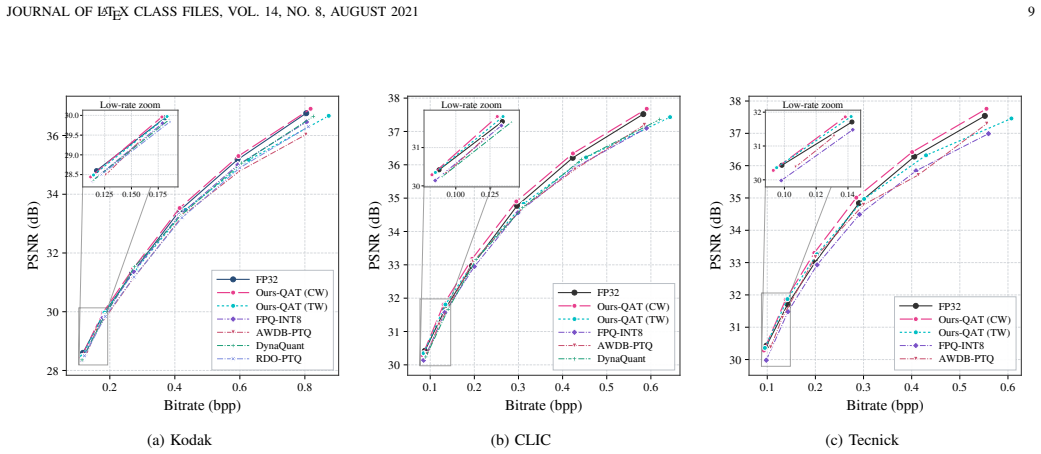
Summary. The paper proposes HaTQ, a transform-domain quantization method for learned image coders. The key idea is to apply orthogonal Hadamard reparameterizations to linear operator weights and activations before uniform INT8 quantization, so that heavy-tailed and inter-channel-variable tensors are reshaped into a more quantization-friendly domain without changing the full-precision operator. Two forms are introduced: Double-Hadamard (DH), which transforms both operands along the contracted dimension, and Weight-only Hadamard (WH), which transforms only weights to avoid coherent activation-range expansion in sensitive layers. A per-layer DH/WH assignment is chosen by an offline profiling statistic p_l (range-expansion probability) and a fixed threshold tau_sel=0.8. The method is evaluated for both PTQ and QAT on GMM and ELIC architectures on Kodak, Tecnick, and CLIC, with uniform W8A8 quantization and both channel-wise and tensor-wise activation quantization. The paper reports consistent BD-rate improvements over uniform, mixed-precision, and non-uniform baselines, and demonstrates an integer-only TensorRT implementation.
Significance. If the reported results hold, the paper makes a useful conceptual and practical contribution: instead of making quantizers more flexible (mixed precision, non-uniform codebooks), it makes the tensors themselves easier to quantize through an orthogonal, function-preserving reparameterization, while retaining a standard uniform INT8 execution path. The algebraic derivations of the DH and WH identities in Sec. IV-B are clean, and the matched-training ablation in Fig. 8 cleanly isolates the benefit of the Hadamard transform from other training changes. The inclusion of PTQ and QAT, two architectures, three datasets, and a TensorRT deployment study strengthens the practical relevance. The main weaknesses are empirical: the layer-selection threshold and profiling setup are not stress-tested, and some optimization hyperparameters are not reported, which limits reproducibility and the strength of the generalization claims.
major comments (4)
- [Sec. V.A, Eqs. (24)-(25)] The central layer-adaptive mechanism is fixed by tau_sel=0.8, chosen 'according to empirical range-expansion statistics', but no sensitivity analysis is given. The ablation in Fig. 9a shows that layer-adaptive selection changes BD-rate from 9.30% to 4.29%, so the QAT result depends strongly on this selection. Please report BD-rate as a function of tau_sel (e.g., 0.5, 0.7, 0.8, 0.9), the distribution of p_l over layers, and whether the FP32-profiled assignment remains optimal after 50 epochs of QAT fine-tuning, which shifts activation statistics.
- [Sec. V.A, Eq. (27)] The network-wise PTQ objective LPTQ = R + lambda D + eta L_reg is central to the PTQ results in Table II, but eta is never given and L_reg is not defined. Without this information, the PTQ experiments cannot be reproduced. Please report the value of eta, the form of L_reg, and any schedule used for the adaptive-rounding regularizer.
- [Sec. V.A, Eq. (24)] The profiling procedure uses M=1000 images, but their provenance is not specified. Since p_l determines the DH/WH assignment, the reported results depend on this unspecified set. Please state the dataset(s) used for profiling and evaluate sensitivity to profiling-set size and composition (e.g., 100 vs 1000 images, DIV2K vs evaluation-domain images).
- [Sec. V.B, Tables II and III] The paper claims that HaTQ 'transfers from GMM to ELIC' and 'consistently improves both QAT and PTQ'. Table III, however, reports no ELIC PTQ results and no tensor-wise PTQ results for ELIC. The transfer claim is therefore only established for the QAT workflow. Please add ELIC PTQ results or restrict the claim to the settings actually evaluated.
minor comments (5)
- [Table II note] The note 'Layer-wise and tensor-wise activation quantization are equivalent and differ only in terminology' is confusing. In Table II, 'layer-wise' appears to refer to the precision assignment of MPPTQ, not to activation quantization granularity. Please rephrase.
- [Eq. (24)] The selection rule uses p_l > tau_sel. The tie case p_l = tau_sel is unspecified. Use a non-strict inequality or state the tie-breaking rule.
- [References] References [68] and [88] appear to be the same paper (Shi et al., 'On quantizing neural representation for variable-rate video coding'), one as arXiv and one as ICLR. Please cite only the published version and avoid duplication.
- [Fig. 9b] The y-axis label 'R-D loss' has no units or normalization. Please clarify whether this is the BD-rate, the objective value, or another quantity.
- [Sec. IV-D] The paper uses a dense 1x1 convolution for online Hadamard transforms. It would be helpful to specify the FLOP/parameter overhead of this realization compared with the baseline INT8 network, in addition to the reported latency and storage numbers.
Circularity Check
No significant circularity: the Hadamard reparameterization is an algebraic identity and the reported gains are empirical, not derived from fitted values.
full rationale
The paper's derivation chain is: express a linear/convolutional operator as Y = X W^T (Eq. 11); apply an orthogonal Hadamard transform to both operands (DH, Eq. 13-14) or to weights only (WH, Eq. 16-17); quantize in the transformed domain; and select per-layer DH/WH using an offline profiling statistic (Eqs. 24-25). The full-precision equivalence is an exact algebraic identity, so the reparameterization is not a fitted approximation. The central empirical claim is that uniform INT8 quantization in this Hadamard domain beats original-domain uniform quantization and prior mixed-precision/non-uniform methods. That claim is tested by ablations in Fig. 8 under identical training/quantization setups (with vs. without Hadamard), and against external baselines in Tables II-III, so it does not reduce to a fitted parameter by construction. The layer-wise DH/WH selection does use a manually chosen threshold tau_sel=0.8 and an empirically estimated range-expansion probability p_l; this is an engineering design choice, not a predicted quantity, and the reported BD-rate improvements are end-to-end measurements rather than consequences of the selection rule alone. The paper does cite prior work by the same authors (RDO-PTQ [13], NeuroQuant [88]) for the network-wise PTQ objective and as a baseline, but this is not load-bearing for the novel Hadamard contribution: the with/without-Hadamard ablation uses the same PTQ/QAT pipeline and isolates the transform effect. No uniqueness theorem is imported from the authors' prior work, and no known result is merely renamed. The most fragile element is the fixed 0.8 threshold and the lack of sensitivity/transfer analysis, but that is a robustness concern, not a circularity.
Axiom & Free-Parameter Ledger
free parameters (6)
- tau_sel =
0.8
- beta_ema =
0.99
- tau_ema =
15
- eta (PTQ regularizer weight)
- M =
1000
- Layer strategy assignment pi_l =
Per-layer DH/WH vector (from profiling)
axioms (4)
- standard math Hadamard matrices of the required orders exist for the tested channel dimensions via Sylvester, Paley, and Kronecker constructions.
- domain assumption INT32 accumulator width is sufficient for the unnormalized Hadamard transforms in integer inference; the paper notes widths must cover growth but gives no overflow bound.
- domain assumption LIC tensors have heavy-tailed distributions and orthogonal mixing reduces excess kurtosis, improving SQNR for most layers.
- domain assumption Nonlinearities can create a nonzero channel mean that the constant Hadamard basis amplifies.
Cite this review
Pith. "Pith review of Hadamard-Domain Model Quantization for Learned Image Coding." pith.science (2026). https://pith.science/paper/GWTHFTSL
@misc{pith2026260801653,
  author       = {Pith},
  title        = {Pith review of: Hadamard-Domain Model Quantization for Learned Image Coding},
  year         = {2026},
  howpublished = {\url{https://pith.science/paper/GWTHFTSL}},
  note         = {Machine review of arXiv:2608.01653}
}
read the original abstract
Uniform INT8 quantization is attractive for deploying learned image coding (LIC), but its rate--distortion (R--D) performance is often limited by heavy-tailed tensors and large inter-channel variations. Existing methods mainly adapt the quantizer through mixed precision or non-uniform codebooks. We propose Hadamard-Transform-domain Quantization (HaTQ), which uses orthogonal Hadamard reparameterization before quantization to redistribute weight and activation responses in the original domain across channels. The reparameterization preserves the original function mapping of each linear operator, while making its weights and activations more amenable to uniform INT8 quantization. HaTQ provides two complementary forms. Double-Hadamard quantization transforms both the input activations and weights, whereas weight-only Hadamard quantization transforms only the weights. This distinction is important because the constant Hadamard basis can coherently accumulate a nonzero channel mean and enlarge the activation range in sensitive layers. We identify these sensitive layers through offline profiling and assign the appropriate form to each layer without input-dependent branching. HaTQ supports both post-training quantization (PTQ) and quantization-aware training (QAT), uses uniform INT8 quantizers, and is compatible with integer-only execution. Experiments on representative LIC architectures and datasets demonstrate consistent improvements across different quantization settings. The resulting QAT models further outperform competing mixed-precision and non-uniform quantization methods. TensorRT deployment results demonstrate practical INT8 inference efficiency. The source code will be publicly released.
Figures




Reference graph
Works this paper leans on
-
[1]
The jpeg still picture compression standard,
G. K. Wallace, “The jpeg still picture compression standard,”IEEE transactions on consumer electronics, vol. 38, no. 1, pp. xviii–xxxiv, 1992
1992
-
[2]
Overview of the high efficiency video coding (hevc) standard,
G. J. Sullivan, J.-R. Ohm, W.-J. Han, and T. Wiegand, “Overview of the high efficiency video coding (hevc) standard,”IEEE Transactions on circuits and systems for video technology, vol. 22, no. 12, pp. 1649– 1668, 2012
2012
-
[3]
Overview of the versatile video coding (vvc) standard and its applications,
B. Bross, Y .-K. Wang, Y . Ye, S. Liu, J. Chen, G. J. Sullivan, and J.- R. Ohm, “Overview of the versatile video coding (vvc) standard and its applications,”IEEE Transactions on Circuits and Systems for Video Technology, vol. 31, no. 10, pp. 3736–3764, 2021
2021
-
[4]
Variational image compression with a scale hyperprior,
J. Ball ´e, D. Minnen, S. Singh, S. J. Hwang, and N. Johnston, “Variational image compression with a scale hyperprior,” inInternational Conference on Learning Representations, 2018
2018
-
[5]
Joint autoregressive and hierarchical priors for learned image compression,
D. Minnen, J. Ball ´e, and G. D. Toderici, “Joint autoregressive and hierarchical priors for learned image compression,”Advances in neural information processing systems, vol. 31, pp. 10 771–10 780, 2018
2018
-
[6]
Learned image com- pression with discretized gaussian mixture likelihoods and attention modules,
Z. Cheng, H. Sun, M. Takeuchi, and J. Katto, “Learned image com- pression with discretized gaussian mixture likelihoods and attention modules,” inProceedings of the IEEE/CVF conference on computer vision and pattern recognition, 2020, pp. 7939–7948
2020
-
[7]
Elic: Efficient learned image compression with unevenly grouped space- channel contextual adaptive coding,
D. He, Z. Yang, W. Peng, R. Ma, H. Qin, and Y . Wang, “Elic: Efficient learned image compression with unevenly grouped space- channel contextual adaptive coding,” inProceedings of the IEEE/CVF conference on computer vision and pattern recognition, 2022, pp. 5718– 5727
2022
-
[8]
Learned image compression with mixed transformer-cnn architectures,
J. Liu, H. Sun, and J. Katto, “Learned image compression with mixed transformer-cnn architectures,” inProceedings of the IEEE/CVF con- ference on computer vision and pattern recognition, 2023, pp. 14 388– 14 397
2023
-
[9]
Dit-ic: Aligned diffusion transformer for efficient image compression,
J. Shi, M. Lu, X. Li, A. Ke, R. Zhang, and Z. Ma, “Dit-ic: Aligned diffusion transformer for efficient image compression,” inProceedings of the IEEE/CVF Conference on Computer Vision and Pattern Recognition, 2026, pp. 25 719–25 729
2026
-
[10]
Taming hierarchical image coding optimization: A spectral regularization perspective,
W. Cong, J. Shi, M. Lu, X. Zhang, and Z. Ma, “Taming hierarchical image coding optimization: A spectral regularization perspective,” in The Fourteenth International Conference on Learning Representations, vol. 1, 2026
2026
-
[11]
Information technology—JPEG AI learning-based image coding system—Part 1: Core coding system,
ISO/IEC, “Information technology—JPEG AI learning-based image coding system—Part 1: Core coding system,” ISO/IEC 6048-1:2025, 2025, accessed 2026-07-24
2025
-
[12]
IEEE Standard for Neural Network-Based Image Coding,
IEEE, “IEEE Standard for Neural Network-Based Image Coding,” IEEE Std 1857.11-2024, 2024
2024
-
[13]
Rate-distortion optimized post-training quantization for learned image compression,
J. Shi, M. Lu, and Z. Ma, “Rate-distortion optimized post-training quantization for learned image compression,”IEEE Transactions on Circuits and Systems for Video Technology, vol. 34, no. 5, pp. 3082– 3095, 2024
2024
-
[14]
A white paper on neural network quantization,
M. Nagel, M. Fournarakis, R. A. Amjad, Y . Bondarenko, M. Van Baalen, and T. Blankevoort, “A white paper on neural network quantization,” arXiv preprint arXiv:2106.08295, 2021
Pith/arXiv arXiv 2021
-
[15]
Activation and weight distribution balancing for optimal post-training quantization in learned image compression,
J. Yu, S. Mai, P. Zhang, Y . Jiang, and J. Cheng, “Activation and weight distribution balancing for optimal post-training quantization in learned image compression,” inProceedings of the 33rd ACM International Conference on Multimedia, 2025, pp. 7959–7967
2025
-
[16]
Post- training quantization for cross-platform learned image compression,
D. He, Z. Yang, Y . Wang, Y . Chen, Q. Zhang, and H. Qin, “Post- training quantization for cross-platform learned image compression,” in International Conference on Learning Representations, 2022
2022
-
[17]
Device interop- erability for learned image compression with weights and activations quantization,
E. Koyuncu, T. Solovyev, E. Alshina, and A. Kaup, “Device interop- erability for learned image compression with weights and activations quantization,” in2022 Picture Coding Symposium (PCS). IEEE, 2022, pp. 151–155
work page 2022
-
[18]
Quantized decoder in learned image compression for deterministic reconstruction,
E. Koyuncu, T. Solovyev, J. Sauer, E. Alshina, and A. Kaup, “Quantized decoder in learned image compression for deterministic reconstruction,” inICASSP 2024-2024 IEEE International Conference on Acoustics, Speech and Signal Processing (ICASSP). IEEE, 2024, pp. 3985–3989
work page 2024
-
[19]
Efficient neural image decoding via fixed-point inference,
W. Hong, T. Chen, M. Lu, S. Pu, and Z. Ma, “Efficient neural image decoding via fixed-point inference,”IEEE Transactions on Circuits and Systems for Video Technology, vol. 31, no. 9, pp. 3618–3630, 2021
work page 2021
-
[20]
Q-lic: Quantizing learned image compres- sion with channel splitting,
H. Sun, L. Yu, and J. Katto, “Q-lic: Quantizing learned image compres- sion with channel splitting,”IEEE Transactions on Circuits and Systems for Video Technology, vol. 35, no. 4, pp. 3798–3811, 2025
work page 2025
-
[21]
End-to-end learned image compression with fixed point weight quantization,
H. Sun, Z. Cheng, M. Takeuchi, and J. Katto, “End-to-end learned image compression with fixed point weight quantization,” inProceedings of the IEEE International Conference on Image Processing, 2020, pp. 3359– 3363
work page 2020
-
[22]
Learned image compression with fixed- point arithmetic,
H. Sun, L. Yu, and J. Katto, “Learned image compression with fixed- point arithmetic,” inPicture Coding Symposium, 2021, pp. 1–5
work page 2021
-
[23]
J. Yang, X. Wang, Q. Li, S. Qiao, and Y . Zhou, “Subset-selection weight JOURNAL OF LATEX CLASS FILES, VOL. 14, NO. 8, AUGUST 2021 13 post-training quantization method for learned image compression task,” IEEE Access, vol. 13, pp. 5145–5153, 2025
work page 2021
-
[24]
Mpp-lic: Mixed precision post-training quantization for learned image compression,
Y . Zhang, W. Shen, T. Gao, N. Zhang, and P. Wang, “Mpp-lic: Mixed precision post-training quantization for learned image compression,” in 2026 Data Compression Conference (DCC). IEEE, 2026, pp. 487–487
work page 2026
-
[25]
Dynaquant: Dynamic mixed-precision quantization for learned image compression,
Y . Bao, Y . Cheng, Y . Liu, Y . Yang, P. Qin, M. Li, and Y . Liang, “Dynaquant: Dynamic mixed-precision quantization for learned image compression,” inProceedings of the AAAI Conference on Artificial Intelligence, vol. 40, no. 17, 2026, pp. 14 475–14 483
work page 2026
-
[26]
Flexible mixed precision quan- tization for learned image compression,
M. A. F. Hossain, Z. Duan, and F. Zhu, “Flexible mixed precision quan- tization for learned image compression,” in2024 IEEE International Conference on Multimedia and Expo (ICME). IEEE, 2024, pp. 1–8
work page 2024
-
[27]
Mixed-precision post- training quantization for learned image compression,
J. Yu, S. Mai, P. Zhang, Y . Jiang, and J. Cheng, “Mixed-precision post- training quantization for learned image compression,”IEEE Internet of Things Journal, vol. 12, no. 16, pp. 34 392–34 405, 2025
work page 2025
-
[28]
Uniq: Uniform noise injection for non-uniform quantization of neural networks,
C. Baskin, N. Liss, E. Schwartz, E. Zheltonozhskii, R. Giryes, A. M. Bronstein, and A. Mendelson, “Uniq: Uniform noise injection for non-uniform quantization of neural networks,”ACM Transactions on Computer Systems (TOCS), vol. 37, no. 1-4, pp. 1–15, 2021
work page 2021
-
[29]
Clarke,Transform coding of images
R. Clarke,Transform coding of images. Academic Press Professional, Inc., 1985
work page 1985
-
[30]
Theoretical foundations of transform coding,
V . K. Goyal, “Theoretical foundations of transform coding,”IEEE Signal processing magazine, vol. 18, no. 5, pp. 9–21, 2001
work page 2001
-
[31]
Hadamard transform image coding,
W. K. Pratt, J. Kane, and H. C. Andrews, “Hadamard transform image coding,”Proceedings of the IEEE, vol. 57, no. 1, pp. 58–68, 1969
1969
-
[32]
R. M. Gray, “Vector quantization,”IEEE ASSP Magazine, vol. 1, no. 2, pp. 4–29, 1984
work page 1984
-
[33]
A. Gersho and R. M. Gray,Vector Quantization and Signal Compression. Springer, 1992
work page 1992
-
[34]
Nonlinear transform coding,
J. Ball ´e, P. A. Chou, D. Minnen, S. Singh, N. Johnston, E. Agustsson, S. J. Hwang, and G. Toderici, “Nonlinear transform coding,”IEEE Journal of Selected Topics in Signal Processing, vol. 15, no. 2, pp. 339–353, 2021
2021
-
[35]
N. S. Jayant and P. Noll,Digital Coding of Waveforms: Principles and Applications to Speech and Video. Englewood Cliffs, NJ, USA: Prentice-Hall, 1984
work page 1984
-
[36]
A method for the construction of minimum-redundancy codes,
D. A. Huffman, “A method for the construction of minimum-redundancy codes,”Proceedings of the IRE, vol. 40, no. 9, pp. 1098–1101, 1952
1952
-
[37]
Discrete cosine transform,
N. Ahmed, T. Natarajan, and K. R. Rao, “Discrete cosine transform,” IEEE Transactions on Computers, vol. C-23, no. 1, pp. 90–93, 1974
1974
-
[38]
Complete discrete 2-d gabor transforms by neural networks for image analysis and compression,
J. G. Daugman, “Complete discrete 2-d gabor transforms by neural networks for image analysis and compression,”IEEE Transactions on Acoustics, Speech, and Signal Processing, vol. 36, no. 7, pp. 1169–1179, 1988
work page 1988
-
[39]
Image compression by back propagation: A demonstration of extensional programming,
G. W. Cottrell, P. W. Munro, and D. Zipser, “Image compression by back propagation: A demonstration of extensional programming,” in Advances in Cognitive Science, N. E. Sharkey, Ed. Chichester, U.K.: Ellis Horwood, 1987, vol. 2
work page 1987
-
[40]
Neural network approaches to image compression,
R. D. Dony and S. Haykin, “Neural network approaches to image compression,”Proceedings of the IEEE, vol. 83, no. 2, pp. 288–303, 1995
work page 1995
-
[41]
Image compression with neural networks: A survey,
J. Jiang, “Image compression with neural networks: A survey,”Signal Processing: Image Communication, vol. 14, no. 9, pp. 737–760, 1999
work page 1999
-
[42]
Variable rate image com- pression with recurrent neural networks,
G. Toderici, S. M. O’Malley, S. J. Hwang, D. Vincent, D. Minnen, S. Baluja, M. Covell, and R. Sukthankar, “Variable rate image com- pression with recurrent neural networks,” inInternational Conference on Learning Representations, 2016
work page 2016
-
[43]
End-to-end optimized image compression,
J. Ball ´e, V . Laparra, and E. P. Simoncelli, “End-to-end optimized image compression,” inInternational Conference on Learning Representations, 2017
work page 2017
-
[44]
Channel-wise autoregressive entropy models for learned image compression,
D. Minnen and S. Singh, “Channel-wise autoregressive entropy models for learned image compression,” in2020 IEEE International Conference on Image Processing (ICIP). IEEE, 2020, pp. 3339–3343
2020
-
[45]
Deep residual learning for image compression
Z. Cheng, H. Sun, M. Takeuchi, and J. Katto, “Deep residual learning for image compression.” inCvpr workshops, 2019, p. 0
work page 2019
-
[46]
The devil is in the details: Window- based attention for image compression,
R. Zou, C. Song, and Z. Zhang, “The devil is in the details: Window- based attention for image compression,” inProceedings of the IEEE/CVF Conference on Computer Vision and Pattern Recognition, 2022, pp. 17 492–17 501
work page 2022
-
[47]
Linear attention modeling for learned image compression,
D. Feng, Z. Cheng, S. Wang, R. Wu, H. Hu, G. Lu, and L. Song, “Linear attention modeling for learned image compression,” inProceedings of the IEEE/CVF Conference on Computer Vision and Pattern Recognition, 2025, pp. 7623–7632
work page 2025
-
[48]
Mambaic: State space models for high-performance learned image compression,
F. Zeng, H. Tang, Y . Shao, S. Chen, L. Shao, and Y . Wang, “Mambaic: State space models for high-performance learned image compression,” inProceedings of the IEEE/CVF Conference on Computer Vision and Pattern Recognition, 2025, pp. 18 041–18 050
work page 2025
-
[49]
Learning convolutional networks for content-weighted image compression,
M. Li, W. Zuo, S. Gu, D. Zhao, and D. Zhang, “Learning convolutional networks for content-weighted image compression,” inProceedings of the IEEE Conference on Computer Vision and Pattern Recognition, 2018, pp. 3214–3223
work page 2018
-
[50]
Entroformer: A transformer-based entropy model for learned image compression,
Y . Qian, M. Lin, X. Sun, Z. Tan, and R. Jin, “Entroformer: A transformer-based entropy model for learned image compression,” in International Conference on Learning Representations, 2022
work page 2022
-
[51]
A. B. Koyuncu, H. Gao, A. Boev, G. Gaikov, E. Alshina, and E. Stein- bach, “Contextformer: A transformer with spatio-channel attention for context modeling in learned image compression,” inEuropean Confer- ence on Computer Vision. Springer, 2022, pp. 447–463
work page 2022
-
[52]
K. Nakanishi, S.-i. Maeda, T. Miyato, and D. Okanohara, “Neural multi- scale image compression,”arXiv preprint arXiv:1806.06550, 2018
work page internal anchor Pith review Pith/arXiv arXiv 2018
-
[53]
QARV: Quantization-aware resnet vae for lossy image compression,
Z. Duan, M. Lu, J. Ma, Y . Huang, Z. Ma, and F. Zhu, “QARV: Quantization-aware resnet vae for lossy image compression,”IEEE Transactions on Pattern Analysis and Machine Intelligence, vol. 46, no. 1, pp. 436–450, 2024
work page 2024
-
[54]
Qarv++: An improved hierarchical vae for learned image compression,
Y . Zhang, Y . Huang, and F. Zhu, “Qarv++: An improved hierarchical vae for learned image compression,”IEEE Transactions on Circuits and Systems for Video Technology, vol. 36, no. 6, pp. 7921–7936, 2026
work page 2026
-
[55]
Lossy compression for lossless prediction,
Y . Dubois, B. K ´egl, F. Bach, and S. Chandar, “Lossy compression for lossless prediction,” inAdvances in Neural Information Processing Systems, vol. 34, 2021, pp. 14 014–14 028
work page 2021
-
[56]
Deep joint source- channel coding for wireless image transmission,
E. Bourtsoulatze, D. B. Kurka, and D. G ¨und¨uz, “Deep joint source- channel coding for wireless image transmission,”IEEE Transactions on Cognitive Communications and Networking, vol. 5, no. 3, pp. 567–579, 2019
2019
-
[57]
Y .-H. Chen, Y .-C. Weng, C.-H. Kao, C. Chien, W.-C. Chiu, and W.- H. Peng, “Transtic: Transferring transformer-based image compression from human perception to machine perception,” inProceedings of the IEEE/CVF International Conference on Computer Vision, 2023, pp. 23 297–23 307
work page 2023
-
[58]
Perception-oriented latent coding for high-performance compressed domain semantic inference,
X. Zhang, M. Lu, Y . Chen, and Z. Ma, “Perception-oriented latent coding for high-performance compressed domain semantic inference,” in2025 IEEE International Conference on Multimedia and Expo (ICME). IEEE, 2025, pp. 1–6
work page 2025
-
[59]
Lossy image compression with conditional dif- fusion models,
R. Yang and S. Mandt, “Lossy image compression with conditional dif- fusion models,” inAdvances in Neural Information Processing Systems, vol. 36, 2023
work page 2023
-
[60]
Lossy image compression with foundation diffusion models,
L. Relic, R. Azevedo, M. Gross, and C. Schroers, “Lossy image compression with foundation diffusion models,” inEuropean Conference on Computer Vision, 2024
work page 2024
-
[61]
Yoda: Yet another one-step diffusion-based video compressor,
X. Li, J. Zhang, J. Shi, M. Lu, and Z. Ma, “Yoda: Yet another one-step diffusion-based video compressor,”arXiv preprint arXiv:2601.01141, 2026
arXiv 2026
-
[62]
Toward extreme image compression with latent feature guidance and diffusion prior,
Z. Li, Y . Zhou, H. Wei, C. Ge, and J. Jiang, “Toward extreme image compression with latent feature guidance and diffusion prior,”IEEE Transactions on Circuits and Systems for Video Technology, vol. 35, no. 1, pp. 888–899, 2024
work page 2024
-
[63]
1.1 computing’s energy problem (and what we can do about it),
M. Horowitz, “1.1 computing’s energy problem (and what we can do about it),” inIEEE International Solid-State Circuits Conference Digest of Technical Papers, 2014, pp. 10–14
work page 2014
-
[64]
Low-bit quantiza- tion of neural networks for efficient inference,
Y . Choukroun, E. Kravchik, F. Yang, and P. Kisilev, “Low-bit quantiza- tion of neural networks for efficient inference,” in2019 IEEE/CVF In- ternational Conference on Computer Vision Workshop (ICCVW). IEEE, 2019, pp. 3009–3018
work page 2019
-
[65]
Efficient 8-Bit Quantization of Transformer Neural Machine Language Translation Model
A. Bhandare, V . Sripathi, D. Karkada, V . Menon, S. Choi, K. Datta, and V . Saletore, “Efficient 8-bit quantization of transformer neural machine language translation model,”arXiv preprint arXiv:1906.00532, 2019
work page internal anchor Pith review Pith/arXiv arXiv 1906
-
[66]
Advances in the neural network quantization: A comprehensive review,
L. Wei, Z. Ma, C. Yang, and Q. Yao, “Advances in the neural network quantization: A comprehensive review,”Applied Sciences, vol. 14, no. 17, p. 7445, 2024
2024
-
[67]
Gpt3. int8 (): 8-bit matrix multiplication for transformers at scale,
T. Dettmers, M. Lewis, Y . Belkada, and L. Zettlemoyer, “Gpt3. int8 (): 8-bit matrix multiplication for transformers at scale,”Advances in neural information processing systems, vol. 35, pp. 30 318–30 332, 2022
2022
-
[68]
On Quantizing Neural Representation for Variable-Rate Video Coding
J. Shi, Z. Chen, H. Li, Q. Zhao, M. Lu, T. Chen, and Z. Ma, “On quantizing neural representation for variable-rate video coding,”arXiv preprint arXiv:2502.11729, 2025
work page internal anchor Pith review Pith/arXiv arXiv 2025
-
[69]
Hawq: Hessian aware quantization of neural networks with mixed-precision,
Z. Dong, Z. Yao, A. Gholami, M. W. Mahoney, and K. Keutzer, “Hawq: Hessian aware quantization of neural networks with mixed-precision,” inProceedings of the IEEE/CVF international conference on computer vision, 2019, pp. 293–302
work page 2019
-
[70]
8-bit numeri- cal formats for deep neural networks,
B. Noune, P. Jones, D. Justus, D. Masters, and C. Luschi, “8-bit numeri- cal formats for deep neural networks,”arXiv preprint arXiv:2206.02915, 2022
Pith/arXiv arXiv 2022
-
[71]
Squeezellm: Dense-and-sparse quantization,
S. Kim, C. Hooper, A. Gholami, Z. Dong, X. Li, S. Shen, M. W. Ma- honey, and K. Keutzer, “Squeezellm: Dense-and-sparse quantization,” in JOURNAL OF LATEX CLASS FILES, VOL. 14, NO. 8, AUGUST 2021 14 Proceedings of the 41st International Conference on Machine Learning, vol. 235. PMLR, 2024, pp. 23 901–23 923
work page 2021
-
[72]
Smoothquant: Accurate and efficient post-training quantization for large language models,
G. Xiao, J. Lin, M. Seznec, H. Wu, J. Demouth, and S. Han, “Smoothquant: Accurate and efficient post-training quantization for large language models,” inInternational conference on machine learning. PMLR, 2023, pp. 38 087–38 099
2023
-
[73]
Quarot: Outlier-free 4-bit inference in rotated llms,
S. Ashkboos, A. Mohtashami, M. L. Croci, B. Li, P. Cameron, M. Jaggi, D. Alistarh, T. Hoefler, and J. Hensman, “Quarot: Outlier-free 4-bit inference in rotated llms,”Advances in Neural Information Processing Systems, vol. 37, pp. 100 213–100 240, 2024
2024
-
[74]
Spinquant: Llm quantization with learned rotations,
Z. Liu, C. Zhao, I. Fedorov, B. Soran, D. Choudhary, R. Krishnamoorthi, V . Chandra, Y . Tian, and T. Blankevoort, “Spinquant: Llm quantization with learned rotations,” inInternational Conference on Learning Rep- resentations, 2025
work page 2025
-
[75]
QuIP#: Even better LLM quantization with hadamard incoherence and lattice codebooks,
A. Tseng, J. Chee, Q. Sun, V . Kuleshov, and C. De Sa, “QuIP#: Even better LLM quantization with hadamard incoherence and lattice codebooks,” inProceedings of the 41st International Conference on Machine Learning, vol. 235. PMLR, 2024, pp. 48 630–48 656
work page 2024
-
[76]
Integer networks for data compression with latent-variable models,
J. Ball ´e, N. Johnston, and D. Minnen, “Integer networks for data compression with latent-variable models,” inInternational Conference on Learning Representations, 2019
work page 2019
-
[77]
Integer quantized learned image compression,
G. W. Jeon, S. E. Yu, and J. S. Lee, “Integer quantized learned image compression,” inProceedings of the IEEE International Conference on Image Processing, 2023, pp. 2755–2759
work page 2023
-
[78]
Structured pruning and quantization for learned image compression,
M. A. F. Hossain and F. Zhu, “Structured pruning and quantization for learned image compression,” inProceedings of the IEEE International Conference on Image Processing, 2024, pp. 3730–3736
work page 2024
-
[79]
Variable-rate learned image compression with integer-arithmetic-only inference,
F. Ye, L. Li, and D. Liu, “Variable-rate learned image compression with integer-arithmetic-only inference,”Journal of Visual Communication and Image Representation, vol. 113, p. 104634, 2025
work page 2025
-
[80]
J. Seberry and M. Yamada,Hadamard Matrices: Constructions using number theory and linear algebra. John Wiley & Sons, 2020
work page 2020
discussion (0)
Sign in with ORCID, Apple, or X to comment. Anyone can read and Pith papers without signing in.