REVIEW 4 major objections 5 minor 121 references
A new methodology for inferring the plasma conditions in solar flare energetic electron source regions from in situ electron energy spectra
T0 review · 4 major / 5 minor · reviewed 2026-08-04 · deepseek-v4-flash
Pith's one-line read The paper claims that the low-energy in situ electron spectrum from a solar flare contains two thermal Maxwellian components, one at 1.4–4.1 MK and one at 12.5–23.1 MK, and that the hotter component is a genuine signature of the flaring sou
desk verdict INSPEX is a solid, open-source methodology contribution; the 12-23 MK 'flaring plasma' temperature inference is not yet supported by the fits. read the letter →
The pith
A machine-rendered reading of the paper's core claim, the machinery that carries it, and where it could break.
The reading
What carries the argument
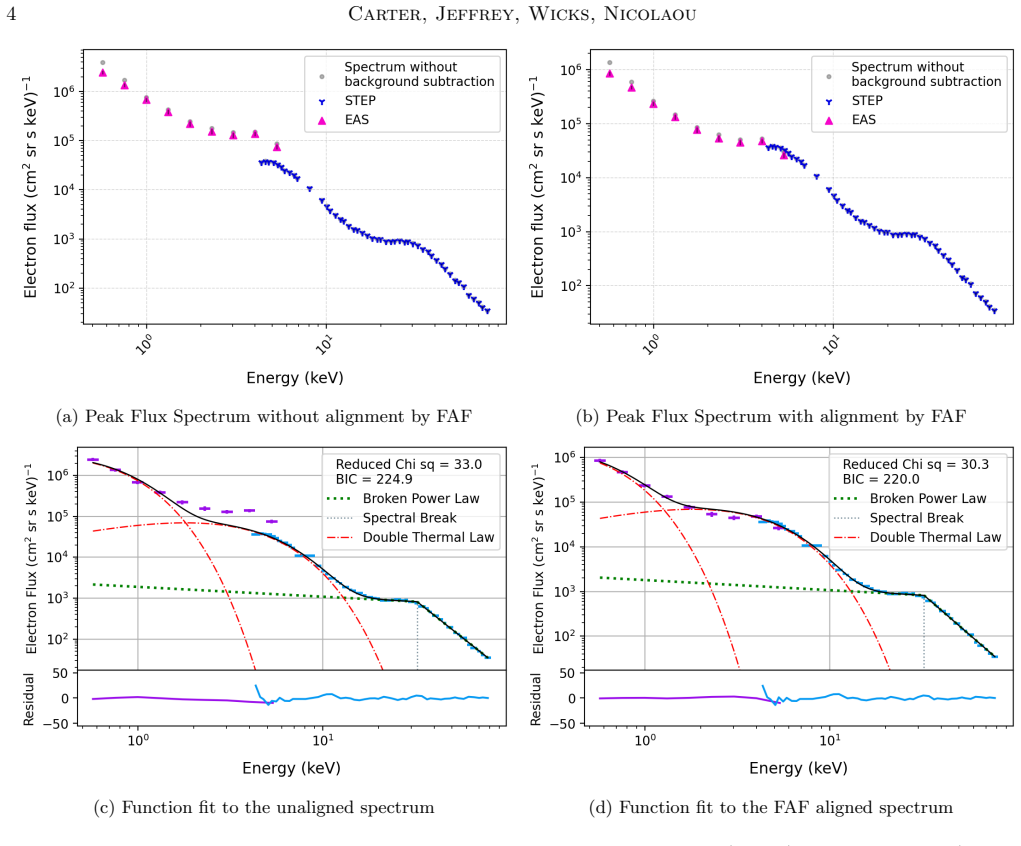
The central instrument is INSPEX, a new Python spectral analysis package that loads Solar Orbiter EAS and STEP data, resamples and background-subtracts time series, aligns the two instruments using a scalar fitting alignment factor (F_AF), and fits combinations of Maxwellian and power-law functions to the resulting peak flux and fluence spectra. The key functional form is the double isothermal Maxwellian, F = A1 E exp(-E/kT1) + A2 E exp(-E/kT2), which captures the low-energy thermal components, supplemented by a broken power law for the non-thermal tail above ~10–20 keV.
What would settle it
For a sample of flares with simultaneous Solar Orbiter in situ data and STIX hard X-ray observations, compute the INSPEX-fitted hot thermal temperature and compare it with the flare temperature derived from STIX spectral fitting; a lack of correlation or a consistent offset exceeding the fitted uncertainties would indicate that the 12–23 MK component is an alignment artifact. More directly, re-fitting the same event with F_AF fixed to 1 (no alignment) should fail to produce two physically plausible thermal components if the detection depends on the alignment factor.
Extended reading notes
Core claim
On its own terms, the paper reports the detection of a two-temperature thermal structure in the low-energy (0.5–20 keV) part of in situ flare electron spectra. For the peak flux spectrum, the cool Maxwellian is at 2.51 ± 0.15 MK and the hot one at 20.89 ± 0.29 MK; the fluence spectrum gives 2.45 ± 0.68 MK and 18.33 ± 0.38 MK. Across different rebinning windows and extraction methods, the hot component ranges from 12.5 to 23.1 MK. The authors state that 'we may have found signatures of hot flaring plasma in in situ electron spectra, indicating that in situ electrons may have passed through or been accelerated in such regions.' They are careful to note that the thermal interpretation is not un
Load-bearing premise
The low-energy spectrum is assumed to faithfully represent the flare electron population after aligning EAS and STEP data with a single scalar multiplier (F_AF), even though STEP views only 30 degrees of the sky and the cause of the observed vertical offset between the instruments is unknown.
Editorial extensions
If this is right
- If the hot thermal component is real, in situ electron spectra can be used to estimate the temperature of the flare acceleration region, complementing hard X-ray remote sensing.
- The consistent high-energy break near 33 keV and a final spectral index of about -3.58 across many fitting forms align with previous in situ and X-ray studies, lending credibility to the spectral construction methodology.
- The INSPEX pipeline provides a reusable, user-friendly way to build and fit multi-component electron spectra from different instruments, enabling future multi-event studies.
- The F_AF alignment procedure, while ad hoc, yields spectra that can be fitted with physically plausible parameters, suggesting a path to standardised combined-spectrum analysis.
- The method's temperature estimates vary with rebinning window and extraction method, so future work must adopt a consistent data-processing protocol before comparing events.
Reading between the lines
- A direct test of the paper's central claim would be to compare the fitted hot temperature (≈20 MK) for this event with simultaneous STIX-derived flare temperatures; a systematic mismatch would suggest the thermal component is an artifact of the F_AF alignment rather than a source-region signature.
- The F_AF values vary strongly with resampling time (0.04 to 0.39), indicating a non-simple calibration offset; a proper cross-calibration of EAS and STEP could replace this empirical factor and either strengthen or weaken the thermal detection.
- Since STEP covers only 30 degrees of sky, the inferred temperatures could be biased by the sampled pitch-angle distribution; a future event with full or better pitch-angle coverage would clarify whether the 12–23 MK component survives.
- If the thermal signature is confirmed across many events, in situ spectra could offer a new diagnostic of the flare acceleration region, potentially distinguishing whether the same source produces both chromospheric and heliospheric accelerated electrons.
Editorial analysis
A structured set of objections, weighed in public.
Referee Report
Summary. The paper introduces INSPEX, a new open-source Python package for loading, calibrating, resampling, background-subtracting, and fitting in situ solar electron spectra. The package is applied to Solar Orbiter EAS and STEP data for the 2021-10-09 M1.6 flare, constructing peak-flux and fluence spectra over 0.57-78.1 keV. Six combinations of thermal and power-law functions are fitted; the authors highlight a double-thermal + double-power-law form, yielding a cool component T1 ~1.4-4.1 MK and a hot component T2 ~12.5-23.1 MK, together with a spectral break near 32-38 keV. They interpret the hot component as a possible thermal signature of the flaring source region, while explicitly framing the event analysis as preliminary and methodological.
Significance. If the inferred 12-23 MK component were robust, it would provide a novel in situ diagnostic of flare source-region plasma, linking heliospheric electrons to the HXR-emitting population. The INSPEX package is a tangible software contribution, and the paper is unusually transparent about data-reduction choices and limitations, including underestimated uncertainties, BIC non-uniqueness, the STEP field-of-view restriction, and the scalar EAS/STEP alignment. However, the evidence presented does not yet establish the physical interpretation: the thermal models are not statistically preferred over pure power laws, and T2 is determined entirely by the EAS spectral shape whose calibration is adjusted with a scalar factor. The paper's main value at present is methodological.
major comments (4)
- [§3.2, Tables 1-6, Figs. 5-6] The text states that all BIC values are within 10 of each other except for the triple-thermal fit, and the reduced chi-squared favours the quintuple power law. By the Kass & Raftery threshold the paper itself invokes, the double-thermal model is not statistically preferred over pure power-law forms. Thus 'can be fitted with two distinct thermal curves' demonstrates flexibility, not evidence for hot plasma. To support the central claim, the paper needs a model-selection test that accounts for the underestimated uncertainties (e.g., Poisson maximum likelihood, synthetic injections, or a strict ΔBIC requirement) showing the thermal components are required, or the paper should present itself purely as a methodological benchmark.
- [§2.3 and §3.1] T2 ~12-23 MK peaks at E = k_B T ~1-2 keV, entirely in the EAS-only range below the 4-5 keV overlap. The alignment factor F_AF is a single scalar computed from the average ratio in the overlap; multiplying EAS data by a constant cannot correct an energy-dependent calibration error, background distortion, or field-of-view mismatch. §3.1 reports that the EAS background is about 100 times higher than STEP while the flare signal is lower, so EAS background subtraction is critical. The paper should validate the EAS spectral shape against an independent measurement or propagate F_AF/systematic uncertainties into T2; otherwise the hot component may be an artifact of the alignment procedure.
- [§3.3, Table 7, Fig. 7] The authors state in §3.3 that the SolO STEP 30-degree field of view 'limits the reliability of the results deduced for this event.' In addition, Table 7 shows T2 changing from 20.91 MK at raw cadence to 12.49 MK at 1-hour resampling, while F_AF varies from 0.04 to 0.39; the hot temperature and the alignment factor track each other. This demonstrates that the inferred T2 is not robust to analysis choices. Please provide an estimate of systematic uncertainty from rebinning and peak-extraction methods, or explicitly restrict the physical claim to a single pre-defined configuration.
- [§1, §4, Eq. (3)] The identification of the fitted T2 with the flare source temperature is post-hoc: T2 is a free parameter in Eq. (3), and the interpretation is guided by a transport model co-authored by one of the present authors (Pallister & Jeffrey 2023; Pallister et al. 2025). To make the physical identification credible, the paper should compare the fitted T2 with an independent temperature measurement for the same event (e.g., GOES or STIX) or demonstrate that the predicted spectral signature is uniquely reproduced. Without such a test, 'may have found signatures' remains a plausible but unvalidated suggestion.
minor comments (5)
- [Abstract and §2.4] The abstract quotes an energy range of 0.5-80 keV, while the data actually span 0.57-78.1 keV; harmonize the two values.
- [Eq. (5)] The formula for reduced chi-squared has a duplicated left-hand side ('χ^2_ν = χ^2_ν = ...'); correct the typographical error.
- [§2.3] The description of F_AF says it multiplies by the 'average difference' between EAS and STEP bins; clarify that this is a ratio and specify which bins are used and how the average is computed.
- [Table 3] The triple-thermal fits return a third component T3 ~138-149 MK, but this value is not discussed. State whether this component is unphysical, a numerical artifact, or has any intended interpretation.
- [§3.3 / Fig. 8] The alternative peak-extraction method using the Weibull time-series fit is described only briefly; give the functional form, the parameter bounds, and the uncertainty treatment for the robust residual calculation used.
Circularity Check
No circularity: the hot thermal component T2 is a fitted parameter, not a prediction-by-construction, and the self-cited transport model only motivates the fit, with independent X-ray consistency checks.
full rationale
The paper is an empirical spectral fitting study, not a derivation from first principles. The central result, T2 = 12.5–23.1 MK, is the temperature parameter in the fitted function of Eq. (3), estimated directly from the combined EAS/STEP energy spectra. It is not obtained by first fitting a model to a subset of data and then predicting a closely related quantity, nor is it defined in terms of the spectral result it purportedly explains. The paper explicitly tests multiple competing function forms (quintuple power law, quadruple power law, triple thermal, etc.) and reports that most BIC values lie within 10, acknowledging that the two-thermal-plus-power-law description is not a unique fit. The motivating transport calculations (Pallister & Jeffrey 2023; Pallister et al. 2025) are co-authored by N. L. S. Jeffrey, but they function only as prior theoretical motivation for including Maxwellian components and for interpreting a fitted temperature as flaring plasma temperature; the numerical T2 values are not imported from those papers and are instead checked for consistency with external X-ray-derived flaring temperatures (e.g., Caspi et al. 2014; Jeffrey et al. 2014; Kontar et al. 2015). The F_AF alignment is a scalar normalization computed from the 4–5 keV overlap ratio; a scalar multiplication cannot, by itself, create the 1–2 keV Maxwellian-like curvature that determines T2, so no component of the thermal fit is forced by the alignment constant by construction. The paper's own caveats—STEP's limited 30-degree field of view, single-event analysis, low data uncertainties, and the equivalence of competing fits—weaken the physical interpretation but are limitations on empirical inference, not circularity. The self-citations are therefore not load-bearing in the sense required to demonstrate circularity, and no equation or fitted parameter reduces to another by definition.
Assumptions & free parameters
free parameters (6)
- F AF (fitting alignment factor) =
0.02 to 0.39 depending on resampling and peak extraction method
- T1 and T2 (Maxwellian temperatures) =
T1 = 2.51 +/- 0.15 MK, T2 = 20.89 +/- 0.29 MK (5-min peak flux); ranges 1.42-5.04 MK and 12.49-23.07 MK across resamplin
- Power-law indices and break energy =
delta_1 = -0.23 +/- 0.13, delta_2 = -3.58 +/- 0.05, E_b = 32.29 +/- 0.62 keV (5-min peak flux)
- Resampling window =
raw, 2, 5, 10, 30, 60 minutes
- Background and integration intervals =
background 01:00-05:00 UTC, integration 07:00-15:00 UTC
- Energy bin selection for EAS =
even-indexed bins only; discard below 0.5 keV
assumptions (6)
- domain assumption A thermal component in the spectrum can be approximated by a single isothermal Maxwellian distribution F = A E exp(-E/(k_B T)), neglecting bulk plasma motions.
- domain assumption Electrons transported through hot, overdense flare regions imprint a Maxwellian component on the in situ spectrum, as predicted by Pallister & Jeffrey (2023) and Pallister et al. (2025).
- domain assumption EAS and STEP sample the same electron population and should align in the overlap region, so a scalar alignment factor F AF is a valid correction.
- domain assumption The 01:00-05:00 UTC pre-event window is a clean background representative of the non-flare conditions.
- domain assumption CME and transport effects between the Sun and the spacecraft can be neglected for the 10-100 keV range.
- domain assumption Electrons detected within the STEP field of view, and the EAS1 pixels aligned to that field of view, are representative of the full flare-accelerated population.
Cite this review
Pith. "Pith review of A new methodology for inferring the plasma conditions in solar flare energetic electron source regions from in situ electron energy spectra." pith.science (2026). https://pith.science/paper/XU2UUHQF
@misc{pith2026260801993,
  author       = {Pith},
  title        = {Pith review of: A new methodology for inferring the plasma conditions in solar flare energetic electron source regions from in situ electron energy spectra},
  year         = {2026},
  howpublished = {\url{https://pith.science/paper/XU2UUHQF}},
  note         = {Machine review of arXiv:2608.01993}
}
read the original abstract
The conditions within solar flares that lead to efficient electron acceleration are not well constrained. It is not clear whether the populations accelerated out into the heliosphere and inward into the chromosphere originate in the same regions. By analysing the energy distributions of heliospheric populations, modelling suggests that it should be possible to see evidence of their originating region(s), including the presence of hot, dense flare plasma. By creating and utilising a novel in situ spectral analysis package called INSPEX we have performed this analysis for flare electrons observed in situ on 09/10/2021, constructing both peak flux and fluence spectra from combined Solar Orbiter in situ electron measurements. We compare how differing methodologies for combining the datasets influence the spectral shapes and the retrieved parameters over an energy range of 0.5-80 keV. We fit different functions to the multi-component form of the energy spectra, testing combinations of thermal and/or power law components, comparing the fit statistics. We find that the spectra can be fitted with two distinct thermal curves at energies below 20 keV, corresponding to typical corona/active region and flaring material temperatures, varying between 1.4 - 4.1 MK and 12.5 - 23.1 MK depending on the rebinning window and peak flux extraction method. This study showcases how INSPEX can provide a novel and user-friendly methodology for studying electron spectra with different instrumentation, allowing investigation of multiple spectral types and signatures of acceleration and transport. This first application provides a benchmark case for the analysis of similar flares.
Figures


Figures from the paper (6 more)


Reference graph
Works this paper leans on
-
[1]
Understanding Breaks in Flare X-Ray Spectra: Evaluation of a Cospatial Collisional Return-current Model. , keywords =. doi:10.3847/1538-4357/aa98de , archivePrefix =. 1706.03897 , primaryClass =
-
[2]
Reduction of the Downward Energy Flux of Nonthermal Electrons in the Solar Flare Corona due to Cospatial Return-current Losses. , keywords =. doi:10.3847/1538-4357/ad71cb , archivePrefix =. 2407.17955 , primaryClass =
-
[3]
Backscatter, anisotropy, and polarization of solar hard X-rays. , keywords =. doi:10.1086/155830 , adsurl =
-
[4]
Benz, A. O. , title =. Living Rev Sol Phys , volume =. 2008 , type =. doi:10.12942/lrsp-2008-1 , url =
-
[5]
The Deduction of Energy Spectra of Non-Thermal Electrons in Flares from the Observed Dynamic Spectra of Hard X-Ray Bursts. , keywords =. doi:10.1007/BF00149070 , adsurl =
-
[6]
The Determination and Use of Mean Electron Flux Spectra in Solar Flares. , keywords =. doi:10.1086/378169 , adsurl =
-
[7]
and Martindale, Adrian and Lindsay, Simon and Muinonen, Karri and Rothery, David A
Bunce, Emma J. and Martindale, Adrian and Lindsay, Simon and Muinonen, Karri and Rothery, David A. and Pearson, Jim and McDonnell, Ivor and Thomas, Chris and Thornhill, Julian and Tikkanen, Tuomo and Feldman, Charly and Huovelin, Juhani and Korpela, Seppo and Esko, Eero and Lehtolainen, Arto and Treis, Johannes and Majewski, Petra and Hilchenbach, Martin ...
-
[8]
Claßen, H. T. and Mann, G. and Klassen, A. and Aurass, H. , title =. A&A , volume =. 2003 , type =
2003
Show all 121 references
-
[9]
Daibog, E. I. and Devicheva, E. A. and Golenetskii, S. V. and Guryan, YuA and Kurt, V. G. and Logachev, YuI and Nogteva, A. V. and Stopovskii, V. G. and Varga, A. , title =. Advances in space research , volume =. doi:info:doi/10.1016/0273-1177(81)90020-X , year =
-
[10]
The Astrophysical Journal , volume =
Dresing, Nina and Effenberger, Frederic and Gómez-Herrero, Raúl and Heber, Bernd and Klassen, Andreas and Kollhoff, Alexander and Richardson, Ian and Theesen, Solveig , title =. The Astrophysical Journal , volume =. doi:10.3847/1538-4357/ab64e5 , year =
-
[11]
and Rodríguez-García, L
Dresing, N. and Rodríguez-García, L. and Jebaraj, I. C. and Warmuth, A. and Wallace, S. and Balmaceda, L. and Podladchikova, T. and Strauss, R. D. and Kouloumvakos, A. and Palmroos, C. and Krupar, V. and Gieseler, J. and Xu, Z. and Mitchell, J. G. and Cohen, C. M. S. and de No...
-
[12]
and Warmuth, A
Dresing, N. and Warmuth, A. and Effenberger, F. and Klein, K. L. and Musset, S. and Glesener, L. and Brüdern, M. , title =. Astronomy & Astrophysics , volume =. doi:10.1051/0004-6361/202141365 , year =
-
[13]
, keywords =
An Observational Overview of Solar Flares. , keywords =. doi:10.1007/s11214-010-9701-8 , archivePrefix =. 1109.5932 , primaryClass =
-
[14]
Fox, N. J. and Velli, M. C. and Bale, S. D. and Decker, R. and Driesman, A. and Howard, R. A. and Kasper, J. C. and Kinnison, J. and Kusterer, M. and Lario, D. and Lockwood, M. K. and McComas, D. J. and Raouafi, N. E. and Szabo, A. , title =. Space Science Reviews , volume =. ...
-
[15]
, keywords =
Dynamics of Late-stage Reconnection in the 2017 September 10 Solar Flare. , keywords =. doi:10.3847/1538-4357/aba94b , archivePrefix =. 2007.13377 , primaryClass =
2017 arXiv
-
[17]
and Pacheco, D
Gómez-Herrero, R. and Pacheco, D. and Kollhoff, A. and Espinosa Lara, F. and Freiherr von Forstner, J. L. and Dresing, N. and Lario, D. and Balmaceda, L. and Krupar, V. and Malandraki, O. E. and Aran, A. and Bučík, R. and Klassen, A. and Klein, K. L. and Cernuda, I. and Eldrum...
-
[18]
, keywords =
Implications of X-ray Observations for Electron Acceleration and Propagation in Solar Flares. , keywords =. doi:10.1007/s11214-010-9680-9 , archivePrefix =. 1109.6496 , primaryClass =
-
[19]
, keywords =
On the Variation of Solar Flare Coronal X-Ray Source Sizes with Energy. , keywords =. doi:10.1088/0004-637X/787/1/86 , archivePrefix =. 1404.1962 , primaryClass =
1962 arXiv
-
[20]
Jeffrey, Natasha L. S. and Saint-Hilaire, Pascal and Kontar, Eduard P. , title =. Astronomy & Astrophysics , volume =. 2020 , type =. doi:10.1051/0004-6361/202038626 , url =
2020 doi
-
[21]
Kaiser, M. L. and Kucera, T. A. and Davila, J. M. and St. Cyr, O. C. and Guhathakurta, M. and Christian, E. , title =. Space Science Reviews , volume =. doi:10.1007/s11214-007-9277-0 , year =
-
[22]
, keywords =
Acceleration and Propagation of Solar Energetic Particles. , keywords =. doi:10.1007/s11214-017-0382-4 , archivePrefix =. 1705.07274 , primaryClass =
-
[23]
, keywords =
Compton backscattered and primary X-rays from solar flares: angle dependent Green's function correction for photospheric albedo. , keywords =. doi:10.1051/0004-6361:20053672 , archivePrefix =. astro-ph/0510167 , primaryClass =
-
[24]
, keywords =
Deducing Electron Properties from Hard X-ray Observations. , keywords =. doi:10.1007/s11214-011-9804-x , archivePrefix =. 1110.1755 , primaryClass =
-
[25]
, keywords =
Collisional Relaxation of Electrons in a Warm Plasma and Accelerated Nonthermal Electron Spectra in Solar Flares. , keywords =. doi:10.1088/0004-637X/809/1/35 , archivePrefix =. 1505.03733 , primaryClass =
-
[26]
, keywords =
Determination of the Total Accelerated Electron Rate and Power Using Solar Flare Hard X-Ray Spectra. , keywords =. doi:10.3847/1538-4357/aafad3 , archivePrefix =. 1812.09474 , primaryClass =
-
[27]
Krucker, Säm and Hurford, G. J. and Grimm, O. and Kögl, S. and Gröbelbauer, H. P. and Etesi, L. and Casadei, D. and Csillaghy, A. and Benz, A. O. and Arnold, N. G. and Molendini, F. and Orleanski, P. and Schori, D. and Xiao, H. and Kuhar, M. and Hochmuth, N. and Felix, S. and ...
-
[28]
Krucker, Säm and Kontar, E. P. and Christe, S. and Lin, R. P. , title =. The Astrophysical Journal , volume =. doi:10.1086/519373 , year =
-
[29]
, keywords =
Energetic Solar Electrons in the Interplanetary Medium. , keywords =. doi:10.1007/BF00158444 , adsurl =
-
[30]
Lin, R. P. , title =. Advances in Space Research , volume =. doi:10.1016/0273-1177(93)90489-x , year =
-
[31]
Lin, R. P. and Anderson, K. A. and Ashford, S. and Carlson, C. and Curtis, D. and Ergun, R. and Larson, D. and McFadden, J. and McCarthy, M. and Parks, G. K. and Rème, H. and Bosqued, J. M. and Coutelier, J. and Cotin, F. and D'Uston, C. and Wenzel, K. -P. and Sanderson, T. R....
1995 doi
-
[32]
and Dennis, Brian R
Lin, Robert P. and Dennis, Brian R. and Benz, Arnold O. and Smith, D. M. and Lin, R. P. and Turin, P. and Curtis, D. W. and Primbsch, J. H. and Campbell, R. D. and Abiad, R. and Schroeder, P. and Cork, C. P. and Hull, E. L. and Landis, D. A. and Madden, N. W. and Malone, D. an...
-
[33]
Luhmann, J. G. and Curtis, D. W. and Schroeder, P. and McCauley, J. and Lin, R. P. and Larson, D. E. and Bale, S. D. and Sauvaud, J. A. and Aoustin, C. and Mewaldt, R. A. and Cummings, A. C. and Stone, E. C. and Davis, A. J. and Cook, W. R. and Kecman, B. and Wiedenbeck, M. E....
-
[34]
McComas, D. J. and Christian, E. R. and Cohen, C. M. S. and Cummings, A. C. and Davis, A. J. and Desai, M. I. and Giacalone, J. and Hill, M. E. and Joyce, C. J. and Krimigis, S. M. and Labrador, A. W. and Leske, R. A. and Malandraki, O. and Matthaeus, W. H. and McNutt, R. L., ...
2019
-
[35]
Pallister, Ross and Jeffrey, Natasha L. S. , title =. The Astrophysical Journal , volume =. doi:10.3847/1538-4357/ad0035 , year =
-
[36]
Exploring the Origin of Solar Energetic Electrons. II. Investigating Turbulent Coronal Acceleration. , keywords =. doi:10.3847/1538-4357/adbaf4 , archivePrefix =. 2502.19105 , primaryClass =
-
[37]
Pan, Lian-De and Lin, R. P. and Kane, S. R. , title =. Solar Physics , volume =. doi:10.1007/bf00146304 , year =
-
[38]
, keywords =
Sixty-five years of solar radioastronomy: flares, coronal mass ejections and Sun Earth connection. , keywords =. doi:10.1007/s00159-008-0013-x , adsurl =
-
[39]
Energetic particle instrument suite for the Solar Orbiter mission
The Energetic Particle Detector. Energetic particle instrument suite for the Solar Orbiter mission. , keywords =. doi:10.1051/0004-6361/201935287 , adsurl =
-
[40]
Warmuth, Alexander , year =
-
[42]
Prospective stereoscopic capabilities of STIX and MiSolFA
Measuring X-ray anisotropy in solar flares. Prospective stereoscopic capabilities of STIX and MiSolFA. , keywords =. doi:10.1051/0004-6361/201730629 , archivePrefix =. 1702.08795 , primaryClass =
-
[43]
Space Science Reviews , author =
Integrated. Space Science Reviews , author =. 2016 , pages =. doi:10.1007/s11214-014-0059-1 , abstract =
2016 doi
-
[44]
Advances in Space Research , volume=
The wind spacecraft and its early scientific results , author=. Advances in Space Research , volume=. 1997 , publisher=
1997
- [45]
-
[46]
, year = 2010, month = jan, volume =
BepiColombo Comprehensive exploration of Mercury: Mission overview and science goals. , year = 2010, month = jan, volume =. doi:10.1016/j.pss.2009.09.020 , adsurl =
2010 doi
-
[47]
Charles Meegan and Giselher Lichti and P. N. Bhat and Elisabetta Bissaldi and Michael S. Briggs and Valerie Connaughton and Roland Diehl and Gerald Fishman and Jochen Greiner and Andrew S. Hoover and Alexander J. van der Horst and Andreas von Kienlin and R. Marc Kippen and Chr...
2009
-
[48]
Solar Physics , author =
The. Solar Physics , author =. 2012 , pages =. doi:10.1007/s11207-011-9776-8 , abstract =
2012 doi
-
[49]
Dean and Thompson, B
Pesnell, W. Dean and Thompson, B. J. and Chamberlin, P. C. , editor =. The. The. 2012 , doi =
2012
-
[50]
, keywords =
The Solar Orbiter EUI instrument: The Extreme Ultraviolet Imager. , keywords =. doi:10.1051/0004-6361/201936663 , adsurl =
-
[51]
Solar Physics , author =
Heliophysics. Solar Physics , author =. 2012 , pages =. doi:10.1007/s11207-010-9624-2 , abstract =
2012 doi
-
[52]
Annamaria Fedeli , title =
-
[53]
Frontiers in Astronomy and Space Sciences , author =
Solar-. Frontiers in Astronomy and Space Sciences , author =. doi:10.3389/fspas.2022.1058810 , abstract =
2022
-
[54]
OSPEX: Object Spectral Executive
-
[55]
Solar Physics , author =
Kappa. Solar Physics , author =. 2010 , pages =. doi:10.1007/s11207-010-9640-2 , abstract =
2010 doi
-
[56]
and Ingargiola, Antonino , title =
Newville, Matthew and Stensitzki, Till and Allen, Daniel B. and Ingargiola, Antonino , title =. doi:10.5281/zenodo.11813 , url =
-
[57]
1992 , publisher=
Numerical Recipes in Fortran 77, The Art of Scientific Computing, V , author=. 1992 , publisher=
1992
-
[58]
Author, Linghua Wang
-
[59]
and Cruce, P
Angelopoulos, V. and Cruce, P. and Drozdov, A. and Grimes, E. W. and Hatzigeorgiu, N. and King, D. A. and Larson, D. and Lewis, J. W. and McTiernan, J. M. and Roberts, D. A. and Russell, C. L. and Hori, T. and Kasahara, Y. and Kumamoto, A. and Matsuoka, A. and Miyashita, Y. an...
-
[60]
Coronal Mass Ejection , url=
Chulaki, Anna , editor=. Coronal Mass Ejection , url=. Space Weather Database Of Notifications, Knowledge, Information (DONKI) , publisher=. 2021 , month=
2021
-
[61]
STEREO IMPACT/STE Calibration and Measurement Algorithm Document
Linghua Wang. STEREO IMPACT/STE Calibration and Measurement Algorithm Document. 2021
2021
-
[62]
The Astrophysical Journal , author =
Non-. The Astrophysical Journal , author =. 2017 , note =. doi:10.3847/1538-4357/836/1/35 , abstract =
2017 doi
-
[63]
Journal of Plasma Physics , year = 2015, month = dec, volume =
Energetic electrons generated during solar flares. Journal of Plasma Physics , year = 2015, month = dec, volume =. doi:10.1017/S0022377815001166 , adsurl =
2015 doi
-
[64]
A. G. Emslie and B. R. Dennis and A. Y. Shih and P. C. Chamberlin and R. A. Mewaldt and C. S. Moore and G. H. Share and A. Vourlidas and B. T. Welsch , title =. The Astrophysical Journal , abstract =. 2012 , month =. doi:10.1088/0004-637X/759/1/71 , url =
2012 doi
-
[65]
Solar Flare , url=
Alden, Carina , editor=. Solar Flare , url=. Space Weather Database Of Notifications, Knowledge, Information (DONKI) , publisher=. 2021 , month=
2021
-
[66]
, keywords =
Stereoscopic Electron Spectroscopy of Solar Hard X-Ray Flares with a Single Spacecraft. , keywords =. doi:10.1086/510586 , archivePrefix =. astro-ph/0611170 , primaryClass =
-
[67]
AGU Fall Meeting Abstracts , year = 2013, volume =
Electron Kappa Distributions in Solar Flares and the Earth's Magnetotail. AGU Fall Meeting Abstracts , year = 2013, volume =
2013
-
[68]
10.1051/0004-6361/201321973
The low-high-low trend of type III radio burst starting frequencies and solar flare hard X-rays⋆ , DOI= "10.1051/0004-6361/201321973", url= "https://doi.org/10.1051/0004-6361/201321973", journal =
-
[69]
10.1051/0004-6361/201937259
The Solar Orbiter Solar Wind Analyser (SWA) suite , DOI= "10.1051/0004-6361/201937259", url= "https://doi.org/10.1051/0004-6361/201937259", journal =
-
[70]
SWA EAS – Caveats to use of Science Data Products. 2021
2021
-
[71]
, keywords =
RHESSI Data Analysis Software: Rationale and Methods. , keywords =. doi:10.1023/A:1022444531435 , adsurl =
-
[72]
, keywords =
Data Analysis with the SolarSoft System. , keywords =. doi:10.1023/A:1005038224881 , adsurl =
-
[73]
The STEREO Mission , pages=
The IMPACT solar wind electron analyzer (SWEA) , author=. The STEREO Mission , pages=. 2008 , publisher=
2008
-
[74]
Lorfing and Hamish A
Camille Y. Lorfing and Hamish A. S. Reid and Raúl Gómez-Herrero and Milan Maksimovic and Georgios Nicolaou and Christopher J. Owen and Javier Rodriguez-Pacheco and Daniel F. Ryan and Domenico Trotta and Daniel Verscharen , title =. The Astrophysical Journal , abstract =. 2023 ...
2023 doi
-
[75]
Acton , abstract =
Charles H. Acton , abstract =. Ancillary data services of NASA's Navigation and Ancillary Information Facility , journal =. 1996 , note =. doi:https://doi.org/10.1016/0032-0633(95)00107-7 , url =
1996 doi
-
[76]
A look towards the future in the handling of space science mission geometry , journal =
Charles Acton and Nathaniel Bachman and Boris Semenov and Edward Wright , abstract =. A look towards the future in the handling of space science mission geometry , journal =. 2018 , note =. doi:https://doi.org/10.1016/j.pss.2017.02.013 , url =
2018 doi
-
[77]
, keywords =
Multiple injections of energetic electrons associated with the flare and CME event on 9 October 2021. , keywords =. doi:10.1051/0004-6361/202245716 , archivePrefix =. 2301.03650 , primaryClass =
2021 arXiv
-
[78]
, keywords =
The Effect of the Electric Field Induced by Precipitating Electron Beams on Hard X-Ray Photon and Mean Electron Spectra. , keywords =. doi:10.1086/506423 , adsurl =
-
[79]
Graham, G. A. and Rae, I. J. and Owen, C. J. and Walsh, A. P. and Arridge, C. S. and Gilbert, L. and Lewis, G. R. and Jones, G. H. and Forsyth, C. and Coates, A. J. and Waite, J. H. , title =. Journal of Geophysical Research: Space Physics , volume =. doi:https://doi.org/10.10...
-
[80]
Ho and Oleksiy Dudnik and Frederic Effenberger and Hamish Reid and Camille Lorfing , title =
Alexander Warmuth and Frederic Schuller and Song Tan and Jake Mitchell and Raul Gomez-Herrero and Ignacio Cernuda and Javier Rodriguez-Pacheco and Fernando Carcaboso and Manon Jarry and Alexis Rouillard and Nina Dresing and Annamaria Fedeli and Aleksi Yli-Laurila and Robert F ...
2025
-
[81]
Bulletin of the American Meteorological Society , volume=
Introducing GOES-I: The first of a new generation of geostationary operational environmental satellites , author=. Bulletin of the American Meteorological Society , volume=. 1994 , publisher=
1994
-
[82]
2019 , publisher=
The GOES-R series: a new generation of geostationary environmental satellites , author=. 2019 , publisher=
2019
-
[83]
Radio Astronomical Tools for the Study of Solar Energetic Particles I
Klein, Karl-Ludwig , year=. Radio Astronomical Tools for the Study of Solar Energetic Particles I. Correlations and Diagnostics of Impulsive Acceleration and Particle Propagation , volume=. doi:10.3389/fspas.2020.580436 , journal=
2020
-
[84]
10.1051/0004-6361:20041258
Coronal phenomena at the release of solar energetic electron events* , DOI= "10.1051/0004-6361:20041258", url= "https://doi.org/10.1051/0004-6361:20041258", journal =
-
[85]
Solar Physics , author =
Temperature and emission measure from goes soft. Solar Physics , author =. 1994 , pages =. doi:10.1007/BF00681100 , abstract =
1994 doi
-
[86]
and McComas, D
Livadiotis, G. and McComas, D. J. , title =. Journal of Geophysical Research: Space Physics , volume =. doi:https://doi.org/10.1029/2009JA014352 , url =. https://agupubs.onlinelibrary.wiley.com/doi/pdf/10.1029/2009JA014352 , abstract =
-
[87]
Space Science Reviews , author =
Understanding. Space Science Reviews , author =. 2013 , pages =. doi:10.1007/s11214-013-9982-9 , abstract =
2013 doi
-
[88]
Astrophysics and Space Science , author =
Misestimation of temperature when applying. Astrophysics and Space Science , author =. 2016 , pages =. doi:10.1007/s10509-016-2949-z , abstract =
2016 doi
-
[89]
10.1051/0004-6361/202140875
Deriving the bulk properties of solar wind electrons observed by Solar Orbiter - A preliminary study of electron plasma thermodynamics , DOI= "10.1051/0004-6361/202140875", url= "https://doi.org/10.1051/0004-6361/202140875", journal =
-
[90]
and Livadiotis, G
Nicolaou, G. and Livadiotis, G. and Owen, C. J. and Verscharen, D. and Wicks, R. T. , title =. The Astrophysical Journal , abstract =. 2018 , month =. doi:10.3847/1538-4357/aad45d , url =
2018 doi
-
[91]
10.1051/0004-6361/201425309
Stopping frequency of type III solar radio bursts in expanding magnetic flux tubes , DOI= "10.1051/0004-6361/201425309", url= "https://doi.org/10.1051/0004-6361/201425309", journal =
-
[92]
knee” spectra observed by RHESSI , DOI=
Implications of solar flare hard X-ray “knee” spectra observed by RHESSI , DOI= "10.1051/0004-6361:20030897", url= "https://doi.org/10.1051/0004-6361:20030897", journal =
-
[93]
10.1051/0004-6361:20041102
The kinetic effects of electron beam precipitation and resulting hard X-ray intensity in solar flares* , DOI= "10.1051/0004-6361:20041102", url= "https://doi.org/10.1051/0004-6361:20041102", journal =
-
[94]
and Zouganelis, I
Maksimovic, M. and Zouganelis, I. and Chaufray, J.-Y. and Issautier, K. and Scime, E. E. and Littleton, J. E. and Marsch, E. and McComas, D. J. and Salem, C. and Lin, R. P. and Elliott, H. , title =. Journal of Geophysical Research: Space Physics , volume =. doi:https://doi.or...
-
[95]
RAS Techniques and Instruments , volume =
Nicolaou, G and Livadiotis, G and Sarlis, N and Ioannou, C , title =. RAS Techniques and Instruments , volume =. 2024 , month =. doi:10.1093/rasti/rzae059 , url =
2024 doi
-
[96]
10.1051/0004-6361/202346031
The data center for the Spectrometer and Telescope for Imaging X-rays (STIX) on board Solar Orbiter , DOI= "10.1051/0004-6361/202346031", url= "https://doi.org/10.1051/0004-6361/202346031", journal =
-
[97]
Solar Physics , author =
Evolution of the. Solar Physics , author =. 2013 , pages =. doi:10.1007/s11207-012-0013-x , abstract =
2013 doi
-
[98]
10.1051/0004-6361/202452030
Effects of cold electron emissions on thermal plasma measurements on board Solar Orbiter spacecraft , DOI= "10.1051/0004-6361/202452030", url= "https://doi.org/10.1051/0004-6361/202452030", journal =
-
[99]
, title =
Battaglia, Marina and Motorina, Galina and Kontar, Eduard P. , title =. The Astrophysical Journal , abstract =. 2015 , month =. doi:10.1088/0004-637X/815/1/73 , url =
2015 doi
-
[100]
and Boerner, Paul and Ryan, Daniel and Caspi, Amir and McTiernan, James M
Aschwanden, Markus J. and Boerner, Paul and Ryan, Daniel and Caspi, Amir and McTiernan, James M. and Warren, Harry P. , title =. The Astrophysical Journal , abstract =. 2015 , month =. doi:10.1088/0004-637X/802/1/53 , url =
2015 doi
-
[101]
, keywords =
High-temperature differential emission measure and altitude variations in the temperature and density of solar flare coronal X-ray sources. , keywords =. doi:10.1051/0004-6361/201526665 , archivePrefix =. 1510.04095 , primaryClass =
-
[102]
, keywords =
Spectra of Solar Impulsive Electron Events Observed Near Earth. , keywords =. doi:10.1088/0004-637X/691/1/806 , adsurl =
-
[103]
, keywords =
Statistical Properties of Super-hot Solar Flares. , keywords =. doi:10.1088/0004-637X/781/1/43 , archivePrefix =. 1312.0371 , primaryClass =
-
[104]
, keywords =
The multi-thermal emission in solar active regions. , keywords =. doi:10.1051/0004-6361/201321653 , adsurl =
-
[105]
Frontiers in Astronomy and Space Sciences , keywords =
High resolution soft X-ray spectroscopy and the quest for the hot (5-10 MK) plasma in solar active regions. Frontiers in Astronomy and Space Sciences , keywords =. doi:10.3389/fspas.2021.638489 , archivePrefix =. 2103.06156 , primaryClass =
2021
-
[106]
doi:10.3847/1538-4357/ab4f7a , url =
The SunPy Project: Open Source Development and Status of the Version 1.0 Core Package , journal =. doi:10.3847/1538-4357/ab4f7a , url =
-
[107]
Mumford and Nabil Freij and David Stansby and Steven Christe and Albert Y
Stuart J. Mumford and Nabil Freij and David Stansby and Steven Christe and Albert Y. Shih and Jack Ireland and Florian Mayer and V. Keith Hughitt and Daniel F. Ryan and Simon Liedtke and Will Barnes and Laura Hayes and David Pérez-Suárez and Vishnunarayan K I. and Pritish Chak...
-
[108]
solo-epd-loader , copyright =
Gieseler, Jan and Palmroos, Christian , month = apr, year =. solo-epd-loader , copyright =
-
[109]
Frontiers in Astronomy and Space Sciences , keywords =
Solar Energetic Particle Time Series Analysis with Python. Frontiers in Astronomy and Space Sciences , keywords =. doi:10.3389/fspas.2022.1073578 , archivePrefix =. 2210.10432 , primaryClass =
2022
-
[110]
The art of scientific computing , volume=
Numerical recipes in Fortran 77 , author=. The art of scientific computing , volume=
-
[111]
Journal of the American Statistical Association , volume=
Bayes factors , author=. Journal of the American Statistical Association , volume=. 1995 , ISSN =
1995
-
[112]
Bell, A. R. , title =. Monthly Notices of the Royal Astronomical Society , volume =. 1978 , month =. doi:10.1093/mnras/182.2.147 , url =
1978 doi
-
[113]
and Abraham, Joel Baby and Nicolaou, Georgios and Verscharen, Daniel and Louarn, Philippe and Horbury, Timothy S
Owen, Christopher J. and Abraham, Joel Baby and Nicolaou, Georgios and Verscharen, Daniel and Louarn, Philippe and Horbury, Timothy S. , TITLE =. Universe , VOLUME =. 2022 , NUMBER =
2022
-
[114]
doi:10.5281/zenodo.21276130 , url =
Samuel Carter , title =. doi:10.5281/zenodo.21276130 , url =
-
[115]
Huber , title =
Peter J. Huber , title =. The Annals of Mathematical Statistics , number =. 1964 , doi =
1964
-
[116]
International Journal of Engineering Research & Technology (IJERT) , volume=
Performance functions alternatives of MSE for neural networks learning , author=. International Journal of Engineering Research & Technology (IJERT) , volume=
-
[117]
Cauchy Loss Function: Robustness Under Gaussian and Cauchy Noise
Mlotshwa, Thamsanqa and van Deventer, Heinrich and Bosman, Anna Sergeevna. Cauchy Loss Function: Robustness Under Gaussian and Cauchy Noise. Artificial Intelligence Research. 2022
2022
-
[118]
Solar Physics , author =
Characterizing. Solar Physics , author =. 2017 , pages =. doi:10.1007/s11207-017-1085-4 , abstract =
2017 doi
-
[119]
, keywords =
Turbulent Pitch-angle Scattering and Diffusive Transport of Hard X-Ray-producing Electrons in Flaring Coronal Loops. , keywords =. doi:10.1088/0004-637X/780/2/176 , archivePrefix =. 1312.0266 , primaryClass =
-
[120]
, keywords =
Solar energetic particle access to distant longitudes through turbulent field-line meandering. , keywords =. doi:10.1051/0004-6361/201527801 , archivePrefix =. 1508.03164 , primaryClass =
-
[121]
10.1051/0004-6361/202555915
Peak-intensity energy spectra of intense solar energetic electron events measured with Solar Orbiter in 2020-2022 , DOI= "10.1051/0004-6361/202555915", url= "https://doi.org/10.1051/0004-6361/202555915", journal =
2020 doi
-
[122]
1992 , publisher=
User's reference guide for odrpack version 2.01: Software for weighted orthogonal distance regression , author=. 1992 , publisher=
1992
-
[123]
and Emslie, A
Kontar, Eduard P. and Emslie, A. Gordon and Clarkson, Daniel L. and Pitňa, Alexander , year=. Ion-scale Turbulence and Energy Cascade Rate in the Solar Corona and Inner Heliosphere , volume=. The Astrophysical Journal Letters , publisher=. doi:10.3847/2041-8213/ae09b0 , number=
Reviewed August 4, 2026 · model on record in the stance chip above.
Discussion (0). Continue with ORCID to comment.