REVIEW 2 major objections 8 minor 54 references
HALT: Verification-Aware Stopping for Retrieval-Augmented Search Agents
T0 review · 2 major / 8 minor · reviewed 2026-08-07 · deepseek-v4-flash
Pith's one-line read Stopping a retrieval agent when every reasoning hop has evidence in hand cuts wasted search while preserving exact match.
desk verdict Per-hop evidence-coverage stopping is a genuinely new signal and the paper is transparent, but the primary EM endpoint is a frozen chunk extractor, not the agent's own answer head, and that gap should be fixed before the headline claim is trusted. read the letter →
The pith
A machine-rendered reading of the paper's core claim, the machinery that carries it, and where it could break.
The reading
What carries the argument
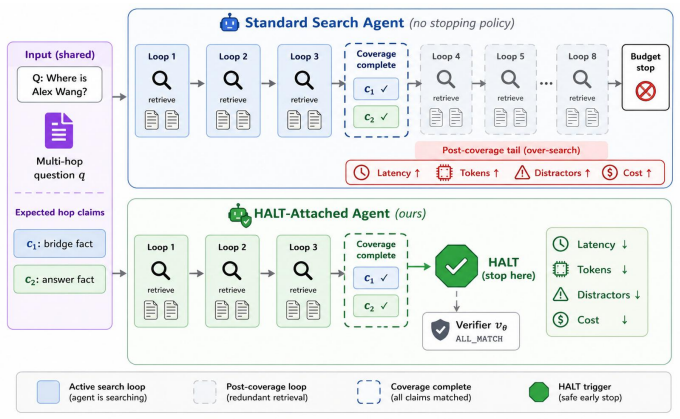
The central mechanism is the per-hop claim-evidence verifier Vθ: a LoRA-adapted Qwen2.5-3B model trained on HotpotQA discrepancy labels to output MATCH, PARTIAL, or NULL for a (claim, sentence) pair. HALT keeps a running maximum label per claim over cumulative evidence and stops only when every claim is MATCH, with ANY_MATCH as a lenient contrast. The machinery is deliberately separate from the host agent: the search policy, retriever, and generator are frozen, and the stopping predicate runs on the agent's own trajectory.
What would settle it
Run the same Self-Ask 3B agent with its own answer head, scoring exact match at the HALT stop loop and at the full budget; if native EM falls by more than 2 percentage points in any dataset while the standardized extractor's EM is preserved, the claim that coverage stopping preserves answer quality in deployment fails.
Extended reading notes
Core claim
On the paper's own terms, the central discovery is that stopping can be framed as evidence coverage: for a multi-hop question, HALT assumes a small set of expected hop claims, and a supervised verifier labels each newly retrieved sentence as MATCH, PARTIAL, or NULL with respect to each claim; the agent is halted at the first loop where every claim has at least one MATCH. The same verifier, trained once on HotpotQA labels, transfers across datasets and from a 3B to a 7B Self-Ask agent without retraining. The paper reports that on identical 3B trajectories the policy cuts average loops by 17-45% with gold claims and by 2-18% with generated claims, and passes a paired 2-point non-inferiority test on standardized-extractor exact match in five of six 3B cells and all three 7B cells. On a 7B agent that already stops early, the same signal detects under-search: forcing continuation until coverage is reached on the flagged subset roughly doubles EM on HotpotQA, and under open-corpus retrieval the verifier abstains, firing on only 6.4% of HotpotQA questions at no EM cost.
Load-bearing premise
The paper's exact-match preservation is measured with a fixed 3B extractor over chunks available at the stop loop rather than the host agent's own answer generator, so if the host generator would have needed later context, the measured EM preservation overstates what a deployed HALT would deliver.
Editorial extensions
If this is right
- A frozen search agent can be made cheaper at runtime without retraining: attaching HALT to a 3B Self-Ask agent removes 17-45% of search loops when gold hop claims are available.
- Deployable settings do not need gold annotations: hop claims generated zero-shot from the question alone still give 2-18% loop savings while passing the same EM non-inferiority test in all three generated-claim cells.
- The same coverage signal controls both over- and under-search: on the 7B agent, selectively forcing continuation on HALT-flagged under-covered questions raises population EM by +2.7 to +8.2 percentage points.
- Under retrieval distribution shift the policy becomes a selective abstainer: in the open-corpus pilot HALT fires on only 6.4% of HotpotQA questions, and on that fired subset same-extractor EM is 0.391 versus the 0.109 population baseline.
- Baselines and ablations indicate the stopping decisions come from claim-evidence alignment rather than from surface-form overlap, page titles, or a fixed stop position.
Reading between the lines
- The paper leaves runtime hop segmentation to future work; one extension is to apply the same coverage predicate to free-form agent trajectories once such a segmenter exists.
- The selective-abstention result suggests the verifier could double as an answerability gate in open-corpus RAG, a use the paper treats as a stress test rather than a deployment target.
- The standardized-extractor endpoint means the EM numbers could change if a production system used the host generator's own answer head; an operator should re-run the non-inferiority check with the deployed generator.
Editorial analysis
A structured set of objections, weighed in public.
Referee Report
Summary. The paper introduces HALT, a verification-aware stopping policy for multi-hop retrieval-augmented search agents. Given a set of expected hop claims (either gold supporting-fact annotations or zero-shot generated claims), HALT uses a small LoRA verifier to check whether the cumulative retrieved evidence supports each claim and halts the agent only when all claims are MATCHed. The host agent, retriever, and generator remain unchanged. Experiments on HotpotQA, 2WikiMultihopQA, and MuSiQue with Self-Ask 3B/7B agents in a closed BM25 distractor setting report loop reductions of 17-45% (gold claims) and 2-18% (generated claims) while preserving standardized-extractor EM within a 2pp non-inferiority margin in the majority of cells; open-corpus pilots on HotpotQA and Bamboogle show conservative firing without EM loss. The paper also includes a bidirectional-control experiment where the same coverage signal identifies under-search on a 7B agent and forcing continuation recovers EM.
Significance. If the results hold, HALT is a simple and practical runtime control: it requires no retraining of the search agent, is orthogonal to the generator, and could reduce latency and cost in over-searching agents. The paper is unusually thorough on the experimental side: paired bootstrap and paired-binary robust tests, Holm correction, threshold and operating-point sweeps, extractor robustness checks, cross-dataset verifier transfer, and a detailed ablation suite. The main weakness is that the primary accuracy endpoint is a frozen standardized extractor applied to the chunks available at the stop loop, not the host agent's own answer; Native EM is described as a faithfulness check but is not reported for Setting A. Because HALT changes the stop loop and therefore the evidence available to the host answer head, the paper's headline 'preserving exact match' is not yet demonstrated for the deployed agent. This is a fixable gap, but it is load-bearing for the central claim.
major comments (2)
- [Section 4; Tables 1-5] The paper's primary endpoint is Std-Ext EM, computed by a frozen Qwen2.5-3B extractor over cumulative chunks at the stop loop, while Native EM from the host agent's own answer head is described in Section 4 as a faithfulness check. However, Section 5 reports no Native EM for HALT or FULL in Setting A; Native EM appears only in Setting B (Table 19) and in a 2Wiki n=200 diagnostic (Appendix E.8), where it diverges sharply from Std-Ext EM (0.000 versus 0.135/0.145). Since HALT deliberately changes the stop loop and hence the chunk set seen by the answer head, the claim that HALT 'largely preserves exact match' in the main controlled setting is not yet supported. Please report Native EM for all Setting A cells (HALT and FULL, both claim sources and both backbones) and rerun the non-inferiority analysis on that endpoint, or explicitly reframe all accuracy claims as being about the standardized extractor rather than about end-to-end answer quality.
- [Section 5.4] The sentence 'HALT is the only distinct stopping policy that both reduces search loops and passes the formal EM non-inferiority test' is stronger than the evidence shown. It is based entirely on Std-Ext EM and on the authors' implemented approximations of FLARE and DRAGIN (DRAGIN-approx is explicitly not an exact reproduction). Given the missing Native EM evidence from the first major comment, this comparative claim should be qualified or verified on the native endpoint before it can stand as a headline result.
minor comments (8)
- [Abstract] The phrase 'largely preserving exact match' should specify 'standardized-extractor exact match' and should mention that Native EM is not reported in the main setting; otherwise the claim can be misread as applying to the host agent's own answers.
- [Section 4] The sentence 'Native EM serves as a faithfulness check' is a promise that is not fulfilled in Section 5 for Setting A; either add the results or remove the promise and point only to the Setting B and diagnostic results.
- [Section 3.2 / Appendix C] The generated-claim target-entity alignment is F1=0.455 on HotpotQA, which is quite low. Please add one sentence in Section 5 explaining how HALT still passes non-inferiority despite noisy claims (e.g., noisy claims reduce firing, and non-firing is lossless because the agent continues to full budget).
- [Section 5.1 / Appendix A] For the HotpotQA gold-claim diagnostic, the verifier training labels and the gold hop claims are both derived from HotpotQA supporting-fact annotations. The paper already labels this condition diagnostic, but it would be useful to state explicitly in Section 5.1 that the HotpotQA gold pair is not an independent estimate of the upper bound.
- [Section 4 / Appendix E.10] The MuSiQue n=1000 slice contains 89 duplicated question ids; this sampling peculiarity should be stated in Section 4 where n=1000 is introduced, not only in an appendix.
- [Ethics Statement] The sentence 'No AI assistant was used to generate experimental data' is confusing because the experimental pipeline uses LLMs for claim generation and answer extraction; please rephrase to clarify that the statement concerns authorship and analysis rather than the method's use of models.
- [Table 4] The notation '≡HALT ∥' in the OR-ensemble row is cryptic; please spell out in the caption that the OR-ensemble's stop loop coincides with HALT(gen) on nearly all questions.
- [Throughout] The paper alternates between '2WikiMultihopQA' and '2WikiMQA'; please unify the terminology.
Circularity Check
No load-bearing circularity: the only near-circular element is the disclosed HotpotQA gold-claim diagnostic, whose stopping targets share the verifier's training labels; the deployable generated-claim and cross-dataset results are independent.
-
self definitional
[Section 3.2, Section 3.3, Appendix A, Section 5.1 (Table 1)]
"Gold claims are constructed from benchmark supporting-fact annotations. They provide clean hop targets and isolate the stopping mechanism from claim-generation error, but rely on metadata unavailable in deployment. We use them as a diagnostic condition. ... Training examples are built automatically from HotpotQA: supporting-fact annotations provide claim–evidence pairs for required hops, and distractor passages provide unsupported pairs. ... (i) MATCH if e is the gold supporting sentence for c and the supporting-fact title in c's record matches the gold page."
In the HotpotQA gold-claim condition, the expected hop claims C(q) are built from the same supporting-fact annotations that define the verifier's MATCH training pairs. ALL_MATCH therefore fires exactly when the verifier, fitted to those labels, recognizes its own training signal in the cumulative evidence. The HotpotQA gold-claim loop-savings and EM numbers are thus an in-sample demonstration of the verifier's training labels rather than an independent prediction. The paper explicitly labels this condition 'diagnostic', and the deployable generated-claim condition (claims produced zero-shot from the question, with alignment F1=0.455 on HotpotQA) plus the cross-dataset 2Wiki/MuSiQue results do not rely on the same labels, so the central claim retains independent content.
full rationale
The central deployable claim is self-contained: hop claims are generated zero-shot from the question, the verifier is trained once on HotpotQA and reused without tuning, and EM and loop results are measured against external benchmarks with a frozen standardized extractor that is not fitted to the stopping signal. There is no self-citation chain, no imported uniqueness theorem, and no fitted parameter renamed as a prediction. The only near-circular element is the HotpotQA gold-claim diagnostic, where the stopping targets and the verifier training labels share the same supporting-fact annotation source; the paper candidly labels this an upper-bound diagnostic and provides independent generated-claim and cross-dataset results. A score of 2 reflects this minor, disclosed label-source overlap, not a central derivation that reduces to its inputs.
Assumptions & free parameters
free parameters (2)
- Verifier LoRA weights =
Qwen2.5-3B-Instruct + LoRA, trained on 9,626 HotpotQA discrepancy rows
- Match-logit threshold tau =
0 (default)
assumptions (4)
- domain assumption Supporting-fact annotations in HotpotQA and 2Wiki are reliable ground truth for expected hop claims.
- domain assumption The closed BM25 pool in Setting A contains all evidence needed to answer.
- domain assumption A frozen standardized extractor's answer over cumulative chunks is a valid proxy for host agent answer quality.
- domain assumption Self-Ask with 3B/7B backbones is representative of retrieval-augmented search agents.
Cite this review
Pith. "Pith review of HALT: Verification-Aware Stopping for Retrieval-Augmented Search Agents." pith.science (2026). https://pith.science/paper/NOBXI263
@misc{pith2026260802009,
  author       = {Pith},
  title        = {Pith review of: HALT: Verification-Aware Stopping for Retrieval-Augmented Search Agents},
  year         = {2026},
  howpublished = {\url{https://pith.science/paper/NOBXI263}},
  note         = {Machine review of arXiv:2608.02009}
}
read the original abstract
Retrieval-augmented search agents answer multi-hop questions by repeatedly issuing search queries and accumulating evidence. This creates a stopping problem: after the necessary evidence has appeared, further retrieval often adds cost, latency, and distracting context rather than useful information. We frame stopping as evidence coverage rather than generator confidence, and introduce HALT, a lightweight verification-aware policy that leaves the search agent unchanged. Given expected hop claims, HALT stops only when cumulative evidence supports each required claim. Across three multi-hop QA benchmarks, HALT reduces redundant search while largely preserving exact match. We separate a deployable setting, where hop claims are generated from the question, from a diagnostic upper bound that uses gold supporting-fact annotations: generated claims give smaller but still exact-match-preserving savings, while gold claims show the larger savings available when hop targets are clean. Baseline comparisons and ablations show that this behavior is driven by claim-evidence alignment rather than generic sufficiency, fixed stop positions, or lexical overlap. Open-corpus pilots further suggest that HALT abstains when coverage cannot be reliably verified. Overall, evidence coverage provides a practical runtime control signal for improving retrieval-augmented agents without retraining or modifying the host agent.
Figures


Figures from the paper (7 more)


Reference graph
Works this paper leans on
-
[1]
Retrieval-Augmented Generation for Knowledge-Intensive
Lewis, Patrick and Perez, Ethan and Piktus, Aleksandra and Petroni, Fabio and Karpukhin, Vladimir and Goyal, Naman and K. Retrieval-Augmented Generation for Knowledge-Intensive. Advances in Neural Information Processing Systems , volume =
-
[2]
Findings of the Association for Computational Linguistics: EMNLP 2023 , pages =
Measuring and Narrowing the Compositionality Gap in Language Models , author =. Findings of the Association for Computational Linguistics: EMNLP 2023 , pages =
2023
-
[3]
Yao, Shunyu and Zhao, Jeffrey and Yu, Dian and Du, Nan and Shafran, Izhak and Narasimhan, Karthik and Cao, Yuan , booktitle=
-
[4]
arXiv preprint arXiv:2503.09516 , year=
Search-r1: Training llms to reason and leverage search engines with reinforcement learning , author=. arXiv preprint arXiv:2503.09516 , year=
-
[5]
arXiv preprint arXiv:2503.19470 , year=
ReSearch: Learning to Reason with Search for LLMs via Reinforcement Learning , author=. arXiv preprint arXiv:2503.19470 , year=. doi:10.48550/arXiv.2503.19470 , url=
-
[6]
Asai, Akari and Wu, Zeqiu and Wang, Yizhong and Sil, Avirup and Hajishirzi, Hannaneh , booktitle =
-
[7]
Proceedings of the 2023 conference on empirical methods in natural language processing , pages=
Active retrieval augmented generation , author=. Proceedings of the 2023 conference on empirical methods in natural language processing , pages=
2023
-
[8]
Proceedings of the 61st annual meeting of the association for computational linguistics (volume 1: long papers) , pages=
Interleaving retrieval with chain-of-thought reasoning for knowledge-intensive multi-step questions , author=. Proceedings of the 61st annual meeting of the association for computational linguistics (volume 1: long papers) , pages=
Show all 54 references
-
[9]
2024 , eprint =
Su, Weihang and Tang, Yichen and Ai, Qingyao and Wu, Zhijing and Liu, Yiqun , booktitle =. 2024 , eprint =
2024
-
[10]
arXiv preprint arXiv:2510.14337 , year=
Stop-RAG: Value-Based Retrieval Control for Iterative RAG , author=. arXiv preprint arXiv:2510.14337 , year=
-
[11]
Knowing You Don't Know: Learning When to Continue Search in Multi-round
Yang, Diji and Zeng, Linda and Rao, Jinmeng and Zhang, Yi , booktitle =. Knowing You Don't Know: Learning When to Continue Search in Multi-round. 2025 , doi =. 2505.02811 , archivePrefix =
2025
-
[12]
arXiv preprint arXiv:2404.13081 , year=
Sure: Summarizing retrievals using answer candidates for open-domain qa of llms , author=. arXiv preprint arXiv:2404.13081 , year=
-
[13]
, booktitle =
Jeong, Soyeong and Baek, Jinheon and Cho, Sukmin and Hwang, Sung Ju and Park, Jong C. , booktitle =. Adaptive-. 2024 , eprint =
2024
-
[14]
, booktitle =
Yang, Zhilin and Qi, Peng and Zhang, Saizheng and Bengio, Yoshua and Cohen, William and Salakhutdinov, Ruslan and Manning, Christopher D. , booktitle =
-
[15]
Constructing a Multi-hop
Ho, Xanh and Nguyen, Anh-Khoa Duong and Sugawara, Saku and Aizawa, Akiko , booktitle =. Constructing a Multi-hop
-
[16]
2022 , publisher=
Trivedi, Harsh and Balasubramanian, Niranjan and Khot, Tushar and Sabharwal, Ashish , journal=. 2022 , publisher=
2022
-
[17]
Proceedings of the 2004 Conference on Empirical Methods in Natural Language Processing , pages =
Statistical Significance Tests for Machine Translation Evaluation , author =. Proceedings of the 2004 Conference on Empirical Methods in Natural Language Processing , pages =
2004
-
[18]
Statistics in Medicine , volume =
Improved Confidence Intervals for the Difference Between Binomial Proportions Based on Paired Data , author =. Statistics in Medicine , volume =
-
[19]
Psychometrika , volume =
Note on the Sampling Error of the Difference Between Correlated Proportions or Percentages , author =. Psychometrika , volume =
-
[20]
The Probabilistic Relevance Framework:
Robertson, Stephen and Zaragoza, Hugo , journal =. The Probabilistic Relevance Framework:. 2009 , doi =
2009
-
[21]
2022 , eprint =
Text Embeddings by Weakly-Supervised Contrastive Pre-training , author =. 2022 , eprint =
2022
-
[22]
2412.15115 , archivePrefix =
Yang, An and Yang, Baosong and Zhang, Beichen and Hui, Binyuan and Zheng, Bo and Yu, Bowen and Li, Chengyuan and Liu, Dayiheng and Huang, Fei and Wei, Haoran and Lin, Huan and Yang, Jian and Tu, Jianhong and Zhang, Jianwei and Yang, Jianxin and Yang, Jiaxi and Zhou, Jingren an...
-
[23]
and Shen, Yelong and Wallis, Phillip and Allen-Zhu, Zeyuan and Li, Yuanzhi and Wang, Shean and Wang, Lu and Chen, Weizhu , booktitle =
Hu, Edward J. and Shen, Yelong and Wallis, Phillip and Allen-Zhu, Zeyuan and Li, Yuanzhi and Wang, Shean and Wang, Lu and Chen, Weizhu , booktitle =. 2022 , eprint =
2022
-
[24]
Proceedings of the 2021 Conference of the North American Chapter of the Association for Computational Linguistics: Human Language Technologies , pages =
Petroni, Fabio and Piktus, Aleksandra and Fan, Angela and Lewis, Patrick and Yazdani, Majid and De Cao, Nicola and Thorne, James and Jernite, Yacine and Karpukhin, Vladimir and Maillard, Jean and Plachouras, Vassilis and Rockt. Proceedings of the 2021 Conference of the North A...
2021
-
[25]
Advances in Neural Information Processing Systems , volume =
Paszke, Adam and Gross, Sam and Massa, Francisco and Lerer, Adam and Bradbury, James and Chanan, Gregory and Killeen, Trevor and Lin, Zeming and Gimelshein, Natalia and Antiga, Luca and Desmaison, Alban and K. Advances in Neural Information Processing Systems , volume =
-
[26]
Proceedings of the 2020 Conference on Empirical Methods in Natural Language Processing: System Demonstrations , pages =
Transformers: State-of-the-Art Natural Language Processing , author =. Proceedings of the 2020 Conference on Empirical Methods in Natural Language Processing: System Demonstrations , pages =
2020
-
[27]
Proceedings of the 13th International Conference on Learning Representations (ICLR) , year=
Sufficient Context: A New Lens on Retrieval Augmented Generation Systems , author=. Proceedings of the 13th International Conference on Learning Representations (ICLR) , year=. 2411.06037 , archivePrefix=
-
[28]
2025 , eprint=
Java, Abhinav and Koundinyan, Srivathsan and Natarajan, Nagarajan and Sharma, Amit , journal=. 2025 , eprint=
2025
-
[29]
Yao, Zijun and Qi, Weijian and Pan, Liangming and Cao, Shulin and Hu, Linmei and Liu, Weichuan and Hou, Lei and Li, Juanzi , booktitle=. Sea. 2025 , doi=. 2406.19215 , archivePrefix=
2025 arXiv
-
[30]
Proceedings of the 63rd Annual Meeting of the Association for Computational Linguistics (Volume 1: Long Papers) , pages=
Adaptive Retrieval Without Self-Knowledge? Bringing Uncertainty Back Home , author=. Proceedings of the 63rd Annual Meeting of the Association for Computational Linguistics (Volume 1: Long Papers) , pages=. 2025 , doi=. 2501.12835 , archivePrefix=
2025 arXiv
-
[31]
Findings of the Association for Computational Linguistics:
Self-Knowledge Guided Retrieval Augmentation for Large Language Models , author =. Findings of the Association for Computational Linguistics:. 2023 , doi =. 2310.05002 , archivePrefix =
2023 arXiv
-
[32]
2026 , eprint =
Wu, Peilin and Zhang, Mian and Wan, Kun and Zhao, Wentian and He, Kaiyu and Du, Xinya and Chen, Zhiyu , booktitle =. 2026 , eprint =
2026
-
[33]
Proceedings of the 2025 Conference on Empirical Methods in Natural Language Processing , pages=
Search Wisely: Mitigating Sub-optimal Agentic Searches By Reducing Uncertainty , author=. Proceedings of the 2025 Conference on Empirical Methods in Natural Language Processing , pages=. 2025 , doi=. 2505.17281 , archivePrefix=
2025
-
[34]
Advances in Neural Information Processing Systems 38 (NeurIPS 2025) , year=
Knowing When to Stop: Efficient Context Processing via Latent Sufficiency Signals , author=. Advances in Neural Information Processing Systems 38 (NeurIPS 2025) , year=. 2502.01025 , archivePrefix=
2025
-
[35]
Knowledge Conflicts for
Xu, Rongwu and Qi, Zehan and Guo, Zhijiang and Wang, Cunxiang and Wang, Hongru and Zhang, Yue and Xu, Wei , booktitle =. Knowledge Conflicts for. 2024 , eprint =
2024
-
[36]
Proceedings of the 2024 Joint International Conference on Computational Linguistics, Language Resources and Evaluation (
Tug-of-War between Knowledge: Exploring and Resolving Knowledge Conflicts in Retrieval-Augmented Language Models , author=. Proceedings of the 2024 Joint International Conference on Computational Linguistics, Language Resources and Evaluation (. 2024 , eprint=
2024
-
[37]
2025 , eprint=
Zhang, Qinggang and Xiang, Zhishang and Xiao, Yilin and Wang, Le and Li, Junhui and Wang, Xinrun and Su, Jinsong , booktitle=. 2025 , eprint=
2025
-
[38]
Proceedings of the 12th International Conference on Learning Representations (
Adaptive Chameleon or Stubborn Sloth: Revealing the Behavior of Large Language Models in Knowledge Conflicts , author=. Proceedings of the 12th International Conference on Learning Representations (. 2024 , eprint=
2024
-
[39]
, booktitle=
Wang, Fei and Wan, Xingchen and Sun, Ruoxi and Chen, Jiefeng and Arik, Sercan O. , booktitle=. Astute. 2025 , eprint=
2025
-
[40]
2026 , eprint=
Qiu, Jingxi and Han, Zeyu and Huang, Cheng , journal=. 2026 , eprint=
2026
-
[41]
2026 , eprint=
Qian, Deniz and Chen, Hung-Ting and Choi, Eunsol , journal=. 2026 , eprint=
2026
-
[42]
2025 , eprint =
Lee, Jungyeon and Lee, Kangmin and Kim, Taeuk , booktitle =. 2025 , eprint =
2025
-
[43]
Transactions of the Association for Computational Linguistics , volume=
Know Your Limits: A Survey of Abstention in Large Language Models , author=. Transactions of the Association for Computational Linguistics , volume=. 2025 , eprint=
2025
-
[44]
2020 , eprint =
Min, Sewon and Michael, Julian and Hajishirzi, Hannaneh and Zettlemoyer, Luke , booktitle =. 2020 , eprint =
2020
-
[45]
2025 , eprint=
Sun, Zhongxiang and Zang, Xiaoxue and Zheng, Kai and Song, Yang and Xu, Jun and Zhang, Xiao and Yu, Weijie and Li, Han , booktitle=. 2025 , eprint=
2025
-
[46]
Proceedings of the International Conference on Learning Representations , year=
Retrieval Head Mechanistically Explains Long-Context Factuality , author=. Proceedings of the International Conference on Learning Representations , year=. 2404.15574 , archivePrefix=
-
[47]
Advances in Neural Information Processing Systems 38 (NeurIPS 2024) , year=
Knowledge Circuits in Pretrained Transformers , author=. Advances in Neural Information Processing Systems 38 (NeurIPS 2024) , year=. 2405.17969 , archivePrefix=
2024 arXiv
-
[48]
Proceedings of the International Conference on Learning Representations (ICLR) , year=
Towards Best Practices of Activation Patching in Language Models: Metrics and Methods , author=. Proceedings of the International Conference on Learning Representations (ICLR) , year=. 2309.16042 , archivePrefix=
-
[49]
arXiv preprint arXiv:2303.08112 , year=
Eliciting Latent Predictions from Transformers with the Tuned Lens , author=. arXiv preprint arXiv:2303.08112 , year=. 2303.08112 , archivePrefix=
-
[50]
Proceedings of the International Conference on Learning Representations (
Discovering Latent Knowledge in Language Models Without Supervision , author=. Proceedings of the International Conference on Learning Representations (. 2023 , eprint=
2023
-
[51]
Cheang, Chi Seng and Chan, Hou Pong and Zhang, Wenxuan and Deng, Yang , journal=. Do. 2025 , eprint=
2025
-
[52]
2025 , eprint=
Parry, Andrew and Chen, Catherine and Eickhoff, Carsten and MacAvaney, Sean , booktitle=. 2025 , eprint=
2025
-
[53]
2024 , eprint=
Ghandeharioun, Asma and Caciularu, Avi and Pearce, Adam and Dixon, Lucas and Geva, Mor , booktitle=. 2024 , eprint=
2024
-
[54]
Findings of the Association for Computational Linguistics: ACL 2026 , year=
Beyond Black-Box Interventions: Latent Probing for Faithful Retrieval-Augmented Generation , author=. Findings of the Association for Computational Linguistics: ACL 2026 , year=. 2510.12460 , archivePrefix=
2026 arXiv
Reviewed August 7, 2026 · model on record in the stance chip above.
Discussion (0). Sign in to comment.