REVIEW 3 major objections 4 minor
This paper claims that current vision-language models fail at continuous remote-sensing video understanding — 29.0% average accuracy versus 69.7% on natural videos — and that an evidence-focused two-stage RL framework recovers up to 9.01 po
Reviewed by Pith at T0; open to challenge. T0 means a machine referee read the full paper against a public rubric. the ladder, T0–T4 →
T0 review · deepseek-v4-flash
2026-08-04 16:10 UTC pith:S4YLADI3
load-bearing objection A genuinely useful benchmark and a serious paper, but the headline numbers rest on unverified gold labels and same-distribution tuning; the dataset release and a human baseline should decide it. the 3 major comments →
RSVideo: Are Your Vision-Language Models Ready for Remote Sensing Videos?
The pith
A machine-rendered reading of the paper's core claim, the machinery that carries it, and where it could break.
Core claim
The paper's central claim: continuous remote-sensing video understanding is limited not by model scale or context length but by recovering sparse, weak spatiotemporal evidence — tiny targets, short-lived state changes, scene-constrained spatial relations. On new benchmark RSVideo-Bench, open-source models average 29.0% vs 69.7% on natural-video Video-MME, a 40.7-point gap, traced to four findings: sparse evidence is easily missed; scene context is necessary but redundant; frame-level recognition is insufficient for spatiotemporal reasoning; correct answers do not guarantee grounded decisions. The proposed two-stage framework (evidence-aware SFT plus GRPO RL with rewards for answer correctnes
What carries the argument
The load-bearing mechanism is the evidence-aware reward operating under a fixed visual-token budget. Each video token is scored by fusing global saliency (visual self-attention), question relevance (cross-modal similarity), temporal change (local frame-to-frame inconsistency), and a time–region cell prior; the top-K tokens are retained and the remainder are compressed through question-conditioned cross-attention into M background slots. The reward R = λ_ans R_ans + g_ans(λ_st R_st + λ_bg R_bg − λ_cost C_cost) couples answer correctness to overlap between the model's emitted evidence tag and the human-annotated temporal windows and spatial cells (T*, G*), while the background term rewards rou
Load-bearing premise
Everything hinges on the human-annotated gold answers and evidence labels being correct and uniquely determined by the released video frames — an assumption the paper supports with a three-expert adjudication pipeline but not with agreement statistics, and one that cannot yet be checked because the dataset is not released for audit (Appendix G.6).
What would settle it
Independently re-annotate a random sample of the 2,731 RSVideo-Bench items and measure expert agreement on gold answers and evidence windows; if agreement is low, or if text-only and single-frame inputs already reproduce most of the 29.0% baseline (the paper's own audit shows 23.49% and 33.17%), the 40.7-point gap would be a benchmark artifact rather than a model deficiency — and the RL gains should be re-tested with the evidence-alignment reward removed.
If this is right
- Existing off-the-shelf VLMs are not deployable for remote-sensing video analysis as-is; the 29.0% baseline quantifies the shortfall, and the paper's finding that capacity scaling from 1B to 241B barely moves the needle suggests the bottleneck is evidence selection rather than parameter count.
- Evidence-annotated instruction data plus evidence-aligned reinforcement learning is a repeatable recipe: it beats outcome-only GRPO, T-GRPO, and GSPO on every one of the 26 backbones tested, so the gap-closing mechanism is the evidence reward, not the RL optimizer alone.
- The policy transfers beyond the training distribution: RSVideo training improves average accuracy on MVBench (+0.66), Video-MME (+0.37), UrbanVideo-Bench (+1.52), and SIS-Bench (+1.64) with no external benchmark data used in training.
- Answer accuracy and evidence grounding are separable and jointly optimizable: the full reward lifts accuracy to 40.63% while raising temporal-hit and region-hit grounding diagnostics to 57.4% and 54.8%, so model decisions become more auditable, not just more correct.
Where Pith is reading between the lines
- Editorial inference: the paper's own validity audit (Appendix E.2) shows a random single frame reaches 33.17% versus 36.59% for the full video, and text-only input scores 23.49% against 20% chance — suggesting part of the headline 40.7-point gap reflects failed perception of small or confusable targets and reliance on static scene priors rather than temporal reasoning alone; a capability-resolved
- Editorial inference: the evidence-tag format and the T-Hit/R-Hit metrics are portable diagnostics — any video QA system could be audited for whether its correct answers are grounded in the right frames and regions, independent of the proposed RL training — so the benchmark doubles as a grounding test for future models.
- Editorial inference: because all footage comes from eight public UAV/satellite sources, the strongest stress test is coverage generalization — evaluating the trained policy on unseen platforms, geographic regions, or event types (e.g., maritime or wildlife footage) would reveal whether evidence-focused selection is a general mechanism or a prior fitted to those eight sources.
- Editorial inference: the dataset's deliberate 'insufficient evidence' answer option — correct only when no released frame resolves the question — makes RSVideo-Bench a calibration test for overconfidence; a model that never selects that option is overclaiming, and the paper does not report this distribution, which could be a useful deployment summary metric.
Editorial analysis
A structured set of objections, weighed in public.
Referee Report
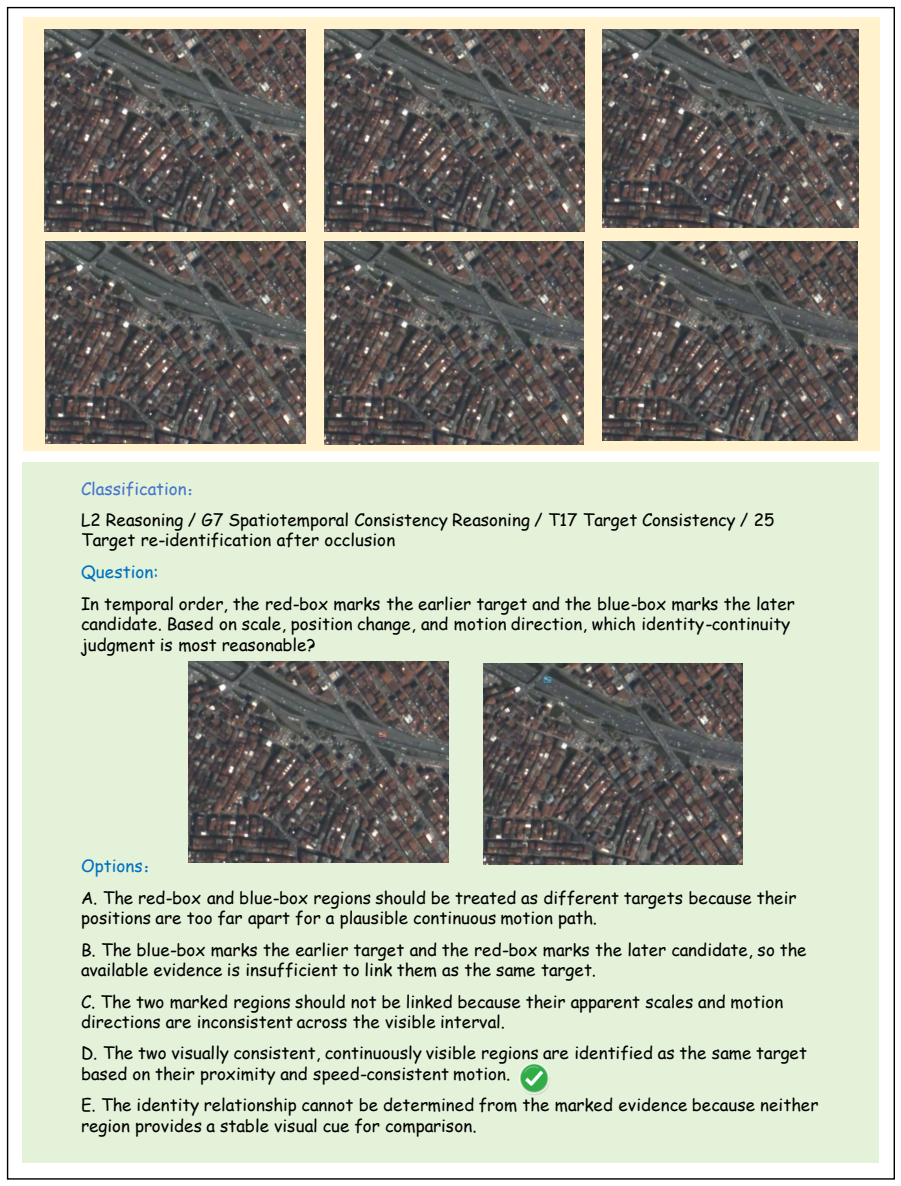
Summary. The paper introduces RSVideo-10K, a remote-sensing video QA dataset of 10,773 five-choice instances (8,042 train/validation, 2,731 locked test) built from eight public UAV/satellite video sources, with a taxonomy of two capability dimensions, seven groups, and 17 tasks. It reports that existing VLMs average 29.0% on RSVideo-Bench versus 69.7% on Video-MME, a 40.7-point gap, and proposes RSVideo, a two-stage training method combining evidence-aware SFT with GRPO-based reinforcement learning that uses spatiotemporal evidence rewards to focus on question-relevant tokens. The method is reported to improve all 26 evaluated backbones, with up to 9.01% absolute gain and a best accuracy of 40.63% on Qwen3.6-27B. The paper also includes transfer experiments to MVBench, Video-MME, UrbanVideo-Bench, and SIS-Bench, plus a validity audit using text-only, random-frame, shuffled-frame, and full-video inputs.
Significance. If the dataset and annotations are valid, the benchmark fills a genuine gap: existing remote-sensing benchmarks are mostly image-based or multi-temporal, while continuous UAV/satellite video QA is underrepresented. The paper is unusually careful about evaluation protocol: Appendix C fixes decoding, sampling, parsing, and option ordering, and Appendix E.2 reports an input-degradation audit showing that temporal order matters. The training method is evaluated across 26 backbones, an unusually broad sweep, and the transfer table provides a check against out-of-distribution overfitting. These are real strengths. However, both headline claims—the 40.7-point natural-to-remote-sensing gap and the causal role of evidence-aligned RL—rest on the correctness and uniqueness of human gold labels and evidence annotations. The manuscript reports no human baseline, no inter-annotator agreement, and the dataset is not yet released, so the benchmark's validity cannot currently be audited. The proposed reward formulation also contains an ambiguity in the background-compression term. The central ideas are plausible and the paper is publishable in principle, but the evidence needed to support the load-
major comments (3)
- [Appendix A.1, B.3, G.6; Table 10] The benchmark's validity rests on the assertion in Appendix A.1 that clips are retained only when 'the correct answer can be established from the released visual input.' The manuscript describes a three-expert pipeline in Appendix B.3 but reports no inter-annotator agreement statistics, no human accuracy on the 2,731 RSVideo-Bench items, and no released sample that an external reviewer can audit. Appendix G.6 states the dataset 'is not yet publicly distributed.' Without a human baseline, the headline 29.0% versus 69.7% gap cannot be interpreted: if human experts score near 90% the gap reflects model deficiency, but if they score near chance the benchmark is not measuring what the paper claims. The validity audit in Table 10 shows that models use video content and temporal order, but it does not establish that the gold answers are uniquely determinable from the video. This is load-bearing
- [§4.2, Eq. (7)] Equation (7) defines R_bg = |I_rem ∩ I*_bg|/|I*_bg| + (|I_rem|/L) M. The text states that 'the second favors summarizing more residual tokens with fewer background slots,' but the formula contains M in the numerator, so it rewards a larger number of background slots M, not fewer. As written, the reward is inconsistent with the stated objective of sparse background compression. Also, the first term is recall-only over non-target tokens, and the overall reward in Eq. (8) only gates evidence rewards on correct answers, so the mechanism by which the method learns to discard background for incorrect trajectories is unclear. The authors should correct the formula or the description and provide a derivation of what the second term is intended to measure.
- [§4.2, Eqs. (6)–(8); Table 3; Table 4] The evidence-alignment reward R_st in Eq. (6) is computed against T* and G* derived from RSVideo-Instruct, and the headline results are measured on RSVideo-Bench, which shares the same eight sources, taxonomy, and annotation protocol as the training set. The reward is also gated by g_ans = I[A=A*] I[E is valid], so trajectories with wrong answers receive no evidence-alignment signal. Consequently, the 1.95-point improvement attributed to R_st in Table 3 may reflect learning the RSVideo-specific tag format and answer distribution rather than a general spatiotemporal evidence-grounding capability. The transfer results in Table 4 show small positive gains on external benchmarks, but those benchmarks do not require evidence tags, so they do not test evidence grounding. To support the claim that RSVideo improves evidence-focused reasoning, the authors should evaluate evidence-alignment metric
minor comments (4)
- [§3.2] Typo: 'datset' should be 'dataset'.
- [Appendix F, Leaf 15 and Leaf 19] Minor typos: 'from start to end??' has a double question mark, and 'bule' should be 'blue'.
- [Appendix G.6] The datasheet says the dataset is not yet distributed, while the abstract and Section 1 state codes will be available. Please state explicitly in the main text what will be released at review time (e.g., a sample, evaluation scripts, prediction files) and what will be released at publication.
- [Table 10] The validity audit shows that 'Random single frame' outperforms 'Full video' on SP, TP, and CER. The text acknowledges this, but a brief explanation in the main text would help readers interpret the non-monotonicity and avoid the impression that the full-video advantage is inconsistent.
Circularity Check
Partial metric-level circularity in TH/RH grounding diagnostics; central accuracy and transfer claims remain independent.
specific steps
-
fitted input called prediction
[Eq. (6) and Appendix C.3; Table 3]
"The first key reward aligns the predicted evidence with annotated temporal positions and spatial cells. Let bT(E) and bG(E) be the temporal indices and spatial cells parsed from E, and let T∗ and G∗ denote the corresponding annotations. We compute RT = | bT(E)∩ T∗|/|T∗|, RG = | bG(E)∩ G∗|/|G∗| ... Temporal Hit (T-Hit) is the fraction of items for which T̂ overlaps the annotated key frame or temporal window. Region Hit (R-Hit) is the fraction for which R̂ overlaps the annotated target region."
The RL reward Rst (Eq. 6) is literally a coverage/overlap measure between the model's predicted evidence tag and the human-annotated T*, G*. The paper's reported grounding diagnostics T-Hit and R-Hit are the same overlap measure against the same annotation fields. Therefore, Table 3's finding that adding Rst increases TH/RH by 4.2/4.5 points is not an independent confirmation of 'evidence grounding': the model was trained to maximize exactly the quantity used as the diagnostic. This is a metric-level circularity. It does not, however, collapse the paper's headline accuracy claims, because accuracy on the held-out RSVideo-Bench and the external transfer results (MVBench, Video-MME, UrbanVideo-Bench, SIS-Bench) are not by construction tied to the evidence-overlap reward.
full rationale
The central claims of the paper are empirical rather than derivational: (1) current VLMs score substantially lower on RSVideo-Bench than on Video-MME, and (2) RSVideo training improves accuracy on the held-out RSVideo-Bench and transfers to external benchmarks. Neither claim reduces to the paper's inputs by construction. The benchmark gap is a measurement, and the accuracy gains are obtained on a locked test set with additional external-benchmark transfer evaluation (Table 4), which the paper explicitly motivates in Section 5.4 by noting that in-domain results alone would not establish generalization. The only circularity I can exhibit with the paper's own equations is narrower: the evidence-grounding rewards (Eq. 6-7) and the T-Hit/R-Hit diagnostics (Appendix C.3) are defined as the same overlap with the same annotations, so improvements in those diagnostics partly reflect fitting to the annotation scheme rather than an independent test of grounding. This is a secondary, metric-level issue and does not undermine the independent content of the accuracy and transfer results. No load-bearing self-citation or imported uniqueness theorem is present; references to the authors' prior benchmarks are contextual, not argumentative.
Axiom & Free-Parameter Ledger
free parameters (6)
- Evidence score fusion weights alpha_sal, alpha_rel, alpha_chg (Eq. 2) =
not reported in text
- Region prior weight alpha_cell (Eq. 3) =
not reported
- Token pooling ratio eta =
0.10
- Visual token budget rho =
0.40
- Reward weights lambda_ans/lambda_st/lambda_bg/lambda_cost =
0.40/0.40/0.15/0.05
- GRPO group size, sampling temperature, KL coefficient =
G=4, temp 0.7, KL 0.03
axioms (5)
- standard math GRPO clipped policy objective with KL penalty to the SFT policy (Appendix D.5, Eq. 18) is a valid optimizer for the evidence-aware return.
- domain assumption Remote-sensing videos are dominated by small targets, large repetitive backgrounds, subtle short-lived state changes, and scene-constrained spatial relations (Sections 2.2, 4.1).
- domain assumption Every retained clip's gold answer and evidence window are uniquely determinable from the released frames (Appendix A.1: clips retained 'only when the correct answer can be established from the released visual input').
- domain assumption The eight public sources (AU-AIR, DTB70, ERA, OOTB, Okutama, SatSOT, Stanford Drone, VISO) provide a representative sample of remote-sensing video understanding, and clip-level split isolation prevents leakage (Appendix A.1, A.3).
- ad hoc to paper Question-relevant evidence can be faithfully represented by coarse temporal indices and spatial cells of a fixed grid, 'Evidence: T08-R05/R06' (Section 4.2; Eq. 12).
invented entities (1)
-
Spatiotemporal evidence tag format (T/G index pairs, e.g., T08-R05/R06)
no independent evidence
Cite this review
Pith. "Pith review of RSVideo: Are Your Vision-Language Models Ready for Remote Sensing Videos?." pith.science (2026). https://pith.science/paper/S4YLADI3
@misc{pith2026260802039,
  author       = {Pith},
  title        = {Pith review of: RSVideo: Are Your Vision-Language Models Ready for Remote Sensing Videos?},
  year         = {2026},
  howpublished = {\url{https://pith.science/paper/S4YLADI3}},
  note         = {Machine review of arXiv:2608.02039}
}
read the original abstract
Remote-sensing videos enable real-time observation of changes in target attributes, short-term activities, and scene evolution. They record motion, actions, interactions, and scene changes that cannot be captured by isolated images. Existing models primarily target single images or discrete temporal observations spanning a long time range. However, a unified evaluation setting for assessing vision-language models on continuous remote-sensing video understanding remains lacking. We introduce RSVideo-10K, a remote-sensing video dataset comprising 10,773 instances, 1.47 million frames, and 17.02 hours of footage, containing both unmanned aerial vehicles and satellite platforms. Its fixed evaluation benchmark, RSVideo-Bench, contains 2,731 test instances and evaluates two complementary aspects of remote-sensing video understanding: L1 Perception and L2 Reasoning, spanning seven capability groups and 17 tasks. Evaluations show that current vision-language models still struggle to recover small local evidence, track short-lived states, and use scene-constrained spatial relations. Based on this analysis, we further propose RSVideo, a reinforcement learning framework for small-target spatiotemporal focusing that selects question-relevant regions across frames and suppresses redundant background tokens. RSVideo achieves a maximum absolute improvement of 9.01% with InternVL3.5-14B and attains the highest accuracy of 40.63% with Qwen3.6-27B across 26 open-source vision-language backbones. Codes will be available at https://github.com/HongjieZhou0329/RSVideo.
Figures



discussion (0)
Sign in with ORCID, Apple, or X to comment. Anyone can read and Pith papers without signing in.