REVIEW 3 major objections 5 minor 62 references
Quantum computer-based simulation of Stark many-body localization in a 1D Fermi-Hubbard model
T0 review · 3 major / 5 minor · reviewed 2026-08-04 · deepseek-v4-flash
Pith's one-line read Using a spin-resolved Jordan-Wigner mapping, SWAP networks, and tensor-network-based circuit compression, the paper shows that a 12-qubit superconducting processor reproduces exact short-time dynamics of a tilted Fermi-Hubbard chain and exh
desk verdict A solid resource-optimization demonstration on 12 qubits, but the Stark-MBL label outruns the data at L=6 and t≤1.25. read the letter →
The pith
A machine-rendered reading of the paper's core claim, the machinery that carries it, and where it could break.
The reading
What carries the argument
The enabling mechanism is the pair of circuit-construction choices: the spin-resolved Jordan-Wigner transformation, which places spin-up and spin-down fermions on separate parity chains so that hopping terms become short XIX+YIY-style operators, and the SWAP network, which makes the resulting next-nearest-neighbor hopping implementable with nearest-neighbor hardware connectivity in constant per-layer depth. On top of this, a tensor-network-based circuit optimizer searches for a parameterized compressed circuit that reproduces the Trotter target state with fidelity above 0.9999, shrinking circuits by roughly 88% in two-qubit gates and 87% in depth. That compression is what makes the dynamics
What would settle it
Measure the half-chain entanglement entropy out to much longer times on the same or a larger system: genuine Stark-MBL shows logarithmic growth with time, whereas Wannier-Stark localization and prethermal transients saturate or behave differently. Alternatively, repeat the strong-tilt run with interactions turned off (U=0); if the density and imbalance dynamics are essentially unchanged, the localization is single-particle and not many-body.
Extended reading notes
Core claim
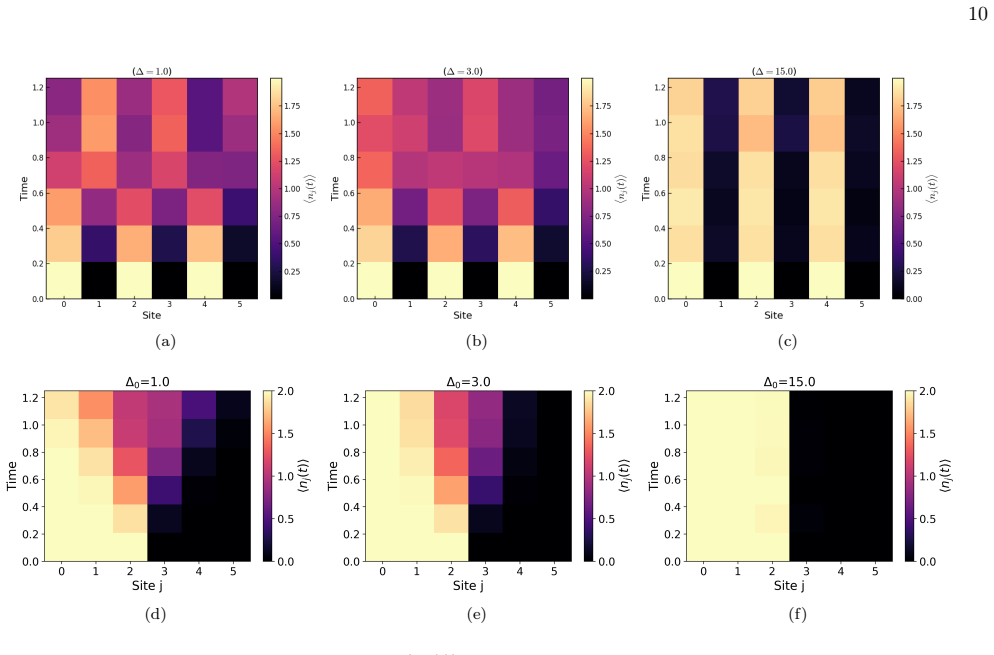
The central claim is that a 12-qubit superconducting processor, running first-order Trotter evolution of the tilted Fermi-Hubbard model with a spin-resolved Jordan-Wigner mapping and SWAP networks, followed by tensor-network-based circuit compression, reproduces the exact short-time dynamics of observables including charge imbalance, quantum Fisher information, participation entropy, and half-chain particle number. At weak (Δ0=1) and intermediate (Δ0=3) tilt the imbalance decays and correlations grow, while at strong tilt (Δ0=15) the imbalance stays near its initial value, density profiles remain frozen, and entanglement growth is strongly suppressed. The authors take this crossover, over ev
Load-bearing premise
The load-bearing premise is that the suppressed dynamics seen at Δ0=15 in a six-site chain over times t≤1.25 is genuinely many-body localization, rather than single-particle Wannier–Stark localization or a short-time transient, since the characteristic MBL signatures (logarithmic entanglement growth, long-time memory) are not measured.
Editorial extensions
If this is right
- Short-time real-time dynamics of a six-site tilted Fermi-Hubbard chain can be faithfully reproduced on current superconducting hardware when circuits are compressed, as verified against exact diagonalization.
- Stark MBL studies require no disorder averaging, so the number of circuit executions is far smaller than for disordered MBL—an advantage the protocol exploits.
- The sign of the crossover—localization at large tilt—shows in simple observables such as charge imbalance and density profiles, within reach of NISQ devices.
- The same compilation pipeline should extend to larger chains and other fermionic models, since compressed gate counts stay roughly flat in time after optimization.
Reading between the lines
- The short-time, six-site data do not actually test the defining MBL hallmarks—logarithmic entanglement growth, long-lived memory, and interaction-dependent delocalization—so the Δ0=15 behavior could equally be Wannier–Stark single-particle localization or a prethermal transient; calling it 'Stark-MBL' is an extrapolation beyond the measured window.
- A decisive extension would be to compare U=0 and U>0 at strong tilt; if the localization is identical, it is not many-body, and if entanglement entropy grows logarithmically at longer times, the MBL interpretation gains support.
- The tensor-network compression route could be reused to push to longer times or larger tilts, where the crossover boundary could be mapped, or to probe the interaction-dependence of the mobility edge in Stark systems.
Editorial analysis
A structured set of objections, weighed in public.
Referee Report
Summary. The paper reports a 12-qubit IBM hardware simulation of a tilted Fermi-Hubbard model with L=6, using spin-resolved Jordan-Wigner mapping, SWAP networks, first-order Trotter evolution, and AQC-Tensor-based circuit compression. It studies CDW and DW initial states and measures charge imbalance, quantum Fisher information, participation entropy, half-chain entanglement, density profiles, and N_half for tilt strengths Δ0=1, 3, and 15 up to t=1.25. The authors report approximately 88% reduction in two-qubit gates and 87% in circuit depth, and claim that hardware results closely reproduce noiseless Trotter and exact diagonalization, exhibiting a crossover from thermalizing to Stark-MBL behavior.
Significance. If the Stark-MBL claim were fully established, this would be a valuable NISQ demonstration. The compression pipeline (AQC-Tensor combined with Qiskit/pytket), the spin-resolved mapping, and the careful hardware execution with dynamical decoupling, Pauli twirling, and postselection are useful practical contributions, and the finite-time localization crossover at strong tilt is clearly visible in the data. However, the data do not isolate many-body effects: with L=6 and t≤1.25, all measured signatures are equally consistent with single-particle Wannier-Stark localization or a short-time prethermal transient. The paper is therefore best read as a resource-efficient quantum simulation of finite-time localization signatures in a tilted Fermi-Hubbard model, not as an observation of Stark MBL.
major comments (3)
- [Sec. III.C, III.D, IV] The central physical claim—that the Δ0=15 behavior constitutes Stark many-body localization—is underdetermined. The observables used (persistent charge imbalance, suppressed QFI, small participation entropy, flat subsystem-entropy profile) are all produced by a noninteracting tilted chain (U=0) in the Wannier-Stark localized regime. The manuscript contains no U=0 comparison, no scan of U at fixed Δ0, no evolution to timescales where the MBL hallmark of logarithmic entanglement growth could be sought, and no spectral or mobility-edge diagnostic. Sec. III.A fixes U=J=1 and acknowledges the short-time limitation, but the conclusion and title still assert 'Stark MBL.' To make the many-body claim load-bearing, the authors should either add a discriminating control (e.g., U=0 dynamics or a U scan at Δ0=15) or reframe the title and conclusion as 'localization signatures' rather than 'Stark many
- [Sec. II.E, Figs. 3, 4, 7] The noiseless benchmark is partly circular. Eq. (10) defines AQC-Tensor optimization as maximizing fidelity to the target Trotter state, with acceptance at F>0.9999. Therefore the optimized noiseless circuit reproduces the target Trotter state by construction; its agreement with exact diagonalization validates only the Trotterization and the compression, not the hardware or the physical labeling. The meaningful test is hardware versus noiseless simulation, but Figs. 3, 4, and 7 and the density heatmaps show no error bars or confidence intervals even though Sec. III.A states each experiment was repeated three times with 20,000 shots. Please report statistical uncertainties and, ideally, the achieved hardware state fidelities; otherwise the statement that hardware results 'closely reproduce' the noiseless dynamics is not quantitatively supported.
- [Sec. III.A] The hardware section does not specify how the three repeated runs were aggregated, whether standard deviations were computed, or whether postselection rates varied across circuits. With 54 circuit executions and 20,000 shots each, shot noise and gate-error fluctuations should be quantified. This is particularly important for the Δ0=15 regime, where the localization signal is a small dynamic range in QFI and entropy; without uncertainty estimates, the observed suppression could be consistent with noise. Please include error bars or confidence intervals on all hardware data points.
minor comments (5)
- [Sec. II.A] Minor typo: 'The resulting Hamiltonian thus looks like' is missing punctuation. Also, the identity terms in Eq. (3) could be clarified; the decomposition of the Stark term into 2I−Z is nonstandard and deserves a short explanation.
- [Fig. 3 caption] The caption mentions SPE2, but SPE2 appears in Fig. 4 rather than Fig. 3. Please correct the caption or move the reference.
- [Table I] The column headers are confusing: 'Δt' appears to label the first column, but the rows are actually (Δ0, t). Please relabel the first two columns clearly.
- [Sec. III.A] The sentence 'four Trotter steps per sampling interval are added' is ambiguous. Please specify the Trotter time step Δt and the number of Trotter steps used for each evolution time.
- [Sec. II.D] The claim that YBG, Matchgate, and Givens-rotation implementations show 'nearly identical fidelities and physical observables' is asserted without supporting data. Either show the comparison or remove the assertion.
Circularity Check
No significant circularity; AQC-Tensor's fidelity-to-target optimization is a by-construction compilation step but is not load-bearing for the independently established physics crossover.
-
other
[Section II.E, Eq. (9)-(10)]
"AQC-Tensor constructs a parameterized compressed circuit, |ψAQC(θ, t)⟩=U AQC(θ, t)|ψ0⟩, and optimizes its parameters using the L-BFGS optimizer [50] to maximize the state fidelity F(θ) =|⟨ψ target(t)|ψAQC(θ, t)⟩|2 ... A compressed circuit is accepted only when the optimized fidelity exceeds 0.9999."
The compressed circuit is, by construction, an approximation to the Trotter target state with fidelity >0.9999. Therefore the noiseless optimized-circuit observables are not independent of the target Trotter observables; agreement with the optimized noiseless Trotter simulation is built into the optimization objective. The paper presents hardware agreement with opt-Trotter(S)/exact as a benchmark, and while hardware noise makes the match non-trivial, the noiseless 'prediction' of Trotter dynamics from the compressed circuit is tautological. The physical crossover itself, however, is independently established by exact diagonalization and Trotter simulation, so this step is not load-bearing for the central physics claim.
full rationale
The central Stark-MBL crossover is obtained from exact diagonalization and first-order Trotter simulation, and the hardware results are benchmarked against those states. The only by-construction element is AQC-Tensor's fidelity maximization (Eq. 10), which defines the compressed circuit as a high-fidelity approximation to the Trotter target state; this is a standard circuit-compilation step, not a fitted parameter being renamed as a prediction. There are no load-bearing self-citations: the cited prior works (e.g., Refs. [40,45]) are by different authors and are method citations. No uniqueness theorem is imported from the authors, and no ansatz is smuggled in via self-citation. The concern that the Δ0=15 data at L=6 and t≤1.25 may not distinguish Stark MBL from noninteracting Wannier-Stark localization or a short-time prethermal plateau is an underdetermination/correctness issue, not a circularity, and is not counted toward the circularity score.
Assumptions & free parameters
free parameters (3)
- AQC-Tensor compressed-circuit parameters θ =
Optimized per (t, Δ0, initial state); accepted only if F(θ)>0.9999
- AQC-Tensor fidelity threshold =
0.9999
- Trotter step size τ =
0.0625 (four steps per 0.25 time unit)
assumptions (4)
- standard math Spin-resolved Jordan-Wigner mapping with separate parity chains correctly represents the t-FHM algebra on 12 qubits (Eq. 3).
- domain assumption First-order Trotter-Suzuki product formula with τ=0.0625 is accurate enough for t≤1.25 (Sec. II.C).
- ad hoc to paper AQC-Tensor compression with fidelity >0.9999 to the target state preserves all measured observables (Eq. 10).
- domain assumption The chosen observables at L=6 and t≤1.25 discriminate Stark MBL from trivial Wannier-Stark localization.
Cite this review
Pith. "Pith review of Quantum computer-based simulation of Stark many-body localization in a 1D Fermi-Hubbard model." pith.science (2026). https://pith.science/paper/4VAHL7VC
@misc{pith2026260802245,
  author       = {Pith},
  title        = {Pith review of: Quantum computer-based simulation of Stark many-body localization in a 1D Fermi-Hubbard model},
  year         = {2026},
  howpublished = {\url{https://pith.science/paper/4VAHL7VC}},
  note         = {Machine review of arXiv:2608.02245}
}
abstract
Many-body localization (MBL) is a dynamical phenomenon that describes the non-ergodicity of isolated quantum many-body systems. In contrast to thermalization, this phenomenon leads to a long-lived memory of initial states of local systems and slow growth of entanglement. In this work, we study Stark MBL in a 12-qubit correlated fermionic system described by the one-dimensional Fermi-Hubbard model using Hamiltonian simulation on an IBM superconducting qubit quantum computer. To enable such a computation on current-day noisy hardware, we combine a series of compilation steps, including the use of the spin-resolved Jordan-Wigner transformation, employing SWAP networks, and integrating a tensor-network-based quantum circuit optimization routine on top of a standard circuit optimization pipeline. As a result, there is approximately an 88$\%$ and 87$\%$ reduction in two-qubit gate count and circuit depth, respectively. Through such simulations of the real-time dynamics using Trotterized quantum circuits, we exhibit a crossover from thermalizing dynamics of the system at a weak tilt of the field to a strongly localized behavior at large tilt with short evolution times. We also benchmark our obtained results with respect to those from exact simulations.
Figures


Figures from the paper (4 more)



Reference graph
Works this paper leans on
-
[1]
Lloyd, Universal quantum simulators, Science273, 1073 (1996)
S. Lloyd, Universal quantum simulators, Science273, 1073 (1996)
1996
-
[2]
I. M. Georgescu, S. Ashhab, and F. Nori, Quantum sim- ulation, Reviews of Modern Physics86, 153 (2014)
2014
-
[3]
Preskill, Quantum computing in the nisq era and be- yond, Quantum2, 79 (2018)
J. Preskill, Quantum computing in the nisq era and be- yond, Quantum2, 79 (2018)
2018
-
[4]
F.Alam, J.L.Bosse, I.Čepait˙ e, A.Chapman, L.Clinton, M. Crichigno, E. Crosson, T. Cubitt, C. Derby, O. Dow- inton, et al., Fermionic dynamics on a trapped-ion quan- tum computer beyond exact classical simulation, arXiv preprint arXiv:2510.26300 (2025)
arXiv 2025
-
[5]
F. Alam, M. Crichigno, E. Crosson, S. T. Flammia, F. M. Gambetta, M. H. Gordon, M. Kreshchuk, A. Montanaro, A. Nocera, and R. A. Santos, Onset of ergodicity across scales on a digital quantum processor, arXiv preprint arXiv:2603.12236 (2026)
arXiv 2026
- [6]
-
[7]
E. T. Campbell, B. M. Terhal, and C. Vuillot, Roads towards fault-tolerant universal quantum computation, Nature549, 172 (2017)
2017
-
[8]
Battistel, C
F. Battistel, C. Chamberland, K. Johar, R. W. Overwa- ter, F. Sebastiano, L. Skoric, Y. Ueno, and M. Usman, Real-time decoding for fault-tolerant quantum comput- ing: Progress, challenges and outlook, Nano Futures7, 032003 (2023)
2023
Show all 62 references
-
[9]
Fauseweh, Quantum many-body simulations on digi- tal quantum computers: State-of-the-art and future chal- lenges, Nature Communications15, 2123 (2024)
B. Fauseweh, Quantum many-body simulations on digi- tal quantum computers: State-of-the-art and future chal- lenges, Nature Communications15, 2123 (2024)
2024
-
[10]
C. Ying, B. Cheng, Y. Zhao, H.-L. Huang, Y.-N. Zhang, M. Gong, Y. Wu, S. Wang, F. Liang, J. Lin, X. Yu, D. Hui, R. Hao, C.-Z. Peng, M.-H. Yung, X. Zhu, and J.-W. Pan, Experimental simulation of larger quantum circuits with fewer superconducting qubits, Physical Re- view Letter...
2023
-
[11]
Kandala, A
A. Kandala, A. Mezzacapo, K. Temme, M. Takita, M. Brink, J. M. Chow, and J. M. Gambetta, Hardware- efficient variational quantum eigensolver for small molecules and quantum magnets, Nature549, 242 (2017)
2017
-
[12]
Kandala, K
A. Kandala, K. Temme, A. D. Córcoles, A. Mezzacapo, J. M. Chow, and J. M. Gambetta, Error mitigation ex- tends the computational reach of a noisy quantum pro- cessor, Nature567, 491 (2019)
2019
-
[13]
J. M. Deutsch, Quantum statistical mechanics in a closed system, Physical Review A43, 2046 (1991)
-
[14]
Srednicki, Chaos and quantum thermalization, Phys- ical Review E50, 888 (1994)
M. Srednicki, Chaos and quantum thermalization, Phys- ical Review E50, 888 (1994)
1994
-
[15]
For weak and intermediate tilts,Nhalf (t)decreases with time, showing that particles leave the initially occupied region and spread across the chain. In contrast, for the strong-field case∆ 0 = 15,N half (t)remains close to its initial value of six particles, demonstrating str...
-
[16]
Nandkishore and D
R. Nandkishore and D. A. Huse, Many-body localization andthermalizationinquantumstatisticalmechanics,An- nual Review of Condensed Matter Physics6, 15 (2015)
2015
-
[17]
Alet and N
F. Alet and N. Laflorencie, Many-body localization: An introduction and selected topics, Comptes Rendus Physique19, 498 (2018)
2018
-
[18]
D. A. Abanin, E. Altman, I. Bloch, and M. Serbyn, Col- loquium: Many-body localization, thermalization, and entanglement, Reviews of Modern Physics91, 021001 (2019)
2019
-
[19]
Gopalakrishnan and S
S. Gopalakrishnan and S. Parameswaran, Dynamics and transport at the threshold of many-body localization, Physics Reports862, 1 (2020)
2020
-
[20]
Sierant, M
P. Sierant, M. Lewenstein, A. Scardicchio, L. Vidmar, and J. Zakrzewski, Many-body localization in the age of classical computing, Reports on Progress in Physics88, 026502 (2025)
2025
-
[21]
Zakrzewski, Many-body localization, arXiv preprint arXiv:2604.12464 (2026)
J. Zakrzewski, Many-body localization, arXiv preprint arXiv:2604.12464 (2026)
2026 arXiv
-
[22]
P. W. Anderson, Absence of diffusion in certain random lattices, Physical Review109, 1492 (1958)
1958
-
[23]
D. Zhu, S. Johri, N. Nguyen, C. H. Alderete, K. Lands- man, N. Linke, C. Monroe, and A. Matsuura, Probing many-body localization on a noisy quantum computer, Physical Review A103, 032606 (2021)
2021
-
[24]
G. H. Wannier, Dynamics of band electrons in electric and magnetic fields, Reviews of Modern Physics34, 645 (1962)
1962
-
[25]
Morong, F
W. Morong, F. Liu, P. Becker, K. S. Collins, L. Feng, A. Kyprianidis, G. Pagano, T. You, A. V. Gorshkov, and C. Monroe, Observation of stark many-body localization without disorder, Nature599, 393 (2021)
2021
-
[26]
van Nieuwenburg, Y
E. van Nieuwenburg, Y. Baum, and G. Refael, From bloch oscillations to many-body localization in clean in- teracting systems, Proceedings of the National Academy of Sciences116, 9269 (2019)
2019
-
[27]
Schulz, C
M. Schulz, C. Hooley, R. Moessner, and F. Pollmann, Stark many-body localization, Physical Review Letters 122, 040606 (2019)
2019
-
[28]
S. R. Taylor, M. Schulz, F. Pollmann, and R. Moess- ner, Experimental probes of stark many-body localiza- tion, Physical Review B102, 054206 (2020)
2020
-
[29]
Zhang, Y
L. Zhang, Y. Ke, W. Liu, and C. Lee, Mobility edge of stark many-body localization, Physical Review A103, 13 023323 (2021)
2021
-
[30]
Scherg, T
S. Scherg, T. Kohlert, P. Sala, F. Pollmann, B. Hebbe Madhusudhana, I. Bloch, and M. Aidelsburger, Observing non-ergodicity due to kinetic constraints in tilted fermi-hubbard chains, Nature Communications12, 4490 (2021)
2021
-
[31]
Wilkinson, C
S. Wilkinson, C. Bharucha, K. Madison, Q. Niu, and M. Raizen, Observation of atomic wannier-stark ladders in an accelerating optical potential, Physical Review Let- ters76, 4512 (1996)
1996
-
[32]
Yao and J
R. Yao and J. Zakrzewski, Many-body localization of bosons in an optical lattice: Dynamics in disorder-free potentials, Physical Review B102, 104203 (2020)
2020
-
[33]
H. Lang, P. Hauke, J. Knolle, F. Grusdt, and J. C. Hal- imeh, Disorder-free localization with stark gauge protec- tion, Physical Review B106, 174305 (2022)
2022
-
[34]
Q. Guo, C. Cheng, H. Li, S. Xu, P. Zhang, Z. Wang, C. Song, W. Liu, W. Ren, H. Dong, R. Mondaini, and H. Wang, Stark many-body localization on a super- conducting quantum processor, Physical Review Letters 127, 240502 (2021)
2021
-
[35]
Wang, Z.-H
Y.-Y. Wang, Z.-H. Sun, and H. Fan, Stark many-body lo- calization transitions in superconducting circuits, Physi- cal Review B104, 205122 (2021)
2021
-
[36]
Aubry and G
S. Aubry and G. André, Analyticity breaking and ander- son localization in incommensurate lattices, Ann. Israel Phys. Soc3, 18 (1980)
1980
-
[37]
Hubbard, Electron correlations in narrow energy bands,ProceedingsoftheRoyalSocietyofLondon.Series A
J. Hubbard, Electron correlations in narrow energy bands,ProceedingsoftheRoyalSocietyofLondon.Series A. Mathematical and Physical Sciences276, 238 (1963)
1963
-
[38]
Stanisic, J
S. Stanisic, J. L. Bosse, F. M. Gambetta, R. A. Santos, W. Mruczkiewicz, T. E. O’Brien, E. Ostby, and A. Mon- tanaro, Observing ground-state properties of the fermi- hubbard model using a scalable algorithm on a quantum computer, Nature Communications13, 5743 (2022)
2022
-
[39]
D. P. Arovas, E. Berg, S. A. Kivelson, and S. Raghu, The hubbard model, Annual Review of Condensed Mat- ter Physics13, 239 (2022)
2022
-
[40]
Grosse, The symmetry of the hubbard model, Letters in Mathematical Physics18, 151 (1989)
H. Grosse, The symmetry of the hubbard model, Letters in Mathematical Physics18, 151 (1989)
1989
-
[41]
T.A.Chowdhury, V.Korepin, V.R.Pascuzzi,andK.Yu, Quantum utility in simulating the real-time dynamics of the fermi–hubbard model using superconducting quan- tum computers, Applied Physics Reviews13(2026)
2026
-
[42]
Jordan and E
P. Jordan and E. Wigner, Über das paulische äquivalen- zverbot, Zeitschrift für Physik47, 631 (1928)
1928
-
[43]
Schreiber, S
M. Schreiber, S. S. Hodgman, P. Bordia, H. P. Lüschen, M. H. Fischer, R. Vosk, E. Altman, U. Schneider, and I. Bloch, Observation of many-body localization of inter- acting fermions in a quasirandom optical lattice, Science 349, 842 (2015)
2015
-
[44]
H. F. Trotter, On the product of semi-groups of opera- tors, Proceedings of the American Mathematical Society 10, 545 (1959)
1959
-
[45]
M. Suzuki, Generalized trotter’s formula and systematic approximants of exponential operators and inner deriva- tions with applications to many-body problems, Commu- nications in Mathematical Physics51, 183 (1976)
1976
-
[46]
T. A. Chowdhury, K. Yu, M. A. Shamim, M. Kabir, and R. S. Sufian, Enhancing quantum utility: Simulat- ing large-scale quantum spin chains on superconducting quantumcomputers,PhysicalReviewResearch6,033107 (2024)
2024
-
[47]
Zhang, K
K. Zhang, K. Yu, K. Hao, and V. Korepin, Optimal real- ization of yang–baxter gate on quantum computers, Ad- vanced Quantum Technologies7, 2300345 (2024)
2024
-
[48]
Bassman Oftelie, R
L. Bassman Oftelie, R. Van Beeumen, E. Younis, E. Smith, C. Iancu, and W. A. de Jong, Constant-depth circuits for dynamic simulations of materials on quantum computers, Materials Theory6, 13 (2022)
2022
-
[49]
G.-L. R. Anselmetti, D. Wierichs, C. Gogolin, and R. M. Parrish, Local, expressive, quantum-number-preserving vqe ansätze for fermionic systems, New Journal of Physics23, 113010 (2021)
2021
-
[50]
Robertson, A
N. Robertson, A. Akhriev, J. Vala, and S. Zhuk, Ap- proximate quantum compiling for quantum simulation: A tensor network based approach, ACM Transactions on Quantum Computing6, 1 (2025)
2025
-
[51]
D. C. Liu and J. Nocedal, On the limited memory bfgs method for large scale optimization, Mathematical Pro- gramming45, 503 (1989)
1989
-
[52]
Javadi-Abhari, M
A. Javadi-Abhari, M. Treinish, K. Krsulich, C. J. Wood, J. Lishman, J. Gacon, S. Martiel, P. D. Nation, L. S. Bishop, A. W. Cross, B. R. Johnson, and J. M. Gam- betta, Quantum computing with qiskit, arXiv preprint arXiv:2405.08810 (2024)
2024 arXiv
-
[53]
Sivarajah, S
S. Sivarajah, S. Dilkes, A. Cowtan, W. Simmons, A. Edg- ington, and R. Duncan, t| ket>: a retargetable compiler for nisq devices, Quantum Science and Technology6, 014003 (2020)
2020
-
[54]
Hyllus, W
P. Hyllus, W. Laskowski, R. Krischek, C. Schwem- mer, W. Wieczorek, H. Weinfurter, L. Pezzé, and A. Smerzi, Fisher information and multiparticle entan- glement, Physical Review A85, 022321 (2012)
2012
-
[55]
Tóth, Multipartite entanglement and high-precision metrology, Physical Review A85, 022322 (2012)
G. Tóth, Multipartite entanglement and high-precision metrology, Physical Review A85, 022322 (2012)
2012
-
[56]
Smith, M
A. Smith, M. S. Kim, F. Pollmann, and J. Knolle, Simu- lating quantum many-body dynamics on a current digi- tal quantum computer, npj Quantum Information5, 106 (2019)
2019
-
[57]
Weinberg and M
P. Weinberg and M. Bukov, Quspin: a python package for dynamics and exact diagonalisation of quantum many body systems part i: spin chains, SciPost Physics2, 003 (2017)
2017
-
[58]
Viola, E
L. Viola, E. Knill, and S. Lloyd, Dynamical decoupling of open quantum systems, Physical Review Letters82, 2417 (1999)
1999
-
[59]
C. H. Bennett, G. Brassard, S. Popescu, B. Schumacher, J. A. Smolin, and W. K. Wootters, Purification of noisy entanglement and faithful teleportation via noisy chan- nels, Physical Review Letters76, 722 (1996)
1996
-
[60]
Ezzell, B
N. Ezzell, B. Pokharel, L. Tewala, G. Quiroz, and D. A. Lidar, Dynamical decoupling for superconducting qubits: A performance survey, Phys. Rev. Applied20, 064027 (2023)
2023
-
[61]
J.J.WallmanandJ.Emerson,Noisetailoringforscalable quantum computation via randomized compiling, Physi- cal Review A94, 052325 (2016)
2016
-
[62]
Cai and S
Z. Cai and S. C. Benjamin, Constructing smaller pauli twirling sets for arbitrary error channels, Scientific Re- ports9, 11281 (2019)
2019
Reviewed August 4, 2026 · model on record in the stance chip above.
Discussion (0). Sign in to comment.