REVIEW 3 major objections 4 minor 105 references
This paper claims that lightweight, training-free intent classifiers built from prefill activation statistics are more robust than trained MLP heads on mixed-intent and adversarial prompts, while trained heads keep an accuracy edge on fine-
Reviewed by Pith at T0; open to challenge. T0 means a machine referee read the full paper against a public rubric. the ladder, T0–T4 →
T0 review · deepseek-v4-flash
2026-08-04 07:45 UTC pith:FO72CNN3
load-bearing objection Useful empirical map of training-free vs trained intent classifiers for LLM routing, but the headline robustness claim rests on a single synthetic attack family and the uncertainty experiment fits its temperature in-sample. the 3 major comments →
Training-Free versus Training-Based Intent Classification in LLMs: Accuracy, Robustness, and Failure Modes
The pith
A machine-rendered reading of the paper's core claim, the machinery that carries it, and where it could break.
Core claim
On the paper's own terms, the central discovery is a consistent trade-off between statistical summaries of prefill activations and supervised classifier heads. The paper introduces VecStat, which keeps coordinate-wise mean and variance of token features, and NormStat, which compresses each token to a single radial norm, then scores prompts by Gaussian KL divergence to per-class baselines. Across seven instruction-tuned and base LLMs, both paradigms saturate coarse-grained intent classification; MLP heads are more accurate on fine-grained mathematical subfield classification; and the training-free statistics are generally more robust to mixed-intent prompts and adversarially rephrased math pr
What carries the argument
A 'compression ladder' over prefill-phase activations: NormStat reduces each token's features to a single radial norm and then to its mean and variance; VecStat retains per-coordinate mean and variance. Both are scored against class baselines with closed-form Gaussian KL divergences or cosine similarity. The theorems show NormStat is dimension-free in calibration cost but blind to directional class differences, while VecStat detects direction but requires O(d) more calibration samples; the empirical study then maps when each regime occurs across tasks.
Load-bearing premise
The adversarial robustness conclusion rests on the assumption that the synthetic rephrasings generated from the three templates in Table 16 are a meaningful proxy for real-world adversarial prompts; the paper itself states the resulting dataset is a controlled stress test rather than a simulation of typical human-authored attacks.
What would settle it
Collect a corpus of naturally noisy or adversarial user prompts—for example, requests that mix code and math content or deliberately obscure their true intent—and measure accuracy of VecStat/NormStat against an MLP head trained on clean calibration data. If the trained head matches or exceeds training-free accuracy on this corpus, the claimed robustness advantage fails to transfer beyond the synthetic test set.
If this is right
- On coarse-grained routing (math vs code vs general text), training-free statistics match trained heads, so a routing system can operate with no gradient updates and no per-class retraining.
- On fine-grained splits such as programming-language identification and mathematical subfields, trained MLP heads remain the higher-accuracy choice, so production routers should keep a trained fallback for hard splits.
- Training-free statistics degrade less on mixed-intent and adversarially rephrased prompts, making them the safer default for untrusted or safety-critical deployments where inputs are noisy.
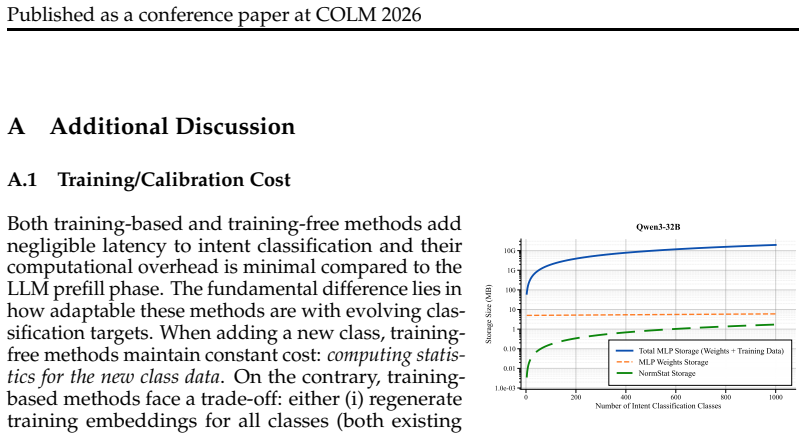
- Adding or removing an intent class costs only a new baseline computation for training-free methods, whereas MLP heads require retraining or caching all training embeddings, whose storage grows with the class count.
- Useful classification can be done from the first 12 layers of a 28-layer model, so intent routing could be decided before the full forward pass completes.
Where Pith is reading between the lines
- The adversarial robustness gap suggests trained heads fit the surface distribution of the calibration data; a natural test is whether augmenting training data with adversarial examples closes the gap or whether the gap is structural to discriminative heads.
- The directional-vs-radial theory may generalize to any taxonomy: classes that differ mostly by direction (like programming languages) will systematically favor coordinate-wise statistics, so method choice could be guided by a quick measure of class separation type.
- The mixed-intent calibration results imply these training-free statistics can act as an uncertainty signal for selective routing, e.g., escalating to a stronger LLM when the predicted probability is near chance.
- The robustness results are bounded by the paper's synthetic rephrasing scheme; real human-authored adversarial prompts may obey different surface cues, so the claimed advantage should be re-tested on naturally occurring noisy traffic before deployment.
Editorial analysis
A structured set of objections, weighed in public.
Referee Report
Summary. The paper compares two families of lightweight intent classifiers operating on LLM internal features: training-free statistics (VecStat, NormStat) and trained heads (Avg-MLP, Tail-MLP, Avg-Linear). It proposes a Gaussian-proxy theory predicting when radial statistics suffice (isotropic-scale regime) and when directional statistics are necessary (directional regime), with a corresponding calibration sample-complexity result. Experiments across seven Qwen/Llama models and four tasks show that coarse tasks are mostly saturated, training-based heads are more accurate on fine-grained math-subfield classification, NormStat fails on programming-language identification as the theory predicts, and training-free methods appear more stable under mixed-intent and adversarially rephrased prompts. The authors also release code and datasets.
Significance. If the central trade-off map is correct, the paper provides a practically useful comparison for LLM routing: extremely cheap prefill statistics can match trained heads on coarse tasks, while trained heads remain preferable for fine-grained distinctions, with the robustness advantage of training-free methods relevant to distribution shift. The theoretical results are simple but nontrivial and are explicitly validated by the Task 2 failure mode of NormStat. The availability of code, datasets, and detailed per-model/per-class tables strengthens the empirical contribution. However, the robustness and mixed-intent claims are currently broader than the evidence supports, and the in-sample temperature calibration weakens the uncertainty comparison.
major comments (3)
- [§3.4, Table 5, Appendix E.4] The central claim that training-free methods are 'generally more robust to ... adversarial prompts' (Abstract) rests on a single synthetic attack family: MATH500 rewritten by GPT-4o with the three templates in Table 16. Appendix E.4 itself states that this dataset 'is intended as a controlled stress test rather than simulating typical human-authored adversarial prompts or real production failures.' The evidence also does not support the unqualified wording: on the Hard tier all methods fall to 0.00 (Table 5; Table 14), and for Qwen3-1.7B-Base nearly all methods are near zero on Easy. The advantage is limited to Easy/Medium tiers, to certain training-free variants, and to aligned models. I recommend replacing 'generally more robust' with a precise statement about robustness to this code-camouflage stress test and adding a caution that other attack families may affect training-free statist
- [§3.3, Appendix E.3, Table 4] The mixed-intent uncertainty comparison is evaluated in-sample. Appendix E.3 shows that the temperature T is fitted by least squares on the same five mix-ratio points r_i that are later used to compute RMSE (\hat T = argmin \sum_i (\sigma(\Delta s_i/T) - r_i)^2). Thus Table 4 and Fig. 3 report training error of a one-parameter calibrator, not out-of-sample calibration quality. This is the load-bearing evidence for the claim that VecStat provides the most accurate uncertainty estimates. Please add a held-out evaluation (e.g., leave-one-ratio-out or a separate calibration split) or report uncalibrated score-accuracy curves; otherwise the uncertainty claim is not established.
- [Abstract, §3.2, Table 2 / Table 10] The first abstract claim that 'both training-free and training-based methods saturate easy benchmarks' is contradicted by the tables. On Task 1 out-of-distribution code, NormStat:KL reaches only 10.37% on HumanEval for Qwen3-8B and 24.59% for Qwen3-32B (Table 2; full results in Table 10). For Qwen3-1.7B-Base, VecStat:KL is 9.06% on MATH500. The paper already acknowledges OOD variation in §3.2, but the abstract and introduction should be qualified to 'most methods on in-distribution coarse tasks' or 'VecStat and trained methods,' not both paradigms.
minor comments (4)
- [Appendix C.3] Theorem numbering is inconsistent: the main-text Theorem 2 (Calibration cost) is restated as 'Theorem 3' at the beginning of Appendix C.3. Renumber for consistency.
- [Eq. (2) and Theorem 2] Eq. (2) defines Snorm with a 1/sqrt(d) normalization, but Theorem 2 defines q = E[||y_1||] and then \hat q = N^{-1} \sum d^{-1/2}||y_i||. Define q consistently as the normalized norm to avoid confusion.
- [Algorithm 1] Algorithm 1 introduces temperature \tau with only the hint '\tau \approx O(\bar d)'. State explicitly how \tau is chosen in production and in experiments, especially since the mixed-intent analysis fits it per method.
- [Table 5] The GPT-5-Nano and GPT-5 rows in Table 5 are single-reference sanity checks with no standard deviations or repeated-run description. Clarify this in the caption so readers do not compare them on equal statistical footing with the other rows.
Circularity Check
No significant circularity; theoretical analysis is self-contained and empirical claims are benchmarked on held-out external data.
full rationale
The paper's central comparison is empirical: VecStat/NormStat are defined as statistics of prefill activations, and their accuracy/robustness is evaluated on held-out external benchmarks (MMLU, GSM8K, MATH500, Magicoder, HumanEval, Aya, Competition Math) with disjoint calibration/test splits. The theoretical results (Theorems 1 and 2) are self-contained Gaussian-proxy statements with proofs in Appendix C; no fitted constant enters the derivations. The adversarial robustness claim rests on a GPT-4o-generated rewrite family, but Appendix E.4 explicitly disclaims that it is a controlled stress test rather than a simulation of real adversarial prompts—an external-validity caveat, not circularity. The mixed-intent uncertainty analysis fits one scalar temperature on the same five mix-ratio points before computing RMSE; this is in-sample calibration (a mild statistical overfitting concern), but the score differences being calibrated come from the methods, so the RMSE ranking is not forced by construction. The only self-citation (Hayou et al. 2025, cited as motivation that activations capture data signal) is non-load-bearing, as the paper also cites independent work on linear probes, sparse autoencoders, and activation steering and provides its own benchmarks. No derivation reduces to its input by construction.
Axiom & Free-Parameter Ledger
free parameters (2)
- Temperature tau in probability conversion =
Fitted per method/model/prompt-order via least squares; values not reported
- MLP hidden width h =
Not reported
axioms (4)
- domain assumption Token features y_t are treated as i.i.d. Gaussian when deriving VecStat/NormStat scoring rules and Theorems 1-2.
- domain assumption Class-conditional activation statistics estimated on calibration data transfer to test prompts, including out-of-distribution sets (MATH500, HumanEval).
- domain assumption GPT-4o rewrites preserve mathematical facts and reasoning while injecting code cues in the adversarial dataset.
- domain assumption Linear projections Wz of hidden states capture intent-relevant information.
read the original abstract
Intent classification in Large Language Models (LLMs) involves categorizing user prompts into predefined classes. For instance, given a user prompt, the system must determine whether it primarily concerns mathematics, coding, or general text processing. Such classification enables routing prompts to specialized models optimized for specific domains, improving both accuracy and computational efficiency. In this work, we conduct a systematic study comparing training-free vs training-based approaches for intent classification. For this purpose, we consider two lightweight, training-free methods based on statistics of internal representations and compare them against MLP classifiers and linear probes. Our comprehensive empirical evaluation reveals that 1) Both training-free and training-based methods saturate easy benchmarks (mathematics vs. coding vs. natural language), 2) Training-based classifiers have an advantage on harder classification tasks (e.g. Java vs Python), and 3) Training-free methods are generally more robust to mixed-intent and adversarial prompts.
Figures




Reference graph
Works this paper leans on
-
[1]
2025 , eprint=
PLoP: Precise LoRA Placement for Efficient Finetuning of Large Models , author=. 2025 , eprint=
2025
-
[2]
2019 International Conference on Asian Language Processing (IALP) , pages=
Using convolutional neural network with BERT for intent determination , author=. 2019 International Conference on Asian Language Processing (IALP) , pages=. 2019 , organization=
2019
-
[3]
International conference on web search and data mining, workshop on query understanding , volume=
Query intent detection using convolutional neural networks , author=. International conference on web search and data mining, workshop on query understanding , volume=
-
[4]
ACM computing surveys , volume=
Pre-train, prompt, and predict: A systematic survey of prompting methods in natural language processing , author=. ACM computing surveys , volume=. 2023 , publisher=
2023
-
[5]
Proceedings of the 25th Annual Meeting of the Special Interest Group on Discourse and Dialogue , pages=
Exploring the Use of Natural Language Descriptions of Intents for Large Language Models in Zero-shot Intent Classification , author=. Proceedings of the 25th Annual Meeting of the Special Interest Group on Discourse and Dialogue , pages=
-
[6]
International conference on machine learning , pages=
On calibration of modern neural networks , author=. International conference on machine learning , pages=. 2017 , organization=
2017
-
[7]
2023 6th international conference on advanced communication technologies and networking (CommNet) , pages=
Pre-trained models for intent classification in chatbot: Comparative study and critical analysis , author=. 2023 6th international conference on advanced communication technologies and networking (CommNet) , pages=. 2023 , organization=
2023
-
[8]
arXiv preprint arXiv:2410.01627 , year=
Intent detection in the age of llms , author=. arXiv preprint arXiv:2410.01627 , year=
-
[9]
arXiv preprint arXiv:2303.08112 , year=
Eliciting latent predictions from transformers with the tuned lens , author=. arXiv preprint arXiv:2303.08112 , year=
-
[10]
arXiv e-prints , pages=
Activation addition: Steering language models without optimization , author=. arXiv e-prints , pages=
-
[11]
arXiv preprint arXiv:2312.06681 , year=
Steering llama 2 via contrastive activation addition , author=. arXiv preprint arXiv:2312.06681 , year=
-
[12]
arXiv preprint arXiv:2502.13329 , year=
Language models can predict their own behavior , author=. arXiv preprint arXiv:2502.13329 , year=
-
[13]
arXiv preprint arXiv:2504.05419 , year=
Reasoning Models Know When They're Right: Probing Hidden States for Self-Verification , author=. arXiv preprint arXiv:2504.05419 , year=
-
[14]
, author=
Multi-domain joint semantic frame parsing using bi-directional rnn-lstm. , author=. Interspeech , pages=
-
[15]
Proceedings of the 2018 Conference of the North American Chapter of the Association for Computational Linguistics: Human Language Technologies, Volume 2 (Short Papers) , pages=
Slot-gated modeling for joint slot filling and intent prediction , author=. Proceedings of the 2018 Conference of the North American Chapter of the Association for Computational Linguistics: Human Language Technologies, Volume 2 (Short Papers) , pages=
2018
-
[16]
arXiv preprint arXiv:1902.10909 , year=
Bert for joint intent classification and slot filling , author=. arXiv preprint arXiv:1902.10909 , year=
Pith/arXiv arXiv 1902
-
[17]
Joint multiple intent detection and slot labeling for goal-oriented dialog , author=
-
[18]
arXiv preprint arXiv:2004.10087 , year=
AGIF: An adaptive graph-interactive framework for joint multiple intent detection and slot filling , author=. arXiv preprint arXiv:2004.10087 , year=
Pith/arXiv arXiv 2004
-
[19]
Proceedings of the 2022 conference on empirical methods in natural language processing , pages=
Enhancing joint multiple intent detection and slot filling with global intent-slot co-occurrence , author=. Proceedings of the 2022 conference on empirical methods in natural language processing , pages=
2022
-
[20]
An evaluation dataset for intent classification and out-of-scope prediction , author=. Proceedings of the 2019 Conference on Empirical Methods in Natural Language Processing and the 9th International Joint Conference on Natural Language Processing (EMNLP-IJCNLP) , pages=
2019
-
[21]
arXiv preprint arXiv:2003.04807 , year=
Efficient intent detection with dual sentence encoders , author=. arXiv preprint arXiv:2003.04807 , year=
Pith/arXiv arXiv 2003
-
[22]
arXiv preprint arXiv:1805.10190 , year=
Snips voice platform: an embedded spoken language understanding system for private-by-design voice interfaces , author=. arXiv preprint arXiv:1805.10190 , year=
-
[23]
Proceedings of the Massively Multilingual Natural Language Understanding Workshop (MMNLU-22) , pages=
Massively multilingual natural language understanding 2022 (MMNLU-22) workshop and competition , author=. Proceedings of the Massively Multilingual Natural Language Understanding Workshop (MMNLU-22) , pages=
2022
-
[24]
arXiv preprint arXiv:2104.05763 , year=
Few-shot intent classification and slot filling with retrieved examples , author=. arXiv preprint arXiv:2104.05763 , year=
-
[25]
Applied Artificial Intelligence , volume=
Enhancing intent classifier training with large language model-generated data , author=. Applied Artificial Intelligence , volume=. 2024 , publisher=
2024
-
[26]
2024 9th International Conference on Information Technology Research (ICITR) , pages=
Large Language Model-Based Student Intent Classification for Intelligent Tutoring Systems , author=. 2024 9th International Conference on Information Technology Research (ICITR) , pages=. 2024 , organization=
2024
-
[27]
arXiv preprint arXiv:2502.15096 , year=
Detecting Student Intent for Chat-Based Intelligent Tutoring Systems , author=. arXiv preprint arXiv:2502.15096 , year=
-
[28]
arXiv preprint arXiv:2504.16871 , year=
Exploring How LLMs Capture and Represent Domain-Specific Knowledge , author=. arXiv preprint arXiv:2504.16871 , year=
-
[29]
arXiv preprint arXiv:2403.05640 , year=
Generating hard-negative out-of-scope data with ChatGPT for intent classification , author=. arXiv preprint arXiv:2403.05640 , year=
-
[30]
GPT-5 System Card , author=
-
[31]
ICLR , year =
Sparse Autoencoders Find Highly Interpretable Features in Language Models , author =. ICLR , year =
-
[32]
2024 , url =
Scaling and Evaluating Sparse Autoencoders , author =. 2024 , url =
2024
-
[33]
Advances in neural information processing systems , volume=
Retrieval-augmented generation for knowledge-intensive nlp tasks , author=. Advances in neural information processing systems , volume=
-
[34]
arXiv preprint arXiv:2004.09936 , year=
Diet: Lightweight language understanding for dialogue systems , author=. arXiv preprint arXiv:2004.09936 , year=
Pith/arXiv arXiv 2004
-
[35]
arXiv preprint arXiv:1709.08716 , year=
Doc: Deep open classification of text documents , author=. arXiv preprint arXiv:1709.08716 , year=
-
[36]
arXiv preprint arXiv:2209.10652 , year=
Toy models of superposition , author=. arXiv preprint arXiv:2209.10652 , year=
-
[37]
arXiv preprint arXiv:2310.05424 , year=
Fast and robust early-exiting framework for autoregressive language models with synchronized parallel decoding , author=. arXiv preprint arXiv:2310.05424 , year=
-
[38]
Advances in Neural Information Processing Systems , volume=
Confident adaptive language modeling , author=. Advances in Neural Information Processing Systems , volume=
-
[39]
arXiv preprint arXiv:2305.07157 , year=
Exploring zero and few-shot techniques for intent classification , author=. arXiv preprint arXiv:2305.07157 , year=
-
[40]
Advances in Neural Information Processing Systems , volume=
Few-shot parameter-efficient fine-tuning is better and cheaper than in-context learning , author=. Advances in Neural Information Processing Systems , volume=
-
[41]
arXiv preprint arXiv:2312.01044 , year=
Large language models are zero-shot text classifiers , author=. arXiv preprint arXiv:2312.01044 , year=
-
[42]
arXiv preprint arXiv:2204.01959 , year=
Data augmentation for intent classification with off-the-shelf large language models , author=. arXiv preprint arXiv:2204.01959 , year=
-
[43]
Proceedings of the 31st International Conference on Computational Linguistics: Industry Track , pages=
Fine-Tuning Medium-Scale LLMs for Joint Intent Classification and Slot Filling: A Data-Efficient and Cost-Effective Solution for SMEs , author=. Proceedings of the 31st International Conference on Computational Linguistics: Industry Track , pages=
-
[44]
Proceedings of the 31st International Conference on Computational Linguistics , pages=
Midlm: Multi-intent detection with bidirectional large language models , author=. Proceedings of the 31st International Conference on Computational Linguistics , pages=
-
[45]
2024 , eprint=
Paraphrase and Aggregate with Large Language Models for Minimizing Intent Classification Errors , author=. 2024 , eprint=
2024
-
[46]
arXiv preprint arXiv:2411.10670 , year=
Intentgpt: Few-shot intent discovery with large language models , author=. arXiv preprint arXiv:2411.10670 , year=
-
[47]
Advances in Neural Information Processing Systems , volume=
Kvquant: Towards 10 million context length llm inference with kv cache quantization , author=. Advances in Neural Information Processing Systems , volume=
-
[48]
arXiv preprint arXiv:1911.02150 , year=
Fast transformer decoding: One write-head is all you need , author=. arXiv preprint arXiv:1911.02150 , year=
Pith/arXiv arXiv 1911
-
[49]
arXiv preprint arXiv:2305.13245 , year=
Gqa: Training generalized multi-query transformer models from multi-head checkpoints , author=. arXiv preprint arXiv:2305.13245 , year=
-
[50]
arXiv preprint arXiv:2407.21118 , year=
Palu: Compressing kv-cache with low-rank projection , author=. arXiv preprint arXiv:2407.21118 , year=
-
[51]
arXiv preprint arXiv:2503.16163 , year=
SpeCache: Speculative Key-Value Caching for Efficient Generation of LLMs , author=. arXiv preprint arXiv:2503.16163 , year=
-
[52]
Selected works of EL Lehmann , pages=
Completeness, similar regions, and unbiased estimation-Part I , author=. Selected works of EL Lehmann , pages=. 2011 , publisher=
2011
-
[53]
1998 , publisher=
Theory of point estimation , author=. 1998 , publisher=
1998
-
[54]
arXiv preprint arXiv:2409.02727 , year=
Pooling and attention: What are effective designs for llm-based embedding models? , author=. arXiv preprint arXiv:2409.02727 , year=
-
[55]
2024 , cdate=
Liang Wang and Nan Yang and Xiaolong Huang and Linjun Yang and Rangan Majumder and Furu Wei , title=. 2024 , cdate=
2024
-
[56]
Salesforce AI Research Blog , volume=
Sfrembedding-mistral: enhance text retrieval with transfer learning , author=. Salesforce AI Research Blog , volume=
-
[57]
arXiv preprint arXiv:2201.10005 , year=
Text and code embeddings by contrastive pre-training , author=. arXiv preprint arXiv:2201.10005 , year=
-
[58]
International Conference on Learning Representations , volume=
Generative representational instruction tuning , author=. International Conference on Learning Representations , volume=
-
[59]
arXiv preprint arXiv:2404.05961 , year=
Llm2vec: Large language models are secretly powerful text encoders , author=. arXiv preprint arXiv:2404.05961 , year=
-
[60]
arXiv preprint arXiv:2202.08904 , year=
Sgpt: Gpt sentence embeddings for semantic search , author=. arXiv preprint arXiv:2202.08904 , year=
-
[61]
International Conference on Learning Representations , volume=
Nv-embed: Improved techniques for training llms as generalist embedding models , author=. International Conference on Learning Representations , volume=
-
[62]
arXiv preprint arXiv:2402.15449 , year=
Repetition improves language model embeddings , author=. arXiv preprint arXiv:2402.15449 , year=
-
[63]
arXiv preprint arXiv:1705.00652 , year=
Efficient natural language response suggestion for smart reply , author=. arXiv preprint arXiv:1705.00652 , year=
-
[64]
Proceedings of the 47th International ACM SIGIR Conference on Research and Development in Information Retrieval , pages=
Fine-tuning llama for multi-stage text retrieval , author=. Proceedings of the 47th International ACM SIGIR Conference on Research and Development in Information Retrieval , pages=
-
[65]
Advances in neural information processing systems , volume=
Chain-of-thought prompting elicits reasoning in large language models , author=. Advances in neural information processing systems , volume=
-
[66]
Choi and Junyoung Chung and Nate Kushman and Julian Schrittwieser and R
Yujia Li and David H. Choi and Junyoung Chung and Nate Kushman and Julian Schrittwieser and R. Competition-Level Code Generation with. Science , volume=. 2022 , publisher=
2022
-
[67]
arXiv preprint arXiv:2401.14196 , year=
DeepSeek-Coder: When the Large Language Model Meets Programming--The Rise of Code Intelligence , author=. arXiv preprint arXiv:2401.14196 , year=
-
[68]
arXiv preprint arXiv:2406.11931 , year=
Deepseek-coder-v2: Breaking the barrier of closed-source models in code intelligence , author=. arXiv preprint arXiv:2406.11931 , year=
-
[69]
Advances in neural information processing systems , volume=
Tree of thoughts: Deliberate problem solving with large language models , author=. Advances in neural information processing systems , volume=
-
[70]
International Conference on Machine Learning , pages=
Pal: Program-aided language models , author=. International Conference on Machine Learning , pages=. 2023 , organization=
2023
-
[71]
OpenAI blog , volume=
Language models are unsupervised multitask learners , author=. OpenAI blog , volume=
-
[72]
Journal of machine learning research , volume=
Exploring the limits of transfer learning with a unified text-to-text transformer , author=. Journal of machine learning research , volume=
-
[73]
arXiv preprint arXiv:1712.05181 , year=
Rasa: Open source language understanding and dialogue management , author=. arXiv preprint arXiv:1712.05181 , year=
-
[74]
arXiv preprint arXiv:2411.12307 , year=
Balancing Accuracy and Efficiency in Multi-Turn Intent Classification for LLM-Powered Dialog Systems in Production , author=. arXiv preprint arXiv:2411.12307 , year=
-
[75]
Intelligent Systems Conference , pages=
Llms will always hallucinate, and we need to live with this , author=. Intelligent Systems Conference , pages=. 2025 , organization=
2025
-
[76]
arXiv preprint arXiv:2302.04023 , year=
A multitask, multilingual, multimodal evaluation of chatgpt on reasoning, hallucination, and interactivity , author=. arXiv preprint arXiv:2302.04023 , year=
-
[77]
arXiv preprint arXiv:2505.09388 , year=
Qwen3 technical report , author=. arXiv preprint arXiv:2505.09388 , year=
-
[78]
arXiv e-prints , pages=
The llama 3 herd of models , author=. arXiv e-prints , pages=
-
[79]
Proceedings of the International Conference on Learning Representations (ICLR) , year=
Measuring Massive Multitask Language Understanding , author=. Proceedings of the International Conference on Learning Representations (ICLR) , year=
-
[80]
arXiv preprint arXiv:2110.14168 , year=
Training Verifiers to Solve Math Word Problems , author=. arXiv preprint arXiv:2110.14168 , year=
discussion (0)
Sign in with ORCID, Apple, or X to comment. Anyone can read and Pith papers without signing in.