REVIEW 3 major objections 3 minor 210 references
Unravelling Mass Transfer in Algols from Surface Abundances. I. Z Vulpeculae
T0 review · 3 major / 3 minor · reviewed 2026-08-05 · deepseek-v4-flash
Pith's one-line read Using the donor's surface C/N ratio as a depth gauge, the paper identifies Z Vul as a nearly conservative Case A system where mass transfer stripped only the outer envelope, not the CNO core.
desk verdict The observational core is first-rate, but the abundance-based evolutionary claim doesn't hold up against the paper's own grid. read the letter →
The pith
A machine-rendered reading of the paper's core claim, the machinery that carries it, and where it could break.
The reading
What carries the argument
The central object is the $C/N$ ratio at the donor's surface, used as a depth gauge along the stellar interior abundance profile. The paper couples it with the interior $C/N$ and He/H mass-coordinate profiles computed by the STARS binary evolution code, so the measured ratio maps onto a specific stripped mass coordinate. On the gainer, the same framework invokes thermohaline mixing (Kippenhahn et al. 1980) to dilute the accreted CNO-processed material and explain the observed mild nitrogen enrichment.
What would settle it
Compute the STARS grid at the measured donor mass ($2.44\pm0.03\,M_\odot$) with the same physics; if no model in the allowed stripping-depth range of about $0.2\,M_\odot$ produces a surface $C/N$ above $\sim0.8$, the claim of a partially stripped envelope fails. Equivalently, an independent determination of the donor's $C/N$ from ultraviolet lines that yields a ratio below $\sim1.5$ at the same atmospheric parameters would contradict the spectroscopy.
Extended reading notes
Core claim
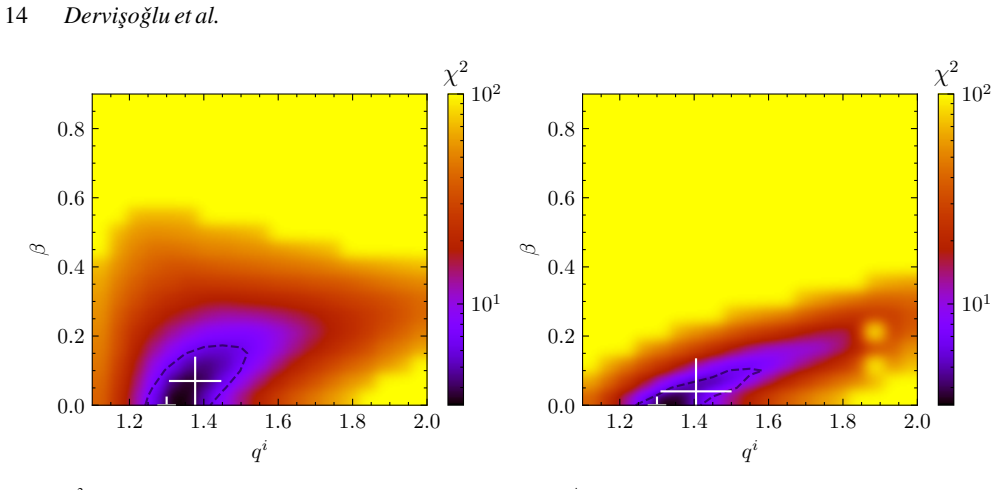
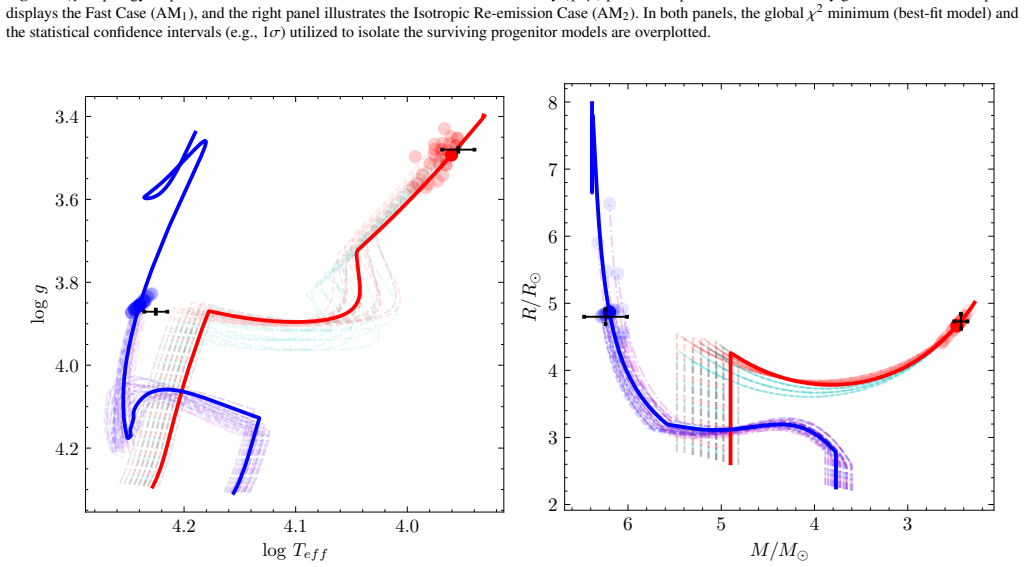
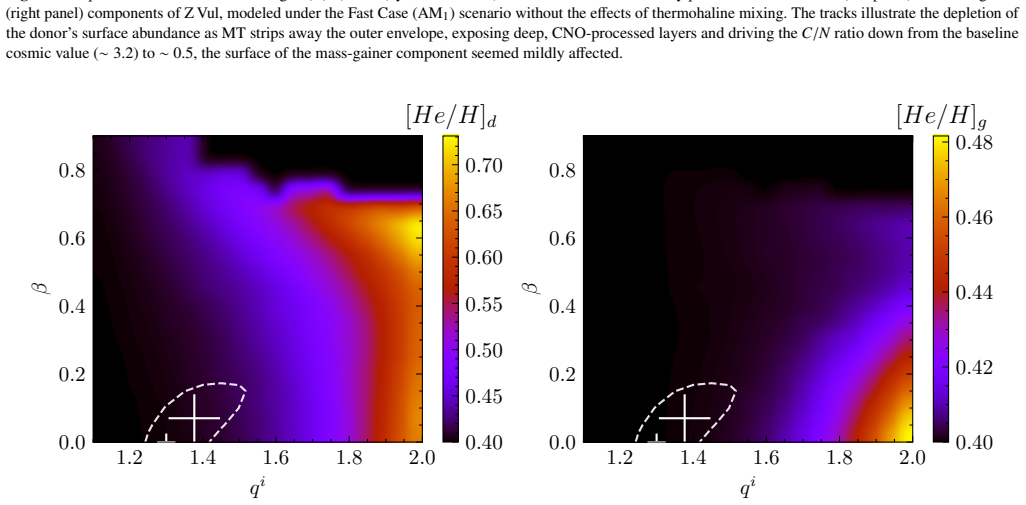
The paper establishes that Z Vul's donor, at $2.44\,M_\odot$, has surface $C/N = 2.14^{+0.55}_{-0.44}$, contradicting the classic deep-inversion expectation for stripped Algol donors. STARS evolutionary models fit to the observed masses, radii, and temperatures favor nearly conservative ($\beta \approx 0.04$–$0.07$) Case A transfer, with initial masses $\approx 5.13$ and $\approx 3.73\,M_\odot$ and $P_i \approx 1.37$ d. The models put the donor surface in an intermediate layer of incomplete CNO processing: predicted $C/N \approx 0.39$, and a $0.2\,M_\odot$ shallower strip would yield the observed value near 2. Helium-to-hydrogen stays at $0.408$, its unprocessed value, which the paper reads
Load-bearing premise
The conclusion rests on the STARS model's $C/N$ abundance profile being accurate enough that a $0.2\,M_\odot$ shift in the stripped mass—from the measured donor mass $2.44\,M_\odot$ to a slightly larger value—reconciles the predicted donor $C/N$ of $0.39$ with the observed $2.14$; none of the reported grid models at the measured mass reaches $C/N$ above $0.79$.
Editorial extensions
If this is right
- Z Vul is identified as a nearly conservative Case A system, $\beta \approx 0.04$–$0.07$, implying most donor mass remained in the binary.
- The donor's $C/N \approx 2.14$ pinpoints its stripped surface in the incomplete-CNO zone, so the depth of stripping—not just its existence—is now observable in Algols.
- The gainer's $C/N \approx 1.70$ after thermohaline mixing shows that accreted abundances are diluted; gainer abundances must be read through a mixing model before use as tracers.
- An unaltered He/H ratio ($0.408$) on the donor provides a clean diagnostic separating envelope-stripped from core-exposed donors.
- The method—abundance determination from disentangled spectra plus an evolutionary grid—is transferable to the planned series on other Algols, giving a population-level handle on mass-transfer efficiency.
Reading between the lines
- If partial stripping is common among Algol donors, single-star surveys that see nitrogen enhancement with normal helium may be misreading past mass transfer as intrinsic chemical peculiarity; Z Vul provides a donor caught in that intermediate state.
- The inferred $\beta \approx 0.04$–$0.07$ is tied to the adopted CNO profile; a revised $^{12}\mathrm{C}(p,\gamma)^{14}\mathrm{N}$ rate or additional mixing in the donor would change the stripping-depth calibration and shift the derived efficiency.
- The same $C/N$-versus-depth mapping could constrain Case A transfer in massive binaries that later merge as black holes, where the final donor's surface abundances are inaccessible but the gainer's pollution pattern after thermohaline mixing may encode the transfer history.
Editorial analysis
A structured set of objections, weighed in public.
Referee Report
Summary. The paper presents a comprehensive multi-wavelength analysis of the Algol-type binary Z Vul: TESS and ground-based photometry, new high-resolution HERMES spectroscopy, light-curve modelling with spot/attenuation prescriptions, spectral disentangling, iterative atmospheric-parameter and NLTE abundance determinations, and a large grid of Cambridge STARS binary evolutionary models under two angular-momentum-loss regimes (AM1 Fast Case, AM2 Isotropic Re-emission). The authors derive absolute parameters (M1=6.26±0.08 Msun, M2=2.44±0.03 Msun) and abundances for both components, finding a donor C/N abundance ratio of about 2.14 and a gainer ratio of about 1.70. The central interpretive claim is that the absence of a deep C/N inversion in the donor, together with the He/H ratio, indicates nearly conservative (β≈0.04–0.07) Case A mass transfer that stripped the donor only to intermediate layers, not reaching the fully CNO-processed core.
Significance. If the evolutionary interpretation were quantitatively supported, the paper would be an important demonstration that surface C/N ratios in Algol donors can trace partial stripping and constrain the efficiency of mass transfer. The observational component is strong: the light-curve analysis, spectral disentangling, and detailed NLTE abundance work are carried out carefully and produce valuable absolute parameters and abundances for a relatively little-studied Algol. However, the central conclusion is not supported by the model grid. All surviving STARS models in Table E1 predict donor C/N below about 0.8, while the observed value is 2.14+0.55/−0.44, a discrepancy of roughly 0.7 dex and several sigma. The only proposed reconciliation—a 0.2 Msun shallower stripping depth—is ad hoc and directly conflicts with the measured donor mass. The abundance test therefore fails, and the paper's headline claim that CNO abundances confirm near-conservative Case A mass transfer is not established.
major comments (3)
- [Section 5, Fig. 8 and Table E1] The grid's best-fit and all surviving models predict donor C/N values far below the observed value. For AM1 the best-fit gives [C/N]d = 0.39±0.12, and for AM2 [C/N]d = 0.38±0.19; the maximum among all listed surviving models in Table E1 is [C/N]d = 0.79. The observed donor C/N is 2.14+0.55/−0.44, which is about 0.7 dex higher. This is a multi-sigma discrepancy and directly contradicts the abstract's statement that 'Constraints from the He and CNO abundances indicate that Z Vul underwent an episode of nearly conservative mass transfer.' The abundances do not provide a constraint in the direction claimed.
- [Section 6, final paragraph] The only bridge between the predicted and observed donor C/N is the statement that 'if the donor had been stripped of just 0.2 Msun less mass, the expected surface C/N would perfectly match our spectroscopic value of 2.' This reconciliation is not part of the computed grid and is quantitatively inconsistent with the measured donor mass. A donor stripped by 0.2 Msun less would have a final mass of about 2.64 Msun, compared with the measured M2=2.44±0.03 Msun, a discrepancy of roughly 7σ. The required C/N gradient—a change by a factor of about 5.5 over 0.2 Msun—is not demonstrated from the STARS profiles, and no such model appears in Table E1. The proposed offset is therefore an unsupported, post-hoc adjustment.
- [Section 5, Eq. (5)] The χ2 statistic used to identify the best-fitting and surviving models is defined only on masses, radii, and effective temperatures. The C/N and He/H abundances are not included in the fit; they are used as an independent post-hoc test. That is a reasonable procedure, but the test fails for the donor: the predicted and observed C/N values are irreconcilable within the grid and the adopted parameters. The paper should either explicitly acknowledge that the abundance test is not reproduced, or refit the evolution including C/N (and He/H) in the χ2 to demonstrate that any part of the parameter space can simultaneously match all constraints.
minor comments (3)
- [Sections 5 and 6] The notation [C/N] is used inconsistently. In the text and figures, values such as [C/N]d = 0.39 and observed C/N = 2.14 are both referred to as 'C/N ratio (by mass fraction)', but the bracket notation usually denotes a logarithmic abundance ratio relative to a standard. Please define the notation explicitly and use it consistently; otherwise the numbers can be misread as dex values.
- [Figure 10 caption] The caption states 'current observed state of the Z Vul secondary (M2≈2.48 M⊙ at log t≈7)', while Table 2 gives M2=2.44±0.03 M⊙. Please harmonize the value used for the observed donor mass.
- [Section 5] Two consecutive paragraphs discuss thermohaline mixing and the gainer C/N prediction with nearly identical wording ('This process occurs when nucleosynthetically altered material...' and 'The calculated surface yields without thermohaline mixing...'). The duplication should be removed and the discussion consolidated.
Circularity Check
No significant circularity: the near-conservative beta is chi2-fitted to observed M, R, Teff; the C/N ratio is used as an independent (though discrepant) check, and the self-citations are methodological and corroborated by an independent AM-loss prescription.
full rationale
The central claim that Z Vul underwent a nearly conservative Case A mass transfer is derived from a chi-squared fit of a STARS evolutionary grid to the observed masses, radii, and effective temperatures (Eq. 5), with initial mass ratio and mass-transfer efficiency as free parameters. The C/N abundance ratio is not used in this fit; it is presented as an independent test. Equations (2)-(4) for the initial total mass and period are algebraic consequences of the definitions of beta and of the chosen specific angular-momentum-loss modes, not self-referential reductions. The paper does rely on its own previous formalism (Dervisoglu et al. 2018) for one AM-loss prescription, but the same conclusion is reproduced with the independent AM2 prescription from de Mink et al. (2007), so the self-citation is not load-bearing. The discrepancy between the grid-predicted donor C/N (~0.39) and the observed value (~2.14) is addressed by an ad hoc hypothesis in Section 6 that 0.2 solar masses less stripping would match the observation. This is a post-hoc adjustment and a correctness/robustness concern rather than a circular step, because the observed abundances were not used to define or select the best-fitting model. No step in the derivation reduces by construction to its own inputs or to an unverified self-citation chain.
Assumptions & free parameters
free parameters (6)
- mass transfer efficiency beta =
0.07±0.06 (AM1), 0.04±0.04 (AM2)
- initial mass ratio qi =
1.37±0.07 (AM1), 1.41±0.10 (AM2)
- spot parameters (8 values) =
e.g., fT,p=0.85±0.05, fT,s=0.86±0.05; spot radii about 30 and 65 degrees
- light-fraction linear coefficients lf_pa, lf_pb, lf_sa, lf_sb =
Table 3, Run 4
- atmospheric parameters of both components =
Teff1=16760 K, Teff2=9690 K; logg1=3.88, logg2=3.45; [M/H]=0.00; vsini 111/95 km/s
- ad hoc stripping-depth offset =
0.2 Msun
assumptions (6)
- standard math Orbital AM-loss formulas (Eqs. 2-4) from Giuricin & Mardirossian (1981) and Bhattacharya & van den Heuvel (1991) correctly describe non-conservative mass transfer.
- domain assumption Fast and Isotropic Re-emission AM-loss modes bracket the unobserved rapid mass-transfer phase.
- domain assumption STARS code's CNO abundance profile, semiconvection, and diffusion at the exposed layers are accurate enough for 0.2 Msun-level strip-depth comparisons.
- domain assumption The fainter secondary's LTE abundance analysis yields a C/N ratio unaffected by renormalization and systematic errors.
- domain assumption Z Vul's initial composition is represented by the Nieva & Przybilla (2012) cosmic abundance standard.
- standard math Spectral line profiles do not vary except by dilution during out-of-eclipse phases.
invented entities (1)
-
cool photospheric spots on both components
Cite this review
Pith. "Pith review of Unravelling Mass Transfer in Algols from Surface Abundances. I. Z Vulpeculae." pith.science (2026). https://pith.science/paper/LRUWK4HQ
@misc{pith2026260803348,
  author       = {Pith},
  title        = {Pith review of: Unravelling Mass Transfer in Algols from Surface Abundances. I. Z Vulpeculae},
  year         = {2026},
  howpublished = {\url{https://pith.science/paper/LRUWK4HQ}},
  note         = {Machine review of arXiv:2608.03348}
}
read the original abstract
The photospheric abundance pattern of the components is a sensitive probe of mass and angular momentum transfer in Algols. With the aim to trace the evolutionary history and disclosed efficiency of mass transfer in Algols we collected new high-resolution spectra for about a dozen Algols with the {\sc hermes} spectrograph at the Mercator Telescope on La Palma, Canary Islands. In the present paper, which is the first in the series, we present the results of a comprehensive analysis of Z Vul, a hot Algol-type system. We derived the absolute stellar quantities and elemental abundances for the components. The carbon-to-nitrogen (C/N) ratio is the most sensitive tracer of thermonuclear processing and mass transfer. It is found to be within expected value for gainer but donor lacks the severe C/N inversion traditionally expected for a deeply stripped star. An extensive grid of over three million evolutionary models was calculated with the Cambridge \texttt{STARS} code which allows determination of the best-fitting and all surviving models. Constraints from the He and CNO abundances indicate that Z Vul underwent an episode of nearly conservative mass transfer during the Main Sequence life-time of the originally more massive component (Case A). Our detailed chemical tagging confirms that the surface abundances of the mass-losing component represent the delicately stripped outer layers still not reaching the CNO-rich core. This underscores the need of coupling high-resolution spectroscopic abundances with interior stellar profiles to accurately reconstruct the evolutionary history of interacting binaries.
Figures


Figures from the paper (6 more)



Reference graph
Works this paper leans on
-
[1]
Helium enrichment in O-type stars as a tracer of past binary interaction
The IACOB project: XIII. Helium enrichment in O-type stars as a tracer of past binary interaction. , keywords =. doi:10.1051/0004-6361/202452622 , archivePrefix =. 2412.14107 , primaryClass =
-
[2]
The IACOB project: XVII. Nitrogen abundances in Galactic O-type stars: further hints for separating binary-interaction products from effectively single stars. arXiv e-prints , keywords =. doi:10.48550/arXiv.2604.26606 , archivePrefix =. 2604.26606 , primaryClass =
-
[3]
The IACOB project: XVI. Surface helium abundances in Galactic O-type stars: indications for identifying binary interaction products. arXiv e-prints , keywords =. doi:10.48550/arXiv.2601.20698 , archivePrefix =. 2601.20698 , primaryClass =
-
[4]
5-m Kazan University Telescope at the Turkish National Observatory
High-Resolution Coud \'e -Echelle Spectrometer for the 1. 5-m Kazan University Telescope at the Turkish National Observatory. The Carbon Star Phenomenon , year = 2000, editor =
2000
-
[5]
Spin-orbit alignment for the circumbinary planet host EBLM J0608-59 A/TOI-1338 A
The EBLM project - VII. Spin-orbit alignment for the circumbinary planet host EBLM J0608-59 A/TOI-1338 A. , keywords =. doi:10.1093/mnras/staa2071 , archivePrefix =. 2007.05514 , primaryClass =
arXiv 2007
-
[6]
The Rossiter-McLaughlin effect reloaded: Probing the 3D spin-orbit geometry, differential stellar rotation, and the spatially-resolved stellar spectrum of star-planet systems. , keywords =. doi:10.1051/0004-6361/201527794 , archivePrefix =. 1602.00322 , primaryClass =
-
[7]
Stable mass transfer in massive binaries leading to merging black holes. arXiv e-prints , keywords =. doi:10.48550/arXiv.2512.20054 , archivePrefix =. 2512.20054 , primaryClass =
-
[8]
Comfort zones of stars: A limit on orbital tightening via stable mass transfer shapes the properties of binary black hole mergers. , keywords =. doi:10.1051/0004-6361/202555500 , archivePrefix =. 2505.08860 , primaryClass =
Show all 210 references
- [9]
-
[10]
, keywords =
Interacting Binaries on the Main Sequence as In Situ Tracers of Mass-transfer Efficiency and Stability. , keywords =. doi:10.3847/1538-4357/ae40fc , archivePrefix =. 2511.15347 , primaryClass =
-
[11]
, keywords =
Detailed models of interacting short-period massive binary stars. , keywords =. doi:10.1051/0004-6361/202142574 , archivePrefix =. 2111.03329 , primaryClass =
-
[12]
, keywords =
Spectral Disentangling Reveals Deep CNO-cycle Exposure in ET Cru. , keywords =. doi:10.3847/1538-3881/ae6cfb , archivePrefix =. 2605.14018 , primaryClass =
-
[13]
, keywords =
Some aspects of mass loss and mass transfer in Algol variables. , keywords =. doi:10.1086/190732 , adsurl =
-
[14]
, year = 1955, month = jan, volume =
On the Subgiant Components of Eclipsing Binary Systems. , year = 1955, month = jan, volume =
1955
-
[15]
Annales d'Astrophysique , year = 1948, month = jan, volume =
The masses and mass-ratios of close binary systems. Annales d'Astrophysique , year = 1948, month = jan, volume =
1948
-
[16]
Beta Lyrae-nucleosynthesis revealed
The chemical compositions of algol systems - III. Beta Lyrae-nucleosynthesis revealed. , keywords =. doi:10.1093/mnras/219.3.479 , adsurl =
-
[17]
, keywords =
High signal-to-noise ratio The spectroscopic key to Algol systems. , keywords =. doi:10.1007/BF00215934 , adsurl =
-
[18]
Confirmation of carbon deficiencies in the primaries of eight systems
The chemical compositions of Algol systems - V. Confirmation of carbon deficiencies in the primaries of eight systems. , keywords =. doi:10.1093/mnras/265.3.581 , adsurl =
-
[19]
The carbon and nitrogen abundances of the secondaries of U CEP and U Sge
The chemical composition of Algol systems- II. The carbon and nitrogen abundances of the secondaries of U CEP and U Sge. , keywords =. doi:10.1093/mnras/203.4.1063 , adsurl =
-
[20]
, keywords =
Energy distribution in the strongly interacting binary system SX Cas. , keywords =. doi:10.1086/159897 , adsurl =
-
[21]
, keywords =
Far-ultraviolet emission lines in U Cephei : evidence for a hot, turbulent circumstellar envelope. , keywords =. doi:10.1086/161530 , adsurl =
-
[22]
, keywords =
IUE and optical spectral scans of U Sagittae : an analysis and comparison with U Cephei. , keywords =. doi:10.1086/131509 , adsurl =
-
[23]
, keywords =
Carbon abundance in beta Persei and lambda Tauri. , keywords =
-
[24]
, keywords =
Carbon abundance in the primaries of six Algol-type stars. , keywords =
-
[25]
, year = 1996, month = mar, volume =
Chemical Evolution of Algols. , year = 1996, month = mar, volume =
1996
-
[27]
, keywords =
Spin angular momentum evolution of the long-period Algols. , keywords =. doi:10.1111/j.1365-2966.2010.16732.x , archivePrefix =. 1003.4392 , primaryClass =
2010
-
[28]
Tenth Pacific Rim Conference on Stellar Astrophysics , year = 2014, editor =
Algol Evolution with Spin-down Mechanisms and Systemic Mass Loss. Tenth Pacific Rim Conference on Stellar Astrophysics , year = 2014, editor =
2014
-
[29]
, keywords =
Non-conservative evolution in Algols: where is the matter?. , keywords =. doi:10.1051/0004-6361/201424772 , archivePrefix =. 1502.04957 , primaryClass =
-
[30]
, keywords =
The eclipsing binary V578 Mon in the Rosette nebula: age and distance to NGC 2244 using Fourier disentangled component spectra. , keywords =
-
[31]
, keywords =
Abundances from disentangled component spectra: theeclipsing binary V578 Mon. , keywords =. doi:10.1051/0004-6361:20052804 , archivePrefix =. astro-ph/0504433 , primaryClass =
- [32]
-
[33]
, keywords =
Tracing CNO exposed layers in the Algol-type binary system u Her. , keywords =. doi:10.1093/mnras/stu1652 , archivePrefix =. 1408.2681 , primaryClass =
-
[34]
, keywords =
Spectroscopically resolving the Algol triple system. , keywords =. doi:10.1093/mnras/stv1261 , archivePrefix =. 1506.01254 , primaryClass =
-
[35]
, keywords =
Dynamical parallax, physical parameters, and evolutionary status of the components of the bright eclipsing binary Draconis. , keywords =. doi:10.1051/0004-6361/202142292 , archivePrefix =. 2111.03887 , primaryClass =
-
[38]
, keywords =
Spectroscopic Modeling of the Algol-type Star TW Draconis. , keywords =. doi:10.1088/0004-6256/139/4/1327 , adsurl =
-
[39]
Spectroscopic modeling of oscillating Algol-type stars. I. RZ Cassiopeia. , keywords =. doi:10.1051/0004-6361/200911949 , adsurl =
-
[40]
, keywords =
TX UMa: new orbit, spin rotation and chemical composition of components. , keywords =. doi:10.1111/j.1365-2966.2011.18854.x , adsurl =
2011
-
[41]
, keywords =
Properties of six short-period massive binaries: A study of the effects of binarity on surface chemical abundances. , keywords =. doi:10.1051/0004-6361/201731593 , archivePrefix =. 1709.00937 , primaryClass =
-
[42]
, keywords =
A Catalog of Visual Double and Multiple Stars With Eclipsing Components. , keywords =. doi:10.1088/0004-6256/138/2/664 , archivePrefix =. 0907.5172 , primaryClass =
-
[43]
Publications of the Dominion Astrophysical Observatory Victoria , year = 1920, month = jan, volume =
The spectroscopic orbit and dimensions of ZET Vul. Publications of the Dominion Astrophysical Observatory Victoria , year = 1920, month = jan, volume =
1920
-
[44]
Rediscussion of Eclipsing Binaries. III. Z Vulpeculae. , year = 1957, month = jul, volume =. doi:10.1086/146371 , adsurl =
1957 doi
-
[45]
Journal des Observateurs , year = 1964, month = jan, volume =
Observations photo \'e lectriques de la variable \`a \'e clipse Z Vulpeculae. Journal des Observateurs , year = 1964, month = jan, volume =
1964
-
[46]
, keywords =
Revised photometric elements of 12 semi-detached systems. , keywords =
-
[47]
Information Bulletin on Variable Stars , year = 1972, month = may, volume =
Photoelectric Observations of the Eclipsing Variable Z Vulpeculae. Information Bulletin on Variable Stars , year = 1972, month = may, volume =
1972
-
[48]
, year = 1975, month = jan, volume =
Rotational velocities and spectral types for a sample of binary systems. , year = 1975, month = jan, volume =
1975
-
[49]
, keywords =
A search for rotational velocity changes among eclipsing binary stars. , keywords =. doi:10.1086/131349 , adsurl =
-
[50]
, keywords =
On the linear polarization of close binaries. , keywords =. doi:10.1086/130092 , adsurl =
-
[51]
, keywords =
Reanalysis of two eclipsing binaries: EE Aqr and Z Vul. , keywords =. doi:10.1007/s10509-008-9774-y , archivePrefix =. 0805.0489 , primaryClass =
-
[52]
, keywords =
On OB-type close binary stars. , keywords =. doi:10.1093/mnras/229.4.529 , adsurl =
-
[53]
, keywords =
Variations of the orbital periods in semi-detached binary stars with radiative outer layers. , keywords =. doi:10.1051/aas:1999122 , adsurl =
-
[54]
, keywords =
Absolute parameters of the Algol binary Z Vul. , keywords =. doi:10.1016/j.newast.2009.01.010 , adsurl =
2009 doi
-
[55]
, keywords =
A comparison between observed Algol-type double stars in the solar neighborhood and evolutionary computations of galactic case A binaries with a B-type primary at birth. , keywords =. doi:10.1051/0004-6361/201630131 , archivePrefix =. 1611.08398 , primaryClass =
-
[56]
, keywords =
Magnetic braking at work in binaries. , keywords =. doi:10.1051/0004-6361/202038026 , archivePrefix =. 2003.11387 , primaryClass =
2003 arXiv
-
[57]
, keywords =
Semidetached double-lined eclipsing binaries: Stellar parameters and rare classes. , keywords =. doi:10.1093/mnras/stz3363 , adsurl =
-
[58]
, keywords =
Disentangling of composite spectra. , keywords =
-
[59]
, keywords =
Orbital elements of multiple spectroscopic stars. , keywords =
-
[60]
From Interacting Binaries to Exoplanets: Essential Modeling Tools , year = 2012, editor =
The Disentangling of Stellar Spectra. From Interacting Binaries to Exoplanets: Essential Modeling Tools , year = 2012, editor =. doi:10.1017/S1743921311027827 , adsurl =
2012 doi
-
[61]
, keywords =
Determining stellar atmospheric parameters and chemical abundances of FGK stars with iSpec. , keywords =. doi:10.1051/0004-6361/201423945 , archivePrefix =. 1407.2608 , primaryClass =
-
[62]
, keywords =
Modern stellar spectroscopy caveats. , keywords =. doi:10.1093/mnras/stz549 , archivePrefix =. 1902.09558 , primaryClass =
1902 arXiv
-
[63]
, keywords =
emcee: The MCMC Hammer. , keywords =. doi:10.1086/670067 , archivePrefix =. 1202.3665 , primaryClass =
-
[64]
American Astronomical Society Meeting Abstracts \#215 , year = 2010, series =
Kepler Planet Detection Mission: Introduction and First Results. American Astronomical Society Meeting Abstracts \#215 , year = 2010, series =
2010
-
[65]
American Astronomical Society Meeting Abstracts \#224 , year = 2014, series =
The Transiting Exoplanet Survey Satellite Mission. American Astronomical Society Meeting Abstracts \#224 , year = 2014, series =
2014
-
[66]
Astrometric and photometric star catalogues derived from the ESA HIPPARCOS Space Astrometry Mission
The HIPPARCOS and TYCHO catalogues. Astrometric and photometric star catalogues derived from the ESA HIPPARCOS Space Astrometry Mission. ESA Special Publication , year = 1997, editor =
1997
-
[67]
Journal of Space Science Informatics Japan , volume=
Automated wide-field survey for transient objects with a small telescope , author=. Journal of Space Science Informatics Japan , volume=
-
[68]
American Astronomical Society Meeting Abstracts \#223 , year = 2014, series =
All Sky Automated Survey for SuperNovae (ASAS-SN or ``Assassin''). American Astronomical Society Meeting Abstracts \#223 , year = 2014, series =
2014
-
[69]
, keywords =
The All-Sky Automated Survey for Supernovae (ASAS-SN) Light Curve Server v1.0. , keywords =. doi:10.1088/1538-3873/aa80d9 , archivePrefix =. 1706.07060 , primaryClass =
-
[70]
Lightkurve: Kepler and TESS time series analysis in Python
-
[71]
, keywords =
PolarBase: A Database of High-Resolution Spectropolarimetric Stellar Observations. , keywords =. doi:10.1086/676976 , archivePrefix =. 1401.1082 , primaryClass =
-
[72]
, keywords =
Spectropolarimetric observations of active stars. , keywords =. doi:10.1093/mnras/291.4.658 , adsurl =
-
[73]
, year = 1971, month = jun, volume =
Realization of Accurate Close-Binary Light Curves: Application to MR Cygni. , year = 1971, month = jun, volume =. doi:10.1086/150986 , adsurl =
1971 doi
-
[74]
, keywords =
Unification of Binary Star Ephemeris Solutions. , keywords =. doi:10.1088/0004-637X/780/2/151 , adsurl =
-
[75]
Contributions of the Astronomical Observatory Skalnate Pleso , keywords =
PyWD2015 - A new GUI for the Wilson-Devinney code. Contributions of the Astronomical Observatory Skalnate Pleso , keywords =. doi:10.31577/caosp.2020.50.2.535 , adsurl =
2020 doi
-
[76]
IAU Commission on Close Binary Stars , year = 1993, month = jan, volume =
The new Wilson reflection treatment and the nature of BF Aurigae. IAU Commission on Close Binary Stars , year = 1993, month = jan, volume =
1993
-
[77]
, keywords =
Evidence for conservative mass transfer in the classical Algol system Librae from its surface carbon-to-nitrogen abundance ratio. , keywords =. doi:10.1093/mnras/sty2684 , archivePrefix =. 1810.01465 , primaryClass =
-
[78]
Spectroscopic long-term monitoring of RZ Cas. I. Basic stellar and system parameters. , keywords =. doi:10.1051/0004-6361/202039355 , archivePrefix =. 2011.07903 , primaryClass =
2011 arXiv
-
[79]
, keywords =
A Possible Explanation of the O'Connell Effect in Close Binary Stars. , keywords =. doi:10.1088/1009-9271/3/2/142 , adsurl =
-
[80]
, keywords =
V455 Car: An oscillating eclipsing Algol-type binary in triple star system. , keywords =. doi:10.1016/j.newast.2025.102412 , archivePrefix =. 2506.10124 , primaryClass =
2025
-
[81]
, keywords =
Mass and p-factor of the Type II Cepheid OGLE-LMC-T2CEP-098 in a Binary System. , keywords =. doi:10.3847/1538-4357/aa6ff7 , archivePrefix =. 1704.07782 , primaryClass =
-
[82]
Binary Stars as Critical Tools & Tests in Contemporary Astrophysics , year = 2007, editor =
Modern Analysis Techniques for Spectroscopic Binaries. Binary Stars as Critical Tools & Tests in Contemporary Astrophysics , year = 2007, editor =. doi:10.1017/S1743921307003948 , archivePrefix =. astro-ph/0611422 , primaryClass =
2007 arXiv
-
[83]
Spectroscopically and Spatially Resolving the Components of the Close Binary Stars , year = 2004, editor =
Obtaining normalised component spectra with FDBinary. Spectroscopically and Spatially Resolving the Components of the Close Binary Stars , year = 2004, editor =
2004
-
[84]
Multiple Stars Across the H-R Diagram , year = 2008, editor =
Spectral Disentangling Applied to Triple Systems: RV Crt. Multiple Stars Across the H-R Diagram , year = 2008, editor =. doi:10.1007/978-3-540-74745-1_7 , adsurl =
2008 doi
-
[85]
Turkish Journal of Astronomy and Astrophysics , keywords =
Tayfsal Ay rma Y \"o ntemlerinde MCMC Optimizasyonunun Kullan m. Turkish Journal of Astronomy and Astrophysics , keywords =. doi:10.55064/tjaa.1203660 , adsurl =
-
[86]
Computer Physics Communications , year = 1988, month = dec, volume =
A computer program for calculating non-LTE model stellar atmospheres. Computer Physics Communications , year = 1988, month = dec, volume =. doi:10.1016/0010-4655(88)90177-4 , adsurl =
1988 doi
-
[87]
, keywords =
A Grid of Non-LTE Line-blanketed Model Atmospheres of O-Type Stars. , keywords =. doi:10.1086/374373 , archivePrefix =. astro-ph/0210157 , primaryClass =
-
[88]
, keywords =
A Grid of NLTE Line-blanketed Model Atmospheres of Early B-Type Stars. , keywords =. doi:10.1086/511270 , archivePrefix =. astro-ph/0611891 , primaryClass =
-
[89]
Astronomy Letters , keywords =
High Resolution Optical Spectroscopy of a B-type Abundance Standard Candidate in Ori OB1 HD 35039. Astronomy Letters , keywords =. doi:10.1134/S1063773719080073 , adsurl =
-
[90]
, year = 1971, month = jan, volume =
The evolution of low mass stars. , year = 1971, month = jan, volume =. doi:10.1093/mnras/151.3.351 , adsurl =
1971 doi
-
[91]
, keywords =
Modelling the binary progenitor of Supernova 1993J. , keywords =. doi:10.1111/j.1365-2966.2009.14849.x , archivePrefix =. 0904.0282 , primaryClass =
2009
-
[92]
, keywords =
Modules for Experiments in Stellar Astrophysics (MESA): Binaries, Pulsations, and Explosions. , keywords =. doi:10.1088/0067-0049/220/1/15 , archivePrefix =. 1506.03146 , primaryClass =
-
[93]
Unsolved Problems in Stellar Physics: A Conference in Honor of Douglas Gough , year = 2007, editor =
Critically-rotating Stars in Binaries-An Unsolved Problem. Unsolved Problems in Stellar Physics: A Conference in Honor of Douglas Gough , year = 2007, editor =. doi:10.1063/1.2818989 , archivePrefix =. 0709.2285 , primaryClass =
2007 arXiv
-
[94]
, keywords =
Accretion disks in Algols: Progenitors and evolution. , keywords =. doi:10.1051/0004-6361/201628798 , archivePrefix =. 1604.07589 , primaryClass =
-
[95]
, year = 2000, month = apr, volume =
New labour on Algols: conservative or liberal?. , year = 2000, month = apr, volume =. doi:10.1016/S1387-6473(00)00023-3 , adsurl =
2000 doi
-
[96]
, keywords =
Critically-rotating accretors and non-conservative evolution in Algols. , keywords =. doi:10.1051/0004-6361/201321509 , archivePrefix =. 1306.1348 , primaryClass =
-
[97]
, keywords =
Spin-up and hot spots can drive mass out of a binary. , keywords =. doi:10.1051/0004-6361:200809943 , archivePrefix =. 0804.1215 , primaryClass =
- [98]
-
[99]
, keywords =
Evolution of binary stars and the effect of tides on binary populations. , keywords =. doi:10.1046/j.1365-8711.2002.05038.x , archivePrefix =. astro-ph/0201220 , primaryClass =
2002
-
[100]
Saas-Fee Advanced Course 22: Interacting Binaries , year = 1994, editor =
Interacting binaries: topics in close binary evolution. Saas-Fee Advanced Course 22: Interacting Binaries , year = 1994, editor =
1994
-
[101]
, year = 1991, month = jan, volume =
Formation and evolution of binary and millisecond radio pulsars. , year = 1991, month = jan, volume =. doi:10.1016/0370-1573(91)90064-S , adsurl =
1991 doi
-
[102]
Evolution of Close Binaries. I. , year = 1966, month = jan, volume =
1966
-
[103]
, keywords =
Accurate masses and radii of normal stars: modern results and applications. , keywords =. doi:10.1007/s00159-009-0025-1 , archivePrefix =. 0908.2624 , primaryClass =
-
[104]
, keywords =
A Complete Survey of Case A Binary Evolution with Comparison to Observed Algol-type Systems. , keywords =. doi:10.1086/320560 , archivePrefix =. astro-ph/0009258 , primaryClass =
-
[105]
, keywords =
The time scale of thermohaline mixing in stars. , keywords =
-
[106]
, year = 1972, month = feb, volume =
Thermohaline Convection in Stellar Interiors. , year = 1972, month = feb, volume =. doi:10.1086/151336 , adsurl =
1972 doi
-
[107]
Astrophysical Bulletin , keywords =
High Resolution Optical Spectroscopy of an Intriguing High-Latitude B-Type Star HD119608. Astrophysical Bulletin , keywords =. doi:10.1134/S1990341318010030 , adsurl =
-
[108]
Astrophysical Bulletin , keywords =
High Resolution Optical Spectroscopy of Hot Post-AGB Star Candidates LS IV-04 1 and LB3116. Astrophysical Bulletin , keywords =. doi:10.1134/S1990341318020074 , adsurl =
-
[109]
An observational study of post-asymptotic-giant-branch stars
-
[110]
Monthly Notices of the Royal Astronomical Society , volume=
Tracing CNO exposed layers in the Algol-type binary system u Her , author=. Monthly Notices of the Royal Astronomical Society , volume=. 2014 , publisher=
2014
-
[111]
Confirmation of carbon deficiencies in the primaries of eight systems , author=
The chemical composition of Algol systems--V. Confirmation of carbon deficiencies in the primaries of eight systems , author=. Monthly Notices of the Royal Astronomical Society , volume=. 1993 , publisher=
1993
-
[112]
Astrophysical Journal Supplement Series, vol
Binaries among B2-B5 IV, V absorption and emission stars , author=. Astrophysical Journal Supplement Series, vol. 36, Feb. 1978, p. 241-258. , volume=
1978
-
[113]
1: Hybrid complete linearization/accelerated lambda iteration method , author=
Non-LTE line-blanketed model atmospheres of hot stars. 1: Hybrid complete linearization/accelerated lambda iteration method , author=. The Astrophysical Journal, Part 1 (ISSN 0004-637X), vol. 439, no. 2, p. 875-904 , volume=
-
[114]
arXiv preprint arXiv:1009.5824 , year=
The IACOB spectroscopic database of Northern Galactic OB stars , author=. arXiv preprint arXiv:1009.5824 , year=
-
[115]
Astronomy & Astrophysics , volume=
The chemical abundance analysis of normal early A-and late B-type stars , author=. Astronomy & Astrophysics , volume=. 2009 , publisher=
2009
-
[116]
, author=
VALD: The Vienna Atomic Line Data Base. , author=. Astronomy and Astrophysics Supplement, v. 112, p. 525 , volume=
-
[117]
Physica Scripta , volume=
A major upgrade of the VALD database , author=. Physica Scripta , volume=. 2015 , publisher=
2015
-
[118]
Astronomy and Astrophysics Supplement Series , volume=
VALD-2: The new Vienna Atomic Line Database , author=. Astronomy and Astrophysics Supplement Series , volume=
-
[119]
and Ralchenko, Yu
Kramida, A. and Ralchenko, Yu. and Reader, J. and. 2023 , publisher =
2023
-
[120]
The Astrophysical Journal , volume=
Neon and cno abundances for extreme helium stars—a non-lte analysis , author=. The Astrophysical Journal , volume=. 2011 , publisher=
2011
-
[121]
The Astrophysical Journal , volume=
Near-infrared Spectroscopy of the Sun and Solar Analog Star HD 76151: Compiling an Extensive Line List in the Y, J, H, and K Bands , author=. The Astrophysical Journal , volume=. 2024 , publisher=
2024
-
[122]
Physics and Astronomy Reports , volume=
An Updated Line List for Spectroscopic Investigation of G Stars-II: Refined Solar Abundances via Extended Wavelength Coverage to 10,000. Physics and Astronomy Reports , volume=. 2024 , publisher=
2024
-
[123]
Annual Review of Astronomy and Astrophysics , volume=
Winds from hot stars , author=. Annual Review of Astronomy and Astrophysics , volume=. 2000 , publisher=
2000
-
[124]
Astronomy & Astrophysics , volume=
Present-day cosmic abundances-A comprehensive study of nearby early B-type stars and implications for stellar and Galactic evolution and interstellar dust models , author=. Astronomy & Astrophysics , volume=. 2012 , publisher=
2012
-
[125]
The Astrophysical Journal Supplement Series , volume=
Electron excitation collision strengths for singly ionized nitrogen , author=. The Astrophysical Journal Supplement Series , volume=. 2011 , publisher=
2011
-
[126]
I-Singly ionized oxygen , author=
Non-LTE line formation in early B and late O stars. I-Singly ionized oxygen , author=. Astronomy and Astrophysics (ISSN 0004-6361), vol. 201, no. 2, Aug. 1988, p. 232-246. , volume=
1988
-
[127]
IV-Singly ionized nitrogen , author=
Non-LTE line formation in early B and late O stars. IV-Singly ionized nitrogen , author=. Astronomy and Astrophysics (ISSN 0004-6361), vol. 209, no. 1-2, Jan. 1989, p. 244-254. , volume=
1989
-
[128]
Astronomy and Astrophysics (ISSN 0004-6361), vol
SI II, III and IV in non-LTE for temperature determination in B-stars , author=. Astronomy and Astrophysics (ISSN 0004-6361), vol. 235, no. 1-2, Aug. 1990, p. 326-334. , volume=
1990
-
[129]
Monthly Notices of the Royal Astronomical Society , volume=
Wavefunctions and oscillator strengths for Si II , author=. Monthly Notices of the Royal Astronomical Society , volume=. 1983 , publisher=
1983
-
[130]
Astronomy and Astrophysics, vol
Spectral fine analysis of the extreme helium star BD+ 10.2179 deg , author=. Astronomy and Astrophysics, vol. 118, no. 1, Feb. 1983, p. 39-56. Deutsche Forschungsgemeinschaft , volume=
1983
-
[131]
Journal of Physics B: Atomic and Molecular Physics , volume=
Oscillator strengths of transitions involving 2s3l3L states in the beryllium sequence , author=. Journal of Physics B: Atomic and Molecular Physics , volume=. 1976 , publisher=
1976
-
[132]
Atomic data for opacity calculations. III. Oscillator strengths for C II , author=. Journal of Physics B: Atomic and Molecular Physics , volume=. 1987 , publisher=
1987
-
[133]
volume 2
Atomic transition probabilities. volume 2. sodium through calcium , author=
-
[134]
Monthly Notices of the Royal Astronomical Society , volume=
Opacities for stellar envelopes , author=. Monthly Notices of the Royal Astronomical Society , volume=. 1994 , publisher=
1994
-
[135]
and Kramida, A
Ralchenko, Yu. and Kramida, A. E. and Reader, J. and NIST ASD Team , title =. 2008 , note =
2008
-
[136]
Part 1: Wavelengths: 5.2682 nm to 272.3380 nm , author=
A table of semiempirical gf values. Part 1: Wavelengths: 5.2682 nm to 272.3380 nm , author=. SAO Special Report\# 362, part 1. , volume=
-
[137]
Journal of Physical and Chemical Reference Data , volume=
Improved critical compilations of selected atomic transition probabilities for neutral and singly ionized carbon and nitrogen , author=. Journal of Physical and Chemical Reference Data , volume=. 2007 , publisher=
2007
-
[138]
Vol.: Hydrogen through Neon
Atomic transition probabilities. Vol.: Hydrogen through Neon. A critical data compilation , author=. NSRDS-NBS 4 , year=
-
[139]
, author=
Spectroscopic investigation of B3 V stars: iota Herculis, eta Hydrae, HD 58343. , author=. Astronomy and Astrophysics, Vol. 6, p. 93-113 , volume=
-
[140]
5 W) , author=
The Atmospheres of Tau Scorpii (B0 v) and Lambda Leporis (B0. 5 W) , author=. Astrophysical Journal Supplement, vol. 19, p. 193 (1970) , volume=
1970
-
[141]
Journal of Quantitative Spectroscopy and Radiative Transfer , volume=
Transition probabilities in the Cl II spectrum , author=. Journal of Quantitative Spectroscopy and Radiative Transfer , volume=. 1989 , publisher=
1989
-
[142]
The Astrophysical Journal Supplement Series , volume=
A Grid of Non-LTE Line-blanketed Model Atmospheres ofO-Type Stars , author=. The Astrophysical Journal Supplement Series , volume=. 2003 , publisher=
2003
-
[143]
The Astrophysical Journal Supplement Series , volume=
A grid of NLTE line-blanketed model atmospheres of early B-type stars , author=. The Astrophysical Journal Supplement Series , volume=. 2007 , publisher=
2007
-
[144]
Astronomy and Astrophysics Supplement Series , volume=
The SIMBAD astronomical database-The CDS reference database for astronomical objects , author=. Astronomy and Astrophysics Supplement Series , volume=. 2000 , publisher=
2000
-
[145]
FDBinary: A New Tool for Spectral Disentangling , booktitle =
Iliji. FDBinary: A New Tool for Spectral Disentangling , booktitle =. 2004 , editor =
2004
-
[146]
The carbon and nitrogen abundances of the secondaries of U Cep and U Sge , author=
The chemical composition of Algol systems--II. The carbon and nitrogen abundances of the secondaries of U Cep and U Sge , author=. Monthly Notices of the Royal Astronomical Society , volume=. 1983 , publisher=
1983
-
[147]
Annual review of astronomy and astrophysics , volume=
The chemical composition of the Sun , author=. Annual review of astronomy and astrophysics , volume=. 2009 , publisher=
2009
-
[148]
VizieR Online Data Catalog (other) , keywords =
VizieR Online Data Catalog: Benchmarking B-type line list (Guney+, 2026). VizieR Online Data Catalog (other) , keywords =
2026
-
[149]
The Astrophysical Journal , volume=
Neon Abundances of B Stars in the Solar Neighborhood , author=. The Astrophysical Journal , volume=. 2020 , publisher=
2020
-
[150]
The Astrophysical Journal , volume=
Neon abundances in B stars of the orion association: Solving the solar model problem? , author=. The Astrophysical Journal , volume=. 2006 , publisher=
2006
-
[151]
Non-LTE line formation for SII and SIII. I. Model atoms and first results. , author=. Astronomy and Astrophysics, v. 311, p. 661-668 , volume=
-
[152]
The Astronomical Journal , volume=
Sulfur abundances in the Orion association B stars , author=. The Astronomical Journal , volume=. 2009 , publisher=
2009
-
[153]
Astronomy & Astrophysics , volume=
Quantitative spectroscopy of BA-type supergiants , author=. Astronomy & Astrophysics , volume=. 2006 , publisher=
2006
-
[154]
arXiv preprint arXiv:2409.02742 , year=
Phosphorus Abundances of B-Type Stars in the Solar Neighborhood , author=. arXiv preprint arXiv:2409.02742 , year=
-
[155]
Astronomy & Astrophysics , volume=
The present-day cosmic phosphorus abundance , author=. Astronomy & Astrophysics , volume=. 2025 , publisher=
2025
-
[156]
Monthly Notices of the Royal Astronomical Society , volume=
Non-local thermodynamic equilibrium line formation for Si i--ii--iii in A--B stars and the origin of Si ii emission lines in Her , author=. Monthly Notices of the Royal Astronomical Society , volume=. 2020 , publisher=
2020
-
[157]
arXiv preprint arXiv:2110.12110 , year=
Photospheric silicon abundances of upper main-sequence stars derived from Si II 6347/6371 doublet lines , author=. arXiv preprint arXiv:2110.12110 , year=
-
[158]
First determination of chlorine abundance in HD 37356 and revisions for ϵ CMa, Peg, and HD 135485 , author=
Chemical homogeneity in early B-type stars of the Orion Nebula--I. First determination of chlorine abundance in HD 37356 and revisions for ϵ CMa, Peg, and HD 135485 , author=. Monthly Notices of the Royal Astronomical Society , volume=. 2025 , publisher=
2025
-
[159]
Monthly Notices of the Royal Astronomical Society , volume=
Iron abundances from optical Fe iii absorption lines in B-type stellar spectra , author=. Monthly Notices of the Royal Astronomical Society , volume=. 2007 , publisher=
2007
-
[160]
European Astronomical Society Publications Series , volume=
Hot stars and cosmic abundances , author=. European Astronomical Society Publications Series , volume=. 2013 , publisher=
2013
-
[161]
Astronomy & Astrophysics , volume=
Hydrogen and helium line formation in OB dwarfs and giants-A hybrid non-LTE approach , author=. Astronomy & Astrophysics , volume=. 2007 , publisher=
2007
-
[162]
The Astrophysical Journal , volume=
A cosmic abundance standard: chemical homogeneity of the solar neighborhood and the ISM dust-phase composition , author=. The Astrophysical Journal , volume=. 2008 , publisher=
2008
-
[163]
An analysis of helium lines in spectra of 102 stars , author=
Surface abundances of light elements for a large sample of early B-type stars--III. An analysis of helium lines in spectra of 102 stars , author=. Monthly Notices of the Royal Astronomical Society , volume=. 2004 , publisher=
2004
-
[164]
Analyses of Light Ion Spectra in Stellar Atmospheres. IV. H II in the B Stars , author=. Astrophysical Journal Supplement, vol. 25, p. 433 (1973) , volume=
1973
-
[165]
Physics and Astronomy Reports , volume=
An Updated Line List for Spectroscopic Investigation of G Stars-I: Redetermination of the Abundances in the Solar Photosphere , author=. Physics and Astronomy Reports , volume=. 2023 , publisher=
2023
-
[166]
Astronomy & Astrophysics , volume=
Time-resolved spectral analysis of the pulsating helium star V652 Her , author=. Astronomy & Astrophysics , volume=. 2001 , publisher=
2001
-
[167]
The Astrophysical Journal , volume=
Spectroscopic analysis of DA white dwarfs: Stark broadening of hydrogen lines including nonideal effects , author=. The Astrophysical Journal , volume=. 2009 , publisher=
2009
-
[168]
Astrophysical Journal Supplement, vol
Hydrogen Stark-broadening tables , author=. Astrophysical Journal Supplement, vol. 25, p. 37 (1973) , volume=
1973
-
[169]
Publications of the Astronomical Society of the Pacific , volume=
The Hipparcos and Tycho photometric system passbands , author=. Publications of the Astronomical Society of the Pacific , volume=. 2000 , publisher=
2000
-
[170]
Astronomy and Astrophysics Supplement Series , volume=
Extended VCS Stark broadening tables for hydrogen--Lyman to Brackett series , author=. Astronomy and Astrophysics Supplement Series , volume=. 1997 , publisher=
1997
-
[171]
Astronomy and Astrophysics, Vol
Calculated Profiles of He I 4471 and 4922 A and their Forbidden Components , author=. Astronomy and Astrophysics, Vol. 1, p. 28 (1969) , volume=
1969
-
[172]
The Broadening of He I lines including ion dynamic corrections, with application to 4471
Barnard, AJ and Cooper, J and Smith, EW , journal=. The Broadening of He I lines including ion dynamic corrections, with application to 4471. 1974 , publisher=
1974
-
[173]
Measurement of the HeI 4471
Barnard, AJ and Stevenson, DC , journal=. Measurement of the HeI 4471. 1975 , publisher=
1975
-
[174]
Astrophysical Journal, vol
Calculated Electron and Ion Stark Broadening of the Allowed and Forbidden 2P-nL (n>= 5, L= 1, 2,..., n-1) Triplet and Singlet Transitions in Neutral Helium , author=. Astrophysical Journal, vol. 157, p. 963 , volume=
-
[175]
Journal of Quantitative Spectroscopy and Radiative Transfer , volume=
Stark broadening of neutral helium lines , author=. Journal of Quantitative Spectroscopy and Radiative Transfer , volume=. 1984 , publisher=
1984
-
[176]
Giddings, J. R. , title =. 1981 , address=
1981
-
[177]
and Giddings, J
Butler, K. and Giddings, J. R. , title =. 1985 , note =
1985
-
[178]
Journal of Physical and Chemical Reference Data , volume=
Critically Evaluated Atomic Transition Probabilities for Sulfur Si--Sxv , author=. Journal of Physical and Chemical Reference Data , volume=. 2009 , publisher=
2009
-
[179]
and Ralchenko, Yu
Kramida, A. and Ralchenko, Yu. and Reader, J. and NIST ASD Team , title =. 2024 , howpublished =. doi:10.18434/T4W30F , note =
2024 doi
-
[180]
The Astrophysical Journal , volume=
Non-local Thermodynamic Equilibrium Abundance Analyses of the Extreme Helium Stars V652 Her and HD 144941 , author=. The Astrophysical Journal , volume=. 2017 , publisher=
2017
-
[181]
, author=
Stark Broadening of Important Helium i Lines and Their Forbidden Components. , author=. Ph. D. Thesis , year=
-
[182]
Astronomy and Astrophysics (ISSN 0004-6361), vol
NLTE model stellar atmospheres with line blanketing near the series limits , author=. Astronomy and Astrophysics (ISSN 0004-6361), vol. 282, no. 1, p. 151-167 , volume=
-
[183]
Journal of Physics: Conference Series , volume=
Testing common classical LTE and NLTE model atmosphere and line-formation codes for quantitative spectroscopy of early-type stars , author=. Journal of Physics: Conference Series , volume=. 2011 , organization=
2011
-
[184]
Analyses of light-ion spectra in stellar atmospheres. V. Neon I in B stars. , author=. Astrophysical Journal, Vol. 184, p. 151-166 , volume=
-
[185]
, keywords =
Benchmarking a new atomic line list for high-resolution spectroscopy of B-type stars: chemical characterization of single and binary stellar systems. , keywords =. doi:10.1088/1402-4896/ae364e , adsurl =
-
[186]
, keywords =
ORFEUS-SPAS II Observations of Algol-type Interacting Binaries. , keywords =. doi:10.1086/311398 , adsurl =
-
[187]
, year = 1957, month = oct, volume =
Photoelectric Observations of Eclipsing Binaries. , year = 1957, month = oct, volume =. doi:10.1086/190034 , adsurl =
1957 doi
-
[188]
, year = 1956, month = mar, volume =
Spectral Types of Some Eclipsing Binaries. , year = 1956, month = mar, volume =. doi:10.1086/146155 , adsurl =
1956 doi
-
[189]
Publications of the Dominion Astrophysical Observatory Victoria , year = 1950, month = feb, volume =
The magnitude differences between the components of eighty-two spectroscopic binaries. Publications of the Dominion Astrophysical Observatory Victoria , year = 1950, month = feb, volume =
1950
-
[190]
, year = 1975, month = jan, volume =
Str \"o mgren four-colour observations of Northern Hemisphere binary systems. , year = 1975, month = jan, volume =
1975
-
[191]
, keywords =
MK Classifications of some Northern Hemisphere Binary Systems. , keywords =
-
[192]
, year = 1971, month = oct, volume =
An analytic model of eclipsing binary star systems. , year = 1971, month = oct, volume =. doi:10.1086/111187 , adsurl =
1971 doi
-
[193]
, year = 1973, month = apr, volume =
A Computer Program for Modeling Nonspherical Eclipsing Binary Star Systems. , year = 1973, month = apr, volume =. doi:10.1086/129447 , adsurl =
1973 doi
-
[194]
, keywords =
BVRJK Photometry and a Spectroscopic Study of the Algol Short-Period Binary VV Ursae Majoris. , keywords =. doi:10.1086/339835 , adsurl =
-
[195]
Polarization in Variable Stars. II. Eclipsing Binaries. , year = 1965, month = jun, volume =
1965
-
[196]
, keywords =
Observations of radio stars at 10.6 GHz. , keywords =
-
[197]
, keywords =
Eclipsing binaries as IRAS sources. , keywords =
-
[198]
, keywords =
HERMES: a high-resolution fibre-fed spectrograph for the Mercator telescope. , keywords =. doi:10.1051/0004-6361/201015435 , archivePrefix =. 1011.0258 , primaryClass =
-
[199]
The 2001 US Naval Observatory Double Star CD-ROM. I. The Washington Double Star Catalog. , keywords =. doi:10.1086/323920 , adsurl =
2001 doi
-
[200]
, keywords =
The Dynamical Mass and Evolutionary Status of the Type II Cepheid in the Eclipsing Binary System OGLE-LMC-T2CEP-211 with a Double-ring Disk. , keywords =. doi:10.3847/1538-4357/aae68f , archivePrefix =. 1810.06524 , primaryClass =
-
[201]
, keywords =
TODCOR: A Two-Dimensional Correlation Technique to Analyze Stellar Spectra in Search of Faint Companions. , keywords =. doi:10.1007/BF00984538 , adsurl =
-
[202]
A survey of galaxy redshifts. I. Data reduction techniques. , keywords =. doi:10.1086/112569 , adsurl =
-
[203]
, year = 1974, month = mar, volume =
Measurements of Velocity Dispersions and Doppler Shifts from Digitized Optical Spectra. , year = 1974, month = mar, volume =
1974
-
[204]
, keywords =
Grid search in stellar parameters: a software for spectrum analysis of single stars and binary systems. , keywords =. doi:10.1051/0004-6361/201526513 , archivePrefix =. 1507.02864 , primaryClass =
-
[205]
, keywords =
Constrained fitting of disentangled binary star spectra: application to V615 Persei in the open cluster h Persei. , keywords =. doi:10.1051/0004-6361/201015913 , archivePrefix =. 1012.2244 , primaryClass =
-
[206]
Accurate fundamental properties and surface chemical composition for V1034 Sco, GL Car, V573 Car, and V346 Cen
High-mass eclipsing binaries: A testbed for models of interior structure and evolution. Accurate fundamental properties and surface chemical composition for V1034 Sco, GL Car, V573 Car, and V346 Cen. , keywords =. doi:10.1051/0004-6361/202244980 , archivePrefix =. 2301.04215 ,...
-
[207]
, keywords =
Physical properties and CNO abundances for high-mass stars in four main-sequence detached eclipsing binaries: V478 Cyg, AH Cep, V453 Cyg, and V578 Mon. , keywords =. doi:10.1093/mnras/sty2516 , archivePrefix =. 1809.04061 , primaryClass =
-
[208]
, keywords =
Orbital and Physical Properties of the Pleiades Binary 27 Tau (Atlas). , keywords =. doi:10.3847/1538-4357/adf224 , archivePrefix =. 2507.15933 , primaryClass =
-
[209]
, keywords =
Capella ( Aurigae) Revisited: New Binary Orbit, Physical Properties, and Evolutionary State. , keywords =. doi:10.1088/0004-637X/807/1/26 , archivePrefix =. 1505.07461 , primaryClass =
-
[210]
, year = 1967, month = jan, volume =
Gravity-Darkening for Stars with Convective Envelopes. , year = 1967, month = jan, volume =
1967
-
[211]
The Proximity Effects in Close Binary Systems. II. The Bolometric Reflection Effect for Stars with Deep Convective Envelopes. , year = 1969, month = jan, volume =
1969
-
[212]
Software and Cyberinfrastructure for Astronomy IV , year = 2016, editor =
The TESS science processing operations center. Software and Cyberinfrastructure for Astronomy IV , year = 2016, editor =. doi:10.1117/12.2233418 , adsurl =
2016 doi
-
[213]
Binaries - Key to Comprehension of the Universe , year = 2010, editor =
Reconstruction and Analysis of Component Spectra of Binary and Multiple Stars. Binaries - Key to Comprehension of the Universe , year = 2010, editor =. doi:10.48550/arXiv.0909.3246 , archivePrefix =. 0909.3246 , primaryClass =
Reviewed August 5, 2026 · model on record in the stance chip above.
Discussion (0). Continue with ORCID to comment.