REVIEW 4 major objections 6 minor 12 references
DUD: Decoupled Update Dynamics for Reliable Uncertainty Quantification in Large Language Models
T0 review · 4 major / 6 minor · reviewed 2026-08-05 · deepseek-v4-flash
Pith's one-line read A language model's uncertainty reveals itself only when its memory and attention streams are measured separately, not in its output probabilities.
desk verdict DUD reports solid empirical gains for white-box UQ, but the mechanistic claim is partly confounded by the TE normalization in Eq. 4, and the novelty vs. ICR is overstated. read the letter →
The pith
A machine-rendered reading of the paper's core claim, the machinery that carries it, and where it could break.
The reading
What carries the argument
The central object is the restoration score for module $\phi \in \{\text{MHSA}, \text{FFN}\}$ at layer $l$: $S_{\phi}^{(l)} = \frac{1}{T}\sum_{t=1}^{T}\frac{P_{\text{restored}}^{(l,\phi)}(y_t) - P_{\text{corr}}(y_t)}{TE}$, where $TE$ is the average probability drop caused by embedding noise. It quantifies how much reinstating one clean module into an otherwise corrupted pass perturbs the prediction, relative to the total corruption effect. The dual-stream profile concatenates these scores over all layers, attention first then FFN, into $v \in \mathbb{R}^{2L}$; a four-layer multilayer perceptron maps $v$ to a binary uncertainty estimate. The machinery works by converting passive observation i
What would settle it
Take correct and incorrect generations matched on $P_{\text{clean}}$ and $P_{\text{corr}}$, and recompute restoration scores with the denominator $TE$ replaced by $P_{\text{clean}}$ alone; if the AUROC separation between correct and incorrect collapses, the reported signal is a confidence rescaling rather than mechanistic fragility. A concrete place to look is the late-layer FFN collapse claimed for LLaMA-3.1 on HaluEval.
Extended reading notes
Core claim
The central discovery is that uncertainty is not a uniform degradation but a spatiotemporal fragility signature. By running a clean forward pass, a noise-corrupted pass, and decoupled patch runs that restore either the attention or the FFN activation at one layer, DUD computes per-module restoration scores. The paper finds these scores are mostly negative, and their magnitude separates correct from incorrect generations: near-zero scores mark stable predictions, large negative scores reveal that the generation depends on a precarious internal equilibrium. Across HaluEval, SQuAD, TriviaQA, and HotpotQA on three open language models, the signature is early-layer attention instability when cont
Load-bearing premise
The load-bearing premise is that patching one clean module into an otherwise corrupted forward pass isolates that module's causal contribution and that the normalized magnitude of the restoration score measures fragility, rather than merely rescaling the low clean probability of an already uncertain token.
Editorial extensions
If this is right
- Confidently wrong generations can be flagged even when the model assigns high probability to the wrong token, because the fragility signal lives in the decoupled internal streams, not in the output distribution.
- A probe trained on one knowledge-intensive task transfers to another with only small AUROC loss, suggesting the mechanistic signature is a model property rather than a dataset artifact.
- Uncertainty is localized in specific modules and layers—early attention for context-heavy inputs, late FFN for knowledge retrieval—so monitoring can be focused where failures originate.
- Because the dual-stream profile beats the aggregated ICR Probe, merging memory and context contributions discards exactly the conflict that makes uncertainty visible.
- DUD-Probe's output is better calibrated than baseline scores, so the profile can serve as a probability-like correctness estimate for downstream decision-making.
Reading between the lines
- Editorial extension: the reported architecture-dependent dominance (LLaMA peaks in FFN, Qwen and Gemma in attention) suggests the dual-stream profile could double as a diagnostic of how a given model distributes knowledge and context, not only as a risk score.
- Editorial extension: since the normalization divides by the corruption-induced probability drop, a natural stress test is to control for baseline confidence; if the signal survives matched-confidence pairs, the fragility interpretation is on firmer ground.
- Editorial extension: the multi-forward-pass cost points to distillation—training a single forward-pass estimator or a lightweight probe on DUD-derived labels for real-time monitoring of deployed models.
- Editorial extension: the same decoupled tracing could be applied to other internal conflicts, such as instruction following or refusal behavior, to see whether fragility patterns generalize beyond factual question answering.
Editorial analysis
A structured set of objections, weighed in public.
Referee Report
Summary. The paper proposes DUD (Decoupled Update Dynamics), a white-box uncertainty quantification method for LLMs. DUD computes layer-wise restoration scores by (i) running a clean forward pass, (ii) corrupting input embeddings with Gaussian noise, and (iii) separately patching clean FFN or MHSA activations back into the corrupted forward pass. The normalized probability shift (Eq. 4) is used as a feature, and a small MLP probe is trained on these features with ROUGE-L-derived correctness labels. The authors report AUROC gains over baselines on three LLMs and four QA datasets, cross-dataset transfer results, ablations, and calibration/rejection metrics. The central claim is that uncertainty manifests as module-specific fragility (early-layer MHSA routing instability, late-layer FFN collapse) and that the dual-stream decoupled profile is a robust proxy for the model's epistemic state.
Significance. If the central claim holds, the paper makes a useful contribution: it moves beyond aggregated residual-stream probes and explicitly separates mnemonic and contextual pathways, with a reasonably broad evaluation across architectures and datasets. The cross-dataset transfer experiments (Fig. 5, Appendix I) and the calibration/rejection analyses (Appendix F) are valuable positives. However, the paper currently ships no code and the main tables lack confidence intervals or significance tests. More importantly, the load-bearing normalization in Eq. (4) has a plausible confound with token confidence, and the mechanistic interpretation is imposed post hoc without a sham-patch control. The empirical gains may still be real, but the paper's central interpretive claim is not yet established.
major comments (4)
- [Eq. (4), §3.2] The restoration score is S = (P_restored - P_corr)/TE, with TE = mean(P_clean - P_corr). For low-confidence tokens P_clean is small, so TE is small; any restoration-induced shift is amplified into a large |S|. The paper observes that scores are 'predominantly negative' and interprets this as mechanistic fragility, but it never separates the low-TE regime from genuine module conflict. Because the DUD-Probe is trained on these normalized scores, the AUROC gains in Table 1 may reflect the model's confidence or noise sensitivity rather than decoupled dynamics. Please add controls: include P_clean and TE as probe features, stratify AUROC by TE quintiles, or use the unnormalized difference P_restored - P_corr. Without this, the central mechanistic claim is not supported.
- [§3.2, Figure 2] The causal interpretation that a negative restoration score equals 'fragility' is imposed post hoc. Patching a single clean module activation into an otherwise corrupted forward pass creates an inconsistent internal state; the resulting probability drop could occur for any token, independent of the target module's causal role. The paper lacks a sham-patch control (e.g., restoring a clean activation from a different layer or token, or patching a randomly selected module). Without such a control, the observed early-layer Attention and late-layer FFN patterns cannot be attributed to module-specific memory-context conflict.
- [§5.1, Table 1] The claim that DUD 'significantly outperforms' baselines is not supported by confidence intervals or significance tests. The main table reports only point estimates, despite the 5-fold cross-validation described in §5.1. Several cells are very close (e.g., Gemma-2-9B SQuAD: DUD 0.8218 vs ICR 0.8204; LLaMA-3.1-8B TriviaQA: DUD 0.8031 vs ICR 0.7557, but with unknown variance). Please report mean ± std over folds and paired significance tests for the key comparisons, especially against the ICR Probe.
- [§3.2, Appendix C.2.3] The noise level ν is a free parameter of the method, but no sensitivity analysis is reported. The restoration scores, and therefore the probe features, are defined relative to a specific corruption strength ν=0.15. If the method's advantage depends on this particular value, the claim of a general mechanistic proxy is weakened. Please include a sweep over ν (e.g., 0.05, 0.1, 0.15, 0.2, 0.3) and report AUROC, at least for one model and dataset, to show the results are not artifacts of this choice.
minor comments (6)
- [Eq. (5) vs Eq. (7), Algorithm 1] The feature order is inconsistent: Eq. (5) concatenates [S_attn, S_ffn], Appendix D Eq. (7) and Algorithm 1 use [S_ffn, S_attn]. Please align the notation.
- [Algorithm 1] Line 6 sets TE ← P_clean - P_corr, which is a vector, while Eq. (3) defines TE as the sequence-averaged scalar. Clarify whether the division in Eq. (4) is performed token-wise before averaging or after averaging; this affects the numerical values.
- [§5.1 and Table 1] The model name is given as 'Llama-3-8B-Instruct' in the setup but 'LLaMA-3.1-8B' in the table. Please use a single consistent name.
- [Eq. (6)] The default value of the ROUGE-L threshold τ is not given in the main text; it first appears as 0.5 in Appendix D. State the default in §3.3.
- [Figure 2] The two subplots use different y-axis ranges and scales, which makes the 'sharp decline in FFN scores' visually misleading. Use a common scale or clearly annotate the difference.
- [References] The LLM-Check baseline is attributed to 'Zhang et al. 2025a', but the cited reference is a survey ('Siren's Song in the AI Ocean'). If LLM-Check is from another paper, please cite the correct source.
Circularity Check
No significant circularity: DUD's probe is a supervised classifier on label-independent causal-tracing features; the fragility interpretation is post-hoc naming, not a circular derivation.
full rationale
The paper's derivation chain is not circular. The restoration score S in Eq. 4 is computed from clean, corrupted, and patched forward passes; it depends only on model probabilities and module activations, not on the correctness labels. The DUD-Probe is then trained with BCE on ROUGE-L-derived labels (Eq. 6) and evaluated with held-out data and cross-dataset transfer, so its uncertainty predictions are not fitted inputs renamed as predictions. The 'mechanistic fragility' language is an interpretive label attached to the magnitude of S after the fact; the actual empirical claim that |S| correlates with incorrectness is tested against held-out labels and external baselines. The TE-normalization concern raised by the skeptic is a potential validity confound (small denominators can amplify noise), but it is not circular: S is not defined in terms of the target labels, and no equation reduces the prediction to the input by construction. The paper also does not rely on load-bearing self-citations; its cited mechanistic roles of FFN and MHSA come from external work, and the ICR Probe baseline is an external method. The limitations section honestly notes the white-box and computational costs, which do not indicate circularity. Therefore, no specific circular step can be exhibited, and the correct finding is no significant circularity.
Assumptions & free parameters
free parameters (4)
- Noise level nu =
0.15
- ROUGE-L threshold tau =
0.5
- Probe architecture and training hyperparameters =
2L->128->64->32->1, lr=5e-4, dropout=0.3, epochs=50, batch size 32 (or 256 in Appendix C.5)
- Z-score normalization statistics =
not reported
assumptions (4)
- domain assumption Residual stream update decomposes as h_i^(l) = h_i^(l-1) + a_i^(l) + m_i^(l) without additional nonlinearities or biases.
- domain assumption FFN layers are parametric memory and MHSA layers are contextual routers.
- domain assumption Gaussian noise at input embeddings creates an information bottleneck whose restoration measures mechanistic fragility.
- ad hoc to paper A negative restoration score indicates mechanistic fragility rather than patch incoherence.
Cite this review
Pith. "Pith review of DUD: Decoupled Update Dynamics for Reliable Uncertainty Quantification in Large Language Models." pith.science (2026). https://pith.science/paper/6UAWZF72
@misc{pith2026260803411,
  author       = {Pith},
  title        = {Pith review of: DUD: Decoupled Update Dynamics for Reliable Uncertainty Quantification in Large Language Models},
  year         = {2026},
  howpublished = {\url{https://pith.science/paper/6UAWZF72}},
  note         = {Machine review of arXiv:2608.03411}
}
read the original abstract
Accurate Uncertainty Quantification (UQ) is critical for reliable deployment of Large Language Models (LLMs), yet traditional probability-based metrics often fail to capture the model's true epistemic state. While recent mechanistic approaches leverage hidden state dynamics, they typically aggregate residual stream updates, conflating the distinct roles of parametric memory (Feed-Forward Networks) and contextual processing (Attention). We argue that this aggregation obscures fine-grained mechanistic conflicts, such as memory-context misalignment, that are fundamental indicators of uncertainty. To address this, we introduce \textbf{D}ecoupled \textbf{U}pdate \textbf{D}ynamics \textbf{(DUD)}, a framework that explicitly decouples FFN and Attention contributions via noise-induced causal interventions. By quantifying the independent restoration capabilities of each module, we construct a dual-stream dynamic profile that captures the model's internal fragility. Extensive experiments demonstrate that DUD significantly outperforms state-of-the-art baselines in both uncertainty estimation and calibration, while exhibiting superior cross-dataset generalization, validating decoupled dynamics as a robust proxy for model faithfulness.
Figures


Figures from the paper (5 more)


Reference graph
Works this paper leans on
-
[1]
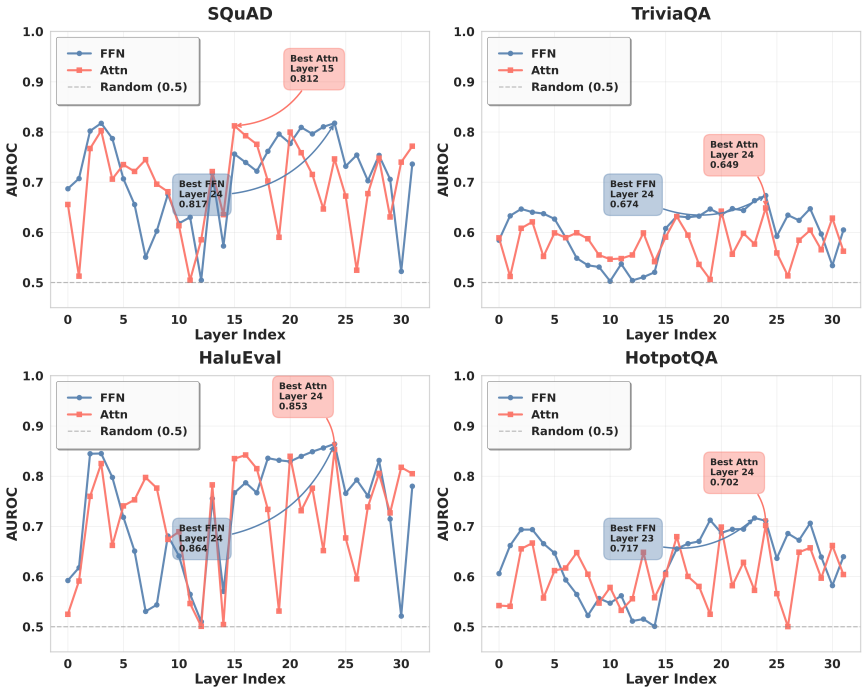
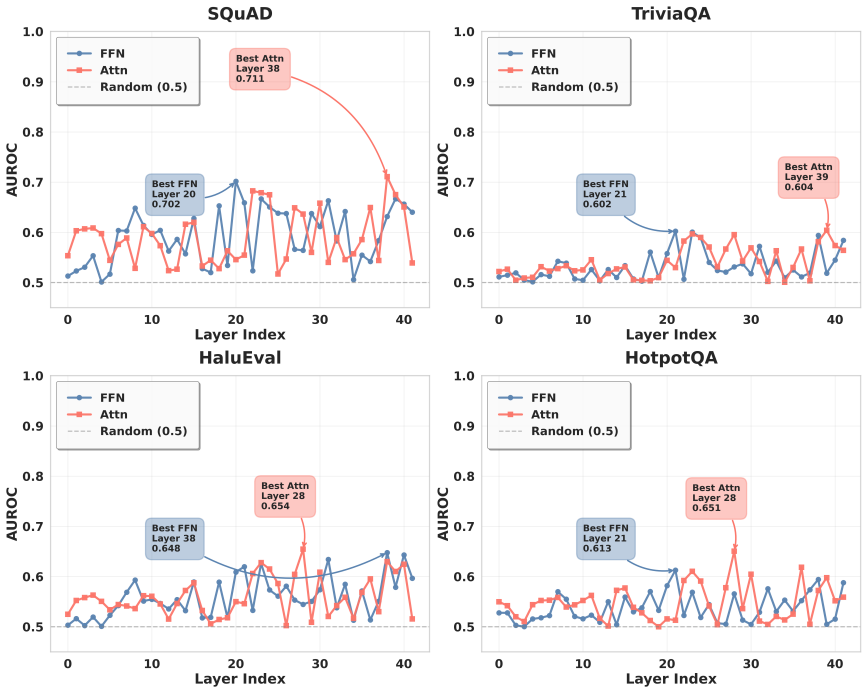
Model-Dependent Module Dominance: Contrary to a single universal rule, the domi- nant uncertainty signal varies by architecture. Qwen-2.5 and Gemma-2 consistently achieve peak performance using Attention restora- tion scores (dominating 8/8 cases combined), whereas LLaMA-3.1 relies exclusively on FFN signals (4/4 cases). This suggests that different archi...
-
[2]
Late-Layer Information Concentration: Across all models, the most discriminative signals are concentrated in the deep layers (Layers 22-26 for Qwen/LLaMA, Layers 28- 39 for Gemma). This validates that uncer- tainty is most effectively detected during the final stages of semantic integration and token projection
-
[3]
Gemma 2: Improving open language models at a practical size. arXiv preprint arXiv:2408.00118. Zhilin Y ang, Peng Qi, Saizheng Zhang, Y oshua Bengio, William Cohen, Ruslan Salakhutdinov, and Christo- pher D Manning. 2018. Hotpotqa: A dataset for diverse, explainable multi-hop question answering. In Proceedings of the 2018 conference on empiri- cal methods ...
arXiv 2018
-
[6]
Performance Hierarchy: LLaMA-3.1-8B exhibits the strongest internal signatures of correctness, achieving the highest peak AU- ROC (0.864), followed by Qwen-2.5 (0.741) and Gemma-2 (0.711). This correlates with the general capability of the base models, sug- gesting that stronger models possess more distinct mechanistic boundaries between cor- rect and inc...
-
[7]
Explicit Instructions: Clear task definition reduces output ambiguity
-
[8]
Standardized Format: Uniform structure across samples minimizes confounding vari- ables
-
[9]
Moderate Few-shot: Three examples pro- vide sufficient task demonstration without ex- cessive context length C.3 Datasets For our experiments, we use 10,000 instances from each dataset. Specifically, we use the QA subset of the HaluEval dataset and the standard splits for other datasets. The datasets used in this study are publicly available and adhere to t...
work page 2023
-
[10]
Consistent Superiority: DUD-Probe achieves the highest AUROC across both model sizes and all datasets, confirming that the effectiveness of decoupled causal tracing is independent of model capacity
Show all 12 references
-
[11]
Scale Robustness: While larger models (14B) generally improve baseline perfor- mance slightly, the relative advantage of DUD-Probe over ICR Probe remains sub- stantial (e.g., +7.5% on HaluEval for 14B, +12.0% for 3B), indicating that our method scales well
-
[12]
Small Model Gains: On the smaller Qwen2.5-3B model, DUD-Probe demon- strates particularly strong improvements over aggregated methods (ICR: 0.8017 → DUD: 0.9212 on HaluEval), suggesting that ex- plicit decoupling is especially valuable when model capacity is limited and intern...
-
[2023]
In Proceedings of the 2023 conference on empirical methods in natural language processing , pages 9004–9017
Selfcheckgpt: Zero-resource black-box hal- lucination detection for generative large language models. In Proceedings of the 2023 conference on empirical methods in natural language processing , pages 9004–9017. Samuel Marks and Max Tegmark. 2023. The geometry of truth: Emergen...
2023 arXiv
-
[2024]
arXiv preprint arXiv:2402.03744
Inside: Llms’ internal states retain the power of hallucination detection. arXiv preprint arXiv:2402.03744. Y ung-Sung Chuang, Linlu Qiu, Cheng-Y u Hsieh, Ran- jay Krishna, Y oon Kim, and James Glass. 2024. Lookback lens: Detecting and mitigating contextual hallucinations in l...
2024 arXiv
Reviewed August 5, 2026 · model on record in the stance chip above.
Discussion (0). Continue with ORCID to comment.