REVIEW 2 major objections 4 minor 6 references
AI World Cup 2026: Benchmarking Large Language Models for End-to-End Football Tournament Prediction
T0 review · 2 major / 4 minor · reviewed 2026-08-05 · deepseek-v4-flash
Pith's one-line read This paper reports a completed ten-model benchmark of full 2026 World Cup forecasts and claims that the final leaderboard was determined almost entirely by knockout-bracket performance, not by group-stage match prediction.
desk verdict A transparent, reproducible full-bracket LLM benchmark whose central knockout-dominance result rests on one sample per model and on scoring weights that all but guarantee the observed correlation. read the letter →
The pith
A machine-rendered reading of the paper's core claim, the machinery that carries it, and where it could break.
The reading
What carries the argument
The load-bearing mechanism is the benchmark's additive three-component scoring rule, especially the knockout progression score $S_{\text{progression}} = 2C_{R32} + 4C_{R16} + 6C_{QF} + 8C_{SF} + 12C_{\text{Final}}$ plus final-placing bonuses, with a 20-point champion bonus. Because stage awards accumulate and knockout points have much larger variance than the group-stage components, the composite total is dominated by bracket path; one early wrong pairing can invalidate later round memberships even when individual match judgments are reasonable. The fixed pre-tournament snapshot plus common JSON schema make the comparison controlled, but the scoring weight is what carries the ranking.
What would settle it
Re-run each of the ten assistants many times under the same fixed prompt, or re-score the archived single-run brackets with knockout points normalized to match the group-phase maximum; if the first-place margin or the correlation between total score and knockout points does not reproduce, the claim that knockout performance drove the leaderboard would not survive.
Extended reading notes
Core claim
The paper's discovery is that when ten language-model assistants are asked to forecast an entire tournament in one shot under a shared protocol, the composite leaderboard is determined by knockout-bracket success. The evidence is the correlation pattern among score components: knockout points varied from 0 to 242 with a standard deviation of 88.65, while group-stage match points and group-standing points were concentrated in narrow ranges; total score correlated at $r=0.986$ with knockout points and at roughly zero with the two group-phase components. The winner, GPT-5.5 Thinking, was the only model to pick Spain and earned 50 more knockout points than the runner-up, overturning a 23-point g
Load-bearing premise
The load-bearing premise is that a single pre-tournament response per model is a representative sample of that model's forecasting ability; because outputs are stochastic and only one bracket was collected per assistant, the ranks could partly reflect luck rather than skill.
Editorial extensions
If this is right
- Forecasting a whole tournament under this protocol is not the same task as predicting matches one at a time; a model can win the composite while ranking mid-pack on group-stage accuracy.
- A bracket leaderboard's ranking is driven by the spread of knockout scoring; if that component is weighted or normalized differently, the winner can change.
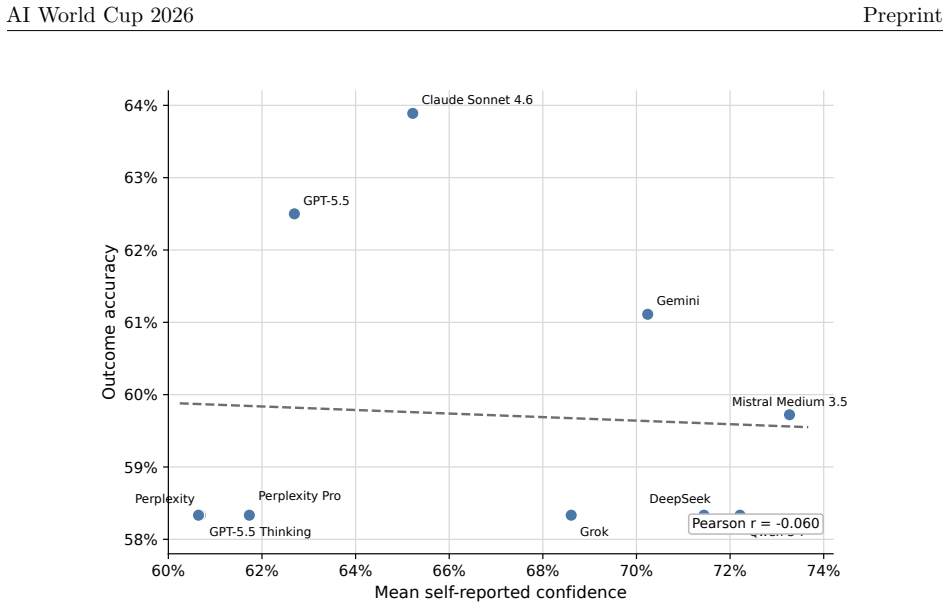
- Self-reported confidence should not be read as calibrated probability; mean confidence was essentially uncorrelated with both total score and outcome accuracy.
- Single pre-tournament forecasts test whether a model can maintain a coherent long-range path from one fixed information state, at the cost of not separating outdated information from weak reasoning.
- Match-level leaders and tournament-level leaders can differ, so composite benchmarks should report component metrics separately rather than only a total.
Reading between the lines
- Editorial inference: if the knockout component were normalized to the same maximum as the group phase, or if round qualification were scored independently of exact bracket pairings, the top of the leaderboard would likely shift; the paper lists this as a robustness check but does not run it.
- Editorial inference: the 27-point gap between first and second, and the unique Spain pick, may be sampling variation from a single stochastic run per model; without repeated independent forecasts the paper cannot distinguish genuine skill from one unusually successful bracket.
- Editorial inference: a natural extension is to use the released raw predictions to score each model by marginal probability of reaching each round, which would test whether the knockout dominance is about bracket path dependence or about genuine long-horizon forecasting ability.
- Editorial inference: the same protocol could be applied to other multistage competitions, such as basketball or cricket tournaments, to see whether the knockout-dominance pattern generalizes beyond football.
Editorial analysis
A structured set of objections, weighed in public.
Referee Report
Summary. The paper reports the completed AI World Cup 2026 benchmark, in which ten LLM-based assistants each submitted a single pre-tournament forecast of the full 2026 FIFA World Cup under a common prompt, data snapshot, JSON schema, and scoring procedure. The scoring system (Eqs. 1–12) combines group-stage match points, group-standing points, and knockout/tournament points. The authors audit the leaderboard, report stage-wise accuracy and confidence, and find that the final ranking was dominated by the knockout component: total score correlates strongly with knockout points (r=0.986) but not with group-stage components. They also compare with three contemporaneous benchmarks and provide a reproducibility roadmap. The raw responses, scoring code, and frozen leaderboard data are released.
Significance. If taken as a descriptive study of these ten realized forecasts, the paper is a valuable, transparent benchmark contribution: the protocol is controlled, the audit is plausible, and the released artifacts (raw responses, scoring code, frozen commit) support replication. The finding that a composite tournament score can be dominated by a high-variance knockout component is a useful caution for designing bracket-based benchmarks. However, the central inference is based on exactly one bracket per model with no repeated sampling, so the observed leaderboard order and the r=0.986 correlation cannot be separated from sampling variation without further evidence. The paper's own limitations section acknowledges this, but the abstract and conclusion present the result more strongly. The paper is an honest and useful empirical report, but its headline claim needs either additional robustness evidence or a more restrictive framing.
major comments (2)
- [§8; §5.2; Abstract] The central claim that the composite leaderboard was determined by knockout performance (r=0.986) is computed from a single pre-tournament bracket per model. LLM outputs are stochastic, so the observed 27-point winning margin, the unique Spain champion pick, and the knockout-vs-group correlation could be sampling variation rather than stable model skill. The limitation is acknowledged in §8 ('Single run per model') and §9.2, but the abstract and §5.2 state the result without this qualification. This is load-bearing for the broader conclusion that forecasting a complete tournament 'tests something different' from per-match prediction. Please either provide repeated-run or bootstrap-based evidence, or explicitly limit the claim to these ten realized forecasts and present the generalization as a hypothesis.
- [§6.3; Eq. (12)] The paper itself recommends robustness analyses (equal weighting of components, normalization by attainable score, removal of the champion bonus, round-level scoring) but does not implement them. Given that the scoring weights in Eq. (12) are arbitrary and the knockout component has sample standard deviation 88.65 versus 8.65 and 12.20 for the two group components, the observed knockout dominance is partly a consequence of the chosen weighting. A sensitivity analysis is needed to determine whether the ranking and the knockout–total correlation are stable under reasonable alternative scoring schemes. Without it, the abstract's statement that the leaderboard 'depend[s] on scoring design' remains qualitative, and the central 'knockout determined the ranking' finding is not yet shown to be robust.
minor comments (4)
- [Table 2] The row for Claude Sonnet 4.6 is typeset incorrectly: '4.6466' should be separate values (46, 6, 65.22). Please fix the table formatting.
- [Eq. (8)] The notation '4CR16' reads ambiguously; use '4C_{R16}' for clarity. Also ensure the subscript convention matches that of C_{R32}, C_{QF}, etc.
- [§5.2] When reporting the correlation with the 'combined score' (r = -0.054), define it explicitly as the sum of group-stage match points and group-standing points, to avoid confusion with the total benchmark score.
- [§8] The absence of an external baseline (betting odds, Elo, simple favorites) is a significant limitation; it is listed but not emphasized in the abstract. Consider a sentence in Section 5 or the conclusion clarifying that the leaderboard is a relative comparison only.
Circularity Check
No significant circularity: the benchmark is self-contained, scoring is pre-specified, and the knockout-dominance conclusion is an acknowledged descriptive result of the scoring design, not a fitted prediction.
full rationale
The paper does not derive a prediction from an input that already contains it. It reports a completed, pre-specified points-based benchmark: total score is defined in Eq. (12) as the sum of three additive components, and the claim that knockout points drove the ranking is a descriptive correlation (r=0.986) computed from the realized scores. The paper explicitly labels these correlations as descriptive (Section 5.2, 'These correlations are descriptive because they are based on only ten submissions') and acknowledges that the composite score's scale is not stage-normalised and that the ranking is especially sensitive to knockout progression (Section 6.3, 'A useful robustness analysis would recompute the leaderboard under several reasonable alternatives...'). No parameter is fitted to the outcome and then renamed as a prediction; no self-citation is load-bearing; no uniqueness theorem or ansatz is imported from prior work. The acknowledged single-run-per-model limitation (Section 8, 'Stochastic assistants can produce different brackets across sessions. Without repeated independent samples, observed differences combine model capability with sampling variation.') is a threat to robustness and generalizability, not a circular-input-output relation. The high correlation between total and knockout points is partly a mathematical consequence of the additive formula plus the realized score spread, but the paper presents this as a design-sensitivity observation rather than as an independent derivation, so it does not constitute circularity.
Assumptions & free parameters
free parameters (1)
- Scoring weights (match: 5/3/2/1; standing: 5/5/3/2; progression: 2/4/6/8/12; placing: 20/10/8/5)
assumptions (3)
- ad hoc to paper The additive composite score (Eq. 12) is a valid measure of end-to-end tournament forecasting quality.
- domain assumption Each model's single forecast is treated as representative of that assistant's performance.
- domain assumption Group standings can be reconstructed from points, goal difference, goals scored, and an alphabetical fallback.
Cite this review
Pith. "Pith review of AI World Cup 2026: Benchmarking Large Language Models for End-to-End Football Tournament Prediction." pith.science (2026). https://pith.science/paper/EBEYB7NB
@misc{pith2026260803416,
  author       = {Pith},
  title        = {Pith review of: AI World Cup 2026: Benchmarking Large Language Models for End-to-End Football Tournament Prediction},
  year         = {2026},
  howpublished = {\url{https://pith.science/paper/EBEYB7NB}},
  note         = {Machine review of arXiv:2608.03416}
}
abstract
Large language models (LLMs) are now regularly asked to forecast real-world events, but comparisons are often difficult because models receive different information, use different tools, and are evaluated under different rules. This paper reports the completed \emph{AI World Cup} benchmark, in which ten LLM-based assistants made a single pre-tournament forecast of the entire 2026 FIFA World Cup. Every submission used the same tournament snapshot, prompt, JSON schema, and scoring procedure. The forecasts covered group-stage scores, group rankings, the knockout bracket, final placings, confidence values, and short explanations. After all 104 matches had been played, GPT-5.5 Thinking finished first with 744 points, followed by GPT-5.5 with 717, Gemini with 699, and Qwen 3.7 with 687. GPT-5.5 Thinking was also the only model to select Spain, which defeated Argentina 1--0 in the final, as champion. The final ranking was driven mainly by knockout performance: total score was strongly correlated with knockout points ($r=0.986$), but showed little relationship with group-stage match points ($r=0.055$), group-standing points ($r=-0.103$), or their combined pre-knockout score ($r=-0.054$). Match-level accuracy produced a different ordering. Claude Sonnet 4.6 correctly predicted the largest number of group-stage outcomes (63.89\%) but placed sixth overall. Average self-reported confidence was also unrelated to either outcome accuracy ($r=-0.060$) or total score ($r=-0.067$). The results suggest that forecasting a complete tournament tests something different from predicting matches one at a time, while also showing how strongly a bracket-based leaderboard can depend on scoring design. The benchmark materials, raw responses, and scoring code are released to support replication and future extensions.
Figures


Figures from the paper (5 more)



Reference graph
Works this paper leans on
-
[1]
Wang, Zhaokai and Gui, Tianlin and Rao, Jiayuan and Di, Shangzhe and Tang, Yihong and Liang, Dingli , journal =. 2026 , eprint =
work page 2026
-
[2]
FIFA World Cup 2026 as a Contamination-Free Benchmark for LLM Forecasting Agents: Four Models, a Bookmaker, and 104 Matches , author =. arXiv preprint arXiv:2607.17765 , year =. 2607.17765 , archivePrefix=
work page Pith review arXiv 2026
-
[3]
Schröder, Jonas and Schweisthal, Jonas and Müller, Oliver and Weinmann, Markus and Feuerriegel, Stefan , journal =. 2026 , eprint =
work page 2026
-
[4]
Monthly Weather Review , volume =
Verification of Forecasts Expressed in Terms of Probability , author =. Monthly Weather Review , volume =
-
[5]
Journal of the American Statistical Association , volume =
Strictly Proper Scoring Rules, Prediction, and Estimation , author =. Journal of the American Statistical Association , volume =
-
[6]
Current Directions in Psychological Science , volume =
Forecasting Tournaments: Tools for Increasing Transparency and Improving the Quality of Debate , author =. Current Directions in Psychological Science , volume =
Reviewed August 5, 2026 · model on record in the stance chip above.
Discussion (0). Sign in to comment.