REVIEW 4 major objections 6 minor 9 references
Dynamically Allocating Evaluation Effort for Model Ranking
T0 review · 4 major / 6 minor · reviewed 2026-08-15 · deepseek-v4-flash
Pith's one-line read The paper proves that when the goal is a top-weighted model ranking, the optimal way to spend a fixed evaluation budget is to sample models in proportion to the square root of their rank-based importance, which with inverse-squared-rank…
desk verdict The empirical allocation result is likely real, but Theorem 3's optimality proof has an algebra error, so the paper is a solid empirical contribution with an unproven headline theorem. read the letter →
The pith
A machine-rendered reading of the paper's core claim, the machinery that carries it, and where it could break.
The reading
What carries the argument
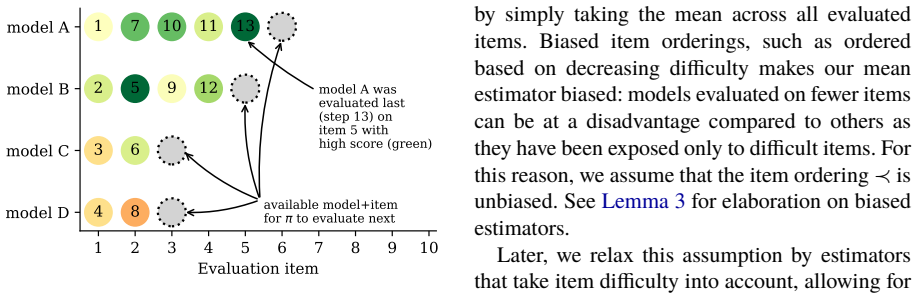
The load-bearing identity is the variance-allocation formula: with sample means of variance $\sigma^2/|R_m|$, the weighted variance loss $\sum_m \omega_m^2 \sigma^2/|R_m|$ is minimized under a budget by setting $|R_m|$ proportional to $\omega_m$ (the square root of the importance weight). The paper proves this by Lagrangian differentiation (Theorem 3). The other piece of machinery is the weighted rank correlation $\tau_\omega$, a modified rank-correlation score in which disagreements involving high-weight models count more, which lets the paper define the objective as 'get the top of the leaderboard right' and choose $\omega_m = 1/\text{rank}^2_m$. The additive noise model $r_{x,m} = q_m + d_x + \varepsilon_{x,m}$ then supports a linear estimator that removes bias when evaluation items are ordered by difficulty rather than at random.
What would settle it
Compute the per-model evaluation variance on a benchmark and solve the Lagrangian minimization with those individual variances; if the resulting optimal allocation differs materially from inverse-rank sampling on the same data, then the theorem's recommendation is not the optimum once the equal-variance premise is relaxed.
Extended reading notes
Core claim
The paper's central claim is that evaluation effort should be allocated according to the square root of the importance weight assigned to each model's rank position, and that for weights $\omega_m = 1/\text{rank}^2_m$ this means sampling the next model to evaluate proportionally to $1/\text{rank}_m$. This is established as Theorem 3: assuming the estimated mean score of each model is an independent Gaussian with variance $\sigma^2/|R_m|$, the Lagrange-optimal allocation that minimizes the weighted sum $\sum_m \omega_m^2 \sigma^2/|R_m|$ under a fixed budget is $|R_m| \propto \omega_m$. Since uniform sampling is recovered when all weights are equal, the theorem places the common baseline as the flat-weight case of the same rule. The paper further proves that any policy that never lets a model's selection probability drop below a positive constant will converge to the true ranking (Theorem 2), and that exact optimal allocation remains NP-hard even with oracle access (Theorem 1). Because the equal-variance assumption fails on real translation data, the paper adds a confusion-minimization algorithm that uses per-model variance estimates to maximize pairwise ranking certainty.
Load-bearing premise
The optimality result depends on the assumption that every model's estimated mean score is an independent Gaussian with the same variance, so that shifting samples toward lower-ranked models provably buys the most ranking certainty; the paper's own measurements show per-model variances differ, which is why the authors introduce a separate confusion-minimization heuristic.
Editorial extensions
If this is right
- With inverse-rank sampling, annotation campaigns can concentrate human effort on the few models that compete for the top spots, cutting the budget needed to identify the best model.
- Uniform sampling, the current baseline, is exactly the optimal policy when all rank positions are weighted equally, so the framework generalizes rather than replaces standard practice.
- The consistency theorem guarantees that adaptive allocation eventually recovers the true ranking as the budget grows, so the method is safe to use at any scale.
- The same allocation logic transfers to automatic evaluation where each model-output judgment costs compute or API calls rather than annotator time.
- Dynamic model selection can be combined with smart item ordering (e.g., difficulty-prioritized items) when score estimates are corrected with an additive difficulty model.
Reading between the lines
- The inverse-rank rule implies an expected evaluation count that falls off as $1/\text{rank}$; a direct extension would be a closed-form budget estimator that predicts, before annotation starts, how much budget is needed to retrieve the top-$k$ set at a target probability.
- Because the optimality proof assumes equal variance across models while the paper's own data show better models have lower variance, a variance-aware analogue (allocating $|R_m| \propto \sigma_m \omega_m$) would be the natural next theorem and could outperform $1/\text{rank}$ sampling on real data.
- The introductory 95%-at-40%-budget claim is framed as a retrieval probability, while the reported experiments use averaged weighted rank correlation; a dedicated experiment measuring exact top-3 retrieval probability would directly test the practical promise.
- The additive quality-plus-difficulty model assumes a single quality per model; in settings where a model's relative quality varies by item type (e.g., language pairs), the same bandit policy could be run per cluster of items to produce specialized rankings.
Signed reviews
Editorial analysis
A structured set of objections, weighed in public.
Referee Report
Summary. The paper proposes a bandit-style framework for allocating human evaluation effort across competing NLP models, with the goal of recovering top-model rankings under a fixed budget. It formalizes evaluation allocation as best-arm identification, proves NP-hardness of the oracle allocation problem, and proposes several sampling policies, including rank-weighted sampling and a confusion-minimization policy. The main theoretical claim is Theorem 3, which states that sampling a model with probability proportional to the square root of its objective weight is optimal for minimizing weighted ranking uncertainty. The empirical section simulates these policies on 290k WMT human evaluations across 37 campaigns, reporting that rank-based sampling and confusion minimization improve weighted Kendall tau over uniform allocation and approach the greedy oracle.
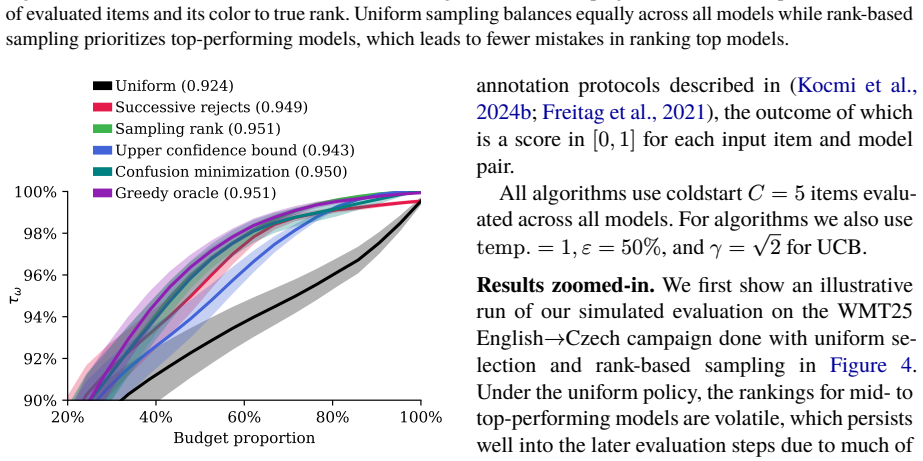
Significance. If the theoretical and empirical claims held, the paper would offer a practical recipe for reducing the cost of large-scale human evaluation: focus annotation effort on competitive models while preserving top-k ranking fidelity. The empirical study is substantial and well-grounded: 100-seed simulations on real WMT data, comparison against a greedy oracle, ablation over item ordering, and synthetic robustness checks. The paper also ships code, which aids reproducibility. However, the central optimality theorem is not established by the proof as written, and the headline 95%/40% claim in the introduction is unsupported by the reported experiments. The practical heuristic value of rank-based sampling may survive, but the paper's core theoretical contribution currently does not.
major comments (4)
- [Appendix B, Theorem 3, Eqs. (43)-(49)] The Lagrange step in the proof of Theorem 3 is algebraically inconsistent. Stationarity in Eq. (45) gives |R_m|^2 = ω_m²σ²/λ, hence |R_m| = ω_m σ/√λ. Substituting into the budget constraint yields |R_m|* = B·ω_m / Σ_k ω_k, i.e. proportional to ω_m, not √ω_m. The conclusion |R_m| ∝ √ω_m only follows if the loss in Eq. (43) were Σ_m ω_m σ²/|R_m| rather than Σ_m ω_m² σ²/|R_m|. As written, the proof does not prove the stated theorem.
- [Section 3.2 and Appendix B, Theorem 3] The proof replaces the weighted Kendall tau objective of Eq. (6) with the surrogate loss L = Σ_m ω_m² σ²/|R_m| without establishing that minimizing this surrogate minimizes the expected value of τ_ω. Weighted Kendall tau is a nonlinear, pairwise function of the estimated means, so reducing individual variances need not reduce the expected number of weighted inversions. Without an explicit bound or monotonicity argument connecting L to E[τ_ω], the optimality claim concerns only a variance proxy, not the stated ranking objective.
- [Appendix B, Eq. (40); Appendix D, Fig. 11; Section 4.2] The assumptions behind Theorem 3 — independent estimators with common variance σ² across models — are contradicted by the paper's own correlated-arms model (Lemma 2, Eq. (29)) and by the empirical heteroscedasticity reported in Figure 11. The paper concedes this in Section 4.2 when it introduces Confusion Minimization specifically to address the violation. Consequently, Theorem 3 cannot justify the claimed optimality of inverse-rank sampling for the WMT experiments; at best the algorithm is an empirically motivated heuristic under those conditions.
- [Section 1 and Section 5] The introduction claims that the ordering of the top 3 among 20 translation models can be reliably (p=95%) retrieved with only 40% of the budget, but no figure or table reports this quantity. Figure 5 shows average weighted Kendall tau, which is not a retrieval probability, and no top-3 hit-rate result appears elsewhere in the provided text. This headline claim should either be removed or supported with the corresponding experiment, e.g. top-3 retrieval frequency over the 100 seeds.
minor comments (6)
- [Section 3.4] The word 'concider' should be 'consider'; similar typographical errors appear elsewhere (e.g. 'Bolzmann' in Section 4.1 and Table 2, 'Rearrranging' in Eq. (46), 'Experimnents' in Limitations, 'cummulative' in Section 4.2).
- [Appendix B, Lemma 1] The proof of Lemma 1 contains a circular equation: it writes Var(μ̂_repeat) = Var(μ̂_repeat) + Cov(r1,r2), which is not a comparison. The argument should directly show Var(μ̂_repeat) = Var(μ̂_distinct) + positive covariance terms.
- [Figure 5] The caption says numbers in the legend show areas under the curves, but no numerical AUC values are visible in the provided figure. Please clarify whether these are omitted or intended to appear in the legend.
- [Table 2] The rows 'Greedy oracle rank1' and 'Greedy oracle rank top 3' are not defined in the text; please specify which objective each oracle variant optimizes.
- [Section 4.3, footnote 5] The statement that the greedy objective is not submodular and can be arbitrarily worse than optimum is important and should be moved into the main text rather than relegated to a footnote.
- [Section 5.1] The text says 'Numbers in legend show areas under curves' but also refers to 'Other algorithms are included in Appendix C.1'; consider adding explicit pointers to Table 2 when discussing Figure 5 and Table 1.
Circularity Check
Theorem 3's optimality proof optimizes a surrogate variance loss with weights ω²_m and contains an algebraic jump (Σω_k replaced by Σ√ω_k), so the claimed √ω-optimality of rank sampling is constructed from the surrogate, not derived from the τ_ω objective.
-
self definitional
[Sec. 4.1 (Eq. 12) and Appendix B, Theorem 3 proof (Eqs. 40–49)]
"Sampling according to √ω_m is the optimal strategy for minimizing the weighted (according to ω_m) ranking uncertainty. ... we define a differentiable loss function that proxies the discrete ranking metric τ_ω ... ∑_{m∈ℳ} ω²_m ⋅ Var(μ̂_m) = ∑_{m∈ℳ} ω²_m σ²/|R_m| ... |R_m|* = (B/Σ_k ω_k) ω_m ... The optimal number of samples |R_m|* is then proportional to the square root of the importance weight ω_m. ... Notably, this intentionally bears resemblance to weights in optimization objective (Equation 6)."
The paper's stated objective is the weighted Kendall tau of Eq. 6, whose pairwise terms are weighted by ω_i·ω_j. The proof never connects the surrogate loss Eq. 43 to Eq. 6; it instead minimizes Σ ω²_m σ²/|R_m|. The Lagrange stationarity condition (Eqs. 45–46) yields |R_m| ∝ ω_m, and Eq. 49 states |R_m|* = B·ω_m/Σ_k ω_k. The theorem statement turns this into 'sampling according to √ω_m' only by calling ω_m² the importance weight, so |R_m| ∝ ω_m = √(ω_m²), and by the erroneous step Eq. 48 where Σ_k ω_k is replaced with Σ_k √ω_k. With the paper's actual choice ω_m = 1/rank², the algebra would give sampling proportional to 1/rank², not the advertised 1/rank.
full rationale
The main theoretical claim of the paper is Theorem 3, 'Sampling according to √ω_m is the optimal strategy for minimizing the weighted (according to ω_m) ranking uncertainty.' On inspection, the proof does not derive this from the weighted Kendall tau objective defined in Eq. 6. It introduces a differentiable proxy loss with squared weights ω²_m (Eq. 43) and minimizes that proxy under a budget. The solution of that minimization is |R_m| ∝ ω_m (Eqs. 46 and 49), which is already different from the theorem's √ω_m conclusion; the proof bridges the gap with an algebraic inconsistency in Eq. 48 (substituting Σ√ω_k for Σω_k). The conclusion 'proportional to the square root of the importance weight' only works if the importance weight in the surrogate is ω_m², so the theorem's content is equivalent to the definition of the surrogate and the square-notation, not to any property of the paper's actual ranking objective. This is a self-definitional circularity in the central theoretical result: the optimality of inverse-rank sampling is constructed from the surrogate loss chosen after the fact, and the proposed sampler in Eq. 12 is explicitly said to 'intentionally bear resemblance' to the objective weights. The empirical evaluation on WMT data is self-contained and does not reduce to a fitted prediction; no load-bearing self-citation chain or imported uniqueness theorem appears. The introduction's 95%/40% claim is not connected to a displayed figure or table, but that is an unsupported-claim issue rather than circularity. Overall, the empirical contribution may stand, but the paper's advertised proof of optimality is circular in the sense that the theorem's conclusion is built into the surrogate objective and the notation.
Assumptions & free parameters
free parameters (6)
- warmup items C =
5
- epsilon-greedy epsilon =
0.5
- Boltzmann temperature =
1
- UCB exploration constant gamma =
sqrt(2)
- ranking objective weight omega_m =
1/rank^2
- synthetic data generative parameters =
mu=0.7, sigma=0.25, d ~ N(0,1)
assumptions (7)
- domain assumption Additive item-model score model: r_{x,m} = q_m + d_x + ε_{x,m}, with d_x and ε_{x,m} independent noise terms.
- domain assumption Assumption 1: the item ordering ≺ is unbiased for the basic theorems.
- domain assumption Assumption 2: constant evaluation cost, cost(x) = 1 for all items.
- ad hoc to paper Estimated model means are independent Gaussians with common variance: μ̂_m ~ N(μ_m, σ²/|R_m|) with the same σ for all models.
- domain assumption Evaluating a model on its next unevaluated item from a shared global ordering is lossless (Appendix A, Observations 1 and 2).
- ad hoc to paper In the NP-hardness reduction, oracle scores can be assigned per model-item pair so each model group occupies its own score interval I_n and a target model's mean crosses its group threshold only at exactly 1 + w_n evaluations.
- standard math Strong Law of Large Numbers and Borel-Cantelli lemmas in the consistency proof.
Cite this review
Pith. "Pith review of Dynamically Allocating Evaluation Effort for Model Ranking." pith.science (2026). https://pith.science/paper/DUK57DYZ
@misc{pith2026260803437,
  author       = {Pith},
  title        = {Pith review of: Dynamically Allocating Evaluation Effort for Model Ranking},
  year         = {2026},
  howpublished = {\url{https://pith.science/paper/DUK57DYZ}},
  note         = {Machine review of arXiv:2608.03437}
}
read the original abstract
While human evaluation is the gold standard in many NLP tasks, it suffers from prohibitive costs and poor scalability. When identifying top-performing models, typical evaluation protocols waste effort by exhaustively evaluating all models on the entire benchmark, a safe but inefficient approach. In this work, we formalize multi-model human evaluation as a best-arm identification problem in a multi-armed bandit setup with correlated arms, where pulling an arm corresponds to human-evaluating a model. By sampling adaptively based on the intermediate model rankings obtained on the samples so far, we can focus the annotation budget on the most competitive models. We prove the optimality of the proposed algorithms and show that it improves discrimination between top-performing models. This makes evaluations faster, cheaper and more aligned with large-scale competition evaluation goals.
Figures


Figures from the paper (6 more)



Reference graph
Works this paper leans on
-
[2]
Since 𝜇̂𝑚,𝐵 converges to 𝑞𝑚, there exists a finite budget 𝐵† such that for all 𝐵 > 𝐵†, |𝜇̂𝑚,𝐵 − 𝑞𝑚| < 𝛿 2 for all 𝑚, implying 𝑅̂𝐵 = 𝑅∗. ∎ We now introduce Lemma 4 which is used for proving Theorem 3. Lemma 4 (Asymptotic allocation convergence): Let 𝜋 be a sampling policy where at each step 𝑡, a model 𝑚 is selected with probability 𝑃𝑡(𝑚) proportional to it...
work page 2010
-
[6]
In ICLR 2024 Workshop on Mathematical and Empirical Understanding of Foundation Models
Best Arm Identification for Prompt Learning under a Limited Budget . In ICLR 2024 Workshop on Mathematical and Empirical Understanding of Foundation Models. Shivalika Singh, Yiyang Nan, Alex Wang, Daniel D’Souza, Sayash Kapoor, Ahmet Üstün, Sanmi Koyejo, Yuntian Deng, Shayne Longpre, Noah A. Smith, Beyza Ermis, Marzieh Fadaee, and Sara Hooker. 2025. The L...
arXiv 2024
-
[8]
Advances in neural information pro cessing systems 36:46595–46623
Judging llm-as-a-judge with mt-bench and chatbot arena. Advances in neural information pro cessing systems 36:46595–46623. Jin Peng Zhou, Christian K. Belardi, Ruihan Wu, Travis Zhang, Carla P. Gomes, Wen Sun, and Kilian Q. Weinberger. 2025. On Speeding Up Language Model Evaluation. ArXiv: 2407.06172 [cs.AI]. Vilém Zouhar, Peng Cui, and Mrinmaya Sachan....
arXiv 2025
-
[2002]
Finite-time analysis of the multiarmed bandit problem. Machine learning 47:235–256. James E Baker. 1985. Adaptive selection methods for genetic algorithms. In Proceedings of the 1st Inter national Conference on Genetic Algorithms , pages 101–111, Pittsburgh, PA, USA. Esma Balkır, Alice Pernthaller, Marco Basaldella, José Hernández-Orallo, and Nigel Coll...
arXiv 1985
-
[2006]
Journal of Machine Learning Research 7(39):1079–1105
Action Elimination and Stopping Conditions for the Multi-Armed Bandit and Reinforcement Learning Problems . Journal of Machine Learning Research 7(39):1079–1105. Markus Freitag, George Foster, David Grangier, Viresh Ratnakar, Qijun Tan, and Wolfgang Macherey. 2021. Experts, Errors, and Context: A Large-Scale Study of Human Evaluation for Machine Translati...
work page 2021
-
[2013]
Almost Optimal Exploration in Multi-Armed Bandits. In Proceedings of the 30th International Conference on Machine Learning, pages 1238–1246, Atlanta, Georgia, USA. Tom Kocmi, Ekaterina Artemova, Eleftherios Avramidis, Rachel Bawden, Ondřej Bojar, Konstan- tin Dranch, Anton Dvorkovich, Sergey Dukanov, Mark Fishel, Markus Freitag, Thamme Gowda, Roman Grundk...
-
[2023]
In Proceedings of the Eighth Conference on Machine Translation , pages 756–767, Singapore
MetricX-23: The Google Submission to the WMT 2023 Metrics Shared Task . In Proceedings of the Eighth Conference on Machine Translation , pages 756–767, Singapore. Shivaram Kalyanakrishnan, Ambuj Tewari, Peter Auer, and Peter Stone. 2012. PAC Subset Selection in Sto- chastic Multi-armed Bandits. In Proceedings of the 29th International Conference on Machin...
work page 2023
-
[2024]
In Proceedings of the 41st International Conference on Machine Learning, Vienna, Austria
tinyBenchmarks: evaluating LLMs with fewer examples. In Proceedings of the 41st International Conference on Machine Learning, Vienna, Austria. Lorenzo Proietti, Stefano Perrella, Vilém Zouhar, Roberto Navigli, and Tom Kocmi. 2025. Estimating Machine Translation Difficulty . In Findings of the Association for Computational Linguistics: EMNLP 2025, pages 24...
Show all 9 references
-
[2025]
ArXiv: 2505.03814 [stat.ML]
Cer-Eval: Certifiable and Cost-Efficient Eval - uation Framework for LLMs . ArXiv: 2505.03814 [stat.ML]. Zhuo Wang, Wen Wu, Guoqing Wang, Guangze Ye, and Zhenxiao Cheng. 2026. MetaEval: Measuring the Discrimination of Benchmarks for Efficient LLM Evaluation. Proceedings of the...
2026 arXiv
Reviewed August 15, 2026 · model on record in the stance chip above.
Discussion (0). Continue with ORCID to comment.