REVIEW 4 major objections 5 minor 45 references
Perceptual Anchoring: Prototype-Guided Text Calibration for Training-free Open-Vocabulary Semantic Segmentation
T0 review · 4 major / 5 minor · reviewed 2026-08-08 · deepseek-v4-flash
Pith's one-line read The paper claims that calibrating generic class text embeddings with per-image visual prototypes—built from the tokens with the highest first-pass score margins—reduces the semantic gap in training-free open-vocabulary semantic…
desk verdict A simple, clearly motivated text-calibration idea with real but small gains, whose plug-and-play claim is undercut by per-dataset tuning of its main hyperparameters. read the letter →
The pith
A machine-rendered reading of the paper's core claim, the machinery that carries it, and where it could break.
The reading
What carries the argument
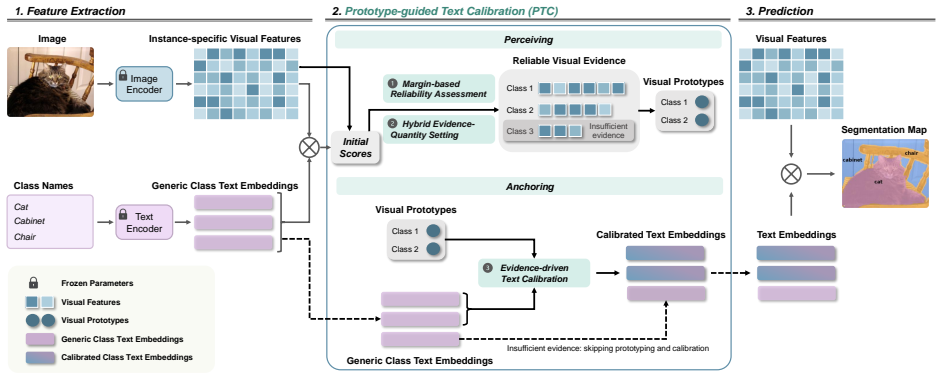
The load-bearing identity is the evidence-driven convex combination in Eq. (11): $t_{\mathrm{cal}}^c = (1-\mu_c)\,t_c + \mu_c\,V_{\mathrm{proto}}^c$. The prototype $V_{\mathrm{proto}}^c$ is a margin-weighted average of the visual tokens whose initial matching scores put them in class $c$ with the largest margin between the top and second class, so it encodes what that specific instance looks like. The coefficient $\mu_c = \mu\,\min\{1,\log(1+n_{\mathrm{ev}}^c)/\log(1+\lambda K_{\min})\}$ keeps the calibration conservative when evidence is thin and prevents large objects from pulling the text embedding too far from its generic meaning. This single interpolation rule carries the argument from the Perceiving stage to the Anchoring stage.
What would settle it
Choose images in which a training-free segmenter gives a large, confident margin to background or to a confusable region for a class (for instance a black dog against a dark wall), build the PTC prototype from those high-margin tokens, and check whether mIoU falls below the uncalibrated baseline. If PTC systematically amplifies confident baseline errors instead of correcting them, the central claim fails.
Extended reading notes
Core claim
The paper's central claim is that the semantic gap in training-free OVSS can be narrowed by treating text embeddings as anchor symbols that should be perceptually linked to the input image, rather than as fixed classification references. Its concrete proposal is the calibration rule $t_{\mathrm{cal}}^c = (1-\mu_c)\,t_c + \mu_c\,V_{\mathrm{proto}}^c$ for every class with enough evidence, where $V_{\mathrm{proto}}^c$ is a visual prototype formed by aggregating the $K_c$ visual tokens with the largest score margins for that class, weighted by margin size. Categories with fewer than $K_{\min}$ supporting tokens are left uncalibrated, and the calibration strength $\mu_c$ grows logarithmically with evidence until it saturates at a global bound $\mu$. The paper validates this rule by integrating it into six training-free baselines and reporting mIoU gains across the eight benchmarks, and by ablations showing that margin-based selection, the hybrid evidence-quantity rule, and adaptive strength each contribute to the gain.
Load-bearing premise
The method assumes that the image regions its starting model is most confident about really do belong to the predicted class, so if that model is confidently wrong, the calibration will build on and reinforce the same mistake.
Editorial extensions
If this is right
- PTC can be added to any training-free OVSS method that emits per-token matching scores, so future visual-feature improvements and this text-side calibration should stack rather than compete.
- Because the calibrated embedding remains a blend with the original generic text vector, the open-vocabulary behavior of the model is preserved for categories that are absent from the image.
- The gain is largest where the baseline is weakest (NACLIP +2.2 average mIoU) and smallest on the strongest baseline (CorrCLIP +0.9), suggesting that text calibration and strong visual representations address overlapping but not identical errors.
- The same recipe should transfer across vision foundation models and CLIP backbones, since the ablations report gains with SAM, DINO, and DINOv2 features and with ViT-B/16, ViT-L/14, and ViT-H/14 encoders.
Reading between the lines
- The paper does not explore iterative recalibration, so an untested consequence of the margin-based evidence filter is that using calibrated embeddings to produce new margins could re-anchor prototypes and further close the gap.
- A transfer the paper leaves implicit is to other CLIP-based dense prediction tasks, such as open-vocabulary detection or referring segmentation, where generic text embeddings are matched to region features.
- The dataset dependence of $K_{\min}$ and $\mu$ suggests that a self-tuning schedule for these two hyperparameters would be the natural next step toward a fully parameter-free plug-in.
- A stress test implied by the paper's own limitation statement is to feed PTC deliberately biased initial scores, to see whether the margin filter or the calibration rule is the main source of robustness.
Editorial analysis
A structured set of objections, weighed in public.
Referee Report
Summary. The paper proposes Prototype-Guided Text Calibration (PTC), a training-free module for open-vocabulary semantic segmentation that calibrates category text embeddings with image-specific visual prototypes. In the Perceiving stage, PTC selects high-margin visual tokens as evidence and aggregates them into per-category prototypes; in the Anchoring stage, it blends these prototypes into the text embeddings with an evidence-adaptive strength, leaving categories with insufficient evidence unchanged. The method is evaluated by adding PTC to six training-free baselines across eight benchmarks, reporting average mIoU gains of roughly 0.8 to 2.2 points, together with ablations of the reliability criterion, the evidence-quantity strategy, the calibration scheme, and the choice of foundation backbones.
Significance. If the reported gains are robust, PTC is a simple and attractive contribution: it is algorithmically clean, requires no training and no additional external models, and the ablations in Tables 2-4 isolate each design choice. The authors also ship code and evaluate across six baselines and eight datasets, which is a strength. However, the central empirical claim is currently weaker than the text suggests because the headline results appear to use dataset-specific and baseline-specific hyperparameters, and because several reported gains are within the expected run-to-run variance. The idea itself is sensible and the derivation is not circular, but the paper must demonstrate a fixed-configuration, plug-and-play version before the generalization claim at the claimed strength can be accepted.
major comments (4)
- [§4.3.2, Fig. 5, Table 1] The sensitivity analysis in §4.3.2 shows that the optimal Kmin and μ vary by orders of magnitude across datasets (Kmin=100 on VOC21, Kmin=2 on Cityscapes, Kmin=10 on ADE20K, Kmin=132 on COCO-Object; μ=0.30, 0.35, 0.15, 0.02 respectively), and the text says 'we adopt dataset-specific configurations for the current baseline' and 'these two parameters are adjusted when PTC is integrated with other baselines.' This means the Table 1 entries likely use per-dataset, per-baseline tuned hyperparameters, so the average gains of +0.8 to +2.2 mIoU are an upper bound rather than evidence that PTC is a plug-and-play module. Please add an evaluation with one fixed (Kmin, μ) configuration held constant across all datasets and baselines, or a nested cross-validation procedure on the validation splits, and report the resulting average gains.
- [Table 1 and §4.3] No repeated-run variance is reported, and several individual improvements are tiny: ResCLIP+PTC gains +0.0 on Context60, ClearCLIP+PTC gains +0.1 on VOC21 and COCO-Object, and CorrCLIP+PTC gains +0.1 on Cityscapes and +0.0 on ADE20K. Single deterministic runs cannot distinguish these from run-to-run noise or numerical nondeterminism. Please report means and standard deviations over at least three runs, or otherwise provide evidence that the small gains are statistically meaningful; currently the average improvements inherit these small, possibly non-significant increments.
- [§5, §4.3.3, Table 6] The conclusion acknowledges that 'the performance of PTC remains dependent on the quality of the constructed visual prototypes.' This is not merely a caveat: Table 6 already shows a degradation on COCO-Object when ViT-L/14 is used (39.2 to 38.8). Since the prototypes are built from the very initial predictions that PTC is trying to correct, biased or background-dominated initial scores can propagate into the calibrated text embeddings. Please add a failure analysis or an explicit condition under which PTC is expected to help versus hurt, such as a per-category breakdown or a comparison of prototypes constructed from correctly versus incorrectly classified initial tokens.
- [§4.3.3, Table 5] The text states that 'incorporating PTC consistently improves segmentation performance across all three VFM variants,' but Table 5 shows SAM-B/16 +PTC decreasing ADE20K from 19.1 to 18.9. This overstatement should be corrected, and the failure mode should be discussed, because the robustness claim across visual foundation models is part of the paper's generalization argument.
minor comments (5)
- [§3.2.3, Eq. (11)] The second case of Eq. (11) is written 'tc,c<Cvalid', which should be 'tc, c∉Cvalid' to denote categories not in the valid set.
- [Title] The title contains a typo, 'Open-V ocabulary', which should be 'Open-Vocabulary'.
- [Fig. 5] The text in Figure 5, especially the Kmin x-axis labels, is very small and difficult to read at print size; please increase font sizes and consider annotating the best operating points directly in the figure.
- [§4.1] The implementation extracts visual evidence from overlapping 224x224 local crops and aggregates it across crops, but Section 3.2 formulates the method on a single set of image features and does not specify how per-crop tokens are aggregated or how overlapping regions are handled; please reconcile the description with the implementation or provide pseudocode for the crop aggregation step.
- [Table 1] Several entries in Table 1 are marked with dashes; please clarify in the caption or text whether dashes mean the method was not evaluated on that dataset, the result is not reported, or the dataset is not applicable to the method.
Circularity Check
No circularity: PTC is self-referential as test-time adaptation, but the reported gains are empirical outcomes, not consequences of the defining equations.
full rationale
The paper's derivation chain is not circular in the sense targeted by this review. PTC constructs visual prototypes from initial matching scores (Eqs. 4-8) and defines calibrated text embeddings as a convex combination of generic text embeddings and these prototypes (Eq. 11). This is self-referential in that the image's own predictions are recycled to adjust the classifier, but the final segmentation maps are computed from the calibrated embeddings and evaluated against external ground-truth labels. The claimed mIoU improvements are therefore empirical results, not consequences of the definitions. Eq. (11) does not reduce Eq. (3) to Eq. (1) by construction, and no fitted parameter is renamed as a prediction: Kmin, mu, lambda, and rho are manually specified hyperparameters whose effects are analyzed in Sec. 4.3, and the benchmark numbers are measured on the standard validation sets. The dataset-specific hyperparameter choices in Sec. 4.3.2 may weaken the 'plug-and-play' generality claim, but that is an evaluation-robustness concern, not an input-output equivalence. The stated limitation in Sec. 5 ('the performance of PTC remains dependent on the quality of the constructed visual prototypes') is a real dependency, but it describes the method's operating condition rather than a circular derivation. No load-bearing self-citations or imported uniqueness theorems appear in the paper.
Assumptions & free parameters
free parameters (4)
- Kmin (minimum evidence tokens) =
100 (VOC21), 2 (Cityscapes), 10 (ADE20K), 132 (COCO-Object); adjusted per baseline
- mu (global calibration strength) =
0.3 (VOC21), 0.35 (Cityscapes), 0.15 (ADE20K), 0.02 (COCO-Object); adjusted per baseline
- lambda (evidence saturation factor) =
10
- rho (sampling ratio) =
0.1
assumptions (4)
- domain assumption CLIP text and image embeddings are commensurable via cosine similarity.
- domain assumption Tokens with the largest score margin are reliable visual evidence for their predicted class.
- domain assumption The convex combination in Eq. (11) preserves generic category semantics while adding instance detail.
- domain assumption CLIP patch features retain object-level localization after the modifications of the baseline.
Cite this review
Pith. "Pith review of Perceptual Anchoring: Prototype-Guided Text Calibration for Training-free Open-Vocabulary Semantic Segmentation." pith.science (2026). https://pith.science/paper/HJTA4JFQ
@misc{pith2026260803991,
  author       = {Pith},
  title        = {Pith review of: Perceptual Anchoring: Prototype-Guided Text Calibration for Training-free Open-Vocabulary Semantic Segmentation},
  year         = {2026},
  howpublished = {\url{https://pith.science/paper/HJTA4JFQ}},
  note         = {Machine review of arXiv:2608.03991}
}
read the original abstract
Training-free open-vocabulary semantic segmentation (OVSS) partitions an image into semantically distinct regions based on arbitrary text descriptions, without learning any additional parameters. However, existing methods typically focus on improving visual representations while treating text embeddings that encode only generic category concepts as fixed classification references. The resulting semantic gap between these generic concepts and the visual representations that capture the specific appearances of target instances often causes incomplete masks and erroneous predictions in non-target regions. Inspired by the symbol-percept correspondence underlying perceptual anchoring, we propose Prototype-Guided Text Calibration (PTC) for training-free OVSS. In the Perceiving stage, PTC selects reliable visual evidence based on initial matching scores to construct category-specific visual prototypes. In the Anchoring stage, PTC uses these prototypes to calibrate their corresponding text embeddings, with the calibration strength adaptively adjusted based on the amount of visual evidence. Consequently, the calibrated text embeddings align more accurately with instance-specific visual representations while preserving generic category semantics and open-vocabulary generalization. Moreover, PTC requires neither additional training nor external models and can serve as a plug-and-play module for existing methods. Extensive experiments across eight benchmarks show that PTC significantly enhances the performance of six representative methods and yields more complete and accurate segmentation results. These results validate PTC as a simple and effective approach to improving visual-text alignment.
Figures


Figures from the paper (2 more)


Reference graph
Works this paper leans on
-
[1]
L.-C. Chen, G. Papandreou, I. Kokkinos, et al., Deeplab: Semantic image segmentation with deep convolutional nets, atrous convolution, and fully connected crfs, IEEE Trans. Pattern Anal. Mach. Intell. 40 (2018) 834–848. doi:10.1109/TPAMI.2017.2699184
arXiv 2018
-
[2]
E. Xie, W. Wang, Z. Yu, et al., Segformer: Simple and efficient design for semantic segmentation with transformers, in: NeurIPS, 2021, V ol. 34, 2021, pp. 12077–12090.doi:10.5555/3540261.3541185
arXiv 2021
- [4]
-
[5]
Radford, J
A. Radford, J. W. Kim, C. Hallacy, et al., Learning transferable visual models from natural language supervision, in: ICML, 2021, V ol. 139, pp. 8748–8763
2021
-
[6]
C. Jia, Y . Yang, Y . Xia, et al., Scaling up visual and vision-language representation learning with noisy text supervision, in: ICML, 2021, V ol. 139, pp. 4904–4916. 14
work page 2021
-
[8]
S. Jiao, Y . Wei, Y . Wang, et al., Learning mask-aware clip representations for zero-shot segmentation, in: NeurIPS, 2023, V ol. 36, pp. 35631–35653.doi:10.52202/075280-1549
- [9]
-
[10]
Y . Xing, J. Kang, A. Xiao, et al., Rewrite caption semantics: Bridging semantic gaps for language-supervised semantic segmentation, in: NeurIPS, 2023, V ol. 36, pp. 68798–68809.doi:10.52202/075280-3011
Show all 45 references
-
[11]
F. Wang, J. Mei, A. L. Yuille, SCLIP: rethinking self-attention for dense vision-language inference, in: ECCV, 2024, V ol. 15079, pp. 315–332.doi:10.1007/978-3-031-72664-4_18
2024 doi
-
[12]
M. Lan, C. Chen, Y . Ke, et al., Proxyclip: Proxy attention improves CLIP for open-vocabulary segmentation, in: ECCV, 2024, V ol. 15126, pp. 70–88.doi:10.1007/978-3-031-73113-6_5
2024 doi
-
[13]
S. Jiao, H. Zhu, J. Huang, et al., Collaborative vision-text representation optimizing for open-vocabulary segmen- tation, in: ECCV, 2024, V ol. 15091, pp. 399–416.doi:10.1007/978-3-031-73414-4_23
2024 doi
- [17]
-
[18]
C. Zhou, C. C. Loy, B. Dai, Extract free dense labels from CLIP, in: ECCV, 2022, V ol. 13688, pp. 696–712. doi:10.1007/978-3-031-19815-1_40
2022 doi
-
[19]
Hajimiri, I
S. Hajimiri, I. B. Ayed, J. Dolz, Pay attention to your neighbours: Training-free open-vocabulary semantic segmentation, in: W ACV, 2025, 2025, pp. 5061–5071.doi:10.1109/WACV61041.2025.00495
2025
-
[20]
Y . Li, H. Wang, Y . Duan, et al., A closer look at the explainability of contrastive language-image pre-training, Pattern Recognition 162 (2025) 111409.doi:10.1016/j.patcog.2025.111409
2025
-
[22]
T. Shao, Z. Tian, H. Zhao, et al., Explore the potential of clip for training-free open vocabulary semantic segmentation, in: ECCV, 2024, V ol. 15144, pp. 139–156.doi:10.1007/978-3-031-73016-0_9
2024 doi
-
[23]
M. Lan, C. Chen, Y . Ke, et al., Clearclip: Decomposing CLIP representations for dense vision-language inference, in: ECCV, 2024, V ol. 15105, pp. 143–160.doi:10.1007/978-3-031-72970-6_9
2024 doi
-
[24]
Y . Yang, J. Deng, W. Li, et al., Resclip: Residual attention for training-free dense vision-language inference, in: CVPR, 2025, pp. 29968–29978.doi:10.1109/CVPR52734.2025.02789
2025
-
[27]
Caron, H
M. Caron, H. Touvron, I. Misra, et al., Emerging properties in self-supervised vision transformers, in: ICCV, 2021, pp. 9650–9660.doi:10.1109/ICCV48922.2021.00951
2021
-
[29]
Radford, J
A. Radford, J. Wu, R. Child, et al., Language models are unsupervised multitask learners (2019)
2019
-
[30]
J. Lee, K. Toutanova, Pre-training of deep bidirectional transformers for language understanding, in: NAACL, 2019, V ol. 1, pp. 4171–4186.doi:10.18653/V1/N19-1423
2019 doi
-
[31]
Coradeschi, A
S. Coradeschi, A. Saffiotti, Perceptual Anchoring of Symbols for Action, in: IJCAI, 2001, pp. 407–416
2001
-
[32]
Coradeschi, A
S. Coradeschi, A. Saffiotti, An introduction to the anchoring problem, Robotics and autonomous systems 43 (2-3) (2003) 85–96
2003
-
[33]
Oquab, T
M. Oquab, T. Darcet, T. Moutakanni, et al., Dinov2: Learning robust visual features without supervision, arXiv preprint arXiv:2304.07193 (2023)
2023 arXiv
- [35]
-
[36]
Barsellotti, R
L. Barsellotti, R. Amoroso, L. Baraldi, et al., Fossil: Free open-vocabulary semantic segmentation through synthetic references retrieval, in: W ACV, 2024, pp. 1464–1473.doi:10.1109/WACV57701.2024.00149
2024
-
[38]
W. Sun, Y . Du, G. Liu, et al., Training-free semantic segmentation via llm-supervision, arXiv preprint arXiv:2404.00701 (2024)
2024 arXiv
-
[39]
Brown, B
T. Brown, B. Mann, N. Ryder, et al., Language models are few-shot learners, in: NeurIPS, 2020, V ol. 33, pp. 1877–1901.doi:10.5555/3495724.3495883
2020
-
[40]
M. A. Aydın, E. M. Çırpar, E. Abdinli, et al., Itaclip: Boosting training-free semantic segmentation with image, text, and architectural enhancements, in: CVPR Workshops, 2025, pp. 4181–4191. doi:10.1109/CVPRW67362. 2025.00398
2025
-
[41]
Q. Chen, L. Yang, Y . Chen, et al., Training-free class purification for open-vocabulary semantic segmentation, in: ICCV, 2025, pp. 23124–23134.doi:10.1109/ICCV51701.2025.02147
2025
-
[42]
Vaswani, N
A. Vaswani, N. Shazeer, N. Parmar, et al., Attention is all you need, in: NeurIPS, 2017, V ol. 30, 2017, pp. 6000 – 6010.doi:10.5555/3295222.3295349
2017
-
[43]
Everingham, S
M. Everingham, S. M. A. Eslami, L. V . Gool, et al., The pascal visual object classes challenge: A retrospective, Int. J. Comput. Vis. 111 (1) (2015) 98–136.doi:10.1007/S11263-014-0733-5
2015 doi
-
[44]
Mottaghi, X
R. Mottaghi, X. Chen, X. Liu, et al., The role of context for object detection and semantic segmentation in the wild, in: CVPR, 2014, pp. 891–898.doi:10.1109/CVPR.2014.119
2014 doi
-
[45]
Caesar, J
H. Caesar, J. Uijlings, V . Ferrari, Coco-stuff: Thing and stuffclasses in context, in: CVPR, 2018, pp. 1209–1218. doi:10.1109/CVPR.2018.00132. 16
2018
-
[46]
Cordts, M
M. Cordts, M. Omran, S. Ramos, et al., The cityscapes dataset for semantic urban scene understanding, in: CVPR, 2016, pp. 3213–3223.doi:10.1109/CVPR.2016.350
2016 doi
-
[47]
B. Zhou, H. Zhao, X. Puig, et al., Semantic understanding of scenes through the ADE20K dataset, Int. J. Comput. Vis. 127 (3) (2019) 302–321.doi:10.1007/S11263-018-1140-0
2019 doi
-
[48]
G. Shin, W. Xie, S. Albanie, Reco: Retrieve and co-segment for zero-shot transfer, in: NeurIPS, 2022, V ol. 35, pp. 33754–33767.doi:10.52202/068431-2446
2022 doi
-
[49]
S. Sun, R. Li, P. Torr, et al., Clip as rnn: Segment countless visual concepts without training endeavor, in: CVPR, 2024, pp. 13171–13182.doi:10.1109/CVPR52733.2024.01251
2024
-
[50]
Karazija, I
L. Karazija, I. Laina, A. Vedaldi, et al., Diffusion models for open-vocabulary segmentation, in: ECCV, 2024, V ol. 15099, pp. 299–317.doi:10.1007/978-3-031-72652-1_18
2024 doi
-
[51]
Rewatbowornwong, N
P. Rewatbowornwong, N. Chatthee, E. Chuangsuwanich, et al., Zero-guidance segmentation using zero segment labels, in: ICCV, 2023, pp. 1162–1172.doi:10.1109/ICCV51070.2023.00113
2023
-
[52]
D. Kang, M. Cho, In defense of lazy visual grounding for open-vocabulary semantic segmentation, in: ECCV, 2024, V ol. 15099, pp. 143–164.doi:10.1007/978-3-031-72940-9_9
2024 doi
-
[53]
Contributors, MMSegmentation: Openmmlab semantic segmentation toolbox and benchmark, https:// github.com/open-mmlab/mmsegmentation(2020)
M. Contributors, MMSegmentation: Openmmlab semantic segmentation toolbox and benchmark, https:// github.com/open-mmlab/mmsegmentation(2020)
2020
-
[54]
Contributors, MMEngine: Openmmlab foundational library for training deep learning models, https: //github.com/open-mmlab/mmengine(2022)
M. Contributors, MMEngine: Openmmlab foundational library for training deep learning models, https: //github.com/open-mmlab/mmengine(2022)
2022
-
[55]
Krähenbühl, V
P. Krähenbühl, V . Koltun, Efficient inference in fully connected crfs with gaussian edge potentials, in: NeurIPS, 2011, pp. 109–117.doi:10.5555/2986459.2986472
2011
-
[56]
Araslanov, S
N. Araslanov, S. Roth, Single-stage semantic segmentation from image labels, in: CVPR, 2020, pp. 4252–4261. doi:10.1109/CVPR42600.2020.00431. 17
2020
Reviewed August 8, 2026 · model on record in the stance chip above.
Discussion (0). Continue with ORCID to comment.