REVIEW 4 major objections 4 minor 56 references
Calibrating Artificial Guilt: Neurally Grounded Reward Shaping for Prosocial Multi-Agent Reinforcement Learning
T0 review · 4 major / 4 minor · reviewed 2026-08-06 · deepseek-v4-flash
Pith's one-line read A single scalar guilt weight of 1.118, extracted from human momentary-happiness data, brings PPO agents' safe-choice rate to within 0.025 of human participants when used as a reward-shaping penalty.
desk verdict The transfer idea is interesting, but the central coefficient is statistically indistinguishable from zero and no unit conversion justifies plugging it into the reward, so the headline claim does not hold. read the letter →
The pith
A machine-rendered reading of the paper's core claim, the machinery that carries it, and where it could break.
The reading
What carries the argument
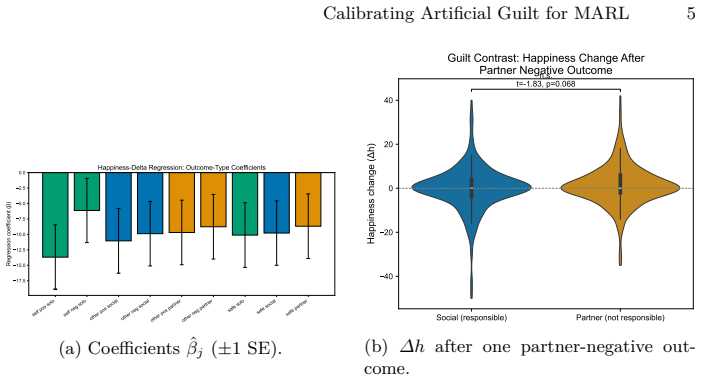
The central object is the guilt-weight contrast $w := \beta_{\text{partner negative}} - \beta_{\text{social negative}}$, recovered from Eq. (1), a subject-fixed-effects ordinary least squares regression of happiness changes on nine outcome-type counts following the momentary-well-being model of Rutledge and colleagues. This scalar is inserted into the shaped reward of Eq. (4), where it scales the partner-shortfall penalty $\Delta_p = \max(0, EV - r_p)$ when the decider chooses risky. Two two-layer MLP PPO actor-critics, one per agent, are trained with fixed hyperparameters across conditions, isolating the effect of $w$ on the learned safe rate and the KL divergence to human choices.
What would settle it
Re-run the same training pipeline with $w$ drawn from the estimated contrast's error distribution (for example $w\in\{0, 0.5, 1.118, 5\}$) and check whether the KL divergence to human choices remains in the reported regime; or retrain holding all hyperparameters fixed while rescaling every reward by a constant factor (for instance $c=300$ in Eqs. (3) and (4)) and see whether the same $w=1.118$ still yields $\mathrm{KL}=0.0012$. If it does not, the calibrated value depends on arbitrary reward scaling rather than on the human data. A complementary check is to re-estimate $w$ on a hold-out half of the 40 participants and test whether the transferred value remains near 1.118.
Extended reading notes
Core claim
On its own terms, the paper establishes a calibration pipeline: a behavioural contrast from a published fMRI dataset, defined as the difference between how much a partner's negative outcome lowers momentary happiness when the participant was responsible (Social) versus when the partner chose (Partner), is estimated as a scalar $\hat{w}=1.118$ and used directly as the penalty weight in the shaped reward $R_d(s,a)=\frac{1}{c}(r_d - w\,\Delta_p\,\mathbb{I}\{a=\text{Risky}\})$. Under identical PPO hyperparameters, this single empirically derived coefficient produces a learned policy whose safe-choice distribution is closer to the human Social distribution than baselines using $w=0$, $0.5$, or $1$, with $\mathrm{KL}(P_{\text{human}}\|P_{\text{agent}})=0.0012$. The authors' claim is that magnitude calibrates what functional form only specifies: human neurobehavioural priors can act as quantitative constraints on prosocial reward shaping.
Load-bearing premise
The load-bearing premise is that a happiness-regression coefficient measured in happiness points per outcome event can be used directly as a monetary penalty weight in the reward function, with no unit conversion, scaling, or derived justification; the coefficient's standard error is 7.39 and its one-sided p-value is 0.44, so the transferred quantity is not statistically distinguishable from zero.
Editorial extensions
If this is right
- Designers can replace sweeps over social penalty magnitude with a single measurement from open human datasets, at least for moral signals with known neural and behavioural signatures.
- Alignment is not just about the functional form of a social term but about its scale, and welfare-based evaluation alone can mis-rank policies relative to human preferences (here Zero scores highest in welfare yet is farthest from human choice).
- The same pipeline could be applied to other contrasts, such as inequity aversion or guilt aversion from psychological games, to test whether human-derived coefficients transfer across paradigms.
- The label 'neurally grounded' points toward reusing subject-specific neural betas, such as anterior insula responses, instead of the behavioural regression, as stronger priors for the shaping weight.
Reading between the lines
- The specific value 1.118 is fragile: its standard error is 7.39 and the one-sided p-value is 0.44, so a wide window of $w$ values could plausibly produce similar KL alignment; the reported comparison between $w=1.118$ and $w=1$ rests on a single training seed and may partly reflect stochastic variation.
- The transfer assumes an unstated unit conversion: happiness points per outcome event are treated as payoff units with no scaling law. A natural test would vary the normalizer $c$ or the reward magnitude and check whether the same $w$ remains the best alignment, which would reveal whether the transfer is unit-free or an artefact of the chosen reward scale.
- A stronger test of the 'neural grounding' claim would be to estimate the guilt weight from subject-level anterior insula betas in the same dataset, or to sample $w$ from the contrast's error distribution across many training runs and check whether the reported alignment holds on average.
Editorial analysis
A structured set of objections, weighed in public.
Referee Report
Summary. The paper proposes a pipeline that calibrates a guilt penalty weight for multi-agent reinforcement learning from a happiness-regression contrast in the public SoDec responsibility dataset, embeds this weight in a two-agent Social Lottery environment, and trains independent PPO agents under four shaping regimes. The authors report that the neurally calibrated weight (w=1.118) yields a safe rate of 0.459, closest to the human Social rate of 0.484 among all conditions, and claim that human neurobehavioural priors can thereby act as quantitative constraints on prosocial reward shaping.
Significance. If the central claim were established, the paper would offer a lightweight alternative to preference-based alignment by reusing public neurobehavioural data to set a single reward-shaping coefficient. The paper has several commendable features: it is based on an open dataset, the experimental protocol fixes hyperparameters across conditions, and the comparison against a selfish baseline and two designer-chosen coefficients is clearly described. However, the load-bearing statistical and unit issues described below mean that the current evidence does not support the claim that the neurobehavioural prior quantitatively constrains the shaping.
major comments (4)
- [§3.2, Eq. (2) and §3.3, Eq. (4)] The guilt weight w is a contrast of happiness-regression coefficients, measured in happiness points per outcome event, but it is inserted directly as the multiplier on the monetary shortfall Δp in the shaped reward. No conversion factor or derivation connects happiness points to the reward units, so the numerical value 1.118 has no human-derived meaning unless one assumes an arbitrary commensurability between the two scales. This is not a presentation issue: because the PPO policy depends on the relative scale of w and the payoff normalization, any scalar could be absorbed into the units. Compounding this, the estimate is statistically indistinguishable from zero: the pooled SE is 7.39 and the one-sided p is 0.44, implying a 95% confidence interval of roughly (-13.4, 15.6). The reported KL advantage at w=1.118 therefore does not demonstrate that the neurobehavioural data constrains the shaping; a wide range of arbitrary scalars would produce similar behaviour.
- [§5, Table 3 and Fig. 5] The headline KL comparison uses the human Social safe rate (0.484) computed from the same ds005588 dataset that was used to fit the guilt weight w in Eq. (2). The calibration and evaluation are therefore in-sample; no held-out human data, cross-validation, or independent human sample is used. This circularity means the reported KL=0.0012 is an in-sample fit, not a predictive match, and it undermines the claim that the calibrated agents 'track' human behaviour in a way that would generalize to new participants or tasks.
- [§3.3, Eq. (4) and c=30] The effective penalty scale in Eq. (4) is w/c because the whole reward is normalized by c, which is set to 30 with no stated justification. The paper does not test sensitivity of the safe rate to c, even though changing c is equivalent to changing w. Since the calibrated value is only identified up to the arbitrary normalizer, the claim that the data provide a 'quantitative constraint' on the shaping weight is not robust. Similarly, the risky half-spread distribution |N(15,5)| is a free parameter that changes the reward statistics and is not varied or justified from the dataset.
- [§1 and §3.1] The title, abstract, and introduction repeatedly refer to 'neurally grounded' and 'neurobehavioural' priors, but the pipeline itself uses only the behavioural event records from ds005588; no BOLD data, neural measures, or imaging-derived quantities enter the calibration. The connection to the anterior insula is purely citational. Given that the paper explicitly states it does not re-analyse BOLD maps, the neural grounding is nominal, which substantially overstates the contribution and could mislead readers about what was transferred.
minor comments (4)
- [§3.2, Fig. 2] The figures appear to use non-rendered Unicode glyphs in the PDF, which makes the coefficient plots and contrast distributions very hard to read; please provide vector graphics with proper symbol rendering.
- [§5, Table 3] Reporting confidence intervals or bootstrap ranges for the safe rate and KL would help readers assess variability across evaluation seeds; the current table gives only means and SDs for some metrics.
- [§3.4] A code repository link and the exact random seeds used for training and evaluation would improve reproducibility; the current text mentions seed 42 but not a public artifact.
- [§6] The 'practical reading' recommends sweeping less and measuring more, but the paper does not demonstrate that the measured scale is reliable because the underlying estimate is non-significant; the recommendation should be tempered accordingly.
Circularity Check
No significant circularity: the happiness-regression contrast is used as a reward coefficient, but the safe-rate match is not forced by construction.
full rationale
The claimed derivation chain is: fit Eq. (1) happiness regressions on ds005588, define w in Eq. (2) as a coefficient contrast, insert the same symbol w into the shaped reward Eq. (4), train PPO, and compare the resulting safe rate to the human Social safe rate 0.484 from the same dataset. None of these steps makes the target safe rate equal to the fitted w by definition. The regression target is momentary happiness, not choice rate; w is not optimized to minimize KL to 0.484; and the agent safe rate is an emergent property of PPO under Eq. (4). Thus there is no self-definition, no fitted parameter renamed as a prediction, and no load-bearing self-citation (the cited happiness and imaging works are external). The in-sample nature of the benchmark (w and P_H,Social both come from ds005588) and the acknowledged non-significance of the contrast (SE=7.39, p=0.44) are real validity limitations, as are the unstated unit conversion from happiness points to reward units and the hand-chosen c=30; these are correctness/robustness concerns, not circularity. The paper is also transparent that neural betas are unused despite the 'Neurally Grounded' title. Under the rule that only explicit reductions count as circularity, the appropriate score is 0.
Assumptions & free parameters
free parameters (3)
- guilt weight w_hat =
1.118
- observation normalizer c =
30
- risky half-spread distribution =
|N(15, 5)|
assumptions (4)
- domain assumption Momentary happiness changes are a linear function of outcome-type counts.
- ad hoc to paper A happiness-regression coefficient can serve as a monetary reward-shaping weight.
- domain assumption The human Social safe rate from ds005588 is the appropriate alignment target.
- domain assumption The contrast captures interpersonal guilt transferable to agents.
Cite this review
Pith. "Pith review of Calibrating Artificial Guilt: Neurally Grounded Reward Shaping for Prosocial Multi-Agent Reinforcement Learning." pith.science (2026). https://pith.science/paper/FWF47FHD
@misc{pith2026260804663,
  author       = {Pith},
  title        = {Pith review of: Calibrating Artificial Guilt: Neurally Grounded Reward Shaping for Prosocial Multi-Agent Reinforcement Learning},
  year         = {2026},
  howpublished = {\url{https://pith.science/paper/FWF47FHD}},
  note         = {Machine review of arXiv:2608.04663}
}
abstract
Cooperative multi-agent reinforcement learning often adds social terms to individual rewards, yet the scale of those terms is usually chosen by hand. We ask whether a guilt signal can instead be calibrated from human neural and behavioural data and transferred to artificial agents. Using the public SoDec responsibility fMRI dataset (40 participants), we fit a subject-fixed-effects regression of momentary-happiness changes on outcome-type counts and recover a guilt weight as the Partner-negative minus Social-negative contrast ($\hat{w}=1.118$, Cohen's $d=0.214$). We embed this weight in a two-agent Social Lottery environment and train independent Proximal Policy Optimization actor-critics under four shaping regimes: neurally calibrated, uniform constant, zero (selfish), and a unit-coefficient oracle. Across 1{,}000 evaluation episodes per condition, the calibrated agents track the human Social safe-choice rate most closely ($0.459$ vs.\ human $0.484$; $\mathrm{KL}=0.0012$), while the other three conditions deviate by one to three orders of magnitude in KL. Human neurobehavioural priors can therefore act as quantitative constraints on prosocial reward shaping.
Figures


Figures from the paper (2 more)


Reference graph
Works this paper leans on
-
[1]
In: Proceed- ings of the Twenty-First International Conference on Machine Learning
Abbeel, P., Ng, A.Y.: Apprenticeship learning via inverse reinforcement learning. In: Proceed- ings of the Twenty-First International Conference on Machine Learning. p. 1. ICML ’04, Associ- ation for Computing Machinery, New York, NY, USA (2004). https://doi.org/10.1145/1015330. 1015430
doi:10.1145/1015330 2004
-
[2]
Bai, Y., Kadavath, S., Kundu, S., Askell, A., Kernion, J., Jones, A., Chen, A., Goldie, A., Mirho- seini, A., McKinnon, C., Chen, C., Olsson, C., Olah, C., Hernandez, D., Drain, D., Ganguli, D., Li, D., Tran-Johnson, E., Perez, E., Kerr, J., Mueller, J., Ladish, J., Landau, J., Ndousse, K., Lukoši¯ ut˙ e, K., Lovitt, L., Sellitto, M., Elhage, N., Schiefer...
arXiv 2022
-
[3]
The American Economic Review97, 170–176 (2007)
Battigalli, P., Dufwenberg, M.A.: Guilt in games. The American Economic Review97, 170–176 (2007)
work page 2007
-
[4]
The American Economic Review 90(1), 166–193 (2000)
Bolton, G.E., Ockenfels, A.: Erc: A theory of equity, reciprocity, and competition. The American Economic Review 90(1), 166–193 (2000)
work page 2000
-
[5]
Botvinick, M., Wang, J.X., Dabney, W., Miller, K.J., Kurth-Nelson, Z.: Deep reinforcement learning and its neuroscientific implications (2020)
work page 2020
-
[6]
Burda, Y., Edwards, H., Storkey, A.J., Klimov, O.: Exploration by random network distillation. ArXiv abs/1810.12894 (2018)
arXiv 2018
-
[7]
Neuron70(3), 560–572 (May 2011)
Chang, L., Smith, A., Dufwenberg, M., Sanfey, A.: Triangulating the neural, psychological, and economic bases of guilt aversion. Neuron70(3), 560–572 (May 2011). https://doi.org/10.1016/ j.neuron.2011.02.056
work page 2011
-
[8]
Econometrica 74(6), 1579–1601 (2006)
Charness, G., Dufwenberg, M.: Promises and partnership. Econometrica 74(6), 1579–1601 (2006)
work page 2006
Show all 56 references
-
[9]
The Quarterly Journal of Economics117(3), 817–869 (2002)
Charness, G., Rabin, M.: Understanding social preferences with simple tests. The Quarterly Journal of Economics117(3), 817–869 (2002)
2002
-
[10]
In: Proceedings of the 31st International Conference on Neural Information Processing Systems
Christiano, P.F., Leike, J., Brown, T.B., Martic, M., Legg, S., Amodei, D.: Deep reinforcement learning from human preferences. In: Proceedings of the 31st International Conference on Neural Information Processing Systems. p. 4302–4310. NIPS’17, Curran Associates Inc., Red Hoo...
2017
-
[11]
ArXivabs/2012.08630 (2020)
Dafoe, A., Hughes, E., Bachrach, Y., Collins, T., McKee, K.R., Leibo, J.Z., Larson, K., Graepel, T.: Open problems in cooperative ai. ArXivabs/2012.08630 (2020)
2020 arXiv
-
[12]
ArXivabs/1903.08082 (2019)
Eccles, T., Hughes, E., Kramár, J., Wheelwright, S., Leibo, J.Z.: Learning reciprocity in complex sequential social dilemmas. ArXivabs/1903.08082 (2019)
2019 arXiv
-
[13]
Nature protocols15, 2186 – 2202 (2019)
Esteban, O., Ciric, R., Finc, K., Blair, R.W., Markiewicz, C.J., Moodie, C.A.S., Kent, J.D., Goncalves, M., Dupre, E., Gomez, D.E.P., Ye, Z., Salo, T., Valabrègue, R., Amlien, I.K., Liem, F., Jacoby, N., Stojić, H., Cieslak, M., Urchs, S., Halchenko, Y.O., Ghosh, S.S., de la V...
2019
-
[14]
ArXivabs/1802.06070 (2018)
Eysenbach, B., Gupta, A., Ibarz, J., Levine, S.: Diversity is all you need: Learning skills without a reward function. ArXivabs/1802.06070 (2018)
2018 arXiv
-
[15]
Munich Reprints in Economics 4 (1998)
Fehr, E., Schmidt, K.M.: A theory of fairness, competition and cooperation. Munich Reprints in Economics 4 (1998)
1998
-
[16]
In: Adaptive Agents and Multi-Agent Systems (2017)
Foerster, J.N., Chen, R.Y., Al-Shedivat, M., Whiteson, S., Abbeel, P., Mordatch, I.: Learning with opponent-learning awareness. In: Adaptive Agents and Multi-Agent Systems (2017)
2017
-
[17]
eLife 14 (Mar 2026)
Gädeke, M., Willems, T.E., Ahmed, O.S., Weber, B., Hurlemann, R., Schultz, J.: Contribu- tions of insula and superior temporal sulcus to interpersonal guilt and responsibility in social decisions. eLife 14 (Mar 2026). https://doi.org/10.7554/elife.105391
2026 doi
-
[18]
Scientific Data3(1) (2016)
Gorgolewski, K.J., Auer, T., Calhoun, V.D., Craddock, R.C., Das, S., Duff, E.P., Flandin, G., Ghosh, S.S., Glatard, T., Halchenko, Y.O., Handwerker, D.A., Hanke, M., Keator, D., Li, X., Michael, Z., Maumet, C., Nichols, B.N., Nichols, T.E., Pellman, J., Poline, J.B., Rokem, A....
2016
-
[19]
In: Neural Information Processing Systems (2016)
Hadfield-Menell, D., Russell, S.J., Abbeel, P., Dragan, A.D.: Cooperative inverse reinforcement learning. In: Neural Information Processing Systems (2016)
2016
-
[20]
Neuron 95(2), 245–258 (2017)
Hassabis, D., Kumaran, D., Summerfield, C., Botvinick, M.: Neuroscience-inspired artificial intelligence. Neuron 95(2), 245–258 (2017). https://doi.org/10.1016/j.neuron.2017.06.011 Calibrating Artificial Guilt for MARL 11
2017 doi
-
[21]
Autonomous Agents and Multi-Agent Systems33(6), 750–797 (Nov 2019)
Hernandez-Leal, P., Kartal, B., Taylor, M.E.: A survey and critique of multiagent deep rein- forcement learning. Autonomous Agents and Multi-Agent Systems33(6), 750–797 (Nov 2019). https://doi.org/10.1007/s10458-019-09421-1
2019 doi
-
[22]
In: Proceedings of the 32nd International Conference on Neural Information Processing Systems
Hughes, E., Leibo, J.Z., Phillips, M., Tuyls, K., Dueñez-Guzman, E., Castañeda, A.G., Dunning, I., Zhu, T., McKee, K., Koster, R., Roff, H., Graepel, T.: Inequity aversion improves coopera- tion in intertemporal social dilemmas. In: Proceedings of the 32nd International Confer...
2018
-
[23]
In: International Conference on Machine Learning (2018)
Jaques, N., Lazaridou, A., Hughes, E., Çaglar Gülçehre, Ortega, P.A., Strouse, D., Leibo, J.Z., de Freitas, N.: Social influence as intrinsic motivation for multi-agent deep reinforcement learn- ing. In: International Conference on Machine Learning (2018)
2018
-
[24]
Journal of Cognitive Neuroscience25, 258–272 (2013)
Koban, L., Corradi-Dell’Acqua, C., Vuilleumier, P.: Integration of error agency and represen- tation of others’ pain in the anterior insula. Journal of Cognitive Neuroscience25, 258–272 (2013)
2013
-
[25]
Koster, R., Balaguer, J., Tacchetti, A., Weinstein, A., Zhu, T., Hauser, O., Williams, D., Campbell-Gillingham, L., Thacker, P., Botvinick, M., Summerfield, C.: Human-centered mech- anism design with democratic ai (2022)
2022
-
[26]
In: Proceedings of the 31st International Conference on Neural Information Processing Systems
Lanctot, M., Zambaldi, V., Gruslys, A., Lazaridou, A., Tuyls, K., Pérolat, J., Silver, D., Graepel, T.: A unified game-theoretic approach to multiagent reinforcement learning. In: Proceedings of the 31st International Conference on Neural Information Processing Systems. p. 419...
2017
-
[27]
In: Proceedings of the 16th Conference on Autonomous Agents and MultiAgent Systems
Leibo, J.Z., Zambaldi, V., Lanctot, M., Marecki, J., Graepel, T.: Multi-agent reinforcement learning in sequential social dilemmas. In: Proceedings of the 16th Conference on Autonomous Agents and MultiAgent Systems. p. 464–473. AAMAS ’17, International Foundation for Au- tonom...
2017
-
[28]
ArXivabs/1811.07871 (2018)
Leike, J., Krueger, D., Everitt, T., Martic, M., Maini, V., Legg, S.: Scalable agent alignment via reward modeling: a research direction. ArXivabs/1811.07871 (2018)
2018 arXiv
-
[29]
ArXivabs/1707.01068 (2017)
Lerer, A., Peysakhovich, A.: Maintaining cooperation in complex social dilemmas using deep reinforcement learning. ArXivabs/1707.01068 (2017)
2017 arXiv
-
[30]
ArXivabs/1706.02275 (2017)
Lowe, R., Wu, Y., Tamar, A., Harb, J., Abbeel, P., Mordatch, I.: Multi-agent actor-critic for mixed cooperative-competitive environments. ArXivabs/1706.02275 (2017)
2017 arXiv
-
[31]
Frontiers in Computational Neuroscience10 (2016)
Marblestone, A.H., Wayne, G., Kording, K.P.: Toward an integration of deep learning and neuroscience. Frontiers in Computational Neuroscience10 (2016)
2016
-
[32]
eLife10(Oct 2021)
Markiewicz, C.J., Gorgolewski, K.J., Feingold, F., Blair, R., Halchenko, Y.O., Miller, E., Hard- castle, N., Wexler, J., Esteban, O., Goncavles, M., Jwa, A., Poldrack, R.: The openneuro re- source for sharing of neuroscience data. eLife10(Oct 2021). https://doi.org/10.7554/elife.71774
2021 doi
-
[33]
Proceedings of the Na- tional Academy of Sciences103, 15623 – 15628 (2006)
Moll, J., Krueger, F., Zahn, R., Pardini, M., de Oliveira-Souza, R., Grafman, J.H.: Human fronto–mesolimbic networks guide decisions about charitable donation. Proceedings of the Na- tional Academy of Sciences103, 15623 – 15628 (2006)
2006
-
[34]
In: International Conference on Machine Learning (1999)
Ng, A., Harada, D., Russell, S.J.: Policy invariance under reward transformations: Theory and application to reward shaping. In: International Conference on Machine Learning (1999)
1999
-
[35]
In: International Confer- ence on Machine Learning (2000)
Ng, A.Y., Russell, S.J.: Algorithms for inverse reinforcement learning. In: International Confer- ence on Machine Learning (2000)
2000
-
[36]
In: Proceedings of the 36th International Conference on Neural Information Processing Systems
Ouyang, L., Wu, J., Jiang, X., Almeida, D., Wainwright, C.L., Mishkin, P., Zhang, C., Agarwal, S., Slama, K., Ray, A., Schulman, J., Hilton, J., Kelton, F., Miller, L., Simens, M., Askell, A., Welinder, P., Christiano, P., Leike, J., Lowe, R.: Training language models to follo...
2022
-
[37]
2017 IEEE Conference on Computer Vision and Pattern Recognition Workshops (CVPRW) pp
Pathak, D., Agrawal, P., Efros, A.A., Darrell, T.: Curiosity-driven exploration by self-supervised prediction. 2017 IEEE Conference on Computer Vision and Pattern Recognition Workshops (CVPRW) pp. 488–489 (2017)
2017
-
[38]
In: Proceedings of the 31st International Conference on Neural Information Processing Systems
Perolat, J., Leibo, J.Z., Zambaldi, V., Beattie, C., Tuyls, K., Graepel, T.: A multi-agent rein- forcement learning model of common-pool resource appropriation. In: Proceedings of the 31st International Conference on Neural Information Processing Systems. p. 3646–3655. NIPS’17...
2017
-
[39]
In: Proceedings of the 17th International Conference on Autonomous Agents and MultiAgent Systems
Peysakhovich, A., Lerer, A.: Prosocial learning agents solve generalized stag hunts better than selfish ones. In: Proceedings of the 17th International Conference on Autonomous Agents and MultiAgent Systems. p. 2043–2044. AAMAS ’18, International Foundation for Autonomous Agen...
2018
-
[40]
The American Economic Review 83(5), 1281–1302 (1993)
Rabin, M.: Incorporating fairness into game theory and economics. The American Economic Review 83(5), 1281–1302 (1993)
1993
-
[41]
Rashid, T., Samvelyan, M., De Witt, C.S., Farquhar, G., Foerster, J., Whiteson, S.: Monotonic value function factorisation for deep multi-agent reinforcement learning. J. Mach. Learn. Res. 21(1) (Jan 2020)
2020
-
[42]
Neural Comput
Rodriguez-Soto, M., Lopez-Sanchez, M., Rodriguez-Aguilar, J.A.: Multi-objective reinforce- ment learning for designing ethical multi-agent environments. Neural Comput. Appl.37(31), 25619–25644 (Aug 2023). https://doi.org/10.1007/s00521-023-08898-y 12 A. Mehta et al
2023 doi
-
[43]
Proceedings of the National Academy of Sciences111(33), 12252–12257 (2014)
Rutledge, R.B., Skandali, N., Dayan, P., Dolan, R.J.: A computational and neural model of momentary subjective well-being. Proceedings of the National Academy of Sciences111(33), 12252–12257 (2014). https://doi.org/10.1073/pnas.1407535111
2014 doi
-
[44]
ArXiv abs/1707.06347 (2017)
Schulman, J., Wolski, F., Dhariwal, P., Radford, A., Klimov, O.: Proximal policy optimization algorithms. ArXiv abs/1707.06347 (2017)
2017 arXiv
-
[45]
https://doi.org/10.18112/ OPENNEURO.DS005588.V1.0.1
Schultz, Johannes, Gädeke, Maria, Willems, Tom, Ahmed, Omar Salah, Hurlemann, René, We- ber, Bernd: Sodec - responsibility fmri experiment dataset (2025). https://doi.org/10.18112/ OPENNEURO.DS005588.V1.0.1
2025
-
[46]
In: Proceedings of the 17th International Conference on Autonomous Agents and MultiAgent Systems
Sunehag, P., Lever, G., Gruslys, A., Czarnecki, W.M., Zambaldi, V., Jaderberg, M., Lanctot, M., Sonnerat, N., Leibo, J.Z., Tuyls, K., Graepel, T.: Value-decomposition networks for cooperative multi-agent learning based on team reward. In: Proceedings of the 17th International ...
2018
-
[47]
Terry, J.K., Black, B., Jayakumar, M., Hari, A., Santos, L., Dieffendahl, C., Williams, N.L., Lokesh, Y., Sullivan, R., Horsch, C., Ravi, P.: Pettingzoo: Gym for multi-agent reinforcement learning (2021)
2021
-
[48]
Towers, M., Kwiatkowski, A., Terry, J., Balis, J.U., Cola, G.D., Deleu, T., Goulão, M., Kallinteris, A., Krimmel, M., KG, A., Perez-Vicente, R., Pierré, A., Schulhoff, S., Tai, J.J., Tan, H., Younis, O.G.: Gymnasium: A standard interface for reinforcement learning environ- men...
2025
-
[49]
Nature575, 350 – 354 (2019)
Vinyals, O., Babuschkin, I., Czarnecki, W.M., Mathieu, M., Dudzik, A.J., Chung, J., Choi, D., Powell, R., Ewalds, T., Georgiev, P., Oh, J., Horgan, D., Kroiss, M., Danihelka, I., Huang, A., Sifre, L., Cai, T., Agapiou, J.P., Jaderberg, M., Vezhnevets, A.S., Leblond, R., Pohlen...
2019
-
[50]
Cerebral Cortex21(11), 2461–2470 (Mar 2011)
Wagner, U., N’Diaye, K., Ethofer, T., Vuilleumier, P.: Guilt-specific processing in the prefrontal cortex. Cerebral Cortex21(11), 2461–2470 (Mar 2011). https://doi.org/10.1093/cercor/bhr016
2011 doi
-
[51]
Wang, J.X., Hughes, E., Fernando, C., Czarnecki, W.M., Duenez-Guzman, E.A., Leibo, J.Z.: Evolving intrinsic motivations for altruistic behavior (2019)
2019
-
[52]
Nature Neuroscience 21(6), 860–868 (May 2018)
Wang, J.X., Kurth-Nelson, Z., Kumaran, D., Tirumala, D., Soyer, H., Leibo, J.Z., Hassabis, D., Botvinick, M.: Prefrontal cortex as a meta-reinforcement learning system. Nature Neuroscience 21(6), 860–868 (May 2018). https://doi.org/10.1038/s41593-018-0147-8
2018 doi
-
[53]
Wiewiora, E.: Potential-based shaping and q-value initialization are equivalent. J. Artif. Int. Res. 19(1), 205–208 (Sep 2003)
2003
-
[54]
In: Proceedings of the 36th International Conference on Neural Information Processing Systems
Yu, C., Velu, A., Vinitsky, E., Gao, J., Wang, Y., Bayen, A., Wu, Y.: The surprising effectiveness of ppo in cooperative multi-agent games. In: Proceedings of the 36th International Conference on Neural Information Processing Systems. NIPS ’22, Curran Associates Inc., Red Hook...
2022
-
[55]
Social Cognitive and Affective Neuroscience9(8), 1150–1158 (Aug 2013)
Yu, H., Hu, J., Hu, L., Zhou, X.: The voice of conscience: neural bases of interpersonal guilt and compensation. Social Cognitive and Affective Neuroscience9(8), 1150–1158 (Aug 2013). https://doi.org/10.1093/scan/nst090
2013 doi
-
[56]
Cerebral Cortex19(2), 276–283 (May 2008)
Zahn, R., Moll, J., Paiva, M., Garrido, G., Krueger, F., Huey, E.D., Grafman, J.: The neural basis of human social values: Evidence from functional mri. Cerebral Cortex19(2), 276–283 (May 2008). https://doi.org/10.1093/cercor/bhn080
2008 doi
Reviewed August 6, 2026 · model on record in the stance chip above.
Discussion (0). Sign in to comment.