REVIEW 3 major objections 5 minor 145 references
Scaling behavior in non-reciprocal and odd conserved dynamics near criticality
T0 review · 3 major / 5 minor · reviewed 2026-08-06 · deepseek-v4-flash
Pith's one-line read Near the critical point of a non-reciprocally coupled conserved mixture, static and dynamic correlations are controlled by two different diverging length scales: a Wilson-Fisher length set by temperature and a new dynamic length set by…
desk verdict Serious RG paper with a plausible two-length-scale picture; the new dynamic exponent is real at leading order but the O(ε²) claim rests on an unverified scaling-hypothesis step. read the letter →
The pith
A machine-rendered reading of the paper's core claim, the machinery that carries it, and where it could break.
The reading
What carries the argument
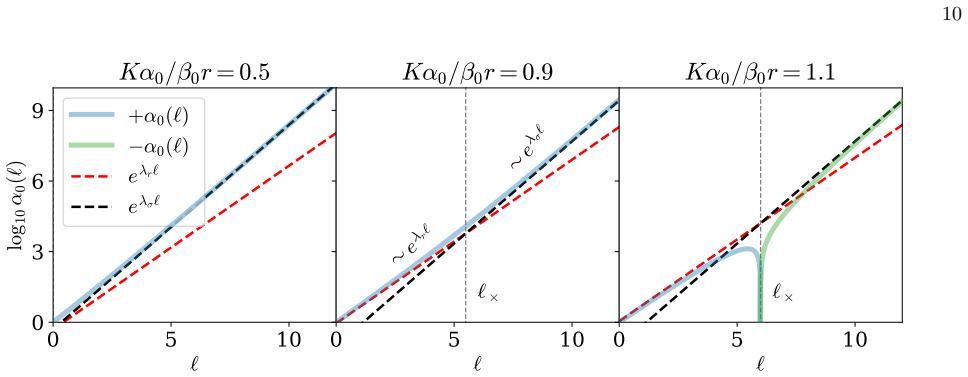
The load-bearing object is the pair of correlation lengths defined from the equal-time correlation function and from the total linear response, $\xi_s$ and $\xi_d$. In the linear theory they satisfy $\xi_s = \sqrt{K/r}$ and $\xi_d = \sqrt{(K+i\beta_0)/(r+i\alpha_0)}$, so any nonzero non-reciprocal coupling makes them differ. The argument is carried by a response-field path-integral representation of the NRCH Langevin dynamics, renormalized with a momentum-shell scheme at one loop and a Callan-Symanzik scheme at two loops, using dimensional regularization. The key identity is the potential condition $f_{\rm eq} \propto f_{\rm nr}$, i.e. $\alpha_1/u = \beta_0/K = \alpha_0/r = \theta$, which defines the odd Cahn-Hilliard (OCH) model with odd mobility $\Upsilon_{ab} = \delta_{ab} + \theta \varepsilon_{ab}$; on this line the system has a Boltzmann-like steady state and a fluctuation-dissipation-like identity. The central result follows from the eigenvalues of the RG flow at the OCH fixed point: $r$ and $\sigma = \alpha_0 - \theta r$ are both relevant directions, with $\lambda_r = 2 - 2\epsilon/5$ and $\lambda_\sigma = 2$, producing the scaling hypothesis $\xi_d(\alpha_0,r) = r^{-\nu} G_{\sigma r}(\sigma/r^\Delta)$ with gap exponent $\Delta = \nu/\nu_n = 1+\epsilon/5$.
What would settle it
Simulate the NRCH Langevin equations numerically near the critical point in $d=3$ and measure the decay of the equal-time correlation $C^{ET}(x)$ and of the total linear response $\chi^T(x)$; if $\xi_d$ does not scale as $r^{-\nu_n}$ or $|\alpha_0-\theta r|^{-\nu_n}$ with $\nu_n \approx 1/2$ while $\xi_s \sim r^{-\nu}$ with $\nu \approx 0.6$, the central claim fails. A cheaper check is to recompute the two-loop integrals $H_1$ and $H_2$ with an independent regularization scheme and verify that the OCH fixed point remains unstable with $\omega_\mu = 2\epsilon/5$.
Extended reading notes
Core claim
Using one-loop momentum-shell and two-loop Callan-Symanzik renormalization group calculations, the paper shows that the NRCH critical point is characterized by two correlation lengths. The equal-time correlation function gives $\xi_s \sim r^{-\nu}$ with the Wilson-Fisher exponent $\nu = 1/2 + \epsilon/10$ and anomalous dimension $\eta = \epsilon^2/50$, matching equilibrium model B. The linear response function instead gives $\xi_d$, which in the effective-equilibrium regime also scales as $r^{-\nu}$, but in the manifestly non-reciprocal regime scales as $r^{-\nu_n}$ or $|\alpha_0-\theta r|^{-\nu_n}$ with the new exponent $\nu_n = 1/2 + O(\epsilon^2)$. This difference is a direct signature of broken time-reversal symmetry: the fluctuation-dissipation theorem no longer ties correlation and response together. The RG analysis identifies an odd Cahn-Hilliard (OCH) fixed point, where the dynamics obeys the potential conditions and has a Boltzmann-like steady state with odd mobility, but this fixed point is unstable; generic systems flow to stable non-reciprocal fixed points NR$\pm$, at which $\alpha_0$ scales as its own relevant direction. Because $\nu_n < \nu$, the dynamic correlation length grows more slowly than the static one, and the crossover between regimes occurs at a length $\xi_\times \sim |K\alpha_0/(\beta_0 r)-1|^{-1/\omega_\mu}$ with $\omega_\mu = 2\epsilon/5$.
Load-bearing premise
The two-loop renormalization-group calculation—in particular the flow of the non-reciprocal stiffness $\beta_0$ and the anomalous dimension $\eta$—is assumed correct without independent numerical or experimental verification; an error in those integrals would change the stability of the OCH fixed point and the value of $\nu_n$.
Editorial extensions
If this is right
- In the manifestly non-reciprocal regime, the dynamic correlation length diverges with exponent $\nu_n = 1/2+O(\epsilon^2)$, so the response length and the static structure length no longer coincide; this is an observable time-reversal-breaking signature.
- The non-reciprocal coupling $\alpha_0$ is a relevant tuning parameter, meaning catalytic reaction rates can drive the system across its critical region just as temperature does.
- Since the dynamic exponent is $z = 4 - \eta$ with $\eta = \epsilon^2/50$, the response time $T_d \sim \xi_d^z$ is extremely sensitive to the tuning parameters, so a modest change in $\alpha_0$ can sharply speed up or slow down the response.
- In the effective-equilibrium regime the model recovers model B scaling ($\xi_d \sim \xi_s \sim r^{-\nu}$, FDT satisfied), so the new behavior is confined to scales beyond the crossover length $\xi_\times$.
- The OCH fixed point describes a conserved, equilibrium-like odd-mobility dynamics with a Boltzmann steady state, but it is unstable; generic conserved non-reciprocal systems flow to the NR$\pm$ fixed points at large scales.
Reading between the lines
- Editorial extension: if $\nu_n = 1/2 + O(\epsilon^2)$ holds beyond two loops, then in $d=3$ the dynamic correlation length diverges with a smaller exponent than the static one, so near criticality the response function would appear short-ranged even where equal-time correlations look critical; a measurement separating these two decays would be a sharp test.
- Editorial extension: the same two-length mechanism should appear in any conserved field theory with broken time-reversal symmetry, for example active model B+ or chiral active matter; the paper's potential-condition analysis suggests the OCH line is the only place FDT-like behavior survives.
- Editorial extension: the crossover length $\xi_\times$ could be probed experimentally in chemically active colloid or enzyme mixtures by measuring the linear response and the static structure factor simultaneously and locating the scale where their decay lengths split.
- Editorial extension: a higher-order or non-perturbative RG check of the two-loop integrals (the $\beta_\kappa$ function and $\eta$) is the natural next step; if those integrals are wrong, the stability of the OCH fixed point and the value of $\nu_n$ would change, but the qualitative two-length picture would likely survive.
Editorial analysis
A structured set of objections, weighed in public.
Referee Report
Summary. The paper studies the non-reciprocal Cahn-Hilliard (NRCH) model near its critical point using perturbative dynamical renormalization group (RG) techniques, with both one-loop momentum-shell and two-loop Callan-Symanzik calculations. The authors identify a line of fixed points (the odd Cahn-Hilliard, OCH, fixed points) that satisfy a potential condition, and a pair of stable manifestly non-reciprocal fixed points (NR±). They argue that the structural correlation length ξ_s always scales with the Wilson-Fisher exponent ν = 1/2 + ε/10, while the dynamic correlation length ξ_d exhibits multiple scaling regimes: an effective-equilibrium regime where ξ_d ∼ ξ_s, and manifestly non-reciprocal regimes where ξ_d ∼ |σ|^{-ν_n} with ν_n = 1/2 + O(ε²), where σ = α0 − θr. The crossover between regimes is controlled by the gap exponent Δ = 1 + ε/5. The paper also derives two-loop results for the β-function of the nonreciprocal stiffness κ and the anomalous dimension η.
Significance. If the results hold, the prediction of two distinct correlation lengths with different scaling exponents in a conserved, non-reciprocal active system is conceptually important and potentially relevant for biological phase separation controlled by metabolic activity. The paper makes a serious technical effort: it presents two complementary RG schemes, provides explicit two-loop integral evaluations in the appendices, and produces falsifiable predictions (e.g., ξ_d ≠ ξ_s in the NR regimes, with a specific crossover exponent). The RG calculation is internally consistent at leading order, and the identification of the OCH fixed line and its instability is a useful contribution. However, the central claim that the NR-regime dynamic exponent is ν_n = 1/2 + O(ε²) rests on a scaling hypothesis around the OCH fixed point, not on a calculation at the NR± fixed points that actually control the NR regime; the paper itself calls for numerical or higher-order verification. This gap materially limits the current strength of the main claim.
major comments (3)
- [§IV B, Eqs. (125)–(126) and Appendix B 3] The exponent ν_n governing ξ_d in the manifestly non-reciprocal regime is taken from the OCH fixed point (Eq. (94), ν_n = 1/λ_σ with λ_σ = 2), but the NR regime is controlled by the NR± fixed points, not by OCH. At NR±, the paper gives only leading-order exponents (Eq. (126): γ'_r = 2ε/5, γ'_α0 = 0) and does not compute the scaling dimension of the σ direction at that fixed point. The crossover scaling form Eq. (90) and its asymptote G(s) ∼ |s|^{-ν_n} are therefore an assumption, not a derivation from the fixed point that governs the NR regime. Since the separation of length scales and the novel exponent are the central results, the authors must either compute the two-loop exponents at NR± (or otherwise derive the asymptote from the RG flow) or clearly state in the abstract and Table I that ν_n in the NR regime is a conjecture. As written, the claim exceeds what the calculation demonstrates.
- [Appendix B 3, sentence beginning 'We therefore surmise that X_s ∼ O(1)'] The structural correlation length is asserted to scale as ξ_s ∼ ξ_r = r^{-ν} with no dependence on σ. This is justified only by a surmise that the scaling function X_s(y) is O(1) over the relevant range of y. Because the paper's key qualitative conclusion is that ξ_s and ξ_d behave differently, an unverified O(1) assumption for ξ_s is load-bearing. The authors should at least compute the linear-level correction to X_s(y) and argue why it remains O(1) under renormalization, or explicitly frame the structural-length scaling as part of the same conjecture.
- [Table I and Section V] Table I lists ν_n = 1/2 + O(ε²) as a definite result for the αNR and r(S)NR regimes, while Section V admits that this is a conjecture requiring numerical or higher-order verification. This inconsistency between the presentation in the table and the stated status of the result should be resolved. The authors should either provide a derivation of the NR-regime exponent from the NR± fixed points, or mark the NR-regime entries as conjectural and adjust the abstract and conclusions accordingly.
minor comments (5)
- [Section III B, Eq. (68)] The notation D_d defined in Eq. (68) is easily confused with the noise amplitude D and the dimension d; consider using a different symbol or explicit wording.
- [Figure 2 caption] The caption refers to a 'yellow-and-black line' and a 'black dashed line' but the colors in the figure are described as black-and-yellow and dashed black; please make the descriptions consistent and unambiguous.
- [Appendix B 3, Eq. (B24) and Eq. (92)] The definition Δ ≡ 1 + ω_μ ν in Eq. (B24) is followed by Eq. (92) where Δ = ν/ν_n; the equivalence follows from ν_n = 1/λ_σ but is not stated explicitly, which can confuse the reader.
- [Throughout] Several references are to arXiv preprints (e.g., [20], [53], [58], [60], [128]); if the journal requires published references, please update where possible.
- [Section IV B, Eq. (121)] In Eq. (121), the OCH exponents are written as γ*_r = γ*_α0 = 2ε/5, but the text later notes that α0 and r have different eigenvalues; please clarify that these are the flow functions, not the eigenvalues, and that the eigenvalues differ as given in Eqs. (123)–(124).
Circularity Check
No significant circularity: the scaling exponents are computed from the paper's own RG flow equations and eigenvalue analysis; the scaling hypothesis is confirmed by Callan-Symanzik matching rather than fitted or defined into the result.
full rationale
The central exponents are derived, not fitted: ν=1/λr and νn=1/λσ from the Jacobian eigenvalues (Eqs. 93-94, 81, 123-124), and η=ε²/50 from the two-loop anomalous dimension (Eq. 119). The scaling hypothesis Eq. (90) is presented as a hypothesis, but it is independently re-derived in App. B3 from the Callan-Symanzik equation and the matching condition δμ(ℓr)=σ̂/r̂^Δ, which fixes Δ=1+ωμν and yields ξd=Λ^{-1} r̂^{-ν} X_d(σ̂/r̂^Δ) (Eq. B37). The NR-regime asymptote ξd∼|σ|^{-νn} follows from this scaling form with νn=ν/Δ=1/(λr+ωμ)=1/λσ; it is a consistency relation, not a fit. The paper cites prior work by the same group for the OCH model and restricted FDT (refs. [90,91]), but those results only characterize the OCH fixed point and are not used to fix the exponent values; the β-functions (Eqs. 114-117) and the two-loop integrals are computed in this paper. The caveat in Sec. V that numerical or higher-order verification is needed concerns the robustness of the two-loop/NR-regime conjecture and is an honest limitation, not a circular step.
Assumptions & free parameters
free parameters (1)
- θ = β_0/K (OCH fixed-line parameter)
assumptions (4)
- standard math Validity of perturbative ε-expansion and two-loop RG
- domain assumption NRCH with SO(2) symmetry and conserved dynamics describes the physical systems of interest
- ad hoc to paper The structural correlation length scaling function is assumed to be O(1), i.e., X_s ~ 1
- domain assumption Identification of the OCH fixed point with effective equilibrium via potential conditions and FDT from cited works [90,91]
invented entities (1)
-
Odd Cahn-Hilliard (OCH) fixed point / odd mobility
independent evidence
Cite this review
Pith. "Pith review of Scaling behavior in non-reciprocal and odd conserved dynamics near criticality." pith.science (2026). https://pith.science/paper/RNSRY7PZ
@misc{pith2026260805027,
  author       = {Pith},
  title        = {Pith review of: Scaling behavior in non-reciprocal and odd conserved dynamics near criticality},
  year         = {2026},
  howpublished = {\url{https://pith.science/paper/RNSRY7PZ}},
  note         = {Machine review of arXiv:2608.05027}
}
read the original abstract
In recent years, non-reciprocity has been explored as a ubiquitous manifestation of non-equilibrium activity at the microscopic scales for various active matter systems, from mixtures of chemically active enzymes, colloids, and droplets, to engineered light-controlled active colloids and robotic meta-materials. A commonly used minimal model to describe the dynamics of a binary mixture of conserved species with non-reciprocal interactions is the non-reciprocal Cahn-Hilliard (NRCH) model. The model is characterized by a temperature-like tuning parameter, which can trigger phase separation, and a non-reciprocal coupling, which can lead to the formation of spatio-temporal patterns, as it represents an intrinsic source of non-equilibrium activity and breaks parity and time-reversal symmetries. Here, we study the scaling behavior of the NRCH model near the critical point using perturbative dynamical renormalization group techniques. We find that structural and dynamical correlations are controlled by different correlation lengths, both of which diverge at the critical point, but governed by different scaling laws. In particular, while the structural correlations are always controlled by temperature and the classical Wilson-Fisher critical exponent, the dynamical correlation length exhibits multiple scaling regimes in which either temperature or non-reciprocal coupling can dominate as the key tuning parameter, with a new critical exponent characterizing the divergence. The critical point corresponds to a conserved equilibrium-like dynamics with odd mobility, which we denote as the odd Cahn-Hilliard (OCH) model. Our findings may have important implications on how living systems can control phase separation and spatio-temporal pattern formation using the rates of catalytic reactions, and in general metabolism, as control parameters.
Figures


Figures from the paper (5 more)


Reference graph
Works this paper leans on
- [130]
-
[1]
Conventions and definitions We use the following shorthand for the integrals throughout the text Z q ≡ Z ddq (2π)d , Z ω ≡ Z dω 2π ,(A1) Z x ≡ Z ddx, Z t ≡ Z dt.(A2) We also define the convenient shorthand δqδω = (2π)d+1δd(q)δ(ω).(A3) The geometric factor, where Ω d is the solid angle ind dimensions, is Ad ≡ Z dΩd (2π)d 1 = 2 (4π) d 2 Γ( d 2 ) = 1 8π2 +O(...
-
[2]
The latter is the linear response of the field to an external perturba- tion
Correlation lengths Consider the equal-time correlation function CET,ab(q)≡C ab(q, t= 0) = Z ω Cab(q, ω),(A5) and the total response function χT,ab(q)≡ Z t χab(q, t) =χab(q, ω= 0).(A6) The former represents the correlation between fluctua- tions at different points at the same time. The latter is the linear response of the field to an external perturba- t...
-
[3]
(1) can be repre- sented as a path-integral using the response field formal- ism [112–114]
Generating functionals The stochastic field theory Eq. (1) can be repre- sented as a path-integral using the response field formal- ism [112–114]. The expectation value of and operatorO is expressed as ⟨O[φ,˜φ]⟩= Z DφD˜φO[φ,˜φ]e−A[φ,˜φ].(A17) 5 Using identities 8.411.7 and 6.565.4 of Ref. [131]. 17 Here, ˜φa is an auxiliary variable called the response fi...
-
[4]
RG equation Regularization introduces an arbitrary scale, given by Λ. As discussed in Section IV, the CS equation is derived 6 It is a property of the minimal subtraction scheme that renor- malization factors depend only ong i, and not onrorα 0 directly. This is why the flow function forris considered separately—only the flow ofg i must vanish to reach a ...
-
[5]
(B9) gives r(ℓ) =re − R ℓ 0 dℓ′γr(g(ℓ′)).(B15) We now consider ˜N=N= 1
Fixed-point scaling form The CS equation is solved by ¯Γ( ˜N ,N) ab (q, ω; ¯gj,¯r,Λ) =e − R ℓ 0 dℓ′[dN, ˜N −N η(gj (ℓ′))] × ¯Γ( ˜N ,N) ab (eℓq, e4ℓω;g j(ℓ), e2ℓr(ℓ),Λ).(B14) In a similar way, the flow-function Eq. (B9) gives r(ℓ) =re − R ℓ 0 dℓ′γr(g(ℓ′)).(B15) We now consider ˜N=N= 1. Close to the fixed-point, where theβ-functions vanish, we can write gi(...
-
[6]
The scaling function will now, in general, depend onδµ
NR scaling forms Let now assumeυ=υ ∗,λ=λ ∗ andκ=κ ∗, while µ=µ ∗ +δµ, and denoteλ ∗ =κ ∗ =µ ∗ =θ. The scaling function will now, in general, depend onδµ. Using the matching condition, we find that δµ(ℓr) = σ KΛ 2 r KΛ 2 −∆ = ˆσ/ˆr∆,(B24) whereσ=α 0 −θr,, and we have defined ∆≡1 +ω µν= 1 + ϵ 5 +O(ϵ 2), ˆr≡r/(KΛ 2), and ˆσ≡σ/(KΛ 2). With this, the scaling f...
-
[7]
(C3) asbarecoupling constants
Renormalization To go beyond the linear theory, we must consider the parameters that appear in the equation of motion, Eq. (C3) asbarecoupling constants. These are related to the renormalized quantities through renormalization constants √ Z¯φ=φ, Zr√ Z ¯r=r, Zu√ Z 3 ¯u=u,(C20) Zβ0√ Z ¯β0 =β 0, Zα0√ Z ¯α0 =α 0, Zα1√ Z 3 ¯α1 =α 1.(C21) A priori, we should al...
Show all 145 references
-
[8]
momentum-conservation
Diagramatics The perturbation series of vertex-functions is organized using Feynman diagrams. We read of the Feynman-rules from the action, Eq. (C6), as follows: q, ω ∗ q′, ω′ =C 0(q, ω)δω−ω ′δq−q ′,(C37) q, ω ∗ q′, ω′ =G 0(q, ω)δω−ω ′δq−q ′,(C38) q, ω ∗ q′, ω′ =G ∗ 0(q, ω)δω−...
-
[9]
This is in contrast with model B, for example, for which any non-zero Feynman-diagrams are the same as for model A, as the conservation law does not affect the integrals
Identities The Gamma function Γ(z) = Z ∞ 0 dt tz−1e−t,Re (z)>0,(D1) obeys (for integern >0) Γ(δ−n) = (−1)n n! 1 δ −γ+ nX m=1 1 m ! +O(δ),(D2) This is related to the Beta function (not to be confused with the RGβ-functions) by B(a, b)≡ Z 1 0 dt ta−1(1−t) b−1 = Γ(a)Γ(b) Γ(a+b) ....
-
[10]
One-loop integrals Here, we evaluate the integrals defined in Eq. (C48). Using Eq. (D6), we identify In = Z k 1 (r+Kk 2)n = 1 K n I (2) (0,n)(r/K).(D9) Using Eq. (D6), we have in particular I1 =− 1 8π2ϵ r d 2 −1 K d 2 +O(ϵ 0),(D10) 24 I2 = 1 8π2ϵ r d 2 −2 K d 2 +O(ϵ 0).(D11) N...
-
[11]
Two-loop integrals Two loop self energy contribution is Σ(2) = 8(u+iα 0) D2u ζ2K3 q2H[Eq. (C65)], where the integralHis given as follows H=K 3 Z k,k′,k′′ δk+k′+k′′+q (r+Kk 2)(r+Kk ′2)(r+Kk ′′2) (D19) × 1+ ir(λ−µ) (k 2 +k ′2 −k ′′2) +iK(λ−κ) (k 4 +k ′4 −k ′′4) r(1 +iµ)(k 2 +k ′...
-
[12]
= 1 128π4ϵ2 +O(ϵ −1).(D23) 25 This gives, H1 ∼ − q2 512π4ϵ + const.+O(q 4, ϵ0).(D24) To calculateH 2, we expand to orderq 2, and obtain H2 = const.+O(q 4, ϵ0) + q2 d 1 1 +iκ × ϵK(0,0) −dK (1,0) + 2 (6 +d)K (2,0) −16K (3,0) −dK (0,1) + 3 (4 +d)K (1,1) −2 (14 +d)K (2,1) + 16K(3,...
-
[13]
Kardar,Statistical Physics of Fields(Cambridge University Press, 2007)
M. Kardar,Statistical Physics of Fields(Cambridge University Press, 2007)
2007
-
[14]
Zinn-Justin,Quantum Field Theory and Critical Phe- nomena, 5th ed
J. Zinn-Justin,Quantum Field Theory and Critical Phe- nomena, 5th ed. (Clarendon Press, 1989)
1989
-
[15]
Risler, J
T. Risler, J. Prost, and F. J¨ ulicher, Phys. Rev. Lett.93, 175702 (2004)
2004
-
[16]
Risler, J
T. Risler, J. Prost, and F. J¨ ulicher, Phys. Rev. E72, 016130 (2005)
2005
-
[17]
Gelimson and R
A. Gelimson and R. Golestanian, Phys. Rev. Lett.114, 028101 (2015). 27
2015
-
[18]
A. N. Malmi-Kakkada, X. Li, H. S. Samanta, S. Sinha, and D. Thirumalai, Phys. Rev. X8, 021025 (2018)
2018
-
[19]
Mahdisoltani, R
S. Mahdisoltani, R. B. A. Zinati, C. Duclut, A. Gam- bassi, and R. Golestanian, Phys. Rev. Research3, 013100 (2021)
2021
-
[20]
Ben Ali Zinati, C
R. Ben Ali Zinati, C. Duclut, S. Mahdisoltani, A. Gam- bassi, and R. Golestanian, Europhys. Lett.136, 50003 (2022)
2022
-
[21]
van der Kolk, F
J. van der Kolk, F. Raßhofer, R. Swiderski, A. Haldar, A. Basu, and E. Frey, Phys. Rev. Lett.131, 088201 (2023)
2023
-
[22]
J. M. Horowitz and M. Kardar, Phys. Rev. E99, 042134 (2019)
2019
-
[23]
Partridge and C
B. Partridge and C. F. Lee, Phys. Rev. Lett.123, 068002 (2019)
2019
-
[24]
Caballero, C
F. Caballero, C. Nardini, and M. E. Cates, J. Stat. Mech.2018, 123208 (2018)
2018
-
[25]
Fej˝ os, Z
G. Fej˝ os, Z. Sz´ ep, and N. Yamamoto, Phys. Rev. E113, 014130 (2026)
2026
-
[26]
Tiberi, J
L. Tiberi, J. Stapmanns, T. K¨ uhn, T. Luu, D. Dahmen, and M. Helias, Phys. Rev. Lett.128, 168301 (2022)
2022
-
[27]
Toner,The Physics of Flocking: Birth, Death, and Flight in Active Matter(Cambridge University Press, 2024)
J. Toner,The Physics of Flocking: Birth, Death, and Flight in Active Matter(Cambridge University Press, 2024)
2024
-
[28]
L. Chen, J. Toner, and C. F. Lee, New Journal of Physics17, 042002 (2015)
2015
-
[29]
Cavagna, D
A. Cavagna, D. Conti, C. Creato, L. Del Castello, I. Gi- ardina, T. S. Grigera, S. Melillo, L. Parisi, and M. Viale, Nature Phys13, 914 (2017)
2017
-
[30]
Cavagna, L
A. Cavagna, L. Di Carlo, I. Giardina, T. S. Grigera, S. Melillo, L. Parisi, G. Pisegna, and M. Scandolo, Nat. Phys. , 1 (2023)
2023
-
[31]
Pisegna, S
G. Pisegna, S. Saha, and R. Golestanian, Proc. Natl. Acad. Sci. U.S.A.121, e2407705121 (2024)
2024
-
[32]
L. P. Dadhichi, S. K. Sahoo, K. V. Kumar, and S. Ra- maswamy, Phys. Rev. Lett.136, 128302 (2026)
2026
-
[33]
Golestanian, Phys
R. Golestanian, Phys. Rev. Lett.136, 068301 (2026)
2026
-
[34]
Noy and R
A. Noy and R. Golestanian, Phys. Rev. Lett.109, 228101 (2012)
2012
-
[35]
Bradde and W
S. Bradde and W. Bialek, Journal of Statistical Physics 167, 462–475 (2017)
2017
-
[36]
Lee, H.-S
D. Lee, H.-S. Lee, and J. Yi, Phys. Rev. Res.7, 023276 (2025)
2025
-
[37]
S. F. Banani, H. O. Lee, A. A. Hyman, and M. K. Rosen, Nat. Rev. Mol. Cell. Biol18, 285 (2017)
2017
-
[38]
C. P. Brangwynne, P. Tompa, and R. V. Pappu, Nature Phys11, 899 (2015)
2015
-
[39]
W. M. Jacobs, Phys. Rev. Lett.126, 258101 (2021)
2021
-
[40]
Shrinivas and M
K. Shrinivas and M. P. Brenner, Proc. Natl. Acad. Sci. U.S.A.118, e2108551118 (2021)
2021
-
[41]
Cotton, R
M. Cotton, R. Golestanian, and J. Agudo-Canalejo, Phys. Rev. Lett.129, 158101 (2022)
2022
-
[42]
Parkavousi, N
L. Parkavousi, N. Rana, R. Golestanian, and S. Saha, Phys. Rev. Lett.134, 148301 (2025)
2025
-
[43]
Romano, M
J. Romano, M. K. Johnsrud, B. Mahault, and R. Golestanian, Phys. Rev. Lett.136, 198301 (2026)
2026
-
[44]
L. J. Sweetlove and A. R. Fernie, Nat Commun9, 2136 (2018)
2018
-
[45]
Testa, M
A. Testa, M. Dindo, A. A. Rebane, B. Nasouri, R. W. Style, R. Golestanian, E. R. Dufresne, and P. Laurino, Nat. Commun.12, 6293 (2021)
2021
-
[46]
Kokkoorakunnel, S
R. Kokkoorakunnel, S. Saha, and R. Golestanian, Phys. Rev. Lett.133, 058401 (2024)
2024
-
[47]
Niebel, S
B. Niebel, S. Leupold, and M. Heinemann, Nat. Metab. 1, 125 (2019)
2019
-
[48]
Jawerth, E
L. Jawerth, E. Fischer-Friedrich, S. Saha, J. Wang, T. Franzmann, X. Zhang, J. Sachweh, M. Ruer, M. Ijavi, S. Saha, J. Mahamid, A. A. Hyman, and F. J¨ ulicher, Science370, 1317–1323 (2020)
2020
-
[49]
Ouazan-Reboul, J
V. Ouazan-Reboul, J. Agudo-Canalejo, and R. Golesta- nian, Nat. Commun.14, 4496 (2023)
2023
-
[50]
Soto and R
R. Soto and R. Golestanian, Phys. Rev. Lett.112, 068301 (2014)
2014
-
[51]
J. A. Cohen and R. Golestanian, Phys. Rev. Lett.112, 068302 (2014)
2014
-
[52]
A. V. Ivlev, J. Bartnick, M. Heinen, C.-R. Du, V. Nosenko, and H. L¨ owen, Phys. Rev. X5, 011035 (2015)
2015
-
[53]
Golestanian, inActive Matter and Nonequilibrium Statistical Physics: Lecture Notes of the Les Houches Summer School: Volume 112, September 2018, edited by J
R. Golestanian, inActive Matter and Nonequilibrium Statistical Physics: Lecture Notes of the Les Houches Summer School: Volume 112, September 2018, edited by J. Tailleur, G. Gompper, M. C. Marchetti, J. M. Yeo- mans, and C. Salomon (Oxford University Press, 2022) pp. 230–293
2018
-
[54]
S. Saha, J. Agudo-Canalejo, and R. Golestanian, Phys. Rev. X10, 041009 (2020)
2020
-
[55]
Z. You, A. Baskaran, and M. C. Marchetti, Proc. Natl. Acad. Sci. U.S.A.117, 19767 (2020)
2020
-
[56]
Soto and R
R. Soto and R. Golestanian, Phys. Rev. E91, 052304 (2015)
2015
-
[57]
Osat and R
S. Osat and R. Golestanian, Nat. Nanotechnol.18, 79 (2022)
2022
-
[58]
Ouazan-Reboul, R
V. Ouazan-Reboul, R. Golestanian, and J. Agudo- Canalejo, Phys. Rev. Lett.131, 128301 (2023)
2023
-
[59]
Ouazan-Reboul, R
V. Ouazan-Reboul, R. Golestanian, and J. Agudo- Canalejo, New J. Phys.25, 103013 (2023)
2023
-
[60]
Uchida and R
N. Uchida and R. Golestanian, Phys. Rev. Lett.104, 178103 (2010)
2010
-
[61]
Uchida and R
N. Uchida and R. Golestanian, EPL89, 50011 (2010)
2010
-
[62]
S. Saha, S. Ramaswamy, and R. Golestanian, New J. Phys.21, 063006 (2019)
2019
-
[63]
Fruchart, R
M. Fruchart, R. Hanai, P. B. Littlewood, and V. Vitelli, Nature592, 363 (2021)
2021
-
[64]
S. A. M. Loos, S. H. L. Klapp, and T. Martynec, Phys. Rev. Lett.130, 198301 (2023)
2023
-
[65]
Bhatt, S
N. Bhatt, S. Mukerjee, and S. Ramaswamy, Emergent hydrodynamics in a non-reciprocal classical isotropic magnet (2023), arXiv:2312.16500 [cond-mat.stat-mech]
2023 arXiv
-
[66]
Y. Duan, J. Agudo-Canalejo, R. Golestanian, and B. Mahault, Phys. Rev. Lett.131, 148301 (2023)
2023
-
[67]
Hickey, R
D. Hickey, R. Golestanian, and A. Vilfan, PNAS120, e2307279120 (2023)
2023
-
[68]
Hanai, Phys
R. Hanai, Phys. Rev. X14, 011029 (2024)
2024
-
[69]
Popli, A
P. Popli, A. Maitra, and S. Ramaswamy, Phys. Rev. Lett.135, 088303 (2025)
2025
-
[70]
Rouzaire, D
Y. Rouzaire, D. J. Pearce, I. Pagonabarraga, and D. Levis, Dynamics of O(2) excitations in a non- reciprocal medium (2026), arXiv:2603.23225 [cond- mat.stat-mech]
2026
-
[71]
Y. Duan, J. Agudo-Canalejo, R. Golestanian, and B. Mahault, Phys. Rev. Research7, 013234 (2025)
2025
-
[72]
Fruchart and V
M. Fruchart and V. Vitelli, Nonreciprocal many-body physics (2026), arXiv:2602.11111 [cond-mat]
2026
-
[73]
Myin and B
C. Myin and B. Mahault, Phys. Rev. Lett.137, 018301 (2026)
2026
-
[74]
Akritidis, A
M. Akritidis, A. Garc´ es, A. Vasilopoulos, M. Carosi, D. Levis, and N. G. Fytas, Fate of the Ising uni- versality class under nonreciprocal interactions (2026), 28 arXiv:2606.06981 [cond-mat.stat-mech]
2026 arXiv
-
[75]
C. Myin, S. Saha, and B. Mahault, Breakdown of Emer- gent Chiral Order and Defect Chaos in Nonreciprocal Flocks (2026), arXiv:2605.05448 [cond-mat.soft]
2026 arXiv
-
[76]
Souslov, B
A. Souslov, B. C. van Zuiden, D. Bartolo, and V. Vitelli, Nature Physics13, 1091–1094 (2017)
2017
-
[77]
Scheibner, A
C. Scheibner, A. Souslov, D. Banerjee, P. Sur´ owka, W. T. M. Irvine, and V. Vitelli, Nature Physics16, 475–480 (2020)
2020
-
[78]
Shankar, A
S. Shankar, A. Souslov, M. J. Bowick, M. C. Marchetti, and V. Vitelli, Nature Reviews Physics4, 380–398 (2022)
2022
-
[79]
Guillet, A
S. Guillet, A. Poncet, M. Le Blay, W. T. M. Irvine, V. Vitelli, and D. Bartolo, Proc. Natl. Acad. Sci.122, e2412993122 (2025)
2025
-
[80]
Veenstra, C
J. Veenstra, C. Scheibner, M. Brandenbourger, J. Binysh, A. Souslov, V. Vitelli, and C. Coulais, Nature 639, 935–941 (2025)
2025
-
[81]
S. C. Al-Izzi, Y. Du, J. Veenstra, R. G. Morris, A. Souslov, A. Carlson, C. Coulais, and J. Binysh, Proc. Natl. Acad. Sci. U.S.A.123, e2531723123 (2026)
2026
-
[82]
X. Ju, C. Chen, C. M. Oral, S. Sevim, R. Golesta- nian, M. Sun, N. Bouzari, X. Lin, M. Urso, J. S. Nam, Y. Cho, X. Peng, F. C. Landers, S. Yang, A. Adibi, N. Taz, R. Wittkowski, D. Ahmed, W. Wang, V. Magdanz, M. Medina-S´ anchez, M. Guix, N. Bari, B. Behkam, R. Kapral, Y. Huan...
2025
-
[83]
S. Chen, D. E. Fan, P. Fischer, A. Ghosh, K. G¨ opfrich, R. Golestanian, H. Hess, X. Ma, B. J. Nelson, T. Pati˜ no Padial, J. Tang, K. Villa, W. Wang, L. Zhang, A. Sen, and S. S´ anchez, Nat. Nanotechnol.20, 990 (2025)
2025
-
[84]
L. M. Sieberer, M. Buchhold, and S. Diehl, Rep. Prog. Phys.79, 096001 (2016)
2016
-
[85]
L. M. Sieberer, M. Buchhold, J. Marino, and S. Diehl, Rev. Mod. Phys.97, 025004 (2025)
2025
-
[86]
Hatano and D
N. Hatano and D. R. Nelson, Phys. Rev. Lett.77, 570 (1996)
1996
-
[87]
W. D. Heiss, J. Phys. A: Math. Theor.45, 444016 (2012)
2012
-
[88]
Hanai and P
R. Hanai and P. B. Littlewood, Phys. Rev. Research2, 033018 (2020)
2020
-
[89]
L. M. Sieberer, S. D. Huber, E. Altman, and S. Diehl, Phys. Rev. Lett.110, 195301 (2013)
2013
-
[90]
U. C. T¨ auber and S. Diehl, Phys. Rev. X4, 021010 (2014)
2014
-
[91]
L. M. Sieberer, S. D. Huber, E. Altman, and S. Diehl, Phys. Rev. B89, 134310 (2014)
2014
-
[92]
Foss-Feig, P
M. Foss-Feig, P. Niroula, J. T. Young, M. Hafezi, A. V. Gorshkov, R. M. Wilson, and M. F. Maghrebi, Phys. Rev. A95, 043826 (2017)
2017
-
[93]
J. T. Young, A. V. Gorshkov, M. Foss-Feig, and M. F. Maghrebi, Phys. Rev. X10, 011039 (2020)
2020
-
[94]
J. T. Young, A. V. Gorshkov, and M. Maghrebi, Nonequilibrium universality of the nonreciprocally cou- pled$\mathbf{O(n 1)\times O(n 2)}$model (2026), arXiv:2411.12680 [cond-mat]
2026
-
[95]
M. F. Maghrebi and A. V. Gorshkov, Phys. Rev. B93, 014307 (2016)
2016
-
[96]
C. P. Zelle, R. Daviet, A. Rosch, and S. Diehl, Phys. Rev. X14, 021052 (2024)
2024
-
[97]
Daviet, C
R. Daviet, C. P. Zelle, A. Rosch, and S. Diehl, Phys. Rev. Lett.132, 167102 (2024)
2024
-
[98]
C. P. Zelle, R. Daviet, A. J. Millis, and S. Diehl, Phys. Rev. B114, 024308 (2026)
2026
-
[99]
P. C. Hohenberg and B. I. Halperin, Rev. Mod. Phys. 49, 435 (1977)
1977
-
[100]
Bray, Adv
A. Bray, Adv. Phys.43, 357 (1994)
1994
-
[101]
Saha and R
S. Saha and R. Golestanian, Nat Commun16, 7310 (2025)
2025
-
[102]
M. K. Johnsrud and R. Golestanian, Phys. Rev. Re- search7, L032053 (2025)
2025
-
[103]
M. K. Johnsrud and R. Golestanian, Phys. Rev. Re- search7, L032054 (2025)
2025
-
[104]
Greve, G
D. Greve, G. Lovato, T. Frohoff-H¨ ulsmann, and U. Thiele, Phys. Rev. Lett.134, 018303 (2025)
2025
-
[105]
Saha, Phase coexistence in the Non-reciprocal Cahn- Hilliard model (2024), arXiv:2402.10057 [cond-mat]
S. Saha, Phase coexistence in the Non-reciprocal Cahn- Hilliard model (2024), arXiv:2402.10057 [cond-mat]
2024 arXiv
-
[106]
Rana and R
N. Rana and R. Golestanian, Phys. Rev. Lett.133, 078301 (2024)
2024
-
[107]
Rana and R
N. Rana and R. Golestanian, New J. Phys.26, 123008 (2024)
2024
-
[108]
Rana and R
N. Rana and R. Golestanian, Phys. Rev. Research8, 023157 (2026)
2026
-
[109]
Suchanek, K
T. Suchanek, K. Kroy, and S. A. M. Loos, Phys. Rev. E108, 064610 (2023)
2023
-
[110]
Parkavousi and S
L. Parkavousi and S. Saha, Phys. Rev. Research8, 023223 (2026)
2026
-
[111]
M. K. Johnsrud and R. Golestanian, J. Stat. Mech. 2025, 123204 (2025)
2025
-
[112]
Parkavousi and S
L. Parkavousi and S. Saha, Nonreciprocal surface ten- sion: Anisotropy-induced defect motility and organiza- tion (2026), arXiv:2605.23425 [cond-mat.soft]
2026 arXiv
-
[113]
I. S. Aranson and L. Kramer, Rev. Mod. Phys.74, 99 (2002)
2002
-
[114]
Graham and F
R. Graham and F. Haake,Quantum Statistics in Op- tics and Solid-State Physics(Springer Berlin Heidel- berg, 1973)
1973
-
[115]
Deker and F
U. Deker and F. Haake, Phys. Rev. A11, 2043 (1975)
1975
-
[116]
Graham and T
R. Graham and T. T´ el, EPL13, 715 (1990)
1990
-
[117]
O’Byrne and M
J. O’Byrne and M. E. Cates, J. Stat. Mech.2024, 113207 (2024)
2024
-
[118]
O’Byrne and M
J. O’Byrne and M. E. Cates, J. Stat. Mech.2025, 053204 (2025)
2025
-
[119]
Mahault, E
B. Mahault, E. Tang, and R. Golestanian, Nat. Com- mun.13, 3036 (2022)
2022
-
[120]
L. P. Kadanoff, Physics Physique Fizika2, 263 (1966)
1966
-
[121]
K. G. Wilson, Phys. Rev. B4, 3174 (1971)
1971
-
[122]
K. G. Wilson, Phys. Rev. B4, 3184 (1971)
1971
-
[123]
K. G. Wilson and J. Kogut, Physics Reports12, 75 29 (1974)
1974
-
[124]
P. C. Martin, E. D. Siggia, and H. A. Rose, Phys. Rev. A8, 423 (1973)
1973
-
[125]
De Dominicis, E
C. De Dominicis, E. Br´ ezin, and J. Zinn-Justin, Phys. Rev. B12, 4945 (1975)
1975
-
[126]
Janssen, Z Physik B23, 377 (1976)
H.-K. Janssen, Z Physik B23, 377 (1976)
1976
-
[127]
B. I. Halperin, P. C. Hohenberg, and S.-k. Ma, Phys. Rev. B13, 4119 (1976)
1976
-
[128]
Goldenfeld,Lectures on Phase Transitions and the Renormalization Group(CRC Press, Taylor & Francis Group, 2019)
N. Goldenfeld,Lectures on Phase Transitions and the Renormalization Group(CRC Press, Taylor & Francis Group, 2019)
2019
-
[129]
Kleinert and V
H. Kleinert and V. Schulte-Frohlinde,Critical Proper- ties of Phi 4 -Theories(WORLD SCIENTIFIC, 2001)
2001
-
[131]
Canet, H
L. Canet, H. Chat´ e, B. Delamotte, and N. Wschebor, Phys. Rev. Lett.104, 150601 (2010)
2010
-
[132]
Canet, H
L. Canet, H. Chat´ e, B. Delamotte, and N. Wschebor, Phys. Rev. E84, 061128 (2011)
2011
-
[133]
Kardar, G
M. Kardar, G. Parisi, and Y.-C. Zhang, Phys. Rev. Lett. 56, 889 (1986)
1986
-
[134]
Maire, A
R. Maire, A. Plati, F. Smallenburg, and G. Foffi, Phys. Rev. Lett.136, 148301 (2026)
2026
-
[135]
Toner, Phys
J. Toner, Phys. Rev. E107, 044801 (2023)
2023
-
[136]
Besse, G
M. Besse, G. Fausti, M. E. Cates, B. Delamotte, and C. Nardini, Phys. Rev. Lett.130, 187102 (2023)
2023
-
[137]
Maes,Non-Dissipative Effects in Nonequilibrium Sys- tems, SpringerBriefs in Complexity (Springer Interna- tional Publishing, Cham, 2018)
C. Maes,Non-Dissipative Effects in Nonequilibrium Sys- tems, SpringerBriefs in Complexity (Springer Interna- tional Publishing, Cham, 2018)
2018
-
[138]
Grinstein, J
G. Grinstein, J. Appl. Phys.69, 5441 (1991)
1991
-
[139]
Metzger, Y
J. Metzger, Y. Kafri, M. Kardar, and J. Tailleur, Generic long-range correlations in nonequilibrium mix- tures (2026), arXiv:2606.14651 [cond-mat.stat-mech]
2026
-
[140]
F. D. Luca, M. E. Cates, and C. Nardini, Generic non- local statistics of the stationary measure in conserved active systems (2026), arXiv:2606.14483 [cond-mat.stat- mech]
2026
-
[141]
J. U. Klamser and L. Berthier, Directed percolation transition to active turbulence driven by non-reciprocal forces (2025), arXiv:2510.04575 [cond-mat]
2025
-
[142]
Sezik and G
E. Sezik and G. Pruessner, Critical Dynamics of Non-Reciprocally Coupled Conserved Systems (2026), arXiv:2605.11892 [cond-mat.stat-mech]
2026 arXiv
-
[143]
I. S. Gradshteyn and I. M. Ryzhik,Table of Integrals, Series, and Products(Academic Press, 2014)
2014
-
[144]
H. B. Tarko and M. E. Fisher, Phys. Rev. B11, 1217 (1975)
1975
-
[145]
U. C. T¨ auber,Critical Dynamics: A Field Theory Ap- proach to Equilibrium and Non-Equilibrium Scaling Be- havior(Cambridge University Press, Cambridge, 2014)
2014
Reviewed August 6, 2026 · model on record in the stance chip above.
Discussion (0). Continue with ORCID to comment.