REVIEW 1 major objections 4 minor 16 references
LC-Implicit-QAOA: Active-Workspace-Capped Exact Objective-and-Gradient Evaluation for Training over Bounded QUBO Light Cones
T0 review · 1 major / 4 minor · reviewed 2026-08-08 · deepseek-v4-flash
Pith's one-line read Exact QAOA objective and gradients computed cone-locally, within a named byte budget
desk verdict A well-scoped systems paper that earns its claims: the new part is the memory-capped execution contract, not the light-cone math, and the verification is honest enough that the main weakness is narrow budget evidence, not correctness. read the letter →
The pith
A machine-rendered reading of the paper's core claim, the machinery that carries it, and where it could break.
The reading
What carries the argument
The central object is the light cone L_p(t), the closed set of qubits reachable from a term's support by at most p graph hops; the identity ⟨C_t⟩_G = ⟨+|⊗^{L_p(t)} U†_{L_p(t)} C_t U_{L_p(t)} |+⟩⊗^{L_p(t)} isolates each term on its induced subgraph. Carrying the argument is a two-stage machinery: the profile Π_p(G) = (k_max, {|G_k|}_k, S_p), formed before allocation, and a planner that scores candidate microbatches B_k and checkpoint sets C_k by predicted active bytes across nine named workspaces (cost/term tables, final, adjoint, checkpoint, reconstruction, derivative, mixer, observable, gradient). The adjoint reverse pass accumulates all 2p angle derivatives at a constant factor over one forward pass, using the standard parameter-shift-free derivative 2 Re⟨λ_after, (−iH) U_α ψ_before⟩ per cone. These pieces together convert exact evaluation from a global-state memory wall into a fit-or-reject scheduling problem.
What would settle it
Run a value-plus-gradient query on a graph family with a large low-width cone (e.g., a star-like graph at depth p≥2) and measure the peak allocated memory of the named active workspaces; if measured allocation ever exceeds the planner's predicted active bytes for a request the planner accepted, the contract is violated. Alternatively, compare the LC gradient with a quad-precision global-state adjoint on a weighted graph with boundary crossings; any discrepancy beyond floating-point accumulation would falsify Corollary 1.
Extended reading notes
Core claim
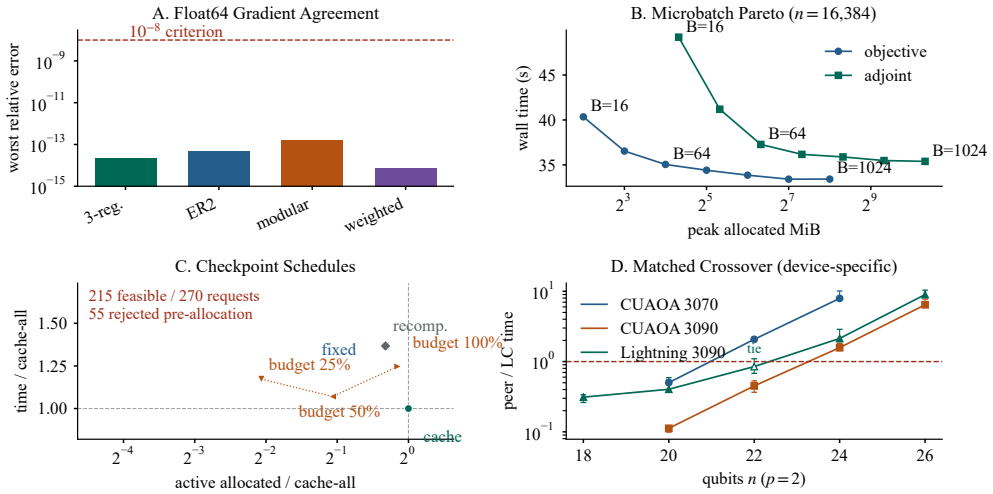
The discovery is that exact QAOA objective-and-gradient evaluation can be executed as a planned, bounded-memory contract when the cost has bounded causal cones. For each term C_t with support S_t, the expectation ⟨C_t⟩ equals its expectation under the QAOA circuit restricted to the induced subgraph on the closed p-hop neighborhood L_p(t), so gates outside the cone cancel. Corollary 1 asserts that differentiating this identity term-by-term and summing shared-parameter derivatives gives the full gradient ∇θF of the global-state objective in exact arithmetic. The implementation then treats the whole evaluation as a resource-constrained scheduling problem: a pre-allocation profile Π_p(G) records cone sizes and induced-edge counts, and a planner jointly selects microbatch sizes and checkpoint subsets under a named-workspace byte model, rejecting requests that do not fit before any local-amplitude allocation. Numerically, the cone-local adjoint agrees with an independently implemented dense global-state adjoint over 1,800 graph–angle comparisons with worst relative $ℓ^{2}$ error 1.56×$10^{{-13}}$.
Load-bearing premise
The planner's byte model assumes that the nine named workspaces it enumerates are exactly the allocations that coexist at the high-water mark; if any uncounted workspace (cone metadata, allocator reserve, device context, or process peak) grows beyond the model's prediction, the memory-budget contract would fail.
Editorial extensions
If this is right
- During QAOA training, one local forward-reverse pass returns the full shared gradient, replacing 4p central-difference objective calls; the paper reports 101 objective-equivalent calls and 189 s versus 909 calls and 1,565 s for central differences at n=512, p=2.
- Memory feasibility and runtime are exponential in the cone size k_t rather than n, so bounded-degree fixed-depth instances scale linearly in n with a cone-set constant.
- Requests that do not fit the declared budget are rejected before allocation, with diagnostics naming candidate global-state or contraction backends for an external orchestrator.
- Degree-capped real-data QUBOs enter the profile-feasible regime at p=2, so evaluator cost becomes a property of the QUBO formulation, not just the circuit depth.
- The matched crossover to global kernels is device- and precision-specific; the paper claims a feasibility screen, not a universal fastest-backend rule.
Reading between the lines
- The same fit-or-reject planning contract could be applied to other variational circuits whose cost terms have bounded causal cones, such as QAOA variants with different mixers or Hamiltonians with k-local terms, provided the cone-restriction identity still holds.
- The byte model suggests a practical high-water-mark audit: instrument peak allocated memory per named workspace on a novel graph family and compare with the planner's prediction; large low-width cones, where contraction tends to win, are the natural first test.
- Because the paper separates measured allocation from allocator-reserved pool memory, an extension could predict whole-process or multi-query memory by composing per-request plans with a pool-reuse model, turning the single-query contract into a training-loop memory contract.
Editorial analysis
A structured set of objections, weighed in public.
Referee Report
Summary. The paper presents LC-Implicit-QAOA, an evaluator for exact QAOA objective and shared-gradient queries on QUBO instances with bounded causal cones. It combines the standard causal-cone restriction of each cost term with adjoint differentiation, then adds a planning layer that profiles cone sizes, batches equal-size cones, and selects checkpoint schedules under a declared named active-evaluator workspace budget M, rejecting requests that do not fit before local-amplitude allocation. The paper reports agreement with an independent dense adjoint to a worst relative gradient error of 1.56e-13, completion of all 104 target requests in a p=2 bounded-cone grid, measured allocated memory within M for all 80 budgeted requests, and speedups in repeated-query optimization compared with central differences.
Significance. If the results hold, the paper addresses a practical bottleneck in QAOA training: exact objective-and-gradient evaluation for large sparse QUBOs without materializing a global state. The contributions are carefully scoped: the exactness of the cone-local adjoint is an algebraic consequence, verified numerically; the memory contract is explicitly defined over named workspaces; dense, hub-driven, and low-width contraction regimes are stated as limitations; and no hardware-independent fastest-backend rule is claimed. The paper also provides an independent complex128/float64 adjoint as a correctness reference and makes the code and supplement available, which strengthens reproducibility. The repeated-query comparison with central differences is a useful demonstration of the method's intended use, even though the optimizer is not a contribution.
major comments (1)
- [Section 4.4 and Section 6.2] The budget-contract claim rests on the completeness of the planner's byte model, but the paper does not show that the named workspace list (cost/term tables, final, adjoint, checkpoint, reconstruction, derivative, mixer, observable, gradient) accounts for every allocation that can coexist at the high-water mark inside the evaluator. Section 4.4 explicitly excludes cone metadata, allocator reserve, CUDA context, and whole-process/device memory, yet it does not rule out transient allocations such as kernel temporaries or host-side arrays appearing within an accepted query. The empirical verification covers 80 budgeted requests drawn from a single checkpoint-planner study with 3 settings × 3 graph instances × 5 repetitions, i.e., at most 9 distinct graphs, all in bounded-cone families. This is an evidence gap rather than a demonstrated failure, but it is load-bearing for the 'fit-or-reject' execution contract. I ask the authors to either (a) provide an enumerative or instrumentation-based argument that all evaluator allocations are captured by the named list, or (b) explicitly narrow the contract statement to 'predicted named-workspace bytes' and present the measured allocation as an empirical sanity check, or (c) extend the budget protocol to at least one additional family (e.g., a dense or scale-free instance that still fits the cone cap) to characterize where the model could break.
minor comments (4)
- [Section 4.2] The symbol B_state appears in the planner specification without a definition in the main text; please define it or point to the supplement where it is introduced.
- [Table 1] The table caption defines 'Y', 'E', and 'N', but 'A' is only explained in the text; make the caption self-contained by adding a note for 'A'.
- [Algorithm 1] The pseudocode returns a Reject with diagnostics but does not list what the diagnostics contain; consider enumerating them in the caption or in the surrounding text.
- [Section 6.2] The two ratios 1.053 and 0.857 are clearly separated in the text, but Figure 2C could benefit from a direct annotation stating that the 1.053 value is the simplified B2k diagnostic and the 0.857 value is the complete-byte-model compliance check.
Circularity Check
No significant circularity: exactness and gradient claims derive from externally cited identities and are cross-checked by an independent dense adjoint; memory compliance is an empirical, non-fitted validation.
full rationale
The paper's core derivation chain is self-contained and non-circular. Proposition 1 restates the standard causal-cone identity with citations to Farhi et al., Streif and Leib, Wurtz and Lykov, and Lykov et al.; the proof sketch does not assume the conclusion. Corollary 1 follows by differentiating Eq. (3) term by term and summing into shared parameter slots, which is a direct algebraic consequence rather than a fitted or assumed result. The adjoint pass is attributed to Jones and Gacon (2020), an external prior result, and the numerical section cross-checks LC against an independently implemented dense global-state adjoint over 1,800 graph-angle pairs; no target quantity is used as an input to that implementation. The memory-budget claim is an engineering validation, not a circular prediction: the planner's byte model sums named workspaces, budget levels are declared before execution, measured allocated evaluator memory is obtained from the runtime allocator, and the simplified B2k estimate (76 bytes/amplitude) deliberately differs from measured allocation (80 bytes/amplitude), showing that the model was not tuned to the measurement. The main caveat is that byte-model completeness is tested on a narrow set of 80 budgeted requests and excludes cone metadata, allocator reserve, CUDA context, and process/device peaks; this is an evidence gap about the contract's generality, not a circular step. There are no load-bearing self-citations, no imported uniqueness theorem, and no renaming of a known result as a new derivation. Therefore the circularity score is 0.
Assumptions & free parameters
assumptions (5)
- standard math Light-cone factorization: the expectation of a local cost term under fixed-depth QAOA equals its expectation on the induced subgraph of its p-hop neighborhood (Prop. 1, Eq. 3).
- standard math Adjoint differentiation of a parameterized local unitary gives shared-parameter gradients with a constant-factor reverse pass (Jones and Gacon 2020, Eq. 4).
- domain assumption The evaluator targets fixed-depth QAOA with one- and two-local diagonal QUBO cost terms and a transverse-field mixer, with initial state |+> tensor product.
- ad hoc to paper The planner byte model enumerates all named active evaluator workspaces that can coexist at the high-water mark; excluded categories (cone metadata, allocator reserve, CUDA context, device peak) are outside the budget M.
- domain assumption Wall-clock timings follow the stated matched device-precision protocols; absolute times are not comparable across hosts.
Cite this review
Pith. "Pith review of LC-Implicit-QAOA: Active-Workspace-Capped Exact Objective-and-Gradient Evaluation for Training over Bounded QUBO Light Cones." pith.science (2026). https://pith.science/paper/N5PRQWMK
@misc{pith2026260805610,
  author       = {Pith},
  title        = {Pith review of: LC-Implicit-QAOA: Active-Workspace-Capped Exact Objective-and-Gradient Evaluation for Training over Bounded QUBO Light Cones},
  year         = {2026},
  howpublished = {\url{https://pith.science/paper/N5PRQWMK}},
  note         = {Machine review of arXiv:2608.05610}
}
read the original abstract
QAOA training repeatedly queries an objective and all shared gradients, making exact evaluation a feasibility bottleneck even when QUBO terms have bounded causal cones. Building on established causal-cone restriction and adjoint differentiation, LC-Implicit-QAOA profiles cone structure and induced-edge counts before local-amplitude and named-workspace allocation, then jointly selects equal-size microbatches and checkpoint schedules under a named active-evaluator workspace budget. "Implicit" means omitting both global state and global cost table, not implicit differentiation; infeasible requests are rejected before those allocations. An independently implemented complex128/float64 dense adjoint agrees with LC over 1,800 graph-angle comparisons, with a worst relative gradient error of 1.56 x 10^-13. LC completes all 104 target requests in a p=2 bounded-cone grid; under a prespecified n <= 24 validation cap, the matched state-plus-cost reference is executed for 28 requests and deliberately not run on 76. Across 80 budgeted requests, measured allocated evaluator memory stays within budget, reaching at most 0.797 of it. On 3-regular n=512, p=2, the adjoint reaches the same finite-budget endpoint in 101 objective-equivalent calls and 189 s, versus 909 calls and 1,565 s for central differences. LC targets fixed-depth one- and two-local diagonal QUBO costs with a transverse-field mixer; it provides neither global states, sampling, nor a hardware-independent fastest-backend rule.
Figures

Reference graph
Works this paper leans on
-
[9]
Large-Scale Quantum Approximate Optimization on Nonplanar Graphs with Ma- chineLearningNoiseMitigation.PhysicalReviewResearch, 6(1): 013223. arXiv:2307.14427. Stein, J.; Blenninger, J.; Bucher, D.; Eder, P. J.; Cetiner, E.; Zorn, M.; and Linnhoff-Popien, C
-
[10]
In2024 IEEE International Conference on Quantum Com- puting and Engineering, 280–285
CUAOA: A Novel CUDA-Accelerated Simulation Framework for the QAOA. In2024 IEEE International Conference on Quantum Com- puting and Engineering, 280–285. arXiv:2407.13012. Streif,M.;andLeib,M.2020.TrainingtheQuantumApprox- imateOptimizationAlgorithmwithoutAccesstoaQuantum Processing Unit.Quantum Science and Technology, 5(3): 034008. arXiv:1908.08862. Wang,...
arXiv 2020
-
[11]
A Unified Complexity-Algorithm Account of Constant-Round QAOA Expectation Computation. arXiv:2511.20212. Wurtz, J.; and Lykov, D
-
[12]
Fixed-Angle Conjectures for theQuantumApproximateOptimizationAlgorithmonReg- ular MaxCut Graphs.Physical Review A, 104(5): 052419. arXiv:2107.00677. Zhang, B.; Fang, B.; Ye, F.; Guo, L.; Song, F.; Tallent, N.; and Tao, D
-
[13]
InProceedings of the 39th ACM International Conference on Supercomputing, 689–704
BMQSim: Overcoming Memory Con- straints in Quantum Circuit Simulation with a High-Fidelity Compression Framework. InProceedings of the 39th ACM International Conference on Supercomputing, 689–704. Zhang, S.-X.; Allcock, J.; Wan, Z.-Q.; Liu, S.; Sun, J.; Yu, H.; Yang, X.-H.; Qiu, J.; Ye, Z.; Chen, Y.-Q.; Lee, C.-K.; Zheng, Y.-C.; Jian, S.-K.; Yao, H.; Hsie...
work page 2023
-
[15]
TensorCircuit-NG: A Universal, Composable,andScalablePlatformforQuantumComputing and Quantum Simulation. arXiv:2602.14167. Zhuang, W.-F.; Pu, Y.-N.; Xu, H.-Z.; Chai, X.; Gu, Y.; Ma, Y.; Qamar, S.; Qian, C.; Qian, P.; Xiao, X.; Hu, M.- J.; and Liu, D. E
-
[16]
Efficient Classical Computation of Quantum Mean Values for Shallow QAOA Circuits
Efficient Classical Computa- tion of Quantum Mean Values for Shallow QAOA Circuits. arXiv:2112.11151
-
[912]
TensorCircuit: a Quantum Software Framework for the NISQ Era
arXiv:2205.10091. Zhang, S.-X.; et al
Show all 16 references
-
[2014]
arXiv:1411.4028
A Quantum Approximate Optimization Algorithm. arXiv:1411.4028. Feeney, S.; Tate, R.; Golden, J.; and Eidenbenz, S
-
[2019]
arXiv:1905.07047
Classical and Quantum Bounded Depth Approximation Algorithms. arXiv:1905.07047. Jones, T.; and Gacon, J
1905 arXiv
-
[2020]
arXiv:2009.02823
Efficient Calculation of Gra- dients in Classical Simulations of Variational Quantum Al- gorithms. arXiv:2009.02823. Lucas, A
2009 arXiv
-
[2021]
In2021 IEEE/ACM Second Interna- tional Workshop on Quantum Computing Software, 27–34
Performance Evalu- ation and Acceleration of the QTensor Quantum Circuit Simulator on GPUs. In2021 IEEE/ACM Second Interna- tional Workshop on Quantum Computing Software, 27–34. arXiv:2204.06045. Lykov, D.; Shaydulin, R.; Sun, Y.; Alexeev, Y.; and Pistoia, M.2023. FastSimulati...
2023 arXiv
-
[2022]
In2022 IEEE 63rd Annual Symposium on Foundations of Computer Science (FOCS), 335–343
Per- formance and limitations of the QAOA at constant levels on large sparse hypergraphs and spin glass models. In2022 IEEE 63rd Annual Symposium on Foundations of Computer Science (FOCS), 335–343. arXiv:2204.10306. Bayraktar, H.; Charara, A.; Clark, D.; Cohen, S.; Costa, T.; ...
-
[2024]
arXiv:2403.02512
Hybrid Quantum Programming with PennyLane Lightning on HPC Platforms. arXiv:2403.02512. Basso, J.; Gamarnik, D.; Mei, S.; and Zhou, L
-
[2025]
arXiv:2508.05883
MPS-JuliQAOA: User-friendly, Scalable MPS-based Simu- lation for Quantum Optimization. arXiv:2508.05883. Glover,F.;Kochenberger,G.;andDu,Y.2018. ATutorialon Formulating and Using QUBO Models. arXiv:1811.11538. Golden, J.; Baertschi, A.; O’Malley, D.; Pelofske, E.; and Eidenben...
2018 arXiv
-
[2026]
https://nvidia.github.io/cuda-quantum/latest/ using/backends/sims/svsims.html
CUDA-Q State Vector Simulators Doc- umentation. https://nvidia.github.io/cuda-quantum/latest/ using/backends/sims/svsims.html. Accessed 2026-07-01. Ozaeta,A.;vanDam,W.;andMcMahon,P.L.2022. Expec- tation Values from the Single-Layer Quantum Approximate Optimization Algorithm on...
2026 arXiv
Reviewed August 8, 2026 · model on record in the stance chip above.
Discussion (0). Continue with ORCID to comment.