REVIEW 3 major objections 6 minor 40 references
G$^2$ARD-GS: Geometry-Guided Anchor-Regularized Gaussian Splatting Distillation
T0 review · 3 major / 6 minor · reviewed 2026-08-08 · deepseek-v4-flash
Pith's one-line read Gaussian compression that keeps surfaces at 30x
desk verdict Honest, internally consistent compression paper whose headline margins are plausibly real but confounded by unmatched optimization compute; worth a serious referee, with a compute-matched comparison as the key ask. read the letter →
The pith
A machine-rendered reading of the paper's core claim, the machinery that carries it, and where it could break.
The reading
What carries the argument
The load-bearing mechanism is the construction-time anchor: for each retained Gaussian, the mean, local orthonormal frame obtained from PCA over the dense prior, and scales are frozen after simplification, and recovery is penalized only when a primitive leaves an anisotropic trust region defined by those anchors. This couples appearance optimization to the surface support established during compression, preventing the off-surface drift and needle-shaped degeneration identified as failure modes of photometric-only recovery.
What would settle it
Run G2ARD-GS at 30x compression on a LiDAR-assisted urban model that includes vegetation, cars, or glass facades, then evaluate frozen-geometry out-of-distribution adaptation and camera registration; if the compact model no longer beats image-driven pruning baselines such as PUP on those scenes, the load-bearing assumption of trustworthy PCA anchors is refuted outside planar surface regions.
Extended reading notes
Core claim
The central claim is that a compact 3D Gaussian map can be both visually faithful and geometrically reusable if simplification respects local surface support and recovery stays attached to that support. G2ARD-GS consolidates a dense prior into surface-aware representatives through progressive rounds, protecting persistent high-frequency texture, then freezes each retained primitive's construction-time mean, local frame, and scale as an anchor. Appearance recovery minimizes a photometric loss under an anisotropic anchor trust region that allows tangential sliding but penalizes off-surface drift, plus a shape regularizer that suppresses needle-like covariance degeneration. On MatrixCity block A this yields the best held-out PSNR, SSIM, and LPIPS at matched 5x to 30x budgets, with a 3.2 to 4.9 dB advantage over PUP in frozen-geometry out-of-distribution adaptation, and a 30.3x compact model preserves GS-CPR registration accuracy on Cambridge KingsCollege while lowering median translation error.
Load-bearing premise
The method assumes that local PCA over the dense prior yields reliable surface anchors, so freezing those anchors preserves the geometry that later appearance recovery should build on; if the prior contains non-planar or noisy structure, the trust region can lock in misplaced support that appearance optimization cannot fix.
Editorial extensions
If this is right
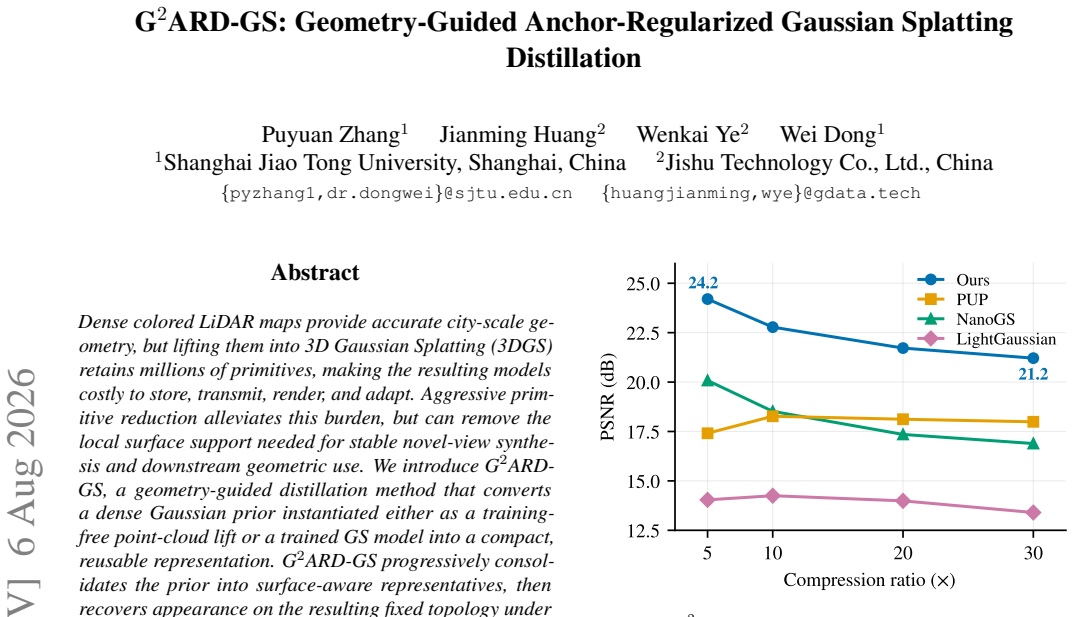
- At matched 5x to 30x primitive budgets on MatrixCity block A, G2ARD-GS claims the best PSNR, SSIM, and LPIPS across all baselines, with a 3.22 dB PSNR lead over PUP at 30x.
- Frozen-geometry appearance adaptation to a disjoint out-of-distribution trajectory improves by 3.68 to 4.93 dB over PUP, and degrading from 10x to 30x costs only about 1.2 dB in OOD PSNR.
- A 30.3x compact model preserves or slightly exceeds teacher-level GS-CPR camera-registration accuracy on KingsCollege, also reducing median translation error from 27.0 cm to 22.4 cm.
- The method works from a training-free point-cloud lift as well as from a trained Gaussian model, with distilled students from the two priors agreeing to within 0.01 dB.
- The fixed recipe transfers to bounded 3DGS scenes such as Mip-NeRF 360 room, giving the smallest teacher-relative PSNR drop among compared methods.
Reading between the lines
- The anchor trust region effectively trades geometric fidelity for appearance flexibility; scenes whose dense prior is non-planar or noisy (vegetation, cars, glass) may lock in misplaced surface support that appearance optimization cannot correct, a regime the paper does not test.
- Because the view-selection module shows no advantage over random sampling at matched budgets in the supplement, its practical role is likely cost reduction rather than higher quality, and combining it with attribute-level compression such as vector quantization could compound storage savings.
- The frozen-anchor design suggests the compact model could serve as a stable substrate for continual appearance updates, since repeated refitting of appearance alone cannot erode the underlying geometry.
Editorial analysis
A structured set of objections, weighed in public.
Referee Report
Summary. The manuscript introduces G2ARD-GS, a multi-round pipeline for compressing dense 3D Gaussian maps into compact, geometrically reusable representations. Starting from either a trained Gaussian model or a training-free point-cloud lift, it progressively simplifies the prior through moment-matched merging with high-frequency protection, selects supervision views via a normal-aware directional-coverage objective, and then recovers appearance on a fixed topology under shape and anisotropic anchor regularizers. On MatrixCity block A, the method reports the best PSNR, SSIM, and LPIPS across matched 5x-30x primitive budgets, improved frozen-geometry appearance adaptation on a disjoint OOD trajectory, and preserved GS-CPR registration accuracy on KingsCollege. The supplement provides detailed configurations, additional ablations, and honest null results for the view-selection module.
Significance. The problem addressed is relevant and timely: producing compact, geometrically stable 3DGS assets from dense LiDAR maps is useful for storage, transmission, and downstream geometric tasks. The paper has notable strengths: all MatrixCity methods start from the same 5.99M-Gaussian teacher, use matched primitive budgets, a unified gsplat evaluator, and held-out views; the supplement is unusually transparent, including a matched-budget control that shows the proposed view-selection policy does not outperform random sampling. If the reported gains survive a compute-matched comparison, the method would be a solid contribution. However, the central head-to-head claim currently rests on an unequal-compute comparison, which the paper itself acknowledges in the Limitations section, and this undermines the strength of the 'leads all baselines' framing.
major comments (3)
- [Sec. 4.1, Table 1, Limitations]
- [Sec. 3.3, Table S8]
- [Sec. 3.2, Sec. 4.3, Sec. 5]
minor comments (6)
- [Table 2]
- [Sec. 4.4, Table 3(b)]
- [Sec. 4.4]
- [Sec. 3.2, Eq. (1)]
- [Fig. 1, Table 1]
- [Table S7]
Circularity Check
No circularity: the central compression and reuse claims are measured against held-out views and independent downstream tasks; the unmatched-compute caveat is a fairness issue, not a circularity.
full rationale
The paper's derivation chain is self-contained rather than circular. A dense Gaussian prior is progressively simplified (Eqs. 1–2), views are selected via a coverage objective (Eq. 3), and appearance is recovered under anchor and shape regularizers (Eqs. 4–6); however, the headline results are evaluated on 510 held-out views with a unified gsplat evaluator, and the reuse claims are tested by independent downstream tasks: frozen-geometry OOD appearance adaptation on a disjoint 495-view set and GS-CPR camera registration on KingsCollege. Teacher renders are used only as distillation targets during recovery, not as the reported metrics. The paper also candidly reports in Supp. Table S8 that geometry-aware view selection does not outperform random or pose-diverse selection at matched budget, so the central results do not rest on a self-fulfilling selection mechanism. No load-bearing argument reduces to a self-citation, a fitted parameter renamed as a prediction, or an imported uniqueness theorem. The acknowledged unmatched optimization budgets (Sec. 4.1 and the Limitations paragraph) weaken the fairness of the head-to-head comparison, but they do not make any reported quantity equal to an input by construction; this is an external-validity concern, not a circularity.
Assumptions & free parameters
free parameters (6)
- anchor loss weight lambda_a =
5e-2 (trained teachers), 1e-3 (PCLift)
- shape loss weight lambda_s =
0 or 1e-4/1e-3
- per-round retention ratio =
0.75
- high-frequency threshold epsilon_h =
0.01
- protection weight lambda_h =
10
- normal compression factor for point-cloud lift =
0.1 (anisotropy clipped at 4.0)
assumptions (4)
- domain assumption Local PCA over 10 nearest neighbors yields a reliable surface-aligned normal per primitive
- domain assumption Moment-matched merging of compatible Gaussians preserves local radiance behavior
- domain assumption The photometric loss plus geometric regularizers is sufficient for appearance recovery on fixed topology
- standard math Standard 3DGS rasterization (Kerbl et al. 2023) is a correct forward rendering model
Cite this review
Pith. "Pith review of G$^2$ARD-GS: Geometry-Guided Anchor-Regularized Gaussian Splatting Distillation." pith.science (2026). https://pith.science/paper/I2JBT766
@misc{pith2026260805704,
  author       = {Pith},
  title        = {Pith review of: G$^2$ARD-GS: Geometry-Guided Anchor-Regularized Gaussian Splatting Distillation},
  year         = {2026},
  howpublished = {\url{https://pith.science/paper/I2JBT766}},
  note         = {Machine review of arXiv:2608.05704}
}
abstract
Dense colored LiDAR maps provide accurate city-scale geometry, but lifting them into 3D Gaussian Splatting (3DGS) retains millions of primitives, making the resulting models costly to store, transmit, render, and adapt. Aggressive primitive reduction alleviates this burden, but can remove the local surface support needed for stable novel-view synthesis and downstream geometric use. We introduce G$^2$ARD-GS, a geometry-guided distillation method that converts a dense Gaussian prior instantiated either as a training-free point-cloud lift or a trained GS model into a compact, reusable representation. G$^2$ARD-GS progressively consolidates the prior into surface-aware representatives, then recovers appearance on the resulting fixed topology under construction-time anchor constraints, with no primitives added or removed during recovery. Under limited supervision, geometry-aware view selection allocates the available view budget. On MatrixCity, G$^2$ARD-GS achieves the best PSNR, SSIM, and LPIPS across matched $5\times$--$30\times$ compression budgets, outperforming PUP by $3.2$--$6.8$,dB in PSNR. When reused as frozen geometry, the compact model improves off-trajectory appearance adaptation by $3.7$--$4.9$,dB over PUP 3D-GS and preserves image-to-model registration accuracy on Cambridge KingsCollege at $30\times$ compression. Project page: https://patrick1159.github.io/gardGS-page/.
Figures


Figures from the paper (4 more)


Reference graph
Works this paper leans on
-
[1]
Barron, Ben Mildenhall, Dor Verbin, Pratul P
Jonathan T. Barron, Ben Mildenhall, Dor Verbin, Pratul P. Srinivasan, and Peter Hedman. Mip-nerf 360: Unbounded anti-aliased neural radiance fields. InIEEE/CVF Conference on Computer Vision and Pattern Recognition, CVPR 2022, New Orleans, LA, USA, June 18-24, 2022, pages 5460–5469. IEEE, 2022. 5, 7
work page 2022
-
[2]
Accelerated coordinate encoding: Learning to relocalize in minutes using rgb and poses
Eric Brachmann, Tommaso Cavallari, and Victor Adrian Prisacariu. Accelerated coordinate encoding: Learning to relocalize in minutes using rgb and poses. InProceedings of the IEEE/CVF Conference on Computer Vision and Pattern Recognition, pages 5044–5053, 2023. 8
work page 2023
-
[3]
HAC: Hash-grid assisted context for 3d gaussian splatting compression
Yihang Chen, Qianyi Wu, Weiyao Lin, Mehrtash Harandi, and Jianfei Cai. HAC: Hash-grid assisted context for 3d gaussian splatting compression. InEuropean Conference on Computer Vision, 2024. 2
work page 2024
-
[4]
LightGaussian: Unbounded 3D Gaussian Compression with 15x Reduction and 200+ FPS,
Zhiwen Fan, Kevin Wang, Kairun Wen, Zehao Zhu, Dejia Xu, and Zhangyang Wang. LightGaussian: Unbounded 3D Gaussian Compression with 15x Reduction and 200+ FPS,
-
[5]
Mini-Splatting: Represent- ing Scenes with a Constrained Number of Gaussians
Guangchi Fang and Bing Wang. Mini-Splatting: Represent- ing Scenes with a Constrained Number of Gaussians. In Computer Vision – ECCV 2024, pages 165–181. Springer Nature Switzerland, Cham, 2024. Series Title: Lecture Notes in Computer Science. 1, 2, 3
work page 2024
-
[6]
EA- GLES: Efficient accelerated 3d gaussians with lightweight encodings
Sharath Girish, Kamal Gupta, and Abhinav Shrivastava. EA- GLES: Efficient accelerated 3d gaussians with lightweight encodings. InEuropean Conference on Computer Vision,
-
[7]
Antoine Gu ´edon and Vincent Lepetit. SuGaR: Surface- aligned gaussian splatting for efficient 3d mesh reconstruc- tion and high-quality mesh rendering. InProceedings of the IEEE/CVF Conference on Computer Vision and Pattern Recognition, pages 5354–5363, 2024. 2
work page 2024
-
[8]
PUP 3D-GS: Princi- pled Uncertainty Pruning for 3D Gaussian Splatting, 2025
Alex Hanson, Allen Tu, Vasu Singla, Mayuka Jayawardhana, Matthias Zwicker, and Tom Goldstein. PUP 3D-GS: Princi- pled Uncertainty Pruning for 3D Gaussian Splatting, 2025. arXiv:2406.10219 [cs]; CVPR 2025. 1, 2, 3, 5, 7
arXiv 2025
Show all 40 references
-
[9]
SplatAD: Real-time Lidar and camera rendering with 3D gaussian splatting for autonomous driving
Georg Hess, Carl Lindstr¨om, Maryam Fatemi, Christoffer Pe- tersson, and Lennart Svensson. SplatAD: Real-time Lidar and camera rendering with 3D gaussian splatting for autonomous driving. InProceedings of the IEEE/CVF Conference on Com- puter Vision and Pattern Recognition, pa...
2025
-
[10]
2D gaussian splatting for geometrically accu- rate radiance fields
Binbin Huang, Zehao Yu, Anpei Chen, Andreas Geiger, and Shenghua Gao. 2D gaussian splatting for geometrically accu- rate radiance fields. InACM SIGGRAPH 2024 Conference Papers. Association for Computing Machinery, 2024. 2
2024
-
[11]
VEGS: View Extrapolation of Urban Scenes in 3D Gaussian Splatting using Learned Priors, 2024
Sungwon Hwang, Min-Jung Kim, Taewoong Kang, Jayeon Kang, and Jaegul Choo. VEGS: View Extrapolation of Urban Scenes in 3D Gaussian Splatting using Learned Priors, 2024. arXiv:2407.02945 [cs.CV]. 1, 2
2024 arXiv
-
[12]
Effective Rank Analysis and Regularization for Enhanced 3D Gaussian Splatting, 2024
Junha Hyung, Susung Hong, Sungwon Hwang, Jaeseong Lee, Jaegul Choo, and Jin-Hwa Kim. Effective Rank Analysis and Regularization for Enhanced 3D Gaussian Splatting, 2024. arXiv:2406.11672 [cs.CV]. 2, 4
2024 arXiv
-
[13]
LI-GS: Gaussian Splatting with LiDAR Incorporated for Accurate Large-Scale Reconstruction, 2024
Changjian Jiang, Ruilan Gao, Kele Shao, Yue Wang, Rong Xiong, and Yu Zhang. LI-GS: Gaussian Splatting with LiDAR Incorporated for Accurate Large-Scale Reconstruction, 2024. arXiv:2409.12899 [cs.RO]. 1, 2
2024 arXiv
-
[14]
3DGS- ReLoc: 3D gaussian splatting for map representation and visual relocalization, 2024
Peng Jiang, Gaurav Pandey, and Srikanth Saripalli. 3DGS- ReLoc: 3D gaussian splatting for map representation and visual relocalization, 2024. arXiv:2403.11367 [cs.CV , cs.GR, cs.RO]. 1
2024 arXiv
-
[15]
Fish- erRF: Active View Selection and Uncertainty Quantifica- tion for Radiance Fields using Fisher Information, 2024
Wen Jiang, Boshu Lei, and Kostas Daniilidis. Fish- erRF: Active View Selection and Uncertainty Quantifica- tion for Radiance Fields using Fisher Information, 2024. arXiv:2311.17874 [cs.CV]. 2, 4
2024 arXiv
-
[16]
PoseNet: A convolutional network for real-time 6-dof cam- era relocalization
Alex Kendall, Matthew Grimes, and Roberto Cipolla. PoseNet: A convolutional network for real-time 6-dof cam- era relocalization. InProceedings of the IEEE International Conference on Computer Vision, pages 2938–2946, 2015. 2, 5
2015
-
[17]
3D Gaussian Splatting for Real-Time Ra- diance Field Rendering, 2023
Bernhard Kerbl, Georgios Kopanas, Thomas Leimk¨uhler, and George Drettakis. 3D Gaussian Splatting for Real-Time Ra- diance Field Rendering, 2023. arXiv:2308.04079 [cs]. 1, 2, 4
2023 arXiv
-
[18]
Compact 3d gaussian representation for radiance field
Joo Chan Lee, Daniel Rho, Xiangyu Sun, Jong Hwan Ko, and Eunbyung Park. Compact 3d gaussian representation for radiance field. InProceedings of the IEEE/CVF Conference on Computer Vision and Pattern Recognition, pages 21719– 21728, 2024. 1, 2
2024
-
[19]
Ground- ing image matching in 3d with MASt3R
Vincent Leroy, Yohann Cabon, and J´erˆome Revaud. Ground- ing image matching in 3d with MASt3R. InEuropean Con- ference on Computer Vision, pages 72–91, 2024. 8
2024
-
[20]
MAGICIAN: Efficient Long-Term Planning with Imag- ined Gaussians for Active Mapping, 2026
Shiyao Li, Antoine Gu´edon, Shizhe Chen, and Vincent Lep- etit. MAGICIAN: Efficient Long-Term Planning with Imag- ined Gaussians for Active Mapping, 2026. Version Number: 2; Accepted at CVPR 2026 (Oral). 2, 4
2026
-
[21]
MatrixCity: A large-scale city dataset for city-scale neural rendering and beyond
Yixuan Li, Lihan Jiang, Linning Xu, Yuanbo Xiangli, Zhenzhi Wang, Dahua Lin, and Bo Dai. MatrixCity: A large-scale city dataset for city-scale neural rendering and beyond. In Proceedings of the IEEE/CVF International Conference on Computer Vision (ICCV), pages 3205–3215, 2023. 2, 5
2023
-
[22]
GS-CPR: Efficient Camera Pose Refinement via 3D Gaussian Splatting, 2025
Changkun Liu, Shuai Chen, Yash Bhalgat, Siyan Hu, Ming Cheng, Zirui Wang, Victor Adrian Prisacariu, and Tristan Braud. GS-CPR: Efficient Camera Pose Refinement via 3D Gaussian Splatting, 2025. arXiv:2408.11085 [cs.CV]; Ac- cepted to ICLR 2025. 8, 3
2025 arXiv
-
[23]
GS-CPR: Efficient camera pose refinement via 3D gaussian splatting
Changkun Liu, Shuai Chen, Yash Bhalgat, Siyan Hu, Ming Cheng, Zirui Wang, Victor Adrian Prisacariu, and Tristan Braud. GS-CPR: Efficient camera pose refinement via 3D gaussian splatting. InThe Thirteenth International Confer- ence on Learning Representations. OpenReview.net, 2...
2025
-
[24]
ECLAIR: A high- fidelity aerial LiDAR dataset for semantic segmentation
Iaroslav Melekhov, Anand Umashankar, Hyeong-Jin Kim, Vladislav Serkov, and Dusty Argyle. ECLAIR: A high- fidelity aerial LiDAR dataset for semantic segmentation. In 2024 IEEE/CVF Conference on Computer Vision and Pattern Recognition Workshops (CVPRW), pages 7627–7637. IEEE,
2024
-
[25]
Srinivasan, Matthew Tancik, Jonathan T
Ben Mildenhall, Pratul P. Srinivasan, Matthew Tancik, Jonathan T. Barron, Ravi Ramamoorthi, and Ren Ng. NeRF: Representing scenes as neural radiance fields for view syn- thesis. InEuropean Conference on Computer Vision, pages 405–421, 2020. 1, 2
2020
-
[26]
K. L. Navaneet, Kossar Pourahmadi Meibodi, Soroush Abbasi Koohpayegani, and Hamed Pirsiavash. CompGS: Smaller and faster gaussian splatting with vector quantization. In European Conference on Computer Vision, 2024. 2
2024
-
[27]
Compressed 3D Gaussian Splatting for Accelerated Novel View Synthesis, 2024
Simon Niedermayr, Josef Stumpfegger, and R¨udiger Wester- mann. Compressed 3D Gaussian Splatting for Accelerated Novel View Synthesis, 2024. arXiv:2401.02436 [cs.CV]. 1, 2
2024 arXiv
-
[28]
ActiveN- eRF: Learning where to see with uncertainty estimation
Xuran Pan, Zihang Lai, Shiji Song, and Gao Huang. ActiveN- eRF: Learning where to see with uncertainty estimation. In European Conference on Computer Vision, pages 230–246,
-
[29]
Paris-Lille-3d: A point cloud dataset for urban scene segmentation and classification
Xavier Roynard, Jean-Emmanuel Deschaud, and Fran c ¸ois Goulette. Paris-Lille-3d: A point cloud dataset for urban scene segmentation and classification. In2018 IEEE/CVF Conference on Computer Vision and Pattern Recognition Workshops (CVPRW), pages 2027–2030. IEEE, 2018. 1
2027
-
[30]
Toronto-3d: A large- scale mobile LiDAR dataset for semantic segmentation of urban roadways
Weikai Tan, Nannan Qin, Lingfei Ma, Ying Li, Jing Du, Guorong Cai, Ke Yang, and Jonathan Li. Toronto-3d: A large- scale mobile LiDAR dataset for semantic segmentation of urban roadways. In2020 IEEE/CVF Conference on Computer Vision and Pattern Recognition Workshops (CVPRW), pa...
2020
-
[31]
NanoGS: Training-Free Gaussian Splat Simplification, 2026
Butian Xiong, Rong Liu, Tiantian Zhou, Meida Chen, Zhiwen Fan, and Andrew Feng. NanoGS: Training-Free Gaussian Splat Simplification, 2026. arXiv:2603.16103 [cs]. 1, 2, 3, 5
2026 arXiv
-
[32]
RSGaussian:3D Gaussian Splat- 9 ting with LiDAR for Aerial Remote Sensing Novel View Synthesis, 2024
Yiling Yao, Wenjuan Zhang, Bing Zhang, Bocheng Li, Yaning Wang, and Bowen Wang. RSGaussian:3D Gaussian Splat- 9 ting with LiDAR for Aerial Remote Sensing Novel View Synthesis, 2024. arXiv:2412.18380 [cs.CV], version 1. 1, 2
2024
-
[33]
FewViewGS: Gaussian splatting with few view matching and multi-stage training
Ruihong Yin, Vladimir Yugay, Yue Li, Sezer Karaoglu, and Theo Gevers. FewViewGS: Gaussian splatting with few view matching and multi-stage training. InAdvances in Neural In- formation Processing Systems. Curran Associates, Inc., 2024. NeurIPS 2024. 1, 4
2024
-
[34]
Drivinggaussian: Compos- ite gaussian splatting for surrounding dynamic autonomous driving scenes
Xiaoyu Zhou, Zhiwei Lin, Xiaojun Shan, Yongtao Wang, De- qing Sun, and Ming-Hsuan Yang. Drivinggaussian: Compos- ite gaussian splatting for surrounding dynamic autonomous driving scenes. InProceedings of the IEEE/CVF Conference on Computer Vision and Pattern Recognition, pages...
2024
-
[36]
Datasets and Evaluation Splits Table S1 lists every split used in the paper and this supple- ment
Additional Implementation and Evaluation Details 1.1. Datasets and Evaluation Splits Table S1 lists every split used in the paper and this supple- ment. All subsequent sections refer back to these names rather than restating them. 1.2. Dense Prior Construction G2ARD-GS accepts...
-
[37]
Rendering Quality under Aggressive Compres- sion G2ARD-GS preserves coherent surface and texture support as the primitive budget is reduced from5×to30×
Compact and Reusable Gaussian Maps 2.1. Rendering Quality under Aggressive Compres- sion G2ARD-GS preserves coherent surface and texture support as the primitive budget is reduced from5×to30×. Figure S1 shows the three operating points not promoted to the main paper. All metho...
-
[38]
Why the Geometry Remains Stable 3.1. Progressive Recovery and Geometry Con- straints Multi-round recovery and construction-time geometric con- straints keep the compact topology from drifting into photo- metrically convenient but geometrically unstable configura- tions. Table ...
-
[39]
Mip-NeRF 360 The fixed G 2ARD-GS recipe transfers to conventional bounded 3DGS scenes without scene-specific redesign
Cross-Domain Transfer 4.1. Mip-NeRF 360 The fixed G 2ARD-GS recipe transfers to conventional bounded 3DGS scenes without scene-specific redesign. Established GS-compression methods are benchmarked on Mip-NeRF 360 [ 1], where a fully converged dense 3D-GS model is always availa...
-
[40]
S1 es- tablishes that quality survives aggressive reduction, Fig
Extended Qualitative Results The figures collected above are ordered to follow the evi- dence chain rather than the experiment history: Fig. S1 es- tablishes that quality survives aggressive reduction, Fig. S2 that the surviving geometry supports appearance adaptation on a new...
- [2023]
Reviewed August 8, 2026 · model on record in the stance chip above.
Discussion (0). Continue with ORCID to comment.