REVIEW 2 major objections 4 minor 42 references
Near-field Hydrodynamics Disentangles Angular Correlations in Confined Active Suspensions
T0 review · 2 major / 4 minor · reviewed 2026-08-08 · deepseek-v4-flash
Pith's one-line read In a thin layer of swimming algae, the angular correlations between pairs of cells decompose into two clean modes—a near-field entrainment mode where neighbors align and a far-field dipolar mode carrying the signature of a 2D source…
desk verdict Good experiment, useful two-mode observable, but the force-free caveat makes the 'fundamentally rooted' claim stronger than the evidence. read the letter →
The pith
A machine-rendered reading of the paper's core claim, the machinery that carries it, and where it could break.
The reading
What carries the argument
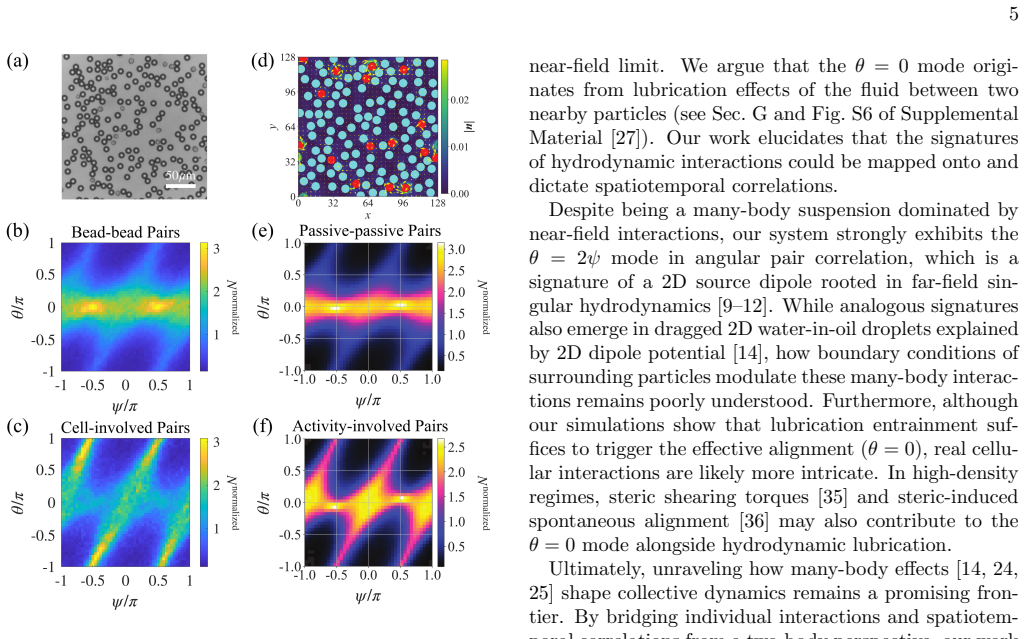
The central object is the angular pair distribution $N(\psi,\theta)$, constructed by mapping, for every pair of cells, the relative position angle $\psi$ (from reference velocity to separation vector) and the relative velocity angle $\theta$ (from reference velocity to partner velocity). The paper's claim is that the distribution is spectrally simple: it concentrates on the lines $\theta=0$ and $\theta=2\psi$, which serve as fingerprints for the two hydrodynamic mechanisms. The far-field fingerprint is the Oseen tensor $(1-2\hat{r}\hat{r})/r^{2}$ of a 2D source dipole (and of the depth-averaged Brinkmanlet in the far field), which exactly produces $\theta=2\psi$; the near-field mechanism is lubrication, whose squeezing and shearing forces and torques between two spheres are given explicitly in the supplement and generate the $\theta=0$ alignment. These mechanisms are computationally realized with a dragged-particle model—spherical particles pulled by a constant force $\mathbf{F}_A\hat{n}$ with no compensating force on the fluid—solved by the smoothed profile method, which reproduces both modes in simulations.
What would settle it
Simulate or observe a quasi-2D suspension of force-free swimming particles, such as neutral squirmers, at the same density and confinement; if the $\theta=0$ alignment at short distances is absent or much weaker than in the dragged-particle model while the $\theta=2\psi$ dipolar mode still appears, the claim that lubrication alone produces the entrainment mode fails. A complementary measurement is to image the flow within a few microns of a free-swimming cell with sub-micron tracers and test whether the unbalanced near-field flow exists in a genuinely force-free swimmer.
Extended reading notes
Core claim
On its own terms, the paper's central discovery is that the angular pair distribution $N(\psi,\theta)$ in confined $C$. $reinhardtii$ suspensions is dominated by two coexisting modes: a horizontal entrainment line at $\theta=0$ and sloping dipole lines at $\theta=2\psi+2n\pi$ ($n=0,\pm1$). The entrainment mode dominates at high area fraction and short pair distances, peaks at $d\approx 8\,\mu$m, and decays to a uniform baseline by $d\approx 12\,\mu$m; the dipolar mode is longer-ranged but suppressed as density increases. Flow-field fitting with three regularized Brinkmanlets plus a source dipole shows that the far field decays as $r^{-2}$ with the $\theta=2\psi$ form, while the near field displays front-back asymmetry and lateral vortices. In active-passive mixtures, passive bead pairs show a strong $\theta=0$ mode and almost no $\theta=2\psi$, whereas pairs involving active cells develop the $\theta=2\psi$ mode, leading the authors to conclude that the dipolar mode is an activity-driven far-field hydrodynamic effect while the entrainment mode is a generic near-field lubrication effect.
Load-bearing premise
The argument depends on treating each swimmer as a bead that is dragged through the water by a constant force, with no equal-and-opposite force on the water; if a real swimmer's near-field flow behaves differently, the entrainment mode could have a different source.
Editorial extensions
If this is right
- In quasi-2D confined suspensions, a measured peak at $\theta=2\psi$ in the angular pair distribution is a direct signature that the far-field flow is that of a 2D source dipole; no other far-field singularity is needed to explain it.
- A measured peak at $\theta=0$ at short distances can be attributed to lubrication entrainment, even in systems where steric torques are absent, because the simulations use only radial repulsive forces and still produce the alignment.
- The two modes should be separately tunable: changing density or concentration of passive particles shifts the balance between entrainment and dipolar correlations without changing their angular signatures.
- The crossover from a dipolar-dominated to entrainment-dominated regime with increasing density, seen in the lateral velocity correlation $C_v(x,0)$, provides a quantitative, experimentally accessible order parameter for this mode competition.
- Because the $\theta=0$ mode appears in passive-passive pairs, it is not activity-specific; the paper's interpretation implies that purely passive, densely confined colloidal suspensions should exhibit the same lubrication-induced alignment.
Reading between the lines
- If the unbalanced dragged-particle model is correct, then the near-field flow of a free-swimming alga is dominated by the body force rather than distributed flagellar forces; a direct experimental test would be to measure the flow inside a few micrometers of a swimming cell with sub-micron tracers and see whether the front-back asymmetry and lateral vortices persist at the same strength for a forc
- The two-mode decomposition may extend beyond algae: any quasi-2D active suspension whose particles have a source-dipole far field and experience lubrication at close range should display the same $\theta=2\psi$ and $\theta=0$ lines, so the method offers a general diagnostic for separating near- and far-field hydrodynamic contributions in confined active matter.
- The neutral-squirmer simulation in the supplement shows a weaker $\theta=0$ mode than the dragged-particle case, suggesting that the balance between the two modes depends on the swimmer's force distribution; a systematic scan over swimmer models could map how flagellar synchronization and body shape tune the entrainment mode. (The authors do not make this parameter-scan prediction explicitly.)
- A practical extension would be to check whether the two-body mode weights can be used to predict three-body or higher-order spatial statistics in the same suspensions, assuming pairwise additivity; if not, the breakdown would mark where genuine many-body hydrodynamics begin.
Editorial analysis
A structured set of objections, weighed in public.
Referee Report
Summary. The paper reports experiments on quasi-2D suspensions of Chlamydomonas reinhardtii, together with hydrodynamic simulations, and claims that angular pair correlations can be decomposed into two modes: an entrainment mode at θ=0 and a dipolar mode at θ=2ψ. The two modes are shown to compete as a function of area fraction and inter-particle distance. The authors fit the single-cell time-averaged flow field with a combination of regularized Brinkmanlets and a source dipole, and use a smoothed-profile-method simulation of dragged particles to reproduce the two modes. An active–passive mixture experiment shows that the θ=2ψ mode requires activity, while the θ=0 mode persists in passive-passive pairs. The central mechanistic conclusion is that the θ=0 mode is a generic near-field hydrodynamic effect rooted in lubrication, while the θ=2ψ mode arises from far-field source-dipole flow.
Significance. If the central claim holds, the paper offers a useful two-body framework for decoding many-body spatiotemporal correlations in confined active suspensions, and the experimental correlation maps are a clear and valuable dataset. The active-passive mixture is a strong control that cleanly separates the two modes, and the use of direct hydrodynamic simulations with the smoothed profile method is appropriate in principle. However, the mechanistic conclusion about the entrainment mode rests on a dragged-particle model that violates the force-free condition for self-propelled swimmers, and the only force-free simulation shown (the neutral squirmer) exhibits a weaker θ=0 mode. The significance is therefore conditional: the experimental phenomenology is convincing, but the claimed hydrodynamic origin of the entrainment mode is not yet established by the simulation evidence.
major comments (2)
- [Supplement Sec. F and Sec. H; main-text Fig. 3] The central simulation support for the entrainment mode uses a dragged-particle model in which a constant active force is applied directly to each particle with no compensating force on the fluid, as stated in Supplement Sec. F. This violates the force-free condition that characterizes self-propelled swimmers. The only force-free simulation presented, the neutral squirmer in Supplement Sec. H, shows a weaker θ=0 mode at short distances (Fig. S7(d)), which is attributed to the absence of the two-vortex near-field structure. Since the paper's abstract and Discussion claim that the θ=0 mode is a generic property rooted in near-field hydrodynamics, the evidence is incomplete: the strong θ=0 mode in Fig. 3(c) and 3(f) may be an artifact of external forcing rather than a generic lubrication effect. A force-free swimmer simulation whose near-field flow reproduces the experimental wobbler's front-back asymmetry (for example, a squirmer with a source-dipole plus force-dipole contribution) is needed to support the conclusion.
- [Sec. E and Table S1] The unbalanced single-cell flow model (F > 2F') is adopted because the balanced model fails to fit the near-field flow, but the unbalanced model is not force-free. The fitted parameters in Table S1 are therefore not physically interpretable as the forces and torques generated by a swimming cell, and the empirical fit alone does not establish that a real force-free swimmer produces the same near-field flow. This matters because the simulated single-particle flow in Fig. 3(b) is fitted with a model (a single regularized Brinkmanlet plus source dipole) that is the far-field analogue of the unbalanced-force description, so the simulation's near-field flow inherits precisely the unbalanced character that produces the θ=2ψ signature. The paper should either justify the unbalanced model on physical grounds independent of fitting success, or test the entrainment mode with a force-free swimmer.
minor comments (4)
- [Supplement Sec. A] There are typographical issues in species names: 'C. reinhartii' should be 'C. reinhardtii', and 'reinhartiicells' should be 'reinhardtii cells'.
- [Figs. 1(e)-1(j) and 3(c)-3(h)] The angular pair distribution maps are presented without error bars or confidence intervals. Given the sparse sampling at small distances, the authors should provide uncertainty estimates or state the statistical threshold used to judge the dominance of one mode over the other.
- [Supplement Sec. H] The neutral-squirmer simulation is truncated at t ≤ 24000 because of polar order, but the paper does not report how sensitive the angular pair distributions in Fig. S7(d)-S7(f) are to this cutoff. A brief convergence check would strengthen the reliability of the comparison.
- [Main text, Sec. C and Fig. S1] The statement that the θ=0 contribution is 'strictly localized in the near field, peaking at d≈8 µm' is obtained from the lateral window |ψ|∈[0.45π,0.55π] only; the text should clarify that this is a lateral-profile conclusion rather than a statement about all angular sectors.
Circularity Check
Mild by-construction element: the simulation's θ=2ψ mode inherits the fitted Oseen-dipole signature, while the experimental measurements and the emergent θ=0 mode remain independent.
-
fitted input called prediction
[Main text (Flow field analysis and Simulation, Fig. 3); Supplemental Sec. D]
"The net unbalanced force F−2F ′ >0 effectively acts as a 2D source dipole, since both Brinkmanlet and source dipole decay into 2D irrotational potential flows with the identical Oseen tensor (1−2 ˆr ˆr)/r2 ... naturally preserving the θ=2ψ asymptotic signature at large distances. ... Importantly, the Oseen tensor (1−2 ˆr ˆr)/r2 strictly satisfies θ=2ψ under our angular definitions."
The dragged-particle simulation is constructed from a single-particle flow that was fitted to the experimental near-field and deliberately retains the source-dipole Oseen tensor, which the paper states satisfies θ=2ψ by definition. The appearance of the θ=2ψ mode in the simulated angular pair distribution (Figs. 3e and 3h) is therefore a kinematic consequence of the input flow field rather than an independent many-body prediction. This is a consistency check for the dipolar mode, not a derivation from first principles. The experimental θ=2ψ mode is measured independently of this fit, so the empirical claim is not circular; however, the simulation's mechanistic support for the dipolar mode is partly by construction.
full rationale
The central experimental results—the two angular modes in the pair distribution, their density- and distance-dependent competition, and the active-passive separation—are direct measurements and do not rest on the model fits. The single-cell flow field is fitted independently, and the θ=0 entrainment mode emerges in the simulation without being encoded in the single-particle flow; the neutral squirmer test in Sec. H provides a separate force-free check, albeit with a weaker θ=0 peak. The only identified circularity is mild: the simulated θ=2ψ mode is inherited from the fitted Oseen-dipole far field, as the paper itself notes that the Oseen tensor strictly satisfies θ=2ψ. There are no load-bearing self-citations; the cited prior work is external and not used to forbid alternatives. The unbalanced dragged-particle model is a stated approximation and a validity caveat rather than a circular step. Overall, the paper is largely self-contained, with one by-construction element in the simulation's dipolar mode, giving a score of 2.
Assumptions & free parameters
free parameters (3)
- Unbalanced-model flow-fit parameters (H, F, delta, F', delta', r_f, beta, I_sd) =
H=14.39 um, F=11.12 pN, delta=7.26 um, F'=3.36 pN, delta'=10.32 um, r_f=11.24 um, beta=0.26 pi, I_sd=7.31 um^3/s
- Source dipole strength I_sd =
7.31 um^3/s (unbalanced), 4543.55 um^3/s (balanced far-field fit)
- Simulation control parameters (r0, d0, FA, epsilon0, L, H, alpha_Omega) =
4, 2, 1, 2, 128, 15, 2.0e3
assumptions (5)
- standard math The quasi-2D flow can be described by the depth-averaged Brinkman equation with no-slip walls
- domain assumption A self-propelled swimmer is force-free
- domain assumption The cell body and flagella can be represented by three point forces and a source dipole
- standard math Lubrication force formulas (S29)-(S30) capture the near-field interaction between two spheres
- domain assumption The smoothed profile method solves the Navier-Stokes equation accurately at Re ~ 0.08
Cite this review
Pith. "Pith review of Near-field Hydrodynamics Disentangles Angular Correlations in Confined Active Suspensions." pith.science (2026). https://pith.science/paper/ACYZTDL6
@misc{pith2026260805756,
  author       = {Pith},
  title        = {Pith review of: Near-field Hydrodynamics Disentangles Angular Correlations in Confined Active Suspensions},
  year         = {2026},
  howpublished = {\url{https://pith.science/paper/ACYZTDL6}},
  note         = {Machine review of arXiv:2608.05756}
}
read the original abstract
Spatial confinement profoundly impacts the transport and self-organization of active matter across diverse biological systems. While the collective orders in confined active matter have been extensively characterized, how geometric constraints reshape near-field flows and the resulting inter-particle correlations remains largely unexplored. In this study, we combine experiments and hydrodynamic simulations to investigate inter-particle correlations within quasi-two-dimensional Chlamydomonas reinhardtii suspensions. We reveal two disentangled modes characterizing cell pairs: a dipolar mode and an entrainment mode, which exhibit a density- and distance-dependent competition. Combining single-cell flow field analysis, hydrodynamic simulations, and active-passive mixtures, we link these two modes to singular hydrodynamics and lubrication-induced entrainment. Our results demonstrate that spatiotemporal correlations in confined active matter are fundamentally rooted in the interplay of these two hydrodynamic mechanisms.
Figures


Figures from the paper (1 more)
Reference graph
Works this paper leans on
-
[1]
L. Hall-Stoodley, J. W. Costerton, and P. Stoodley, Bac- terial biofilms: from the natural environment to infec- tious diseases, Nat. Rev. Microbiol.2, 95 (2004)
work page 2004
-
[2]
M. G. Mazza, The physics of biofilms—an introduction, J. Phys. D: Appl. Phys.49, 203001 (2016)
work page 2016
- [3]
- [4]
-
[5]
M. C. Marchetti, J. F. Joanny, S. Ramaswamy, T. B. Liverpool, J. Prost, M. Rao, and R. A. Simha, Hydrody- namics of soft active matter, Rev. Mod. Phys.85, 1143 (2013)
2013
-
[6]
E. Lauga,The Fluid Dynamics of Cell Motility, Cam- bridge Texts in Applied Mathematics (Cambridge Uni- versity Press, 2020)
work page 2020
-
[8]
T. Ishikawa, M. P. Simmonds, and T. J. Pedley, Hy- drodynamic interaction of two swimming model micro- organisms, J. Fluid Mech.568, 119–160 (2006)
work page 2006
-
[10]
B. Cui, H. Diamant, B. Lin, and S. A. Rice, Anomalous hydrodynamic interaction in a quasi-two-dimensional suspension, Phys. Rev. Lett.92, 258301 (2004)
work page 2004
Show all 42 references
-
[11]
Brotto, J.-B
T. Brotto, J.-B. Caussin, E. Lauga, and D. Bartolo, Hy- drodynamics of confined active fluids, Phys. Rev. Lett. 110, 038101 (2013)
2013
-
[13]
Bricard, J.-B
A. Bricard, J.-B. Caussin, N. Desreumaux, O. Dauchot, and D. Bartolo, Emergence of macroscopic directed mo- tion in populations of motile colloids, Nature503, 95 (2013)
2013
-
[14]
Shani, T
I. Shani, T. Beatus, R. H. Bar-Ziv, and T. Tlusty, Long- range orientational order in two-dimensional microfluidic dipoles, Nat. Phys.10, 140 (2014)
2014
-
[15]
Nishiguchi, K
D. Nishiguchi, K. H. Nagai, H. Chat´ e, and M. Sano, Long-range nematic order and anomalous fluctuations in suspensions of swimming filamentous bacteria, Phys. Rev. E95, 020601 (2017)
2017
-
[16]
P. V. Baruah, N. B. Padhan, B. Maji, R. Pandit, and P. Sharma, First observation of turbulence-like state in dense algal suspensions, Phys. Fluids38, 051904 (2026)
2026
-
[17]
Takaha and D
Y. Takaha and D. Nishiguchi, Quasi-two-dimensional bacterial swimming around pillars: Enhanced trapping efficiency and curvature dependence, Phys. Rev. E107, 014602 (2023)
2023
-
[18]
S. E. Spagnolie, G. R. Moreno-Flores, D. Bartolo, and E. Lauga, Geometric capture and escape of a microswim- mer colliding with an obstacle, Soft Matter11, 3396 (2015)
2015
-
[19]
S. E. Spagnolie and E. Lauga, Hydrodynamics of self- propulsion near a boundary: predictions and accuracy of far-field approximations, J. Fluid Mech.700, 105–147 (2012)
2012
-
[20]
D. R. Brumley, K. Y. Wan, M. Polin, and R. E. Gold- stein, Flagellar synchronization through direct hydrody- namic interactions, eLife3, e02750 (2014)
2014
-
[21]
Pradipta, W
G. Pradipta, W. Lee, V. Tran, K. Welch, S. K. Sankar, Y. Kim, S. Kumar, X. Yong, J. Hong, S. Lim, and X. Cheng, Seeing new depths: Three-dimensional flow of a free-swimming alga, Phys. Rev. X16, 021019 (2026)
2026
-
[22]
J. R. Blake, A note on the image system for a stokeslet in a no-slip boundary, Math. Proc. Camb. Philos. Soc. 70, 303–310 (1971)
1971
-
[23]
A. J. T. M. Mathijssen, A. Doostmohammadi, J. M. Yeomans, and T. N. Shendruk, Hydrodynamics of micro- swimmers in films, J. Fluid Mech.806, 35–70 (2016)
2016
-
[24]
Yoshinaga and T
N. Yoshinaga and T. B. Liverpool, From hydrodynamic lubrication to many-body interactions in dense suspen- sions of active swimmers, Eur. Phys. J. E41, 76 (2018)
2018
-
[25]
D. Y. Kim, S. G. Nagella, K. H. Choi, and S. C. Takatori, Direct experimental measurement of many-body hydro- dynamic interactions with optical tweezers, Phys. Rev. Fluids10, 064301 (2025)
2025
-
[26]
Kyoya, D
K. Kyoya, D. Matsunaga, Y. Imai, T. Omori, and T. Ishikawa, Shape matters: Near-field fluid mechanics dominate the collective motions of ellipsoidal squirmers, Phys. Rev. E92, 063027 (2015)
2015
-
[27]
See Supplemental Material at [URL will be inserted by publisher], which includes detailed experimental and nu- merical procedures, additional experimental and numeri- cal results, and supplemental videos from experiment and simulation
-
[28]
Mondal, A
D. Mondal, A. G. Prabhune, S. Ramaswamy, and P. Sharma, Strong confinement of active microalgae leads to inversion of vortex flow and enhanced mixing, eLife10, e67663 (2021)
2021
-
[29]
As an exception, the flow field in the front region does not display∼r −2 power-law decay, because it still could not be regarded as the far-field region due to the existence of two front flagella
-
[32]
Drescher, R
K. Drescher, R. E. Goldstein, N. Michel, M. Polin, and I. Tuval, Direct measurement of the flow field around swimming microorganisms, Phys. Rev. Lett.105, 168101 (2010)
2010
-
[35]
Dauchot, G
O. Dauchot, G. Marty, and G. Biroli, Dynamical het- erogeneity close to the jamming transition in a sheared granular material, Phys. Rev. Lett.95, 265701 (2005)
2005
-
[36]
Near-field Hydrodynamics Disentangles Angular Correlations in Confined Active Suspensions
L. Caprini, U. Marini Bettolo Marconi, and A. Puglisi, Spontaneous velocity alignment in motility-induced phase separation, Phys. Rev. Lett.124, 078001 (2020). Supplemental Material for “Near-field Hydrodynamics Disentangles Angular Correlations in Confined Active Suspensions”...
2020
-
[37]
To make the fitting smoother, we reduce the effect of singularities by using 2D regularized Brinkmanlet
Importantly, the Oseen tensor (1−2 ˆr ˆr)/r2 strictly satisfiesθ= 2ψunder our angular definitions. To make the fitting smoother, we reduce the effect of singularities by using 2D regularized Brinkmanlet. We regard the spatial distribution of forcefϕ δ(r) as a blob rather than ...
-
[38]
Blair and E
D. Blair and E. Dufresne, The MATLAB par- ticle tracking code repository (2008), available at https://site.physics.georgetown.edu/matlab/
2008
-
[39]
Thielicke and E
W. Thielicke and E. J. Stamhuis, PIVlab – towards user- friendly, affordable and accurate digital particle image velocimetry in MATLAB, J. Open Res. Softw.2, e30 (2014)
2014
-
[40]
Nagel and F
M. Nagel and F. Gallaire, Boundary elements method for microfluidic two-phase flows in shallow channels, Com- put. Fluids107, 272 (2015)
2015
-
[41]
Leiderman and S
K. Leiderman and S. D. Olson, Swimming in a two- dimensional brinkman fluid: Computational model- ing and regularized solutions, Phys. Fluids28, 021902 (2016)
2016
-
[42]
Liron and S
N. Liron and S. Mochon, Stokes flow for a stokeslet be- tween two parallel flat plates, J. Eng. Math.10, 287 (1976)
1976
-
[43]
G. K. Batchelor,An Introduction to Fluid Dynamics, Cambridge Mathematical Library (Cambridge University Press, 1967)
1967
-
[44]
Jeanneret, D
R. Jeanneret, D. O. Pushkin, and M. Polin, Confinement enhances the diversity of microbial flow fields, Phys. Rev. Lett.123, 248102 (2019)
2019
-
[45]
Nakayama and R
Y. Nakayama and R. Yamamoto, Simulation method to resolve hydrodynamic interactions in colloidal disper- sions, Phys. Rev. E71, 036707 (2005)
2005
-
[46]
Yamamoto, J
R. Yamamoto, J. J. Molina, and Y. Nakayama, Smoothed profile method for direct numerical simulations of hydro- dynamically interacting particles, Soft Matter17, 4226 (2021)
2021
-
[47]
Kim and S
S. Kim and S. Karrila,Microhydrodynamics: Principles and Selected Applications, Butterworth-Heinemann series in chemical engineering (Elsevier Science & Technology Books, 1991)
1991
-
[48]
J. J. Molina, Y. Nakayama, and R. Yamamoto, Hydrody- namic interactions of self-propelled swimmers, Soft Mat- ter9, 4923 (2013)
2013
-
[49]
Delfau, J
J.-B. Delfau, J. Molina, and M. Sano, Collective behavior of strongly confined suspensions of squirmers, Europhys. Lett.114, 24001 (2016)
2016
Reviewed August 8, 2026 · model on record in the stance chip above.
Discussion (0). Continue with ORCID to comment.