REVIEW 3 major objections 5 minor 12 references
Iterate or Widen? When Test-Time Refinement Helps LiDAR Scene Completion: A Controlled Study of Evidence Geometry, Training Coverage, and Compute
T0 review · 3 major / 5 minor · reviewed 2026-08-07 · deepseek-v4-flash
Pith's one-line read A fixed-depth iterative refiner beats a parameter-matched wider one-shot model by 0.911 mIoU when a contiguous LiDAR sector is missing, but not under independent thinning or additive clutter.
desk verdict A careful within-sequence study of iterate-vs-widen in LiDAR SSC; the headline 0.911-point refiner gain is likely real on this sequence but is not yet evidence for a fresh route. read the letter →
The pith
A machine-rendered reading of the paper's core claim, the machinery that carries it, and where it could break.
The reading
What carries the argument
The load-bearing mechanism is the weight-tied multigrid refiner: a 0.533-million-parameter update rule whose three-step unrolled application corrects the frozen one-shot base's logit belief. At each step it re-encodes the raw input and combines four signals—encoded evidence, a projection of the current logits, an innovation signal that measures observed occupancy unexplained by the current belief, and predictive entropy—through a shared convolutional gated-recurrent (ConvGRU) smoother operating at fine, middle, and coarse scales in a V-cycle. The final head predicts the logit update and is zero-initialized, so an untrained refiner exactly reproduces the base; the same weights are reused at every step. This design is what makes the comparison to a wider one-shot model parameter-matched (0.51% difference), and the paired moving-block bootstrap over five training seeds and temporally ordered frames is what gives the uncertainty statement its shape.
What would settle it
One concrete check: run the primary refiner-versus-wide comparison at 40% contiguous angular removal on a validation set whose protocol choices were not fixed by it—a different route, a different sensor, or an official test-server submission—and see whether the mIoU difference still lies entirely above the 0.5-point margin. If the interval falls below that margin, or if reselecting the unweighted objective and FP32 precision on an independent split changes the decision, the sequence-08-specific claim does not transfer.
Extended reading notes
Core claim
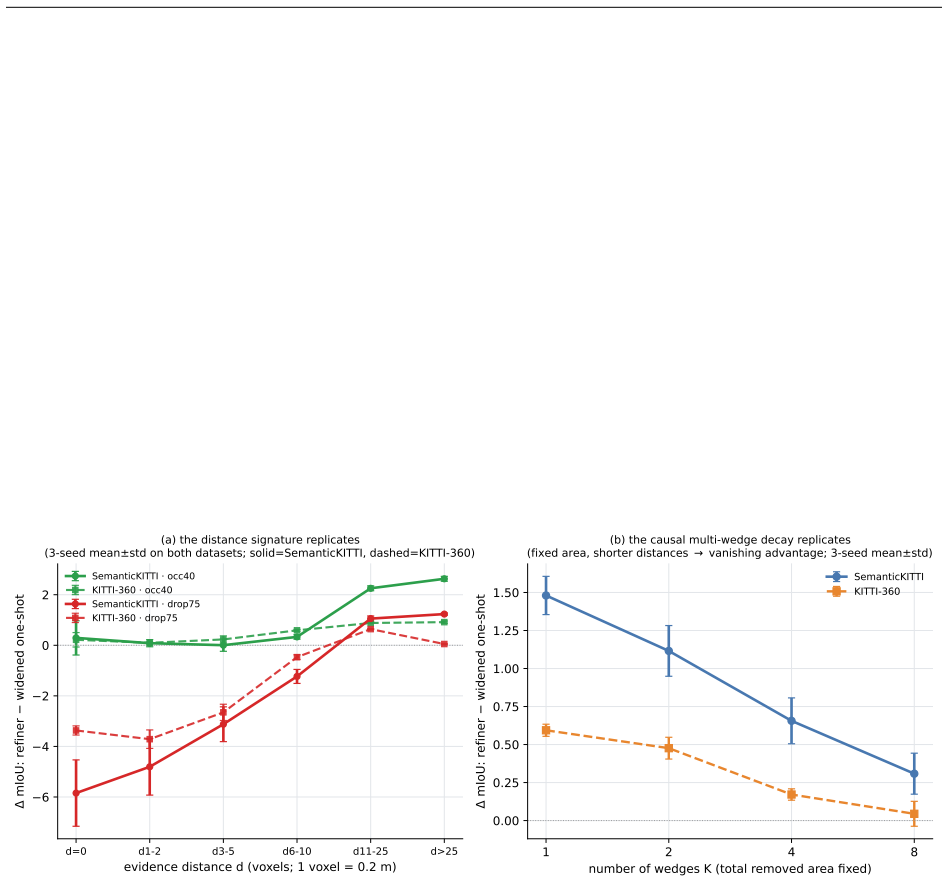
The central claim is an empirical boundary for when test-time iteration helps single-sweep LiDAR scene completion. Compared against a parameter-matched wide one-shot model on the same 815 ordered validation frames, the full iterative system—a frozen base predictor plus three steps of a weight-tied multigrid refiner—improves semantic mIoU by 0.911 points under 40% contiguous angular removal, with a paired moving-block bootstrap 95% interval of [0.804, 1.040] that clears the study's predeclared 0.5-point practical margin. The effect survives a control in which the wide model is trained for the same aggregate number of update steps. Under independent 75% thinning the refiner adds only 0.300 points while removal augmentation adds 5.975 points, and the augmentation benefit reproduces in a recognized one-shot backbone, LMSCNet-SS. Neither intervention repairs additive clutter, where the refiner can raise false occupancy at inserted returns. The paper intentionally calls the effect an iterative-system result, not an architecture-only result, and it claims no universal or causal evidence-distance law.
Load-bearing premise
The load-bearing premise is that SemanticKITTI sequence 08 can serve as a confirmatory test set even though the legacy development phase used that same sequence to fix the unweighted objective and FP32 precision, so the measured 0.911-point advantage could be partly fitted to these 815 frames.
Editorial extensions
If this is right
- At 40% contiguous angular removal, the iterative system is a compute-for-accuracy purchase: it gains 0.911 mIoU over the wide control but costs 10.74 ms and 0.75 GiB per frame versus 6.25 ms and 0.23 GiB, so deployment should choose it only when coherent missing sectors matter enough to pay that price.
- Under broad independent thinning and range attenuation, training with removal augmentation is the dominant lever; the 5.975-point augmentation gain at 75% thinning reproduces in a different one-shot backbone, LMSCNet-SS, so robustness credit goes to observation-model coverage rather than iteration.
- Unrolling tied refinement beyond the trained J=3 steps lowers accuracy under every corruption family, even as update magnitudes shrink; the paper diagnoses this as overthinking and cautions against treating shrinking updates as convergence.
- Additive clutter is not fixed by either strategy: the refiner's false-occupied rate rises at inserted returns, indicating that spurious evidence needs rejection, uncertainty, or observation validation rather than more iterations.
- The wide one-shot model remains the efficient default; the evidence favors fixed-depth refinement only in the coherent-gap regime.
Reading between the lines
- Extending the paper's boundary, a direct test of the distance hypothesis—varying nearest-evidence distance at fixed removed area, with frozen checkpoints and corrected protocol—would show whether the coherent-gap advantage scales with evidence geometry; the paper retains only exploratory evidence for this.
- The observation-coverage result implies that robustness gains in iterative-model papers should be reattributed to training augmentation unless augmentation is matched; a cheap falsifier is running the same matched design on a second route or dataset with the augmentation family held fixed.
- The clutter failure suggests a concrete remedy the paper did not test: flagging inserted or unsupported occupied returns before refinement and suppressing updates at those voxels might convert the refiner's worst case into a recoverable one.
Editorial analysis
A structured set of objections, weighed in public.
Referee Report
Summary. This paper asks whether a weight-tied iterative refiner (three fixed-depth updates of a frozen one-shot base) beats a parameter-matched wider one-shot model on LiDAR semantic scene completion under controlled input corruptions. Using SemanticKITTI sequence 08, five training seeds, byte-identical corruption realizations, and paired moving-block bootstrap, it reports a 0.911 mIoU gain for the full iterative system over the wide control at 40% contiguous angular removal, a 0.300 gain under 75% independent thinning, and no benefit under additive clutter; observation-family augmentation contributes 5.975 points under thinning. The paper also reports latency, memory, FLOPs, depth-dependence diagnostics, and an LMSCNet-SS external anchor for the augmentation effect, and concludes with a geometry-conditioned boundary rather than a universal advantage.
Significance. The study is unusually careful on controls that are often missing: parameter matching to 0.51%, identical corruption masks with hashes, paired bootstrap over seeds and ordered frames, a registered primary contrast and practical margin, automated release gates with checkpoint hashes, and an external backbone replication. If the primary effect reproduces on a genuinely held-out route, the paper provides a valuable empirical boundary for when test-time refinement helps. Its main limitation is that all confirmatory numbers come from a single sequence that also served as the development set for protocol decisions; the external anchor does not cover the refiner contrast. The paper is transparent about this, but the central claim currently rests on within-sequence evidence.
major comments (3)
- [§8, Appendix D, §5] The primary confirmatory interval is computed on the same sequence used to fix protocol choices: Section 8 admits sequence 08 served as a development set in the legacy phase, and Appendix D states that the unweighted objective and FP32 precision were fixed using exploratory legacy observations on that same sequence. The 0.5-point margin, the occ40 primary contrast, the block length 20, and the registered contrasts were also fixed after legacy analyses of these 815 frames. The moving-block bootstrap interval [0.804, 1.040] therefore quantifies variability conditional on a protocol selected with the evaluation frames; it is not a valid confidence interval for the effect on an untouched route. This is load-bearing because the 0.911-point advantage is the paper's main quantitative result. To support the abstract's boundary claim, the authors need either a genuinely held-out sequence or dataset replication of the refiner–wide contrast, or a clear re-scoping of the central claim to within-sequence confirmatory status.
- [§5.6, Figure 7] The external LMSCNet-SS replication tests only the observation-coverage effect (augmentation under thinning and sector removal), not the iterative-system contrast. As the paper itself states, it cannot establish that the refiner–wide effect transfers across architectures. Consequently, this anchor does not mitigate the single-sequence threat to the primary iterate-or-widen claim. The paper should avoid any implication that the external backbone supports the geometry-conditioned boundary as a general result; at present it supports only the training-coverage component.
- [§5.2, Figure 3] The geometry-conditioned boundary in the abstract is assembled from the primary occ40 contrast plus secondary contrasts for thinning and clutter. The secondary contrasts are not multiplicity-adjusted and are interpreted as diagnostics, which is appropriate, but the deployment implications in Section 7 (e.g., 'Cover the expected observation family first' and 'Use widening as the efficient default') depend on these secondaries as much as on the primary. If the primary loses its confirmatory status because of the development-set issue, the boundary claim should be correspondingly downgraded rather than presented as the paper's main conclusion.
minor comments (5)
- [§4.5, §5] The term 'predeclared' is used for the practical margin and the primary contrast. Since the protocol amendment is internal (supplementary S1), please state explicitly whether this is an internal protocol freeze or an externally timestamped preregistration, so readers can calibrate the strength of the claim.
- [Table 1] The headline columns should state the exact severity used for each condition (e.g., occ40, drop75, fog0.8, clutter0.5) in the caption or column headers; currently 'Sector', 'Thinning', 'Attenuation', and 'Clutter' are ambiguous without reading the body text.
- [§5.4] The 'net correction fraction' should be defined at first use in the text (corrections minus regressions over all valid voxels), rather than only in the Figure 5 caption, so the reported values are self-contained.
- [Figure 2] The bands are cross-seed standard deviations; consider also marking the bootstrap interval for the headline severities, since the text refers to both types of uncertainty and readers may otherwise conflate them.
- [Appendix D vs. §8] The statement that the unweighted objective and FP32 precision were fixed using exploratory legacy observations on the development sequence should appear in the main text before the results (not only in Appendix D), because it directly affects interpretation of the primary interval.
Circularity Check
No circularity: the refiner–wide contrast is a controlled empirical measurement, and the acknowledged same-sequence protocol selection is a validity limitation rather than a derivation-level circular step.
full rationale
The paper's central claim is an empirical contrast: the augmented-base refiner minus the parameter-matched augmented wide one-shot at 40% contiguous angular removal equals +0.911 mIoU with a moving-block bootstrap interval of [0.804, 1.040]. This difference is measured from trained checkpoints on identical corruption realizations; no equation defines the contrast in terms of the models' fitted parameters, and no fitted constant is renamed as a prediction. The zero-initialized refiner that exactly reproduces the base before training is a design control, not a circular construction. The mechanism controls (no-denoising and two-level variants) compare trained ablations and quantify dependencies rather than assuming them. The only self-referential element is the Section 8 admission that sequence 08 served as a legacy development set and that the unweighted objective and FP32 precision were fixed using exploratory observations on that same sequence, echoed in Appendix D. This is a protocol-selection and external-validity concern: the evidence is confirmatory-within-sequence rather than a genuinely hidden test, and the shared objective and precision apply equally to all arms, so the 0.911-point effect is not forced by those choices. The paper explicitly labels the legacy phase exploratory and excludes protocol-v1 evidence-distance and cross-dataset analyses from confirmatory claims (Section 6 and Appendix F), so no load-bearing self-citation chain exists. The LMSCNet-SS replication is an independent external topology. Accordingly, no circular step is present and the derivation is self-contained as an empirical study.
Assumptions & free parameters
free parameters (5)
- Practical margin of 0.5 mIoU points =
0.5 mIoU
- Moving-block bootstrap block length =
20 frames, with sensitivities at 10 and 40
- Training exposure schedule =
80,000 one-shot updates; 40,000 refiner updates; 120,000 wide sensitivity
- Corruption severity grid =
occ40, drop75, fog0.8, clutter0.5, plus neighboring severities
- Corruption probability function constants =
pdrop = min(0.98, 0.05 + s r); padd = 0.06 s (1 - r)^2
assumptions (6)
- domain assumption SemanticKITTI official label remapping, invalid mask, and first-view occlusion mask are correct and applied as described.
- domain assumption Sequence 08 can serve as a valid evaluation set despite prior development use.
- domain assumption Training seeds {0,1,2,3,4} and the moving-block bootstrap over ordered frames adequately characterize model and temporal variability.
- domain assumption The wide one-shot control and the full iterative system are matched in all confounds except the intended comparison.
- domain assumption The LMSCNet-SS reproduction is faithful to the upstream topology.
- ad hoc to paper Corruption functions are appropriate stress tests for the intended evidence-geometry distinction.
Cite this review
Pith. "Pith review of Iterate or Widen? When Test-Time Refinement Helps LiDAR Scene Completion: A Controlled Study of Evidence Geometry, Training Coverage, and Compute." pith.science (2026). https://pith.science/paper/IQXA5GST
@misc{pith2026260806014,
  author       = {Pith},
  title        = {Pith review of: Iterate or Widen? When Test-Time Refinement Helps LiDAR Scene Completion: A Controlled Study of Evidence Geometry, Training Coverage, and Compute},
  year         = {2026},
  howpublished = {\url{https://pith.science/paper/IQXA5GST}},
  note         = {Machine review of arXiv:2608.06014}
}
read the original abstract
Should a completion model spend extra test-time compute by iterating, or spend a similar parameter budget on a wider one-shot predictor? The answer is easily confounded by denoising curricula, corruption augmentation, capacity, and unpaired evaluation. We study this question in LiDAR semantic scene completion by comparing a one-shot predictor, a parameter-matched wider predictor, and a weight-tied multigrid refiner initialized from the same frozen predictor. The protocol separates coherent region removal, independent thinning, range-dependent attenuation, and additive clutter while preserving exact scene-condition pairing. Across five training seeds and 815 SemanticKITTI sequence-08 frames, the full iterative system improves mIoU over the wide control by 0.911 points under contiguous angular removal, with a 95% moving-block bootstrap interval of [0.804, 1.040] that clears a predeclared 0.5-point practical margin. Under independent 75% thinning, iteration adds only 0.300 points [0.166, 0.436], whereas observation-family augmentation adds 5.975 points [5.662, 6.140]. Neither intervention repairs additive clutter. The iterative system also costs 10.74 ms and 0.75 GiB per frame, versus 6.25 ms and 0.23 GiB for the wide control. These results establish a geometry-conditioned empirical boundary rather than a universal advantage: coherent gaps can justify fixed-depth refinement, broadly thinned evidence is addressed more effectively by training coverage, and spurious evidence requires a different robustness mechanism.
Figures


Figures from the paper (8 more)


Reference graph
Works this paper leans on
-
[4]
Adaptive computation time for recurrent neural networks.arXiv preprint arXiv:1603.08983,
Alex Graves. Adaptive computation time for recurrent neural networks.arXiv preprint arXiv:1603.08983,
-
[5]
doi: 10.52202/079017-2361. URLhttps://proceedings.neurips.cc/ paper_files/paper/2024/hash/87571720167f7e88827c40e468e3101f-Abstract-Conference.html. Alexia Jolicoeur-Martineau. Less is more: Recursive reasoning with tiny networks.arXiv preprint arXiv:2510.04871,
-
[7]
David Raposo, Sam Ritter, Blake Richards, Timothy Lillicrap, Peter Conway Humphreys, and Adam Santoro. Mixture-of-depths: Dynamically allocating compute in transformer-based language models.arXiv preprint arXiv:2404.02258,
-
[9]
Hierarchical reasoning model.arXiv preprint arXiv:2506.21734, 2025a
Guan Wang, Jin Li, Yuhao Sun, Xing Chen, Changling Liu, Yue Wu, Meng Lu, Sen Song, and Yasin Abbasi Yadkori. Hierarchical reasoning model.arXiv preprint arXiv:2506.21734, 2025a. Guoqing Wang, Zhongdao Wang, Pin Tang, Jilai Zheng, Xiangxuan Ren, Bailan Feng, and Chao Ma. Occgen: Generative multi-modal 3d occupancy prediction for autonomous driving. InEurop...
-
[10]
Shaoyuan Xie, Lingdong Kong, Wenwei Zhang, Jiawei Ren, Liang Pan, Kai Chen, and Ziwei Liu. RoboBEV: Towards robust bird’s eye view perception under corruptions.arXiv preprint arXiv:2304.06719,
-
[12]
Scaling latent reasoning via looped language models.arXiv preprint arXiv:2510.25741,
Rui-Jie Zhu et al. Scaling latent reasoning via looped language models.arXiv preprint arXiv:2510.25741,
-
[1989]
URLhttps://doi.org/10.1214/aos/1176347265
doi: 10.1214/aos/1176347265. URLhttps://doi.org/10.1214/aos/1176347265. Heng Li, Yuenan Hou, Xiaohan Xing, Xiao Sun, and Yanyong Zhang. OccMamba: Semantic occupancy prediction with state space models.arXiv preprint arXiv:2408.09859,
-
[2021]
Pondernet: Learning to ponder.arXiv preprint arXiv:2107.05407,
Andrea Banino, Jan Balaguer, and Charles Blundell. Pondernet: Learning to ponder.arXiv preprint arXiv:2107.05407,
Show all 12 references
-
[2023]
Bartoldson, Bhavya Kailkhura, Abhinav Bhatele, and Tom Goldstein
Jonas Geiping, Sean McLeish, Neel Jain, John Kirchenbauer, Siddharth Singh, Brian R. Bartoldson, Bhavya Kailkhura, Abhinav Bhatele, and Tom Goldstein. Scaling up test-time compute with latent reasoning: A recurrent depth approach.arXiv preprint arXiv:2502.05171,
-
[2024]
Joao Carreira, Pulkit Agrawal, Katerina Fragkiadaki, and Jitendra Malik
URLhttps://arxiv.org/abs/2409.18092. Joao Carreira, Pulkit Agrawal, Katerina Fragkiadaki, and Jitendra Malik. Human pose estimation with iterative error feedback. InIEEE Conference on Computer Vision and Pattern Recognition (CVPR),
-
[2025]
Yunpeng Zhang, Zheng Zhu, and Dalong Du
URLhttps://arxiv.org/abs/2512.18363. Yunpeng Zhang, Zheng Zhu, and Dalong Du. Occformer: Dual-path transformer for vision-based 3d semantic occupancy prediction. InInternational Conference on Computer Vision (ICCV),
-
[2026]
Charlie Snell, Jaehoon Lee, Kelvin Xu, and Aviral Kumar
Accessed 2026-07-23. Charlie Snell, Jaehoon Lee, Kelvin Xu, and Aviral Kumar. Scaling LLM test-time compute optimally can be more effective than scaling model parameters.arXiv preprint arXiv:2408.03314,
2026 arXiv
Reviewed August 7, 2026 · model on record in the stance chip above.
Discussion (0). Continue with ORCID to comment.