REVIEW 3 major objections 5 minor 42 references
UAV3DCrop: Benchmarking 3D Reconstruction in Repeated Multi-Angle UAV Crop Surveys
T0 review · 3 major / 5 minor · reviewed 2026-08-10 · deepseek-v4-flash
Pith's one-line read A new repeated-survey UAV benchmark shows that 3D reconstruction method rankings shift completely depending on whether you measure appearance, photogrammetry-referenced depth, or canopy height, so current methods are not interchangeable…
desk verdict A substantial, carefully reported crop-reconstruction benchmark whose 'no single method wins all' conclusion survives scrutiny, even though the depth leader is protocol-sensitive and lacks independent ground-truth validation. read the letter →
The pith
A machine-rendered reading of the paper's core claim, the machinery that carries it, and where it could break.
The reading
What carries the argument
The benchmark's load-bearing machinery is the repeated multi-angle UAV survey protocol combined with a common photogrammetric reference. Each scene is flown as eight oblique lines at 45-degree gimbal pitch with azimuths 45 degrees apart plus two perpendicular nadir grids, processed independently through structure-from-motion and bundle adjustment in commercial photogrammetry software; the resulting dense multi-view stereo depth maps define the z-depth ground truth for every method. Geometry is scored on the same held-out raster using camera-frame z-depth in meters, with a fixed revised export that masks Gaussians outside a 1.25x scene bounding box or with longest physical axis above 2 m. Canopy height is measured as the difference between the 85th/90th percentile canopy-surface height and the 50th percentile bare-ground height within a 0.4 m radius, with each method supplying its own ground. Paired bootstrap resampling over scenes (or over scenes within sequences) decides which leader is statistically supported, and ordinary least-squares regressions with sequence fixed effects and FDR correction relate degradation to days since first acquisition, image count, GSD, tie-point multiplicity, and reprojection error.
What would settle it
Measure a subset of the surveyed plots with an independent terrestrial laser scanner or surveyed ground control points and recompute Track A depth RMSE and canopy-height MAE against that reference; if Scaffold-GS no longer leads depth or its lead over Splatfacto disappears, the paper's geometry and 'no single method wins' conclusions fail.
Extended reading notes
Core claim
The paper establishes a task-conditional ordering of 3D reconstruction methods on field crops. Under a fixed 90/10 train/test split in every scene, Splatfacto-big attains the best PSNR, SSIM, and LPIPS on all four crops; Scaffold-GS attains the best z-depth RMSE, AbsRel, SILog, and Pearson correlation on all four crops; and Scaffold-GS and Splatfacto are within bootstrap error of each other on canopy height, at 0.091 and 0.092 m scene-macro MAE. Among four pretrained feed-forward models, MapAnything leads seven of eight metrics and is stable across crops, while VGGT, Pi3, and MASt3R fail on absolute scale (0.89–0.97 AbsRel) in a way that similarity alignment conceals. Repeated acquisitions show that appearance degrades with later sequence position and lower tie-point multiplicity, depth degrades most with fewer images, and feed-forward failures are model-specific. The conclusion is that no single method wins on appearance, geometry, and canopy height at once.
Load-bearing premise
The load-bearing premise is that the dense multi-view stereo depth maps produced by the same photogrammetry software that aligns the UAV images provide a correct geometric reference; the 2.34 cm camera-location residual only confirms internal consistency, and the authors themselves note that structure-from-motion is least reliable in repetitive or moving scenes.
Editorial extensions
If this is right
- Agricultural monitoring pipelines that need true measurements should not choose a method by rendering quality: the best renderer here has 71% higher canopy-height error than the best height method.
- Scene-optimized reconstruction should report both native and revised geometry exports, since the revised export removes large depth outliers and changes downstream canopy-height error unevenly across methods.
- Feed-forward zero-shot geometry evaluation must report unaligned, metric-scale outputs alongside aligned outputs; alignment alone can hide scale failures of 0.89–0.97 relative error.
- Crop-grouped reporting is needed because failures concentrate differently: corn has the highest depth error, oat the highest canopy-height error, and feed-forward models fail on different crops.
- Acquisition diagnostics such as tie-point multiplicity and image count are usable as practical quality cues for deciding which repeated surveys need re-inspection.
Reading between the lines
- Editorial inference: the 2.34 cm median camera-location residual is internal consistency only; without independent ground control or laser scans, the depth ground truth may be biased in repetitive or moving canopies, so the depth rankings should be read as conditional on that photogrammetric reference.
- Editorial inference: the benchmark's within-scene canopy-height correlations (r ≈ 0.5) suggest that fine within-plot height ordering is much weaker than across-date height differences, which weakens the claim of full agronomic utility for precision within-plot decisions.
- Editorial inference: a natural testable extension is to combine photometric consistency with depth or canopy-surface regularization in scene-optimized training; the results suggest this could close the appearance-geometry gap.
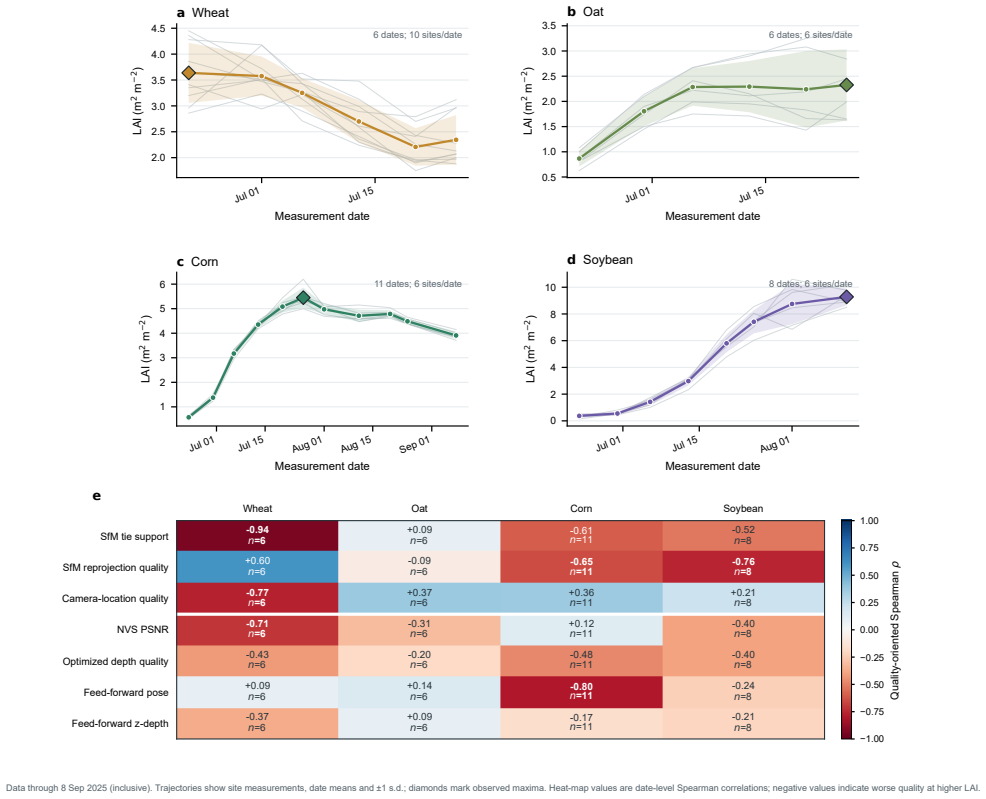
- Editorial inference: the linked effective-LAI measurements could be used as an interior-structure validation target, since all current metrics probe only canopy surface; this would test whether visually plausible scenes reproduce within-canopy foliage density.
Signed reviews
Editorial analysis
A structured set of objections, weighed in public.
Referee Report
Summary. The paper introduces UAV3DCrop, a public benchmark of repeated multi-angle UAV crop surveys containing 88,830 RGB images from 91 scenes across corn, soybean, wheat, and oat, together with refined poses, a photogrammetric depth reference, and linked field measurements. Track A evaluates seven scene-optimized NeRF/3DGS methods on held-out novel-view synthesis, photogrammetry-referenced depth, and canopy-height recovery; Track B evaluates four pretrained feed-forward models on zero-shot pose and geometry estimation, with both aligned and unaligned metric-scale scoring. The central finding is a task-conditional method ordering: Splatfacto-big leads appearance on every crop, Scaffold-GS leads photogrammetry-referenced depth, Scaffold-GS and Splatfacto are statistically tied for canopy height, and among feed-forward models only MapAnything recovers usable metric scale.
Significance. If the results hold, this is a substantial contribution to precision agriculture and 3D vision: a large real-world dataset, a fixed two-track protocol, a public release, a scene-level QC audit, and careful paired bootstrap uncertainty. The observation that appearance quality and geometric accuracy do not coincide for crop canopies is important and actionable for benchmark design, and the canopy-height results use an independent manual ruler reference, which strengthens that leg of the evaluation. The paper also reports a thorough sensitivity analysis of acquisition conditions and is transparent about many of its limitations. However, the depth-based ranking rests on a photogrammetric reference that is not independently validated, and the revised-export threshold selection is a protocol choice that changes the depth leader; these issues directly affect the headline 'no single method wins all' conclusion and require revision.
major comments (3)
- [Sec. 3.2, Table 4] The z-depth ground truth is a dense multi-view stereo reference generated by Agisoft Metashape from the same UAV images that provide the refined poses for all scene-optimized methods, with no ground control points or laser-scan check. As the paper states, the 2.34 cm median camera-location residual is a measure of internal consistency, not external accuracy. Because every evaluated method uses these Metashape-refined poses, the depth RMSE in Table 4 measures agreement with Metashape's surface rather than absolute geometry; a method that reproduces Metashape's biases in repetitive or moving canopies could appear more accurate without being more correct. The claim that 'Scaffold-GS leads depth' (Sec. 4.1) and the 'geometry' leg of the no-single-method-wins conclusion (Sec. 5) are therefore not independently established. I ask the authors to either provide independent validation on a subset of scenes (e.g., TLS or surveyed ground control) or explicitly relabel all depth metrics as 'agreement with a photogrammetric reference' and temper the conclusion accordingly.
- [Sec. 3.3, A.2, Table 9] The revised depth-export thresholds (1.25x AABB expansion and 2 m Gaussian-axis cutoff) were selected in preliminary output-control tests on the benchmark scenes and then frozen. This is a post-hoc protocol choice made on the evaluation data, and the sensitivity is large: under the native export, the depth RMSE leader is CityGaussian (1.015 m) with Scaffold-GS second (1.326 m), while under the revised export Scaffold-GS leads (0.722 m) and CityGaussian is second (0.849 m); Splatfacto improves from 7.498 m to 1.379 m. The main-text depth ranking (Table 4) is therefore a consequence of the chosen export. I recommend that the authors validate the thresholds on a held-out set of scenes or use standard fixed criteria without preliminary inspection, and that the main text report both native and revised rankings or otherwise quantify the protocol-dependence of the leader set.
- [Sec. 4.2, Table 11] The reported statistical tie between Scaffold-GS and Splatfacto for canopy-height recovery is contingent on the revised export: Splatfacto's pooled MAE improves from 0.350 m to 0.089 m under revision, while Scaffold-GS changes little (0.082 to 0.086 m). Since RQ2 is intended to provide an independent downstream validation, the main-table height results (Table 5) should include native-export values or at least a discussion of this sensitivity. As written, the tie could be partly an artifact of the threshold selection described in Sec. A.2.
minor comments (5)
- [Sec. 3.3] Please provide a single explicit definition of camera-frame z-depth (distance along the optical axis versus along the viewing ray) in Sec. 3.3, since the term is used repeatedly thereafter.
- [Table 6] The caption header 'Scale Point map Pose z-depth Ray' is confusing; please split it into separate descriptive column names.
- [Sec. 4.1] The sentence 'The remaining methods fall to 15.28–16.42 dB, a gap of about 3 dB' is ambiguous because the range includes methods that are not all far from 19.40 dB; please rephrase to specify the gap relative to the leader.
- [Figure 5] Please state in the caption that cell entries are standardized beta coefficients and that asterisks denote FDR q<0.05; the information appears in the text but should be readable from the figure itself.
- [Supplementary Table 14] The win-rate definition for the point-level R2 row is nonstandard (it uses lower squared error within the scene); please add a footnote explaining this special case.
Circularity Check
No circularity: the benchmark's depth reference is an acknowledged internal-consistency reference, not a fitted input that determines the rankings.
full rationale
The paper's central claim is an empirical, task-conditional ordering of reconstruction methods, and that ordering is not derived from any fitted parameter or self-citation. Track A depth evaluation uses an Agisoft Metashape dense-MVS reference computed from the same UAV images that provide the poses, but the authors explicitly disclose that the 2.34 cm camera-location residual is 'a measure of internal consistency rather than of external accuracy' and that 'no independent ground check points were surveyed.' This is an external-validity limitation, not a circular reduction: the evaluated methods are not optimized against that depth signal, so their agreement with it is not forced by construction. The revised-export thresholds were 'selected in preliminary output-control tests and then fixed across all scenes and methods'; although they change Splatfacto's RMSE from 7.498 m to 1.379 m, this is a disclosed, frozen protocol choice rather than a parameter fitted to produce the reported leader. Canopy-height validation rests on an independent manual-ruler field reference, and Track B uses official pretrained weights without crop-specific fine-tuning. The only self-citation, reference [38], appears in a future-work sentence about retrieving LAI and is not load-bearing for any reported result. No step in the derivation chain reduces to its own inputs, so the appropriate finding is no significant circularity.
Assumptions & free parameters
free parameters (2)
- Revised depth export thresholds =
AABB expansion 1.25x, Gaussian longest-axis cutoff 2 m
- Canopy-height extraction parameters =
0.4 m radius; 20-point minimum; ground 50th percentile; canopy 85th percentile (90th for oat)
assumptions (4)
- domain assumption Metashape SfM and dense MVS depth provide an accurate reference for z-depth evaluation.
- domain assumption The evenly spaced 10% test split tests the relevant operational regime for agronomic surveys.
- standard math Bootstrap resampling across scenes within sequences provides valid inference for leader-vs-runner-up comparisons.
- domain assumption The 2025-only plant-height field reference is representative of all benchmark scenes.
Cite this review
Pith. "Pith review of UAV3DCrop: Benchmarking 3D Reconstruction in Repeated Multi-Angle UAV Crop Surveys." pith.science (2026). https://pith.science/paper/ZNMPMS2I
@misc{pith2026260806404,
  author       = {Pith},
  title        = {Pith review of: UAV3DCrop: Benchmarking 3D Reconstruction in Repeated Multi-Angle UAV Crop Surveys},
  year         = {2026},
  howpublished = {\url{https://pith.science/paper/ZNMPMS2I}},
  note         = {Machine review of arXiv:2608.06404}
}
abstract
Accurate 3D crop monitoring underpins data-driven precision agriculture by enabling field-scale analysis of plant structure, growth dynamics, and management response. Modern 3D reconstruction methods perform strongly on generic benchmarks, but rendered appearance may not translate into metrically and agronomically useful geometry in crop fields. We introduce UAV3DCrop, a public benchmark of repeated multi-angle unmanned aerial vehicle (UAV) crop surveys. It contains 88,830 RGB images at $5280 \times 3956$ pixels, with a ground sampling distance of 3.6-5.8 mm, from 91 scenes spanning corn, soybean, wheat, and oat. Track A evaluates seven scene-optimized methods -- Neural Radiance Field (NeRF) and 3D Gaussian Splatting (3DGS) variants -- on held-out views, photogrammetry-referenced depth, and canopy-height recovery. Track B tests four pretrained feed-forward models on zero-shot camera-pose and geometry estimation. The scene-optimized methods rank differently across the three targets: Splatfacto-big leads appearance, whereas Scaffold-GS leads depth and is statistically tied with Splatfacto for canopy height. Among feed-forward models, MapAnything leads on seven of the eight metrics, while the remaining models vary more across crops and fail severely on absolute scale in a way that alignment conceals. Repeated acquisitions reveal further sensitivities that differ by output type and by model, associated with position within the acquisition sequence and with tie-point multiplicity. Current 3D reconstruction methods are therefore not yet interchangeable for agronomic use: no single method wins on appearance, geometry, and canopy height at once, and only one of four feed-forward models recovers usable metric scale. The dataset is publicly available at https://link-dev.github.io/UAV3DCrop/
Figures


Figures from the paper (4 more)


Reference graph
Works this paper leans on
-
[1]
Sami Khanal, John Fulton, and Scott Shearer. An overview of current and potential applications of thermal remote sensing in precision agriculture.Computers and electronics in agriculture, 139:22–32, 2017
work page 2017
-
[2]
Applications of remote sensing in precision agriculture: A review.Remote sensing, 12(19):3136, 2020
Rajendra P Sishodia, Ram L Ray, and Sudhir K Singh. Applications of remote sensing in precision agriculture: A review.Remote sensing, 12(19):3136, 2020
work page 2020
-
[3]
A review on plant high-throughput phenotyping traits using uav-based sensors
Chuanqi Xie and Ce Yang. A review on plant high-throughput phenotyping traits using uav-based sensors. Computers and Electronics in Agriculture, 178:105731, 2020
work page 2020
-
[4]
Guijun Yang, Jiangang Liu, Chunjiang Zhao, Zhenhong Li, Yanbo Huang, Haiyang Yu, Bo Xu, Xiaodong Yang, Dongmei Zhu, Xiaoyan Zhang, Ruyang Zhang, Haikuan Feng, Xiaoqing Zhao, Zhenhai Li, Heli Li, and Hao Yang. Unmanned aerial vehicle remote sensing for field-based crop phenotyping: current status and perspectives.Frontiers in Plant Science, 8:1111, 2017. d...
-
[5]
Zarco-Tejada, Urs Schmidhalter, Matthew P
Xiuliang Jin, Pablo J. Zarco-Tejada, Urs Schmidhalter, Matthew P. Reynolds, Malcolm J. Hawkesford, Rajeev K. Varshney, Tao Yang, Chengwei Nie, Zhenhai Li, Bo Ming, Yonggui Xiao, Yongdun Xie, and Shaokun Li. High-throughput estimation of crop traits: A review of ground and aerial phenotyping platforms.IEEE Geoscience and Remote Sensing Magazine, 9(1):200–2...
-
[6]
Srinivasan, Matthew Tancik, Jonathan T
Ben Mildenhall, Pratul P. Srinivasan, Matthew Tancik, Jonathan T. Barron, Ravi Ramamoorthi, and Ren Ng. NeRF: Representing scenes as neural radiance fields for view synthesis.Communications of the ACM, 65(1): 99–106, 2021. doi: 10.1145/3503250
doi:10.1145/3503250 2021
-
[7]
Bernhard Kerbl, Georgios Kopanas, Thomas Leimkühler, and George Drettakis. 3d gaussian splatting for real- time radiance field rendering.ACM Transactions on Graphics, 42(4):139:1–139:14, 2023. doi: 10.1145/3592433
doi:10.1145/3592433 2023
-
[8]
Nerfstudio: A modular framework for neural radiance field development
Matthew Tancik, Ethan Weber, Evonne Ng, Ruilong Li, Brent Yi, Justin Kerr, Terrance Wang, Alexander Kristoffersen, Jake Austin, Kamyar Salahi, Abhik Ahuja, David McAllister, and Angjoo Kanazawa. Nerfstudio: A modular framework for neural radiance field development. InACM SIGGRAPH 2023 Conference Proceedings, pages 72:1–72:12, 2023. doi: 10.1145/3588432.3591516
arXiv 2023
Show all 42 references
-
[9]
Pag-nerf: Towards fast and efficient end-to-end panoptic 3d representations for agricultural robotics.IEEE Robotics and Automation Letters, 9(1):907–914, 2024
Claus Smitt, Michael Halstead, Patrick Zimmer, Thomas Läbe, Esra Guclu, Cyrill Stachniss, and Chris McCool. Pag-nerf: Towards fast and efficient end-to-end panoptic 3d representations for agricultural robotics.IEEE Robotics and Automation Letters, 9(1):907–914, 2024. doi: 10.1...
2024
-
[10]
Cotton3dgaussians: Multiview 3d gaussian splatting for boll mapping and plant architecture analysis.Computers and Electronics in Agriculture, 234:110293, 2025
Lizhi Jiang, Jin Sun, Peng W Chee, Changying Li, and Longsheng Fu. Cotton3dgaussians: Multiview 3d gaussian splatting for boll mapping and plant architecture analysis.Computers and Electronics in Agriculture, 234:110293, 2025
2025
-
[11]
Wheat3dgs: In-field 3d reconstruction, instance segmentation and phenotyping of wheat heads with gaussian splatting
Daiwei Zhang, Joaquin Gajardo, Tomislav Medic, Isinsu Katircioglu, Mike Boss, Norbert Kirchgessner, Achim Walter, and Lukas Roth. Wheat3dgs: In-field 3d reconstruction, instance segmentation and phenotyping of wheat heads with gaussian splatting. InProceedings of the IEEE/CVF ...
2025
-
[12]
Schönberger, Silvano Galliani, Torsten Sattler, Konrad Schindler, Marc Pollefeys, and Andreas Geiger
Thomas Schöps, Johannes L. Schönberger, Silvano Galliani, Torsten Sattler, Konrad Schindler, Marc Pollefeys, and Andreas Geiger. A multi-view stereo benchmark with high-resolution images and multi-camera videos. In Proceedings of the IEEE Conference on Computer Vision and Patt...
2017 doi
-
[13]
Mip-NeRF 360: Unbounded anti-aliased neural radiance fields
Jonathan T Barron, Ben Mildenhall, Dor Verbin, Pratul P Srinivasan, and Peter Hedman. Mip-NeRF 360: Unbounded anti-aliased neural radiance fields. InProceedings of the IEEE/CVF conference on computer vision and pattern recognition, pages 5470–5479, 2022
2022
-
[14]
DUSt3R: Geometric 3D vision made easy
Shuzhe Wang, Vincent Leroy, Yohann Cabon, Boris Chidlovskii, and Jerome Revaud. DUSt3R: Geometric 3D vision made easy. InProceedings of the IEEE/CVF conference on computer vision and pattern recognition, pages 20697–20709, 2024
2024
-
[15]
Vggt: Visual geometry grounded transformer
Jianyuan Wang, Minghao Chen, Nikita Karaev, Andrea Vedaldi, Christian Rupprecht, and David Novotny. Vggt: Visual geometry grounded transformer. InProceedings of the Computer Vision and Pattern Recognition Conference, pages 5294–5306, 2025. 12
2025
-
[16]
MapAnything: Universal feed-forward metric 3D reconstruction
Nikhil Keetha, Norman Müller, Johannes Schönberger, Lorenzo Porzi, Yuchen Zhang, Tobias Fischer, Arno Knapitsch, Duncan Zauss, Ethan Weber, Nelson Antunes, Jonathon Luiten, Manuel Lopez-Antequera, Samuel Rota Bulò, Christian Richardt, Deva Ramanan, Sebastian Scherer, and Peter...
2026
-
[17]
Binglin Zhu, Yan Zhang, Yanguo Sun, Yi Shi, Yuntao Ma, and Yan Guo. Quantitative estimation of organ-scale phenotypic parameters of field crops through 3d modeling using extremely low altitude uav images.Computers and Electronics in Agriculture, 210:107910, 2023
2023
-
[18]
Shunfu Xiao, Yulu Ye, Shuaipeng Fei, Haochong Chen, Bingyu Zhang, Qing Li, Zhibo Cai, Yingpu Che, Qing Wang, AbuZar Ghafoor, Kaiyi Bi, Ke Shao, Ruili Wang, Yan Guo, Baoguo Li, Rui Zhang, Zhen Chen, and Yuntao Ma. High-throughput calculation of organ-scale traits with reconstru...
2023 doi
-
[19]
Quality control and crop characterization framework for multi-temporal uav lidar data over mechanized agricultural fields.Remote Sensing of Environment, 256:112299, 2021
Yi-Chun Lin and Ayman Habib. Quality control and crop characterization framework for multi-temporal uav lidar data over mechanized agricultural fields.Remote Sensing of Environment, 256:112299, 2021
2021
-
[20]
Lidar applications in precision agriculture for cultivating crops: A review of recent advances.Computers and electronics in agriculture, 207: 107737, 2023
Gilberto Rivera, Raúl Porras, Rogelio Florencia, and J Patricia Sánchez-Solís. Lidar applications in precision agriculture for cultivating crops: A review of recent advances.Computers and electronics in agriculture, 207: 107737, 2023
2023
-
[21]
Gromo25: Acm multimedia 2025 grand challenge for plant growth modeling with multiview images
Shreya Bansal, Ruchi Bhatt, Amanpreet Chander, Rupinder Kaur, Malya Singh, Mohan Kankanhalli, Ab- dulmotaleb El Saddik, and Mukesh Saini. Gromo25: Acm multimedia 2025 grand challenge for plant growth modeling with multiview images. InProceedings of the 33rd ACM International C...
2025
-
[22]
Tomato multi-angle multi-pose dataset for fine-grained phenotyping.Scientific Data, 13:309, 2026
Yujie Zhang, Sabine Struckmeyer, Andreas Kolb, and Sven Reichardt. Tomato multi-angle multi-pose dataset for fine-grained phenotyping.Scientific Data, 13:309, 2026. doi: 10.1038/s41597-026-06926-9
2026 doi
-
[23]
Mipdb: A maize image-phenotype database with multi-angle and multi-time characteristics.bioRxiv, 2024
Panpan Wang, Jianye Chang, Wenpeng Deng, Bingwen Liu, Haozheng Lai, Zhihao Hou, Linsen Dong, Qipian Chen, Yun Zhou, Zhen Zhang, Hailin Liu, and Jue Ruan. Mipdb: A maize image-phenotype database with multi-angle and multi-time characteristics.bioRxiv, 2024. doi: 10.1101/2024.04...
2024 doi
-
[24]
Seitz, and Richard Szeliski
Noah Snavely, Steven M. Seitz, and Richard Szeliski. Photo tourism: exploring photo collections in 3d.ACM Transactions on Graphics, 25(3):835–846, 2006. doi: 10.1145/1141911.1141964
2006 arXiv
-
[25]
Schönberger and Jan-Michael Frahm
Johannes L. Schönberger and Jan-Michael Frahm. Structure-from-motion revisited. InProceedings of the IEEE Conference on Computer Vision and Pattern Recognition, pages 4104–4113, 2016. doi: 10.1109/CVPR.2016.445
2016 doi
-
[26]
Multi-view stereo for community photo collections
Michael Goesele, Noah Snavely, Brian Curless, Hugues Hoppe, and Steven M Seitz. Multi-view stereo for community photo collections. In2007 IEEE 11th international conference on computer vision, pages 1–8. IEEE, 2007
2007
-
[27]
Recent advances in 3D Gaussian splatting.Computational Visual Media, 10(4):613–642, 2024
Tong Wu, Yu-Jie Yuan, Ling-Xiao Zhang, Jie Yang, Yan-Pei Cao, Ling-Qi Yan, and Lin Gao. Recent advances in 3D Gaussian splatting.Computational Visual Media, 10(4):613–642, 2024
2024
-
[28]
AA-RMVSNet: Adaptive aggregation recurrent multi-view stereo network
Zizhuang Wei, Qingtian Zhu, Chen Min, Yisong Chen, and Guoping Wang. AA-RMVSNet: Adaptive aggregation recurrent multi-view stereo network. InProceedings of the IEEE/CVF International Conference on Computer Vision, pages 6167–6176, 2021. doi: 10.1109/ICCV48922.2021.00613
2021
-
[29]
BlendedMVS: A large-scale dataset for generalized multi-view stereo networks
Yao Yao, Zixin Luo, Shiwei Li, Jingyang Zhang, Yufan Ren, Lei Zhou, Tian Fang, and Long Quan. BlendedMVS: A large-scale dataset for generalized multi-view stereo networks. InProceedings of the IEEE/CVF Conference on Computer Vision and Pattern Recognition, pages 1787–1796, 202...
2020
-
[30]
Grounding image matching in 3D with MASt3R
Vincent Leroy, Yohann Cabon, and Jérôme Revaud. Grounding image matching in 3D with MASt3R. In European conference on computer vision, pages 71–91. Springer, 2024
2024
-
[31]
InInternational Conference on Learning Representations, 2026
Yifan Wang, Jianjun Zhou, Haoyi Zhu, Wenzheng Chang, Yang Zhou, Zizun Li, Junyi Chen, Jiangmiao Pang, Chunhua Shen, and Tong He.π3: Permutation-equivariant visual geometry learning. InInternational Conference on Learning Representations, 2026. URLhttps://openreview.net/forum?i...
2026
-
[32]
Instant neural graphics primitives with a multiresolution hash encoding.ACM Transactions on Graphics, 41(4):102:1–102:15, 2022
Thomas Müller, Alex Evans, Christoph Schied, and Alexander Keller. Instant neural graphics primitives with a multiresolution hash encoding.ACM Transactions on Graphics, 41(4):102:1–102:15, 2022. doi: 10.1145/3528223.3530127
2022
-
[33]
Splatfacto: Nerfstudio’s gaussian splatting implementation.https://docs.nerf.studio/ nerfology/methods/splat.html, 2026
Nerfstudio Team. Splatfacto: Nerfstudio’s gaussian splatting implementation.https://docs.nerf.studio/ nerfology/methods/splat.html, 2026. Accessed: 2026-07-30
2026
-
[34]
Mip-splatting: Alias-free 3d gaussian splatting
Zehao Yu, Anpei Chen, Binbin Huang, Torsten Sattler, and Andreas Geiger. Mip-splatting: Alias-free 3d gaussian splatting. InProceedings of the IEEE/CVF Conference on Computer Vision and Pattern Recognition, pages 19447–19456, 2024
2024
-
[35]
Scaffold-gs: Structured 3d gaussians for view-adaptive rendering
Tao Lu, Mulin Yu, Linning Xu, Yuanbo Xiangli, Limin Wang, Dahua Lin, and Bo Dai. Scaffold-gs: Structured 3d gaussians for view-adaptive rendering. InProceedings of the IEEE/CVF Conference on Computer Vision and Pattern Recognition, pages 20654–20664, 2024
2024
-
[36]
CityGaussian: Real-time high-quality large-scale scene rendering with Gaussians
Yang Liu, Chuanchen Luo, Lue Fan, Naiyan Wang, Junran Peng, and Zhaoxiang Zhang. CityGaussian: Real-time high-quality large-scale scene rendering with Gaussians. InEuropean Conference on Computer Vision, pages 265–282. Springer, 2024
2024
-
[37]
Structure from motion photogrammetry in forestry: A review.Current Forestry Reports, 5(3):155–168, 2019
Jakob Iglhaut, Carlos Cabo, Stefano Puliti, Livia Piermattei, James O’Connor, and Jacqueline Rosette. Structure from motion photogrammetry in forestry: A review.Current Forestry Reports, 5(3):155–168, 2019. doi: 10.1007/s40725-019-00094-3
2019 doi
-
[38]
Qi Yang, Junxiong Zhou, Liya Zhao, and Zhenong Jin. NeRF-LAI: A hybrid method combining neural radiance field and gap-fraction theory for deriving effective leaf area index of corn and soybean using multi-angle UAV images.Remote Sensing of Environment, 328:114844, 2025. doi: 1...
2025
-
[39]
Uav-based multispectral phenotyping for disease resistance to accelerate crop improvement under changing climate conditions.Remote sensing, 12(15): 2445, 2020
Walter Chivasa, Onisimo Mutanga, and Chandrashekhar Biradar. Uav-based multispectral phenotyping for disease resistance to accelerate crop improvement under changing climate conditions.Remote sensing, 12(15): 2445, 2020
2020
-
[40]
Rui Yang, Yong He, Xiangyu Lu, Yiying Zhao, Yanmei Li, Yinhui Yang, Wenwen Kong, and Fei Liu. 3d-based precise evaluation pipeline for maize ear rot using multi-view stereo reconstruction and point cloud semantic segmentation.Computers and Electronics in Agriculture, 216:108512, 2024
2024
-
[41]
Twenty five years of remote sensing in precision agriculture: Key advances and remaining knowledge gaps.Biosystems engineering, 114(4):358–371, 2013
David J Mulla. Twenty five years of remote sensing in precision agriculture: Key advances and remaining knowledge gaps.Biosystems engineering, 114(4):358–371, 2013
2013
-
[42]
Rethinking resilient agriculture: From climate-smart agriculture to vulnerable- smart agriculture.Journal of Cleaner Production, 319:128602, 2021
Hossein Azadi, Saghi Movahhed Moghaddam, Stefan Burkart, Hossein Mahmoudi, Steven Van Passel, Alishir Kurban, and David Lopez-Carr. Rethinking resilient agriculture: From climate-smart agriculture to vulnerable- smart agriculture.Journal of Cleaner Production, 319:128602, 2021...
2021
Reviewed August 10, 2026 · model on record in the stance chip above.
Discussion (0). Continue with ORCID to comment.