REVIEW 4 major objections 5 minor 143 references
CO Structures with Narrow Lines in Nearby Quiescent Regions
T0 review · 4 major / 5 minor · reviewed 2026-08-10 · deepseek-v4-flash
Pith's one-line read The paper identifies 57 narrow-line CO structures, mostly diffuse sheet-like veil clouds, and argues they lie within about 300 pc as a widespread, previously overlooked molecular-gas component.
desk verdict A careful MWISP catalog of 57 narrow-line CO structures with a plausible but load-bearing distance extrapolation; the catalog is solid, the Local Bubble and mass-budget claims need more distance anchors. read the letter →
The pith
A machine-rendered reading of the paper's core claim, the machinery that carries it, and where it could break.
The reading
What carries the argument
The load-bearing machinery is a selection pipeline built on the survey's high spectral resolution (0.16 km/s channels): GaussPy+ decomposes each 12CO spectrum into Gaussian components, ACORNS clusters the components into coherent structures in position-position-velocity space, and a three-part cut selects the final sample (pixel-by-pixel FWHM below 0.8 km/s, at least 50% of pixels narrow, projected area at least 56.25 $arcmin^{2}$). The paper then corrects the observed 12CO linewidths for opacity with the $\beta_\tau$ relation, converts the residual nonthermal velocity dispersion to a Mach number, and uses a three-dimensional extinction map to place distances on the largest structures. The 'veil cloud' is the named object at the center of the argument: a diffuse, sheet-like CO structure with a large projected area, a sub-parsec thickness, and subsonic to transonic internal motion.
What would settle it
Measure parallactic or extinction distances for the 46 structures without distance measurements; if a substantial fraction lies beyond about 300 pc while still showing narrow lines, the veil-cloud interpretation and the derived sheet thicknesses and masses would be ruled out. A complementary check is to re-observe the same fields at spectral resolution below 0.1 km/s: if the narrow lines split into multiple velocity components, the subsonic-turbulence claim would be an artifact of line blending.
Extended reading notes
Core claim
The central discovery claim is that a population of 57 CO structures with narrow lines exists in the survey data, and that these structures are not dense cores but diffuse, low-column-density clouds. After opacity correction, their intrinsic CO linewidths average about 0.50 km/s, corresponding to Mach numbers near or below one, so the gas is quiescent rather than supersonically turbulent. The 11 structures with direct distance measurements lie at 196–265 pc, and the authors conclude that the majority of the sample lies within 300 pc, concentrated along sightlines toward the Galactic center and anticenter in a pattern matching the Gould Belt and the Local Bubble's surface. The sheet-like subset, called veil clouds, has physical sizes of 1–3 pc and inferred thicknesses of 0.1–0.3 pc, and the paper argues that they formed by supernova-driven compression of the local interstellar medium and trace the transition from atomic to molecular gas. The final claim is that such quiescent, diffuse molecular structures are widespread in the Galaxy and represent a previously overlooked part of the molecular gas reservoir.
Load-bearing premise
The claim that most of the 57 clouds lie within 300 pc rests on measured distances for only 11 of them; the other 46 are placed nearby because their velocities sit near zero and their sky positions match local complexes, so if a substantial fraction is actually much farther away, the derived sizes, densities, masses, and Local Bubble link would all fail.
Editorial extensions
If this is right
- Earlier CO surveys with ~1 km/s channels and arcminute beams would blend these narrow components into broad, apparently supersonic lines, so completeness limits, not the absence of gas, set the apparent scarcity.
- The total mass of molecular gas in quiescent regions may exceed CO-bright estimates by a substantial factor; the paper suggests the diffuse surroundings of these clouds could hold one to two orders of magnitude more gas.
- Veil clouds are early-stage molecular clouds at the atomic-to-molecular transition, and the H I narrow self-absorption (HINSA) features seen toward several of them support formation out of cold atomic gas compressed by supernova shocks.
- In the absence of sustained turbulent injection, turbulence decays on timescales under a megayear, so the subsonic state is the expected endpoint for old supernova-compressed gas.
- Magnetic fields dominate the dynamical state of veil clouds (magnetic pressure exceeds thermal pressure and mass-to-flux is about 0.6), so ion-neutral friction sets the dissipation scale at roughly the cloud thickness.
Reading between the lines
- A natural testable extension is to measure distances for the 46 clouds without extinction-based distances using stellar parallax or background-star absorption; the Local Bubble interpretation predicts they should cluster within a few hundred parsecs and bracket the bubble shell.
- If the sample is representative of quiescent regions elsewhere, similar narrow-line diffuse CO structures should appear toward the surfaces of other superbubbles, and wide-area surveys with high spectral resolution should find them at comparable incidence.
- One could also check the magnetic picture directly: polarimetric observations of a few veil clouds should reveal ordered fields aligned with their elongated striations, with strengths of order 10 microgauss.
- The observed near-zero velocity pattern implies that veil clouds could affect the local gas budget used to interpret interstellar absorption and emission toward nearby sources, beyond their role in star formation.
Editorial analysis
A structured set of objections, weighed in public.
Referee Report
Summary. This paper uses Phase I MWISP 12CO/13CO/C18O data, processed with GaussPy+ decomposition and ACORNS clustering, to identify 57 CO structures with narrow line widths. It derives their temperatures, column densities, opacities, and Mach numbers, classifies the more extended sheet-like examples as 'veil clouds,' and argues, on the basis of 3D extinction distances for 11 of the larger structures and the kinematic concentration of the whole sample near V_LSR≈0, that these objects are local (196–265 pc), associated with the Local Bubble, and represent a widespread, previously overlooked component of Galactic molecular gas. The turbulent dissipation is discussed in terms of cascade decay and ion–neutral friction, assuming B≈10 μG.
Significance. If the local and widespread nature of this population is confirmed, the paper would meaningfully revise the inventory of diffuse molecular gas and the initial conditions for star formation. The strengths of the manuscript are its systematic, survey-scale identification procedure, the explicit opacity correction of the line widths, and the cross-checks against 3D extinction, H I, and PGCC data. The paper is also honest about several assumptions, including the magnetic field strength in §4.2. However, the two load-bearing steps—distance assignment for the full sample and the fiducial density/thickness derivation—are model-dependent or extrapolated, and the 'widespread' claim goes beyond the current data. The central result is plausible and interesting, but it needs either additional distance constraints or a substantial reframing before publication.
major comments (4)
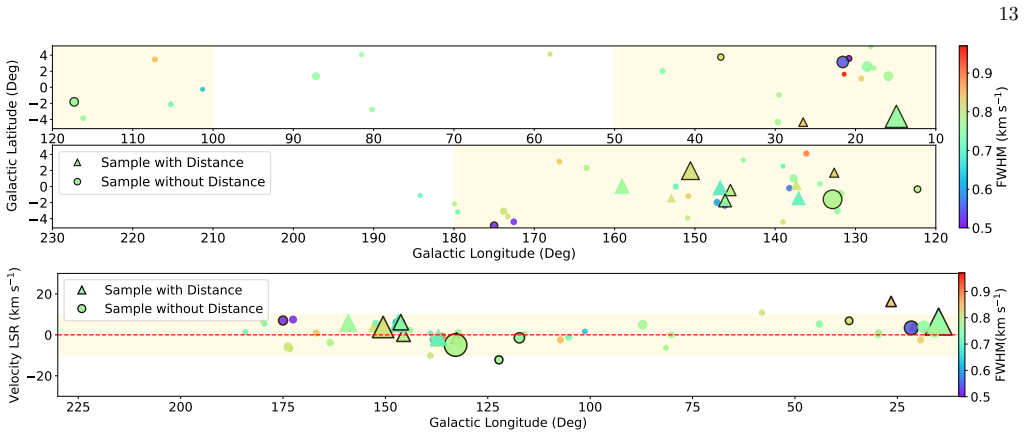
- [§3.2, §4.1, Fig. 5] The conclusion that 'the majority of these sheet-like, diffuse CO structures are located within 300 pc (and likely closer)' is the load-bearing step for the veil-cloud interpretation, but it is directly measured for only 11 of the 57 structures. Those 11 are the largest-area structures, covering nearly 50% of the total 12CO area, so the measured subset is not shown to be representative of the remaining 46 smaller structures. In the anticenter longitude range l≈100°–180°, V_LSR near 0 km/s is kinematically compatible with distances of 1–3 kpc because the kinematic distance ambiguity is severe there; therefore the kinematic argument cannot exclude larger distances for the smaller structures. Because physical size, column-derived mass, and sub-parsec thickness all scale with distance, a substantial fraction of the 46 unmeasured objects could lie at several kpc without violating any presented constraint. I would like to see either a quantitative distance-constraint argument for the unmeasured subsample (e.g., using background extinction, H I absorption, or 3D dust maps along each sightline) or a clear statement that the local and Local-Bubble association is established only for the 11 large structures and is a hypothesis for the rest.
- [§3.3.1] The fiducial density n_H2≈300 cm^-3 is chosen because the plane-parallel slab geometry gives the lowest critical density among the three geometries considered, and that density is then used to infer the 0.1–0.3 pc thickness that motivates the sheet-like morphology. This is partly circular: the assumed geometry sets the density, and the density sets the thickness that is then cited as evidence for the geometry. With N(H2)≈3×10^20 cm^-2, the stated range n_H2≈300–1000 cm^-3 corresponds to thicknesses of about 0.3 to 0.1 pc, so the 'sheet-like' conclusion is largely a restatement of the chosen plane-parallel assumption. I request an independent density constraint (for instance, from dust extinction, HI/H2 partitioning, or an excitation calculation that does not presuppose a geometry), or at minimum a presentation of the thickness and morphology as explicit functions of the assumed geometry.
- [§3.3.2, Eqs. (3)–(4)] The opacity correction in the 13CO-dark regions is central to the subsonic/transonic Mach numbers, but in those regions τ_12CO is not directly measured; it is inferred from Eq. (3) with a Monte Carlo/KDE fit of the factor F. Even within the adopted 90% KDE contour, τ_12CO ranges from 1.3 to 3.5, which translates into a noticeable systematic range in the corrected intrinsic line width: for a representative observed 12CO FWHM of 0.73 km/s, the correction gives roughly 0.47–0.59 km/s depending on τ. A short sensitivity table showing ΔVint and the resulting Mach number as functions of τ, Tex, and the filling-factor ratio would be needed before 'subsonic/transonic' can be treated as a robust property of the full sample rather than of the particular τ estimate.
- [§4.3 and Abstract] The paper states in §4.3 that such diffuse, subsonic/transonic structures are likely 'widespread throughout the Galaxy,' and the abstract asserts that they 'likely represent a widespread but previously overlooked component of the Galactic molecular gas reservoir.' The current survey covers only |b|≤5.15° of the northern Galactic plane, and the local-distance claim is anchored to only 11 objects. A galactic-scale population claim needs a completeness/selection-function argument—for example, the surveyed volume and the number of narrow-line structures per unit area in the two concentration intervals versus the rest of the surveyed strip, or an estimate of how many such clouds would be expected in the full Galaxy if this density of objects is typical. Without that, the final sentence of the abstract should be explicitly framed as a prediction to be tested by future surveys.
minor comments (5)
- [§3.3.1] There is a grammatical typo, 'for each CO structures,' which should read 'for each CO structure.'
- [Fig. 5 caption] The caption says 'the symbols are the same as in Figure 4,' but Figure 4 is plotted in l–b and l–v space whereas Figure 5 is a face-on physical map; please state explicitly what is plotted on the horizontal and vertical axes of Figure 5.
- [§3.3.2] The term 'veil clouds' is introduced qualitatively as diffuse, sheet-like structures with large projected areas, but no quantitative membership criterion is given. A reproducible definition (e.g., projected area and axis-ratio or thickness threshold) would make the subsample easier to compare with future studies.
- [§3.1] The final sample depends on the three thresholds FWHM<0.8 km/s, narrow_cov≥50%, and area≥56.25 arcmin^2, but the sensitivity of the results to these thresholds is not discussed. I suggest adding a sentence or a small figure showing how the sample size changes when the thresholds are varied.
- [§3.2] The text refers readers to 'Table 1 for methodological details,' but Table 1 is a catalog of source parameters rather than a methodology table; the intended cross-reference is probably to Section 2 or Section 3.1.
Circularity Check
No significant circularity: the paper's central claims are supported by independent data and standard methods; the distance extrapolation is a limitation, not a circular reduction.
full rationale
The paper's derivation chain does not reduce any result to its own inputs. The 57-object sample is selected by an observed FWHM threshold, but the paper's substantive claims (nearby distances, veil-cloud sheet geometry, Local Bubble association, widespread CO-dark reservoir) are not implied by that cut. Distances for 11 large structures come from the external 3D extinction map of S. Zhang et al. (2025); even though this map has overlapping authors, it is a data product used as input, not a conclusion derived from the present paper. The extension to the remaining 46 objects via low V_LSR and sky positions is an extrapolation with real systematic risk (especially near the anticenter), but extrapolation is not circularity: no equation is reused as its own output, and no fitted parameter is renamed a prediction. The assumption B ~ 10 uG for the ambipolar-diffusion estimate is explicitly flagged as an assumption rather than a fitted constraint. The 'narrow-line' property is by definition part of the sample selection, but the physical interpretation as subsonic/transonic turbulence requires opacity correction and a temperature assumption, so it is not a pure tautology. No load-bearing claim is justified solely by a self-citation chain.
Assumptions & free parameters
free parameters (6)
- Narrow-line FWHM threshold =
0.8 km/s
- Narrow-line coverage fraction threshold (narrow_cov) =
50%
- Projected area threshold =
56.25 arcmin^2
- Gas kinetic temperature =
10 K
- Fiducial volume density n_H2 =
~300 cm^-3
- Magnetic field strength B =
~10 uG
assumptions (6)
- domain assumption The measured velocity dispersion is decomposed into thermal and non-thermal parts with a Gaussian line profile (Eq. 5), with the thermal part tied to an assumed T = 10 K.
- domain assumption 12CO and 13CO have similar excitation temperatures, so 13CO optical depth can be inferred from 12CO and a fixed abundance ratio.
- ad hoc to paper The plane-parallel slab geometry applies for the critical density estimation, giving n_H2 ~ 300 cm^-3.
- domain assumption The distances of the 11 large structures, measured via 3D extinction maps, are representative of the full sample.
- domain assumption Ion-neutral friction formulas of Hennebelle 2013 and Hennebelle and Andre 2013 apply to veil clouds with adopted n, B, and L0.
- standard math The radiative transfer model of Equations 1 through 3, with a filling factor f and optically thick 12CO, describes the 13CO-dark regions.
Cite this review
Pith. "Pith review of CO Structures with Narrow Lines in Nearby Quiescent Regions." pith.science (2026). https://pith.science/paper/SP2YMTXC
@misc{pith2026260807321,
  author       = {Pith},
  title        = {Pith review of: CO Structures with Narrow Lines in Nearby Quiescent Regions},
  year         = {2026},
  howpublished = {\url{https://pith.science/paper/SP2YMTXC}},
  note         = {Machine review of arXiv:2608.07321}
}
read the original abstract
Using CO data from Phase I of the Milky Way Imaging Scroll Painting (MWISP) survey, we present a systematic study of molecular structures with narrow lines. We identify 57 CO structures, most of which exhibit low densities and subsonic/transonic turbulence. Among them, structures with large projected areas and diffuse, sheet-like geometries are identified as veil clouds. The low LSR velocities and the concentration of these CO structures toward both the Galactic center (e.g., Ophiuchus, Aquila) and anticenter (e.g., Cepheus, Taurus) regions suggest a local origin for the sample, as supported by distance measurements of about 200--300pc for a subset with relatively large angular extents. These nearby structures likely arise from large-scale compression driven by past supernova activity within the Local Bubble. The observed low-velocity-dispersion emission may trace quiescent regions where turbulence has decayed due to a lack of sustained energy injection. For diffuse veil clouds with an assumed magnetic field of ~10uG, ion-neutral friction may provide an additional mechanism for turbulent dissipation on sub-parsec scales corresponding to their thickness of 0.1--0.3pc. Tracing the atomic-to-molecular transition, veil clouds provide a unique window into the diffuse, quiescent precursor state of dense gas. They likely represent a widespread but previously overlooked component of the Galactic molecular gas reservoir, with significant implications for cloud formation and evolution, the total mass budget and spatial distribution of molecular gas, and the initial conditions of star formation as a related consequence.
Figures


Figures from the paper (3 more)


Reference graph
Works this paper leans on
-
[1]
doi:10.1093/mnras/staa2369 , eprint =
, keywords =. doi:10.1093/mnras/staa2369 , eprint =
-
[2]
arXiv , author =:1901.00285 , journal =
doi:10.3847/1538-4365/aaf1c8 , eid =. arXiv , author =:1901.00285 , journal =
arXiv 1901
-
[3]
arXiv , author =:2403.00061 , journal =
doi:10.3847/1538-3881/ad2fcb , eid =. arXiv , author =:2403.00061 , journal =
-
[4]
arXiv , author =:1906.10506 , journal =
doi:10.1051/0004-6361/201935519 , eid =. arXiv , author =:1906.10506 , journal =
arXiv 1906
-
[5]
arXiv , author =:1911.06860 , journal =
doi:10.1051/0004-6361/201936814 , eid =. arXiv , author =:1911.06860 , journal =
arXiv 1911
-
[6]
doi:10.1086/300392 , journal =
-
[7]
doi:10.1088/0004-637X/721/1/686 , eprint =
, keywords =. doi:10.1088/0004-637X/721/1/686 , eprint =
-
[8]
doi:10.1146/annurev-astro-082812-140944 , eprint =
, keywords =. doi:10.1146/annurev-astro-082812-140944 , eprint =
Show all 143 references
-
[9]
doi:10.1051/0004-6361:200809481 , eprint =
, keywords =. doi:10.1051/0004-6361:200809481 , eprint =
-
[10]
arXiv , author =:1603.08521 , journal =
doi:10.1051/0004-6361/201527319 , eid =. arXiv , author =:1603.08521 , journal =
-
[11]
arXiv , author =:2309.08998 , journal =
doi:10.3847/1538-4357/acf9ef , eid =. arXiv , author =:2309.08998 , journal =
-
[12]
doi:10.1146/annurev.aa.32.090194.001203 , journal =
-
[13]
doi:10.1086/157237 , journal =
- [14]
-
[15]
doi:10.1093/mnras/194.4.809 , journal =
-
[16]
doi:10.1086/180567 , journal =
-
[17]
doi:10.1038/s41550-025-02541-7 , eprint =
Nature Astronomy , keywords =. doi:10.1038/s41550-025-02541-7 , eprint =
- [18]
-
[19]
arXiv , author =:2403.04961 , journal =
doi:10.3847/1538-4357/ad61de , eid =. arXiv , author =:2403.04961 , journal =
- [20]
-
[21]
doi:10.1103/RevModPhys.76.125 , eprint =
Reviews of Modern Physics , keywords =. doi:10.1103/RevModPhys.76.125 , eprint =
-
[22]
, keywords =
Radio radiation from interstellar molecules. , keywords =. doi:10.1146/annurev.aa.12.090174.001431 , adsurl =
-
[23]
doi:10.1088/0004-637X/725/1/466 , journal =
-
[24]
, year = 2012, month = sep, volume =
Magnetic Fields in Molecular Clouds. , year = 2012, month = sep, volume =. doi:10.1146/annurev-astro-081811-125514 , adsurl =
2012 doi
-
[25]
arXiv , author =:1511.06370 , journal =
doi:10.1051/0004-6361/201526015 , eid =. arXiv , author =:1511.06370 , journal =
-
[26]
doi:10.1051/0004-6361:20031214 , journal =
-
[27]
doi:10.1111/j.1365-2966.2006.11044.x , eprint =
, keywords =. doi:10.1111/j.1365-2966.2006.11044.x , eprint =
2006
-
[28]
doi:10.1038/nature17196 , journal =
-
[29]
doi:10.1038/nature17424 , journal =
-
[30]
doi:10.1038/s41586-021-04286-5 , eprint =
, keywords =. doi:10.1038/s41586-021-04286-5 , eprint =
-
[31]
arXiv , author =:1705.00477 , journal =
doi:10.1051/0004-6361/201731049 , eid =. arXiv , author =:1705.00477 , journal =
-
[32]
arXiv , author =:1303.1830 , journal =
doi:10.1088/0004-637X/774/2/128 , eid =. arXiv , author =:1303.1830 , journal =
-
[33]
arXiv , author =:2403.02385 , journal =
doi:10.3847/1538-3881/ad2ea3 , eid =. arXiv , author =:2403.02385 , journal =
-
[34]
arXiv , author =:1005.2618 , journal =
doi:10.1051/0004-6361/201014666 , eid =. arXiv , author =:1005.2618 , journal =
-
[35]
arXiv , author =:1610.05918 , journal =
doi:10.3847/1538-4357/834/1/57 , eid =. arXiv , author =:1610.05918 , journal =
- [36]
- [37]
-
[38]
arXiv , author =:2206.14220 , journal =
doi:10.3847/1538-4357/ac7c74 , eid =. arXiv , author =:2206.14220 , journal =
-
[39]
arXiv , author =:1801.02634 , journal =
doi:10.3847/1538-3881/aabc4f , eid =. arXiv , author =:1801.02634 , journal =
-
[40]
arXiv , author =:1307.6212 , journal =
doi:10.1051/0004-6361/201322068 , eid =. arXiv , author =:1307.6212 , journal =
- [41]
-
[42]
arXiv , author =:1109.3016 , journal =
doi:10.1088/0004-637X/744/1/73 , eid =. arXiv , author =:1109.3016 , journal =
-
[43]
doi:10.1111/j.1365-2966.2010.16768.x , eprint =
, keywords =. doi:10.1111/j.1365-2966.2010.16768.x , eprint =
2010
- [44]
-
[45]
arXiv , author =:1306.5452 , journal =
doi:10.1051/0004-6361/201321292 , eid =. arXiv , author =:1306.5452 , journal =
-
[46]
arXiv , author =:2203.14989 , journal =
doi:10.1051/0004-6361/202142713 , eid =. arXiv , author =:2203.14989 , journal =
- [47]
- [48]
-
[49]
arXiv , author =:2507.18002 , journal =
doi:10.3847/1538-3881/adf49b , eid =. arXiv , author =:2507.18002 , journal =
-
[50]
doi:10.1111/j.1365-2966.2009.15598.x , eprint =
, keywords =. doi:10.1111/j.1365-2966.2009.15598.x , eprint =
2009
-
[51]
doi:10.1051/0004-6361:20066820 , eprint =
, keywords =. doi:10.1051/0004-6361:20066820 , eprint =
- [52]
-
[53]
doi:10.1086/170143 , journal =
-
[54]
doi:10.1086/303642 , journal =
-
[55]
doi:10.1007/978-3-540-85122-6 , title =
-
[56]
doi:10.1086/160451 , journal =
-
[57]
doi:10.1086/497123 , journal =
-
[58]
arXiv , author =:1209.2856 , journal =
doi:10.1088/0004-637X/761/2/156 , eid =. arXiv , author =:1209.2856 , journal =
- [59]
-
[60]
arXiv , author =:1509.04663 , journal =
doi:10.3847/0004-637X/822/1/11 , eid =. arXiv , author =:1509.04663 , journal =
-
[61]
arXiv , author =:1107.0971 , journal =
doi:10.1051/0004-6361/201117039 , eid =. arXiv , author =:1107.0971 , journal =
-
[62]
arXiv , author =:1412.1083 , journal =
doi:10.1051/0004-6361/201424576 , eid =. arXiv , author =:1412.1083 , journal =
-
[63]
arXiv , author =:2003.13534 , journal =
doi:10.3847/1538-4357/ab84f1 , eid =. arXiv , author =:2003.13534 , journal =
2003
-
[64]
arXiv , author =:2111.12593 , journal =
doi:10.3847/1538-4357/ac3df8 , eid =. arXiv , author =:2111.12593 , journal =
-
[65]
arXiv , author =:1809.07598 , journal =
doi:10.1051/0004-6361/201833583 , eid =. arXiv , author =:1809.07598 , journal =
-
[66]
doi:10.1146/annurev.astro.37.1.311 , eprint =
, keywords =. doi:10.1146/annurev.astro.37.1.311 , eprint =
-
[67]
doi:10.1146/annurev-astro-081811-125610 , eprint =
, keywords =. doi:10.1146/annurev-astro-081811-125610 , eprint =
-
[68]
doi:10.1146/annurev.aa.25.090187.000323 , journal =
-
[69]
doi:10.1007/978-3-662-47890-5_2 , eprint =
Saas-Fee Advanced Course , keywords =. doi:10.1007/978-3-662-47890-5_2 , eprint =
-
[70]
arXiv , author =:2004.06113 , journal =
doi:10.1007/s11214-020-00674-x , eid =. arXiv , author =:2004.06113 , journal =
2004 arXiv
-
[71]
doi:10.1146/annurev.astro.41.011802.094859 , eprint =
, keywords =. doi:10.1146/annurev.astro.41.011802.094859 , eprint =
- [72]
-
[73]
doi:10.1051/0004-6361:200810803 , eprint =
, keywords =. doi:10.1051/0004-6361:200810803 , eprint =
-
[74]
arXiv , author =:0912.0288 , journal =
doi:10.1051/0004-6361/200913780 , eid =. arXiv , author =:0912.0288 , journal =
- [75]
- [76]
-
[77]
arXiv , author =:2109.09765 , journal =
doi:10.3847/1538-4357/ac1f96 , eid =. arXiv , author =:2109.09765 , journal =
-
[78]
doi:10.1017/S0022112004009802 , journal =
-
[79]
arXiv , author =:1301.7598 , journal =
doi:10.1051/0004-6361/201219928 , eid =. arXiv , author =:1301.7598 , journal =
-
[80]
doi:10.1088/0004-637X/695/2/825 , eprint =
, keywords =. doi:10.1088/0004-637X/695/2/825 , eprint =
-
[81]
doi:10.1086/503199 , journal =
- [82]
- [83]
- [84]
-
[85]
doi:10.1088/0004-637X/716/2/1191 , eprint =
, keywords =. doi:10.1088/0004-637X/716/2/1191 , eprint =
-
[86]
doi:10.1111/j.1365-2966.2012.20770.x , eprint =
, keywords =. doi:10.1111/j.1365-2966.2012.20770.x , eprint =
2012
-
[87]
arXiv , author =:1610.06175 , journal =
doi:10.1051/0004-6361/201629178 , eid =. arXiv , author =:1610.06175 , journal =
-
[88]
doi:10.1073/pnas.1601040113 , eprint =
Proceedings of the National Academy of Science , keywords =. doi:10.1073/pnas.1601040113 , eprint =
-
[89]
doi:10.1103/PhysRevLett.125.031101 , eid =
, month =. doi:10.1103/PhysRevLett.125.031101 , eid =
-
[90]
arXiv , author =:2404.09592 , journal =
doi:10.1051/0004-6361/202450374 , eid =. arXiv , author =:2404.09592 , journal =
-
[91]
doi:10.1126/science.1106924 , journal =
-
[92]
doi:10.1088/0004-637X/710/1/133 , eprint =
, keywords =. doi:10.1088/0004-637X/710/1/133 , eprint =
-
[93]
arXiv , author =:1101.2029 , journal =
doi:10.1051/0004-6361/201116479 , eid =. arXiv , author =:1101.2029 , journal =
-
[94]
arXiv , author =:1409.6957 , keywords =
Journal of Physics Conference Series , doi =. arXiv , author =:1409.6957 , keywords =
-
[95]
doi:10.1103/PhysRevLett.88.081101 , eprint =
, keywords =. doi:10.1103/PhysRevLett.88.081101 , eprint =
-
[96]
doi:10.1146/annurev.astro.45.051806.110602 , eprint =
, keywords =. doi:10.1146/annurev.astro.45.051806.110602 , eprint =
- [97]
-
[98]
doi:10.1016/S1384-1076(03)00068-X , journal =
-
[99]
arXiv , author =:2508.14547 , journal =
doi:10.3847/1538-3881/adfe68 , eid =. arXiv , author =:2508.14547 , journal =
-
[100]
doi:10.1051/0004-6361:20030477 , eprint =
, keywords =. doi:10.1051/0004-6361:20030477 , eprint =
-
[101]
arXiv , author =:2206.03045 , journal =
doi:10.1051/0004-6361/202142531 , eid =. arXiv , author =:2206.03045 , journal =
-
[102]
arXiv , author =:2109.09763 , journal =
doi:10.3847/2041-8213/ac1f95 , eid =. arXiv , author =:2109.09763 , journal =
-
[103]
arXiv , author =:1611.06466 , journal =
doi:10.3847/1538-4357/834/2/141 , eid =. arXiv , author =:1611.06466 , journal =
-
[104]
arXiv , author =:1104.1669 , journal =
doi:10.1088/0067-0049/194/2/43 , eid =. arXiv , author =:1104.1669 , journal =
-
[105]
doi:10.1038/s41586-024-07496-9 , eprint =
, keywords =. doi:10.1038/s41586-024-07496-9 , eprint =
-
[106]
arXiv , author =:1310.3330 , journal =
doi:10.1051/0004-6361/201321761 , eid =. arXiv , author =:1310.3330 , journal =
-
[107]
The Perseus OB2 Superbubble and the Taurus-Auriga-California-Perseus Molecular Cloud Loop , year =
Chen, Xuepeng and Guo, Weihua and Feng, Jiangcheng and Su, Yang and Sun, Yan and Yan, Qingzeng and Fang, Min and Yang, Ji , doi =. The Perseus OB2 Superbubble and the Taurus-Auriga-California-Perseus Molecular Cloud Loop , year =
-
[108]
arXiv , author =:2212.00812 , journal =
doi:10.3847/2041-8213/aca7b9 , eid =. arXiv , author =:2212.00812 , journal =
-
[109]
doi:10.1007/b137959 , title =
-
[110]
arXiv , author =:1804.08979 , journal =
doi:10.3847/1538-4357/ab1eb0 , eid =. arXiv , author =:1804.08979 , journal =
-
[111]
arXiv , author =:2512.08260 , journal =
doi:10.3847/1538-4365/ae29e7 , eid =. arXiv , author =:2512.08260 , journal =
-
[112]
arXiv , author =:2504.17855 , journal =
doi:10.3847/1538-4357/adf731 , eid =. arXiv , author =:2504.17855 , journal =
-
[113]
arXiv , author =:1105.6097 , journal =
doi:10.1088/0004-637X/738/1/101 , eid =. arXiv , author =:1105.6097 , journal =
- [114]
-
[115]
arXiv , author =:1404.2024 , keywords =
Protostars and Planets VI , doi =. arXiv , author =:1404.2024 , keywords =
2024 arXiv
- [116]
-
[117]
doi:10.1146/annurev-astro-081915-023409 , eprint =
, keywords =. doi:10.1146/annurev-astro-081915-023409 , eprint =
-
[118]
arXiv , author =:1609.02989 , journal =
doi:10.3847/0004-637X/831/1/46 , eid =. arXiv , author =:1609.02989 , journal =
-
[119]
arXiv , author =:1402.3553 , keywords =
Protostars and Planets VI , doi =. arXiv , author =:1402.3553 , keywords =
- [120]
-
[121]
doi:10.1086/305574 , journal =
-
[122]
arXiv , author =:2505.00407 , journal =
doi:10.3847/1538-3881/add69a , eid =. arXiv , author =:2505.00407 , journal =
- [123]
- [124]
-
[125]
doi:10.1146/annurev.astro.45.071206.100404 , eprint =
, keywords =. doi:10.1146/annurev.astro.45.071206.100404 , eprint =
-
[126]
Planck 2015 results. XXVIII. The Planck Catalogue of Galactic cold clumps. , keywords =. doi:10.1051/0004-6361/201525819 , archivePrefix =. 1502.01599 , primaryClass =
2015 arXiv
-
[127]
Frontiers in Astronomy and Space Sciences , keywords =
The role of magnetic field in molecular cloud formation and evolution. Frontiers in Astronomy and Space Sciences , keywords =. doi:10.3389/fspas.2019.00005 , archivePrefix =. 1902.00798 , primaryClass =
2019
-
[128]
, keywords =
Magnetically Aligned Velocity Anisotropy in the Taurus Molecular Cloud. , keywords =. doi:10.1086/587510 , archivePrefix =. 0802.2084 , primaryClass =
-
[129]
, keywords =
When Magnetic Fields Sculpt the Sky: The Riegel─Crutcher Cloud in Optical Polarization. , keywords =. doi:10.3847/1538-4357/ae610c , archivePrefix =. 2605.08823 , primaryClass =
-
[130]
, year = 2015, month = aug, volume =
Molecular Clouds in the Milky Way. , year = 2015, month = aug, volume =. doi:10.1146/annurev-astro-082214-122324 , adsurl =
2015 doi
-
[131]
, keywords =
The Universality of Turbulence in Galactic Molecular Clouds. , keywords =. doi:10.1086/425978 , archivePrefix =. astro-ph/0409420 , primaryClass =
-
[132]
, keywords =
Unravelling the structure of magnetized molecular clouds with SILCC-Zoom: sheets, filaments, and fragmentation. , keywords =. doi:10.1093/mnras/stad2054 , archivePrefix =. 2307.08746 , primaryClass =
-
[133]
, keywords =
CO in the Draco nebula: the atomic-molecular transition. , keywords =. doi:10.1093/mnras/stae1419 , archivePrefix =. 2406.01542 , primaryClass =
-
[134]
, keywords =
The Universality of Turbulence in the Molecular Interstellar Medium and Its Exploitation as a Distance Estimator. , keywords =. doi:10.1086/345597 , adsurl =
-
[135]
, keywords =
Gas Emissions in Planck Cold Dust Clumps A Survey of the J = 1-0 Transitions of ^ 12 CO, ^ 13 CO, and C ^ 18 O. , keywords =. doi:10.1088/0004-637X/756/1/76 , archivePrefix =. 1206.7027 , primaryClass =
-
[136]
A Study of the Physical Properties and Star Formation Activity of a Large Sample of Molecular Clouds. I. Distances. , keywords =. doi:10.3847/1538-4365/ae6580 , archivePrefix =. 2606.02028 , primaryClass =
-
[137]
, keywords =
Ambipolar diffusion in interstellar clouds - Time-dependent solutions in one spatial dimension. , keywords =. doi:10.1086/158897 , adsurl =
-
[138]
, keywords =
The effect of ambipolar diffusion on low-density molecular ISM filaments. , keywords =. doi:10.1051/0004-6361/201527400 , archivePrefix =. 1602.04737 , primaryClass =
-
[139]
, keywords =
Gas of 96 Planck Cold Clumps in the Second Quadrant. , keywords =. doi:10.3847/0067-0049/224/2/43 , adsurl =
-
[140]
, keywords =
The TOP-SCOPE Survey of Planck Galactic Cold Clumps: Survey Overview and Results of an Exemplar Source, PGCC G26.53+0.17. , keywords =. doi:10.3847/1538-4365/aaa3dd , archivePrefix =. 1711.04382 , primaryClass =
-
[141]
, keywords =
Neutral Atomic Phases of the Interstellar Medium in the Galaxy. , keywords =. doi:10.1086/368016 , archivePrefix =. astro-ph/0207098 , primaryClass =
-
[142]
, keywords =
Magnetically Dominated Strands of Cold Hydrogen in the Riegel-Crutcher Cloud. , keywords =. doi:10.1086/508706 , archivePrefix =. astro-ph/0608585 , primaryClass =
-
[143]
Planck early results. XXIII. The first all-sky survey of Galactic cold clumps. , keywords =. doi:10.1051/0004-6361/201116472 , archivePrefix =. 1101.2035 , primaryClass =
Reviewed August 10, 2026 · model on record in the stance chip above.
Discussion (0). Continue with ORCID to comment.