REVIEW 3 major objections 3 minor 183 references
White Dwarf Kicks via Episodic Mass Ejection from Red Giant Stars
T0 review · 3 major / 3 minor · reviewed 2026-08-15 · deepseek-v4-flash
Pith's one-line read The paper argues that the observed ~1 km/s white-dwarf kicks come from a random walk of ~10^4 small recoils caused by episodic asymmetric mass ejection during the red-giant phase.
desk verdict Stochastic episodic mass-loss kicks are a new, plausible mechanism for ~1 km/s WD kicks; the mass-dependent trend is robust, the amplitude is calibrated. read the letter →
The pith
A machine-rendered reading of the paper's core claim, the machinery that carries it, and where it could break.
The reading
What carries the argument
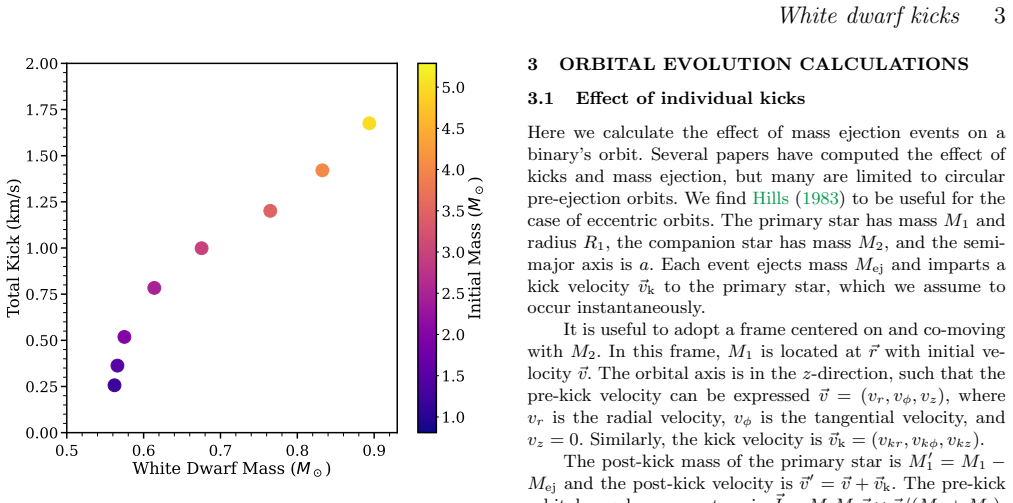
The load-bearing object is the per-event ejected mass from equation (3), $M_{\rm ej} = f_{\rm ej}\,\rho(R)\,R_d\,R^2\,\exp\bigl[-(v_{\rm esc}/2v_{\rm con})\sqrt{1-R/R_d}\bigr]$, derived from a shock-supported chromosphere model; it sets the single-kick scale $v_k=(M_{\rm ej}/M_1)v_{\rm esc}$. Net kicks come from integrating $dv_{\rm k,tot}^2/dM = v_k^2/M_{\rm ej}$ over the mass lost (equation 8), a random-walk accumulation with $\sqrt{N}$ scaling. For binaries, the machinery is the Hills (1983) energy/angular-momentum update for eccentric orbits, retaining the second-order $v_k^2$ term that always heats the orbit, plus a loss-cone treatment (orbits whose periastron drops to the stellar radius) for collisions. That combination yields analytic unbound fractions (equation 29) and collision fractions (equation 39) that match the numerical integrations shown in Figures 3 and 4.
What would settle it
Time-resolved millimeter or infrared monitoring of AGB stars can measure per-event ejecta masses; if typical events carry far less than $10^{-4}\,M_\odot$ for $f_{\rm ej}$ of order unity, equation (8) predicts net kicks well below the observed $\sim 1$ km/s and no significant binary disruption. Conversely, a large sample of wide WD binaries that shows no increase of disruption with WD mass would rule out the mass trend that is the model's most robust signature.
Extended reading notes
Core claim
The paper's central claim is that the observed $\sim 1$ km/s white-dwarf kicks are the accumulated result of many ($N \sim 10^{4}$) small, randomly oriented recoils from episodic mass ejection in red-giant progenitors. Each event ejects $M_{\rm ej} \sim 10^{-4}\,M_\odot$ and imparts a kick $v_k \sim (M_{\rm ej}/M_1)\,v_{\rm esc} \sim 5$ m/s, so the net kick is $v_{\rm k,tot} \approx \sqrt{N}\, v_k \sim 0.5$ km/s (equation 5). Integrating equation (8) over stellar evolution tracks with $f_{\rm ej}=0.5$ gives net kicks that increase steeply with white-dwarf mass, roughly $0.2$–$1.8$ km/s across the mass range shown in Figure 2. Applied to binaries, the stochastic kicks make orbital energy and angular momentum random-walk: binaries with $a \gtrsim 10^{3}$ AU are preferentially unbound, with larger disruption fractions at larger separations and for higher-mass white dwarfs, and a few percent of closer binaries diffuse into the loss cone and collide, matching the observed excess disruption of long-period and high-mass WD binaries.
Load-bearing premise
All predictions scale with the square root of the per-event ejected mass $M_{\rm ej}$ from equation (3), which the paper calls uncertain at the order-of-magnitude level; the efficiency factor $f_{\rm ej}$ is set to $0.5$ specifically to match the observed kick amplitude, so if real ejecta masses are much smaller the kicks and binary disruption largely disappear.
Editorial extensions
If this is right
- Wide WD binaries with separations $a \gtrsim 10^{3}$ AU are preferentially disrupted, with the disruption fraction growing with separation and with progenitor mass.
- A few percent of binaries with $a \sim 10$–$10^{3}$ AU are driven into collisions or tidal circularization, producing eccentric common-envelope events and possibly luminous red novae.
- Open clusters with escape velocities below a few km/s should show a deficit of white dwarfs, strongest for high-mass WDs, and some escaping high-mass WDs should move at a few km/s.
- Kicks of about 1 km/s can unbind Oort-cloud comets around white dwarfs but not planets with $a \lesssim 10^{2}$ AU, shaping the observed pattern of WD pollution.
- The model cannot produce the eccentricities of $\sim 1$ AU WD binaries; those need other mechanisms such as mass transfer or common-envelope evolution.
Reading between the lines
- The mass-ordering prediction is more robust than the amplitude: even if $M_{\rm ej}$ is revised downward, the model still predicts that high-mass WDs receive larger kicks and disrupt more wide binaries, so a sample of wide binaries split by WD mass can test the mechanism independently of the $f_{\rm ej}=0.5$ calibration.
- Individual recoils of a few m/s imply that AGB stars undergoing episodic mass loss should show small, direction-changing astrometric jitter on timescales between ejection events, distinguishing episodic random kicks from a steady rocket.
- Including tides would convert many predicted collisions into tidal circularization or post-common-envelope binaries, so the predicted transient rate from this channel is probably an upper bound until tidal effects are folded in.
Signed reviews
Editorial analysis
A structured set of objections, weighed in public.
Referee Report
Summary. This paper proposes that the ~1 km/s kicks inferred for white dwarfs arise from the stochastic accumulation of many small recoils during episodic, asymmetric mass loss from their red giant progenitors. It estimates the per-event ejected mass from a chromosphere/shock model (Eq. 3), computes the net random-walk kick using MESA stellar models (Fig. 2), and develops analytic approximations for the resulting binary orbital evolution, including unbinding and collisions, which it validates against Monte Carlo integrations (Fig. 4). The model is then used to predict the retention fraction of wide WD binaries as a function of progenitor mass and is compared with the disruption fractions reported by El-Badry & Rix (2018) and Hwang & Zakamska (2025).
Significance. If the mechanism is correct, the paper provides a physical explanation for the recently inferred WD kick scale, with two genuinely predictive features: a strong increase of kick amplitude with WD mass and a sharp increase of binary disruption fraction with initial separation. These trends are testable with Gaia DR4 and future wide-binary samples. The analytic orbital-evolution treatment is careful and matches the paper's own numerical integrations remarkably well (Figure 4). The paper is also transparent about uncertainties, explicitly stating that the per-event ejected mass is uncertain at the order-of-magnitude level and that the efficiency factor f_ej is calibrated to the observed kick scale.
major comments (3)
- [Section 4 and Eq. (3)] The central quantitative amplitude of the model is not independently predicted. Equations (5) and (8) imply v_k,tot proportional to sqrt(M_ej), and M_ej in Eq. (3) is proportional to f_ej times an exponential that depends on the uncertain ratio v_esc/v_con. In Section 4 the paper states 'We achieve good agreement with the measurements by choosing f_ej = 0.5', which means the normalization of the predicted kick distribution is calibrated to the very observations the paper aims to explain. Because the paper itself acknowledges that M_ej is uncertain at the order-of-magnitude level, reducing M_ej by a factor of 10 would lower v_k,tot to roughly 0.15 km/s and suppress the wide-binary unbinding fraction from the tens-of-percent level to a few percent, erasing the claimed agreement with El-Badry & Rix (2018) and Hwang & Zakamska (2025). The mass-dependent and separation-dependent trends may survive, but the claimed quantitative agreement is a consequence of the calibration. Please present results as explicit functions of f_ej and M_ej, propagate the order-of-magnitude uncertainty through the disruption fractions, and identify independent observational constraints on M_ej (e.g., clump masses in CO/HCN observations) rather than calibrating to the WD-kick data.
- [Section 3.3 and Figure 5] The claimed agreement with the observed binary disruption fractions is not quantified. Figure 5 does not plot the observational data from Hwang & Zakamska (2025) or El-Badry & Rix (2018), nor does the text report a goodness-of-fit statistic; the statement that the retention fractions are 'similar to those measured' is qualitative. In addition, the predicted fractions depend on the assumed initial binary population: the authors adopt the Duquennoy & Mayor (1991) log-normal semi-major-axis distribution and fix M2 = M1,i/2, but no justification is given that this distribution is representative of the WD-progenitor population. Please show the observed points with uncertainties in Figure 5 and either perform a quantitative comparison or explicitly characterize the match as a qualitative plausibility argument rather than a confirmed agreement.
- [Section 3.2.1 and Figure 4] The analytic unbinding and collision fractions are validated against numerical integrations for a single binary configuration, M1,i = 1.6 Msun with M2 = 1 Msun and fixed M_ej = 1e-4 Msun. The application to the full range of progenitor masses in Figure 5 assumes that the same degree of accuracy holds when v_esc/v_c, the mass-loss history, and M_ej(t) change substantially across the stellar grid. Given that the collision fraction in particular is sensitive to the loss-cone treatment and to the eccentricity distribution, I request Monte Carlo spot checks at least at the low-mass and high-mass endpoints of Figure 5 to confirm that the analytic formulas remain accurate in those regimes.
minor comments (3)
- [Section 2, Eq. (3)] The photospheric density rho(R) = 1e-9 g/cm^3 and the convective velocity v_con ~ 5 km/s are quoted without a reference or a scaling relation. Because M_ej depends exponentially on v_esc/v_con, a brief justification or citation for these fiducial values would help the reader assess the resulting order-of-magnitude uncertainty.
- [Section 3.3] Please state the mean and standard deviation of the Duquennoy & Mayor (1991) log-normal semi-major-axis distribution used in the integrations, and comment on the sensitivity of the retention fractions to the simplifying assumption M2 = M1,i/2.
- [Section 4] The statement that the predicted disruption fraction increases with semi-major axis 'in a manner similar to that observed' would be easier to verify if the authors pointed to the specific figure or selection window in El-Badry & Rix (2018) and Hwang & Zakamska (2025) that is being compared.
Circularity Check
Kick amplitude and the normalization of binary-disruption agreement are calibrated through f_ej=0.5, while the mass-dependent trend and shape of the disruption curves remain independent.
-
fitted input called prediction
[Section 2 (Eq. 3) and Section 4 (Discussion)]
"Here, f ej is a parameter of order unity that can be calibrated with observations of WD kicks. ... We achieve good agreement with the measurements by choosing f ej = 0.5 (equation 3), which we deem as a success for our model, because we expect f ej to be of order unity."
Equation 5 gives v_k,tot ~ sqrt(N) M_ej/M1 v_esc, and with N ~ M_env/M_ej this becomes v_k,tot ~ sqrt(M_env M_ej)/M1 v_esc, while Eq. 3 makes M_ej proportional to f_ej. Thus the total kick amplitude scales as sqrt(f_ej). The paper fixes f_ej = 0.5 specifically 'to achieve good agreement with the measurements', so the claimed ~0.5 km/s kick scale is calibrated to the observed WD-kick scale rather than independently predicted. Since Figure 5 computes binary disruption using these calibrated kick amplitudes, the quantitative agreement with the measured disruption fractions inherits that calibration. The mass-dependent trend and the shapes of the disruption curves are not fitted, which is why the circularity is partial rather than total.
full rationale
The paper's most visibly circular step is the efficiency f_ej in Eq. 3. Although described as 'of order unity', Section 4 explicitly states that f_ej = 0.5 is chosen to achieve good agreement with measurements, and all kick amplitudes scale as sqrt(M_ej) = sqrt(f_ej) times the chromosphere model. Consequently, the headline amplitude ~0.5 km/s and the normalization of the binary-disruption fractions in Figure 5 are consequences of this calibration, not independent predictions. However, several load-bearing results are not circular: the random-walk accumulation (Eqs. 5 and 8) is a parameter-free statistical derivation; the predicted increase of kick amplitude with WD mass follows from the mass-dependence of v_esc/v_con and envelope mass in the model, independent of the absolute value of f_ej; and the analytic forms for the unbound fraction, collision fraction, and their dependence on semi-major axis (Eqs. 29, 34, 39-40) are derived and checked against numerical integrations rather than fitted to observations. The reliance on Fuller & Tsuna (2024) for the chromosphere model is a self-citation used as physical input, but it is not the mechanism that makes the amplitude circular; the f_ej calibration is. Accordingly, the paper is partially circular: the amplitude-related quantitative agreement reduces to a fit, while the mechanism and functional shapes have independent content. Score 6 reflects this partial reduction without suggesting that the entire derivation is equivalent to its inputs.
Assumptions & free parameters
free parameters (1)
- f_ej (mass ejection efficiency/solid-angle factor) =
0.5
assumptions (5)
- domain assumption The chromosphere density profile of equation 1, from Fuller & Tsuna (2024), describes the material lifted by shock waves above the AGB photosphere.
- domain assumption The net momentum lost per ejection event is P_ej ~ M_ej v_esc; subsequent acceleration of dust by radiation does not impart further recoil to the star.
- domain assumption Kick directions are randomly oriented and uncorrelated between events.
- domain assumption Kicks occur at random orbital phases in the binary integrations.
- domain assumption The AGB mass-loss prescription from Fuller & Tsuna (2024) used in the MESA stellar models.
Cite this review
Pith. "Pith review of White Dwarf Kicks via Episodic Mass Ejection from Red Giant Stars." pith.science (2026). https://pith.science/paper/KFINVWOU
@misc{pith2026260807455,
  author       = {Pith},
  title        = {Pith review of: White Dwarf Kicks via Episodic Mass Ejection from Red Giant Stars},
  year         = {2026},
  howpublished = {\url{https://pith.science/paper/KFINVWOU}},
  note         = {Machine review of arXiv:2608.07455}
}
abstract
Recent observations have found evidence that white dwarf (WD) stars receive a kick of $\sim$1 km/s as the envelopes of their red giant progenitors are expelled. We show that these kicks can arise from asymmetric and episodic mass loss of red giant stars. Based on simple hydrodynamic models of red giant mass loss, each mass ejection event likely expels of order $\sim \! 10^{-4} \, M_\odot$, imparting a small and randomly oriented kick to the star, with the net kick to the WD arising from a combination of many $(N \sim 10^4)$ events. Each kick is of order $v_k \sim 5 \, {\rm m/s}$, with a total kick of order $v_{\rm k,tot} \approx \sqrt{N} v_k \sim 0.5 \, {\rm km/s}$. We predict substantially larger net kicks for higher mass WDs. We also model the orbital evolution of binary stars experiencing a stochastic series of kicks, developing analytic models to explain numerical integrations. For nominal mass ejection parameters, widely separated binaries $(a \gtrsim 10^3 \, {\rm AU})$ can become unbound, with larger fractions of unbound systems at larger separations and for higher WD masses. The orbital eccentricities can also approach unity, causing stellar collisions that may result in luminous transients and eccentric common envelope events.
Figures


Figures from the paper (2 more)


Reference graph
Works this paper leans on
-
[1]
Natal Kick by Early-asymmetrical Pairs of Jets to the Neutron Star of Supernova Remnant S147. , keywords =. doi:10.3847/1538-4357/ae0332 , archivePrefix =. 2506.21548 , primaryClass =
-
[2]
A Theory for Neutron Star and Black Hole Kicks and Induced Spins. arXiv e-prints , keywords =. doi:10.48550/arXiv.2311.12109 , archivePrefix =. 2311.12109 , primaryClass =
-
[3]
Multidimensional supernova simulations with approximative neutrino transport. I. Neutron star kicks and the anisotropy of neutrino-driven explosions in two spatial dimensions. , keywords =. doi:10.1051/0004-6361:20064855 , archivePrefix =. astro-ph/0601302 , primaryClass =
-
[4]
Steady-state Relativistic Stellar Dynamics Around a Massive Black hole. , keywords =. doi:10.3847/0004-637X/820/2/129 , archivePrefix =. 1508.01390 , primaryClass =
-
[5]
The stellar distribution around a black hole: numerical integration of the Fokker-Planck equation. , keywords =. doi:10.1086/156685 , adsurl =
-
[6]
Rates of Stellar Tidal Disruption. , keywords =. doi:10.1007/s11214-020-00651-4 , archivePrefix =. 2003.08953 , primaryClass =
arXiv 2003
-
[7]
arXiv e-prints , keywords =
Evolution of Binaries Under Stochastic Perturbations. arXiv e-prints , keywords =
-
[8]
arXiv e-prints , keywords =
Contribution of White Dwarf Formation Kicks to the Free-Floating Planet Population. arXiv e-prints , keywords =
Show all 183 references
-
[9]
Eccentric mass transfer as a solution to the wide eccentric binary problem
Eccentricity as a probe of mass-transfer physics. Eccentric mass transfer as a solution to the wide eccentric binary problem. arXiv e-prints , keywords =. doi:10.48550/arXiv.2606.09464 , archivePrefix =. 2606.09464 , primaryClass =
- [10]
-
[11]
Reviews in Mineralogy and Geochemistry , keywords =
The Evolution and Delivery of Rocky Extra-Solar Materials to White Dwarfs. Reviews in Mineralogy and Geochemistry , keywords =. doi:10.2138/rmg.2024.90.05 , archivePrefix =. 2401.08767 , primaryClass =
2024 arXiv
-
[12]
Population Synthesis of Common Envelope Mergers. I. Giant Stars with Stellar or Substellar Companions. , keywords =. doi:10.1088/0004-637X/720/2/1752 , archivePrefix =. 1007.4545 , primaryClass =
-
[13]
, keywords =
Multiplicity among Solar Type Stars in the Solar Neighbourhood - Part Two - Distribution of the Orbital Elements in an Unbiased Sample. , keywords =
-
[14]
, keywords =
The dearth of high-mass hydrogen-atmosphere metal-polluted white dwarfs within 40 pc. , keywords =. doi:10.1093/mnras/staf428 , archivePrefix =. 2503.09734 , primaryClass =
-
[15]
, keywords =
Constraints on Remnant Planetary Systems as a Function of Main-sequence Mass with HST/COS. , keywords =. doi:10.3847/1538-4357/ad86bb , archivePrefix =. 2410.06335 , primaryClass =
-
[16]
, keywords =
On the pollution of white dwarfs by exo-Oort cloud comets. , keywords =. doi:10.1093/mnras/stad2281 , archivePrefix =. 2306.10102 , primaryClass =
-
[17]
, keywords =
Violent stellar merger model for transient events. , keywords =. doi:10.1111/j.1365-2966.2006.11056.x , archivePrefix =. astro-ph/0606467 , primaryClass =
2006
-
[18]
, keywords =
Wide Post-common Envelope Binaries from Gaia: Orbit Validation and Formation Models. , keywords =. doi:10.1088/1538-3873/ad6809 , archivePrefix =. 2405.06020 , primaryClass =
-
[19]
, keywords =
High-angular-resolution ALMA imaging of the inhomogeneous dynamical atmosphere of the asymptotic giant branch star W Hya: SiO, H _ 2 O, SO _ 2 , SO, HCN, AlO, AlOH, TiO, TiO _ 2 , and OH lines. , keywords =. doi:10.1051/0004-6361/202554900 , archivePrefix =. 2512.03156 , prima...
-
[20]
, keywords =
White Dwarfs in Wide Binaries: The Strong Effects of Stellar Evolution and Mass Loss. , keywords =. doi:10.3847/1538-4357/adfa1c , archivePrefix =. 2508.08364 , primaryClass =
-
[21]
, keywords =
White-dwarf kicks and implications for barium stars. , keywords =. doi:10.1051/0004-6361/201015254 , archivePrefix =. 1008.3818 , primaryClass =
-
[22]
, keywords =
Dynamical Evolution of White Dwarfs in Triples in the Era of Gaia. , keywords =. doi:10.3847/2041-8213/acf76b , archivePrefix =. 2306.13130 , primaryClass =
-
[23]
, keywords =
The Fate of Gaia's Wide Binaries: Interplay of White-dwarf Recoil and Tidal Interactions. , keywords =. doi:10.3847/1538-4357/ae3b26 , archivePrefix =. 2509.08880 , primaryClass =
-
[24]
, keywords =
Orbital evolution with white-dwarf kicks. , keywords =. doi:10.1111/j.1365-2966.2007.12441.x , archivePrefix =. 0706.0912 , primaryClass =
2007
- [26]
-
[27]
, keywords =
An Extremely Massive White Dwarf Escaped from the Hyades Star Cluster. , keywords =. doi:10.3847/2041-8213/acffc4 , archivePrefix =. 2310.03204 , primaryClass =
-
[28]
, keywords =
The Ultramassive White Dwarfs of the Alpha Persei Cluster. , keywords =. doi:10.3847/2041-8213/ac50a5 , archivePrefix =. 2110.09668 , primaryClass =
-
[29]
, keywords =
Reconstructing the Pleiades with Gaia EDR3. , keywords =. doi:10.3847/1538-4357/ac45fc , archivePrefix =. 2110.03837 , primaryClass =
-
[30]
, keywords =
Massive White Dwarfs in Young Star Clusters. , keywords =. doi:10.3847/1538-4357/abdeb7 , archivePrefix =. 2101.08300 , primaryClass =
-
[31]
, keywords =
The Dynamical Effects of White Dwarf Birth Kicks in Globular Star Clusters. , keywords =. doi:10.1088/0004-637X/695/1/L20 , archivePrefix =. 0902.1166 , primaryClass =
-
[32]
, keywords =
On the radial distribution of white dwarfs in the globular cluster NGC 6397. , keywords =. doi:10.1111/j.1745-3933.2007.00402.x , archivePrefix =. 0709.4286 , primaryClass =
2007
-
[33]
, keywords =
The White Dwarf Deficit in Open Clusters: Dynamical Processes. , keywords =. doi:10.1086/379005 , archivePrefix =. astro-ph/0308261 , primaryClass =
-
[34]
, keywords =
Mass loss towards the white dwarf stage. , keywords =
-
[35]
Double Core Evolution. X. Through the Envelope Ejection Phase. , keywords =. doi:10.1086/305778 , archivePrefix =. astro-ph/9801230 , primaryClass =
-
[36]
arXiv e-prints , keywords =
Searching for White Dwarf Candidates Formed Through Binary evolution in Star Clusters. arXiv e-prints , keywords =. doi:10.48550/arXiv.2602.16550 , archivePrefix =. 2602.16550 , primaryClass =
-
[37]
, keywords =
The First Catalog of Candidate White Dwarf─Main-sequence Binaries in Open Star Clusters: A New Window into Common Envelope Evolution. , keywords =. doi:10.3847/1538-4357/ad7500 , archivePrefix =. 2407.04775 , primaryClass =
-
[38]
Applications to X-ray binaries and to the binarypulsars
The effects of sudden mass loss and a random kick velocity produced in a supernova explosion on the dynamics of a binary star of arbitrary orbital eccentricity. Applications to X-ray binaries and to the binarypulsars. , keywords =. doi:10.1086/160871 , adsurl =
-
[39]
, keywords =
Shock-powered light curves of luminous red novae as signatures of pre-dynamical mass-loss in stellar mergers. , keywords =. doi:10.1093/mnras/stx1768 , archivePrefix =. 1705.03895 , primaryClass =
-
[40]
Science , keywords =
Identification of the Long-Sought Common-Envelope Events. Science , keywords =. doi:10.1126/science.1225540 , archivePrefix =. 1301.5897 , primaryClass =
-
[41]
2025 , eprint=
Ensemble seismic study of the properties of the core of Red Clump stars , author=. 2025 , eprint=
2025
- [42]
-
[43]
, keywords =
E pur si muove: Galilean-invariant cosmological hydrodynamical simulations on a moving mesh. , keywords =. doi:10.1111/j.1365-2966.2009.15715.x , archivePrefix =. 0901.4107 , primaryClass =
2009
-
[44]
Stellar evolution of low and intermediate-mass stars. I. Mass loss on the AGB and its consequences for stellar evolution. , keywords =
-
[45]
, keywords =
Evolution of Low- and Intermediate-Mass Stars to the End of the Asymptotic Giant Branch with Mass Loss. , keywords =. doi:10.1086/173033 , adsurl =
-
[46]
, keywords =
The Core Mass Growth and Stellar Lifetime of Thermally Pulsing Asymptotic Giant Branch Stars. , keywords =. doi:10.1088/0004-637X/782/1/17 , archivePrefix =. 1312.4544 , primaryClass =
-
[47]
Clumpy dust clouds and extended atmosphere of the AGB star W Hydrae revealed with VLT/SPHERE-ZIMPOL and VLTI/AMBER. II. Time variations between pre-maximum and minimum light. , keywords =. doi:10.1051/0004-6361/201629761 , archivePrefix =. 1611.04622 , primaryClass =
-
[48]
, keywords =
Clumpy dust clouds and extended atmosphere of the AGB star W Hydrae revealed with VLT/SPHERE-ZIMPOL and VLTI/AMBER. , keywords =. doi:10.1051/0004-6361/201628229 , archivePrefix =. 1603.01197 , primaryClass =
-
[49]
Mapping the ^ 12 CO J = 1-0 and J = 2-1 emission in AGB and early post-AGB circumstellar envelopes. I. The COSAS program, first sample. , keywords =. doi:10.1051/0004-6361/201014755 , adsurl =
-
[50]
, keywords =
On the reliability of mass-loss-rate estimates for AGB stars. , keywords =. doi:10.1051/0004-6361:20078876 , archivePrefix =. 0806.0517 , primaryClass =
-
[51]
Exploring wind-driving dust species in cool luminous giants. I. Basic criteria and dynamical models of M-type AGB stars. , keywords =. doi:10.1051/0004-6361/201219138 , archivePrefix =. 1209.2112 , primaryClass =
-
[52]
The close circumstellar environment of Betelgeuse. V. Rotation velocity and molecular envelope properties from ALMA. , keywords =. doi:10.1051/0004-6361/201731761 , archivePrefix =. 1711.07983 , primaryClass =
-
[53]
, keywords =
The inhomogeneous submillimeter atmosphere of Betelgeuse. , keywords =. doi:10.1051/0004-6361/201731171 , archivePrefix =. 1706.06021 , primaryClass =
-
[54]
Mechanisms, models and measurements
Mass loss of stars on the asymptotic giant branch. Mechanisms, models and measurements. , keywords =. doi:10.1007/s00159-017-0106-5 , adsurl =
-
[55]
, keywords =
Modules for Experiments in Stellar Astrophysics (MESA): Planets, Oscillations, Rotation, and Massive Stars. , keywords =. doi:10.1088/0067-0049/208/1/4 , archivePrefix =. 1301.0319 , primaryClass =
-
[56]
, keywords =
Oscillatory convective modes in red giants: a possible explanation of the long secondary periods. , keywords =. doi:10.1093/mnras/stv1587 , archivePrefix =. 1507.03430 , primaryClass =
-
[57]
, keywords =
A Buddy for Betelgeuse: Binarity as the Origin of the Long Secondary Period in Orionis. , keywords =. doi:10.3847/1538-4357/ad87f4 , archivePrefix =. 2408.09089 , primaryClass =
-
[58]
, keywords =
An Implicit Finite Volume Scheme to Solve the Time-dependent Radiation Transport Equation Based on Discrete Ordinates. , keywords =. doi:10.3847/1538-4365/abe303 , archivePrefix =. 2102.02212 , primaryClass =
-
[59]
, keywords =
An Algorithm for Radiation Magnetohydrodynamics Based on Solving the Time-dependent Transfer Equation. , keywords =. doi:10.1088/0067-0049/213/1/7 , archivePrefix =. 1403.6126 , primaryClass =
-
[60]
, keywords =
Multiphase Shock Cooling Emission in Ultrastripped Supernovae. , keywords =. doi:10.3847/1538-4357/addc72 , archivePrefix =. 2503.08790 , primaryClass =
-
[61]
, keywords =
Extreme Mass Loss in Low-mass Type Ib/c Supernova Progenitors. , keywords =. doi:10.3847/2041-8213/ac9b3d , archivePrefix =. 2210.10187 , primaryClass =
- [62]
-
[63]
, keywords =
Rapid Binary Mass Transfer: Circumbinary Outflows and Angular Momentum Losses. , keywords =. doi:10.3847/1538-4357/adf067 , archivePrefix =. 2505.21264 , primaryClass =
-
[64]
, keywords =
Ultra short-period WD Binaries Are Not Undergoing Strong Tidal Heating. , keywords =. doi:10.3847/1538-4357/ad1dd6 , archivePrefix =. 2401.14397 , primaryClass =
-
[65]
, keywords =
White dwarf binaries suggest a common envelope efficiency 1/3. , keywords =. doi:10.1093/mnras/stac3313 , archivePrefix =. 2211.02036 , primaryClass =
-
[66]
, keywords =
Common envelope evolution of eccentric binaries. , keywords =. doi:10.1093/mnras/stab2291 , archivePrefix =. 2105.02227 , primaryClass =
-
[67]
arXiv e-prints , keywords =
The White Dwarf Initial-Final Mass Relation from Open Clusters in Gaia DR3. arXiv e-prints , keywords =. doi:10.48550/arXiv.2510.24877 , archivePrefix =. 2510.24877 , primaryClass =
-
[68]
, keywords =
Asteroseismic masses of red giants in the Galactic Globular Clusters M9 and M19. , keywords =. doi:10.1093/mnras/stae2686 , archivePrefix =. 2412.01089 , primaryClass =
-
[69]
, keywords =
First asteroseismic analysis of the globular cluster M80: multiple populations and stellar mass-loss. , keywords =. doi:10.1093/mnras/stad3565 , archivePrefix =. 2307.07158 , primaryClass =
-
[70]
, keywords =
Integrated mass-loss of evolved stars in M4 using asteroseismology. , keywords =. doi:10.1093/mnras/stac1918 , archivePrefix =. 2207.02406 , primaryClass =
-
[71]
, keywords =
Evidence that Mass Loss on the Red Giant Branch Decreases with Metallicity. , keywords =. doi:10.3847/1538-4357/ade3c7 , archivePrefix =. 2505.12794 , primaryClass =
-
[72]
arXiv e-prints , keywords =
AREPO-RSG: Aspherical Circumstellar Material and Winds from Pulsating Dusty Red Supergiants in Global 3D Radiation Hydrodynamic Simulations. arXiv e-prints , keywords =. doi:10.48550/arXiv.2510.14875 , archivePrefix =. 2510.14875 , primaryClass =
-
[73]
, keywords =
New observations and models of circumstellar CO line emission of AGB stars in the Herschel SUCCESS programme. , keywords =. doi:10.1051/0004-6361/201526705 , archivePrefix =. 1506.09065 , primaryClass =
-
[74]
The Open Journal of Astrophysics , keywords =
Boil-off of red supergiants: mass loss and type II-P supernovae. The Open Journal of Astrophysics , keywords =. doi:10.33232/001c.120130 , archivePrefix =. 2405.21049 , primaryClass =
-
[75]
, keywords =
Imprints of white dwarf recoil in the separation distribution of Gaia wide binaries. , keywords =. doi:10.1093/mnras/sty2186 , archivePrefix =. 1807.06011 , primaryClass =
- [76]
-
[77]
, keywords =
Shock Cooling and Possible Precursor Emission in the Early Light Curve of the Type II SN 2023ixf. , keywords =. doi:10.3847/2041-8213/ace4c4 , archivePrefix =. 2306.06097 , primaryClass =
-
[78]
, keywords =
Explosion imminent: the appearance of red supergiants at the point of core-collapse. , keywords =. doi:10.1093/mnras/stac2427 , archivePrefix =. 2208.10883 , primaryClass =
-
[79]
, keywords =
The mass-loss rates of red supergiants and the de Jager prescription. , keywords =. doi:10.1051/0004-6361/201013993 , archivePrefix =. 1010.5369 , primaryClass =
-
[80]
, year = 1934, month = mar, volume =
The radiative equilibrium of extended stellar atmospheres. , year = 1934, month = mar, volume =. doi:10.1093/mnras/94.5.444 , adsurl =
1934 doi
-
[81]
, year = 1962, month = jan, volume =
On graphite particles as interstellar grains. , year = 1962, month = jan, volume =. doi:10.1093/mnras/124.5.417 , adsurl =
1962 doi
-
[82]
, year = 1974, month = feb, volume =
Interstellar abundances: gas and dust. , year = 1974, month = feb, volume =. doi:10.1086/152654 , adsurl =
1974 doi
-
[83]
, keywords =
The wind speeds, dust content, and mass-loss rates of evolved AGB and RSG stars at varying metallicity. , keywords =. doi:10.1093/mnras/stw2708 , archivePrefix =. 1610.05761 , primaryClass =
-
[84]
Exploring wind-driving dust species in cool luminous giants. III. Wind models for M-type AGB stars: dynamic and photometric properties. , keywords =. doi:10.1051/0004-6361/201424917 , archivePrefix =. 1502.00032 , primaryClass =
-
[85]
Dynamic atmospheres and winds of cool luminous giants. I. Al _ 2 O _ 3 and silicate dust in the close vicinity of M-type AGB stars. , keywords =. doi:10.1051/0004-6361/201628424 , archivePrefix =. 1605.09730 , primaryClass =
-
[86]
, keywords =
Dynamical Modeling of Long-Period Variable Star Atmospheres. , keywords =. doi:10.1086/166378 , adsurl =
-
[87]
, keywords =
Pulsation and mass loss in Mira variables. , keywords =. doi:10.1086/156721 , adsurl =
-
[88]
Shock wave interpretation of emission lines in long period variable stars. II. Periodicity and mass loss. , keywords =. doi:10.1086/156911 , adsurl =
-
[89]
, keywords =
Theoretical velocity structure of long-period variable star photospheres. , keywords =. doi:10.1086/157038 , adsurl =
-
[90]
, keywords =
On the optical properties of resonant drag instabilities: variability of asymptotic giant branch and R Coronae Borealis stars. , keywords =. doi:10.1093/mnras/stac2035 , archivePrefix =. 2111.09335 , primaryClass =
-
[91]
, keywords =
Non-linear evolution of instabilities between dust and sound waves. , keywords =. doi:10.1093/mnras/stz2128 , archivePrefix =. 1810.08214 , primaryClass =
-
[92]
, keywords =
Resonant drag instabilities in protoplanetary discs: the streaming instability and new, faster growing instabilities. , keywords =. doi:10.1093/mnras/sty854 , archivePrefix =. 1711.03975 , primaryClass =
-
[93]
, keywords =
Using spectral modeling to break light-curve degeneracies of type II supernovae interacting with circumstellar material. , keywords =. doi:10.1051/0004-6361/202346754 , archivePrefix =. 2307.08584 , primaryClass =
-
[94]
Volume II: Gas dynamics
The physics of astrophysics. Volume II: Gas dynamics
-
[95]
, keywords =
A periodic shock wave model for Mira variable atmospheres. , keywords =. doi:10.1086/163690 , adsurl =
-
[96]
Circumstellar dust shells around long-period variables. V. A consistent time-dependent model for the extreme carbon star AFGL 3068. , keywords =
-
[97]
On the gas temperature in the shocked circumstellar envelopes of pulsating stars. III. Dynamical models for AGB star winds including time-dependent dust formation and non-LTE cooling. , keywords =. doi:10.1051/0004-6361:20030444 , adsurl =
- [98]
-
[99]
2011 , publisher=
Linear and Nonlinear Waves , author=. 2011 , publisher=
2011
-
[100]
ON THE PROBLEM OF A SHOCK WAVE ARRIVING AT THE EDGE OF A GAS , author =. Communs. Pure and Appl. Math. , volume =. 1960 , month =. doi:10.1002/cpa.3160130303 , url =
1960 doi
-
[101]
, keywords =
The Expulsion of Stellar Envelopes in Core-Collapse Supernovae. , keywords =. doi:10.1086/306571 , archivePrefix =. astro-ph/9807046 , primaryClass =
-
[102]
A Universal mass-loss concept for massive stars
Exploring the Red Supergiant wind kink. A Universal mass-loss concept for massive stars. , keywords =. doi:10.1051/0004-6361/202347801 , archivePrefix =. 2309.08657 , primaryClass =
-
[103]
, keywords =
Evolution and Mass Loss of Cool Ageing Stars: a Daedalean Story. , keywords =. doi:10.1146/annurev-astro-090120-033712 , archivePrefix =. 2011.13472 , primaryClass =
2011 arXiv
-
[104]
A recent dimming event from dust
The light curve of the semiregular variable L _ 2 Puppis - I. A recent dimming event from dust. , keywords =. doi:10.1046/j.1365-8711.2002.05822.x , archivePrefix =. astro-ph/0207485 , primaryClass =
2002
-
[105]
, keywords =
Dust-enshrouded giants in clusters in the Magellanic Clouds. , keywords =. doi:10.1051/0004-6361:20053528 , archivePrefix =. astro-ph/0507571 , primaryClass =
-
[106]
, keywords =
Mass Loss From Cool Stars: Impact on the Evolution of Stars and Stellar Populations. , keywords =. doi:10.1146/annurev.astro.38.1.573 , adsurl =
-
[107]
An extensive grid of DARWIN models for M-type AGB stars. I. Mass-loss rates and other properties of dust-driven winds. , keywords =. doi:10.1051/0004-6361/201935366 , archivePrefix =. 1904.10943 , primaryClass =
1904 arXiv
-
[108]
The enigmatic nature of the circumstellar envelope and bow shock surrounding Betelgeuse as revealed by Herschel. I. Evidence of clumps, multiple arcs, and a linear bar-like structure. , keywords =. doi:10.1051/0004-6361/201219792 , archivePrefix =. 1212.4870 , primaryClass =
-
[109]
, keywords =
An empirical formula for the mass-loss rates of dust-enshrouded red supergiants and oxygen-rich Asymptotic Giant Branch stars. , keywords =. doi:10.1051/0004-6361:20042555 , archivePrefix =. astro-ph/0504379 , primaryClass =
-
[110]
, keywords =
The Extreme Scarcity of Dust-enshrouded Red Supergiants: Consequences for Producing Stripped Stars via Winds. , keywords =. doi:10.3847/1538-4357/ac6dcf , archivePrefix =. 2205.02207 , primaryClass =
-
[111]
, keywords =
A New Version of Reimers' Law of Mass Loss Based on a Physical Approach. , keywords =. doi:10.1086/491579 , archivePrefix =. astro-ph/0507598 , primaryClass =
-
[112]
, keywords =
Mass loss rates in the Hertzsprung-Russell diagram. , keywords =
-
[113]
, keywords =
The luminosities of cool supergiants in the Magellanic Clouds, and the Humphreys-Davidson limit revisited. , keywords =. doi:10.1093/mnras/sty1302 , archivePrefix =. 1804.06417 , primaryClass =
-
[114]
, keywords =
Asymptotic giant branch superwind speed at low metallicity. , keywords =. doi:10.1111/j.1365-2966.2004.08417.x , archivePrefix =. astro-ph/0410120 , primaryClass =
2004
-
[115]
, keywords =
Circumstellar masers in the Magellanic Clouds. , keywords =. doi:10.1051/0004-6361:20010052 , archivePrefix =. astro-ph/0101125 , primaryClass =
-
[116]
, keywords =
A new sample of OH/IR stars in the Galactic center. , keywords =. doi:10.1051/aas:1998127 , adsurl =
-
[117]
, keywords =
Bright, Months-long Stellar Outbursts Announce the Explosion of Interaction-powered Supernovae. , keywords =. doi:10.3847/1538-4357/abd032 , archivePrefix =. 2010.11196 , primaryClass =
2010 arXiv
-
[118]
, keywords =
The Prevalence and Influence of Circumstellar Material around Hydrogen-rich Supernova Progenitors. , keywords =. doi:10.3847/1538-4357/acd8be , archivePrefix =. 2212.03313 , primaryClass =
-
[119]
, keywords =
A Large Fraction of Hydrogen-rich Supernova Progenitors Experience Elevated Mass Loss Shortly Prior to Explosion. , keywords =. doi:10.3847/1538-4357/abef05 , archivePrefix =. 2008.09986 , primaryClass =
2008 arXiv
-
[120]
Nature Astronomy , keywords =
The electron-capture origin of supernova 2018zd. Nature Astronomy , keywords =. doi:10.1038/s41550-021-01384-2 , archivePrefix =. 2011.02176 , primaryClass =
2011 arXiv
- [121]
-
[122]
, keywords =
The Effective Temperature Scale of Galactic Red Supergiants: Cool, but Not As Cool As We Thought. , keywords =. doi:10.1086/430901 , archivePrefix =. astro-ph/0504337 , primaryClass =
-
[123]
Evolved Massive Stars at Low Metallicity. VI. Mass-loss Rate of Red Supergiant Stars in the Large Magellanic Cloud. , keywords =. doi:10.3847/1538-3881/ad12bf , archivePrefix =. 2401.03778 , primaryClass =
- [124]
-
[125]
, keywords =
Exploring the Mass-loss Histories of the Red Supergiants. , keywords =. doi:10.3847/1538-3881/abab15 , archivePrefix =. 2008.01108 , primaryClass =
2008 arXiv
-
[126]
Evolved massive stars at low-metallicity. V. Mass-loss rate of red supergiant stars in the Small Magellanic Cloud. , keywords =. doi:10.1051/0004-6361/202244770 , archivePrefix =. 2304.01835 , primaryClass =
-
[127]
, keywords =
Testing a Predictive Theoretical Model for the Mass Loss Rates of Cool Stars. , keywords =. doi:10.1088/0004-637X/741/1/54 , archivePrefix =. 1108.4369 , primaryClass =
-
[128]
Weak Shock Propagation with Accretion. I. Self-similar Solutions and Application to Failed Supernovae. , keywords =. doi:10.3847/1538-4357/aad198 , archivePrefix =. 1805.06456 , primaryClass =
-
[129]
, keywords =
Type IIP supernova light curves affected by the acceleration of red supergiant winds. , keywords =. doi:10.1093/mnras/sty475 , archivePrefix =. 1802.07752 , primaryClass =
-
[130]
, keywords =
A Luminous Red Supergiant and Dusty Long-period Variable Progenitor for SN 2023ixf. , keywords =. doi:10.3847/2041-8213/ace618 , archivePrefix =. 2306.08678 , primaryClass =
-
[131]
, keywords =
SN 2023ixf in Messier 101: A Variable Red Supergiant as the Progenitor Candidate to a Type II Supernova. , keywords =. doi:10.3847/2041-8213/ace4ca , archivePrefix =. 2306.04722 , primaryClass =
-
[132]
Grefenstette and Murray Brightman and Hannah P
Brian W. Grefenstette and Murray Brightman and Hannah P. Earnshaw and Fiona A. Harrison and R. Margutti , title =. 2023 , month =. doi:10.3847/2041-8213/acdf4e , url =
2023 doi
-
[133]
, keywords =
From Discovery to the First Month of the Type II Supernova 2023ixf: High and Variable Mass Loss in the Final Year before Explosion. , keywords =. doi:10.3847/2041-8213/acf299 , archivePrefix =. 2307.03165 , primaryClass =
-
[134]
arXiv e-prints , keywords =
A Shock Flash Breaking Out of a Dusty Red Supergiant. arXiv e-prints , keywords =. doi:10.48550/arXiv.2311.14409 , archivePrefix =. 2311.14409 , primaryClass =
-
[135]
, keywords =
SN 2023ixf in Messier 101: Photo-ionization of Dense, Close-in Circumstellar Material in a Nearby Type II Supernova. , keywords =. doi:10.3847/2041-8213/acf2ec , archivePrefix =. 2306.04721 , primaryClass =
-
[136]
Final Moments. I. Precursor Emission, Envelope Inflation, and Enhanced Mass Loss Preceding the Luminous Type II Supernova 2020tlf. , keywords =. doi:10.3847/1538-4357/ac3f3a , archivePrefix =. 2109.12136 , primaryClass =
-
[137]
, keywords =
Early Spectroscopy and Dense Circumstellar Medium Interaction in SN 2023ixf. , keywords =. doi:10.3847/2041-8213/acf9a4 , archivePrefix =. 2306.10119 , primaryClass =
-
[138]
Science Bulletin , keywords =
Circumstellar material ejected violently by a massive star immediately before its death. Science Bulletin , keywords =. doi:10.1016/j.scib.2023.09.015 , archivePrefix =. 2309.01998 , primaryClass =
2023 arXiv
-
[139]
, keywords =
Early Time Spectropolarimetry of the Aspherical Type II Supernova SN 2023ixf. , keywords =. doi:10.3847/2041-8213/acf1a3 , archivePrefix =. 2307.01268 , primaryClass =
-
[140]
, keywords =
High-resolution Spectroscopy of SN 2023ixf's First Week: Engulfing the Asymmetric Circumstellar Material. , keywords =. doi:10.3847/1538-4357/acf366 , archivePrefix =. 2306.07964 , primaryClass =
-
[141]
arXiv e-prints , keywords =
Signatures of convection in the atmospheres of cool evolved stars. arXiv e-prints , keywords =
-
[142]
, keywords =
Global 3D radiation-hydrodynamical models of AGB stars with dust-driven winds. , keywords =. doi:10.1051/0004-6361/202244992 , archivePrefix =. 2301.11836 , primaryClass =
-
[143]
Effects of convection and radial pulsations on atmospheric structures
Global 3D radiation-hydrodynamics models of AGB stars. Effects of convection and radial pulsations on atmospheric structures. , keywords =. doi:10.1051/0004-6361/201629594 , archivePrefix =. 1702.05433 , primaryClass =
-
[144]
, keywords =
Three-dimensional simulations of the atmosphere of an AGB star. , keywords =. doi:10.1051/0004-6361:20078096 , adsurl =
-
[145]
Dynamic model atmospheres of AGB stars. III. Effects of frequency-dependent radiative transfer. , keywords =. doi:10.1051/0004-6361:20021757 , adsurl =
-
[146]
, keywords =
Analytic, dust-independent mass-loss rates for red supergiant winds initiated by turbulent pressure. , keywords =. doi:10.1051/0004-6361/202039224 , archivePrefix =. 2101.03070 , primaryClass =
-
[147]
, keywords =
A hybrid steady-state magnetohydrodynamic dust-driven stellar wind model for AGB stars. , keywords =. doi:10.1111/j.1365-2966.2010.17414.x , archivePrefix =. 1006.2181 , primaryClass =
2010
-
[148]
, keywords =
The magnetized bellows of Betelgeuse. , keywords =. doi:10.1111/j.1365-2966.2012.20703.x , archivePrefix =. 1109.5148 , primaryClass =
2012
-
[149]
Modelling description and analysis of approximations
Dynamical opacity-sampling models of Mira variables - I. Modelling description and analysis of approximations. , keywords =. doi:10.1111/j.1365-2966.2008.14037.x , archivePrefix =. 0810.0560 , primaryClass =
2008
-
[150]
Three-dimensional hydrodynamical CO ^ 5 BOLD model atmospheres of red giant stars. VI. First chromosphere model of a late-type giant. , keywords =. doi:10.1051/0004-6361/201730405 , archivePrefix =. 1705.09641 , primaryClass =
-
[151]
Comparisons of interferometric observations with 1D hydrostatic, 3D convection, and 1D pulsating model atmospheres
What causes the large extensions of red supergiant atmospheres?. Comparisons of interferometric observations with 1D hydrostatic, 3D convection, and 1D pulsating model atmospheres. , keywords =. doi:10.1051/0004-6361/201425212 , archivePrefix =. 1501.01560 , primaryClass =
-
[152]
Spherical opacity sampling model atmospheres for M-giants. I. Techniques,data and discussion. , keywords =
-
[153]
, keywords =
Atmospheric dynamics and the mass loss process in red supergiant stars. , keywords =. doi:10.1051/0004-6361:20066353 , archivePrefix =. 0705.0266 , primaryClass =
-
[154]
, keywords =
Vigorous atmospheric motion in the red supergiant star Antares. , keywords =. doi:10.1038/nature23445 , archivePrefix =. 1708.06372 , primaryClass =
-
[155]
Radiative hydrodynamic simulations of red supergiant stars. III. Spectro-photocentric variability, photometric variability, and consequences on Gaia measurements. , keywords =. doi:10.1051/0004-6361/201015768 , archivePrefix =. 1012.5234 , primaryClass =
-
[156]
, keywords =
Radiative Acceleration of Dense Circumstellar Material in Interacting Supernovae. , keywords =. doi:10.3847/1538-4357/acdb71 , archivePrefix =. 2301.10667 , primaryClass =
-
[157]
arXiv e-prints , keywords =
Resolving the explosion of supernova 2023ixf in Messier 101 within its complex circumstellar environment. arXiv e-prints , keywords =. doi:10.48550/arXiv.2310.10727 , archivePrefix =. 2310.10727 , primaryClass =
-
[158]
Radiative hydrodynamics simulations of red supergiant stars. IV. Gray versus non-gray opacities. , keywords =. doi:10.1051/0004-6361/201117463 , archivePrefix =. 1109.3619 , primaryClass =
-
[159]
, keywords =
A dusty veil shading Betelgeuse during its Great Dimming. , keywords =. doi:10.1038/s41586-021-03546-8 , archivePrefix =. 2201.10551 , primaryClass =
-
[160]
Nature Astronomy , keywords =
The Great Dimming of Betelgeuse seen by the Himawari-8 meteorological satellite. Nature Astronomy , keywords =. doi:10.1038/s41550-022-01680-5 , archivePrefix =. 2205.14165 , primaryClass =
-
[161]
, keywords =
Three-dimensional imaging of convective cells in the photosphere of Betelgeuse. , keywords =. doi:10.1051/0004-6361/202142271 , archivePrefix =. 2202.12011 , primaryClass =
-
[162]
, keywords =
The Great Dimming of Betelgeuse: A Surface Mass Ejection and Its Consequences. , keywords =. doi:10.3847/1538-4357/ac7853 , archivePrefix =. 2208.01676 , primaryClass =
-
[163]
New Astronomy
Analysis of photometric and spectroscopic variability of red supergiant Betelgeuse. New Astronomy. doi:10.1016/j.newast.2022.101962 , archivePrefix =. 2211.04380 , primaryClass =
2022
-
[164]
Astronomy and Geophysics , keywords =
Betelgeuse: a review. Astronomy and Geophysics , keywords =. doi:10.1093/astrogeo/atad020 , archivePrefix =. 2306.09449 , primaryClass =
-
[165]
, keywords =
A model for (non-lognormal) density distributions in isothermal turbulence. , keywords =. doi:10.1093/mnras/stt010 , archivePrefix =. 1211.3119 , primaryClass =
-
[166]
, keywords =
Density and velocity correlations in isothermal supersonic turbulence. , keywords =. doi:10.1093/mnras/stad2195 , archivePrefix =. 2307.04876 , primaryClass =
-
[167]
, keywords =
Finite shock model of density in supersonic turbulence. , keywords =. doi:10.1093/mnrasl/slac123 , archivePrefix =. 2210.03597 , primaryClass =
- [168]
- [169]
-
[170]
, keywords =
Shock Breakout in Three-dimensional Red Supergiant Envelopes. , keywords =. doi:10.3847/1538-4357/ac75e3 , archivePrefix =. 2206.04134 , primaryClass =
-
[171]
Memoires of the Societe Royale des Sciences de Liege , keywords =
Circumstellar absorption lines and mass loss from red giants. Memoires of the Societe Royale des Sciences de Liege , keywords =
-
[172]
, keywords =
Numerical Simulations of Convective Three-dimensional Red Supergiant Envelopes. , keywords =. doi:10.3847/1538-4357/ac5ab3 , archivePrefix =. 2110.03261 , primaryClass =
-
[173]
, keywords =
A new mass-loss rate prescription for red supergiants. , keywords =. doi:10.1093/mnras/staa255 , archivePrefix =. 2001.07222 , primaryClass =
2001 arXiv
-
[174]
, keywords =
Extreme value statistics for two-dimensional convective penetration in a pre-main sequence star. , keywords =. doi:10.1051/0004-6361/201630362 , archivePrefix =. 1706.04852 , primaryClass =
-
[175]
Nature Astronomy , keywords =
Tidally trapped pulsations in a close binary star system discovered by TESS. Nature Astronomy , keywords =. doi:10.1038/s41550-020-1035-1 , archivePrefix =. 2003.04071 , primaryClass =
2003 arXiv
-
[176]
, keywords =
The single-sided pulsator CO Camelopardalis. , keywords =. doi:10.1093/mnras/staa989 , archivePrefix =. 2004.03471 , primaryClass =
2004 arXiv
-
[177]
, keywords =
A tidally tilted sectoral dipole pulsation mode in the eclipsing binary TIC 63328020. , keywords =. doi:10.1093/mnras/stab336 , archivePrefix =. 2102.01720 , primaryClass =
-
[178]
, keywords =
Tidally Tilted Pulsations in HD 265435, a Subdwarf B Star with a Close White Dwarf Companion. , keywords =. doi:10.3847/2041-8213/ac5c59 , archivePrefix =. 2203.04970 , primaryClass =
-
[179]
, keywords =
Multiwavelength View of the Type IIn Zoo: Optical to X-Ray Emission Model of Interaction-powered Supernovae. , keywords =. doi:10.3847/1538-4357/abfaf8 , archivePrefix =. 2103.08338 , primaryClass =
-
[180]
, keywords =
Tidally trapped pulsations in binary stars. , keywords =. doi:10.1093/mnras/staa2376 , archivePrefix =. 2008.02836 , primaryClass =
2008 arXiv
-
[181]
, keywords =
Early Supernovae Light Curves Following the Shock Breakout. , keywords =. doi:10.1088/0004-637X/725/1/904 , archivePrefix =. 1004.2496 , primaryClass =
-
[182]
, keywords =
Optical to X-Ray Supernova Light Curves Following Shock Breakout through a Thick Wind. , keywords =. doi:10.1088/0004-637X/759/2/108 , archivePrefix =. 1202.3437 , primaryClass =
-
[183]
, keywords =
Shock Breakout in Dense Circumstellar Material with Application to PS1-13arp. , keywords =. doi:10.3847/1538-4357/abe938 , archivePrefix =. 2011.01937 , primaryClass =
2011 arXiv
-
[184]
Science , keywords =
Asteroseismology can reveal strong internal magnetic fields in red giant stars. Science , keywords =. doi:10.1126/science.aac6933 , archivePrefix =. 1510.06960 , primaryClass =
Reviewed August 15, 2026 · model on record in the stance chip above.
Discussion (0). Continue with ORCID to comment.