REVIEW 3 major objections 3 minor 43 references
LUCID: Latent-Skill Unified Control via Imagined Dynamics for Long-Horizon Humanoid Loco-Manipulation
T0 review · 3 major / 3 minor · reviewed 2026-08-11 · deepseek-v4-flash
Pith's one-line read A hierarchical planner that rehearses skills in an imagined dynamics model lifts long-horizon humanoid manipulation success.
desk verdict A promising hierarchical RL idea that is currently only an abstract: the load-bearing missing piece is any evidence that the learned macro-dynamics model stays accurate enough for long-horizon imagined rollouts. read the letter →
The pith
A machine-rendered reading of the paper's core claim, the machinery that carries it, and where it could break.
The reading
What carries the argument
The central mechanism is the macro-dynamics world model: a learned model that takes a latent skill decision and the current state and predicts the temporally extended next state that results from executing that skill through the frozen low-level policy. This model converts the high-level planning problem into one that can be optimized by imagined rollouts, without requiring the high-level policy to interact with the real environment during training. The frozen latent-conditioned low-level policy is the other load-bearing piece: it supplies reusable whole-body skills whose outcomes the world model must predict.
What would settle it
Train LUCID, then compare the macro-dynamics model's predicted next states with actual next states from executing the chosen skill in the environment; if prediction error grows with horizon or diverges on unseen state distributions, the high-level policy is optimizing against a biased simulator. A direct test would retrain the high-level policy with the world model replaced by ground-truth skill outcomes and compare success rates.
Extended reading notes
Core claim
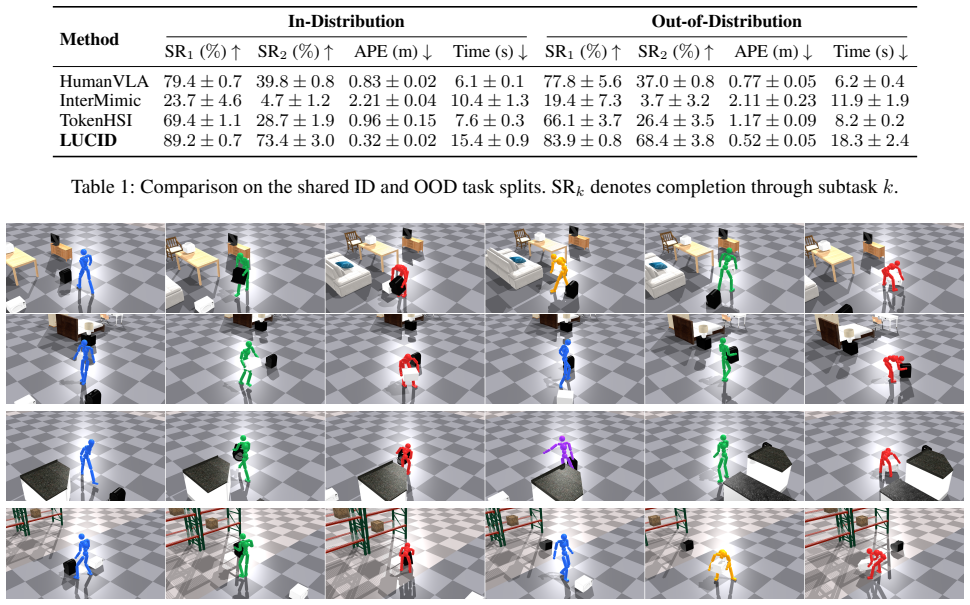
LUCID is a hierarchical model-based reinforcement learning framework in which planning over skills happens inside a learned model, not through a scripted coordinator. A structured latent-conditioned low-level policy is trained first, using adversarial imitation, and then frozen. A high-level policy selects latent skills, and a macro-dynamics world model predicts the state transitions those skills produce over extended time horizons; the high-level policy is optimized against imagined rollouts of that model. The paper reports that this arrangement outperforms prior baseline methods in simulations of multi-object rearrangement, measured by full-task success and partial-completion rates, and argues that learning the decision layer makes the system more flexible than finite-state machines or task-specific model-free policies.
Load-bearing premise
The learned world model must predict the long-horizon effects of each skill accurately enough that optimizing the high-level policy against its imagined rollouts transfers to the real environment.
Editorial extensions
If this is right
- If LUCID's central claim holds, hand-designed planners and finite-state machines are not required for coordinating pretrained skills in long task sequences.
- The same frozen skill library can be reused across tasks by retraining only the high-level policy and world model, since the low-level policy is not modified after its initial training.
- Training the high-level policy through imagined rollouts means interaction data for the decision layer can be generated without executing long action sequences, which reduces the cost of collecting experience.
- Improved partial-completion rates suggest that even when a full task fails, the agent still accomplishes meaningful subgoals, which matters for deployment where graceful degradation is preferable to total failure.
Reading between the lines
- A testable extension is to measure how much the macro-dynamics model's prediction error compounds with task horizon; the central claim predicts that error stays bounded enough for the high-level policy to remain effective.
- The framework could be transferred to real hardware if the imagined rollouts are supplemented with a small amount of real-world fine-tuning, because the frozen low-level skill policy may already provide stable whole-body behaviors.
- The same hierarchical decomposition might apply to other long-horizon problems where low-level skills are reusable and the main difficulty is choosing among them, such as navigation with primitive maneuvers or manipulation with tool-use primitives.
Signed reviews
Editorial analysis
A structured set of objections, weighed in public.
Referee Report
Summary. The manuscript, available to this review only as an arXiv abstract, introduces LUCID, a hierarchical model-based reinforcement learning framework for long-horizon humanoid loco-manipulation. LUCID first trains a latent-conditioned low-level policy via adversarial imitation, then freezes it while jointly learning a high-level policy and a macro-dynamics world model. The world model predicts temporally extended state transitions induced by latent skill decisions, enabling the high-level policy to be optimized through imagined rollouts. The authors claim that, across simulated multi-object rearrangement scenarios, LUCID improves full-task success and partial-completion rates over prior baseline methods.
Significance. If the reported results are supported by rigorous experiments, the paper would address a genuine limitation of current hierarchical approaches, which typically coordinate pretrained skills with scripted planners, finite-state machines, or task-specific model-free policies. Learning a macro-dynamics model over latent skills is a plausible and potentially reusable mechanism for long-horizon sequential tasks, and the idea of optimizing a high-level policy entirely through imagined temporally extended rollouts is an interesting contribution. However, because the abstract provides no numerical results, no experimental setup, and no validation of the world model, the significance is entirely conditional and cannot be assessed from the manuscript as presented.
major comments (3)
- [Abstract] The central claim of improved full-task success and partial-completion rates is reported without any supporting evidence: the abstract contains no numerical results, no comparison table, no task definitions, no error bars, and no ablations. As a standalone manuscript, the performance claim is not verifiable, and this is a load-bearing gap for the paper's contribution.
- [Abstract, macro-dynamics world model] The high-level policy is optimized through imagined rollouts of a learned macro-dynamics world model, but the abstract provides no evidence of this model's prediction fidelity, no horizon-dependent compounding-error analysis, and no comparison against ground-truth or oracle dynamics. Because the entire high-level planning mechanism depends on this model, an unvalidated or biased world model could invalidate the claimed task-success gains; this absence of validation is a critical omission.
- [Abstract, evaluation] The evaluation is described only as 'various simulated multi-object rearrangement scenarios.' There is no specification of the number of rearrangement steps, the length of the planning horizon, the number of skills used, the baseline methods, or the number of seeds. Without these details, the reader cannot judge whether the reported improvement is meaningful, statistically reliable, or generalizable.
minor comments (3)
- [Abstract, first sentence] The term 'macro-dynamics world model' is not defined in the abstract; a brief explanation of what is predicted (e.g., state transitions at the skill level) would improve accessibility.
- [Abstract, framework description] The phrase 'structured latent-conditioned low-level policy' is underspecified; the nature of the latent structure and how it is learned is not described, which limits reproducibility.
- [Abstract, baselines] The prior baseline methods are not named, making it impossible to assess whether the comparison is fair or representative of the state of the art.
Circularity Check
No circularity identifiable from the abstract; the framework's dependence on world-model accuracy is an empirical risk, not a definitional reduction.
full rationale
This is an abstract-only review, so no equations, derivations, or cited prior theorems are available to inspect. The central mechanism — a frozen low-level skill policy, a jointly learned high-level policy, and a macro-dynamics world model used for imagined rollouts — is a standard hierarchical model-based RL architecture. The high-level policy is optimized against predictions of temporally extended state transitions, but the reported success metrics are measured in the environment, not read off from the world model's own training objective. Training the world model and policy in the same simulator is not circular by construction; it is the normal MBRL setup, and any concern about prediction drift or optimistic planning is a correctness or generalization risk, not a circularity. No self-citations appear in the abstract, no fitted parameter is renamed as a prediction, and no known result is repackaged under new coordinates. Under the hard rule that circularity must be exhibited with a specific reduction, no such step can be identified from the available text. The honest finding is therefore no significant circularity, with score 0.
Assumptions & free parameters
assumptions (3)
- domain assumption The latent-conditioned low-level policy produced by adversarial imitation captures reusable skills that can be frozen and composed.
- domain assumption The macro-dynamics world model accurately predicts temporally extended state transitions induced by latent decisions.
- domain assumption Simulated multi-object rearrangement scenarios are informative proxies for real humanoid loco-manipulation.
Cite this review
Pith. "Pith review of LUCID: Latent-Skill Unified Control via Imagined Dynamics for Long-Horizon Humanoid Loco-Manipulation." pith.science (2026). https://pith.science/paper/OWTFDGLN
@misc{pith2026260807746,
  author       = {Pith},
  title        = {Pith review of: LUCID: Latent-Skill Unified Control via Imagined Dynamics for Long-Horizon Humanoid Loco-Manipulation},
  year         = {2026},
  howpublished = {\url{https://pith.science/paper/OWTFDGLN}},
  note         = {Machine review of arXiv:2608.07746}
}
read the original abstract
Long-horizon humanoid loco-manipulation requires composing versatile whole-body skills and reliable high-level decision making. Existing methods often coordinate pretrained skills with scripted planners, finite-state machines or task-specific model-free policies, restricting their ability to handle complex task sequences. To address this limitation, we propose \textbf{LUCID}, a hierarchical model-based reinforcement learning framework that plans over reusable skills through imagined rollouts of a learned dynamics model. LUCID first trains a structured latent-conditioned low-level policy via adversarial imitation and then freezes it while jointly learning a high-level policy and macro-dynamics world model. The world model predicts the temporally extended state transitions induced by latent decisions, enabling high-level policy optimization through imagined rollouts. We evaluate our framework across various simulated multi-object rearrangement scenarios. Experimental results show that LUCID improves the full-task success and partial-completion rates compared to prior baseline methods, demonstrating its effectiveness in complex sequential loco-manipulation tasks.
Figures


Figures from the paper (2 more)


Reference graph
Works this paper leans on
-
[1]
IEEE/ASME Transactions on Mechatronics , volume=
Humanoid locomotion and manipulation: Current progress and challenges in control, planning, and learning , author=. IEEE/ASME Transactions on Mechatronics , volume=. 2026 , publisher=
work page 2026
-
[2]
ACM Transactions On Graphics (TOG) , volume=
Ase: Large-scale reusable adversarial skill embeddings for physically simulated characters , author=. ACM Transactions On Graphics (TOG) , volume=. 2022 , publisher=
2022
-
[3]
Nature , volume=
Mastering diverse control tasks through world models , author=. Nature , volume=. 2025 , publisher=
2025
-
[4]
arXiv preprint arXiv:2010.02193 , year=
Mastering atari with discrete world models , author=. arXiv preprint arXiv:2010.02193 , year=
arXiv 2010
-
[5]
ACM Transactions on Graphics (ToG) , volume=
Amp: Adversarial motion priors for stylized physics-based character control , author=. ACM Transactions on Graphics (ToG) , volume=. 2021 , publisher=
2021
-
[6]
Advances in Neural Information Processing Systems , volume=
Humanvla: Towards vision-language directed object rearrangement by physical humanoid , author=. Advances in Neural Information Processing Systems , volume=
-
[7]
ACM Transactions on Graphics (TOG) , volume=
Object motion guided human motion synthesis , author=. ACM Transactions on Graphics (TOG) , volume=. 2023 , publisher=
2023
-
[8]
Proceedings of the IEEE/CVF International Conference on Computer Vision , pages=
Stochastic scene-aware motion prediction , author=. Proceedings of the IEEE/CVF International Conference on Computer Vision , pages=
Show all 43 references
-
[9]
arXiv preprint arXiv:2108.10470 , year=
Isaac gym: High performance gpu-based physics simulation for robot learning , author=. arXiv preprint arXiv:2108.10470 , year=
-
[10]
ACM SIGGRAPH 2023 Conference Proceedings , pages=
Synthesizing physical character-scene interactions , author=. ACM SIGGRAPH 2023 Conference Proceedings , pages=
2023
-
[11]
arXiv preprint arXiv:1707.06347 , year=
Proximal policy optimization algorithms , author=. arXiv preprint arXiv:1707.06347 , year=
-
[12]
ACM SIGGRAPH 2023 conference proceedings , pages=
Calm: Conditional adversarial latent models for directable virtual characters , author=. ACM SIGGRAPH 2023 conference proceedings , pages=
2023
-
[13]
arXiv preprint arXiv:2506.09366 , year=
Skillblender: Towards versatile humanoid whole-body loco-manipulation via skill blending , author=. arXiv preprint arXiv:2506.09366 , year=
-
[14]
2024 International Conference on 3D Vision (3DV) , pages=
Synthesizing physically plausible human motions in 3d scenes , author=. 2024 International Conference on 3D Vision (3DV) , pages=. 2024 , organization=
2024
-
[15]
International Conference on Learning Representations , volume=
Unified human-scene interaction via prompted chain-of-contacts , author=. International Conference on Learning Representations , volume=
-
[16]
ACM Transactions on Graphics , volume=
Neural state machine for character-scene interactions , author=. ACM Transactions on Graphics , volume=. 2019 , publisher=
2019
-
[17]
Proceedings of the Computer Vision and Pattern Recognition Conference , pages=
Tokenhsi: Unified synthesis of physical human-scene interactions through task tokenization , author=. Proceedings of the Computer Vision and Pattern Recognition Conference , pages=
-
[18]
Proceedings of the Computer Vision and Pattern Recognition Conference , pages=
Intermimic: Towards universal whole-body control for physics-based human-object interactions , author=. Proceedings of the Computer Vision and Pattern Recognition Conference , pages=
-
[19]
arXiv preprint arXiv:2510.11072 , year=
Physhsi: Towards a real-world generalizable and natural humanoid-scene interaction system , author=. arXiv preprint arXiv:2510.11072 , year=
-
[20]
Proceedings of the IEEE/CVF Conference on Computer Vision and Pattern Recognition , pages=
Skillmimic: Learning basketball interaction skills from demonstrations , author=. Proceedings of the IEEE/CVF Conference on Computer Vision and Pattern Recognition , pages=
-
[21]
arXiv preprint arXiv:1803.10122 , volume=
World models , author=. arXiv preprint arXiv:1803.10122 , volume=
-
[22]
arXiv preprint arXiv:2509.16757 , year=
Hdmi: Learning interactive humanoid whole-body control from human videos , author=. arXiv preprint arXiv:2509.16757 , year=
-
[23]
Artificial intelligence , volume=
Between MDPs and semi-MDPs: A framework for temporal abstraction in reinforcement learning , author=. Artificial intelligence , volume=. 1999 , publisher=
1999
-
[24]
ACM Transactions on Graphics (TOG) , volume=
Neural categorical priors for physics-based character control , author=. ACM Transactions on Graphics (TOG) , volume=. 2023 , publisher=
2023
-
[25]
arXiv preprint arXiv:1912.01603 , year=
Dream to control: Learning behaviors by latent imagination , author=. arXiv preprint arXiv:1912.01603 , year=
1912 arXiv
-
[26]
International Conference on Learning Representations , volume=
Td-mpc2: Scalable, robust world models for continuous control , author=. International Conference on Learning Representations , volume=
-
[27]
arXiv preprint arXiv:2203.04955 , year=
Temporal difference learning for model predictive control , author=. arXiv preprint arXiv:2203.04955 , year=
-
[28]
Conference on robot learning , pages=
Daydreamer: World models for physical robot learning , author=. Conference on robot learning , pages=. 2023 , organization=
2023
-
[29]
arXiv preprint arXiv:2501.10100 , year=
Robotic world model: A neural network simulator for robust policy optimization in robotics , author=. arXiv preprint arXiv:2501.10100 , year=
-
[30]
arXiv preprint arXiv:2602.11758 , year=
Haic: Humanoid agile object interaction control via dynamics-aware world model , author=. arXiv preprint arXiv:2602.11758 , year=
-
[31]
Proceedings of the AAAI conference on artificial intelligence , volume=
The option-critic architecture , author=. Proceedings of the AAAI conference on artificial intelligence , volume=
-
[32]
arXiv preprint arXiv:1610.05182 , year=
Learning and transfer of modulated locomotor controllers , author=. arXiv preprint arXiv:1610.05182 , year=
-
[33]
Proceedings of the 28th annual conference on Computer graphics and interactive techniques , pages=
Composable controllers for physics-based character animation , author=. Proceedings of the 28th annual conference on Computer graphics and interactive techniques , pages=
-
[34]
Advances in neural information processing systems , volume=
Mcp: Learning composable hierarchical control with multiplicative compositional policies , author=. Advances in neural information processing systems , volume=
-
[35]
arXiv preprint arXiv:1811.11711 , year=
Neural probabilistic motor primitives for humanoid control , author=. arXiv preprint arXiv:1811.11711 , year=
-
[36]
International Conference on Machine Learning , pages=
CoMic: Complementary task learning & mimicry for reusable skills , author=. International Conference on Machine Learning , pages=. 2020 , organization=
2020
-
[37]
2022 IEEE/RSJ International Conference on Intelligent Robots and Systems (IROS) , pages=
Hierarchical reinforcement learning for precise soccer shooting skills using a quadrupedal robot , author=. 2022 IEEE/RSJ International Conference on Intelligent Robots and Systems (IROS) , pages=. 2022 , organization=
2022
-
[38]
IEEE Robotics and Automation Letters , volume=
Cascaded compositional residual learning for complex interactive behaviors , author=. IEEE Robotics and Automation Letters , volume=. 2023 , publisher=
2023
-
[39]
International Conference on Learning Representations , volume=
Hierarchical world models as visual whole-body humanoid controllers , author=. International Conference on Learning Representations , volume=
-
[40]
ACM Transactions On Graphics (TOG) , volume=
Deepmimic: Example-guided deep reinforcement learning of physics-based character skills , author=. ACM Transactions On Graphics (TOG) , volume=. 2018 , publisher=
2018
-
[41]
ACM Transactions On Graphics (TOG) , volume=
Maskedmimic: Unified physics-based character control through masked motion inpainting , author=. ACM Transactions On Graphics (TOG) , volume=. 2024 , publisher=
2024
-
[42]
arXiv preprint arXiv:2312.04393 , year=
Physhoi: Physics-based imitation of dynamic human-object interaction , author=. arXiv preprint arXiv:2312.04393 , year=
-
[43]
Advances in Neural Information Processing Systems , volume=
Omnigrasp: Grasping diverse objects with simulated humanoids , author=. Advances in Neural Information Processing Systems , volume=
Reviewed August 11, 2026 · model on record in the stance chip above.
Discussion (0). Continue with ORCID to comment.