REVIEW 4 major objections 5 minor 51 references
InstructionCrafter: Generating Consistent and High-Fidelity Visual Instructions
T0 review · 4 major / 5 minor · reviewed 2026-08-14 · deepseek-v4-flash
Pith's one-line read Freezing spatial layers of a video diffusion model yields sharper, consistent step-by-step picture guides from text alone.
desk verdict Practical, well-ablated method for visual instruction generation, but the 'best overall' claim rides on a post hoc metric weighting and does not survive alpha=1. read the letter →
The pith
A machine-rendered reading of the paper's core claim, the machinery that carries it, and where it could break.
The reading
What carries the argument
The load-bearing mechanisms are spatial-freeze training plus two instruction-aware adapters. Spatial-freeze training keeps the frozen spatial convolutions and spatial self-attention layers that control local texture and high-frequency detail, so the pretrained image-quality prior stays intact while temporal and cross-attention layers adapt to procedural semantics. The Consistent Adapter is a stack of four transformer layers with global attention over all step tokens and adjacent attention over neighboring steps, capturing both task-level dependencies and local transitions. The Context-Aware Temporal Adapter forms a Gram matrix $G_s = C_s C_s^\top$ from a spatial slice of cross-attention outputs and adds a per-head learnable bias $B_s = \beta G_s$ to temporal self-attention, so frames with similar step semantics attend to each other; both adapters are zero-initialized to behave as identity at the start of training.
What would settle it
Re-run the full evaluation with SC-F computed at $\alpha=1$ or with a pre-registered user study that weights step faithfulness and cross-image consistency equally; the paper's supplementary Table 1 shows that under $\alpha=1$ Stable Diffusion, not InstructionCrafter, achieves the best SC-F on ShowHowTo.
Extended reading notes
Core claim
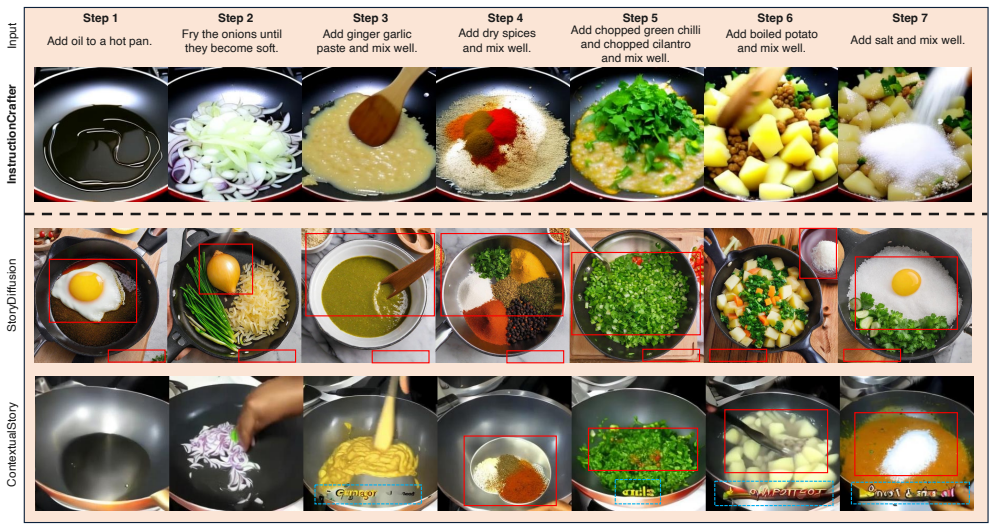
The central discovery is that separating the optimization of temporal and instructional alignment from per-frame visual quality lets a single model achieve state-of-the-art overall performance on both ShowHowTo and WikiHow-VGSI. Building on VideoCrafter2, the authors freeze all spatial convolutional blocks and spatial self-attention layers, finetune temporal attention and cross-attention on per-step texts, and add the Consistent Adapter and Context-Aware Temporal Adapter. The Consistent Adapter aggregates textual cues from the whole instruction sequence and from neighboring steps so object identity and attributes persist across frames, while the Context-Aware Temporal Adapter converts cross-attention outputs into a step-conditioned bias for temporal self-attention, propagating inter-step relations. This combination reduces trainable parameters from 1.4B to 0.7B while improving VIEScore perceptual quality from 0.662 to 0.742 and achieving the best SC-F, Semantic, and overall balance of scores on both benchmarks.
Load-bearing premise
The state-of-the-art claim depends on the chosen SC-F weighting, where a neutral choice ($\alpha=1$) changes the ShowHowTo ranking and would put Stable Diffusion ahead.
Editorial extensions
If this is right
- Text-only visual instruction generation without any reference image can outperform pipelines that tile frames, generate autoregressively, or finetune the full backbone.
- Freezing spatial layers reduces trainable parameters by about half and suppresses artifacts such as noise, blur, watermarks, and spurious subtitles learned from low-quality web video.
- The two adapters work best together: ablations show that either adapter alone underperforms the full combination on both semantic and perceptual scores.
- Diffusion Transformer backbones with 3D VAE temporal compression are less suited to per-step text conditioning, since their compressed latents make step-specific semantics harder to preserve.
- The approach generalizes across diverse procedural domains including cooking, DIY, electronics repair, and crafts, as shown on the WikiHow-VGSI zero-shot evaluation.
Reading between the lines
- The SC-F meta-metric's weighting is a free parameter, and the paper's own supplementary results show that with $\alpha=1$, Stable Diffusion leads SC-F on ShowHowTo; a different principled weighting could therefore change the headline ranking.
- The Gram-matrix bias mechanism is generic enough to be reused in other multi-condition sequence generation tasks such as storyboards, comic panels, or medical procedure illustrations, where per-frame text conditions vary while visual identity must persist.
- A user study that weights step faithfulness more heavily than cross-image consistency might shift preferences toward zero-shot methods, whose main weakness in the current protocol is low consistency rather than low visual quality.
- The spatial-freeze recipe could be tested as a general recipe for adapting video diffusion models to any task with per-frame text conditioning, not just visual instructions, whenever the training data is visually noisier than the pretraining data.
Editorial analysis
A structured set of objections, weighed in public.
Referee Report
Summary. The paper proposes InstructionCrafter, a diffusion-based framework for generating step-by-step visual instructions from textual procedure descriptions. The key ideas are (i) spatial-freeze training, which freezes spatial layers of a pretrained video diffusion backbone (VideoCrafter2) while finetuning temporal, cross-attention, and text-conditioning pathways, and (ii) two lightweight adapters: a Consistent Adapter that aggregates global and adjacent step-text context, and a Context-Aware Temporal Adapter that injects step-conditioned biases into temporal self-attention. The method is evaluated on ShowHowTo and WikiHow-VGSI using CLIP-based Step Faithfulness (SF), DINOv3-based Cross-Image Consistency (CIC), a weighted SF-CIC F-score (SC-F), and VLM-based VIEScore semantic/perceptual components. The paper claims state-of-the-art overall performance on both datasets and includes ablations on training strategy, adapter design, and cross-attention finetuning, plus a small user study.
Significance. If the claimed results hold, the paper offers a practical text-only pipeline for generating coherent, faithful, and artifact-free visual instructions, and the spatial-freeze idea is a plausible way to preserve pretrained per-frame quality while adapting temporal and text pathways. The ablations are informative and the adapters are lightweight and zero-initialized. However, the central state-of-the-art claim is not robustly supported: the SC-F metric weighting (alpha=2) is selected after observing the empirical score ranges, and with alpha=1 the paper's own supplementary results show Stable Diffusion ahead on ShowHowTo. In addition, the method does not dominate on the component faithfulness metrics on ShowHowTo, and the most directly competing prior method (Souček et al./ShowHowTo) is not included in the quantitative comparison. These issues collectively mean the paper's headline contribution needs revision rather than acceptance as-is.
major comments (4)
- [Section 4.1, SC-F definition, and Supplementary Table 1 (B.2)] The SC-F composite metric uses alpha=2, justified as balancing the empirical ranges of SF and CIC observed in the authors' own experiments. Supplementary Table 1 shows that with alpha=1, Stable Diffusion achieves the best SC-F on ShowHowTo (0.468 vs. 0.435 for InstructionCrafter). Since the headline claim in Section 4.2 that InstructionCrafter 'achieves the best overall performance on both datasets' rests on this weighting, the ranking is not robust to the metric's free parameter. The authors should either justify alpha independently of the observed results, report the full alpha-sweep prominently as the primary result, or temper the claim to a weighted-aggregate statement.
- [Section 4.2, Table 1] Even under the chosen alpha=2, the claimed 'best overall' is not a domination: on ShowHowTo, the Baseline has higher SF (0.464 vs. 0.455) and higher Semantic score (0.555 vs. 0.537), while InstructionCrafter wins only on CIC and Perceptual. The SC-F gap over the Baseline is also small (0.460 vs. 0.455). The manuscript should explicitly state this trade-off structure and avoid implying that the method is uniformly best on faithfulness, consistency, and quality; the strengths are consistency and perceptual quality at a small cost in step-faithfulness on ShowHowTo.
- [Section 4.1, Compared Methods, and Section 4.2] The paper lists Souček et al. [40] (ShowHowTo) as a compared method category but does not include it in Table 1; instead, it introduces a self-defined Baseline (fully finetuned VideoCrafter2 with per-frame text conditioning). Since Souček et al. use an image-to-video model with first-frame reference, the absence of this directly competing prior method or a faithful adaptation of it leaves the claim of outperforming the actual state-of-the-art visual-instruction method unsubstantiated. At minimum, the authors should either incorporate the original ShowHowTo method (with its reference-image setting) or clearly argue why the setting difference makes it non-comparable, and avoid saying the method outperforms [40] on the basis of Table 1.
- [Section 4.5, Table 7] The user study involves only 15 participants, reports no confidence intervals or significance tests, and the average preference over the Baseline is 53%. This is too weak to independently validate the alpha=2 weighting or the claim of overall superiority in human preference. The authors should add statistical testing (e.g., binomial tests or confidence intervals per baseline) or present the study as a pilot with corresponding caveats.
minor comments (5)
- [Section 3.2, Section 1, Table 4] The trainable parameter counts are inconsistent: Section 3.2 says '1.4B vs 0.7B', the Introduction says 'from 1.4B to 0.6B', and Table 4 lists 0.6B for Spatial-Freeze and 0.7B for the full model. The authors should unify these numbers and clarify whether 0.6B refers to a specific ablation or a typo.
- [Section 4.3, Open-Sora comparison] The modifications from Open-Sora to Open-Sora++ are described only as 'several efforts' and 'adjusting several hyperparameters'; for reproducibility, the authors should list the exact architectural changes and hyperparameter settings.
- [Supplementary Section B.2] The statement that improvements 'may seem marginal' in the supplementary is rather important and should be reflected in the main text's discussion of effect sizes and practical significance, rather than only appearing in the appendix.
- [Table 1 caption] The caption mentions red/blue marking for best/second-best values, which is conventional, but the actual table formatting in the PDF must be checked so that the colors are distinguishable in grayscale printing; adding bold or symbols would improve clarity.
- [Section 4.1, CIC metric] The CIC metric uses DINOv3 features but the reference [36] is cited as 'Siméoni et al.' with a different spelling in the reference list; please ensure the spelling and citation are consistent.
Circularity Check
The 'best overall performance' claim is partly forced by the post hoc choice of the SC-F metric weight alpha=2; under alpha=1, Stable Diffusion wins on ShowHowTo.
-
fitted input called prediction
[Section 4.1 (Evaluation Metrics, SC-F definition), Section 4.2 (Quantitative Results), Supplementary B.2 (Full Quantitative Results, Table 1)]
"where we set α=2 to place greater weight on consistency to balance the empirical ranges of SF (typically 0.20-0.60) and CIC (typically 0.40-0.55) observed in our experiments. ... Stable Diffusion achieves the best SC-F with α=1 where vanilla F-score is applied, but this is counterintuitive since it has the lowest CIC. In contrast, SC-F with larger α values better reflects the overall performance, where our method outperforms others. Therefore, the selected α=2 is reasonable."
The headline claim 'InstructionCrafter achieves the best overall performance on both datasets' (Section 4.2) is evaluated with the SC-F metric whose free parameter alpha is set to 2 after observing the empirical SF/CIC ranges and after observing that alpha=1 gives a different winner. Supplementary Table 1 shows Stable Diffusion beats InstructionCrafter on ShowHowTo under alpha=1 (0.468 vs 0.435), while alpha=2 reverses the ranking (0.460 vs 0.426). On ShowHowTo, InstructionCrafter also trails the Baseline on the VLM Semantic component (0.537 vs 0.555), so its 'overall' advantage comes from the CIC component amplified by the chosen alpha.
full rationale
The paper's core technical derivation — spatial-freeze training plus the Consistent Adapter and Context-Aware Temporal Adapter — is self-contained and is not circular: the adapters are defined operationally, the frozen-spatial-layer strategy is an architectural choice tested by ablations, and the component metrics (CLIP-based SF, DINOv3-based CIC, VLM-based VIEScore) are externally defined and do not embed the method's output. There is no load-bearing self-citation chain and no renamed known result. The circularity is localized to the headline 'overall SOTA' claim: SC-F with alpha=2 is chosen in Section 4.1 using the authors' own observed score ranges, and the supplementary explicitly concedes that alpha=1 gives the best SC-F to Stable Diffusion on ShowHowTo. Because the paper's own evidence shows the ranking flips with the metric's free parameter, the central 'best overall on both datasets' statement reduces in part to that post hoc weighting choice rather than to a parameter-free property of the model. This warrants a moderate circularity score of 6.
Assumptions & free parameters
free parameters (1)
- SC-F alpha weighting =
2 (selected from observed SF 0.20-0.60 and CIC 0.40-0.55 ranges)
assumptions (5)
- domain assumption Freezing spatial layers preserves the pretrained per-frame quality prior and prevents absorption of dataset-specific artifacts.
- domain assumption DINOv3 feature distances quantify cross-image consistency and the VIEScore protocol with Qwen3-VL quantifies semantic and perceptual quality.
- domain assumption Artifacts in fully finetuned models originate from the low quality of automatically extracted ShowHowTo training data.
- domain assumption VideoCrafter2 is a suitable backbone because its lack of temporal compression preserves per-frame latent representations for step-wise conditioning.
- standard math Standard diffusion denoising objective and classifier-free guidance remain valid for this task.
Cite this review
Pith. "Pith review of InstructionCrafter: Generating Consistent and High-Fidelity Visual Instructions." pith.science (2026). https://pith.science/paper/ZHXZUHZL
@misc{pith2026260808460,
  author       = {Pith},
  title        = {Pith review of: InstructionCrafter: Generating Consistent and High-Fidelity Visual Instructions},
  year         = {2026},
  howpublished = {\url{https://pith.science/paper/ZHXZUHZL}},
  note         = {Machine review of arXiv:2608.08460}
}
read the original abstract
Given textual task instructions, generating step-by-step visual instructions as an image sequence requires the simultaneous satisfaction of multiple properties, specifically step faithfulness, cross-image consistency, and per-frame visual quality. Existing text-to-image generation approaches rarely meet all three properties, owing to independent sampling that breaks consistency, finetuning on low-quality video that degrades per-frame quality, and frozen backbones that lack multi-step understanding. In this work, we propose InstructionCrafter, a diffusion-based framework with the key idea of separating the optimization of temporal and instructional alignment from per-frame visual quality via (1) spatial-freeze training and (2) instruction-aware adapters. Built on a pretrained video diffusion backbone, InstructionCrafter freezes the spatial layers that control per-frame detail and updates only temporal and text-conditioning pathways to learn instruction semantics and inter-step relations, which preserves the generative prior for per-frame quality and reduces trainable parameters by about 50 percent compared with full finetuning. We also introduce two lightweight adapters that enhance the model's understanding of instructional context. The Consistent Adapter aggregates textual cues from the entire instruction sequence and from neighboring steps to keep object identity and attributes consistent across frames, and the Context-Aware Temporal Adapter converts cross-attention outputs into biases for temporal self-attention, explicitly propagating inter-frame relations. Extensive experiments on two benchmark datasets demonstrate state-of-the-art overall performance on step faithfulness, cross-image consistency, and per-frame visual quality while significantly reducing noise, blur, and spurious subtitles. Our code and trained models will be publicly available.
Figures


Figures from the paper (30 more)




Reference graph
Works this paper leans on
-
[40]
T. Wan, A. Wang, B. Ai, B. Wen, C. Mao, C.-W. Xie, D. Chen, F. Yu, H. Zhao, J. Yang, et al. Wan: Open and ad- vanced large-scale video generative models.arXiv preprint arXiv:2503.20314, 2025. 1
arXiv 2025
-
[1]
S. Bai, Y . Cai, R. Chen, K. Chen, X. Chen, Z. Cheng, L. Deng, W. Ding, C. Gao, C. Ge, et al. Qwen3-vl technical report.arXiv preprint arXiv:2511.21631, 2025. 2
arXiv 2025
-
[2]
J. Bi, P. Liu, A. V osoughi, J. Wu, J. He, and C. Xu. Generat- ing instructional illustrations via text-conditioned diffusion. arXiv preprint arXiv:2505.16425, 2025. 2
work page Pith review arXiv 2025
-
[3]
A. Blattmann, R. Rombach, H. Ling, T. Dockhorn, S. W. Kim, S. Fidler, and K. Kreis. Align your latents: High- resolution video synthesis with latent diffusion models. In CVPR, pages 22563–22575, 2023. 1
work page 2023
-
[4]
J. Bordalo, V . Ramos, R. Val´erio, D. Gl´oria-Silva, Y . Bitton, M. Yarom, I. Szpektor, and J. Magalhaes. Generating coher- ent sequences of visual illustrations for real-world manual tasks. InACL, pages 12777–12797, 2024. 1, 3, 4
work page 2024
-
[5]
H. Chen, Y . Zhang, X. Cun, M. Xia, X. Wang, C. Weng, and Y . Shan. Videocrafter2: Overcoming data limitations for high-quality video diffusion models. InCVPR, pages 7310– 7320, 2024. 4
work page 2024
-
[6]
Dosovitskiy, L
A. Dosovitskiy, L. Beyer, A. Kolesnikov, D. Weissenborn, X. Zhai, T. Unterthiner, M. Dehghani, M. Minderer, G. Heigold, S. Gelly, J. Uszkoreit, and N. Houlsby. An image is worth 16x16 words: Transformers for image recognition at scale. InICLR, 2021. 1
2021
- [7]
Show all 51 references
-
[8]
Z. Feng, Y . Ren, X. Yu, X. Feng, D. Tang, S. Shi, and B. Qin. Improved visual story generation with adaptive context mod- eling. InACL, pages 4939–4955, 2023. 1
2023
-
[9]
G. Gaur, M. Zolfaghari, and T. Brox. Storysync: Training- free subject consistency in text-to-image generation via re- gion harmonization.arXiv preprint arXiv:2508.03735, 2025. 1
2025 arXiv
-
[10]
Y . Guo, C. Yang, A. Rao, Z. Liang, Y . Wang, Y . Qiao, M. Agrawala, D. Lin, and B. Dai. Animatediff: Animate your personalized text-to-image diffusion models without specific tuning.ICLR, 2024. 5, 10
2024
-
[11]
J. Ho, A. Jain, and P. Abbeel. Denoising diffusion proba- bilistic models. InNeurIPS, 2020. 1
2020
-
[12]
Ho and T
J. Ho and T. Salimans. Classifier-free diffusion guidance. arXiv preprint arXiv:2207.12598, 2022. 1
2022 arXiv
-
[13]
E. J. Hu, Y . Shen, P. Wallis, Z. Allen-Zhu, Y . Li, S. Wang, L. Wang, W. Chen, et al. Lora: Low-rank adaptation of large language models.ICLR, 2022. 2
2022
-
[14]
D. P. Kingma and M. Welling. Auto-encoding variational bayes.arXiv preprint arXiv:1312.6114, 2013. 1
2013 arXiv
-
[15]
Krojer, D
B. Krojer, D. Vattikonda, L. Lara, V . Jampani, E. Porte- lance, C. Pal, and S. Reddy. Learning action and reasoning- centric image editing from videos and simulation.NeurIPS, 37:38035–38078, 2024. 1
2024
-
[16]
M. Ku, D. Jiang, C. Wei, X. Yue, and W. Chen. VIEScore: Towards explainable metrics for conditional image synthesis evaluation. InACL, 2024. 2
2024
-
[17]
B. F. Labs, S. Batifol, A. Blattmann, F. Boesel, S. Consul, C. Diagne, T. Dockhorn, J. English, Z. English, P. Esser, et al. Flux. 1 kontext: Flow matching for in-context im- age generation and editing in latent space.arXiv preprint arXiv:2506.15742, 2025. 1
2025 arXiv
-
[18]
M. Li, M. Ning, and M.-F. Moens. Consistent story gen- eration with asymmetry zigzag sampling.arXiv preprint arXiv:2506.09612, 2025. 1
2025
-
[19]
C. Liu, H. Wu, Y . Zhong, X. Zhang, Y . Wang, and W. Xie. Intelligent grimm-open-ended visual storytelling via latent diffusion models. InCVPR, pages 6190–6200, 2024. 1
2024
-
[20]
Y . Ma, W. Xu, C. Zhao, K. Sun, Q. Jin, X. Yang, Z. Zhao, C. Fan, and Z. Hu. Storynizor: Consistent story generation via inter-frame synchronized and shuffled id injection. In AAAI, volume 39, pages 6027–6035, 2025. 1
2025
-
[21]
Menon, I
S. Menon, I. Misra, and R. Girdhar. Generating illustrated instructions. InCVPR, pages 6274–6284, 2024. 1, 3, 4
2024
-
[22]
Miech, D
A. Miech, D. Zhukov, J.-B. Alayrac, M. Tapaswi, I. Laptev, and J. Sivic. Howto100m: Learning a text-video embedding by watching hundred million narrated video clips. InICCV, pages 2630–2640, 2019. 2
2019
-
[23]
X. Pan, P. Qin, Y . Li, H. Xue, and W. Chen. Synthesizing coherent story with auto-regressive latent diffusion models. InWACV, pages 2920–2930, 2024. 1
2024
-
[24]
Peebles and S
W. Peebles and S. Xie. Scalable diffusion models with trans- formers. InICCV, pages 4195–4205, 2023. 1
2023
-
[25]
Phung, S
Q. Phung, S. Ge, and J.-B. Huang. Coherent zero-shot visual instruction generation.arXiv preprint arXiv:2406.04337,
-
[26]
Podell, Z
D. Podell, Z. English, K. Lacey, A. Blattmann, T. Dockhorn, J. M¨uller, J. Penna, and R. Rombach. Sdxl: Improving latent diffusion models for high-resolution image synthesis.arXiv preprint arXiv:2307.01952, 2023. 1, 4
2023 arXiv
-
[27]
Y . Pu, Z. Huang, V . Boddeti, and Y . Kong. Show me: Unify- ing instructional image and video generation with diffusion models. InProceedings of the IEEE/CVF Winter Confer- ence on Applications of Computer Vision, pages 3285–3296,
-
[28]
Rombach, A
R. Rombach, A. Blattmann, D. Lorenz, P. Esser, and B. Om- mer. High-resolution image synthesis with latent diffusion models.CVPR, pages 10684–10695, 2022. 1, 3
2022
-
[29]
Shen and M
X. Shen and M. Elhoseiny. Storygpt-v: Large language mod- els as consistent story visualizers. InCVPR, pages 13273– 13283, 2025. 1
2025
-
[30]
M. Shi, X. Zeng, J. Huang, Y . Cui, F. Ferroni, J. Li, S. Pa- chori, Z. Li, Y . Balaji, H. Wang, et al. Duogen: Towards general purpose interleaved multimodal generation.arXiv preprint arXiv:2602.00508, 2026. 2
2026
-
[31]
Sohl-Dickstein, E
J. Sohl-Dickstein, E. Weiss, N. Maheswaranathan, and S. Ganguli. Deep unsupervised learning using nonequilib- rium thermodynamics. InICML, pages 2256–2265. pmlr,
-
[32]
T. Song, J. Cao, K. Wang, B. Liu, and X. Zhang. Causal- story: Local causal attention utilizing parameter-efficient tuning for visual story synthesis. InICASSP, pages 3350– 3354, 2024. 1
2024
-
[33]
Y . Song, C. Liu, and M. Z. Shou. Makeanything: Harness- ing diffusion transformers for multi-domain procedural se- quence generation.arXiv preprint arXiv:2502.01572, 2025. 2
2025 arXiv
-
[34]
Y . Song, J. Sohl-Dickstein, D. P. Kingma, A. Kumar, S. Er- mon, and B. Poole. Score-based generative modeling through stochastic differential equations. InICLR, 2021. 1
2021
-
[35]
Sou ˇcek, D
T. Sou ˇcek, D. Damen, M. Wray, I. Laptev, and J. Sivic. Gen- 31 howto: Learning to generate actions and state transforma- tions from instructional videos. InCVPR, pages 6561–6571,
-
[36]
Sou ˇcek, P
T. Sou ˇcek, P. Gatti, M. Wray, I. Laptev, D. Damen, and J. Sivic. Showhowto: Generating scene-conditioned step- by-step visual instructions. InCVPR, pages 27435–27445,
-
[37]
Y . Suo, F. Ma, K. Shen, L. Zhu, and Y . Yang. Long-horizon visual instruction generation with logic and attribute self- reflection. InICLR, 2025. 2
2025
-
[38]
Tao, B.-K
M. Tao, B.-K. Bao, H. Tang, Y . Wang, and C. Xu. Sto- ryimager: A unified and efficient framework for coherent story visualization and completion. InECCV, pages 479–
-
[39]
Tewel, O
Y . Tewel, O. Kaduri, R. Gal, Y . Kasten, L. Wolf, G. Chechik, and Y . Atzmon. Training-free consistent text-to-image gen- eration.TOG, 43(4):1–18, 2024. 1
2024
-
[41]
M. Wang, H. Ding, J. Peng, Y . Zhao, Y . Chen, and Y . Wei. Characonsist: Fine-grained consistent character generation. InICCV, 2025. 1
2025
-
[42]
Y . Wang, B. Zhu, Y . Hao, C.-W. Ngo, Y . Tan, and X. Wang. Cookingdiffusion: Cooking procedural image generation with stable diffusion.ACM Trans. Multimed. Comput. Com- mun. Appl., 2025. 2
2025
-
[43]
M. Xu, M. Tao, and B.-K. Bao. Chain-of-cooking: Cook- ing process visualization via bidirectional chain-of-thought guidance. InACM Multimedia, pages 9287–9295, 2025. 2
2025
-
[44]
A. Yang, A. Li, B. Yang, B. Zhang, B. Hui, B. Zheng, B. Yu, C. Gao, C. Huang, C. Lv, C. Zheng, D. Liu, F. Zhou, F. Huang, F. Hu, H. Ge, H. Wei, H. Lin, J. Tang, J. Yang, J. Tu, J. Zhang, J. Yang, J. Yang, J. Zhou, J. Zhou, J. Lin, K. Dang, K. Bao, K. Yang, L. Yu, L. Deng, M. L...
2025 arXiv
-
[45]
Y . Yang, A. Panagopoulou, Q. Lyu, L. Zhang, M. Yatskar, and C. Callison-Burch. Visual goal-step inference using wik- ihow.arXiv preprint arXiv:2104.05845, 2021. 3, 5, 28
2021 arXiv
-
[46]
Z. Yang, J. Teng, W. Zheng, M. Ding, S. Huang, J. Xu, Y . Yang, W. Hong, X. Zhang, G. Feng, et al. Cogvideox: Text-to-video diffusion models with an expert transformer. arXiv preprint arXiv:2408.06072, 2024. 1
2024 arXiv
-
[47]
Zhang, B
R. Zhang, B. Wen, H. Xie, Y . Yao, S. Zuo, J.-Y . Jiang-Lin, H.-H. Shuai, and W.-H. Cheng. Cookanything: A framework for flexible and consistent multi-step recipe image genera- tion. InACM Multimedia, 2025. 2
2025
-
[48]
Zheng and Y
S. Zheng and Y . Fu. Contextualstory: Consistent visual sto- rytelling with spatially-enhanced and storyline context. In AAAI, pages 10617–10625, 2025. 4, 8
2025
-
[49]
Zheng, X
Z. Zheng, X. Peng, T. Yang, C. Shen, S. Li, H. Liu, Y . Zhou, T. Li, and Y . You. Open-sora: Democratizing efficient video production for all.arXiv preprint arXiv:2412.20404, 2024. 1, 5, 9
2024 arXiv
-
[50]
Y . Zhou, D. Zhou, M.-M. Cheng, J. Feng, and Q. Hou. Sto- rydiffusion: Consistent self-attention for long-range image and video generation.NeurIPS, 2024. 1, 4, 8
2024
-
[51]
Z. Zhou, J. Li, H. Li, N. Chen, and X. Tang. Storymaker: Towards holistic consistent characters in text-to-image gen- eration.arXiv preprint arXiv:2409.12576, 2024. 1 32
2024 arXiv
Reviewed August 14, 2026 · model on record in the stance chip above.
Discussion (0). Continue with ORCID to comment.